Comet in Our Sky?
-
Has anyone read this book and can tell what's
there?
If not goto:
http://www.sgwiki.com/wiki/Lim_Chin_Siong
and find someone really could have beaten LKY in any fair election here!
It is really a book to be found only at selected anti-garmen stores, would anyone know to find it ?
goto see it here
http://www.sgwiki.com/wiki/Comet_in_our_Sky
This is the only single most un-usual POST without responses but many looks to see, is it funny or stupid?
-
Originally posted by norey:
I'm sad to read all this, if it is true ? my emotions is like Our Nation Natural and Caring Father can't claim us back for our well being, but the cruel Step-Father keep using the fear factors to force us to listens to his commands...........
Has anyone read this book and can tell what's
there?
If not goto:
http://www.sgwiki.com/wiki/Lim_Chin_Siong
and find [b]someone really could have beaten LKY in any fair election here!
It is really a book to be found only at selected anti-garmen stores, would anyone know to find it ?
goto see it here
http://www.sgwiki.com/wiki/Comet_in_our_Sky
This is the only single most un-usual POST without responses but many looks to see, is it funny or stupid? [/b]
But then nobody can do anything to help stopping his abuse on us, let's hope our caring father can think of away to save us from this bad step-father torturing. -
From the referenced back cover of the book, there seems to be a price sticker showing the name "Popular" - which means it could be from Popular Bookstore ?
Now was that in Ringgit or Dollar ?
To be able to zoom in for a larger size easy reading format, return to the referenced site given by 'norey' :
http://www.sgwiki.com/wiki/Comet_in_our_Sky -
History is for those are interested to know where we come from and where we are heading, and we must understand the past as recorded in history, so as to prepare our minds for the future.
The following is an interesting follow-up read on Lim Chin Siong - whose character seem to be assassinated in the style that is now all too familiar.
"History and Founding of PAP"
Thursday, January 26, 2006
Part 1: History and Founding of PAP
No “Singapore Politics” will be complete without the historical perspectives of PAP and Singapore’s Independence. In the first part, I hope to bring some history that is outside of our textbooks (or propaganda, depends on how you see it), and shed light on why PAP is the PAP we know today. Younger Singaporeans, like me, may not know of the insights on the founding of PAP and the true leaders (aside from the much-publicized Lee Kuan Yew) that made us from a British outpost to a country. But hopefully, in understand our past; we can derive thoughts to prepare us for the future. This first part will provide some interesting look (hopefully) into the history of PAP from 1955 to 1965. This will also serve as a starter to 6 leaders of Singapore, Dr Toh Chin Chye, Dr Goh Keng Swee, Lim Chin Siong, Devan Nair, S Rajaratnam and Lim Kim San.
The Malayan Forum
The PAP’s origins can be traced to the Malayan Forum started by Dr Goh Keng Swee. The Forum comprised of a group of students who met in Malaya Hall, Bryanston Square, London. It united students from the Left and Right in the fight for independence of Malaya and Singapore. The Malacca-born Goh Keng Swee, who was at London School of Economics, was the first Chairman. He was succeeded by Toh Chin Chye, who was reading for doctorate in Physiology. Other members included John Eber, Lim Khean Chye, Tun Razak, Gazalie Shafie and Mohammad Sopiee, some of them became prominent in the independence of Malaya. However, the membership never exceeded 50. They considered themselves as socialism, a term that many confused with Communism, which purports to “benefit the people” according to Dr Toh Chin Chye.
Some of them, with the passion of Independence, took up the political cause and came back to Singapore in 1953. Later, Dr Goh, Kenny Byrne and Dr Toh formed the Council for Joint Action with Lee Kuan Yew as the legal advisor. That was how LKY got involved in union politics. During then, LKY was also the legal advisor to Samad Ismail (editor of Utusan Melayu and ex-detainee), Lim Chin Siong and Devan Nair. The newly returned graduates from Cambridge and London gathered fortnightly at the basement of LKY’s rambling Straits-Style bungalow in Oxley Road. It was coined as “The Underground”, suitably apt considering the risk of being arrested under Internal Security regulations that forbade such political meetings. The regulars in the meeting included LKY, Dr Toh, S. Rajaratnam, K. Byrne, Samad Ismail, Devan Nair, Kum Swee Yee, Goh Keng Swee, Chan Chiaw Thor and Lim Chin Siong.
With special attention from the “Special Branch” (old version of ISD), they would always be watched and risk being detained without trial. Thus Dr Toh suggested forming a political party and registering as a society to avoid such complications. That is how the “Action Party” was formed and later, they added the word “People” into it.
The New PeopleÂ’s Action Party
In the early years, recruitment amongst their English-speaking colleagues was not going well. Dr Goh Keng Swee introduced his chess partner, Dr Lee Siew Choh (later joined Barisan Socialis) and Dr Toh brought in Yong Nyuk Lin, who enjoyed a promising career in Overseas Assurance. Just a handful responded to the PAPÂ’s Democratic Socialism, seen as dangerously Left-Wing. Thus it fell to Lim Chin Siong and his trade union colleagues: Fong Swee Suan, Devan Nair, James Puthucheary and Samad Ismail to bring in the masses: the trade unions, the workers and the Chinese school associations.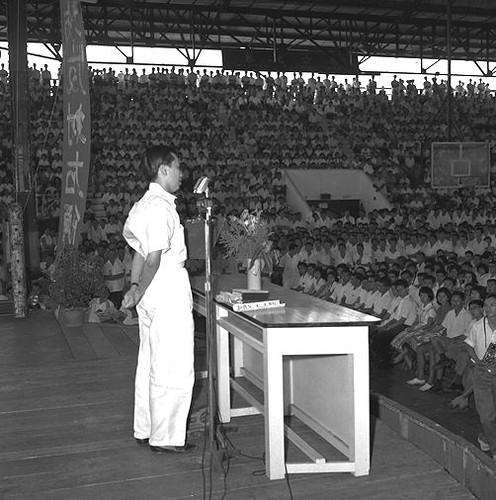
The Man Who Almost Became PM
It was a job which Lim Chin Siong did superbly. His rallies in Hokkien and Mandarin were masterful. His rallies were attended by some 40,000 people, each mesmerized by Lin Chin Siong’s oratory. “The British say you cannot stand on your own two feet,” he jeered. “Show them! Show them how you can stand!” And 40,000 people leapt up, shining with sweat, fist in the air, shouting “Merdeka!”
“You have to understand,” said Devan Nair, “the mood of the people at that time. There was bitter anti-colonialism. Massive unemployment. And to the masses, the Communist was the only heroes. Lim Chin Siong had the ground. Where the masses were concerned, Chinese trade union leaders and the Communist were the only leaders.”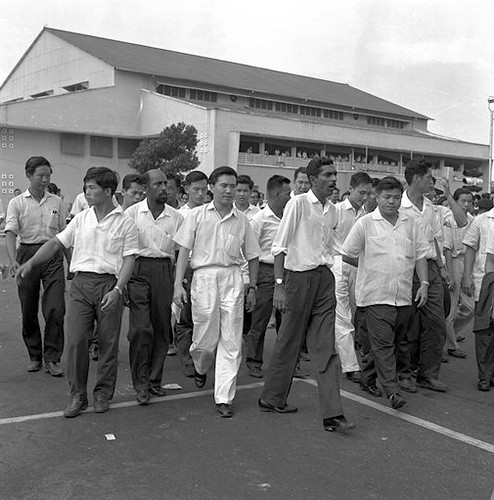
Lim certainly had the respect of Lee Kuan Yew. David Marshall said, “Chin Siong was introduced to me by Lee Kuan Yew. Kuan Yew came to visit me in my little office underneath the stairs and said, “Meet the future Prime Minister of Singapore!” I looked at Lim Chin Siong and I laughed. LKY said, “Don’t laugh!” He is the finest Chinese orator in Singapore and he will be our next Prime Minister!”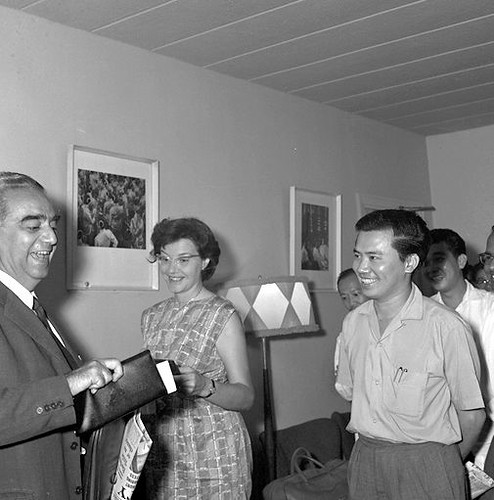
-
David Marshall and Failure from Independence
David Marshall led the first Merdaka Mission to open negotiations with the British for Independence of Singapore. Constitutional discussions began in London in April 1956. On board, representing the PAP, were Lim Chin Siong and Lee Kuan Yew.
The mission returned in failure and their demands for independence were refused. The British felt that the Labour Front government was too weak and the Communist elements in Singapore too powerful. If there was to be independence, the British fears needed to be calmed. David Marshall resigned and Lim Yew Hock took over as Chief Minister. He had two objectives. Firstly, he had to prove to the British that Singapore was able to resist Communism. Secondly, he wanted to purge the trade unions, schools and political parties of pro-Communist and Left Wing Leaders who were beginning to threaten the rule of the moderate politicians such as himself and LKY. Thus began a series of arrests under the Public Security Ordinance. Lim Chin Siong, Devan Nair and Fong Swee Suan were some of the prominent politicians being detained. (This issue will be dealt with in further details under Lim Chin Siong and Devan Nair at Part III)
It was Lim Yew Hock who took both blame and credit for the waves of Internal Security arrest. But the PAP was undoubtedly the main beneficiary of his tough regime. Lim Yew Hock arrested five Left Wing PAP members, newly elected onto the party’s Central Executive Committee (CEC) in August 1957, delivering the PAP from what was effectively a Left Wing Coup. Shortly after, PAP introduced the “cadres system” (to be elaborated under Dr Toh Chin Chye section at Part II), which prevented any further Left Wing infiltration into the party’s inner core.
Independence from the British
The next Constitutional Mission to London in April 1958 was a success. Under the State of Singapore Act in August 1958, the colony became a self-governing state. Elections for the new 51 member Legislative Assembly were scheduled for May 1959. Lim Yew Hock was given a heroÂ’s welcome on his return and a noisy motorcade from Kallang Airport.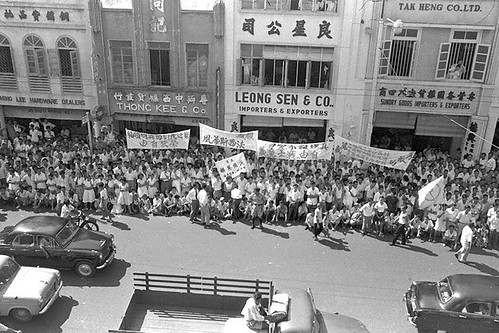
The Dilemma and Shrewdness of LKY
In the run-up to 1959 elections, the PAP was in a dilemma. The Party was to be led into the elections by LKY and his Right Wong colleagues. But they needed the Left Wing leaders, who were in prison to attract the following of the masses.
“It was at that point that Kuan Yew played his political cards superbly,” remembers Devan Nair. “It was masterly. He is politically very, very shrewd. He came to the jail and told us, look, I’m not gong to stand for elections unless I am satisfied that you are really committed to the ideal of a free, democratic, socialist and non-communist Malaya. And you are committed to the policies of the PAP. So Chin Siong, Woodhull, Fong and so on, gave verbal assurances. We knew that if the PAP didn’t form the next government we would continue to be in the jug (aka jail). But if the PAP did win, in 1959 and if PAP formed the next government, then we would be released and we could start our union work again.”
“But Kuan Yew was too smart. He said, “No, put it down in writing.” And I (Devan Nair) told them, “Yes, if we are sincere, we ought to put it down in writing.” And the more important of which was The Ends and Means of Malayan Socialism”, said Devan. They all signed and committed themselves to the PAP. This enabled LKY to run for office on a platform which demanded their immediate release. The trade unions mobilized their mass muscles, putting the PAP into power by a landslide. The PAP formed the government with LKY as the Prime Minister.
Lim Chin Siong and his colleagues, released from jail amidst a flurry of doves, were tucked into obscurity as Political Secretaries in the Ministries.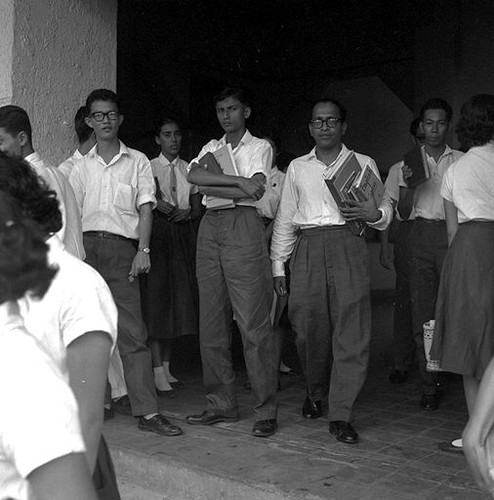
Cracks and Split in PAP
As the PAP government settled into power, the uneasy union between the Left and Right continued. The first sign of trouble was Devan Nair’s resignation from the Education Ministry. “I went to Kuan Yew and told him, “Look, I meant every word of The Ends and Means of Malayan Socialism. But I am afraid that my friends are not sincere. I don’t want to be caught in a situation where I’ll be fighting with my friends. So I want to leave. I’m resigning.” He went to St Andrew’s School where he became a teacher there instead.
The next crack came when one of the most powerful members in PAP, Ong Eng Guan, the Minister of National Development and one of the three representatives on the Internal Security Council, published an attack on PAP. He accused the party leadership of being “undemocratic” and “dictatorial”. The Party responded by sacking him from the PAP and stripped of his seat in Hong Lim and all his other positions.
He defiantly stood as an Independent in the Hong Lim by-elections and gave the PAP candidate, Jek Yuen Thong, a sound beating. Ong was fluent in dialect and Mandarin; a rarity amongst the English educated. Despite the PAP sending the charismatic Lim Chin Siong to speak at the mass rally at Hong Lim, Ong Eng Guan still won.
This is not the end of the crisis for PAP. On June 1961, Lim Chin Siong wrote to Dr Toh, demanding the release of their Left Wing political colleagues. PAP could not agree to this with their prior agreements with the British. The beginning of the split between Left and Right was the Anson By-elections on July 1961. The Left demanded “internal democracy in the PAP” and the release of all political prisoners from detention. They were refused. The Left then threw their support to the rival candidate, David Marshall and he won.
The final split came just few days later in the Legislative Assembly. Thirteen Left Wing PAP Assemblymen abstained from voting with the party line. They were dismissed from the PAP. In August 1961, they formed a rival party, the Barisan Sosialis, led by Dr Lee Siew Choh and Lim Chin Siong. They took 35 branch committees, 19 of the 23 organizing secretaries and an estimated 80 percent of the membership. PAP under LKY was a mere shell, according to Dr Lee. -
The Last Breathe of Hope for PAP
The Singapore government was on the verged of being toppled. Every session, the opposition would motion of no confidence. But across the shores, the Prime Minister of the Federation of Malaya, Tengku Abdul Rahman, watched the events and feared that Singapore was about to become a Communist State, a “second Cuba” and a danger to Malaya. Thus, this was the start of the intense and frantic, Battle for Merger.
Barisan Sosialis held sway in Singapore but it knew that in a wider Malaysia they would be crushed. On the other hand, PAP needed Malaysia to break the BarisanÂ’s hold on the Singapore Electorate. Thus, they enlisted Malayan Tengku and the British as allies, playing on their long standing fear of Communism.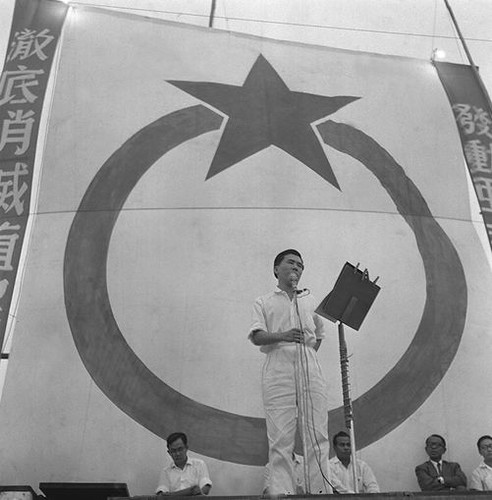
On July 1962, the Barisan Sosialis, led by David Marshall and Dr Lee Siew Choh, appealed against the merger in the United Nations in New York. The Merger Referendum, issued in 1962, was testimony to the murkiness of the Battle. It was deliberately ambiguous. It asked voters to choose what kind of merger they wanted, not whether indeed they wished for a merger. All spoilt votes were to be counted as votes in favour of merger. With this controversial tactic, the PAP won the Battle for Merger.
Tengku then decided to clean out the Communism with “Operation Cold Store”. Hundreds of arrest was made and effectively decapitated the Left Wing Barisan Sosialis. A snap elections was called, under the protection of the Malaysian Security Council, produced a clear PAP victory. The Barisan, with most of their leaders in prison, garnered only 13 out of 51 seats. On September 1963, the PAP government had won its battle against the Left.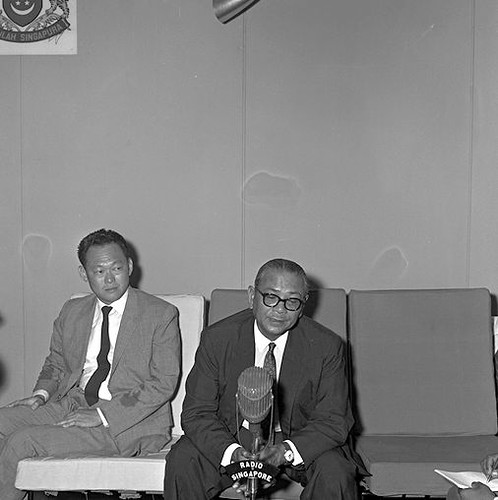
Merger and Separation of Singapore
Singapore spent 1071 days in Malaysia. Perhaps the first Singapore Leader to despair was Goh Keng Swee (more details on Part II). The integration of the economies of Malaya and Singapore was scuppered by the competitive rather than complementary nature of the two countries. Malaya refused to drop her tariff walls to admit Singapore goods and Singapore refused to abandon her free-port tax regime. Things got ugly with “mud-slinging”, a steadily rising political and racial temperature.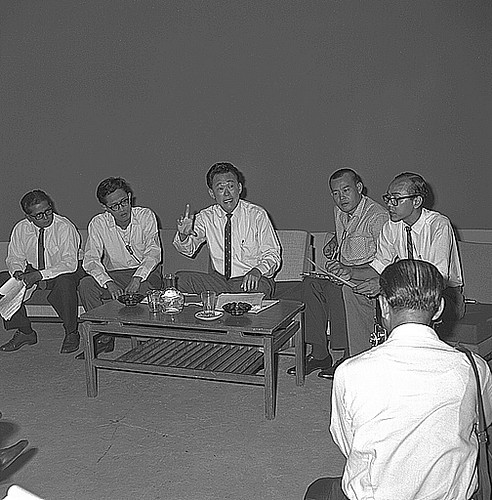
The independence of Singapore on the 8th August 1965 came as a total shock to most of the country. They were informed by radio and over television, by a tearful Lee Kuan Yew. He was to retire (to seek solace), in despair, to a government bungalow in Changi. Dr Toh, with his colleagues, held the fort and provided the much needed stability when LKY was no where to be seen.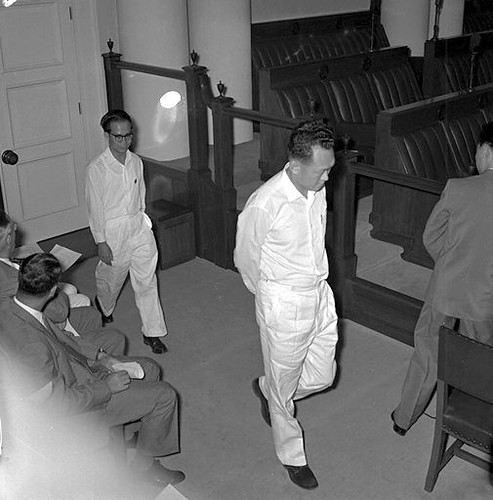
Coming Soon: Part 2: Old Guards and Leaders of Singapore I
True Founders of Singapore: Dr Toh Chin Chye and Dr Goh Keng Swee
Both men were the pioneering members of PAP and Deputy Prime Ministers of Singapore. One is the founding Chairman of the PAP, the other the true architect of SingaporeÂ’s success. In the confusion of SingaporeÂ’s sudden separation with Malaysia, PM Lee Kuan Yew wept on national television and withdraws to a government bungalow in Changi. But behind the scene was the stabilizing force of Dr Toh Chin Chye made the chaos orderly. Dr Toh also played a crucial role in the development of Science and Technology in industrialization of Singapore. As for Dr Goh Keng Swee, he is widely hailed as the true architect of SingaporeÂ’s success with his visionary leadership. He was first Defense Minister and practically transformed the swarm lands of Jurong into an industrial oasis. -
Wednesday, January 18, 2006
Coming Soon: 4-Part Series on the History and Founding of PAP & the Old Guards of Singapore
The past articles of this blog focused mainly on the present and recent history of Singapore Politics, on PM Lee Hsien Loong, Third Generation Ministers and on recent Election issues. But no Singapore Politics would be complete without the history of PAP, its early founding and the tale of 6 men. As such, I will try to attempt on a new direction (more like reverse direction) in bring the past history of Singapore Politics to “blog space”. Thus this will be a 4 Part Series on the Histories and Leaders that would be featured in the coming month. Here are the synopses:
Part 1: History and the Founding of PAP
For those who have visited the PAP website, would know that they have a short concise history of the Party. As in most concise history, the details that they left behind are often the most important and interesting. Stories of their struggles, backstabbing, “politicking” and crisis made what PAP is today. This article will span from 1957 to the day of separation with Malaysia in 1965 and involved the lives of Seven Key Leaders that shaped the present day Singapore Politics. Lee Kuan Yew, Goh Keng Swee, Toh Chin Chye, S Rajaratnam, Devan Nair, Lim Chin Siong and Lim Kim San. Aside from Lee Kuan Yew, who is well publicized to say the least, the 6 other leaders will be featured in separate articles.
Part 2: Old Guards and Leaders of Singapore I
True Founders of Singapore: Dr Toh Chin Chye and Dr Goh Keng Swee
Both men were the pioneering members of PAP and Deputy Prime Ministers of Singapore. One is the founding Chairman of the PAP, the other the true architect of SingaporeÂ’s success. In the confusion of SingaporeÂ’s sudden separation with Malaysia, PM Lee Kuan Yew wept on national television and withdraws to a government bungalow in Changi. But behind the scene was the stabilizing force of Dr Toh Chin Chye made the chaos orderly. Dr Toh also played a crucial role in the development of Science and Technology in industrialization of Singapore. As for Dr Goh Keng Swee, he is widely hailed as the true architect of SingaporeÂ’s success with his visionary leadership. He was first Defense Minister and practically transformed the swarm lands of Jurong into an industrial oasis.
Part 3: Old Guards and Leaders of Singapore II
Almost Prime Ministers: Lim Chin Siong and Devan Nair
Both men were said to be Communist and detained for several times for their beliefs. But if history has taken its turn, Lim Chin Siong would have become the Prime Minister of Singapore, or at least this was what Lee Kuan Yew said. Once, Lee Kuan Yew introduced Lim Chin Siong to David Marshall, “Meet the future Prime Minister of Singapore!” David Marshall laughed but LKY said, “Don’t laugh! He’s the finest Chinese orator in Singapore and he will be our next Prime Minister!” History has its own ironies with LKY himself being the PM. Devan, on the other hand, was the lifeline of PAP after the party split. Should he have joined Lim Chin Siong and not created NTUC, the power in office today would not have been the PAP. With the credit of bringing the union over to the PAP, he was later appointed President of Singapore only to unceremoniously resign from office.
Part 4: Old Guards and Leaders of Singapore III
Leaders Home and Abroad: Lim Kim San and S Rajaratnam
The HDB housing is probably one of the very rare cases of public housing gone right in the world. Where every other country failed and Singapore’s public housing succeeded due to one leader, Lim Kim San. Away from home, the Foreign Minister that steered Singapore into the Global map was S Rajaratnam. The investments we attracted, the foreign relations we built, the diplomacy that was forged when Singapore was not even on the world’s map, Rajaratnam made us a “country”. After independence, two main problems plagued Singapore: Housing and Jobs. Lim Kim San assured the housing and Rajaratnam brought in the foreign investors and made diplomacy our only defense when we do not have soldiers. -
Well History is never silent even when the garmen tried hard to suppress it!
Even the P.M. Lee Hsien Loong had to admit it :
Goto see http://www.sgwiki.com/wiki/Auspicium_Melioris_Aevi
-
Originally posted by norey:
Not funny, not stupid; just that not many of the younger generation will know him.
Has anyone read this book and can tell what's
there?
If not goto:
http://www.sgwiki.com/wiki/Lim_Chin_Siong
and find [b]someone really could have beaten LKY in any fair election here!
It is really a book to be found only at selected anti-garmen stores, would anyone know to find it ?
goto see it here
http://www.sgwiki.com/wiki/Comet_in_our_Sky
This is the only single most un-usual POST without responses but many looks to see, is it funny or stupid? [/b]
Who is this folk hero, Lim Chin Siong?
Informative site from Atobe:
http://singaporegovt.blogspot.com/2006_01_01_singaporegovt_archive.html
“I liked and respected him for his simple lifestyle and his selflessness. He did not seek financial gain or political glory. He was totally committed to the advancement of his cause.
He and many of his comrades, graduates from the Chinese middle schools, taught my colleagues and me the meaning of dedication to a cause.
They were prepared to sacrifice everything for their cause, and many did. Some lost their lives in the jungles, many were banished to China.
Because of the standards of dedication they set, we, the English-educated PAP leaders, had to set high standards of personal integrity and spartan lifestyles to withstand their political attacks. They were ruthless and thorough. We became as determined as they were in pursuing our political objectives."
----The Singapore Story: Memoirs of Lee Kuan Yew. Singapor: Times Editions. -
definitely learnt something new today.
-
OK, i checked up liao, he not graduate.
Therefore he has no place in LKY's political leadership model.
Moreover, he is Chinese-ed --- where got chance? -
BTW U r behind us all the time in history: He was a folk hero, he ws a real person we could touch and feel..sorry U r not born yet hehehehehehehe!Originally posted by ObviousMan:OK, i checked up liao, he not graduate.
Therefore he has no place in LKY's political leadership model.
Moreover, he is Chinese-ed --- where got chance? 
-
Yeah..history is always a lesson to learn. Education cp is like comparing Mah and Chiam , and who still loses in evry election to Chiam in spite degrees and better grades?Originally posted by alien2:BTW U r behind us all the time in history: He was a folk hero, he ws a real person we could touch and feel..sorry U r not born yet hehehehehehehe! -
Huh? I think my parents were only toddlers or kids themselves during that period!Originally posted by alien2:BTW U r behind us all the time in history: He was a folk hero, he ws a real person we could touch and feel..sorry U r not born yet hehehehehehehe! 
But then again, LIM CHING SIONG is the MAN!
MERDEKA! -
Right..most ppl are not born yet, considering your parents were just toddlers!Originally posted by ObviousMan:Huh? I think my parents were only toddlers or kids themselves during that period!
But then again, LIM CHING SIONG is the MAN!
MERDEKA!
However, it's only the 60s..when the PAP was a popular people movement but now,
it's a movement which had left the people
and most people could only dream to have that kind of freedom we once had..
Now nobody can vote since the PAP run the garmen..
I hope to vote.. but never have been able to do so
and would you believe I'm 60 ?
Nowadays the leaders who instituted the LAWS just made use of it to put people in jail or get them to be harassed in the Courts then fined:
goto :http://www.sgwiki.com/wiki/Political_white_lie .. and then find out who said this
::::"There is no policy too sensitive to question, and no subject so taboo that you cannot even mention it."
Furthermore they demanded blood and sweat.. -
hmm
i take a singapore studies module in uni...from what we are taught, it seems to suggest (when i read the notes) that lim chin siong was not as extremist as the pap played him out to be. i was quite suprised in fact, i thought nus would give more pro-govt stuff, but actually no...they show both sides of the story...
when lim chin siong was detained in 1963, lee kuan yew warned him about it beforehand, and offered him safe passage out of singapore, but lcs refused.
his detention was needed for the merger with Malaya, because he was seen as the figurehead of the communists, but on moral grounds, Operation Coldstore was not fully justified. -
At NUS they are never given too much to read, and the fine prints are sometime missing..to really appreciate history U can read more from outside sources..like the book
Or other speakers and people who lived thru it....
However this topic is too touchy for anyone to major in..
I lived thru it and saw most of the events..then was apolitical..still do but try to be more objective from a bird-point of view..
-
Is it not sad, that for a FIRST WORLD COUNTRY such as Singapore is purported to be, our HISTORY is carefully edited for the Young to be "educated" (more likely inculcated); and for those at the Tertiary levels to avoid learning too much of real life events - to form any disfavorable attitudes towards reality on the ground - beyond approved text ?Originally posted by alien2:At NUS they are never given too much to read, and the fine prints are sometime missing..to really appreciate history U can read more from outside sources..like the book
Or other speakers and people who lived thru it....
However this topic is too touchy for anyone to major in..
I lived thru it and saw most of the events..then was apolitical..still do but try to be more objective from a bird-point of view..
It was disappointing that the wife - and family - of the late Dr Lee Siew Choh was persuaded by her brother - (one of those favored by the POWER OF ONE) - NOT to publish his memoirs, which was supposedly a rebuttal of LKY's memoirs.
It was a dream that remained unfulfilled for the late Dr Lee, who had been assisted by his daughter, rushing through his last year to accomplish this goal of publishing a rebuttal.
In the end, the wife was persuaded to let the water flow under the bridge, and not let the 'grudge fight' go to the next generation.
Sadly, Singaporeans will never learn of the truth of those events in the early political life of Singapore - the tussle of history according to LKY and his political opponents.
Sadly, the late President Nair was also persuaded - by the retired SM, the late Rajaratnam - to abandon his attempt at writing his own memoirs; and hence stopped the destruction of the POWER OF ONE by someone that is very close at the center of power - a destruction of the center from within. -
Originally posted by Atobe:Is it not sad, that for a FIRST WORLD COUNTRY such as Singapore is purported to be, our HISTORY is carefully edited for the Young to be "educated" (more likely inculcated); and for those at the Tertiary levels to avoid learning too much of real life events - to form any disfavorable attitudes towards reality on the ground - beyond approved text ?
It was disappointing that the wife - and family - of the late Dr Lee Siew Choh was persuaded by her brother - (one of those favored by the POWER OF ONE) - NOT to publish his memoirs, which was supposedly a rebuttal of LKY's memoirs.
It was a dream that remained unfulfilled for the late Dr Lee, who had been assisted by his daughter, rushing through his last year to accomplish this goal of publishing a rebuttal.
In the end, the wife was persuaded to let the water flow under the bridge, and not let the 'grudge fight' go to the next generation.
Sadly, Singaporeans will never learn of the truth of those events in the early political life of Singapore - the tussle of history according to LKY and his political opponents.
Sadly, the late President Nair was also persuaded - by the retired SM, the late Rajaratnam - to abandon his attempt at writing his own memoirs; and hence stopped the destruction of the POWER OF ONE by someone that is very close at the center of power - a destruction of the center from within.
Response from Alien2:
Right and agreed, that is so pathetic..but history is not necessary built upon one single sourcewe have plenty to show that LKY only view was lopsided to show< his own version>, plenty if you want to find more.. Read Chin Peng's story about the communists struggle and you find absolutely no mention of Lim Chin Siong ..why??? because it was probably that the late Lim was never a communist after all!
I have seen the book
in the store at Popular in J.B. and I looked for Lim's name within the index..there was none! -
Originally posted by alien2:Response from Alien2:
Right and agreed, that is so pathetic..but history is not necessary built upon one single sourcewe have plenty to show that LKY only view was lopsided to show< his own version>, plenty if you want to find more.. Read Chin Peng's story about the communists struggle and you find absolutely no mention of Lim Chin Siong ..why??? because it was probably that the late Lim was never a communist after all!
I have seen the book
in the store at Popular in J.B. and I looked for Lim's name within the index..there was none!If you did not find Lim Chin Siong's name in the memoir written by the leader of the Malayan Communist Party - Chin Peng, you will probably not find the name of Chia Thye Poh in that book either.
One will need to think again, if those Singaporean Catholics - whom the POWER OF ONE confronted, accused as Communists subversives, and incarcerated under the ISA - were also erroneously judged by a SINGLE OPINION ?
As can be seen in the local events over the last FORTY-FIVE YEARS, the 'name calling' habit started very early in the Politics of Singapore, and this habit continue to this day - with the words getting more pungent, surgical, and venomous. -
Some additional small information about Singapore Politics conducted in the 1960s - from the ex-Solicitor General during this period, who had listened to the instructions of the POWER OF ONE :
Review of
Comet in Our Sky: Lim Chin Siong in History
&
Dark Clouds at Dawn: A Political Memoir
by Francis Seow
Given Singapore's rugged political history, there has, understandably, been a noticeable dearth of dissident literature. The reasons are not far to seek: political dissidents, especially those detained by the authorities, were inhibited by conditions of their release from associating with one another let alone writing biographies questioning their original detention. Singapore, a command society, does not encourage such lèse-majesté literature, and publishers -- be they domestic or foreign -- are slow to publish in this regard for fear of, among other possibilities, losing their printing or publishing licence.
Thus, these two books, Comet in Our Sky: Lim Chin Siong in History (edited by Tan Jing Quee and Jomo. K.S., illustrated. 170 pp., IBSN 983-9602) and Said Zahari's Dark Clouds at Dawn: A Political Memoir, (illustrated. 316 pp., IBSN 983-9602-13-6) make a belated albeit refreshing presence to correct the lopsided official history. It is worth recalling that it was Lee Kuan Yew, then in political opposition, who first sought the favour and support of Lim Chin Siong, and, to a lesser degree, of Said Zahari, among others, in his quest for political control. They became his comrades with whom he ran, and later hunted, with the British colonial and Malaysian governments. Some would call it political astuteness but others would term it base treachery. Be that as it may, there is no doubt whatsoever Lee played a singular role behind the scenes in their subsequent incarceration by those governments, rationalizing their detention many years later by labelling them communists, communist sympathizers and such like, even though he knew they were not. In this regard, the gross libel he practised on them was perpetuated by an uncritical news media -- until the scales fell in 1971 as a result of his ham-fisted suppression of the print media. Some official records, but not all, have recently been declassified in London, enough to suggest that Lim Chin Siong -- and his fellow detainees -- were not as stridently red as Lee had painted them to be.
Given the increasing availability of those records and, as dissidents are emboldened to write their political memoirs, further light will be thrown onto Lee's sinister role in the 1950s and 1960s, especially in the 1963 internal security exercise cynically-named Operation Cold Store, wherein he used the bogey of communism to prevail upon the British and Malayan governments to decimate the effective political opposition in one fell swoop by arbitrary arrests: a pretext which he still uses even after Singapore achieved independence. Comet in Our Sky: Lim Chin Siong in History is unfortunately not written by him, although Said Zahari -- a former Utusan Melayu editor and long-time fellow political detainee -- mentions a projected collaboration to write a joint memoir. It was, however, frustrated by Chin Siong's sudden demise twenty-three days shy of his sixty-third birthday of a heart attack on February 5, 1996. The political climate was not then conducive for such literary endeavour: in any event, they would not have had easy access to research facilities and the publishing industry, which was -- and still is -- too intimidated to consider, let alone accept, any contrary publishing assignments.
Some essayists speak of Chin Siong's emotional distress in prison. Like Said Zahari, he was placed in solitary confinement for inordinately long periods at a time, a sure prescription for depression. But, unlike Said Zahari, Chin Siong apparently suffered from high-blood pressure, whose adverse effects combined with periods of solitary confinement were further intensified by the psychotropic drugs specially prescribed him by the prison psychiatrist, which finally drove him to attempt suicide at the General Hospital. It sparked off ugly rumours at the time that he was being deliberately done in by the authorities. However, Lee, in his self-serving memoirs, From Third World to First, put it down to the sudden realization that "Communism [had] failed him." The explanation is not only cynical but facile -- just as his statement simpliciter therein that, unlike his fellow detainees, Chin Siong was not banished from Singapore under Operation Cold Store. Lee failed to mention that Chin Siong is a Singapore citizen who could not by law be banished: it was thus no act of compassion. Significantly, the self-same prison psychiatrist later committed suicide reviving knowing whispers that Chin Siong had been over-prescribed medications against the former's better judgment. However it may be, the last word on this topic has not been written.
Thus, when Chin Siong appeared before a triumphant Lee in his grandiose official residence at Sri Temasek to plead for his release to the United Kingdom "for studies," he was not so much a "disillusioned " man, as Lee asserted, as a broken man. Long solitary confinement under torturous conditions and generous prescriptions of psychotropic drugs had broken him. No explanation is offered by any essayists as to why Chin Siong became instead a barrow-boy selling fruits and vegetables in London. For he was known to have a sharp intellect, amongst other accomplishments. Was it because he was so crushed in body and mind that it took him years to recuperate from his fearsome ordeal? Be that as it may, they never met again, but in a statement that pushes the outer edge of credibility, Lee however claimed they "... exchanged greetings in New Year cards."
Even so, Chin Siong paid a high price for his relative freedom: in the egregious ISD -- Internal Security Department -- fashion, he had been psyched up to denounce his comrades, some of whom did not know of nor appreciate his physical and mental distress, including the nefarious use of sleep deprivation. One can only surmise what indignities he was made to go through! It is in this context that the open letter allegedly written by Chin Siong to Dr. Lee Siew Choh, the Barisan Sosialis chairman, urging him and the Barisan faithful to abandon the good fight, must be read. If experience is any guide, there is every reason to believe the letter was dictated and crafted by the ISD as a condition of his release. With his contrived exile to London, Lee removed the greatest political threat to him and his PAP government. -
cont from above
This book is a collection of reflective essays and tributes by Chin Siong's former political colleagues and fellow detainees, friends and admirers who had known him during his life-time, among whom are Malaysian Professor of Anthropology Syed Husin Ali, Malaysian Academy of Sciences Vice President Dr. M. K. Rajakumar, and Malaysian poet laureate, Usman Awang. It, however, tends to be repetitious as the essays have not been edited with regard to one another. It is a pity there are no contributions from C.V. Devan Nair -- Chin Siong's former political comrade and fellow detainee and, later, president of Singapore -- and Dr. Lee Siew Choh, which would have lent even greater political heft to this slender volume.
However that may be, two very fine essays by British academic, Dr. T.N. Harper, and his Australian counterpart, Dr. Greg Poulgrain, give the book that extra edge, which for them alone makes the book recommendable, notwithstanding the editorial and printing limitations noted. They expose Lee's perfidy -- which was to characterize his long tenure as prime minister -- and by implication call into question his spin on those events in The Singapore Story, whose debut as his political memoirs was assisted by a legion of government personnel and staff from the Straits Times newspaper. One small comment. Given the contents, the title is a misnomer: Lim Chin Siong was not a comet. He is a star in Singapore's political firmament, and, as such, occupies a place in its political pantheon.
The second book, Dark Clouds at Dawn: A Political Memoir , by Said Zahari, is important for several reasons: it provides a rare insight into the interferences in the editorial direction of Utusan Melayu, the leading pan-Malayan Malay newspaper, by UMNO -- the United Malays National Organization -- the principal partner in the Alliance government, which precipitated the unprecedented but consequential Utusan Melayu strike action not so much over pay or conditions of work but over those interferences, and its acquisition by UMNO to become the mouthpiece of the UMNO-MCA Alliance government. In the result, Said Zahari, a Singapore citizen, was banished to Singapore. He also describes the roles inter se of Utusan Melayu's several senior personnel, including that of its owner, Yusuf Ishak, who became the first local head of an independent Singapore, and his relations with A. Samad Ismail, the legendary pan-Malaysian journalist and nationalist, Othman Wok, a senior journalist who later became Singapore minister for social affairs, and a host of Malaysian political luminaries.
It focuses on his own arrest in Operation Cold Store, his long travails in detention, and his friendship with Chin Siong, among other detainees. In a press conference at the 1971 Helsinki International Press Institute conference, Lee -- to a question asked by a journalist -- spun a convoluted tale of Said Zahari's arrest and detention: that he was not arrested because of his journalistic work but as a communist: eight years into his detention, he was suddenly branded a communist. Said Zahari exposes Lee's duplicity when he told Lord Goodman, Master of University College, Oxford, inquiring on behalf of International P.E.N., over his continued imprisonment that [his] detention was being maintained "only because you have -- it is asserted -- refused to renounce violence as a political instrument." It was a wholly dishonest assertion -- a cheap forensic trick, which Lee repeatedly uses to deflect international criticisms of his arbitrary actions.
These books are written for an audience familiar with the personalities and the locales mentioned. The interchanging use of abbreviations, titles, names and nicknames can be confusing for readers approaching this subject cold. Both books have no indexes, and the latter, in particular, would have greatly benefitted with a glossary of names and designations of the dramatis personae, the political parties and organizations. But there is no excuse for misspelling the names of well-known persons, of which James Michener, the American novelist, is one example. These are important books with a tale to tell which would have benefitted from a stricter editorial pen and keener proof-readings. Be that as it may, these books cannot be neglected by any serious students of Singapore and Southeast Asia. They are published by Insan, Kuala Lumpur. -
Can anyone help us out by giving us a longer list of books not usually found on the Island or being banned by garmen< PAP >?