Bye bye MY water by 2011
-
1.ha ha,I get the SG officail confirmation that in 2003,half of SG water
from JB.U guess where I get this? from MY MFA!!
--http://domino.kln.gov.my/water.htm
5. Getting the basic facts and figures right.
Singapore:
"Singapore buys only half of its water, or about 150 million gallons per day (mgd) from Malaysia. The other 150 mgd come from its own reservoirs." (Singapore Ministry of Information, Communications and the Arts, 2003 ;Water Talks? If Only It Could;, page 6.)
Note:150 million gallon =680,000 cubic millimeter(m3)
2.Further Confirmed half of water extracted locallyAt present, around 680,000 cubic metres of Singapore's water consumption is sourced from domestic reservoirs.
---The Straits Times 16 Nov 05,''Nature conservation and water: A link worth noting''
by Lee Poh Onn
u wont believe 2011.but pl read on.
sg sales of potable water in down trend!!!
year...................2002......03.......04.....05
population(m)....4.17.....4.19.....4.24....4.35
land(km2)............685.....697......699.....699.
Confirmed half of water extracted locallyAt present, around 680,000 cubic metres of Singapore's water consumption is sourced from domestic reservoirs.
---The Straits Times 16 Nov 05,''Nature conservation and water: A link worth noting''
by Lee Poh Onn
Water treated..1,315...1,360....1,369.....1,352( m3 in 1000/day)
Sale of potable..1,259...1,224...1,203....1,206(m3..in 1000/day)
water
NEWater..................??.........27.....55......73( m3 in 1000/day)
Industrail water.......??.......98.....104.....107( m3 in 1000/day)
Desalination water.................................??
Hyflux
pl read my posting on 24.09.2006 sunday for more details.
3.It is expected that the need for Johor water will be completely replaced by 2011.
--Strait times 14.07.2006,Friday ,page H11.by Jeremy AU YONG
Heading:Newater Plant in Kranji may be sold to private sector.
.This
is more aggresive than my old estimation of 30% water fr MY in 2011!!click here lah.
4.Almost whole sg is water catchment area.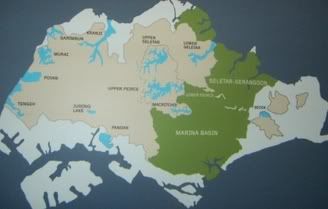
Beige in color is current water catchment area.Green is water
catchment area of proposed Reservoirs of Marina,Sg Puggol ,
Sg Serangoon and and Lower Seletar.All the new and extended
reservoirs will be ready in 6 years .
MM LEE challenged PUB turn Jurong industrail area into catchment also.
A area of about 40 km2.
5.Pl share new info of water independence here .why the reporter made this statement.No one dared to make this claim unless authorized by very high
authority,if u think ST speaks for SG gov.
[/b] -
I dun understand....does that means we will be self-sufficient by 2011.

-
Originally posted by lionnoisy:
SG GOV HAD PLANNED IT MORE THAN 10 YEARS AGO. WHEN WE OPENED BINTAN ISLAND RESORT FROM WHERE UNDER WATER PIPELINES HAD BEEN INSTALLED TO S'PORE.
--Strait times 14.07.2006,Friday ,page H11.by Jeremy AU YONG
Heading:Newater Plant in Kranji may be sold to private sector.
2.[b]This
is more aggresive than my old estimation of 30% water fr MY in 2011!!click here lah.
3.Almost whole sg is water catchment area.
Beige in color is current water catchment area.Green is water
catchment area of proposed Reservoirs of Marina,Sg Puggol ,
Sg Serangoon and and Lower Seletar.All the new and extended
reservoirs will be ready in 6 years .
MM LEE challenged PUB turn Jurong industrail area into catchment also.
A area of about 40 km2.
4.Pl share new info of water independence here .why the reporter made this statement.No one dared to make this claim unless authorized by very high
authority,if u think ST speaks for SG gov.[/b] -
it means we have to start drinking newater by 2011.

-
The cecent reports suggest that Sg is PLANNING to be self sufficient by 2011, based on forecasted supply and demand.Originally posted by kaka_22:I dun understand....does that means we will be self-sufficient by 2011.
http://www.pub.gov.sg/home/Faq.aspx#Q1
There is mention of getting water from Riau Islands, which if agreements can be reached, then I guess imported water will still be used.
End of the day.. the PUB's 3P program sounds like a wonderful idea, to get private entities to supply water, regardless of nationality. -
Pls dun waste water
-
you think the damming of the Singapore and kallang river will spoil the feng shui of singkarpor ?. ..
-
so..
can guess how much our water bill will rise by 2011? -
Already the MRT has done itOriginally posted by Fatum:you think the damming of the Singapore and kallang river will spoil the feng shui of singkarpor ?. .. -
Originally posted by sbst275:Already the MRT has done it

More details please. -
Drink recycled and filtered water
-
it's 2061. got a correction in today's papers.
-
old posting 17.09.2005
I repeat the opening posting here.
With the completion of desalination plant(10% of yearly consumption),Marina Barrage,and
inter-connectionof all reservoirs (55%x 14%=8%).
Projected sources of water supply in 2011,per day,in m3
Local catchment............740,000...m3
NEWater.......................208,000
Desalination.................134,000
Marina Reservoir............80,000
Reservoirs intergrated.100,000
Industrial water .......200,000.....Jurong RECLAMATION PLANT
Total local sources....1,462,000
Let say yearly increase in water consumption is 3%.Then in 2011,we need 1,740,000m3 per day.That is we need import 278,000m3 water from MY.
That is only 16% of our consumption in 2011.
2.The above figures exclude the following new items.I forget to tell u
the proposed new reservoir in the down stream of Lower Seletar Reservoir in 2009. and
Sg Punggol and Sg Serangoon will turn to reservoirs too.
After all,two thirds of Sg will turn into catchment area when Marina Basin turn into Reservoir.Do u know now urban area ,like HDB estates,are catchment area also.So the water local catchment can provide in 2011 is still a Top Secret.
2.S$1 billion can really say bye bye to MY water.read my old postings.
$200m can provide 10% of SG demand.Costing $200 million, it is being built by Hyflux, whose chief executive
My NOTE:78 cents is the lowest price.It will float with oil price.
Olivia Lum has become known as Singapore's 'Water Queen' for her talent in
seizing business opportunitiesto do with that most vital of commodities.....
It is one of the world's most energy-efficient desalination plants and will
sell water to the PUB at one of the lowest prices in the world for desalinated
water 78 cents a cubic metre.(My NOTE)
This is lower than the $1.17 to $1.40 a cubic metre which households
currently pay.
One of these is the membrane bioreactor technology for treating waste water to produce Newater. The company behind this technology is Singaport Cleanseas,
whose shareholders are PSA Corp and four local shipyards.....
The pioneer listing, in 2001, was Hyflux, which is now building two
desalination plants in China and one in Dubai, as well as the one at Tuas, as
the good times flow in the water treatment business.
3.This may happen only here!!
Singapore water usage----more consumption,but less demand!!Why?
year...................... 02......03.........04
population(m)......4.17.....4.19.....4.24
land(km2)..............685.....697......699
no.of NEWater..........0.......2........3
plants
Water treated..1,315...1,360....1,369..( m3 in 1000/day)
Sale of water...1,259...1,224...1,203....(m3..in 1000/day)
Domestic...............687......690......686......( m3 in 1000/day)
Non--domestic.......572......534......517......( m3 in 1000/day)
Domestic...............165......165......162
consumption
pax/ litres/day
water treated...56......136........166...(m3..in 1000 per day)
more than sale
With the operations of desalination plant,the demand of water will drop by 135,000m3 a day
4.SG already has the means to forgo MY water now.So dunt use this
as excuse to migrate. -
yes, more likely... cause this is the time when the last of the contracts expired, I will be very happy when this happen and we are self sufficient on this.Originally posted by neeyh:it's 2061. got a correction in today's papers.
-
no watering on lawn of Royal Garden
Tuesday July 18, 09:36 PM,2006
Performers at a Buckingham Palace Garden Party in June 2006
LONDON (AFP) - Queen Elizabeth II bemoaned the yellowed state of her Buckingham Palace lawn, which cannot be watered because of a ban, some guests at her traditional summer garden party revealed.
"The queen said, 'Have you seen our garden, it's all like that. We are only allowed to water the flowers'," reported Jane Benton, who exchanged a few words with the British monarch..
The queen wore a lime green dress and hat and sheltered from the sun with an umbrella as she received 7,000 guests at her London residence, in temperatures that reached 34 degrees Celsius (93 degrees Fahrenheit).
Water shortages in Britain have led to a ban on using hose pipes, filling private swimming pools, washing cars and watering golf courses.
-
Lazy one summary:
i am happy to tell u that Sg is less dependant on MY's water,
i guess not more than 20% of water need to be imported fr
MY in 2011.Currently,we import some 50% of water fr MY.
PUB will only carry out this kind of large scale experiment
provied the initial one are successful.I think all these two
new methods can be implemented in 6 years.
These 2 trial plants can supply 6 mgd out of 300mgd-million gallon per day.
1.Status of this variable salinity plant:
An $8-million demonstration plant that can produce one million gallons of drinking water daily is under construction at Sungei Tampines and is expected to be completed by the end of 2006.
this variable salinity plant can potentially boost Singapore's water catchment area from two-thirds of the island's total surface area(in 2009) to 90 per cent in unkown yearwhen this plants are installed around singapore.It turns water from the sea, river, stream or even drains into usable water.
In 2006, 50% of Sg land is water catchment area which provide
half of water demand.Government safe guard this figure as TOP SECRET.
How much 90%of water catchment area
can provide if these plants installed in rivers of Sg?
2.Status of membrane distillation:
Pilot project running from Jan 2006 .PUB will build
a demonstration plant after the pilot trial ends
its run in 2007.Read this more info
Another is the pilot testing of technology involving membrane distillation at Senoko refuse incineration plant.
The test began in 2006 January and uses low-grade residual steam from the refuse incineration plant with a capacity of 1,000 tonnes per day to potentially produce five million gallons of near-distilled water per day from seawater.
This can only happen in sg for government allow incineration and distillation plants combined together.The energy used is also 3 times less than that used in reverse osmosis.Monday August 14,2006
'Harvesting' nearly every drop
For a start, the PUB is working on a new "two-in-one" plant that can treat both freshwater and seawater. Conceived and developed by the PUB, this variable salinity plant can potentially boost Singapore's water catchment area from two-thirds of the island's total surface area to 90 per cent.
Said Mr Tan: "With this plant, the viability of tapping marginal water catchments to produce drinkable water is enhanced and we can convert nearly the whole of Singapore into a water catchment to 'harvest' nearly every drop of rain that falls on Singapore."
And during dry spells, the plant - which has the flexibility to switch from a freshwater to seawater source, and vice versa - can produce drinking water from seawater.
An $8-million demonstration plant that can produce one million gallons of drinking water daily is under construction at Sungei Tampines and is expected to be completed by the end of the year. It will allow the PUB to test the concept and gain operational experience.
The PUB expects the variable salinity plant to produce drinking water even more cheaply than its $200-million seawater desalination plant in Tuas, which produces 30 million gallons of drinking water daily, at 78 cents per cubic metre - already half the production cost of desalinated water elsewhere.
Singapore's daily need for about 300 million gallons of water is met by four reliable sources of water, or "National Taps": Local reservoirs, water from Johor, NEWater and desalinated water.
"Today, our four National Taps are complete ... but we cannot stop there," said Mr Tan.
For the past three years, the PUB has been spending $5 million annually on research and development projects - and will continue to do so.
This seed funding - together with other external funding sources such as the Ministry of Environment and Water Resources' Innovation for Environment Sustainability Fund and The Enterprise Challenge Fund - has generated about $50 million worth of R&D projects over the past two years.
1.Among them is the variable salinity plant.2. Another is the pilot testing of technology involving membrane distillation at Senoko refuse incineration plant.
The test began in January and uses low-grade residual steam from the refuse incineration plant with a capacity of 1,000 tonnes per day to potentially produce five million gallons of near-distilled water per day from seawater.
"This is unlike the current conventional reverse osmosis desalination approach, which requires high pressure to push water through a reverse osmosis membrane," said Mr Tan.
This technology can also be applied to exploit low-grade steam or heat from power stations and other heat-generating plants.
"The world is full of ideas waiting to be leveraged on. We cannot confine our R&D within Singapore and expect great results. Over the years, we've tracked technological developments overseas, networked with other governments, water companies and so on. Now we need to take things a step further and encourage greater collaboration with international research institutes.
"I am convinced that this is the best way to gather the best ideas or technologies and the best persons for the job," said Mr Tan.
Some of the institutions the PUB works with are the Centre for Water Re search in the National University of Singapore; the Environmental Engineering Research Centre at the Nanyang Technological University; the University of California, Berkeley and Stanford University in the US; as well as the University of Western Australia's Centre for Water Research.
As a young engineer, Mr Tan was in the team that drew up Singapore's first water masterplan in 1972 that already included the possibility of reclaiming water, and witnessed PUB's first foray in 1974 to build a pilot plant to turn used water into potable water - the precursor of today's NEWater factories.
"The costs were astronomical and the membranes were unreliable, so the idea was shelved," he said.
The project was revived in 1998 with the advent of the necessary technology, at which time Mr Tan was the Permanent Secretary at what was then called the Environment Ministry. By May 2000, Singapore had its first NEWater plant in Bedok.
Today, Singapore has three NEWater plants. A fourth NEWater plant is being built, which when completed will provide a total of 60 million gallons daily. - TODAY
Beige in color is current water catchment area.
Green is water catchment area of proposed Reservoirs
of Marina,Sg Puggol , Sg Serangoon and and Lower Seletar Extension.
When the new and extended reservoirs ready in 2009,
then water catchment will be 65% of sg land area .
If variable salinity plants installed around Sg ,it will go up to 90%,
as told by PUB Chairman.
2.read more for Sg water issue
This ZAOBAO news
said that Sg water will be self sufficient--15.08.2006
3.In conclusion,not more than 20% of water need to be imported fr
MY in 2011. -
NEL runs right under Singapore River before entering Clarke Quay station.Originally posted by Manager433:
More details please.
they pumped water out of Singapore River and dammed it to build cut-and-cover 2-by-2 tunnels with the crossovers right under the tunnel.
same thing for the tunnel between marina bay and raffles place, which was built using the same way.
CCL under kallang river between stadium and nicoll highway is bored under the waterbed i think.
think u also have read before that below orchard road is one big giant canal. somerset station is built under it. the tunnels run alongside it. NEL tunnel out of dhoby ghaut cuts through it. city hall station tunnels run under it too.
-
Confirmed half of water extracted locally
At present, around 680,000 cubic metres of Singapore's water consumption is sourced from domestic reservoirs.
---The Straits Times 16 Nov 05,''Nature conservation and water: A link worth noting''
by Lee Poh Onn
The question is how much more water we can catch
with new Reservoirs of Marina,Sg Puggol ,
Sg Serangoon and and Extension of Lower Seletar
and linking up of all reservoirs.
Secondaly,New methods of The Membrane Bio-Reactor,
The Membrane Distillation and the Variable Salinity Plant
sure can boost local supply.
2.
I think all new method of treating raw water to WHO
standard for drinking or treating sewage back to drinking
water have to go through the following process:
A.Theory studies and small scale experiment in labatory;
B. pilot project
C.demonstration plant
D.Mass scale production
B,C,D
can be verified from this report
Our pilot plant can be rushed to provide water for Maldives.
Another project - the Variable Salinity Plant - produces potable water from rainwater and seawater as well as smaller streams.
PUB says this project can potentially increase Singapore's water catchment area from 67 percent to 90 percent.
A demonstration plant at Sungei Tampines will be ready by year's end.
The plant from the pilot project has been donated to the Maldives to desalinate water from the sea for potable use.
Projected water supply per day m3 in 2015.
3Local supply side
3.1Confirmed
NEWater..250,000...m3.read Editor's note of Annual Report 2005.News ..............................rooms of Information Center.
Desalination..136,000.14 Sep 2005 Official Opening of SingaporeÂ’s................................... Seawater Desalination Plant
Industrial water..200,000....Jurong RECLAMATION PLANT
Total confirmed 586,000m3
3.2Estimated
Local catchment............960,000,est 80% is catchment.Now 50% gives ...............................................................600,000m3
Marina Reservoir............80,000.Marina Barrage,and inter-connectionof all .........................................................reservoirs (55%x 14%=8%).
Reservoirs intergrated...100,000.Personal estimation.
Total local sources....1,726,000
Even local catchment still provide 600,000 m3 in 2015,
total local supply is 1,186,000m3.(586,000+600,000).
This is unlikely.
4.Demand side
year...................... 02......03.........04
population(m)......4.17.....4.19.....4.24
land(km2)..............685.....697......699
no.of NEWater..........0.......2........3
plants
Water treated..1,315...1,360....1,369..( m3 in 1000/day)
Sale of water...1,259...1,224...1,203....(m3..in 1000/day)
Domestic...............687......690......686......( m3 in 1000/day)
Non--domestic.......572......534......517......( m3 in 1000/day)
Domestic...............165......165......162
consumption
pax/ litres/day
water treated...56......136........166...(m3..in 1000 per day)
more than sale
5.Sale of water is dropping
More reclamation of water is the reason.There are some
factory installed with in house water plants. -
PUB annual report 2005
just released.Information Center,news room,annual report.
2.pl tell me how much water sold in 2005 and the location of
the data?
-
I prefer to see Singapore water issue from very very prudent perspective.
Imagine trying to maintain constant and reliable supply of clean potable freash water to over 4 million Singapore inhabitants living on a tropical sun-baked 700sq-km with 1st world hygene standard at the same time able sustain a water-demanding economy.
That is no mean feat, imo. -
at the same time population of spore will be increasing what...whole island become catchment area also not enuff
-
Confirmed half of water extracted locally
At present, around 680,000 cubic metres of Singapore's water consumption is sourced from domestic reservoirs.
---The Straits Times 16 Nov 05,''Nature conservation and water: A link worth noting''
by Lee Poh Onn
water info updated---important
1.DEMAND SIDE
fr :
PUB's Key envoronment stat figues 2006--
http://www.pub.gov.sg/downloads/pdf/kes2006.pdf
This may happen only here!!
Singapore water usage----more consumption,but less demand!!Why?
year....................2002......03.........04.......05
population(m)......4.17.....4.19.....4.24....4.35
land(km2)..............685.....697......699....699
GDP at Current Market Prices (S$)......$194b
.........Per Capita GDP.......................$44,666
no.of NEWater..........0.......2...........3......3
plants
no of desalination ...................................1
plant
Water treated..1,315...1,360....1,369.....1352( m3 in 1000/day)
Sale of potable...1,259...1,224...1,203....1206(m3..in 1000/day)
water
Domestic...............687......690......686.....694( m3 in 1000/day)
Non--domestic.......572......534......517.....512( m3 in 1000/day)
Domestic...............165......165......162.....160
consumption
litres/per capita/day
NEWater..................??.........27.....55......73( m3 in 1000/day)
Industrail water.......??.......98.....104.....107( m3 in 1000/day)
water treated...56......136........166....?(m3..in 1000 per day)
more than sale
1.1 we need to concern the volume of of potable water sold.
99 % of this potable water come from catchment,1 % from NEWater.
The sources of NEWater (the ultra pure water)and
industrial water(low grade reclaimed water from sewage
for non--potable use) is unlimted from sewage.
In spore,100% of sewage is collected and treated to
international standard before discharged into sea.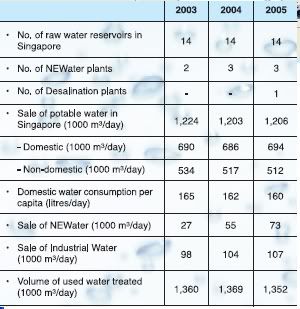
supply side hopefully can bring to u today....
2.PROJECTED SUPPLY SIDE
pl read the top
Projected sources of water supply in 2011,per day,in m3
Local catchment............650,000...m3 ,as at '03,50% of demand(state secret)
NEWater................290,000(Note 1)
Desalination .................136,000...(30 mgd---million gallon per day)
Marina Reservoir &..........95,000...(NOTE 2) 1.35 m m3x 0.5 x 0.14
intergration of reservoirs
New reservoirs.........??????(note 3)
variable salinity plant...................????(NOTE 5,can increase catchment to 90%)
membrane distillation...................????(pilot testing.read link of salinity plant)
(NOTE 6)
Total minimum .........1,170,000 m3 per day
NOTE:
1.This press release states that by 2011,non-potable NEWwater
is 55 mgd,15% of daily needs.Potable water up to 2.5% of daily needs,
i calculate to be 9 mgd.Total 64 mgd =290,000 m3.
NEWater is in high demand from electronic industry which need ample
of water in wafer manufacturing.NEWater can be used in air cond cooling,
central cool water for new CBD etc.No need to worry we have to drink
too much NEWater.Please note that NEWater would be available to companies (for non-potable uses) located in the following supply zones:
----fr PUB
. Bedok (includes Tampines, Pasir Ris, Loyang, Chai Chee, etc)
. Kranji (includes Woodlands, Yishun, etc)
. Seletar (includes Ang Mo Kio, Yio Chu Kang, etc)
At least 55 mgd of NEWater will be supplied directly to industries -and 10 mgd will be blended with freshwater in reservoirs by 2011.
2.So excess water from the Marina Reservoir will be pumped to the Upper Peirce Reservoir for storage before treatment. We are linking up all the reservoirs for surplus water to be channelled to other reservoirs increasing the yield of water extracted by 14%.
--MM LEE AT THE MARINA BARRAGE COMMENCEMENT CEREMONY ON 22 MARCH 2005
3.The proposed new reservoir in the down stream of Lower Seletar Reservoir in 2009. and Sg Punggol and Sg Serangoon will turn to reservoirs too.
Feasibility and engineering studies were conducted for the Seletar Serangoon Reservoir Scheme (SSRS) project was completed in 2003
4.
Max capacity of Industrial Water is 200,000 m3
5.variable salinity plantThe demonstration plant is currently under construction at Sungei Tampines and is expected to be ready by end-2006.If successful, it can potentially increase the water catchment area in Singapore from 67 per cent to 90 per cent.
This variable salinity method has already gone through the Pilot testing.
So ,PUB will not spent so much $$ to build demonstration plant
if this method not promising.
6.membrane distillationOn the other hand, the membrane distillation plant utilises low-grade steam or heat from power stations, refuse incineration plants and other heat-generating plants to produce drinking water from seawater. This is unlike the current conventional reverse osmosis desalination approach, which requires high pressures to push water through a reverse osmosis membrane.
Pilot testing started in January 2006 at a plant installed at Senoko Refuse Incineration Plant. The low-grade residual steam from the refuse incineration plant with a capacity of 1000 tonnes per day could potentially produce 23,000 cubic metres (5 million gallons per day) of near distilled water daily.
Conclusion
we need concern the volume of sale of potable water only.
Other format of water,NEWater and industrail water,its sources
come from the sewage which is ample.
i cant project the demand of potable water which sales drops from
...1,259,000 m3 in 2002 to 1,206,000 m3 in 2005.
This is close to projected water supply minimum 1,170,000 m3 per day.
no need to guess if we need MY water.Just teach every one,
esp kids,save water every day.Migrate to Aussie for scare
of water supply.Over there water is a problem.... -
done wat?Originally posted by sbst275:Already the MRT has done it -
Raise price fares..Originally posted by alvin-ncs:done wat?
-
One less dependency on Msia. Upz!!
