Bye bye MY water by 2011
-
Good lah..... if no need to buy from Malaysia, then less augrment = better country to country relationship.....

-
Erm, do you have the numbers to prove that?Originally posted by chiabaliao:Recycled water will always be limited. You can never achieve self-sufficiency that way. You need a large catchment area, and that is where Singapore must really really come to a realistic agreement with Malaysia. Self sufficiency is a pipe-dream, in my opinion, unless you do massive desalination of sea-water at a high cost. -
SG has employed a giant running around SG to use
a huge bowl to collect rain water.
When water forecast raining in certain water catchment area,
water in the reservoir for the catchment will be pumped away
to accommodate the incoming rains.Increasing the catchment area is just one way
---www.nea.gov.sg/cms/ccird/soe/soe_chap2.pdf
to maximise the water supply from local catchments.
In reality, the catchment size contributing to a
reservoir may not coincide with its storage capacity.
This mismatch results in rainwater going to waste.
To address this, we have embarked on a
Reservoir Integration Scheme to connect
various reservoirs through a system of pumps and pipelines.
In this way, the Public Utilities Board (PUB) will be
able to pump excess water from one reservoir
to another for storage. The Scheme is slated
for completion in 2006.
Strait Times 17.02.2007 Sat page S8 -
Simple, ask Johor to shut off the pipes, and let's see whether recycled water is enough.Originally posted by SingaporeTyrannosaur:Erm, do you have the numbers to prove that? -
Factory is saving water and money!!
2.Thats why sg sales of primary water is on down trend.
SEAA Winner STMicroelectronics
January 25, 2005
In the world of business, the words "industries" and "environmental conservation" often do not go hand-in-hand.
One organisation however, has shown that you can run your business, and conserve the environment as well.
STMicroelectronics, a global semi-conductor company, was one of the winners of last year's Singapore Environmental Achievement Awards.
The Singapore Environmental Achievement Awards is an annual competition organised by the Singapore Environmental Council.
This competition aims to recognise organisations in Singapore that have shown an exemplary example in being environmentally and socially responsible.
With a significant number of eco-friendly initiatives implemented so far, STMicroelectronics has shown dedication in protecting the environment.
Mr Chong Yuen Ngian(CYN), the site facility, safety, security and environment director for STMicroelectronics, describes some of these initiatives.
CYN: In terms of ecology project and in the energy category, we introduce a kind of device called ball technique for chillers. Why chillers? Because in air-con systems, it consumes more energy. For chillers, we have achieve energy savings, amounting to 15 MWH of electricity every year, which is what more than 2500 households, living in air-conditioned, 5-room condominium would need in a year.
For water, recycyling of waste water has allowed us to save the equivalent of 2-3 olympic sized swimming pools daily.
For chemical, we have set up a sulphuric acid recyling plant on site, to reclaim waste acid for prouction re-use. This project has the savings of SGD$3 million a year. -
Originally posted by chiabaliao:Simple, ask Johor to shut off the pipes, and let's see whether recycled water is enough.

Are you just talking about now or in the future when total sufficency is achieved... which is the point of this thread?
Please use a tad of common sense, instead of one liners. And also please do your research, Google is your friend.
Given the Malaysians intend to sell water more expensively then we can make on our own once the treaties expire, does it make any sense to keep buying from them once you have set up your own means? -
Malaysia alway use the water issues to threaten us so by being self-efficient we can save cost and save face...

-
Self-sufficiency does not necessarily save cost nor is self-sufficiency the goal of the government. Saving face is more for the Malaysian government which continues to sell us raw water at 2 cents. Unless the government has turned around and decided on some expensive massive programs (more and more huge desalination plants) other than newater (which will probably supply only 25-30% of Singapore's needs), then only self-sufficiency is possible. In fact, the government talks about 4 taps - 1) water catchments (transforming 90% of Singapore land into catchment area), 2) newater, 3) imported water, and 4) desalinated water. So, it's unlikely they want to stop the third tap.Originally posted by soulwinner:Malaysia alway use the water issues to threaten us so by being self-efficient we can save cost and save face... -
Who says that we must turn off one of the taps just to prove self-sufficency?
What we are trying to do is to make sure that we are not screwed if the foreign tap is ever turned off due to means beyond our control. As it stands now so far they have been doing a rather sucessful job.
The Malaysians know are aware of this reality and now know that the cards are not all on their side in this game anymore.
Currently rainfall provides us with 50 percent of our water, and traditionally the other 50 percent comes from Malaysia, a portion that we have been shaving down by finding water from other sources and increasing catchment areas.
The single desalination plant built in 2005 itself already reduced the 50 percent we must take from Malaysia to 40, and that was just the beginning of the desalination project. We haven't even figured in the increases of the other two local taps yet, of which Newater shaves off another 8 percent and increased water catchment even more. And note that these technologies are just in their starting stage and have not yet reach their zenith. This is a dramatic improvement from the 50 percent we used to rely on them and the proportion of this is still increasing.
Unless Singapore dramatically increase its daily water requirements (unlikely given that our water-intensive industries have matured and we are looking into regenerative sources of water), the Malaysian tap is becoming less of a do-or-die part of our water supply.
As it stands there are no technical or economic hurdles that are impossible to overcome- just that there's no need for a knee-jerk response to achieve self-sufficency when Malaysia is still treaty-bound until 2061... however sitting around and convincing ourselves that we always have to rely on them is hardly the way to go as well. But is there really anything major in the way of self-sufficency? No, it's more a matter of time.
Is that good for us? Yes. Can we contuine to rely on Malaysia forever? I think not. The will have their own problems with water in the future as well, despite some of their politicans calls for Johoreans to take more baths.
It's not even really a choice for us, it's simply something we must do. -
No, the Tuas desalination plant will only supply 10 percent of Singapore's present needs. Singapore's water need is expected to grow by a third in 10 years. Of course, decreasing the amount of imported water is a good thing, but the government is realistic and does not rule out imported water.Originally posted by SingaporeTyrannosaur:Who says that we must turn off one of the taps just to prove self-sufficency?
What we are trying to do is to make sure that we are not screwed if the foreign tap is ever turned off due to means beyond our control. As it stands now so far they have been doing a rather sucessful job.
The Malaysians know are aware of this reality and now know that the cards are not all on their side in this game anymore.
Currently rainfall provides us with 50 percent of our water, and traditionally the other 50 percent comes from Malaysia, a portion that we have been shaving down by finding water from other sources and increasing catchment areas.
The single desalination plant built in 2005 itself already reduced the 50 percent we must take from Malaysia to 40, and that was just the beginning of the desalination project. We haven't even figured in the increases of the other two local taps yet, of which Newater shaves off another 8 percent and increased water catchment even more. And note that these technologies are just in their starting stage and have not yet reach their zenith. This is a dramatic improvement from the 50 percent we used to rely on them and the proportion of this is still increasing.
Unless Singapore dramatically increase its daily water requirements (unlikely given that our water-intensive industries have matured and we are looking into regenerative sources of water), the Malaysian tap is becoming less of a do-or-die part of our water supply.
As it stands there are no technical or economic hurdles that are impossible to overcome- just that there's no need for a knee-jerk response to achieve self-sufficency when Malaysia is still treaty-bound until 2061... however sitting around and convincing ourselves that we always have to rely on them is hardly the way to go as well. But is there really anything major in the way of self-sufficency? No, it's more a matter of time.
Is that good for us? Yes. Can we contuine to rely on Malaysia forever? I think not. The will have their own problems with water in the future as well, despite some of their politicans calls for Johoreans to take more baths.
It's not even really a choice for us, it's simply something we must do.
(Just as we can never never hope to achieve any semblance of self-sufficiency in energy needs. We import all the oil and gas from overseas. Renewable energy like solar and others constitute only a minute amount. China and India go all over the world cultivating relationship to ensure oil security, as they can never achieve self-sufficiency in oil either.) -
2.The projection of increases one third in 10 years seem not valid.Originally posted by chiabaliao:Singapore's water need is expected to grow by a third in 10 years.
Sales of potable water decreases in a row of 3 years.,
when population increases and GDP also up!!!!
year....................2002......03.........04.......05
Water treated..1,315...1,360....1,369.....1352( m3 in 1000/day)
Sale of potable...1,259...1,224...1,203....1206(m3..in 1000/day)
water
Domestic...............687......690......686.....694( m3 in 1000/day)
Non--domestic.......572......534......517.....512( m3 in 1000/day)
population(m)......4.17.....4.19.....4.24....4.35
Note the huge drop in non--dom water most likely
replaced by NEWater and industral water.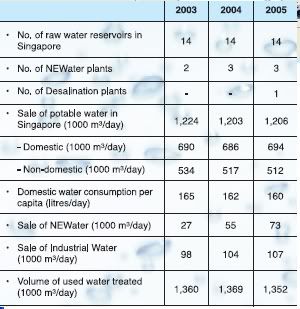
pl read my post 24.09.2006. -
Fair enough, obviously it would be unwise to disregard the foreign tap entirely. Just that if JB ever cut the line for whatever reason, it would be mean the absolute collapse of Singapore, which is a good thing.Originally posted by chiabaliao:Of course, decreasing the amount of imported water is a good thing, but the government is realistic and does not rule out imported water. -
I have to add that future imported water may come from countries other than Johor. Diversification of sources is the key here. In case of natural disaster like dry spell, we can import more water or run the plants to their upper limits to make up for low reservoir levels.Originally posted by SingaporeTyrannosaur:Fair enough, obviously it would be unwise to disregard the foreign tap entirely. Just that if JB ever cut the line for whatever reason, it would be mean the absolute collapse of Singapore, which is a good thing. -
Whatever it takes to survive.
-
when our populations hits 6.5 million.. how much increase will also be not enough..

-
Please do your math before commenting.Originally posted by Urroh:when our populations hits 6.5 million.. how much increase will also be not enough.. -
2.pl read my opening post.ONLY HALF OF WATER DEMANDOriginally posted by SingaporeTyrannosaur:Fair enough, obviously it would be unwise to disregard the foreign tap entirely. Just that if JB ever cut the line for whatever reason, it would be mean the absolute collapse of Singapore, which is a good thing.
COME FROM JB in 2005!!
Desalination plant cut 10%,Ulu Pandan WRP 10%.
Plus sales of potable water decreases 3 years in a row..
Now,import water should be 30%.
4.NEWater''To meet this growing demand, Ulu Pandan NEWater plant has expanded its capacity from 25 to 32 million gallons of water per day. And two other NEWater plants, Kranji and Bedok, have large-scale expansion plants.
For the past ten years,NEWater is expected to provide 15% of SG
"PUB will also bring forward the construction of the fifth NEWater factory at Changi which will produce 50 million gallons per day. Therefore, by 2011, our NEWater plants will have the combined capacity to meet 30 percent of Singapore's water needs, double the original target and this puts us in a strong position to meet any future uncertainties in water supply."
water needs in 2011..
From next month, it will be lowered by 15 cents to $1 per cubic metre.
Keppel to supply 148,000m3/day of NEWater at largest water reuse plant in East Asia -
is Newater diatom free?
-
what is it?Originally posted by audiovideo:is Newater diatom free?
2.can any one post the PM today speech now?? -
Yes, not only that but, the water it produces is actually purer then normally treated water. This is about one step beyond the reclaimed that Yanks use.Originally posted by audiovideo:is Newater diatom free?
Unless of course, you have any reason to disbelieve it... but you'll then have to provide better reasons.
http://en.wikipedia.org/wiki/NEWater -
It is confirmed now that SG can forgo importing MY water in 2011!!
But of course,SG will not do so!!
NEWater and future demand over estimated
PM LEE confirms that NEWater will provide 30 % of water demand in 2011.After the completion of Changi NEWater Plant in 2011 of 231,300m3/day,the total output
of all NEWater plants will be more than 490,000m3/day
---http://www.zaobao.com/sp/sp070316_501.html
Thats mean the est water demand in 2011 is 1,630,000 m3/day.
I think it is over est when the sales of potable water in down
trend from 2002 to 2005:
Sale of potable...1,259...1,224...1,203....1206(m3..in 1000/day)
water.
There is no need to worry source of NEWater and Industrial water.
Every drop of of sewage is collected and treated!!
Back of envelope calculation that SG will self sufficient in 2011
If u dunt feel boring,u can read previous postings in few threads!!.
But no need.
Half of SG water demand come from MY before completions of desalination and NEWater plants.It can now be replaced by:
30 % of SG demand: NEWater when Changi NEWater Plant completed in 2011
.................................15% currently.
10% of SG demand: Desalination Plant was completed.
10% of SG demand:from increase of catchment area fr half of SG to 2 third.
.........(Complete in circa 2011.assume new catchment not so effective.May be .............more effective)
8% of SG demand: from intergration of reservoirs est completion 2010.
??% of SG demand:from variable salinity plant which is in large scale demonstration levelIf successful, it can potentially increase the water catchment area in Singapore from 67 per cent to 90 per cent.
let say also not so effective,
say 15 % of SG demand.
Total new sources range from 58% to 73% to replace 50% from MY!!
2.Ha Ha.I expect many will say I am a fool and die hard pro PAP
with no brain.Pl do some home work before u post. -
ha ha,I get the SG officail confirmation that in 2003,half of SG water
from JB.U guess where I get this? from MY MFA!!
--http://domino.kln.gov.my/water.htm
5. Getting the basic facts and figures right.
Singapore:
"Singapore buys only half of its water, or about 150 million gallons per day (mgd) from Malaysia. The other 150 mgd come from its own reservoirs." (Singapore Ministry of Information, Communications and the Arts, 2003 ;Water Talks? If Only It Could;, page 6.)
2.The followings can totally replace JB water of 680,000m3 by
2011.
Plants............................................2007........2011
Kranji,Bedok,Seletar NEWater........... 112,000...112,000
(capacity will be increased) para 3.5
Ulu Pandan NEWater........................148,000...148,000
Changi NEWater ...............................................230,000
SingSpring Desalination Plant............136,000...136000
TOTAL...........................................396,380...626,000
It is a matter of matching.To over come psychology barrier and being
very pure,NEWater is best for wafer/ manufacturing(est. 15 % of all
water demand in 2011),air-cond/machine cooling,cleansing etc.
It is est 2 % of potable water in 2011 will be NEWater.
3.The variable salinity plant ...can potentially increase the water catchment area in Singapore from 67 per cent to 90 per cent.
4.In theory,JB water can be forgone.But in reality,It wont!! -
SG aims for ''self-sufficient in water.''But the time frame has not been
officially announced.
1.It is a key pillar of our efforts to become self-sufficient in water.
--Speech by Prime Minister Lee Hsien Loong at the Official Opening of Keppel Seghers Ulu Pandan Newater Plant on 15 March 2007
2.By 2061 when the 1962 Agreement expires, we can be totally self-sufficient, if there is no new water agreement with Malaysia.
--SPEECH BY PRIME MINISTER GOH CHOK TONG AT THE OFFICIAL LAUNCH OF NEWATER ON FRIDAY, 21ST FEBRUARY 2003, AT NEWATER VISITOR CENTRE, 20 KOH SEK LIM ROAD.--http://stars.nhb.gov.sg/stars/public/
3.Why the expansion of few million gallons capacity need PM
gracing?Why he had to attend 2 functions on the same day?
(SCCCI)
Why 2061 is not repeated here?
So,what is the time frame of ''self-sufficient in water''.
What message that SG want to send to neighbour?
Target without time frame is not SG style.
It is too sensitive to say lah.Cheers with NEWater of course!
www.hyflux.com/pj_sg_bedok.html -
If our fren in the north fix all the leaking ,theft etc,
their water supply increase good 40 %.
Currently ,their
Non-revenue Water,or NRW is 25 to 30%.--http://www.adb.org/water/topics/non-revenue/default.asp
big image
2.Many countries,incl real first world,like building grand
projects like dams to solve water problems.
In fact ,they can increase water supply easily by 30 to 50%
if they reduce their NRW.
But very few people like fixing the pipes!! -
hmm if Sg popluation reach to 6.5 million will SG
have enough water resources to Survive ?


