Ooops! No More Sand For Singapore.
-
Sg offerred credit facilities, but this was not utilised by Indonesia.Originally posted by blowfish:oh is it. i though i read it somewhere. -
Oh great, this is just going to push up HDB and property prices...!
Good job indeed... -
What's next?
Thailand bans rice exports to us?
Wouldn't be surprised at all....!
We sure are getting 'luckier'... -
YEAH!!! Next time drink Newater enough leowz... who needs rice, sand and all other nonsense. We just want WAR!!!!
-
From this incident, it just shows how vulnerable we are. Got money to buy, others donÂ’t want to sell, we suffer. Maybe 1 day, middle east will not sell oil to us, thailand will not sell rice....
-
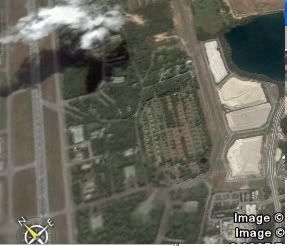
left is Paya Lebar Air Base runway which is est 60 m wide,right is flyover.
few knolls of sands in white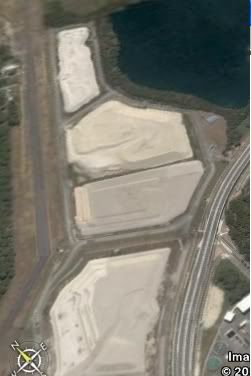
sands,sands,every where.$$ going upppppp
This is at the nothe west corner of Bedor Reservoir. -
Why? No need concrete floor for IRs?Originally posted by shade343:RELAX.
The IRs will most probably use steel frame structures. Although more expensive, its much faster to erect as compared to using concrete. IRs are targetting to build as fast as possible.
You mean other countries are not in need of steel? -
Singapore will harness technology to create artificial man-made sand and rice.
-
If there is a tiny short little specky boy in class who is very rich and is the top student in school.
The rest of the students in class are big, but poor and got no money, and lousy in studies. They are jealous of tiny rich boy. They think he is proud, and he look down on them. So the poorer students ostracize tiny rich boy.
What can tiny rich boy do? He can everyday use his wealth to buy lots of beer, wine, roast duck, roast chicken, cigarettes to offer to the poorer boys, until they get drunk and cannot study. They are grateful to tiny rich boy and no longer ostracise him.
The rich boy will graduate to join the top secondary school like RI, or top JC. The poorer students will fail their PSLE and repeat in primary school, or secondary school.
-
Want to know the real reason to ban the export of sands?Originally posted by bigmouthjoe:Wah you so cruel, those that are suffering are poor people (like me)...
But I agree, let's go to war!!!
Bleh.
It is their typical way in asking for more money
The current price already making them rich,
but they never know how to stop asking for more
Pretending to hold back the export of sand is just a trick
But if one day, when S'pore finally decides to stop buying,
then they will crawl back and start begging
The lesson: Never give in to any form of blackmail -
I thought you guys very good at politics one?
If you step on someone toes, someone will step back one lor... just givve them one reason huh they will stomp on your foot one times jialat. Singapore has no allies at all in this region. Maybe you guys who care so much about your bloody face will be the first one to run away when shit happens. All those who say that government good lah are those who benefit from some government policy or other.
I thought thailand is good friend, but now also no more. What you pro takshiit guys got to say? -
NOOOOOOOOOOO!!!!Originally posted by ShutterBug:What's next?
Thailand bans rice exports to us?
Wouldn't be surprised at all....!
We sure are getting 'luckier'...
i love thai rice!!!!!
-
Indonesia ban ALL sand export,not just pin point to SG
Thursday January 25, 6:17 PM
Indonesia bans sand exports
ADVERTISEMENT
SINGAPORE: Indonesia has announced a ban on land sand exports. Land sand is used in the construction industry to produce cement.
2.So,sg haS to prepare plan A to Z . -
with commodities price increasing again, construction cost will escalate again
-
One problem here. The poor big boys are smart too. And the rich little boy wasn't so smart after all.Originally posted by norm:If there is a tiny short little specky boy in class who is very rich and is the top student in school.
The rest of the students in class are big, but poor and got no money, and lousy in studies. They are jealous of tiny rich boy. They think he is proud, and he look down on them. So the poorer students ostracize tiny rich boy.
What can tiny rich boy do? He can everyday use his wealth to buy lots of beer, wine, roast duck, roast chicken, cigarettes to offer to the poorer boys, until they get drunk and cannot study. They are grateful to tiny rich boy and no longer ostracise him.
The rich boy will graduate to join the top secondary school like RI, or top JC. The poorer students will fail their PSLE and repeat in primary school, or secondary school. -
Originally posted by chiabaliao:One problem here. The poor big boys are smart too. And the rich little boy wasn't so smart after all.
-
Just come back from TW,very messy there!!!!Originally posted by Lowclassman:Why? No need concrete floor for IRs?
You mean other countries are not in need of steel?
This ah Bian may create a war there!!!
Every bldg needs sands to create concrete just depended on ratios!!!
Dont need 2 talk 2 ppls who doesnt even know wat is concrete!!!! -
Originally posted by ninefold9:
Don't buy from them lor. Source from somewhere else even if it costs more. When the Indonesians run out of money they will come crawling back. They can't be always relying on their women to service Singapore men
[b]Want to know the real reason to ban the export of sands?
It is their typical way in asking for more money
The current price already making them rich,
but they never know how to stop asking for more
Pretending to hold back the export of sand is just a trick
But if one day, when S'pore finally decides to stop buying,
then they will crawl back and start begging
The lesson: Never give in to any form of blackmail
[/b]
-
Can buy sand from White Sands mall.
-
Wednesday January 31, 12:17 PM
Sand ban a wake-up call for industry: architects
ADVERTISEMENT
SINGAPORE : The recent Indonesian ban on the sale of sand to Singapore has been an effective wake-up call for the industry, say architects.
Sustainable construction and alternative materials are now the buzzwords.
The Singapore Institute of Architects has also proposed a million-dollar research programme to look into solutions.
400,000 tonnes of sand from a regional country arrived at Jurong Port on Monday, just a week after Indonesia, the main supplier of sand to Singapore, banned all sand exports.
Architects say over-reliance on traditional sources and materials is due to a lack of research into sustainable construction now.
Tai Lee Siang, Council Member, Singapore Institute of Architects, said, "It does mean that what is really the new material that builders architects can depend on? There is a lack of research in the industry, even from the institute's point of view. We noticed that because of the good growth.
"There is a lack of research to anticipate problems to prepare for rainy days, so we want to embark on a research programme, we want the industry players to spend more on research to prepare ourselves, as sustainability issues are very great and environmental changes very great and all these will impact how we build."
Architect Tay Kheng Soon, who has been one of the key voices for sustainable development in Singapore, agrees that more needs to be done.
Tay Kheng Soon, Architect, Akitek Tenggara, said, "It is a great opportunity to rethink our building systems. Any change that happens has to be driven by certain forces - the sand ban is one of them, but the big question is really sustainable development.";
And many ideas are already being explored - like those by architect Jeremy Chan, who is looking at dry wall construction and triangular steel frames to reduce the amount of steel used.
He said, "Our industry is very used to using reinforced concrete in most of our construction, so this kind of really throws us into the deep end to think of a totally new way to conceptualising architecture and maximising a different material and expressing it in a different way."
Architect Mak Hon Yue has done an experiment on seacrete or sea concrete - which is an alternative to concrete.
Seacrete can be grown by passing an electric current through sea water to build up minerals and eliminates the need for sand.
He said, "There must be a culture of looking at alternative materials which is not really apparent in Singapore. And without that culture, we can't move ahead, we can't begin to develop alternatives if people are not interested in it, or they can't find commercial value in it, they won't pursue it, and I think that's very important.
"The reason why seacrete is not widely used, talked about is because people have yet to see the commercial viability of it - it's definitely sustainable - it's just to get people to see the commercial viability of it."
And the potential for seacrete is huge.
Mr Tay said, "In about 10 years, If you start now, theoretically, you could have a gigantic floating platform out there, outside Pasir Panjang and we could use it for our new seaport or resorts or whatever. We can live without sand."
The Building & Construction Authority has already come out to encourage the industry to adopt new construction materials and methods, while the proposed research programme by the Singapore Institute of Architects will also go some way to reduce the dependence on imported raw materials like sand. - CNA/ms
Sinkapore boast again!!!
Shellfish create their shells mainly out of Calcium carbonate, which like salt is suspended or dissolved in sea water. In addition to salt there are at least 56 other minerals available from sea water.
In the mid 1970's Professor Hilbertz from a Texas (USA) university was looking for methods to prevent metal from rusting and discovered a way to produce material very similar to shell fish shells. Which has been called by a variety of names, but we will stick with seacrete.
He discovered that if you run a small electrical current through a wire mesh immersed in the ocean, the material, mainly calcium carbonate, accretiate or is formed on the wire. The greater the current the more the minerals accretiated. Using a small electrical current in a few months it had become over an inch thick. It was both lighter and stronger than reinforced concrete. He went on to create some large structures by this process.
The technical article (tab above left) explains how it works and the formula for making it work, plus more information.
We have not yet looked at applications for this, although within visions, from the home page you will find some ideas as to how this might be able to be used.
In our opinion, in the longer term, this will form a major way for quality structures to be created, as very low cost. Clearly at this point it is less well understood than Ferrocement, and offers the opportunity for great developments.
It should be remembered that sub assemblies as well as complete structures can be made with this method.
Shells are often patterned, and very decorative, and we would see in the future the scope to grow whole structures or sub assemblies with colored patterned built in.
Very much of what has been said about Ferrocement from strength in box structures to the effective use with pods can also be said about seacrete. We have however not duplicated all the information within this section. -
Seacrete, also known as Seament and Sea Cement, is a substance formed by electro-accumulation of minerals dissolved in seawater.
Seacrete samples range in compressive strength from 3720 to 5350 lbf/in² (26 to 37 MPa) – for comparison, the concrete typically used in sidewalks has a strength of about 3500 lbf/in² (24 MPa). With very slow deposition (up to a year or more) strengths as high as 8000 lbf/in² (55 MPa) have been achieved. This is due to the fact that the material is deposited in a less porous (and thus denser state) when the material is deposited slowly. One of the main component of seacrete is magnesium hydroxide, another is calcium carbonate. This composition is chiefly the result of the composition of seawater.
It has been erronously reported that one kilowatt hour of electric power will result in the accretion of about 1.9 kg (4.2 lb) of seacrete; unfortunatelly this value appears to come from a confusion of power with energy and is therefore incorrect by a factor of 42 (the duration of the experiment was 42 hours). Correcting for this, seacrete becomes rather expensive: At $0.05 per kilowatt hour it would cost $1.10/kg, plus the cost of the electrodes (one of which will be embedded within the resulting object).
The production methods used in the original experiment were not optimal, and it is hoped that significantly lower costs will be possible. -
So how is this possible?
The mineral calcium carbonate, in the ocean, has electrically positive charged ions. All electrical currents, consists of the flow of ions from a positive point to a negative point. Like magnets, with ions opposites attract.
The wire mesh is immersed in seawater and electrical connections made, which creates an electrical flow where the wire mesh becomes a negative cathode. Ions of calcium combine with ions of carbonate in the seawater to form positive ions of calcium carbonate, which is attracted to the negative cathode of the wire mesh and deposited on the mesh as a solid.
As long as the electrical current flows, calcium carbonate and traces of other minerals, from the seawater, will continue to accretiate and thicken on the wire mesh indefinitely.
The amount that is extracted is surprising to say the least, and it is claimed that one kilowatt hour of electricity, (the equivalent power consumption of a one bar electric fire running for one hour) running through the wire mesh, will extract 4.2 pounds of calcium carbonate out of the seawater and deposit it onto the wire mesh as a solid.
Strength
Actual Seacrete creations of Professor Hilbertz demonstrated that Seacrete is both stronger and lighter than standard concrete. Seacrete created in 6 weeks, on ½" wire mesh, has a breaking strength of 4267 psi, which is 20% stronger than normal concrete. If it is deposited for longer periods, it produces an even stronger Seacrete, with breaking strengths up to 8000 psi obtained after 1 year. Seacrete is superior in every way to conventional concrete. It helps the environment by not needing all of the ingredients of traditional concrete. There is no sand, aggregate or endless bags of cement required.
Power formula
The amount of electrical current required to cause Seacrete to accretiate on the wire mesh is low. Only thirty amps at six volts is needed to form a current density of 1.3 milli-amps per square inch and create a one inch thickness of Seacrete in approximately 6 weeks. For more rapid deposition of calcium carbonate onto the wire mesh, current densities as high as 50,000 milli-amps per square foot can be used, but the greater the current density, the weaker the Seacrete.
Professor Hilbertz perfected the accretiation of Seacrete down to exact formulas. 189 milli-amps of current density through a ½ inch wire mesh will accretiate 1/10th of an inch of Seacrete in 170 hours. This is an accretiation rate of .0005 inches per hour. It takes three weeks, at that current density, to fill the ½ inch gaps in the wire mesh. A kilowatt of electrical power at 12 volts will create a current density of 189 milli-amps per square foot over a total area of 441 square feet.
More research
Surprisingly, the original work of Professor Hilbertz was not followed up except by a few enthusiasts lately, therefore Seacrete is still in the experimental stages and still requires more research into methods of creating very large structures. There, however, would not appear to be any problem that cannot be overcome. -
can we introduce a new business like new water, so we can call it NEW SAND...
 Originally posted by mhcampboy:Where else Singapore is importing sand from?
-
I prefer to introduce a Newgovernment.
-
Don't always think money solve everything. Sometimes other people feel that we throw money at them. If you are ion need of financial help, then your rich and hypocritical relative lend you money. Would you feel good?Originally posted by blowfish:didnt we lent indonesia hugh $$$ beofre during crisis? now they doing this?
Feels like being slapped in the faceSpore has learned how to create water. Its called Newater. Now they will also learn ways to create sand. It will be called NewSand.
Is it also created from the same sh!t that made the water? Will it grow mutant plants just as newwater is rumoured to cause health issues?