ST and Govt out of touch with American Politics
-
It is not the fixation of staying the course. both decision are going to be bad anyway. Half of the foreign figthers are Saudi origin as reported.Originally posted by Fingolfin_Noldor:What is the fixation with withdrawal = bad? As it is, the US is being led by the nose by Iran. The Iranians have threatened before that if they want to be wreck havoc on US troops it can and will. The entire Iraq is now being turned into a trap and the US is walking right into one. The US Army will get roasted alive in an urban warfare scenario. Period. Better to withdraw now, and then force all parties to come to terms. Everyone in Iraq barely tolerates the US because they all view the US as a foreign occupier.
Not to mention, the situation in the Middle East is such that taking sides will eventually lead some ... distant problem in the future... Especially when there are already 2 sides existing for centuries with plenty of mutual hatred. In any case, the Saudis are shitty allies to begin with.
The solution lies in the Iraqis finding common ground between all 3 major "factions": The Sunnis, the Shia, and the Kurds. A forced Military solution will not work especially when all sides have been brutalised by Saddam and before that now the capacity for revenge is far greater than anything the US can impose upon them.
If the insistance on staying is because the US created the mess it must fix it, then put it this way, there is nothing the US can do militarily except politically. If this was the initial phases of the invasion, it would have been achievable, but this administration bungled the initial phases of the invasion that it has far crossed the point of no return.
And now there is the issue of blooded terrorists going from Iraq and taking their trade elsewhere.
Is just which outcome does not widen the conflict into the region. I think Saudi has warn the US if they Pull out, they will move in and risk a regional conflict, i believe it would cost more live and debt. Contain the conflict within Iraq allow the regional political process to take its course. They are already meeting at various party including Iran and i think is a long way but is a step forward.
Withdrawer of troops involved global oil supply issue. And I suspect that is holding US from pulling out. I think they might redeployed rather than withdraw.
terrorist have already been move out and but looks to me they came from Pakistan.
A side note Democrats are more social policy friendly while Republican aren't, but i would not put bill clinton that high up either. -
We did initially, especially with respect to the Michael Fay caning case. It was only later did things improve when Singapore and US cooperated with regard to the Asian Economic crisis.Originally posted by Mat Toro:We didn't have a bad relationship with the last Democrat govt. Democrats do oppose free trade because they need to protect unions and that is not good for the world.
Clinton admin did nothing for the economy. They were just enjoying growth because of the internet boom and reduced taxes by Reagan. Had Clinton not increased taxes, the economy would have grown more.
Thats why Clinton still doesn't have a legacy except for the monica sex scandal and they are still searching for one.
Reagan, while reducing taxes, simply spent tonnes of cash in the military which expanded debt. -
Whether or not the outcome leads to a widened conflict depends on whether the Arabs and the Persians want to make peace really. Likely what will happen in Iraq, is that it will be a proxy war. The Saudis, while having fanciful machinery, aren't exactly... well trained.Originally posted by Arapahoe:It is not the fixation of staying the course. both decision are going to be bad anyway. Half of the foreign figthers are Saudi origin as reported.
Is just which outcome does not widen the conflict into the region. I think Saudi has warn the US if they Pull out, they will move in and risk a regional conflict, i believe it would cost more live and debt. Contain the conflict within Iraq allow the regional political process to take its course. They are already meeting at various party including Iran and i think is a long way but is a step forward.
Withdrawer of troops involved global oil supply issue. And I suspect that is holding US from pulling out. I think they might redeployed rather than withdraw.
terrorist have already been move out and but looks to me they came from Pakistan.
A side note Democrats are more social policy friendly while Republican aren't, but i would not put bill clinton that high up either. -
In terms of a sectarian proxy war, I would be wary of the Saudis instead. I foresee Iran moving away from religious extremism in the near future..
-
Michael Fay issue has to do with the American media and not really the Amrican govt. I'm glad our govt stood the ground and punished the vandal.Originally posted by Fingolfin_Noldor:We did initially, especially with respect to the Michael Fay caning case. It was only later did things improve when Singapore and US cooperated with regard to the Asian Economic crisis.
Reagan, while reducing taxes, simply spent tonnes of cash in the military which expanded debt.
Reagan's spending on the military was great investment because it ultimately brought down Soviets and ended the cold war. Thats why Reagan was hailed as a great president by both Republicans and Democrats alike. -
Actually, no. That is a myth. The Soviets didn't increase their spending even as Reagan did. They couldn't anyway. What really brought the Soviets down was internal coup.Originally posted by Mat Toro:Michael Fay issue has to do with the American media and not really the Amrican govt. I'm glad our govt stood the ground and punished the vandal.
Reagan's spending on the military was great investment because it ultimately brought down Soviets and ended the cold war. Thats why Reagan was hailed as a great president by both Republicans and Democrats alike.
And quite frankly, Yeltsin is no saint in Russia, but openly despised. That man allowed the Soviet Union to be carved up, and at the same time allowed the state treasury to be plundered.
I hope you remember that the American President asked our President to remove the caning and we said no, though we lowered the sentence. -
Originally posted by Fingolfin_Noldor:
There was no internal coup at all. The soviets themselves allowed the dis-integration of the USSR because they knew they can never out spend Reagan. Thats why there was a smooth transition.
Actually, no. That is a myth. The Soviets didn't increase their spending even as Reagan did. They couldn't anyway. What really brought the Soviets down was internal coup.
It wasn't Yeltsin but Gorbachev who orchestrated the dissolve.
And quite frankly, Yeltsin is no saint in Russia, but openly despised. That man allowed the Soviet Union to be carved up, and at the same time allowed the state treasury to be plundered..
Yeltsin was not despised but revered in Russia because he was reformist.
Are you sure you know history?
Thats all clinton did to appease the liberals. The american govt did not take any action against Singapore even though the media was pushing it.
I hope you remember that the American President asked our President to remove the caning and we said no, though we lowered the sentence. -
There was no internal coup at all. The soviets themselves allowed the dis-integration of the USSR because they knew they can never out spend Reagan. Thats why there was a smooth transition.
Smooth transition?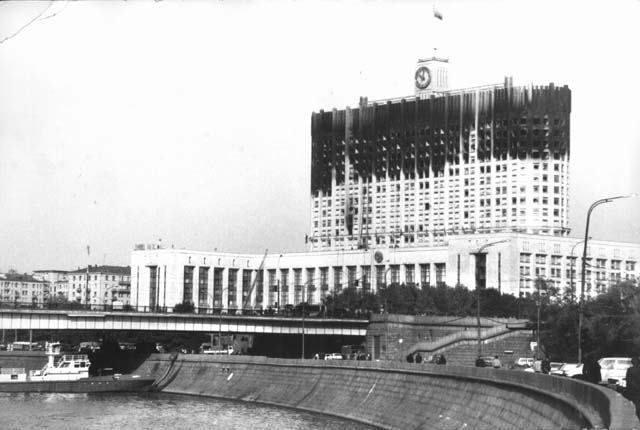
Yeah, smooth transition. That's the Supreme Soviet by the way. Who did it? Why, Russian troops who supported Yeltsin of course.It wasn't Yeltsin but Gorbachev who orchestrated the dissolve.
Gorbachev? Oh please. Take a look at the sign below:
Yeltsin was not despised but revered in Russia because he was reformist.
Are you sure you know history?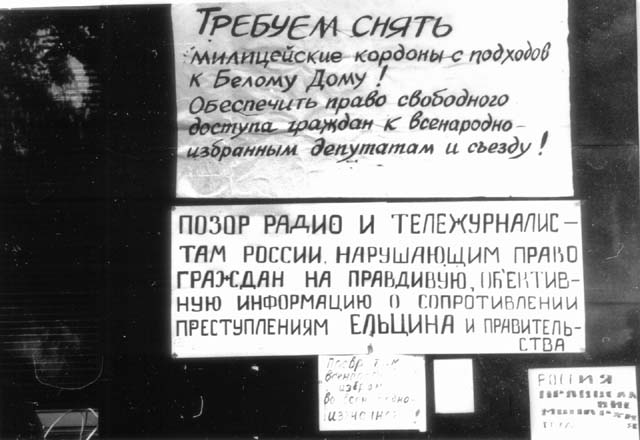
"We demand that the cordones around the White House be lifted! To allow the citizens to freely contact the nation-elected deputees!"
"Shame to the citizens and journalists who cover up, break the right of Russian citizens to objective and truthful information about the resistance to Yeltsin's crimes"
And the icing on the cake:
Yeah, Yeltsin FTW!
And oh please, that thug sold off state assets in a ridiculous prices and had a broken tax system and allowed the Oligarchs run away with impunity.
And oh by the way, Wikipedia gives the sanitized version the West loves, because the West loves Yeltsin.
They of course hated anything communist, or smacks of it. -
This happened only after the transition, not before.
Again you seem not to know what you are talking about.
First you said the collapse of the Soviet Union was brought about by a coup which never happened.
Now you show a coup that was to oppose this dissolution that was not even successful.
I suggest you think thru your stuff. Don't insult other people's intelligence and please respect the forumners here and please stop bluffing your way thru. -
Actually, no, these pictures were taken in 1993, after the dissolution of the Soviet Union. What happened was Yeltsin had a constitutional dispute with the Supreme Soviet and there after, had his troops fire upon the Supreme Soviet and their supporters. What happened next was the Russian equivalent of Tiananmen. And no, you won't see much of these pictures in western media. The links are even Russian. I would hardly call this smooth transition especially when it happened immediately after the "dissolution of the Soviet Union". Not only that, this thug managed to get himself extraordinary presidential powers and used brute force to remove an elected parliament. Are you certain Gorbachev is the real person behind the dissolution? What when the real mover of the dissolution was Yeltsin and a bunch of thugs who dismantled the country so that they could plunder it with impunity and driving millions of Russians into poverty?Originally posted by Mat Toro:This happened only after the transition, not before.
Again you seem not to know what you are talking about.
First you said the collapse of the Soviet Union was brought about by a coup which never happened.
Now you show a coup that was to oppose this dissolution that was not even successful.
I suggest you think thru your stuff. Don't insult other people's intelligence and please respect the forumners here and please stop bluffing your way thru.
But as for the dissolution, read the following:
This is what Gorbachev himself wrote:After they issued those Belovezha accords, I made a public statement, that three people cannot, by secretly gathering somehwere in the forest, to make decisions to destroy this country. The country for which our ancestors laid our lives. And I made propositions, to the Supreme Soviets of the Republics, a new Soviet Treaty, to make corrections and perhaps even take something from the Belovezha... but never forget about hte All-Union referenda, where the nation voted to preserve the Union.
Of course, guess what happened next ?
But instead of that they put only the Belovezha accord on the votes, and only 3 deputees in Ukraine voted against them. In Belorussia, only one - Lukashenko, in Russia - three were abstaining and three were against. Zyuganov voted "yes" on the request of Khazbulatov. Watch the TV records!
Yeltsin himself wrote about this:In his memoirs "The President Notes" Yeltsin openly writes, that in secret from the people, and from the government, he and his closest allies were preparing the forcible dissolution of the USSR. He mentions that the "conspirators" included Burbulis, Shakhrai, Gaidar, Kozyrev, Ilyushin. 7th December 1991, Yeltsin, accompanied by Burbulis, Shakhrai, Poltoranin and Kozyrev flies to Minsk with a firm intent to bring about the end of the Soviet Union. The goal of the trip is kept secret even from his closest surrounding, as he wrote in the memoirs, those people do not yet know that Yeltsin plans to do the horrible.
And even Russians rejoiced when that thug died: http://www.soviet-empire.com/ussr/viewtopic.php?t=41821&start=50&sid=70a6b0ebb5e21ca7e4c9fdd8bfa90633
The best quote from a post one poster put it:very sad that people like YELTSIN, jakovlev dies. Gorbachev is still alive. We wish him good health and happy life, so he can survive till his capital punishment".
The bigger question is this: Whose version of history do you follow? The Western view of Russian History or the Russian view of their own?
And what? You are going to trust the version of history given by a bunch of thugs in the various states who separated and subsequently plundered the country and were removed later? -
The Soviet Union split and it wasn't a coup that did it. The Kremlin itself planned it simply because they knew they could not match Reagan and the Soviet system was pointless.
-
anyway this is about american politics n what SG view right ? So we start a new thead for Russian politics.
In any case i think if it wasn't for the bad outcome of the war in iraq i don't think Democrats stand a chance for this coming election. i suspect if Hilary were to take office I don;t think she will pull out but redeployed. I think after 8 years as first lady she understood how international relation are played. 8 years observing she must have pick up some do's n don't.
I don't think Obama fully comprehend the situation, so far it is just generic speech on foreign policy. Maybe that is why PM Aus Howard was speaking out. It reflect if Obama abilities to accept America place and responsibilities in History. After all, all the previous war was fought by white american. African american has a very different perspective in history.
the news media seemed to cover more and shade more positive on Democrats candidates maybe because they have generated the most money. able to pay top dollar for coverage.
eversince LHL took office he has been quite outspoken publicly on foreign policy, however i am not sure most of his position are well thought out of consequences not sure if MOF have a team to work with him on what position he wants to take or he decide what to say at the last minute. So i would not be surprise if he said something stupid down the road during the election years. like "stay the course" "don't leave with your tail behind the leg"
American remember that.
-
How many more right wing myths are you going to spout?Originally posted by Mat Toro:The Soviet Union split and it wasn't a coup that did it. The Kremlin itself planned it simply because they knew they could not match Reagan and the Soviet system was pointless.The breakup of the Soviet Union ended Russia's march to democracy
Putin's Russia can only be understood in the light of the national collapse triggered by the dissolution of the USSR
Stephen Cohen
Wednesday December 13, 2006
The Guardian
The most consequential event of the second half of the 20th century took place 15 years ago at a secluded hunting lodge in the Belovezh Forest near Minsk. On December 8 1991, heads of three of the Soviet Union's 15 republics, led by Russia's Boris Yeltsin, met there to sign documents abolishing that 74-year-old state.
For most western commentators the Soviet breakup was an unambiguously positive turning point in Russian and world history. As it quickly became the defining moment in a new American triumphalist narrative, the hope that Mikhail Gorbachev's pro-Soviet democratic and market reforms of 1985-91 would succeed was forgotten. Soviet history was now presented as "Russia's seven decades as a rigid and ruthless police state". American academics reacted similarly, most reverting to pre-Gorbachev axioms that the system had always been unreformable and doomed. The opposing view that there had been other possibilities in Soviet history, "roads not taken", was dismissed as a "dubious", if not disloyal, notion. Gorbachev's reforms, despite having so remarkably dismantled the Communist party dictatorship, had been "a chimera", and the Soviet Union therefore died from a "lack of alternatives".
Article continues
Most specialists no longer asked, even in the light of the human tragedies that followed in the 1990s, if a reforming Soviet Union might have been the best hope for the post-communist future of Russia. Nor have mainstream commentators asked if its survival would have been better for world affairs. On the contrary, they concluded that everything Soviet had to be discarded by "the razing of the entire edifice of political and economic relations". Such certitudes are now, of course, the only politically correct ones in US (and most European) policy, media and academic circles.
A large majority of Russians, on the other hand, as they have regularly made clear in opinion surveys, regret the end of the Soviet Union, not because they pine for "communism" but because they lost a secure way of life. They do not share the nearly unanimous western view that the Soviet Union's "collapse" was "inevitable" because of inherent fatal defects. They believe instead, and for good reason, that three "subjective" factors broke it up: the way Gorbachev carried out his political and economic reforms; a power struggle in which Yeltsin overthrew the Soviet state in order to get rid of its president, Gorbachev; and property-seizing Soviet bureaucratic elites, the nomenklatura, who were more interested in "privatising" the state's enormous wealth in 1991 than in defending it. Most Russians, including even the imprisoned oligarch Mikhail Khodorkovsky, therefore still see December 1991 as a "tragedy".
In addition, a growing number of Russian intellectuals have come to believe that something essential was lost - a historic opportunity to democratise and modernise Russia by methods more gradualist, consensual and less traumatic, and thus more fruitful and less costly, than those adopted after 1991.
One common post-Soviet myth, promoted by Yeltsin's supporters, is that the dissolution was "peaceful". In reality, ethnic civil wars erupted in central Asia and Transcaucasia, killing hundreds of thousands and brutally displacing even more, a process still under way.
It is hard to imagine a political act more extreme than abolishing what was still, for all its crises, a nuclear superpower state of 286 million citizens. And yet Yeltsin did it, as even his sympathisers acknowledged, in a way that was "neither legitimate nor democratic".
Having ended the Soviet state in a way that lacked legal or popular legitimacy - in a referendum nine months before, 76% had voted to preserve the union - the Yeltsin ruling group soon became fearful of real democracy. And indeed Yeltsin's armed overthrow of the Russian parliament soon followed.
The economic dimensions of Belovezh were no less portentous. Dissolving the union without any preparatory stages shattered a highly integrated economy and was a major cause of the collapse of production across the former Soviet territories, which fell by almost half in the 1990s. That in turn contributed to mass poverty and its attendant social pathologies, which are still, in the words of a respected Moscow economist, the "main fact" of Russian life today.
And, as a one-time Yeltsin supporter wrote later, "almost everything that happened in Russia after 1991 was determined to a significant extent by the divvying-up of the property of the former USSR". Soviet elites took much of the state's enormous wealth with no regard for fair procedures or public opinion. To enrich themselves, they wanted the most valuable state property distributed from above, without the participation of legislatures. They achieved that, first by themselves, through "spontaneous nomenklatura privatisation", and after 1991, through Kremlin decrees issued by Yeltsin.
Fearful for their dubiously acquired assets and even for their lives, the new property holders were as determined as Yeltsin to limit or reverse the parliamentary electoral democracy initiated by Gorbachev. In its place they strove to create a political system devoted to and corrupted by their wealth, at best a "managed" democracy. Hence their choice of Vladimir Putin, a vigorous man from the security services, to replace the enfeebled President Yeltsin in 1999. And uncertain how long they could actually retain their immense property, they were more interested in stripping its assets than investing in it. The result was an 80% decline in investment in Russia's economy by the end of the 1990s - and the nation's demodernisation. Given such a record, it is scarcely surprising that Putin's attempt to reassert state control over Russia's oil and gas industries is so popular.
So why did so many western commentators hail the breakup of the Soviet Union as a "breakthrough" to democracy? Their reaction was based mainly on anti-communist ideology and hopeful myths.[
Yeltsin abolished the Soviet Union with the backing of the nomenklatura elites - pursuing the "smell of property like a beast after prey", as Yeltsin's chief minister put it - and an avowedly pro-democracy wing of the intelligentsia. Traditional enemies in the pre-Gorbachev Soviet system, they colluded in 1991 largely because the intelligentsia's radical market ideas seemed to justify nomenklatura privatisation.
But the most influential pro-Yeltsin intellectuals were neither coincidental fellow travellers nor real democrats. Since the late 1980s they had insisted that free-market economics and large-scale private property would have to be imposed on Russian society by an "iron hand" regime using "anti-democratic measures". Like the property-seeking elites, they saw Russia's newly elected legislatures as an obstacle. Admirers of Chile's Augusto Pinochet, they said of Yeltsin: "Let him be a dictator!" Not surprisingly, they cheered (along with the US government and mainstream media) when he used tanks to destroy Russia's popularly elected parliament in 1993.
Political and economic alternatives still existed in Russia after 1991, and none of the factors contributing to the end of the Soviet Union were inexorable. But even if democratic and market aspirations were among them, so were cravings for power, political coups, elite avarice, extremist ideas and widespread perceptions of illegitimacy and betrayal. It should have been clear which would prevail. -
Actually, Hillary is riding a lot on Bill Clinton's popularity.... and it's kinda of hard for him not to overshadow her during the campaign walksOriginally posted by Arapahoe:anyway this is about american politics n what SG view right ? So we start a new thead for Russian politics.
In any case i think if it wasn't for the bad outcome of the war in iraq i don't think Democrats stand a chance for this coming election. i suspect if Hilary were to take office I don;t think she will pull out but redeployed. I think after 8 years as first lady she understood how international relation are played. 8 years observing she must have pick up some do's n don't.
I don't think Obama fully comprehend the situation, so far it is just generic speech on foreign policy. Maybe that is why PM Aus Howard was speaking out. It reflect if Obama abilities to accept America place and responsibilities in History. After all, all the previous war was fought by white american. African american has a very different perspective in history.
the news media seemed to cover more and shade more positive on Democrats candidates maybe because they have generated the most money. able to pay top dollar for coverage.
eversince LHL took office he has been quite outspoken publicly on foreign policy, however i am not sure most of his position are well thought out of consequences not sure if MOF have a team to work with him on what position he wants to take or he decide what to say at the last minute. So i would not be surprise if he said something stupid down the road during the election years. like "stay the course" "don't leave with your tail behind the leg"
American remember that.
As for Obama, some Aussies on another forum regard the Australian PM as a class one idiot. Actually they consider most of the political establishment as idiots. The reason being is that Howard is feeling weak politically at home with rising domestic resistance to Australian involvement of the war and the rising popularity of his political opponents made him attempt to pander to Bush. I mean, he is one of Bush's pet dogs.
Actually, CNN and FoxNews are right wing..... and FoxNews hates the Democrats.... It's not because the Democrats have the most money really. Even news networks know that hte tide of public opinion is against the war. -
This article appeared in the NYTimes:
The New York Times
Printer Friendly Format Sponsored By
July 19, 2007
Cleric Switches Tactics to Meet Changes in Iraq
By ALISSA J. RUBIN
BAGHDAD, July 18 — After months of lying low, the anti-American Shiite cleric Moktada al-Sadr has re-emerged with a shrewd strategy that reaches out to Iraqis on the street while distancing himself from the increasingly unpopular government.
Mr. Sadr and his political allies have largely disengaged from government, contributing to the political paralysis noted in a White House report last week. That outsider status has enhanced Mr. SadrÂ’s appeal to Iraqis, who consider politics less and less relevant to their daily lives.
Mr. Sadr has been working tirelessly to build support at the grass-roots level, opening storefront offices across Baghdad and southern Iraq that dispense services that are not being provided by the government. In this he seems to be following the model established by Hezbollah, the radical Lebanese Shiite group, as well as Hamas in Gaza, with entwined social and military wings that serve as a parallel government.
He has also extended the reach of his militia, the Mahdi Army, one of the armed groups that the White House report acknowledged remain entrenched in Iraq. The militia has effectively taken over vast swaths of the capital and is fighting government troops in several southern provinces. Although the militia sometimes uses brutal tactics, including death squads, many vulnerable Shiites are grateful for the protection it affords.
At the same time, the Mahdi Army is not entirely under Mr. SadrÂ’s control, and he publicly denounces the most notorious killers fighting in his name. That frees him to extend an olive branch to Sunni Arabs and Christians, while championing the Shiite identity of his political base.
On May 25, in his first public Friday Prayer in months, he explicitly forbade sectarian attacks.
“It is prohibited to spill the blood of Sunnis and Iraqi Christians,” he told Shiites in a much publicized sermon. “They are our brothers, either in religion or in the homeland.”
Almost from the day American troops entered Iraq, the mercurial Mr. Sadr has confounded American and Iraqi politicians alike. He quickly rallied impoverished Shiites in peaceful displays of Shiite strength, as had his father, a prominent cleric. When the Sunni Arab insurgency gained momentum, he raised a Shiite insurgency in direct opposition to the American-backed Iraqi government that had excluded him.
His basic tenets are widely shared. Like most Iraqis, he opposes the American military presence and wants a timetable for departure — if only to attain some certainty that the Americans will leave eventually. He wants the country to stay unified and opposes the efforts of those Shiites who have had close ties to Iran to create a semiautonomous Shiite region in southern Iraq.
After his Mahdi militia was defeated in a bloody battle against American forces in Najaf in 2004, Mr. Sadr established himself as a political player, using the votes of loyal Parliament members to give Nuri Kamal al-Maliki the margin needed to win the post of prime minister.
Now that the leadership is in poor repute, Mr. Sadr has shifted once again. The six ministers in the cabinet and 30 lawmakers in Parliament allied to him have been boycotting sessions. They returned Tuesday, but it is not clear they will stay long.
The mainstream political parties in Iraq realize that Mr. Sadr is growing more influential, but appear to be flummoxed over how to deal with him. They see him as unpredictable and manipulative, but too politically and militarily important to ignore.
“He’s powerful,” said Jaber Habeeb, an independent Shiite member of Parliament and political science professor at Baghdad University. “This is a fact you have to accept, even if you don’t like it.”
The latest stance by the more conventional political parties is to keep him at armÂ’s length. The two major Shiite parties, Dawa and the Supreme Islamic Iraqi Council, along with the two Kurdish parties, have been negotiating to form a new moderate coalition.
Mr. SadrÂ’s political leaders were told he was welcome to join, but the invitation came belatedly, after the other groups had all but completed their discussions. Mr. SadrÂ’s lieutenants announced that he had no interest in joining.
Experts in Shiite politics believe that efforts to isolate Mr. Sadr are bound to fail.
“Sadr holds the political center in Iraq,” said Joost Hiltermann, the director of the International Crisis Group’s office in Amman, Jordan. “They are nationalist, they want to hold the country together and they are the only political organization that has popular support among the Shias. If you try to exclude him from any alliance, well, it’s a nutty idea, it’s unwise.”
The mainstream parties talk about Mr. Sadr carefully. Some never mention his followers or the Mahdi militia by name, but speak elliptically of “armed groups.” Others acknowledge his position but are reserved on the challenge he poses.
“Moktada Sadr is one of the political leaders of this country,” Adel Abdul-Mahdi, one of Iraq’s two vice presidents, said in a recent interview. “We disagree on some things, we have differences. We have to work to solve our differences.”
The Sadrists exhibit a quiet confidence, and are pulling ever more supporters into their ranks. “The Sadr movement cannot be marginalized; it is the popular base,” said Sheik Salah al-Obaidi, the chief spokesman and a senior strategist for Mr. Sadr’s movement in Najaf. “We will not be affected by efforts to push us to one side because we are the people. We feel the people’s day-to-day sufferings.”
A number of working-class Shiites reflected that sentiment in conversations about the Mahdi militia and Mr. Sadr. Their relatives and neighbors work both for the Sadr offices and for the militia, blurring the line between social programs and paramilitary activity.
Mr. Sadr’s offices are accessible storefronts that dispense a little bit of everything: food, money, clothes, medicine and information. From just one office in Baghdad and one in Najaf in 2003, the Sadr operation has ballooned. It now has full-service offices in most provinces and nine in Baghdad, as well as several additional storefront centers. In some neighborhoods, the militiamen come around once a month to charge a nominal fee — about 5,000 Iraqi dinars, or $4 — for protection. In others, they control the fuel supply, and in some, where sectarian killings have gone on, they control the real estate market for empty houses.
The Mahdi militia is deeply involved in that sectarian killing. In a vicious campaign in the Amil neighborhood in western Baghdad, once a mixed working-class neighborhood of Shiites and Sunni Arabs, it has driven out many Sunnis and isolated others in a few enclaves.
Young men, said by residents to be part of the Mahdi militia, check every car coming into the Shiite section of the neighborhood. And many mornings, the bodies of several Sunni Arabs are dumped in a brick-strewn lot near the neighborhoodÂ’s entrance. Local Shiites routinely claim that the bodies are of foreign terrorists.
However, each community insists that it is the victim of the other. A sniper in the Sunni Arab area shoots at Shiites lined up to buy at a gasoline station that straddles the two communities. That, in turn, is used to justify retaliatory attacks on Sunni Arabs.
Among Shiites, the militia is viewed as their best form of protection from Sunni Arab insurgents. “This is the Mahdi Army standing in our streets,” said Rahman al-Mussawi, 38, a community leader who says he is proud that he still has Sunni Arab neighbors on his block, even though Sunni insurgents almost certainly killed his three younger brothers. They disappeared along a deadly stretch of road south of Baghdad where Shiites have been victims of Sunni extremists.
Mr. Mussawi gestured to the end of the block, where young Mahdi guards in T-shirts checked cars entering the neighborhood: “The Americans chase them away. If the Americans just would leave, then the neighborhood would be quiet.”
The Mahdi ArmyÂ’s darker side is rarely discussed in Shiite neighborhoods. In Amil, some people fiercely reject any suggestion that the group runs death squads. Others might admit to some problems, but dismiss them as the excesses of a few bad apples.
“Of course there are some wrongdoings done by renegades in the Mahdi Army who deviated from the good and honorable line of the army,” said Mohammed Abu Ali, 55, a mechanical engineer who helps out in the Sadr office in Amil. “We do not approve these wrongdoings and we try to rid of elements in the Mahdi Army.”
Mr. Sadr began his most recent ascent after the bombing of the golden dome of the Askariya shrine in Samarra, sacred to Shiites, in February 2006. It was one of a string of assaults by Sunni Arab insurgents on Shiites that had gone on for more than two years.
Mr. SadrÂ’s militia began to strike back, supported by Shiites who felt it was their only protection.
Iraqi politicians say Mr. Sadr made another smart move this spring, when he pulled out of the government to protest its refusal to set a timetable for the withdrawal of American troops. Stymied by infighting, Mr. Maliki has yet to fill the posts.
Shortly after a second bombing in Samarra this June, Mr. Sadr called for a mass Shiite pilgrimage to the Sunni Arab city to honor an imam whose body lies in the ruined shrine. Government officials had to plead with him to cancel it to avoid violence. He eventually did, but not until he had made his point: he was a power to be reckoned with.
Qassim Daoud, a secular Shiite lawmaker, says Mr. Sadr has figured out the alchemy to playing the outsider, but having just enough of a place in the government to have leverage.
“He is one of those people who has two legs, one inside the political process and one outside the political process,” Mr. Daoud said. “So, he uses both to attack the process.” -
To be fair, 911 gave him the platform - and in a way, altered his mindset drastically and forced him to become the delusional "destiny politician" he regards himself to be - to create the mess which will always be synonymous with his administration. That, more than anything, accounts for his Iraq adventures.Originally posted by Atobe:When this current US President George Bush first came into his White House office, he seemed to have already targetted his sights at Sadam Hussein - as Sadam made the mistake of taunting George Bush Senior that he will still be around when G. Bush Senior and a few more other US Presidents come in and out of their respective presidentail terms.
With Cheney backing him, George Bush Junior was all the more adamant to have his own version of an Iraqi campaign as his father had.
The biggest issue I take with the incumbent, besides his inexcusably remarkable incompetence, was his inability to put capable people in key positions of his administration. In the context of US politics, that is what usually happens (although in this instance, his suspect intellect must have compounded matters no doubt) with someone who owes nothing to his ability and almost everything exclusively to the reputation and capability of his other family members who have him a headstart. While it's less clear he owes his place at Yale to the fact that James Prescott Bush and George HW Bush were Yale alumni, it's just about beyond any reasonable doubt anyone with his incompetence and inexperience could have risen through the ranks of the GOP the way he did - just analyse his huge war chest in the GOP Presidential primaries compared to others vying for the GOP nomination in 2000.
It says a lot about the PR abilities of a man who regards Putin as a friend, Musharraf as a credible ally and actually regards this fascist regime as worthy of paying 3 visits (at least) to while in Office, doesn't it?Originally posted by Atobe:
As much as Singapore Government is seen to be out of touch with American Politics, the US President seems to be a country boy out of touch with the World and its Politics - and had under his command - a vast choice of military men, equipment and military industry to support his planned Iraqi adventure.
In less then ten years in the White House office, President George Bush Jr spent the US Treasure into massive deficits and burden the future US generations with deep debt that will take a few generation to clear.
The greatest remiss of the whole economic mismanagement of the Bush administration stems not so much from what things are like as they stand. Rather, you do sometimes wonder if things might have been better had the incumbent inherited his father's economy rather the one Clinton vacated - there's no denying the fact the rosy economy which existed when Clinton left Office gave the incumbent massive leeway (and by extension, massive confidence of the American masses) in the way he's run national affairs. Obviously, 911 was a just reason (whatever the consensus on his actions, it was almost a universally shared belief that he had to do something to put that right) that further accentuated the urgency of Bush's policies we've seen over the last few years. That said, the underlying reason behind the national debt could very much - IMO at least - be attributed to a string of daft and naive policies (not least, his mind-boggling estimation of timeframe required for operations in Iraq - if anything, it's the Americans who have been "shocked and awed" ). -
You're really making me laugh.Originally posted by Mat Toro:We didn't have a bad relationship with the last Democrat govt. Democrats do oppose free trade because they need to protect unions and that is not good for the world.
Clinton admin did nothing for the economy. They were just enjoying growth because of the internet boom and reduced taxes by Reagan. Had Clinton not increased taxes, the economy would have grown more.
Thats why Clinton still doesn't have a legacy except for the monica sex scandal and they are still searching for one.
Lowest unemployment rate in 30 years, lowest inflation rate since the Kennedy administration, highest average wages across the board for all ethnicity, first administration to churn out bugdet surpluses instead of deficits since Lyndon Johnson (and that's before you consider Clinton transformed the greatest budget deficits ever to the highest budget surpluses ever during his term of office) and more people going to college than any point in time. All that for the world's strongest economy (perhaps, you need reminding the economy of scale we're talking about here). That's not an economic legacy worthy of mention?
If the drivel you've been espousing is what this regime's propaganda mouthpieces have been feeding you, I can surely understand why they're ranked 154th in the world for press freedom. -
Not least, when George W. Bush returned, a lot of the ideological idiots in the previous administration returned and they single handedly created the largest ever deficit since the Great Depression or WWII.Originally posted by walesa:You're really making me laugh.
Lowest unemployment rate in 30 years, lowest inflation rate since the Kennedy administration, highest average wages across the board for all ethnicity, first administration to churn out bugdet surpluses instead of deficits since Lyndon Johnson (and that's before you consider Clinton transformed the greatest budget deficits ever to the highest budget surpluses ever during his term of office) and more people going to college than any point in time. All that for the world's strongest economy (perhaps, you need reminding the economy of scale we're talking about here). That's not an economic legacy worthy of mention?
If the drivel you've been espousing is what this regime's propaganda mouthpieces have been feeding you, I can surely understand why they're ranked 154th in the world for press freedom.
And yes, this guy's been spouting all the crap from the ST, hardly the place to go for International news. -
You're making me laugh, really.Originally posted by Mat Toro:Reagan's spending on the military was great investment because it ultimately brought down Soviets and ended the cold war. Thats why Reagan was hailed as a great president by both Republicans and Democrats alike.
Are you in the business of re-writing history? You're the first chap to tell me Reagan's spending on the military "brought down the Soviets and ended the Cold War". -
He's been reading too many Tom Clancy books and right wing articles, i.e. The Straits Times.Originally posted by walesa:You're making me laugh, really.
Are you in the business of re-writing history? You're the first chap to tell me Reagan's spending on the military "brought down the Soviets and ended the Cold War". -
This whole argument is pointless because there are numerous takes on it, depending on your perspective.Originally posted by Mat Toro:The Soviet Union split and it wasn't a coup that did it. The Kremlin itself planned it simply because they knew they could not match Reagan and the Soviet system was pointless.
Officially, the USSR ceased to exist on 25th December 1991 when Gorbachev formally announced its dissolution - then again, by then, the USSR was effectively non-existent with the CIS (Commonwealth of Independent States) already drawn up and the former Soviet republics (as we now come to address them collectively) were in the midst of drafting their new Constitutions.
If you want to credit the dissolution of the USSR to Yeltsin, then you'd be talking about the failed coup where Yeltsin stood atop the tank (pictures of that can be found easily on the internet).
That said, it wouldn't be illogical to attribute the dissolution of the USSR to Lech Walesa and the Pope's actions in the early 1980's either, culminating in the de-satellisation of the Eastern Bloc, which eventually prompted the unrest that spreaded across the Soviet Union itself. -
She should - and with good reason. It'd be foolhardy not to play on your strength against an opponent.Originally posted by Fingolfin_Noldor:Actually, Hillary is riding a lot on Bill Clinton's popularity.... and it's kinda of hard for him not to overshadow her during the campaign walks
I remain convinced Al Gore made the fatal mistake in 2000 of distancing himself from the man who, despite his personal indiscretions, has an economic legacy worthy of putting him right up there with the finest individuals to have graced the White House. -
The trouble back then, was that the Republics pandered themselves to the Christian fundamentalists and successfully got them to back them. Apparently, these bastards represent some 10% of the electorate. Not only that, they got them to vote for the Republicans. Much of this was to do with superior Republican electoral planning which totally outmaneuvered the Democrats.Originally posted by walesa:She should - and with good reason. It'd be foolhardy not to play on your strength against an opponent.
I remain convinced Al Gore made the fatal mistake in 2000 of distancing himself from the man who, despite his personal indiscretions, has an economic legacy worthy of putting him right up there with the finest individuals to have graced the White House. -
THere were of course many factors that would have led to the collapse, but many of the movers of the collapse were hell-bent on taking control of the state and plundering it. It was PAP on steroids.Originally posted by walesa:This whole argument is pointless because there are numerous takes on it, depending on your perspective.
Officially, the USSR ceased to exist on 25th December 1991 when Gorbachev formally announced its dissolution - then again, by then, the USSR was effectively non-existent with the CIS (Commonwealth of Independent States) already drawn up and the former Soviet republics (as we now come to address them collectively) were in the midst of drafting their new Constitutions.
If you want to credit the dissolution of the USSR to Yeltsin, then you'd be talking about the failed coup where Yeltsin stood atop the tank (pictures of that can be found easily on the internet).
That said, it wouldn't be illogical to attribute the dissolution of the USSR to Lech Walesa and the Pope's actions in the early 1980's either, culminating in the de-satellisation of the Eastern Bloc, which eventually prompted the unrest that spreaded across the Soviet Union itself. -
I think the bigger flaw stems from Al Gore's campaign - by distancing himself from Clinton, he made himself unavailable to most (if not all) of the key players who had propelled Clinton to office in 1992. Of course, the worse thing he could have done was to prevent Clinton, who'd readily made himself available, from campaigning for him. Besides, I'm unconvinced if Al Gore had had James Carville (the strategist who had propelled Clinton to office in '92 and re-election in '96) on board running his strategy, he'd have lost.Originally posted by Fingolfin_Noldor:The trouble back then, was that the Republics pandered themselves to the Christian fundamentalists and successfully got them to back them. Apparently, these bastards represent some 10% of the electorate. Not only that, they got them to vote for the Republicans. Much of this was to do with superior Republican electoral planning which totally outmaneuvered the Democrats.
Of course, it's easy for me to talk about that on hindsight, but if you consider the fact that Gore lost by 537 votes in Florida - a state where more than 100, 000 votes went to Ralph Nader - and numerous other close losses elsewhere (and Gore had the simple majority, mind), the whole Clinton economic legacy could have just tipped things his way.
The whole notion of the GOP paddling their religious drivel to the fundamentalists doesn't really strike a chord with me despite it covering 10% of the eligible electorate because it's hard to track how many of those eligible in this category actually turned up to vote on election day. Referring to the above paragraph, it's pretty clear - to me, at least - Al Gore's indiscretions were instrumental in his failed bid. Ironically, if you needed an indication (Gore was needlessly worried about the female votes considering the Lewinsky affair), more women had actually voted for him in 2000 than those who did for Clinton's re-election bid in '96 - it's indeed a shame, among his other oversights, he placed too much of an emphasis on the women's votes.