This post was supposed to have been posted in the earlier thread ''A Blast from the Past'', which somehow was locked out as a topic having expired.
In anyway, looking back at events and comparing to present day politics in Singapore, was it co-incidental that when the PAP was formed, it had its objectives in Socialism but evolved 50 years later to resemble a fascist party ?
The following will provide a peek into the evolution of politics in Singapore during the 1950s.
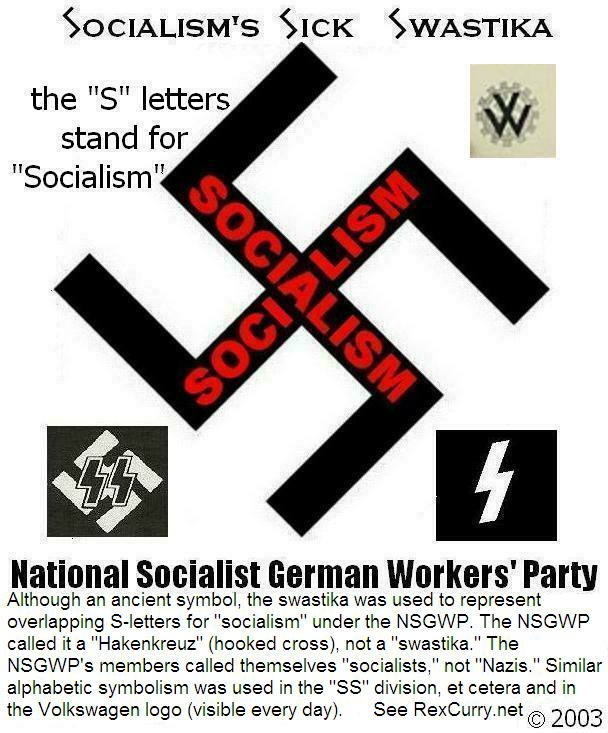
A recent Opinion Editorials column gained attention for showing the swastika's modern use as overlapping S-shapes for "Socialism. " The column, which exposed the British Union of Fascists and National Socialists and its logo (an S-shaped lightning bolt for "Socialists" ) led to new discoveries regarding symbolism in the Peoples Action Party (PAP) of Singapore. http://rexcurry.net/peoples-action-party-pap-singapore-socialism.html
The PAP began as a socialist party and adopted as its logo the same S-shaped symbolism of the British Union of Fascists and National Socialists (BUFNS). The noted historian Dr. Rex Curry (author of "Swastika Secrets" ) has established that the PAP's logo originated as an "S" letter for "Socialists. " http://rexcurry.net/british-union-of-fascists-sir-oswald-mosley.html
Wikipedia is announcing the amazing discoveries concerning the PAP and the BUFNS. Dr. Curry's research about the BUFNS ranks at the top of internet searches. Recent articles at opinioneditorials.com report on the many references to the research on Wikipedia. Even Wikipedia's founder Jimbo Wales has publicly commented on Dr. Curry's influence on Wikipedia. His work is probably be the most referenced historical research on Wikipedia. The work has been reviewed and verified by wikipedia writers. Some Wikipedia writers use Dr. Curry's work without attribution in apparent attempts to bolster their own credibility.
Of course, Wikipedia is a glorified anonymous bulletin board and is constantly changed, often at the hands of vandals and even neo-nazis. A recent web search for "British Union of Fascists and National Socialists" showed Dr. Curry's work at the top, and indicated that there is no wikipedia article in existence. Wikipedia gives the mis-impression that the BUFNS never existed, or that its name-change never occurred. It is more air-brushed revisionist history on wakipedia.
The PAP smeared its way onto the political scene in 1954 when it was formed by English-educated middle-class men who had returned to Singapore from Britain. The PAP became a member of the Socialist International. The PAP logo has a double connotation for "Singapore Socialists."
The PAP's logo supports Dr. Curry's discovery that the swastika was used as alphabetic symbolism for overlapping "S" letters for "socialism" under the National Socialist German Workers' Party.
In the early 1950's, when the socialist symbolism was adopted in Singapore, the leader of the BUFNS (Oswald Mosley) was trying to revive his socialist movement in Britain and was still using the same S-shaped symbol for socialism in his Union Movement (UM). Mosley had returned to the leadership of British national socialism by founding the UM in 1948 at a meeting in London's Farringdon Hall, where as many as fifty one separate groups came under the new umbrella. Mosley re-emerged as a candidate in 1959 in North Kensington (which included Notting Hill), in the first parliamentary election for him since 1931.
There is evidence that the PAP also adopted the stiff-arm salute of the National Socialists.
The gesture originated from national socialists in the United States in 1892 from the original Pledge of Allegiance written by Francis Bellamy, as shown in the historical discoveries of Dr. Rex Curry. It was part of a scheme for government to take over all education and to place flags over each school, and to compel robotic chanting daily in worship of government for twelve years of every child's life. It still occurs today in some oddball states in the USA, though the gesture has changed.
From national socialists in the USA, the straight-arm salute spread worldwide to: the National Socialists German Workers' Party; the former Union of Soviet Socialist Republics; the British Union of Fascists and National Socialists; the Peoples' Action Party; the Peoples' Republic of China. The salute is still used in Russia and in the Peoples' Republic of China and elsewhere.
Behind it was the same dogma that led to the socialist Wholecaust (of which the Holocaust was a part): 60 million slaughtered under the former Union of Soviet Socialist Republics; 50 million under the Peoples' Republic of China; 20 million under the National Socialist German Workers' Party. It was the worst slaughter in the history of the world. It was so bad that Holocaust Museums could quintuple in size by including Wholecaust museums.
The Peoples' Action Party continues to share goals with socialists in China.
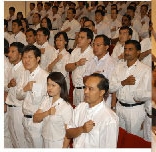
The PAP eventually played copycat to the United States again in adopting a hand-over-the-heart gesture. PAP members continue to wear uniforms at their Party meetings, dressing all in the same color and clothing.
The PAP initially adopted a traditional socialist party organization together with a vanguard cadre from its socialist-leaning faction in 1958. The PAP formed a joint alliance with the so-called communists against colonialism in Singapore during the party's early years.
continue below
Atobe
continuation
Today, the PAP considers itself as subscribing to socialist ideologies. The PAP has been the ruling political party in Singapore since 1959 and thus has a large role in the formation of the government of Singapore.
From the 1963 general elections onwards, the PAP has dominated Singapore's parliament and politics. The PAP has held the overwhelming majority of seats in Parliament since 1966, when the opposition Barisan Sosialis (Socialist Front), another socialist group that split from PAP in 1961, resigned from Parliament after winning 13 seats following the 1963 state elections, which itself occurred months after a number of their leaders had been arrested in Operation Coldstore. The resignation left the PAP as the only major political party.
In 1976 the PAP resigned from the Socialist International, after the Dutch Labour Party had proposed to expel the party.
In January 1991, the PAP introduced the White Paper on Shared Values, which tried to create a national ideology and institutionalize Asian values. The party also has 'rejected' what they considered Western-style liberal democracy.
In the 2006 Singapore general election, the PAP won 82 of the 84 elected seats in the Parliament of Singapore.
During the PAP's existence, the socialist dogma of Union of Soviet Socialist Republics caused the USSR to collapse internally. That, and other developments, have educated people about the horrors of the socialist Wholecaust (of which the Holocaust was a part): 62 million slaughtered under the Union of Soviet Socialist Republics; 49 million slaughtered under the Peoples' Republic of China; 21 million slaughtered under the National Socialist German Workers' Party.
In spite of socialist dogma of political parties like the PAP, free-markets have continued to grow and prosper. Singapore frequently ranks extremely highly on indices of "economic freedom."
Lee Kuan Yew has also said in 1992: "Through Hong Kong watching, I concluded that state welfare and subsidies blunted the individual's drive to succeed. I watched with amazement the ease with which Hong Kong workers adjusted their salaries upwards in boom times and downwards in recessions." Yew resolved to reverse course on the welfare policies which his socialist dogma had inherited or copied from British socialists.
The USA is still the worst example in the world of bizarre laws that require robotic chanting to a national flag in government schools (socialist schools) every day for 12 years.
The Bellamys promoted a government takeover of schools, the placement of flags at schools, and robotic chanting of the pledge to the flag with the old notorious gesture. When the government granted their wishes, the government schools imposed segregation by law and taught racism as official government policy. The schools mandated the robotic chanting of the pledge with the straight-arm salute and persecuted and expelled children who would not comply, arrested parents, and even took children from parents on allegations of "unfit parenting." There were acts of violence and lynchings.
The USA still follows similar anti libertarian policies promoted by the Bellamys. Many socialist policies caused the USA's big, expensive, oppressive government, its aggressive military socialism, and its growing police state. It caused the Great Socialist Depression (from the Federal Reserve Act of 1913, the Smoot-Hawley Tariff Act 1930 etc) that persisted and even lasted through U.S. involvement in WWII.
The Pledge still exists along with laws mandating that teachers lead the robotic chanting every day for twelve years of each child's life (though the salute was altered).
The government still owns and operates schools, including the same schools that imposed segregation by law and taught racism as official government policy. That policy even outlasted the National Socialist German Workers' Party by over 15 years.
After segregation in government's schools ended, the Bellamy legacy caused more police-state racism of forced busing that destroyed communities and neighborhoods and deepened hostilities. Those schools still exist. Infants are given social security numbers (socialist slave numbers from 1935 during the NSGWP) that track and tax everyone for life. Government schools (socialist schools) demand the numbers for enrollment.
The pledge and the flag have become examples of how dangerous government schools are (and how dangerous government is in general). The brainwashing ritual has indoctrinated many students of government schools with the national socialist propaganda.
Support for Dr. Curry's discoveries also comes from the Oxford English Dictionary (OED). http://rexcurry.net/roman-salute-oxford-english-dictionary.html
Support also comes from the web site of the American Philological Association. http://rexcurry.net/american-philological-association-apa.html
Rex Curry is published worldwide as a libertarian and a lawyer with a degree in journalism. http://RexCurry.net is the only site on the internet that collects and displays historic photographs of the original Pledge of Allegiance. Rex collects historic photos that show how socialism has harmed the U.S., and his hobby is also photography and graphic art, displayed on the website. His predecessors helped settle Key West back when Florida's government was virtually non-existent. The Curry Mansion (historic home of Florida's first capitalist millionaire) is still on the local tour.
Atobe
On the 50th Annivesary of the founding of PAP, MM LKY made a speech detailing the evolution of politics as he see it from the past, and into the distant future.
Speech by Minister Mentor Lee Kuan Yew at the 50th anniversary of the inauguration of the PAP at the Victoria Concert Hall, 21 November 2004
It is a privilege given to a very few to be present at the founding of a political party and also at its 50th anniversary. I could not have imagined that 50 years after Sunday 21 November 1954, I would be in this same hall, on the same date and also on a Sunday, to celebrate the tumultuous journey of the PAP. For the historical record, I recall that several moving spirits behind the PAP who were closely following the proceedings that morning 50 years ago - Goh Keng Swee, S Rajaratnam, and K M Byrne. Toh Chin Chye was on stage with me that day. They are an important part of the history of Singapore.
It was a most unlikely story and one that cannot be repeated. The world of 1954 was in great ferment. European empires in Southeast Asia collapsed when the Japanese captured the region. The British, French and Dutch returned in 1945. But revolutionary forces had been released. It allowed a group of young English university educated activists to play a decisive role in determining the future of Singapore.
In April 1955, six months after its inauguration, the PAP won 3 out of 25 seats in the Legislative Assembly elections. Four years later in May 1959 the PAP won a majority of 43 out of 51 seats in the general elections and formed the first government of self-governing Singapore. I became a prime minister at the age of 35. All around us were earth-shaking changes. British India had been partitioned in 1947 between India and Pakistan. Burma, Ceylon became independent in 1948, Indonesia in 1949. The communists liberated China in 1949. The French were defeated in Dien Bien Phu in 1954. Malaya celebrated its independence in 1957.
The world of 2004 is radically transformed. The threat of communism has dissolved after the Soviet Union imploded in 1991. Singapore has linked up with the developed world, America, Japan and Europe. Its per capita income, social infrastructure and quality of life, are those of the First World. How did this come about?
The PAP started as an anti-colonial, nationalist, democratic-socialist party. After several years in government we found that socialism could not work. It was already malfunctioning in Britain. PAP leaders were young students in England in the 1940s after the war. The British Labour Party was embarked on a programme to create a welfare state to look after its people from cradle to grave. We soon realised that equalising incomes destroyed the incentive for the individual to work and to achieve. Welfarism blunted the drive in Britons to create the wealth.
Slowly we abandoned socialist theories. We became increasingly pragmatic and moved towards the free market and free competition. But we used the power of government to tax and take a part, not the major portion, of the rewards of enterprise and growth from the successful to help the less successful. But it must be done without making them free-loaders, or we would blunt their desire to work and to excel in order to provide the best for their families.
Hence we subsidised their basic needs, health, housing and education. We made every effort to have a playing field level for all children, rich or poor. In short we became anti-doctrinaire. Because of pragmatic policies, we won the support of grassroots leaders. Singaporeans voted for the PAP in freely contested 11 general elections in the last 45 years.
No political party can remain unchanged. Those countries that did not change adequately, like the Soviet Union, imploded. Eastern Europe broke out of the embrace of the Soviet Union to rejoin Western Europe in the EU, to seek a better future co-operating with the free market economies of the EU.
The PeopleÂ’s Republic of China saved itself from collapse because Deng Xiaoping reversed policies in 1978 by his open door policy, to invite trade and investments with the free market economies. Finally China joined WTO to implement free market practices.
The world will keep on changing because people invent new technologies to create wealth. If we stop learning and changing, we will stagnate and decline.
Why is it so important for political leaders and cadre members to understand economics and technology? Because the first task of a government is to provide the people with security and a living, with the highest possible standard of living and the best quality of life.
Singapore has fared well in the last 50 years. To do as well in the next 50, we have to keep on acquiring new skills and knowledge. We will have to adopt new models for growth and crafting new strategies. Huge countries, like India and China have joined the WTO and are competing in the world market for investments, trade and inventing their own technologies and products. Our Asean neighbours have embarked on strategies similar to ours.
After having studied us, they repeat what we have done, but able to do it at lower costs. To meet this competition we have to cut our costs, increase productivity and upgrade our economy.
Fortunately the next 10 or 20 years hold out great promise. We have special FTAs or CEPAs (Comprehensive Economic Partnership Agreements) with the US, Japan, Australia, New Zealand and soon, also with India and China, and the European Union.
To maximise the value of this access to their markets, their capital and technologies, our people must be better educated, more disciplined, more productive and competitive. We have to be ahead in skills and knowledge, and in quality of leadership at all levels - political, economic and social. We cannot protect specific jobs or companies. What we have to protect is total employment, by creating more jobs. Never mind which particular industry or services sector contract; we must ensure that industry and services as a whole are expanding and create more jobs.
Then we will achieve the lowest unemployment rates with the highest growth rates. This will mean a stable and healthy society.
But will economic growth alone ensure that the PAP can retain its support for the next 50 years?
It will help but will not be decisive. To win support we must offer superior leadership and capabilities as against what other parties can provide. At every general election (GE) we must induct younger men and women of ability, integrity and commitment for the PAP to remain vigorous, sensitive to changes, and never complacent.
We have established a unique political culture of clean and honest politics in Singapore. Our institutions are unsullied and uncorrupted, even though we have remained in power for 45 years. This is because we have had men and women of integrity in Parliament and in charge of government. They do not seek power to get rich.
The key to PAPÂ’s longevity is self-renewal continually, inducting younger men and women of ability and integrity, with high energy levels. It does not matter what their political views and philosophies are so long as they are pro-Singapore. Arguments on alternative policies and different futures can be intra-party (within the party) rather than inter-party (between parties). If we do not have these arguments within the party, they will surface as inter-party competition.
Because we, the Chinese majority in Singapore, suffered communal bullying and discrimination during the two years we were a part of Malaysia, the first generation leaders vowed that we would never bully or discriminate our minorities.
continue below
Atobe
continuation
We adopted the national pledge that S Rajaratnam crafted, that we would build Singapore based on meritocracy, fair to all, “regardless of race, language or religion”. And we have successfully moderated communal conflicts of interests by having arguments between the competing communal aspirations settled within political parties. All parties have to field minority ethnic candidates as joint candidates in GRCs. The alternative is to have separate Malay and other minority constituencies. Had we gone that way and kept some 15% Malay-Muslim majority constituencies, the competitive bidding for Malay votes by Malay-based political parties would have raised the intensity of communalist and religious appeals. This would have provoked a reaction from the majority Chinese based parties, who will appeal to Chinese communal interests.
Racial politicking would have made Chinese majority parties more pro-Chinese and so sharpen the racial divide. Because our policies encourage intra-party resolution of competing communal interests, we have succeeded in toning down communal rhetoric. The results have been better for all. No group is oppressed, suppressed or depressed. Instead we have a political culture that values integrity, meritocracy and fairness, and rewards people according to their performance.
I have seen several societies I know well change in my lifetime. The people of Britain of the 1940s where I was a student were a cultivated people, polite and well-mannered, always helpful to the old and weak on buses and trains, and drivers would politely wave you on if you had the right of way. Now the texture of British society is rougher. Courtesy is less evident. Everyone demands his right to a higher place in society and a bigger piece of the economic pie. Politicians and MPs are no longer polite to each other but shout each other down in Parliament. Their social and sexual mores are no longer prim and proper. Their media and politicians are anti-elitist, denigrating excellence, wanting to dumb other people and institutions down to the lowest common denominator, to avoid anyone being inferior.
There are increasing pressures for universities of excellence like Oxford, Cambridge and London to take more students from the state schools who might not have the high grades of those from the public (privately-funded) “public” schools. So students of their public schools of excellence are disadvantaged by not getting their students into the top universities. Singapore must never go this way.
America and France cherish and nurture their top institutions. They seek to excel by recruiting the best students to train as the future leaders in government, business, industries and the professions. Their societies and economies have benefited from these graduates of their elite schools, colleges and institutions.
TodayÂ’s Japanese are different from their fathers and grand-fathers who were in Singapore in the 1940s as conquerors and from those I met in Japan in the 1960s, who were hardworking and dedicated to companies and departments. That generation restored their Japan to strength and wealth. The present generation is different. Japanese women are no longer willing to be housewives who slave away looking after their husbands and children. They want a life of their own. Many of the well educated stay single and pursue their own careers. Divorce rates have increased. Young Japanese are no longer ready to sacrifice themselves for their company.
The Chinese in China have changed the most dramatically of all. They are no longer blue and grey ants all wearing the same Mao suits, every one giving standard stereotype answers to my questions. Now they are very individualistic and competitive. They want to go into business and become rich. They have abandoned all pretence at equality and egalitarianism, and are no longer willing to share poverty.
In a globalised world with close and frequent interactions between peoples, values and traditional norms of behaviour have been influenced and changed. People travel, they watch satellite TV and are on the internet. Their lifestyles are different.
I have watched Singapore change over the last 40 years. Our women, of all races, are well-educated, and more career focussed. They want to be successful in their work, not just be good wives and loving mothers. So the balance of responsibilities between husband and wife must be adjusted so that the family can function better in these changed circumstances.
The world is changing at a faster rate as technology and globalisation affects every society. To lead Singapore, PAP leaders and cadres must have their antennae up, sensitive to the changing social and sexual mores of the young. Societies like Singapore, closely linked with the advanced countries in trade, industry and travel, adopt new life-styles. We must keep abre.ast of these changes in our people and guide them away from harmful trends. And we must get our young to continue to care for the old, who have built Singapore.
What will Singapore be in the next 50 years?
This is an exciting challenge for you, SingaporeÂ’s post-independence generation. You can take this city to greater heights. You can make it a dynamo to fire progress and prosperity, for ourselves and also for our partners in the region. You can do this because Singapore is now a centre for collecting, disseminating and creating knowledge, expertise, technology, financial resources. It is connected to the hubs of all successful economies.
Being small is to be vulnerable to predators. But for a long while the balance in the triangular US-Japan-China relationship ensures international order, giving the region the advantage to grow and prosper. Singapore has the international space to extend our economy across the globe.
continue below
Atobe
continuation
Last September, answering a PBS TV American interviewer who asked what I would do if I were a young man, I said I would want to be well educated in English and Chinese in Singapore, start a company, grow it and go regional to Asean, China, India, the US, Japan and Europe. I want to encourage more young Singaporeans to be enterprising, to build dynamic businesses.
In my youth in the 1940s, I wanted to be a successful lawyer and become wealthy. By the 1950s when I could have become one, an inner voice told me to join my close colleagues to make Singapore independent, to transform our society and improve the lives of our fellow men.
My generation started with very little backing. Your generation has considerable assets, a well educated people, world class infrastructure, established networks linking us with all centres of economic and political significance and a per capita GDP among the first tier nations.
To be successful in a profession or in business, to become wealthy cannot be compared to making the lives of your fellow men better. This can bring immense satisfaction. Your generation can make Singapore a throbbing, sparkling city, where people can live well, where many can be successful enough for the world to be their oyster. They can work in Singapore and bring up their families with wholesome values, and enjoy leisure and recreation anywhere in the wide world. Singapore can stay ahead if you who have ideas, ideals and drive, listen to your inner voice that tells you that you can make a difference to make Singapore better for all.
To sum up, we have to be on top of the political competition, a competition of ideas, of organisation and of performance.
The PAP must from time to time re-examine all its assumptions and policies. However successful they may have been in the past, they may not be relevant for the future. They may have to be modified, changed or abandoned.
What must remain constant is integrity, and our commitment to a just, fair and caring society. We must have that clear-headedness, to analyse SingaporeÂ’s challenges, and to debate them within the PAP, in Parliament with other parties, and work out solutions. We have to enable the less successful to have a decent life commensurate with our overall standards, and give a fair and equal chance for their children to compete on par and to excel in their generation.
This task is never done. Human nature and the desire to do oneÂ’s best for oneÂ’s family, especially oneÂ’s children, has not changed.
A good government has to balance the need for growth which requires individual effort and achievement to be richly rewarded, and the need for the less successful to stay in the race and give their children an equal chance in their generation. Then we will have a fair and just society that all feel they belong to and own.
Finally, the PAP can be confident of winning in the next GE because the second generation leaders under Goh Chok Tong brought into Parliament men and women of ability, integrity and dedication in three successive GEs. The present third generation leaders with Lee Hsien Loong must do as much if they want the PAP to remain dynamic and succeed in the decade ahead.
It is amazing that in this 50th anniversary speech that there should be so many ironies and oddities.
LKY mentioned that the PAP has been able to have ''men and women of integrity in Parliament and in charge of government.'' and that ''They do not seek power to get rich''. Yet, he has single handedly created the circumstances to enrich those in power in Singapore that will beyond comparison to even the President of the most powerful state on this globe.
In the process, he has created the highest paying PM position for all wannabe Singaporean politicians to vie for.
It is also odd for LKY to comment that ''to become wealthy cannot be compared to making the lives of your fellow men better'' - yet he will insist that Ministers should be paid a thousand times more than ''the fellow men'' whose monies are taken to pay for the million dollar ministerial wages.
Is it not odd for LKY to mention that despite 'the first generation leaders' experiencing communal bullying and discrimination during the two years as part of Malaysia, and had 'vowed that we would never bully or discriminate our minorities' - somehow the minorities in Singapore has continuously felt themselves being disadvantaged ?
The government had made sure that HDB policies will ensure that the ethnic mix per block will reflect the composition of Singaporean Society, which will not allow the Minorities to gather in such numbers that affect the ethnic ratio. In the process, this policy has retricted the ability of the Minority in selling their HDB units to a smaller market in the resale market, as they are only allowed to sell to another member from the Minority only.
In the face of globalisation, and other societies - from India to China - opening up to allow individualism to flourish, it is ironical that LKY - having realised the competition of ideas and ideals - will continue to be dogmatic in refusing to allow a more open political environment that will develop individualism and idealism, and will insist that political debate is best held within the Party rather then inter-parties.
It is also ironical that LKY will encourage Singaporeans who have ''the ideas, ideals and drive, {to} listen to your inner voice that tells you that you can make a difference to make Singapore better for all''; and yet will treat Singaporeans - like Chee Soon Juan, Low Thia Kiang, Sylvia Lim, J.B. Jeyaratnam, Tang Liang Hong, Francis Seow - with such perverted personal persecution that seems to contradict the spirit of pursuing one's ideas, ideals and drive.
Is Politics the exclusive domain of LKY and his MIW clones ?