Homeless soon, thanks to HDB
-
Homeless soon, thanks to HDB
Posted by theonlinecitizen on February 25, 2008
 By Selene Cheng
6.5 million people. That is the projected number of people our government believes Singapore can accommodate. Already, 80% of the population lives in subsidised housing, and with the development of estates in Sengkang and Punggol, no one will have to be a vagrant. No one will have to sleep under the void deck with aluminium cans for a pillow, or at the beach with the sky as their blanket.
Unfortunately, nothing could be further from the truth. Being homeless in Singapore is a real possibility, as theonlinecitizen (TOC) has found out, and you don’t even need to be old and dirt poor in order to have no roof over your head.
In this special feature on home ownership in Singapore, theonlinecitizen tells the story of Andrew, a 34-year old young man who will soon be out of a home in 3 months because of the Housing and Development Board’s (HDB) lack of compassion and flexibility.
In the beginning
Andrew has a family of four: his father, his mother, (both in their sixties), himself and his sister. His father is a real estate agent. In 1992, the family bought an executive maisonette, taking out a mortgage loan of $464,100.
The family woes started in 1991, when Andrew’s father, the sole breadwinner then, started chalking up less sales. Despite the financial difficulties, his father managed to pay the instalments.
It was not to last for long. In 1996, the property slump severely affected his father’s income. Andrew’s father went into debt, and could not afford the monthly mortgage loan repayments, the utilities and the service and conservancy charges (S & CC).
14 instalment plans and family conflict
Because the family could not afford to pay for the utilities, they worked out instalment plans with Singapore Power (SP). TOC understands that the family has drawn up 14 instalment plans to date since 1999, and the family have kept to the plans with varying degrees of success.
“My father was always a dollar short and a day late,” said Andrew. “He tried driving a taxi, being an agent at a maid agency, but the money was never enough (to cover the bills). So he was always struggling to find a job (that paid enough).”
“For a good 10 years (1996 – 2006), he was out of a (stable) job.”
Because of the family’s inability to make repayments, the family’s electricity and water supply was often cut off. Andrew estimates it has been about 20 times now. The stress of being unable to repay the mortgage loan and the frequent utilities disconnections took a toll on the family. “Our quarrels just seemed to escalate,” said Andrew. “We always argued about why (we have) no money to pay, whose responsibility it is to pay, why my father can’t get a job, etc…”
“There was so much finger pointing”, he said wistfully..
Utilities cut so many times, he knows the routine
Andrew’s electricity and water has been cut off so many times he knows the drill already. According to Andrew, a Singapore Power (SP) representative comes, rings the doorbell, the family opens the door and pleads with the representative not to cut off their utilities. The discussion ends with his father signing a document undertaking to pay the arrears plus late payment penalties etc.
One family member then goes down to the SP office with the signed document to “settle” the matter, and a technician would be sent to reconnect the utilities the same day. Andrew said that the SP office usually asked them to pay in full, but because the family could not, they would “pay something, like anything” and their utilities would be reconnected.
“There were times my entire family survived on my mother’s $600-$800 salary as a part-time worker in Yoshinoya to pay the bills,” said Andrew.
Lack of compassion from SingPower
 The most recent incident in January 2008, however, showed SP’s lack of compassion.
The family owed SP $2000+ in utilities, and they had kept to their latest repayment plan of $250 monthly. However, once they missed just 1 month’s payment last year, an SP representative was sent to disconnect the supply in January.
Andrew recounts that that day, the technician had rang the doorbell, but because his father was in the toilet, no one came to the door. The SP rep thus proceeded to disconnect the supply.
Halfway while Andrew’s father was doing his business, the light in the toilet went off. Realising that the electricity had been cut off, Andrew’s father rushed out of the toilet in a panic and pleaded with him, saying that he’d sign whatever was needed, as long as the electricity was reconnected. But Andrew said that this time there was no discussion and no immediate reconnection.
“The man didn’t even want my father to sign anything, he just repeated again and again, ‘I’m sorry sir, I’m just doing my job’, and asked us to go down to the SP office to settle with them,” said Andrew.
“What kind of system has created an employee that fears the system so much that he doesn’t even dare to go beyond what he was told he was supposed to do?”, said Andrew. Upset, he called the SP Customer Service Centre.
 “Where’s all the compassion in all this? I’ve been through all this before, I know the procedure,” said Andrew. He explained to the customer service officer that the previous reps had always discussed the issue with them, and had always reconnected their supply. In response, said Andrew, the SP Customer Service Officer “proceeded to give (him) an education on what is supposed to happen” and repeated the procedure that Andrew already knew, reiterating that if nobody answered the door, they have a right to disconnect the power immediately.
 “I told them, ‘I know the procedure. But why the previous people who came to disconnect can be compassionate, just sign the paper and they’ll reconnect immediately? Why not this time?”, he asks.
It was evident that the talk with SP was fruitless, for Andrew said that his father was soon served a letter demanding payment by 5 Feb with no exceptions.
Andrew added that the amount was originally in arrears for $2000+, but as of Jan it had been paid down to $700+.
“That shows our effort since we made our first arrangement with SP that we pay, every month,” said Andrew. He said that they always paid the current charges plus a bit more to offset the original debt. The $700+ would have just taken a few more months to pay off.
“But the hammer just comes down on us, and I don’t understand why. I don’t understand that.”
No mercy from HDB either
 Andrew’s woes are not confined to SP charges alone. Andrew will soon be homeless as well, because the family cannot afford the S & CC and the mortgage loan repayments, the latter of which have to be paid in cash (no CPF because his father is self-employed).
 Andrew explains that since April 1999, they have received financial assistance in the form of deferred payments for their S & CC, or smaller payments of the interest only. Andrew makes it clear that they have only received these concessions due to their constant pleading.
“I estimate my father has gone down to HDB to plead about 10 times already,” said Andrew. “We’ve also pleaded with them through our MP, Mr Wong Kan Seng, at least for 5 years already.” Andrew said that each time HDB sends them a letter demanding payment, his father goes down to the HDB office to pay a little to keep the family from being continually hounded.
Andrew’s father had had a repayment plan of $120 per month for the S & CC charges, but had not been able to pay still. The HDB’s “compassion” finally ran out. In November last year, the family was served a lawyer’s letter demanding they pay their 20 months’ worth of S & CC charges of around $2000. The actual arrears amount to $1600+, while the remaining is a penalty for late payment.
HDB also turned down their appeal to make partial payments of their monthly house loan instalments as they had been given extensions. The original instalments were $2000+ per month, but are now $3000+ (including penalties for late payments). A letter issuing an ultimatum was sent to them, telling them to register their flat for sale by 28 Jan, and sell the house within three months.
When asked why they did not sell the house earlier, Andrew replies that the property market was not good, and if they sold the house, they would have made a massive financial loss and still be in debt to HDB. “My dad’s intention all the while is for the house value to appreciate, so he can cover all debts, be free of this burden of being in debt to HDB,” said Andrew.
He also adds that his father recently had been sent a letter, informing him (father) that he had been barred from applying for a HDB season parking ticket because of the S & CC arrears. The move has made the family worse off financially, said Andrew, as his father needs the car (and therefore season parking ticket to park the car) for his work as a real estate agent.
“Finding a house is tough as hell in Singapore”
The family has no choice but to sell the house. The sale means that Andrew’s father will lose his entire lifetime of CPF savings. But Andrew sees a glimmer of sunshine in the gloom. The property market is good now, and their house has had a good valuation; the money they get from the sale will cover all SP, S & CC, and mortgage loan money they owe.
Andrew’s parents’ eligibility to apply for a new HDB loan is in doubt because of his father’s debt history. Andrew himself, though, is going to get married, and he and his fiancée have the ability to buy a new house. The plan is to have their parents stay with them.
The problem, however, lies in finding a house within the tight deadline of three months. “Finding a house is tough as hell in Singapore,” said Andrew. He said that if they bought a resale flat, they would have to pay a cash top-up of at least $30,000 - $40,000, and on top of that the 10% downpayment for the HDB loan. Andrew said that he and his fiancée have the means to service the HDB loan, but not enough to cough up a $30,000 cash top-up.
Andrew said he has been looking for flats with a cash top-up of $5000-$10,000. Andrew and his fiancée have viewed about 30 units so far since August 2007, but have not managed to find one within their budget.
Immediately he corrects himself – he did find one within their budget. “We saw one house in Sengkang, ground floor unit, 4-room, asking for $5000 cash (top-up) only,” said Andrew. “And we said, ok, we want, but when we called up 2 hours later, after we had viewed the house, the agent said [it had been] sold already. Because after I left, another 4 people (had come), and one person offered $7000, the other offered $10,000, and the last offered $20,000,” said Andrew. “It was like bidding, you know,” said Andrew.
“So the loser is the one who doesn’t have the cash lah.”
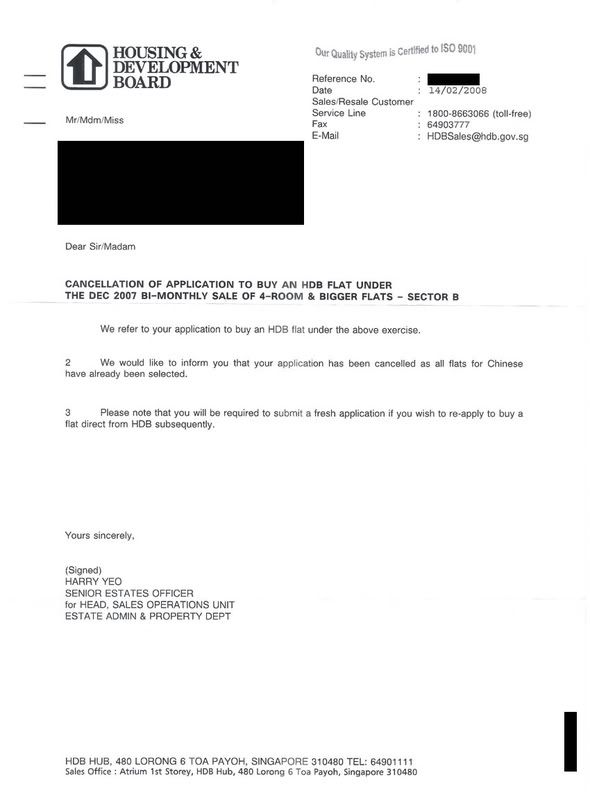 Andrew said that he also tried balloting for a flat, but was unsuccessful. He had applied for a flat in both mature and new estates, even unpopular estates, and each time his queue number has been unfavourable. In the recent Sengkang balloting exercise, he said that the 400+ units attracted 5,000 applicants, and his queue number was 2600. A recent balloting exercise for 200 units in mature estates attracted 10,000 applicants, of which he was number 5938.
 Andrew said he read on the HDB website that those who had submitted more applications and failed to get a flat would be moved up further the queue. “But nobody knows how many people are in the queue,” said Andrew. “Nobody knows how many have played this game, and (applied repeatedly) just to get ahead in the queue, and each application is $10 you know,” said Andrew.
“I wonder, how many houses are out there in HDB ready to be sold, and how many are actually being released in every batch?”
“Is this a money churning exercise?”
No priority given by HDB for family to buy flat
Andrew is desperate to find a house, “any house”, he says, for if he cannot get a flat within the next 3 months, he and his family will be homeless. Andrew said that he even went down to the Bishan HDB office to find out what he could do. The staff who served him told him that “even as staff (they didn’t) have priority to know what are the units that are not being released”.
“Is there such a system that says that for those who truly need it on a case-by-case basis we give you priority?”, he asked.
“Because I’m going to be homeless!”
Homeless in Singapore?
It is highly likely that Andrew’s case is not an isolated one. For more than 15 years, Andrew has slept through hot nights and used candles for lighting. He is helpless to improve his situation much. He does not have a degree – he is self-employed – his income varies from month to month, and he explains that he would earn even less than what he earns now if he took a regular job.
Andrew’s plight also brings up more disturbing questions. Why do repeated appeals from an esteemed MP to the HDB and SP have seemingly little effect? Why must the HDB – a quasi-government body, no less – and SP, a major utilities provider, be so hard on one down-and-out old man? What is the breakdown of the number of people who have balloted more than once in order to get a higher priority in the queue for flats? Is balloting a money-making exercise after all, despite HDB’s claim that balloting is to give everyone “a fair chance”?
In summary, these are the problems that Andrew and his family face:
1. They must put their flat on the resale market by Jan 28, 2008.
2. Repay $464,100 of mortgage loans
3. Pay the $700 in utilities
4. Pay their Town Council $3000 in S&C charges
And even if they manage to pay off the debts, Andrew and his family may still end up on the street – because he can’t afford a resale flat and the queue for a new flat will take some time.
Yet, despite all that he is going through, he only asks that the HDB considers his circumstances and maybe move him up in the queue for a new flat.
Andrew says that this is an opportunity for his family to finally get out of the cycle of being in debt for so long – if only the HDB would be compassionate about his situation.
There are questions that only the relevant authorities can answer. The clock is ticking, and for those like Andrew who are stuck between a rock and a hard place, their next home may be the void deck. Let us hope that it will not be for lack of compassion from our government that people will sleep outside at night.
Otherwise, thanks to the HDB, a family will be homeless.
NOTE:
Andrew’s friend, Leong Sze Hian, who alerted TOC to the story, says:
How many Singaporeans are there like my friend, Andrew and his family, who may lose their home, and their life CPF savings, because they cannot pay for their HDB flat?
With the apparent “disappearance” of the flats given financial assistance statistics in this year’s HDB Annual Report (this statistic was in past Annual Reports - the previous year’s figure was 28,386), how many can’t pay?
When the HDB makes a demand for a flat owner to sell his or her flat in the open market by a certain deadline, will it disappear from the “financial assistance” statistics?
Will it also disappear from the “flats repossessed by HDB” statistics? (360 flat-owners voluntarily surrendered their flats from 2003 to 2006 - reply to question in Parliament, March 2007).
Read Sze Hian’s earlier article on the disappearing statistics for the number of flat-owners whose applications for financial assistance were approved: Uniquely Singapore, F1 or F9?: Inflation up, HDB property tax up, statistics disappear, Ministers’ pay up again soon.
Read also: “HDB’s mistake but she’s made to pay - 4 years later”.
-
While i sympathise with their problems, there are few questions to be raised.
1) Why did the father buy a $400,000+++ flat in 1992 when he started facing problems in 1991 ? Nevertheless, he still needs help now despite his strange decision.
2)Andrew is 34-years old, can afford to get married soon but can't afford to help pay some bills for so many years? What about his sister? They all live together right ? 4 people cannot pay power bills and S&C ? They make it sound like his dad is the sole breadwinner.
-
was it lionnoisy or d-ddy or tch05 said that there is alot of leeways from HDB should the family failed to pay the mortgages? how now?
-
complain so much for what, also no use. main thing is to realise that you are in sinkarpor Inc.
-
HDB urged to be more compassionate in arrears cases
By Chio Su-Mei, Channel NewsAsia | Posted: 26 February 2008 1609 hrs
SINGAPORE: The Housing and Development Board (HDB) came under the spotlight in Parliament on Tuesday with MP Ong Kian Min urging it to exercise compassion in cases of mortgage arrears.The MP for Tampines GRC said that while the lower income group in other countries could move to cheaper housing, Singaporeans do not have that option as HDB flats are already the cheapest form of housing.
He recounted how nine families in his constituency approached him for help on Monday night, having received compulsory acquisition notices from HDB due to mortgage arrears.
Among them was Judy Mitchell, a single parent with a working daughter and an aged mother.
Mr Ong said even if Mdm Mitchell sold her current flat, she would still be unable to purchase a smaller flat, and is unlikely to get a loan from HDB or a commercial bank due to her age. She is currently over S$10,000 in mortgage arrears.
"I cannot imagine in Singapore, where we pride ourselves in our home ownership policy that a family of two working adults supporting one elderly family member would have their HDB flat repossessed and be left homeless. What is our social compact? There are those among us like Mdm Judy Mitchell who are trying their best, working hard, wanting to be self-reliant. I believe the government should step in and give them a helping hand," Mr Ong said.
The need for a more supportive housing board was also brought up by Mr Yeo Guat Kwang, an MP for Aljunied GRC.
Speaking in Mandarin, Mr Yeo touched on the problems faced by Singaporeans who have problems selling off a bigger flat to downgrade to a smaller unit.
Saying that HDB should help Singaporeans downgrade, Mr Yeo reminded the housing board that its mission is to help Singaporeans own their homes.
- CNA/so -
This is the so call public housing n next time it will be better for the local to sell their flat n buy house in JB, Malaysia. I wonder if the MP is getting more n more outspoken against the some of the policies which is considered silly?
-
Goverment should show sympathy to people that are really in dire situation such as a family of 4 or 6 living in a one room or 3 rooms flat with a monthly income of less then $1500 (just an example). But in this case, obviously Andrew's father failed to plan and dive right in to buy a executive mansionette back then. And he can only blame himself for been in this situation. His intention is to provide the best for his family, but he should have done within his mean especially when his pay is pegged to commision which is consider as a non-stable income.
We can't blame the goverment for not showing sympathy because it is not their job to teach any adult about financial planning. If they are going to show sympathy to every single Tom, Dick or Harry, i think we will be in deep shit pretty soon. This may sound cruel, but i think it will be fairer that the goverment pay more attention to those that really in dire situation which i stated an example above rather then in this case.
Goverment should help us own our houses, but it is not the goverment job to make sure that people buy houses which is within their earning mean. Simply put, don't blame other for your own poor financial planning.