Lee Kuan Yew and PAP regime's great fear and Dr Chee's hope
-
The decline and fall of Nepal's last king
Gopal Sharma
Reuters North American News Service
Jun 11, 2008 09:16 EST
KATHMANDU, June 11 (Reuters) - Not long ago he was revered by some as a Hindu god, waited upon by thousands of royal palace retainers. His face adorned banknotes and the national anthem sang his praises.
Now Nepal's former King Gyanendra is vilified, has lost his crown and is being forced out of his palace.
A specially elected assembly voted overwhelmingly to abolish the 239-year-old monarchy two weeks ago, leaving Gyanendra to go down in history as the last king of Nepal. Gyanendra will now move to an old royal hunting lodge just outside the capital until he has a chance to find a permanent home.
Addressing a first-ever press conference at the Narayanhiti royal palace in Kathmandu on Wednesday, Gyanendra vowed not to leave the country but stay in Nepal and work for the people.
The 60-year-old businessman-turned-monarch has only himself to blame, many Nepalis say, after an ill-judged power grab in 2005 when he dismissed the government, jailed politicians and declared a state of emergency.
Gyanendra was apparently fed up with Nepal's corrupt and squabbling politicians and decided only he could rescue the country from a deadly Maoist insurgency.
The attempt backfired, and he was forced to back down the following year after weeks of street protests that ultimately sealed his and the monarchy's fate.
CHILD KING
As a three-year-old boy Gyanendra was thrust on the throne in 1950 when his grandfather briefly fled to India, in the midst of a power struggle with the country's hereditary prime ministers, the Ranas.
When King Tribhuvan returned a few months later, Gyanendra retreated once more into the background, building a fortune in tea, tobacco and hotels and getting involved in environmental conservation.
Then, nearly seven years ago, his more popular brother King Birendra and eight other members of the royal family were shot and killed by the crown prince, who then turned his gun on himself.
Gyanendra was back on the throne, and like many of his predecessors, he was brought up to believe he knew better than his subjects what was best for Nepal.
The massacre had broken the mystique of a monarchy once revered as incarnations of the Hindu god Vishnu, while Gyanendra's seizure of power unleashed the wrath of the people.
"I think he is getting what he deserved," said 48-year-old labourer Suntali Khatri, breast-feeding her two-year-old daughter next to a building site. "He could not ask for more."
OVER-AMBITIOUS?
Gyanendra went to school in Darjeeling, a hill station in eastern India, and graduated from Tribhuvan University in Kathmandu.
Mohan Prasad Lohani, who taught him English in university, said he was an irregular student -- more interested in politics than studies. "He had his own notion of how things should change. He was very ambitious," he said.
That ambition could have been his downfall, analysts say. And it has been a dramatic fall from grace.
In the past two years, the government has seized thousands of acres of royal lands, nationalised more than a dozen of his palaces and sacked his priest in a purge of palace employees.
Virtually confined to his palace, the king had his annual allowance cut, been hit with tax demands and requests for unpaid electricity bills. He has seen his face replaced by an image of Mount Everest on the country's banknotes and praise of him purged from the national anthem.
But royalists who have met him said he has taken it all calmly, and he looked composed and even smiled during his address to the press.
Some royalists argue that the hasty abolition of the monarchy could backfire and leave the country without the anchor it needs in times of change. But royalist parties won just four seats in the 601-member assembly in April.
While many Nepalis liked the idea of a constitutional monarchy, few like the idea of being ruled by Gyanendra or his unpopular son Paras, who has a reputation as a playboy and a reckless driver. (Writing by Gopal Sharma and Simon Denyer; Editing by Bappa Majumdar)http://wiredispatch.com/news/?id=207222
In a situation like ours, however, there is no realistic chance of an opposition party winning the election and displacing the PAP as the ruling party. This is because the PAP keeps changing the rules—and introducing new ones—to make it impossible for opposition parties to win any significant number of seats. It is just not realistic or intelligent to attempt to change the election system that the PAP controls by going through the election system that the PAP controls.
It is, therefore, important to seek an alternative path to make our elections free and fair. The only solution is for citizens to exercise their rights through peaceful mass protests to compel the PAP to accede to the people’s demands for a free and fair election system. The immediate reaction of Singaporeans would be that public protests in Singapore are banned. In such a case how are citizens going to organize a mass movement? The answer is through the use of non-violent action (see below).http://www.yoursdp.org/index.php/the-party/why-we-do-what-we-do
Lee Kuan Yew's nightmare:
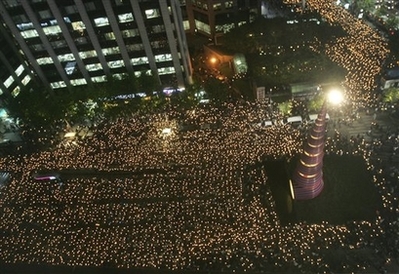
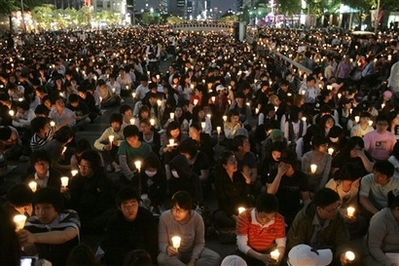
- South Korea mass protest over USA beef imports.
Lee Kuan Yew's nightmare is that mass Singapore protest against PAP might finally bring his regime to an end.
-
Lee Kuan Yew n his silver-spooned kid son will not tolerate any kind of protest,not even a peaceful one.Hmmm....perhaps they prefer violent revolution,just like the one happening in France in the 18th century.
-
Ok,its a little too far,but comeon, u think all this can be possible without any support?
As long as people dont support me, this is all bullshit and ISD probly says i have a very good writing skills and have nothing better to do.
Comeon,remove the quote
-
-
Originally posted by ceecookie:
What we need to do is to organise a coup-de-tat with the citizens rioting against the PAP Govenment.
But an overthrow is difficult when the Ministry of Defense and the SAF is controlled by the Government.
I suggest that the soldiers in the Singapore Armed Force and in the MINDEF organise a mass-mutiny first to assasinate the Defense Minister,and after ceasing the control of the Government, then will a coup be possible because Lee Kuan Yew finally no longer has control of the state's army.
The total head count of the National Servicemen can already make up a significant amount to do a mutiny.
A foreign power's help will be very feasible and needed in this case.I hope to see the United States supporting and helping us in the Revolution.
careful ISD later go storm down ur door tonight, and drag you to whitley detention center.
-
LKY and family reign of terror should come to an end for your god damn conscience or what is left of it.
-
"the SAF is controlled by the Government."
Yo bro, all of you are the men in green uniform, man -
Originally posted by deathmaster:
careful ISD later go storm down ur door tonight, and drag you to whitley detention center.
Yeah man you can't post something like dat here...
you may find yourself listed as a terrorist....
only to spend your next 40 years of your life in some ISD holliday camp. -
-
just let PAP be.. its not like we are suffering under them.. infact i think they did quite a good job...
if the opposition has the quality.. no matter how much PAP "bend" the rules.. the opposition would still win..
-
Originally posted by elementalangel:
just let PAP be.. its not like we are suffering under them.. infact i think they did quite a good job...
if the opposition has the quality.. no matter how much PAP "bend" the rules.. the opposition would still win..
Heard of a person named Daw Aung San Suu Kyi? -
Originally posted by Bentsb05:
wa!!!! looks like u have a making of a top movie producer.....orhhhh!!
is it a bloody scene or bloodless ahh??? when r u calling for audition?? how much can u pay for the cast huh?? got capital or not???
Even you admit its a joke...
remove the quote guys,its all bullshit when there's no support and even if isd wanna be bothered,why cant they act on other threads in the Speakers Corner section?
-
Okay lah, I think better remove the quotes.
Don't play around with the fucking ISD.
Moderators may have to step in.
-
Poh Ah Pak,
If i have "dirtied" the thread,i apologise.
However,what i want in the end is the same as yours(as with several other unnamed people), i want the PAP regime to finally end and true democracy to start.
Of course,there's different tolerence of the unhappy citizens of Singapore.
Having PAP remaining as a (minority) party after the Event, which can be a peaceful protest or a violent one nevertheless, is fine to me. All i ask for, is for the laws to be amended to give the opposition and new parties more power and absolutelly no restriction at all.
However, due to the nature of strict communist-like control that PAP holds over the political state of Singapore,a peaceful lasting protest may not be possible.I will not elaborate on the alternatives as i do not want to alert the ISD in labellng me as a potential risk.I admit that the previous post was fanatical and revolutionary-sounding,but bear in mind that this is due to my hatred for the PAP and Lee Kuan Yew,and often can be bullshit if you want to label it as.
All i can say is - the tension of the citizens is rising every year,slowly and waiting to burst out. The PAP regime will not be in power for long,whether measured in years or decades.
Now,please remove the quotes.
-
Moderators, you can just fucking delete the entire fucking thread.
I don't want ISD fuckers to stir up trouble.
A detainee remembers
http://www.singapore-window.org/tfhmemo.htm
Singaporean cyber-dissident speaks his mind
By Martyn See
SINGAPORE - Robert Ho is arguably Singapore's leading cyber-dissident. In late 2001, Ho was arrested in his home for allegedly posting "inflammatory" articles online during the general elections, representing the first-ever case of its kind.
In 2002, after an as-yet-unspecified article(s) was posted on the soc.culture.singapore newsgroup, police entered his home, seized his computer and served him a summons to attend an investigation.Three weeks later, he was forcibly taken to a police station by officers who entered his home without a warrant or a charge. In 2005, on returning from a shopping mall where he had distributed flyers alleging electoral fraud, he was again apprehended and his computer seized.
In all, he has been arrested an additional three times since 2001, and on repeated occasions the authorities have remanded him at a mental institution. He has yet to be prosecuted for any of the alleged offences, although a criminal-defamation case is still pending from 2002.
While other critics, including international publications, have yielded to defamation threats from Singapore's political leaders, Robert Ho has emerged from his arrests and detentions even more recalcitrant against the establishment.
In Singapore's political cyberspace, where fear of surveillance and potential libel suits have compelled many dissident netizens and bloggers to post articles under pseudonyms, Ho continues to stick his neck out by disclosing his real identity online.See: In 2001, you became the first person in Singapore to be arrested for posting an article on the Internet. What happened?
Ho: On November 16, 2001, about 11:15am, eight serious stern men rang my doorbell and came into my flat. They quickly searched my entire flat, asked for my computer and took it as well as every single computer-related device from printers, floppy disks, CD-ROMs [and] modems to cables.
They then took me away to the CID [Central Investigation Department] Police Cantonment Complex. Being arrested and having all my entire computer system confiscated was quite unnerving and disconcerting. The handcuffs were locked on so tight I suffered a pinched nerve in my left wrist for weeks after.
At the CID, I was questioned for hours, during which I dictated my statements to [police official] Soh Kien Peng. I finished the statements around 14:05pm, pleading not guilty in summation to the charge of posting in soc.culture.singapore my article entitled "Break the law and get away with it, like PAP", posted on October 19, 2001. This article is also posted in "Singaporeans for Democracy" at www.sfdonline.org. [This was a reference to the ruling People's Action Party.]
After my statements were recorded, edited and signed, I was taken to a cell where I was to spend the night on the bare floor. The next morning, I was driven to the Subordinate Courts, where I awaited my turn for the judge to deal with me. We accused were processed like an assembly line, with each one getting very limited time or attention. Singapore efficiency, if you like... -
Just delete fucking thread.