Lee Kuan Yew and PAP regime's great fear... (cont'd)
-
The decline and fall of Nepal's last king
Gopal Sharma
Reuters North American News Service
Jun 11, 2008 09:16 EST
KATHMANDU, June 11 (Reuters) - Not long ago he was revered by some as a Hindu god, waited upon by thousands of royal palace retainers. His face adorned banknotes and the national anthem sang his praises.
Now Nepal's former King Gyanendra is vilified, has lost his crown and is being forced out of his palace.
A specially elected assembly voted overwhelmingly to abolish the 239-year-old monarchy two weeks ago, leaving Gyanendra to go down in history as the last king of Nepal. Gyanendra will now move to an old royal hunting lodge just outside the capital until he has a chance to find a permanent home.
Addressing a first-ever press conference at the Narayanhiti royal palace in Kathmandu on Wednesday, Gyanendra vowed not to leave the country but stay in Nepal and work for the people.
The 60-year-old businessman-turned-monarch has only himself to blame, many Nepalis say, after an ill-judged power grab in 2005 when he dismissed the government, jailed politicians and declared a state of emergency.
Gyanendra was apparently fed up with Nepal's corrupt and squabbling politicians and decided only he could rescue the country from a deadly Maoist insurgency.
The attempt backfired, and he was forced to back down the following year after weeks of street protests that ultimately sealed his and the monarchy's fate.
CHILD KING
As a three-year-old boy Gyanendra was thrust on the throne in 1950 when his grandfather briefly fled to India, in the midst of a power struggle with the country's hereditary prime ministers, the Ranas.
When King Tribhuvan returned a few months later, Gyanendra retreated once more into the background, building a fortune in tea, tobacco and hotels and getting involved in environmental conservation.
Then, nearly seven years ago, his more popular brother King Birendra and eight other members of the royal family were shot and killed by the crown prince, who then turned his gun on himself.
Gyanendra was back on the throne, and like many of his predecessors, he was brought up to believe he knew better than his subjects what was best for Nepal.
The massacre had broken the mystique of a monarchy once revered as incarnations of the Hindu god Vishnu, while Gyanendra's seizure of power unleashed the wrath of the people.
"I think he is getting what he deserved," said 48-year-old labourer Suntali Khatri, breast-feeding her two-year-old daughter next to a building site. "He could not ask for more."
OVER-AMBITIOUS?
Gyanendra went to school in Darjeeling, a hill station in eastern India, and graduated from Tribhuvan University in Kathmandu.
Mohan Prasad Lohani, who taught him English in university, said he was an irregular student -- more interested in politics than studies. "He had his own notion of how things should change. He was very ambitious," he said.
That ambition could have been his downfall, analysts say. And it has been a dramatic fall from grace.
In the past two years, the government has seized thousands of acres of royal lands, nationalised more than a dozen of his palaces and sacked his priest in a purge of palace employees.
Virtually confined to his palace, the king had his annual allowance cut, been hit with tax demands and requests for unpaid electricity bills. He has seen his face replaced by an image of Mount Everest on the country's banknotes and praise of him purged from the national anthem.
But royalists who have met him said he has taken it all calmly, and he looked composed and even smiled during his address to the press.
Some royalists argue that the hasty abolition of the monarchy could backfire and leave the country without the anchor it needs in times of change. But royalist parties won just four seats in the 601-member assembly in April.
While many Nepalis liked the idea of a constitutional monarchy, few like the idea of being ruled by Gyanendra or his unpopular son Paras, who has a reputation as a playboy and a reckless driver. (Writing by Gopal Sharma and Simon Denyer; Editing by Bappa Majumdar)http://wiredispatch.com/news/?id=207222
In a situation like ours, however, there is no realistic chance of an opposition party winning the election and displacing the PAP as the ruling party. This is because the PAP keeps changing the rules—and introducing new ones—to make it impossible for opposition parties to win any significant number of seats. It is just not realistic or intelligent to attempt to change the election system that the PAP controls by going through the election system that the PAP controls.
It is, therefore, important to seek an alternative path to make our elections free and fair. The only solution is for citizens to exercise their rights through peaceful mass protests to compel the PAP to accede to the people’s demands for a free and fair election system. The immediate reaction of Singaporeans would be that public protests in Singapore are banned. In such a case how are citizens going to organize a mass movement? The answer is through the use of non-violent action (see below).http://www.yoursdp.org/index.php/the-party/why-we-do-what-we-do
Lee Kuan Yew's nightmare:
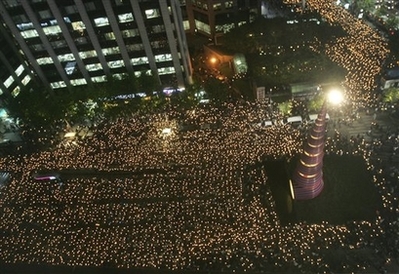
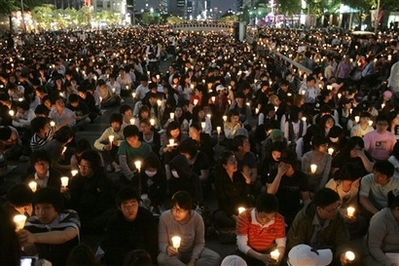
- South Korea mass protest over USA beef imports.
Lee Kuan Yew's nightmare is that mass Singapore protest against PAP might finally bring his regime to an end.
My apologies for reviving this thread,but i've found something which is pretty useful and contribute to this great fear of LKY's.
'Russ' go amok in Bærum
Police in the Oslo suburb of Bærum struggled to control the worst night of violence involving teenaged russ so far this year. It's high season for their wild partying that traditionally accompanies the last days of their schooling.
Between 30 and 40 of the painted busses used by the russ (roughly pronounced "roose") were gathered late Tuesday night at the waterfront area in Sandvika called Kadettangen.
"Police had to send in all available patrols after several reports of noise, drunkenness and fighting," the operations leader of the Asker and Bærum Police District, Jørgen Jacobsen, told Norwegian Broadcasting (NRK) Wednesday morning.
He said chaos reigned when police arrived at the scene, and their forces were insufficient to handle the brawling crowds. "It was almost impossible for us to get through," Jacobsen said. "There were russ-busses in the driveways and everywhere, along with lots of garbage and several fights."
There was so much fighting going on, he said, "that we didn't manage to control it all."
Police had their hands full simply trying to corral the drunken teenagers inside the various busses, and order them out of the area. There wasn't time, he said, for police to identify the brawling teens."
Source : Aftenposten Norway (Afternoon Post)Yes,this is a traditional event that is tolerated in Norway.
But somehow - if the International Schools' students here(AIS,CIS,GEP etc) is interested in this,they may be of significant help which we can organise a mass scale version of this which even though have no violence motiff,can already be of a great fear to Lee Kuan Yew and his PAP lackeys because it shows the mass people's power(in the russ case's - too much of a quantity for the police to control) of toppling the Government later on.
-
LKY has entrenched himself with laws, for something like that to happen, it would have to be mass unemployment or hyper-inflation.
-
It will be chaotic once this happen.
-
fixed..
-
Originally posted by Midlusionz:
It will be chaotic once this happen.
If this happens (which is way overdue), it might be chaotic for a while..... But our lives will definitely change for the better!