Democracy in Sg
-
http://online.wsj.com/article/SB121443744095705301.html?mod=googlenews_wsj
Democracy in Singapore
June 26, 2008; Page A14
Lee Kuan Yew's Singapore can rightly be proud of many achievements, but full democracy is not one of them. The city-state he founded in 1965 and led as Prime Minister until 1990 is economically prosperous and its citizens enjoy a range of freedoms. Political dissent is not among them.
Which makes a recent David vs. Goliath exchange between one of the country's few opposition politicians and Mr. Lee worth noting. The dialogue took place in a courtroom and is therefore privileged – which means we can report on it without risking a lawsuit, which Mr. Lee often files against critics. Audio files are available on the Singapore Democratic Party's Web site, and a partial transcript is available at Singapore Rebel, an independent blog.
The setting was a hearing to assess damages against Chee Soon Juan, head of the Singapore Democratic Party, and his sister and colleague, Chee Siok Chin. In 2006, the Chees lost a defamation suit brought by Mr. Lee and his son, Prime Minister Lee Hsien Loong, over an article they published in their party newsletter that was interpreted by the court to imply corruption on the part of the government. In last month's hearing, the elder Mr. Lee, who holds the title of Minister Mentor, was cross-examined by Mr. Chee, who was representing himself.
Mr. Chee is no orator, and on one level the dissident was no match for the eloquent Mr. Lee. But when the subject turned to the moral underpinnings of democracy – freedoms of speech, assembly and association – the debate went game, set and match to Mr. Chee.
Mr. Chee set out his philosophy while questioning Mr. Lee: "What I'm interested in is justice, the rule of law, because ultimately it is not about you, Mr. Lee. It is not about me. It's about the people of Singapore, it is about this country and everything we stand for. You and I will pass on, but I can tell you, the practice of the rule of law, the entire concept of justice, democracy – that is going to last for all eternity."
Mr. Lee didn't respond directly to those assertions, choosing instead to cite the International Bar Association's decision to "honor" Singapore by holding its annual conference there last year and noted a letter from the association's president saying "how impressed they were by the standards they found to obtain in the judiciary."
Elsewhere in the hearing, Mr. Lee defended his string of defamation suits against opposition politicians and the press: "They know me by now," Mr. Lee said, referring to the people of Singapore, "that if anybody impugns the integrity of the government, of which I was the prime minister, I must sue."
He went on: "There are various parts of this government which do not comply with Western practices, including the law of libel. But it is a system that has worked." Mr. Lee has never lost a libel suit. He and his son are currently suing the Far Eastern Economic Review, a sister publication of this newspaper, and its editor, Hugo Restall.
Our reading is that the Minister Mentor sounded more than a tad defensive – no less so than in his characterization of Mr. Chee, who has been bankrupted as a result of lawsuits by Mr. Lee and other politicians. He called Mr. Chee, a "liar, a cheat and altogether an unscrupulous man." Not to mention "a near-psychopath." Mr. Chee, for his part, referred to Mr. Lee as a "pitiable figure."
It's hard to know what Singaporeans make of all this. Mr. Lee is widely revered as the father of their country, and Mr. Chee is often scorned for his aggressive tactics. But at least, thanks to the Internet, they are able to read the exchange and make up their own minds.
So, too, in the case of Gopalan Nair, which is making its way through the courts now. Mr. Nair is a former Workers' Party candidate. He is now a U.S. citizen and online advocate for media freedom in Singapore. He traveled to the city-state to attend Mr. Chee's hearing last month and recorded his thoughts on his blog, where he expressed his contempt for the court proceedings and challenged Mr. Lee to sue him.
On May 31, he was arrested and interrogated. On June 2, he was charged with insulting Judge Belinda Ang, who presided over the Chee hearing, by email. He was released on June 5, six days after his initial arrest, and charged on June 12 with insulting another judge in a separate, 2006 email. Last week, the court changed the first charge and specified that the offending remarks about Judge Ang were made on a blog, not by email.
Mr. Nair's case is scheduled to go to court in mid-July. Meanwhile, Mr. Chee was just released from jail, where he served 11 days for "scandalizing" the court during his questioning of Mr. Lee. His sister served 10 days. The court has yet to set the amount of monetary damages in the defamation case. When it does, we'll know the price of political dissent these days in Lee Kuan Yew's Singapore.thank god we have the internet to find out more details and thus able to make up our own minds
-
Hmm. Yes the internet is very useful.
-
umm . ..... I wanna correct the writer. It is not Lee Kuan Yew's Singapore, Singapore belongs to all Singaporeans not just LKY. Sue sue sue sue. He is lucky he wins his law suits on defamation because the law is for the pap in sg.
-
Originally posted by Civilgoh:
umm . ..... I wanna correct the writer. It is not Lee Kuan Yew's Singapore, Singapore belongs to all Singaporeans not just LKY. Sue sue sue sue. He is lucky he wins his law suits on defamation because the law is for the pap in sg.
Does the PAP create the law then? -
Tearing down the facade
Saturday, 28 June 2008 Chee Soon Juan
His words are explained, researched and re-explained, every jab of the finger or the bringing down of his fist for effect is broadcast, accolades are reported in greater detail than a doctoral dissertation, and every smile is published in vivid colour.
This is the Lee Kuan Yew that Singaporeans have come to know. Confident. Unerring. Sharp. Superhuman.
But this is not the Lee Kuan Yew I saw.
The man I confronted in court regurgitated his lines, was lost for words, and sought refuge in his counsel depending on the question I asked.Of course, he was his usual belligerent self and seemed like he was looking for a good intellectual joust. But he was nothing like the sharped-tongue sage that many, including me, were persuaded by the media to believe -- the one they call Minister Mentor.
My first glimpse of the Lee's ordinariness came at the beginning of my cross-examination when I asked him why he insisted on testifying through lunchtime and why he refused to tell the court the "important matter" that he had to attend to that afternoon. It was a straightfoward question that required only a simple answer.
But the Minister Mentor was tongue-tied despite ample opportunity for him to recover. Looking at Mr Lee from where I stood, I could see that his mouth was agape. But while he attempted to speak, no words came forth. After several agonising seconds, his counsel had to come to his rescue.
Was age catching up and slowing the MM down? No, in the middle of that exchange Mr Lee let out one of his laughs, not the kind evoked from jollity but the sort laced with contrived cynicism meant for covering up embarrassment. This demonstrated a mind that was still clear but not the superlative one that his propagandists would have us believe.
Cherry-picking
MM Lee was also unremarkable in his ability to think on his feet. I discovered this during the exchange where he mentioned foreign organisations lauding his achievements, organisations such as PERC (Political and Economic Risk Consultancy) and Transparency International-Malaysia. Incidentally, one of PERC's chief, Bruce Gale, now works for the Straits Times as Senior Writer.
When I listed out at least ten other organisations that criticised his undemocratic ways, Mr Lee countered that the organisations I had named were "liberal organisations" whereas those he cited were rating agencies concerned about "where investors put their money in."
Such argument could easily be pulled apart by a secondary school student. The dichotomy was simplistic as it was false. The practice of liberal democracy and the ability to attract investments are not mutually exclusive. If they were India would not be one of the biggest magnets for investments, and neither would democracies like Ireland, Chile, South Korea, Hong Kong and Taiwan.
Mr Lee seemed unable to grasp the fact that Singapore is a country and as a country, its people don't just robotically seek investments. There are such things as happiness that stem from being able to participate in the country's decision-making process and, as an extension, feeling a sense of rootedness to society. Is it any wonder that Singaporeans are one of the gloomiest and most stressed-out peoples in Asia?
When confronted with these observations, Mr Lee could only regurgitate that without his system, there could not be the prosperity that Singapore was enjoying.
Patriotism? Who cares
Yes, prosperity. But for whom? When I persisted and pointed out that even if Singaporeans were as well off as Mr Lee wanted to believe and, as a consequence, as happy and contented, why did a survey conducted in 2007 show that 50 percent of young Singaporeans wanted to leave the haven given a chance and a shocking 37 percent indicated that they were not patriotic to the country.
Mr Lee responded that he was "not moved one way or the other other." The final test, he pointed out, was whether these people were leaving permanently.
He had apparently forgotten that just a few months ago, he had admitted in an interview that the brain drain in Singapore was a "pretty serious" problem because many of our top talent were going overseas and not coming back.
When I made it plain to him that talented Singaporeans were leaving on a permanent basis, and one of the reasons for their leaving was that they were disenchanted with his system, the MM couldn't engage further. He changed the subject and asked me to quickly discharge myself from bankruptcy so that I could campaign in an election against the PAP.
Mr Lee's response was troubling. The finding that nearly 40 percent of our youth did not feel loyalty to the country ought to raise a monumental alarm across the government. (How are our National Servicemen going to defend a country that they are not patriotic to?) Yet, Mr Lee indicated that he didn't quite care. What has this country become when the government is keener on attracting investments than the patriotism of its citizens?
From London de-classified
One way to duck a question is to change the subject. The other is to take refuge behind counsel.
When I asked the MM about the declassified memos and letters from London regarding his role in the incarceration of his political opponents, in particular Mr Lim Chin Siong, and his manoeuvring to keep Lim from challenging for the prime ministership, Mr Lee uncharacteristically chose to remain silent, preferring to let his lawyer plead the irrelevance of my question.
I had expected a robust defence of his so-called fight with the so-called communists in the left-wing of the PAP, his pet topic. But despite my stressing that this went to the issue of his integrity, Mr Lee shied away. No matter how hard I pressed, the MM remained silent.
Contrast these: Mr Lee had volunteered the award by Transparency International-Malaysia to bolster his claim of his unblemished integrity. But when confronted with the question of his treatment of Mr Lim Chin Siong he was stone-cold silent.
Oh yes, there was also the PM
The courtroom confrontation with Mr Lee was not the only subject. There was also his son, the PM. The fact that Lee Jr's performance was so completely overshadowed speaks volumes of the his leadership.
For all of his bluster Mr Lee Kuan Yew, at least, ventured his own thoughts and his own philosophy. Hsien Loong was altogether different. He kept his eye firmly on his lawyer and relied heavily on counsel's objections to avoid any engagement (see here). His crossing swords with Siok Chin also exposed his limitations in a toe-to-toe debate.
At one point, Mr Davinder Singh even said that he was the one to make the decisions in the courtroom leaving his client - the country's top decision-maker no less - looking limp and unable to hold his own. Maybe the Minister Mentor position is not so redundant after all.
I take pains to point out these tribunal encounters not to denigrate Mr Lee Kuan Yew. I make them so that Singaporeans are disabused of the image that Lee's propaganda machine has made him out to be, the image of a God-like figure to be held in fearful awe and never questioned.
Nations run into trouble when the people allow their politicians to be cast in such reverential light. Autocrats work to ensure that they are cast in a mystical portrait -- larger-than-life and beyond reproach. We must undo what has happened in Singapore. Mr Lee Kuan Yew is most certainly not the person that the media paints him to be.
For our own sakes and for the sake of our nation, we must see that he is one with all the foibles and weaknesses of any other man. For that he must be held accountable just like any other man.http://www.yoursdp.org/index.php/perspective/vantage/38-vantage/556-tearing
-
Now we know the reasons for the full ad verbatim court proceedings not being reported in the daily newsprints.
Is it any surprise that we see two different faces at the end of a strenuous day at the Court ?
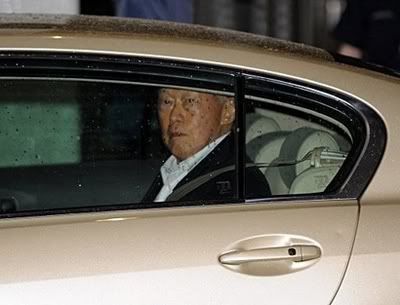
one of sour hollow 'victory'... after an abrasive day of futile confrontation
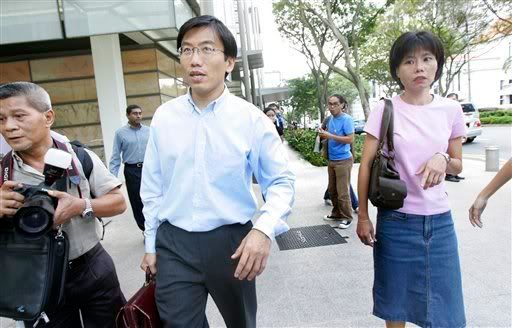
and one of contented defeat.... after getting the long awaited day of face-to-face confrontation.