what exactly is forward fuel price?
-
1) anyone know what exactly is this forward fuel price?
2) which company also uses this pricing system?
3) what is the advantage of this pricing system compare to the others?
4) why other country are able to lower electricity tariff while we need to increase by a ridiculous 21%?
5) who came up with this pricing system?
i try to google but cant find much information, if any expert out there please enlighten me, thanks.
-
The proud thing singaporeans should feel is that they accept all hikes while other country citizens are not as consistent as unique singaporeans.
-
got a feeling the people running the place bought a pile of futures contracts...
that is, a contract to buy something at a fixed price at a fixed time...
those things are such that if i buy a contract like that from an oil company to sell me 1 million barrels of oil on 15 Dec 2008 at a price of US$110 a barrel, no matter what happens to the price of oil on 15 Dec 2008, i will have to buy 1 million barrels of oil from that company at US$110 per barrel...
to lock in that price, i will pay someone a certain fee for that contract..
now, if on 15 Dec 2008, the price of oil goes up to US$120, i profit US$10 per barrel
if on 15 Dec 2008, the price of oil drops to US$100, i lose US$10 per barrel...
what most companies do when they buy these futures contracts is to remove the uncertainty of price fluctuations.. in that way, they can plan their cash flow...
-
it is refer to fuel price in any given time of a year when price at at it highest forwarded then normal..eg now is US$90 per barrel and goes on for 4 months, it went backward to US$80, then after a month it jumped to US$150 for 2 months, then come down to 130 for the rest of the year. So the as per forward fuel price dictation, it takes on the US$150 as it benchmarks to decide on it business cost.
Therefore, the forward fuel price that was calculated to this year was abt US$148 at its highest, if i am not wrong...or more than that...
-
Originally posted by the Bear:
got a feeling the people running the place bought a pile of futures contracts...
that is, a contract to buy something at a fixed price at a fixed time...
those things are such that if i buy a contract like that from an oil company to sell me 1 million barrels of oil on 15 Dec 2008 at a price of US$110 a barrel, no matter what happens to the price of oil on 15 Dec 2008, i will have to buy 1 million barrels of oil from that company at US$110 per barrel...
to lock in that price, i will pay someone a certain fee for that contract..
now, if on 15 Dec 2008, the price of oil goes up to US$120, i profit US$10 per barrel
if on 15 Dec 2008, the price of oil drops to US$100, i lose US$10 per barrel...
what most companies do when they buy these futures contracts is to remove the uncertainty of price fluctuations.. in that way, they can plan their cash flow...
Ok...so does it mean that we'll see a price fall of electricity charges in the near future?

-
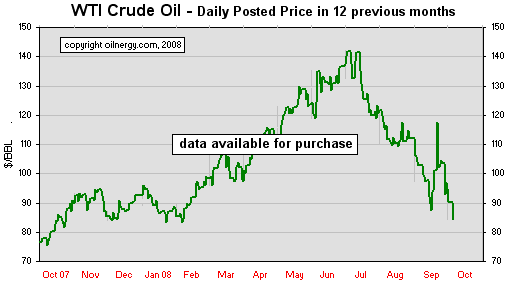
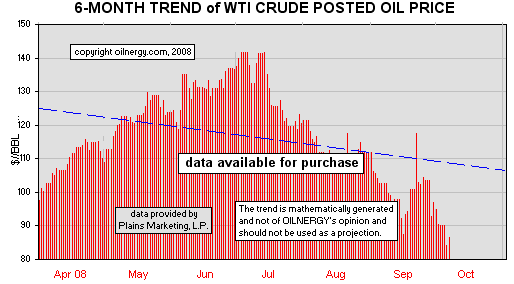
Oil peaked in Jun and Jul '08 at above US$ 150 and it is currently on the decline trend for the months Oct - Dec. Don't you think it's ridiculous that our Jun & Jul charges are cheaper than Oct - Dec, shouldn't the electricity price be closer to the Jan - Mar period. 80% of our electricity needs are powered by natural gas from Indonesia. Why use crude oil to price electricity?
The sad thing is, majority of Singaporeans still believe that there is justification for their pegging to crude oil. It's more about fleecing from the sheeps, afterall if they don't fleece from us sheeps, where else can they get their wools.

*maeh maeh maeh*
-
Originally posted by maurizio13:
Oil peaked in Jun and Jul '08 at above US$ 150 and it is currently on the decline trend for the months Oct - Dec. Don't you think it's ridiculous that our Jun & Jul charges are cheaper than Oct - Dec, shouldn't the electricity price be closer to the Jan - Mar period. 80% of our electricity needs are powered by natural gas from Indonesia. Why use crude oil to price electricity?
The sad thing is, majority of Singaporeans still believe that there is justification for their pegging to crude oil. It's more about fleecing from the sheeps, afterall if they don't fleece from us sheeps, where else can they get their wools.
*maeh maeh maeh*
I would think it's forward pricing, doubt they will price a refined product based on spot crude prices.
-
Originally posted by AnotherHIke?:
1) anyone know what exactly is this forward fuel price?
2) which company also uses this pricing system?
3) what is the advantage of this pricing system compare to the others?
4) why other country are able to lower electricity tariff while we need to increase by a ridiculous 21%?
5) who came up with this pricing system?
i try to google but cant find much information, if any expert out there please enlighten me, thanks.
It is like this. You can buy fuel for immediate delivery (October) and the seller will quote you a price.
You can also buy fuel for delivery in December and the seller will quote you a price, the price for delivery in December for the order that is placed in October. That is buying forward.
You can wait until December then you order your fuel for delivery in December instead of buying forward, buying now for delivery in December.
The reason you buy in October for delivery in December instead of buying in December for delivery in December is because you took a gamble that if you order in December, the price would have gone up. By the way, buying forward, the price is usually more expensive due to carrying costs, (or warehousing costs to the layman).
So you take a gamble, you bet, you tikam tikam and if you bet correctly and the price goes up in December, you make extraordinary profits but if you bet wrongly, no problem, you raise electricity charges by 21% and silliporeans pay for your gambles.
-
In the futures market, they are playing with "papers" aka "futures contracts" and even though it is possible to "take" or "make deliveries", that is usually not done (due to a variety of reasons). It is usually "settled" and that is, you sell away the "long" contracts, the "papers", instead of taking delivery and if you hold "short" contracts, the "papers" you "settle" aka "liquidate" aka "sell away your short contracts" instead of delivering the goods.
When you are in the physical business and that is you buy and sell real goods and commodities like fuel or wheat or rice (say Cold Storage, they buy to stock the supermarkets, they buy the real products and not the papers aka known as futures contracts) you might buy forward and that is known as the "forward market" as opposed to "futures market" (to repeat, in the futures market you trade in papers, futures contracts).
So if NTUC takes a gamble and buy rice forward (in October) for December delivery but Cold Storage did not and the price of rice rises in December (when Cold Storage place the order), then NTUC will just sell at the same price as Cold Storage, the higher price and make extraordinary profits.
If the price falls in December, then Cold Storage (having placed the order in December) will be able to sell at the lower price (lower as compared to if the price had risen) but NTUC (having paid a higher price because they took the bet in October and buy for December delivery), with their political clout can raise prices by 21% and pass the price rise to you the silliporeans.
-
i already decided
to make my own generator
or buy some huge solar panel to generate
energy for my own house
-
Originally posted by noahnoah:
i already decided
to make my own generator
or buy some huge solar panel to generate
energy for my own house
In advance countries, you can sell the excess electricity you generate (say from solar power) back to the grid (you supply instead of buying) and get paid for it.
I think maybe if Dr Chee Soon Juan is the Prime Minister, then maybe these kind of just and fair practices will come into effect in Singapore and you can almost be 100% sure that the present regime will abhor such things as the people selling electricity to the power company.
-
so ok i got the info on question 1, how about the other 4? anyone?
2) which company also uses this pricing system?
3) what is the advantage of this pricing system compare to the others?
4) why other country are able to lower electricity tariff while we need to increase by a ridiculous 21%?
5) who came up with this pricing system?
and also which system is HK energy comapny using? how come they are able to lower?
-
Originally posted by AnotherHIke?:
so ok i got the info on question 1, how about the other 4? anyone?
2) which company also uses this pricing system?
3) what is the advantage of this pricing system compare to the others?
4) why other country are able to lower electricity tariff while we need to increase by a ridiculous 21%?
5) who came up with this pricing system?
and also which system is HK energy comapny using? how come they are able to lower?
2) SIA? Hedging against oil price
3) I think someone replied earlier that it is easier to plan cash-flow
-
Originally posted by AnotherHIke?:
so ok i got the info on question 1, how about the other 4? anyone?
2) which company also uses this pricing system?
3) what is the advantage of this pricing system compare to the others?
4) why other country are able to lower electricity tariff while we need to increase by a ridiculous 21%?
5) who came up with this pricing system?
and also which system is HK energy comapny using? how come they are able to lower?
doing homework ah ?
-
Originally posted by AnotherHIke?:
so ok i got the info on question 1, how about the other 4? anyone?
2) which company also uses this pricing system?
3) what is the advantage of this pricing system compare to the others?
4) why other country are able to lower electricity tariff while we need to increase by a ridiculous 21%?
5) who came up with this pricing system?
and also which system is HK energy comapny using? how come they are able to lower?
...actually it is very common among commodity traders... like rubber and rice... but Singaporeans are no longer familiar with it (as we used to be familiar, since Singapore was a major international trading hub in commodities, but PAP killed off the business with the high costs) ... and so, to answer your question,the answer is, companies that buy commodities for their own use and the traders, the sellers.
-
Originally posted by AnotherHIke?:
so ok i got the info on question 1, how about the other 4? anyone?
2) which company also uses this pricing system?
3) what is the advantage of this pricing system compare to the others?
4) why other country are able to lower electricity tariff while we need to increase by a ridiculous 21%?
5) who came up with this pricing system?
and also which system is HK energy comapny using? how come they are able to lower?
The sellers of commodities and the traders uses this pricing system. They buyer usually have no say, they just accept the prices the sellers or traders quote. The buyer will ask the seller, "What is the spot price (current delivery), and what is 1 month forward and 3 months forward (the price for delivery one month and 3 months later)?
-
Originally posted by eagle:
2) SIA? Hedging against oil price
3) I think someone replied earlier that it is easier to plan cash-flow
Jet fuel
-
Originally posted by AnotherHIke?:
so ok i got the info on question 1, how about the other 4? anyone?
2) which company also uses this pricing system?
3) what is the advantage of this pricing system compare to the others?
4) why other country are able to lower electricity tariff while we need to increase by a ridiculous 21%?
5) who came up with this pricing system?
and also which system is HK energy comapny using? how come they are able to lower?
Say you bought forward at a high price but because the prices have been dropping so sharply, you can average the high price you bought earlier with the lower forward prices you buy later.
This might be what "other countries" do or did when they did not increase the electricity prices or lower the electricity prices.
The asspots will find any excuse to take more money from the people and Singaporeans being silliporeans will just shut up, bend over and let them screw.
-
Something doesn't smell right here.
It doesn't make sense to forward-buy fuel at $65 above current market prices. Perhaps they're not buying forwards at all, but are instead *anticipating* that high price in the near future? Either way the customers pay the translated price of $155 when the actual price is $90 or so.
-
I have decided to harvest my own fossil fuel to light up the house, I'll start with the Book of All Singapore Laws and Bullshits
-
Originally posted by webben:
Something doesn't smell right here.
It doesn't make sense to forward-buy fuel at $65 above current market prices. Perhaps they're not buying forwards at all, but are instead *anticipating* that high price in the near future? Either way the customers pay the translated price of $155 when the actual price is $90 or so.
suppose today i buy a commodity 3 months forward at $100 and spot prices are at $95. Next month spot prices drop to $70. It would make sense to you next month that i bought at $100 which is $30 above market prices...fact is i bought it this month already.
-
All I know is that Singaporeans generally welcome price hikes and price increases.
Yes, I read the local Straits Times.
-
Originally posted by charlize:
All I know is that Singaporeans generally welcome price hikes and price increases.
Yes, I read the local Straits Times.
As well as foreign pests
-
Originally posted by webben:
Something doesn't smell right here.
It doesn't make sense to forward-buy fuel at $65 above current market prices. Perhaps they're not buying forwards at all, but are instead *anticipating* that high price in the near future? Either way the customers pay the translated price of $155 when the actual price is $90 or so.
er... the $90 you are referring to US Nymex crude in US$? The $155 is SGD, USD and for what, Light Sweet or Refined Crude, "Fuel"? You cannot use crude oil, unrefined for fuel. If you want to attck the asspots and their asspolicies, you must do it intelligently and truthfully.
-
Originally posted by AndrewPKYap:
Say you bought forward at a high price but because the prices have been dropping so sharply, you can average the high price you bought earlier with the lower forward prices you buy later.
This might be what "other countries" do or did when they did not increase the electricity prices or lower the electricity prices.
The asspots will find any excuse to take more money from the people and Singaporeans being silliporeans will just shut up, bend over and let them screw.
Ok, we are very unhappy abt this price hike, but apart from ranting and raving in forums, what else can we do? Switch to candles and kinetic energy? Refuse to to pay the hiked-up price and wait for the penalty? Protest on the street and wait to be jailed? When our PM, MP and even opposition party member, pple who r supposed to "represent/help" us, all sit there watching quietly, wat can we do?
LL work harder to earn more money for them to squeeze lor... =p
And they call the people who managed to escape from this dictatorial country a quitter...Go figure...