Protectionism - An Unneccessary Evil
-
To help the common masses understand better the evils of protectionism, here goes:-
Country Korvenia is self sufficient in rice cultivation and production. It costs only $1 for a 5kg packet of rice to be produced, but is sold at $5 for a 5kg packet to Korvenians, making those in the rice industry rich with the 'marked up', leading to excesses and complacency in productivity.
Country Bruviapore is equally self sufficient, but productive, and has excess rice to sell at $3kg per 5kg packet.
It attempts to sell to Korvenia, but korvenian rice lobby groups blocks such sales with import taxes, etc, thru their government, resulting in Bruviapore rice being sold at $8 per 5kg packet, with $5 each packet being paid to Korvenian govt.
Korvenian consumers are thus the losers, stuck with buying rice at $5/ 5kg packet from their own producers.
Thus, in its simplest form, protectionism kills productivity, enterprise and creativity in the industrial and biz process.
It only protects those who benefits from the 'marked -up' - the CEOs, suppliers, distributors, Union and hedg fund operators, NOT the farmers or consumers.
With the latest Apec decision to remove 'protectionism, it means lesser import taxes and tarrifs, or none at all. In this climate, people everywhere are not spending anyway, benefiting not even the protectionist groups.
Therefore, with trade barriers removed, productive and cheaper manufactured goods will be acceptable to attract consumers to spend, circulating money and promoting growth.
This is a significant and important developement, which will directly help our export industry greatly as well as attract investors to set up production on our shores.
It will provide jobs for us all and increase our treasury for social spending. With our nation holding the Apec chair next year, may we push hard to remove this unneccessary evil call protectionism in our planet and help save the world.
-
er..protect whose interest?
-
Any shopkeeper will know this. It's either you sell a product at eg, (A) $200 to earn $100 profit, or you sell a product at (B) $2 to earn $1 profit, but sold to 100 people.
If your product is exclusive, system A is best. But if not and very competitive, system B is a survival alternative.
Since the recession in the 80's, Spore had opted for alternative B. No doubt our workers were paid low, but our products were better priced, which means more consumer appreciation, and allow jobs to be retained.
We have also not drop alternative A, thus the spending on R&D, to develope niche and exclusive products in bio-med and hi-tech industries.
So before you complain about low wages, would you prefer to live with NO wage?
May President-to-be Obama see this light too. We need the richest country in the world to spend as well.
-
Originally posted by yamizi:
er..protect whose interest?
A win-win solution for all, from the famer to the consumer and all those in between. Everyone gets a cut, better than no cut.No need to get too greedy and want it all. Thats what protectionism does - want it all for short term gain instead of sharing that wealth for long term growth.
-
Thus, in its simplest form, protectionism kills productivity, enterprise and creativity in the industrial and biz process.
What about infant industries?
Should they be protected?
-
It only protects those who benefits from the 'marked -up' - the CEOs, suppliers, distributors, Union and hedg fund operators, NOT the farmers or consumers.
But it helps to keep businesses going and creates jobs.
If local industries collapses, no jobs for locals, no income, rice how cheap also cannot afford.
-
Originally posted by Poh Ah Pak:
What about infant industries?
Should they be protected?
If you mean entreprenuership, then any entreprenuer worth his salt should either go into niche industries to survive or have deep pockets to use system B to muscle his way in. Biz is a cruel world where pity has no place, unlike societies.If you mean new industries, then there is no need to protect anything, because you are developing something new and no one can copy it, at least for the moment, and Singapore is a signatory to international copyright legal issues.
If you mean a tiny island intending to grow crops for cultivation, then it would be better to assess if they can do it and market the product cheaper than international prices. If not, that tiny island is better off turning those plots of land into casinos and hotels to earn revenue for social spending.
-
China had often been seen as an economic threat to the world. They have huge spaces, resources and cheap labour. There is no need to surrender to this fatalistic view.
Individual states will have to either sell niche products, or band together as one huge conglomerate, using economies of scale in technology and minimum low wages, will give China a run for its money.
The issue is economic integration, - a greater pan ASEAN to counter China, or EU. That is, if we individual asian states can ever agree to anything collectively. A solution is possible, only if it can be adopted.
If not, we would be better off on our own and think of niche areas whereby we can create jobs and wealth for our fellow citizens.
-
Comparative Advantage from another perspective.

In all Economic books, they always advocate Free Trade based on the theory of Comparative Advantage.

In such a situation, it's beneficial to engage in Free Trade as the quantities produced for computers and apples, will far exceed what both countries would produce if they had decided to produce at their own combination of both products. This is irregardless of the country's efficiency in production, whether you are efficient or inefficient, you tend to gain from Free Trade.http://www.sgforums.com/forums/10/topics/256623
-
But we know that we can't produce our products indefinitely, to whatever quantities we want. So what if the world demand and supply for both computers and apples has an equilibrium quantity.
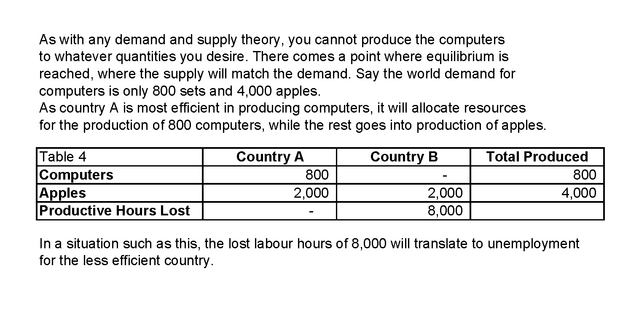
So is Free Trade really beneficial for all participants?
If the world demand has an equilibrium, it's only beneficial to efficient countries. -
Agree we should have competition at all levels.
-
Agree we should have competition at all levels.
The early industrial countries developed their economies by protectionism.
How Rich Countries Got Rich ... and Why Poor Countries Stay Poor
http://www.amazon.com/How-Rich-Countries-Poor-Stay/dp/0786718420
-
In all Economic books, they always advocate Free Trade based on the theory of Comparative Advantage.
But is we strictly follow the so called theory of Comparative Advantage, certain states will be doomed to certain low profit industries.
Cannot develop and improve.
Bad Samaritans: The Myth of Free Trade and the Secret History of Capitalism
-
Originally posted by Poh Ah Pak:
But is we strictly follow the so called theory of Comparative Advantage, certain states will be doomed to certain low profit industries.
Cannot develop and improve.
Bad Samaritans: The Myth of Free Trade and the Secret History of Capitalism
While we may enjoyed reading differing opinions and views, from intellectuals to the common laymen, as we live in a free society where everyone, even the cleaning lady has an opinion and would be respected for it, such opinions MUST NOT distract us from the socia-economic realities faced by the masses.We are barbarians at heart. Civilisation is an unnatural act forced upon by our wise ancestors so that we may live in peace and productivity to pursue a better life than our natural cousins -animals of the wild.
Thus, the ingrained instincts of survival of the fittest is ever present in our minds, more so in the concrete jungles of free market capitalism.
There are no free lunches, and the market pays handsomely, based on merit and not who you are. Those who cannot measure up to the harsh international markets, will have to pay the price of failure.
Whether for good or for bad, our young had been prepared since 3 yrs old to understand what is competition, and is now a natural instinct ingrained into them, so as to be prepared to take on the harsh realities of our planet in the market place.
Our society will never leave anyone behind, and do all we can to help. But for those who cannot measure up, or stand the pace, best stay back and don't obstruct progress AND natural evolution in terms of scientific knowledge of the human species.
Bitching and moaning won't help. Regression or failure is not an option. This is Singapore.
As for other nations left behind, there is nothing we can do, except to be a role model which they can take example with, on how our society function, and adapt accordingly, or be left far behind.
-
I don't agree with your views xtreyier.
Your political outlook is different from my political outlook, for this reason, we rarely agree on political issues.
-
We are barbarians at heart. Civilisation is an unnatural act forced upon by our wise ancestors so that we may live in peace and productivity to pursue a better life than our natural cousins -animals of the wild.
Thus, the ingrained instincts of survival of the fittest is ever present in our minds, more so in the concrete jungles of free market capitalism.
There are no free lunches, and the market pays handsomely, based on merit and not who you are. Those who cannot measure up to the harsh international markets, will have to pay the price of failure.
...The appearance of stability from 1840 to about 1900 was superficial, temporary and destructive in the long run, because, as I have said, you must have communities, and communities and societies must rest upon cooperation and not on competition.
Anyone who says that society can be run on the basis of everyone's trying to maximise his own greed is talking total nonsense.
All the history of human society shows that it's nonsense. And to teach it in schools, and to go on television and call it the American way of life still doesn't make it true.
Competition and envy cannot become the basis of any society or any community...
http://www.wealthbuilder.ie/essay
-
I'm drowning from the sea of generalizations and more generalizations
-
Originally posted by xtreyier:
....
It only protects those who benefits from the 'marked -up' - the CEOs, suppliers, distributors, Union and hedg fund operators, NOT the farmers or consumers.
....
Therefore, with trade barriers removed, productive and cheaper manufactured goods will be acceptable to attract consumers to spend, circulating money and promoting growth.
...It will provide jobs for us all and increase our treasury for social spending. With our nation holding the Apec chair next year, may we push hard to remove this unneccessary evil call protectionism in our planet and help save the world.
Protectionism doesn't help the farmers and (domestic) consumers? When subsidised foreign goods are prevented from destroying native industries, wouldn't that advance the social good? Natives enjoy employment and the society isn't getting ripped off by foreign corporations. Besides, it maintains self-sufficiency in crucial areas like agriculture and industry.
The term "free trade" is the biggest misnomer of all. Its simply semantic deception when institution like the WB and IMF, acting as a front for western corporations, systematically eradicate domestic economic capacity of Third World nations and establish economic slavery.
From1966-1970, Africa was a net exporter of food, averaging 1.6 million tons in food exports. However, when the WTO together with its corporate-runned partners in the WB/IMF stepped in to so-call implement 'free trade', subsidised western food imports destroyed African agriculture so that hunger has ravaged the continent. Just look at the IMF Structural Adjustment Program, to help a country, it privatises public services (good news for western corporations looking to enslave Third World countries), reduces state regulations (more good news for monopoly capitalism), devalues the currency (more exploitation due to cheap raw materials), cuts social spending (plunging the population further into poverty, thereby making corporate control easier) and finally, removing trade barriers (destroying domestic employment and control of national resources). It seems that protectionism is really what it seems, protecting a people from corporate greed, and letting a country use its resources for the better of its people.
When you say that protectionism works against the common good, you're not taking into account corporate-political collusion. The dominant political system in the western world today isn't democracy or socialism, its corporate-fascism. Just look at the US right now, $7 trillion in tax-payers' money to the banks while $25 billion to save 2.3 million jobs is much a big deal. But I digress, free trade is just another gimmick for corporations, in control of western government, to conquer Third World countries not with the sword, but through debt.
-
Originally posted by xtreyier:
We are barbarians at heart. Civilisation is an unnatural act forced upon by our wise ancestors so that we may live in peace and productivity to pursue a better life than our natural cousins -animals of the wild.
Thus, the ingrained instincts of survival of the fittest is ever present in our minds, more so in the concrete jungles of free market capitalism.
There are no free lunches, and the market pays handsomely, based on merit and not who you are. Those who cannot measure up to the harsh international markets, will have to pay the price of failure.
Whether for good or for bad, our young had been prepared since 3 yrs old to understand what is competition, and is now a natural instinct ingrained into them, so as to be prepared to take on the harsh realities of our planet in the market place.
....As for other nations left behind, there is nothing we can do, except to be a role model which they can take example with, on how our society function, and adapt accordingly, or be left far behind.
Are you even human? Or have you evolved into the species of corporate bastards that place money and power above human concerns? Sure, our society is that inhumane. But that is no reason to go with the flow and abandon our humanity. In the pursuit of money (pieces of paper), we make other people in less developed countries suffer, is that human? When you leave other nations behind, you're not being a role model to them, because by then, they'll probably be slogging in sweat shops, or being slaughtered in civil war just so you can wear that pair of branded shoes or use the latest handphone model.
-
Originally posted by freedomclub:
Are you even human? Or have you evolved into the species of corporate bastards that place money and power above human concerns? Sure, our society is that inhumane. But that is no reason to go with the flow and abandon our humanity. In the pursuit of money (pieces of paper), we make other people in less developed countries suffer, is that human? When you leave other nations behind, you're not being a role model to them, because by then, they'll probably be slogging in sweat shops, or being slaughtered in civil war just so you can wear that pair of branded shoes or use the latest handphone model.
I can feel your angst. It only sets my flags up, because in that 'moral indignitive' anger, you are allowing your emotions to take control, clouding up your judgement, and prone to error in your assessment of the situation on hand.
It leaves nothing for discussion, as it will be fully one-sided - you will only accept your pre-judged views and nothing from anyone else.
All that i would advise is for you to calm down, rationalize it and look at it from a bigger perspective, study the society that Africa really is, from its first known inhabitants, the Olmecs to present.
=============================As for your claim of my 'inhumanity', it is only your opinion, of which i have no control, nor seek to control, or have any control. All i can say is that we all have no right to interfere in another's society on how it is managed.
For example, you and i would have reacted with shock and disgust at Myammar's method to keep its citizens servile.
There were calls to arms to 'liberate' Myammar, but it would only lead to another tragedy of the likes of Somali, Vietnam, Afghanistan, and Iraq.
My point is, how can we outsiders 'liberate' or give freedom to a society, which only society themselves can bestow upon their leaders?
Freedom had always been fought for, toppled monarchies and tyrants with it, shed blood for it and in our case, got kicked out and left to die for it, all by society ourselves?
What right do we, outsiders, have, to stop our own progress or resolve our own citizen's hunger, and wait for other societies if their own leaders lead them to , mismanagement of resources, economic doom and exploitation instead of socia - technological progress?
In your angst, it is easy to condemn others, fill your stomach with hot and heated air, and stand upon your high horse of moral righteousness.
When you or your loved ones are hungry, reality will eventually set in and force you to do the 'right' thing - demand for a fair share of the international economic pie. We buy their goods. It is time for them to buy ours. Is this plea an inhuman call?
-
Originally posted by xtreyier:
I can feel your angst. It only sets my flags up, because in that 'moral indignitive' anger, you are allowing your emotions to take control, clouding up your judgement, and prone to error in your assessment of the situation on hand.
It leaves nothing for discussion, as it will be fully one-sided - you will only accept your pre-judged views and nothing from anyone else.
....When you or your loved ones are hungry, reality will eventually set in and force you to do the 'right' thing - demand for a fair share of the international economic pie. We buy their goods. It is time for them to buy ours. Is this plea an inhuman call?
I pointed out that you totally disregarded the corporate agenda of "free trade". I admit my argument was emotionally fueled, but the "inhuman call" you refer to is based on the exploitation of the Third World by corporate institutions like the WB/IMF. Its not mutual trade. If it is, I can have nothing to say. But as it is, "free trade" just deprives the Third World of their "fair share of the international economic pie". As you rightly said, foreign powers have no right to interfere with the affairs of other countries. But that is what "free trade" does under the banner of the WB/IMF. How is the globalisation of monopoly capitalism "fair" when during the second half of the 20th Century, global income inequality doubled, poverty rose 17% despite global GNP rising 40%. While the WB was "restructuring" Ecuador's economy from 1968-1998, poverty rose by 60%. Is that humane? I'm asking you now.
I'm not rejecting your arguments. You probably took that out of some economics textbook and its definitely theoretically sound, but which unfortunately leaves out realpolitik. If you can prove that humanity has benefited from "free trade", I'm ready to accept that, provided you have evidence. I don't close my mind off to other viewpoints. Isnt that what you're doing, by ignoring the corporate infiltrated global institutions? While we benefit from "free trade", of course we would support it. Look at the Third World and say that "free trade" benefits them. It is precisely because of "free trade" that western corporations have invaded Africa in a free-for-all resource grab. To make your handphone, innocent Congolese die amid a civil war backed by 100 major corporations, thats from a UN report, not my opinion. Isn't that nice? The visible gun of fascist powers.
And whats wrong with arguing for a humane approach to society? Aren't you human? Placing profits above human concerns, which is what "free trade" does (in trying to maximise profits) is probably a most paralysing social concept.
-
Yes, I can see you point.
I think the topic of what kind of industry that we want to develop (ie protect) as the country's core competency is something worth discussing.
The early industrial countries developed their economies by protectionism.
-
My point is not to qualify the worth of protectionism. It is simply what its called; a policy that protects the citizens of a country, in today's context, from capitalism gone wild. "Free trade" just means opening up a Third World/developing economy to corporations that only exist to make money. When rich corporations, with powerful political leverage of the WTO/WB/IMF infiltrate into those countries, a gangbang of immense proportions take place. Human and environmental concerns go down the drain as long as they can continue raking in the billions.
A case in point, when Ecuador opened its gates to Chevron, it paved the way for environmental damage 18 times worse than the Exxon Valdex incident. 30,000 indigeous people brought Chevron to court in 1993. But unfortunately, with the corporate muscle of Big Oil, Chevron has not been held accountable till today.
-
Originally posted by maurizio13:
Comparative Advantage from another perspective.
In all Economic books, they always advocate Free Trade based on the theory of Comparative Advantage.
In such a situation, it's beneficial to engage in Free Trade as the quantities produced for computers and apples, will far exceed what both countries would produce if they had decided to produce at their own combination of both products. This is irregardless of the country's efficiency in production, whether you are efficient or inefficient, you tend to gain from Free Trade.http://www.sgforums.com/forums/10/topics/256623
when i read that in someone else's economics text book my first thought was what kind of bullshit is that? its only logical in the textbook but once it's applied to people it won't work. no one wants to be the one to be sacrificed.
-
Originally posted by xtreyier:
To help the common masses understand better the evils of protectionism, here goes:-
Country Korvenia is self sufficient in rice cultivation and production. It costs only $1 for a 5kg packet of rice to be produced, but is sold at $5 for a 5kg packet to Korvenians, making those in the rice industry rich with the 'marked up', leading to excesses and complacency in productivity.
Country Bruviapore is equally self sufficient, but productive, and has excess rice to sell at $3kg per 5kg packet.
It attempts to sell to Korvenia, but korvenian rice lobby groups blocks such sales with import taxes, etc, thru their government, resulting in Bruviapore rice being sold at $8 per 5kg packet, with $5 each packet being paid to Korvenian govt.
Korvenian consumers are thus the losers, stuck with buying rice at $5/ 5kg packet from their own producers.
Thus, in its simplest form, protectionism kills productivity, enterprise and creativity in the industrial and biz process.
It only protects those who benefits from the 'marked -up' - the CEOs, suppliers, distributors, Union and hedg fund operators, NOT the farmers or consumers.
With the latest Apec decision to remove 'protectionism, it means lesser import taxes and tarrifs, or none at all. In this climate, people everywhere are not spending anyway, benefiting not even the protectionist groups.
Therefore, with trade barriers removed, productive and cheaper manufactured goods will be acceptable to attract consumers to spend, circulating money and promoting growth.
This is a significant and important developement, which will directly help our export industry greatly as well as attract investors to set up production on our shores.
It will provide jobs for us all and increase our treasury for social spending. With our nation holding the Apec chair next year, may we push hard to remove this unneccessary evil call protectionism in our planet and help save the world.
What a load of rubbish.
They teach this in primary school issit ?
Overly simplistic.
Real life economy is more dynamic than this childish primany level case studies.
Protectionism is about making sure the jobs STAYS in the country. And your Kervonia case study only tells of the GREEDY government.
So what if you remove the trade barrier... the farmers in Kervonia got no job.. even if the rice is 80cents.. they will not be able to afford it.
In the end.. the rich gets cheaper goods.. and the workers starve to death... Please think more deeper next time... OK ? Good.