Chia Thye Poh,man of principle
-
Originally posted by skythewood:
just curious. does all the topics discussed here have an ultimate motive or purpose? this is more of a point of view thing, so why not share your point of view on the action of Chia? Does everything have to be about anti PAP and PAP?
i think it should. it lends credance to the discussion.however, if one chooses to rant around the circle, it is his right too. i have nothing against it. at least i know now and can better waste my time elsewhere.
thanks for clarifying.
-
Originally posted by redDUST:
i think it should. it lends credance to the discussion.however, if one chooses to rant around the circle, it is his right too. i have nothing against it. at least i know now and can better waste my time elsewhere.
thanks for clarifying.
the topics in the forum works as a democracy. if the topic sucks, no one post, it dies off. If it interest you, and you have something to say, you post. you think it sucks, don't post.
-
Originally posted by googoomuck:
Who are those that were released after signing the doc?
We all know that S. Nathan worked for the Japanese police during the Japanese occupation of Singapore.
LKY also worked for the Japanese government propaganda department during the Japanese occupation of Singapore.
working for the enemy is the right thing to do.
-
Originally posted by skythewood:
Chia Thye poh was held by ISA for 23 years imprisonment and 9 years house arrest in Sentosa, without charge or trial. there were others like him, but they were released after they agreed to sign a document to renounce violence and sever ties, if any, with the Communist Party of Malaya.(CPM)
Chia was given the same deal, but he refused to sign the document as he feels that doing so will mean he admits to advocating violence and being part of CPM before, thus the 32 year saga.
If you were him, will you do the same? or will you be more flexible?
We are here looking for facts,not fictions.
can u add up the followings no. of years?
The 9 years were not house arrest.Chia could moved around.Dear!
I dunt want to say PAP was a nice guy.But u probable no need to
paint PAP darker than the reality.Ok?
http://www.mha.gov.sg/news_details.aspx?nid=240
26 November 1998Press Statement: Restriction on Chia Thye Poh lapse, 26 November 98The Government has decided to allow Chia Thye Poh's Restriction Order (RO) to lapse on 27 Nov 98. The Internal Security Department had recommended this in Sep 98, and the ISA Advisory Board had supported the recommendation.
The Government has always adopted a measured and cautious approach to Chia Thye Poh's case. Chia was moved from a prison to a home environment of government half-way houses in 1982, when he was still under detention.In 1989 Chia was released from detention and placed in Restriction Orders (RO) to reside in Sentosa Island, where he was allowed to move freely and receive visitors.
In 1990 and 1992 this was further relaxed to allow Chia to visit Singapore mainland daily, and subsequently to reside on Singapore mainland.
Since 1992, Chia's RO has been renewed with progressively fewer restrictive conditions.
This allowed Chia in Aug 97 to go to Hamburg on a 1-year Hamburg Foundation Scholarship.
ISD has reported that Chia's conduct suggests he is unlikely to engage in activities prejudicial to Singapore's security. Should Chia in future re-involve himself in such activities, he will be dealt with firmly under the law.
MINISTRY OF HOME AFFAIRS
26 NOVEMBER 1998---end of quote@@@@@@@@@@@@@@@@@@
Then it came to the question if he choose to stay in prison or
MHA wanted to detain him longer.I think it was the former.
MHA would not so stupid to put his head on the chopping board.
U know AI can deny it.Right?
source:Prime Minister Office search engine.now removed.
It was a press release from MHA.
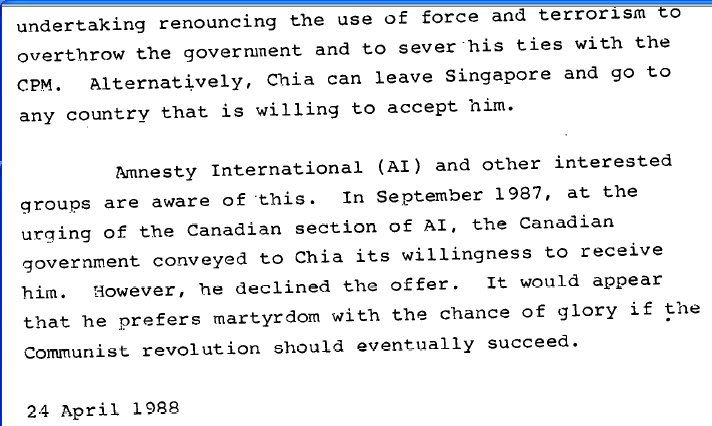
can u read that Chia declined the offer from Canadian gavaman
to allow Chia stay in Canada.
I agree he wanted to be a martyrdom.But i am not sure when did he this
think.
i will be back on why he had to be detained so long.
ssss
-
Why were he be detained for so long?
U will say LKY afraid Chia came out to contest him in election etc.
Thats MHA fixed him ,making him stay long long inside.
This is one of the explanations.
I read a report interviewing him saying the same line of story below:
He refused to sign a undertaking that he would not use
violence after he would be released!!
http://en.wikipedia.org/wiki/Chia_Thye_Poh
The other detainees were released eventually after they each signed a document promising to renounce violence and sever ties with the Communist Party of Malaya (CPM).[7] However, he refused as he felt that signing such a document would imply that he was affiliated with the CPM and, in his own words: "to renounce violence is to imply you advocated violence before. If I had signed that statement I would not have lived in peace."[3
@@@@@@@@@@@@@@@
Did he put the priority right?
Lets assume it was his real reason that he refused to sign the undertaking.
This made MHA extend his detention.
(Lets say FBI catch a guy
who threatened to kill US President.Do u think FBI would release
the guy who refuses to sigh a similiar undertaking not to harm
the US President?)
We put his political ideas aside.Chia sure was a leader of BN.
What were his priority?
1.Came out and lead BN again or other political party,or exile
to other countries?
2.Continue stay inside prison?
3.Reunion with his family?(When he was released in l997,
his mom was still alive.)
4.others...
What was the top priority of political leaders?
I think any political leader must stay political alive.
Get out of prison asap.People need u,man,outside of prison!!
However,in 20 and 21 century,the opposition parties leaders
just commit political suicides!!
They ruined the once biggest opposition patry of 3 seats in Parliment
to zero seat!!
@@@@@@@@@@@@@@@@@''
Chia Thye Poh,man of stupid principle
@@@@@@@@@@@''
http://www.mha.gov.sg/news_details.aspx?nid=241
30 November 1998Press Statment:Ministry refutes Chia Thye Poh's claim that he was never under any communist party and that he was merely performing duties as a MP, 30 November 98Chia Thye Poh was quoted in the Reuters report of 27 Nov 98 as follows ? "I was never under any communist party. I was merely performing my duty as a Member of Parliament."
This is not true. In 1966, the Barisan Sosialis (BSS) decided to adopt the strategy of extra-parliamentary struggle. To this end, Chia Thye Poh who was a BSS MP resigned from Parliament together with the other BSS MPs to take their struggle to the streets.
Chia was therefore not an MP when he was arrested on 29 Oct 66. He had resigned from the office of MP to which he was elected to serve his constituents. Instead he advocated armed struggle and violence. He publicly renounced Parliamentary politics and declared his resorting to an unconstitutional struggle on the streets.
Chia was never arrested for performing his duties as an MP. Chia was arrested for his involvement in the CPM communist united front and to avert widespread unlawful demonstrations and violence.
MINISTRY OF HOME AFFAIRS30 NOVEMBER 1998---end of quote
nnnnnnn
-
Originally posted by lionnoisy:
We are here looking for facts,not fictions.
can u add up the followings no. of years?
The 9 years were not house arrest.Chia could moved around.Dear!
I dunt want to say PAP was a nice guy.But u probable no need to
paint PAP darker than the reality.Ok?
http://www.mha.gov.sg/news_details.aspx?nid=240
26 November 1998Press Statement: Restriction on Chia Thye Poh lapse, 26 November 98The Government has decided to allow Chia Thye Poh's Restriction Order (RO) to lapse on 27 Nov 98. The Internal Security Department had recommended this in Sep 98, and the ISA Advisory Board had supported the recommendation.
The Government has always adopted a measured and cautious approach to Chia Thye Poh's case. Chia was moved from a prison to a home environment of government half-way houses in 1982, when he was still under detention.In 1989 Chia was released from detention and placed in Restriction Orders (RO) to reside in Sentosa Island, where he was allowed to move freely and receive visitors.
In 1990 and 1992 this was further relaxed to allow Chia to visit Singapore mainland daily, and subsequently to reside on Singapore mainland.
Since 1992, Chia's RO has been renewed with progressively fewer restrictive conditions.
This allowed Chia in Aug 97 to go to Hamburg on a 1-year Hamburg Foundation Scholarship.
ISD has reported that Chia's conduct suggests he is unlikely to engage in activities prejudicial to Singapore's security. Should Chia in future re-involve himself in such activities, he will be dealt with firmly under the law.
MINISTRY OF HOME AFFAIRS
26 NOVEMBER 1998---end of quote@@@@@@@@@@@@@@@@@@
Then it came to the question if he choose to stay in prison or
MHA wanted to detain him longer.I think it was the former.
MHA would not so stupid to put his head on the chopping board.
U know AI can deny it.Right?
source:Prime Minister Office search engine.now removed.
It was a press release from MHA.
can u read that Chia declined the offer from Canadian gavaman
to allow Chia stay in Canada.
I agree he wanted to be a martyrdom.But i am not sure when did he this
think.
i will be back on why he had to be detained so long.
ssss
so... the 9 years is not house arrest? some guy in wiki think it is, http://en.wikipedia.org/wiki/House_arrest#Singapore
if it is not house arrest, how would you define the 9 years?
-
paint PAP darker than the reality.Ok?
What about detention without trial for 23 years?
Is that dark or okay?
-
Originally posted by Poh Ah Pak:
What about detention without trial for 23 years?
Is that dark or okay?
There are closed door hearing and lawyers or any persons
can represent accused to submit the accused's case.
SG President have to endorse the detentions more than 30 days.
Advisory committee also have to make submission to President.
Why do they need to fix the detainees?
I think u need read more.Whether u trust the real operation of ISA is another matter.
Have USA get any closed door hearing for detainees in Cuba?
@@@@@@@@@@2
the proof:
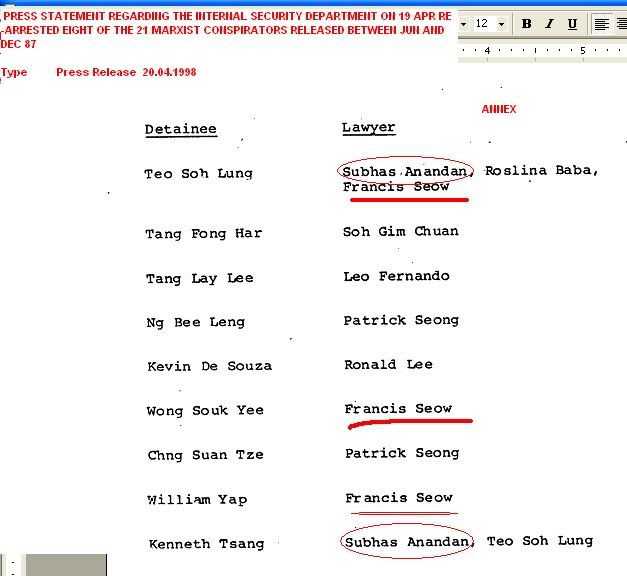
http://www.sgforums.com/forums/10/topics/330910
http://www.mha.gov.sg/publication_details.aspx?pageid=35&cid=348
Detainees have the right to be represented by
a lawyer of their choice, or by any other person
they may choose.
• Detainees are not held in secret detention.
Family members are informed and are assisted
by a family support and liaison officer.
• Visits may be denied during investigations, but
after 30 days, the detainee has the right to see
family visitors regularly and also lawyers to
prepare his case before the Advisory Board.A person arrested under the ISA can be
detained for up to 48 hours.
• Any detention beyond that must be approved
by at least a Superintendent of Police.
• This must also be reported to the Commissioner
of Police.
• If someone is to be detained for more than
14 days, the Commissioner of Police must report
the case to the Minister for Home Affairs.
• No one can be detained for more than 30 days
from the time of arrest unless the Minister for
Home Affairs approves an Order of Detention.
The permission of the President of the Republic
of Singapore is also needed.nnn
-
Originally posted by skythewood:
so... the 9 years is not house arrest? some guy in wiki think it is, http://en.wikipedia.org/wiki/House_arrest#Singapore
if it is not house arrest, how would you define the 9 years?
I assume during the 9 years period,
Chia could move around during day time.
I think he needed to go back to designated residence at designated time.
i call it curfew,rather than house arrest.
Under house arrest,u cant go out.Dunt u?
-
Originally posted by lionnoisy:
I assume during the 9 years period,
Chia could move around during day time.
I think he needed to go back to designated residence at designated time.
i call it curfew,rather than house arrest.
Under house arrest,u cant go out.Dunt u?
He was confined to sentosa. That is not very much of going around, is it? curfew means you can go to maybe orchard and shop, this guy can't leave the island.
-
Originally posted by skythewood:
He was confined to sentosa. That is not very much of going around, is it? curfew means you can go to maybe orchard and shop, this guy can't leave the island.
The Government has always adopted a measured and cautious approach to Chia Thye Poh's case. Chia was moved from a prison to a home environment of government half-way houses in 1982, when he was still under detention.
In 1989 Chia was released from detention and placed in Restriction Orders (RO) to reside in Sentosa Island, where he was allowed to move freely and receive visitors.
In 1990 and 1992 this was further relaxed to allow Chia to visit Singapore mainland daily, and subsequently to reside on Singapore mainland.
Since 1992, Chia's RO has been renewed with progressively fewer restrictive conditions.
This allowed Chia in Aug 97 to go to Hamburg on a 1-year Hamburg Foundation Scholarship.For the half--way house,i dunt have the details.Do u have any?
i assume it was Day out,Night in institution.
2.For sentosa,can i call Island Arrest?
It was much better than prison cell and half--way house.
In Sentosa,he worked as Assiatant Curator
for Sentosa Development Corp,getting a starting salary of $900.
http://stars.nhb.gov.sg/stars/tmp/839-1989-02-17.pdf
-
many are interested in oz prices and properties'
If the cuts passed through to mortgages, standard variable rates would hit 5 per cent, a level not seen since 1964, when they were fixed at that level under the Coalition government of Robert Menzies.
The Melbourne Institute-TD Securities inflation gauge is negative for a second successive month, suggesting prices will fall in the December quarter, paving the way for Australia’s first sustained run of deflation in more than half a century.
Rates on track for 44-year low
@@@@@@@@@@@@@@@@
one of major national banks will cut 10% staff:
ANZ tipped to make heavy job cuts
HUNDREDS, and possibly thousands, of jobs will go from the ANZ within weeks as the bank aggressively reduces costs in the face of the economic slowdown and credit crisis.
A well-placed source who is aware of ANZ's plans said it would axe 3000-3500 staff and contractors — 10% of its workforce.
The redundancies will occur at least two weeks before Christmas to avoid more bad publicity. "They are moving through the entire organisation," the source said. "They are trying to take as much cost pressure out as they can."
For comparsion ,DBS cut 6 %.
@@@@@@@@@@@
nnnn
-
10,000 bank jobs at risk---Oz labour union said
14 Nov | Up to 10,000 jobs could go in the next 12 to 18 months if ...
- November 14, 2008
Up to 10,000 jobs could go in the next 12 to 18 months if the big banks restructure their workforces, the Finance Sector Union (FSU) says.
FSU national secretary Leon Carter said speculation that ANZ Bank planned to cut up to 3500 of its staff in the lead-up to Christmas could trigger mass sackings at the other big banks.
Already there is speculation that Westpac will shed 5000 jobs when it merges with St George.
"We think that 10,000 jobs could disappear out of the banking sector over the next 12 to 18 months," Mr Carter told reporters in Melbourne today.
-
Originally posted by lionnoisy:
For the half--way house,i dunt have the details.Do u have any?
i assume it was Day out,Night in institution.
2.For sentosa,can i call Island Arrest?
It was much better than prison cell and half--way house.
In Sentosa,he worked as Assiatant Curator
for Sentosa Development Corp,getting a starting salary of $900.
http://stars.nhb.gov.sg/stars/tmp/839-1989-02-17.pdf
there is no island arrest. the definition of house arrest still holds, even if the boundary is an island. that's why in my very first post, i mentioned house arrest in sentosa.
but whatever, they held him for a very long time, and that is for certain
-
Originally posted by skythewood:
Chia Thye poh was held by ISA for 23 years imprisonment and 9 years house arrest in Sentosa, without charge or trial. there were others like him, but they were released after they agreed to sign a document to renounce violence and sever ties, if any, with the Communist Party of Malaya.(CPM)
Chia was given the same deal, but he refused to sign the document as he feels that doing so will mean he admits to advocating violence and being part of CPM before, thus the 32 year saga.
If you were him, will you do the same? or will you be more flexible?
question: does it mean that he refuses to sever ties with CPM even if he never had any ties with them in the first place?principles.. yes.. he has principles.. but.. sometimes i wonder because Charles Manson never abandoned his principles either..
-
Malayan Emergency aka Communist Insurgency:1948 to 1960
Chia Thye Poh arrested: 1966
Although CPM still existed after 1960, it was already on a decline. The PAP Govt is just using the Communist bogeyman as an excuse to detain its political rivals. If the PAP have any evidence to link Chia to CPM, they would have tried him in court. Obviously they do not have any evidence. Signing that document is like admitting to being a member of CPM.
-
I am proud that my Jurong was once led by Chia Thye Poh.
He did not kowtow and bow in front of Lee Kuan Yew and submit to his will.
STATE ASSEMBLY GENERAL ELECTION 1963:
JURONG
Voters: 7,611
Voter turnout: 7,204 (94.7%)
CHIA Thye Poh Wins for Barisan Socialis
http://www.singapore-elections.com/ge1963/jurong.html
-
Chia Thye Poh ? The Man Himself
(Human Rights)In 1989, James Gomez ( then a 2nd year NUS undergraduate) was President of the NUS Philosophy Society and editor of the society?s magazine ? PHILOTIN. He & Susan Chua interviewed Chia Thye Poh about his views on politics and the Internal Security Act while Chia was confined in Sentosa.
Monday, 02 January 1989

by James Gomez & Susan Chua (PHILOTIN)
Chia Thye Poh, a political detainee for twenty-three years, was released conditionally on the 17th of May 1989. He now lives on the island of Sentosa. As a figure who evokes much interest, political or otherwise, an interview with him seems only appropriate in line with this issue's emphasis on political philosophy.
As such, here we have for you, a first hand, and exclusive insight into the life and ideals of the man himself. Chia Thye Poh, as a primary school student, had a taste of studying both in a Chinese as well as an English school.
His secondary education was obtained in Chinese High School. In 1958, he entered Nanyang University, majoring in physics. He was also vice-chairman of the university's Student Union. After graduation, he became a council member of the Guild of Graduates.
Mr Chia then became a teacher. He taught in Chung Cheng High School for a short period before he went back to Nanyang University as a graduate assistant in the Physics Department. During this period, he was preparing to further his studies abroad.
However, Operation Cold Store (Feb. 1963) and the subsequent Sept. 1963 general elections drastically changed the course of his life.
He stood for elections and won a seat under the banner of Barisan Socialis in the Jurong constituency. (At present, Barisan Socialis is integrated into the Worker?s Party).
The following interview with Mr Chia was carried out at his residence in Sentosa. The aim of the interview is to bring across a more distinct picture of Mr Chia?s ideals and aspirations.
Question: When did your political awakening begin and how did it begin?
Answer: My political awakening began when I was in Chinese High School. At that time, there was a strong anti-colonial movement in Asia and Africa. In Singapore, people were struggling for independence. And in Chinese schools, there was a feeling that Chinese education was discriminated against. There were incidents that Chinese school teachers were arrested and Chinese schools ordered to close down. These events raised the political consciousness of majority of students and I was one of them. We opposed the colonial education policy and later, became active in the struggle for independence.
Q: What was/is your ideology? Has your years in detention altered your ideology?
A: My ideology: to struggle for a fair, just and democratic society (freedom of speech, freedom of the press and more parliamentary representation for the people). When I was a parliamentarian, my close contact with the people, especially the lower income group, had strengthened my ideal. My ideal has not been dampened after nearly 23 years under detention. In fact, prison life can only make a person more determined to fight against oppression and for a fair, just and democratic society.
Q: What are your current views regarding the running of Singapore?
A: Under the PAP rule, there is no genuine parliamentary democracy. In essence, it has been practising a one-party rule. It seems to want to remain as the sole, dominant party, with other small parties acting as marginal opposition and ?sparring partners? for new PAP MPs. The opposition parties will never be allowed to grow strong. Before past elections, potential opposition candidates had been arrested; so were some of the elected opposition MPs who were arrested after the elections. The GPC (Government Parliamentary Committee) feedback unit and introduction of non-elected MPs are merely improvements on the one-party rule. There is always the danger of one-party rule slipping into one-man rule, and worse still, into dynastic rule. The PAP government does not like critical newspapers or publications, and is intolerant towards sharp criticisms. They seem elitist and arrogant, regarding themselves as the best and the most suitable to rule Singapore. And they rule it with iron-handed policies.
Q: What do you think of the opposition parties in Singapore?
A: If the PAP itself laments the difficulties of getting good candidates for elections, one can imagine how much harder it is for the opposition parties to do the same. Opposition parties candidates risk not only loss of jobs, but also personal freedom. However, despite all difficulties, including little access to the media, the opposition parties had scored 37% of the popular votes in the last general election. To withstand the continual onslaught of the powerful PAP machinery and to make further headway, the opposition parties will need more co-ordinated efforts. They need to build up their branch organisations, so that, through their own network, party programmes and policies can be brought across to the people.
Q: What kind of change would you like to see in Singapore?
A: The last election shows that the people want more opposition members in the Parliament (37% popular votes went to opposition parties). However, there is only one opposition MP in the 81 seat Parliament. The discrepancies are too obvious and cry for correction. (In the 1963 election, Barisan Socialis gained 33% of the popular votes, and there were 13 members in the 51 seat parliament). There should be proportionate representation of opposition voices in Parliament, so that there can be a real check and balance system. Basic human rights should be respected, the ISA (Internal Security Act) should be abolished. There should be freedom of speech and freedom of the press so that the people can have better access to information and can voice their feelings without fear.
Q: Do you feel that it is not essential to have the ISA?
A: In 1955, when there was still a jungle warfare in Johor and the other states of Malaya, the PAP congress had adopted a resolution, calling for the abolition of Emergency Regulations. Yet, since its coming to power, it has never hesitated in using the ISA to arrest, detain and crush its opponents. The PAP government has openly stated that the ISA, periodical arrests and secret police are the mainstays for the security of the state. But, for a long time past, the situation in Singapore has been peaceful. And with other stringent laws well in place, the government is in fact more than amply equipped to deal with any security problem. The ISA is a powerful weapon, but it is a remnant of the colonial rule. It tramples upon the basic human rights and hinders the progress of democracy.
Q: What are your reasons for not leaving Singapore? If you could go into exile elsewhere at present, would you? If not, why not?
A: In 1985, when the Home Affairs Minister said that the government allowed me to emigrate, my reply was that as I had been detained for nearly 20 years, the government should release me unconditionally, and not try to drive me out of my country. My stand on the issue has not changed and I have no intention of going into exile someplace else. My main concern is to achieve complete freedom. Whether a political prisoner should go into exile depends on whether he can contribute to the people's cause. It is the people?s struggle inside the country that can determine the course of events. And it is important for me to be close to the people and share their weal and woe.
Q: How is your life in Sentosa? Is it relatively comfortable?
A: My life in Sentosa is like an indefinite internal exile after 23 years under detention without trial. I am now under the restrictions of four conditions and am put under close surveillance in the island. Sentosa is a tiny island of 3.5 sq. km and a tourist resort with no residence. Thus, there are no provisions like shops for residential living. Most of my daily necessities have to be brought in by my family members. When I want to go to the mainland for medical check-up or a haircut, I have to apply for written permit from the ISD (Internal Security Department) and travel under escort. Sentosa, to me, is just like another prison. The scenery is good, but freedom is scarce.
Q: Do you see yourself being released unconditionally to the mainland?
A: I have never lost hope during me years under detention. I am confident that no matter how much difficulties I face, and how long it will take, the government will have to release me unconditionally one day. My struggle for personal freedom is not an isolated one. It is the people?s struggle for democracy. My partial release onto Sentosa is the result of collective effort. I hope that with continued support from the people, I can one day gain my complete freedom.
Taken from the newsletter of the Philosophy Society, The Philotin. Issue No.2, August 1989.
-
Chia Thye Poh with Lim Chin Siong in early 1960s:

Chia Thye Poh talking to reporters:

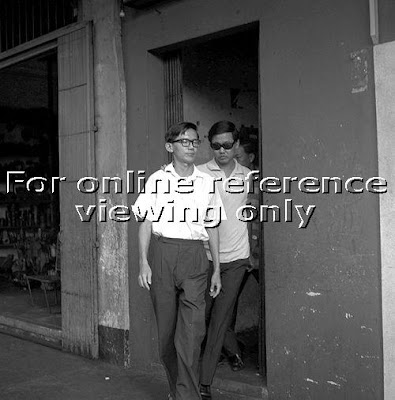
Chia Thye Poh arrested by ISD in 1966:

-
Chia Thye Poh detained in Sentosa 1990:


-
Altogether, Chia Thye Poh was detained by PAP regime for 32 years.
He is the second longest held political prisoner in the world.
-
And I never learnt about this man till I was in my 20s. Thanks to internet. It's a whitewash in history and social studies books.
-
And I never learnt about this man till I was in my 20s.
I don't think Lee Kuan Yew will allow people to know about Chia Thye Poh in school.
-
Originally posted by Poh Ah Pak:
I don't think Lee Kuan Yew will allow people to know about Chia Thye Poh in school.
and i don't think the small kids in school will be too pleased to learn more stuff in school. i remember i hate history in class. but than, i know about the racial riots and the communist parties, just that i didn't bother to dig deeper, cos i was lazy.
-
I wonder why Lee Kuan Yew locked up Chia Thye Poh for so long, 32 years.
Said Zahari locked up for 17 years only.
Very strange.
Did Chia Thye Poh posed such a great threat to Lee Kuan Yew's rule?