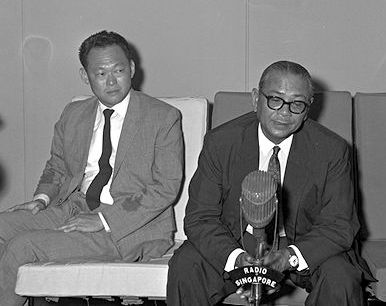
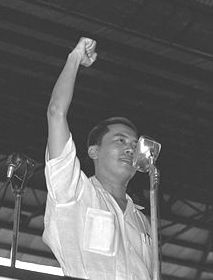
Influx of foreigners upsets social cohesion
-
Originally posted by GHoST_18:
yah...
the women will be maid overseas and u can expect the men to be digging soil and laying bricks elsewhere..
i cant imagine a batch of singaporean males living in dorms and waking up at 6am to cramp into a small lorry to work...

Over exaggeration, this will not happen. We are 1st world country. No matter what happens, we will always not go another country to become maid or brick layers. Analyze this-
We have economy, infrastructure, business, tourism input all the time. Though things may not be rosy at times, it still goes on constantly. We also have a large world class, transport system, strategic airport and port, major strengths.
Sometimes LKY like to over exaggerate, but understandable since he is from the old generation.
-
to socialist;
from way which singapore goes led by the present lees....................we could end up worse overseas!
-
to socialist;
do so,me intel gathering,,,,,,,,,,,,,,ya been reading too much mein kampf books!
try data collection of taiwanese,japanese n south koreans overseas in usa,oz n elsewhere.
-
Originally posted by MINIGUN2000:
to socialist;
do so,me intel gathering,,,,,,,,,,,,,,ya been reading too much mein kampf books!
try data collection of taiwanese,japanese n south koreans overseas in usa,oz n elsewhere.
lucky i am reading Mee Kampong cook books, if not also gone nuts liao.. -
Maybe ethnically diverse identities should be embraced instead of forcing all immigrants to assimilate to Singapore identity? I mean, we are a nation of immigrants. When our forefathers came, they stuck to their own dialect groups. Over time, the differences fell away and coalesced a Singaporean identity e.g like our grandparents lost their Chinese accents and got a Singlish one. The thing is, Singlish was not fostered upon them, it was the result of a co-mingling of different languages (Malay, English, Chinese, Hokkien) to form a truly particular vernacular. So who's to say in a coupla generations time, these foreign immigrants and their children, and own children will be speaking a typical Singaporean lingo. Countries all around are becoming like that - I think we should embrace our diversity, especially since we are a nation of immigrants anyway.
-
Originally posted by la luce nella piazza:
Maybe ethnically diverse identities should be embraced instead of forcing all immigrants to assimilate to Singapore identity? I mean, we are a nation of immigrants. When our forefathers came, they stuck to their own dialect groups. Over time, the differences fell away and coalesced a Singaporean identity e.g like our grandparents lost their Chinese accents and got a Singlish one. The thing is, Singlish was not fostered upon them, it was the result of a co-mingling of different languages (Malay, English, Chinese, Hokkien) to form a truly particular vernacular. So who's to say in a coupla generations time, these foreign immigrants and their children, and own children will be speaking a typical Singaporean lingo. Countries all around are becoming like that - I think we should embrace our diversity, especially since we are a nation of immigrants anyway.
You dun understand, these PRC gals here are taking our sg housewife's husband away creating broken families. And these foreigners are taking our bread and butter away. It is not like old time when all come in at the same time with the same poor conditions.
Today crimes alone may not have increased, by the nos of foreigner creating crimes is rising..pimps, overstay, sells illegal cig and stuffs, cons local, sex with house maids, stealing from owners etc etc...We pay the taxes all these well so that the policeforce get their pay checks. And we paid them to take care of foreigner created crimes??
-
Maybe ethnically diverse identities should be embraced instead of forcing all immigrants to assimilate to Singapore identity? I mean, we are a nation of immigrants. When our forefathers came, they stuck to their own dialect groups. Over time, the differences fell away and coalesced a Singaporean identity e.g like our grandparents lost their Chinese accents and got a Singlish one. The thing is, Singlish was not fostered upon them, it was the result of a co-mingling of different languages (Malay, English, Chinese, Hokkien) to form a truly particular vernacular. So who's to say in a coupla generations time, these foreign immigrants and their children, and own children will be speaking a typical Singaporean lingo. Countries all around are becoming like that - I think we should embrace our diversity, especially since we are a nation of immigrants anyway.
Problem is too many foreigners.
-
Fair points all, I must say I am astounded by your logic today. You have overdone yourself :) But to take each in turn:
1. The PRC vs SG housewife situation. Ultimately it takes two to clap. Also, I agree there have been cases of pei du mamas coming to Singapore on the pretext of their children's education but ultimately wanting to land a Singaporean man, but I do not want to mar all pei du mamas just by some black sheep. Firstly, if pei du mammas or PRC woman hit off with single local man - it is absolutely ok. I have seen many hardworking PRCs who come here for a better life and they wait on tables and do all the menial chores that locals wouldn't touch ever - and they get tgr with local single man. That is fine and dandy. What is not so fine, is breaking up families. But this I blame as much the local married straying man as much as the PRC. If not the PRCs, the local straying man will take his infidelity abroad to say Batam, if his intent is to get a mistress. So having a PRC in Singapore is inconsequential. One might argue that the presence of PRC exacerbates the potential of local man to stray. But that is neglecting the fact that the choice lies in the local man whether to stray. The root of the problem is therefore the man's propensity to stray and not just the PRC. Because if it is not the PRC, it is the Batam mistress. If it is not the Batam mistress, it will be someone else. The solution to this stealing husband syndrome is to get the husband to cut it out. Which of course leads to whole other arguments about female empowerment (so that they can leave their husbands) which again leads on to other arguments about assumed gender roles in the whole "family is the building block of Singapore society" philosophy. But that is another topic altogether.
2. Foreigners taking bread and butter away. Only for the higher skilled occupations because the lower skilled foreign immigrants do work that we shun. And for the higer skilled occupations, I daresay Singaporeans have a skillset comparable to foreign talent. We just need more confidence and creativity and boldness in the workplace. That shouldn't be a problem within the next 10 years. We are in a globalised world, our competition is not just with the next NUS grad but with the graduate from another country.
3. Crimes from the lower-skilled foreign immigrants? I don't deny the situation. But that is a opp cost our society takes in order to get our skyscrapers, our roads, our HDBs. That is a solution of course - provide adequate housing and decent living standards and maybe foreign immigrants may carry themselves with more decorum.
-
Originally posted by la luce nella piazza:
Maybe ethnically diverse identities should be embraced instead of forcing all immigrants to assimilate to Singapore identity? I mean, we are a nation of immigrants. When our forefathers came, they stuck to their own dialect groups. Over time, the differences fell away and coalesced a Singaporean identity e.g like our grandparents lost their Chinese accents and got a Singlish one. The thing is, Singlish was not fostered upon them, it was the result of a co-mingling of different languages (Malay, English, Chinese, Hokkien) to form a truly particular vernacular. So who's to say in a coupla generations time, these foreign immigrants and their children, and own children will be speaking a typical Singaporean lingo. Countries all around are becoming like that - I think we should embrace our diversity, especially since we are a nation of immigrants anyway.
As what some people have mentioned, there are too many foreigners.
The correct policy should have been to let in new citizens in small batches so that integration can occur in a smoother and less disruptive pace.
Right now, the foreign population is almost double the local population. (I think the stats are 2 out of every 5 people in sg are foreigners) With so many of their own countrymen already here in singapore, there is little incentive for say, PRCs (who have become new citizens) to integrate into singapore society as they could easily spend their time with their own countrymen and practice their own local traditions. That is why you always see groups of people of the same nationalities sticking with their own cliques. 5 years back, you would see groups of 2-3 PRCs hanging out together. Right now, you can see probably see bigger groups of 5 or more.
Why bother to integrate and adapt to singapore culture and norms like what sg ministers are telling them when they are more comfortable with their own home customs/language/culture ?
-
Originally posted by la luce nella piazza:
Fair points all, I must say I am astounded by your logic today. You have overdone yourself :) But to take each in turn:
1. The PRC vs SG housewife situation. Ultimately it takes two to clap. Also, I agree there have been cases of pei du mamas coming to Singapore on the pretext of their children's education but ultimately wanting to land a Singaporean man, but I do not want to mar all pei du mamas just by some black sheep. Firstly, if pei du mammas or PRC woman hit off with single local man - it is absolutely ok. I have seen many hardworking PRCs who come here for a better life and they wait on tables and do all the menial chores that locals wouldn't touch ever - and they get tgr with local single man. That is fine and dandy. What is not so fine, is breaking up families. But this I blame as much the local married straying man as much as the PRC. If not the PRCs, the local straying man will take his infidelity abroad to say Batam, if his intent is to get a mistress. So having a PRC in Singapore is inconsequential. One might argue that the presence of PRC exacerbates the potential of local man to stray. But that is neglecting the fact that the choice lies in the local man whether to stray. The root of the problem is therefore the man's propensity to stray and not just the PRC. Because if it is not the PRC, it is the Batam mistress. If it is not the Batam mistress, it will be someone else. The solution to this stealing husband syndrome is to get the husband to cut it out. Which of course leads to whole other arguments about female empowerment (so that they can leave their husbands) which again leads on to other arguments about assumed gender roles in the whole "family is the building block of Singapore society" philosophy. But that is another topic altogether.
2. Foreigners taking bread and butter away. Only for the higher skilled occupations because the lower skilled foreign immigrants do work that we shun. And for the higer skilled occupations, I daresay Singaporeans have a skillset comparable to foreign talent. We just need more confidence and creativity and boldness in the workplace. That shouldn't be a problem within the next 10 years. We are in a globalised world, our competition is not just with the next NUS grad but with the graduate from another country.
3. Crimes from the lower-skilled foreign immigrants? I don't deny the situation. But that is a opp cost our society takes in order to get our skyscrapers, our roads, our HDBs. That is a solution of course - provide adequate housing and decent living standards and maybe foreign immigrants may carry themselves with more decorum.
There are bigger problems than that.
Your concern is too narrow.
It concerns the survival of the Singapore identity.
GARY MORMINO: Exactly. And about one of three Floridians is a native, second lowest in the Union. Someone said the state license plate should be “Where Everyone Is from Somewhere Else.” This has created great problems for the state in connecting—making Floridians believe they have a sense of place here. And that’s one of the great challenges, I think, to modern Florida: a sense of shared sacrifice and a commitment to the future.
-
Originally posted by Ah Chia:
There are bigger problems than that.
Your concern is too narrow.
It concerns the survival of the Singapore identity.
GARY MORMINO: Exactly. And about one of three Floridians is a native, second lowest in the Union. Someone said the state license plate should be “Where Everyone Is from Somewhere Else.” This has created great problems for the state in connecting—making Floridians believe they have a sense of place here. And that’s one of the great challenges, I think, to modern Florida: a sense of shared sacrifice and a commitment to the future.
I think singapore culture will undergo a major change in the next 5 to 10 years.
Yes, what you see as local culture now will look more like another country's soon.
-
Originally posted by charlize:
I think singapore culture will undergo a major change in the next 5 to 10 years.
Yes, what you see as local culture now will look more like another country's soon.
China?
Years of no spitting campaign gone down the drain.
-
Originally posted by charlize:
As what some people have mentioned, there are too many foreigners.
The correct policy should have been to let in new citizens in small batches so that integration can occur in a smoother and less disruptive pace.
Right now, the foreign population is almost double the local population. (I think the stats are 2 out of every 5 people in sg are foreigners) With so many of their own countrymen already here in singapore, there is little incentive for say, PRCs (who have become new citizens) to integrate into singapore society as they could easily spend their time with their own countrymen and practice their own local traditions. That is why you always see groups of people of the same nationalities sticking with their own cliques. 5 years back, you would see groups of 2-3 PRCs hanging out together. Right now, you can see probably see bigger groups of 5 or more.
Why bother to integrate and adapt to singapore culture and norms like what sg ministers are telling them when they are more comfortable with their own home customs/language/culture ?
-
Originally posted by charlize:
I think singapore culture will undergo a major change in the next 5 to 10 years.
Yes, what you see as local culture now will look more like another country's soon.
expect ur hawker food to taste diff in 5 to 10 years time...
these days, those ppl at the kopitiam selling me my fishball noodles and char siew rice are PRCs...
-
There won't be char siew rice or fishball noodles in 5 to 10 years time.
There will be more jiao zi and yang rou chuan.
-
I think singapore culture will undergo a major change in the next 5 to 10 years.
I think Singapore identity will be totally destroyed by that time.
Like that might as well go merge with Malaysia.
This PAP regime really becoming more and more worthless in my eye.
-
There won't be char siew rice or fishball noodles in 5 to 10 years time.

All gone.
Mee siam maybe still have.
-
Originally posted by deepak.c:
There won't be char siew rice or fishball noodles in 5 to 10 years time.
There will be more jiao zi and yang rou chuan.
maybe u will see more ye wei...
-
Originally posted by Ah Chia:
All gone.
Mee siam maybe still have.
Next time, even mee siam with hum also no more.
-
We need a real Singaporean to lead us, not this current bunch of PAP blood suckers.
Only know how to suck foreign cock.
The problem is that the leadership of Singapore felt into the hands of someone from minority group.
That is the main problem.
It's not majority lead majority, like Sinhalese lead Sinhalese.
It's minority lead majority.
That is the root of the problem.
-
If the leadership felt into the hands of Lim Chin Siong, that is majority lead majority.
But this did not happen.
That is why from the beginning, from the birth of the Singapore state, the foundations were always weak.
The foundations of nation building in singapore were weak and flawed from the very start.
By mid 1980s, the flaws began to reveal themselves.
-
Soon yu have to put at least 2 foreigners in one GRC to get votes. That will be a joke on ourselves.

-
In most countries, when independence came from colonial masters, the first leaders were usually someone from the majority ethnic group of that state.
China - Mao Zedong
DPRK - Kim Il Sung
Myanmar - Aung San
Vietnam - Ho Chin Min
Malaya - Tunku Abdul Rahman etc.
In Singapore, this was not the case.
The man who logically should be the first leader, was ousted from the political scene.
It is actually from this event that leads us to all the problems of self identity, nation building, migration etc that we are facing today.
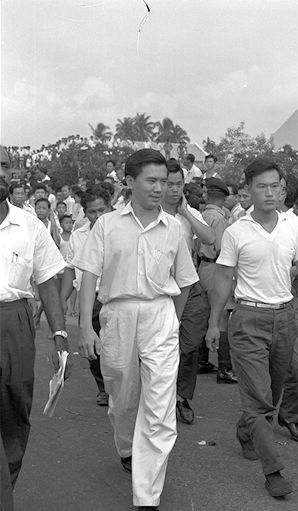
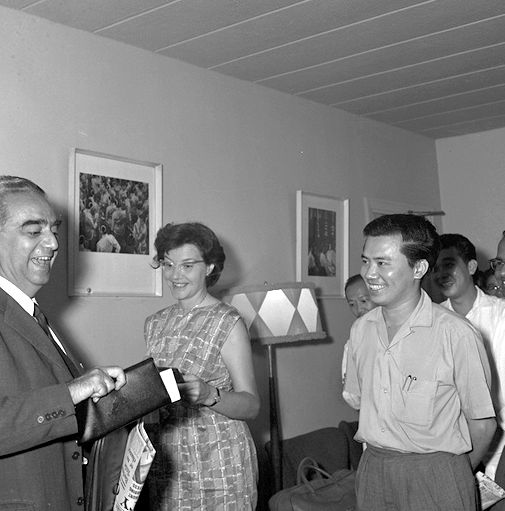
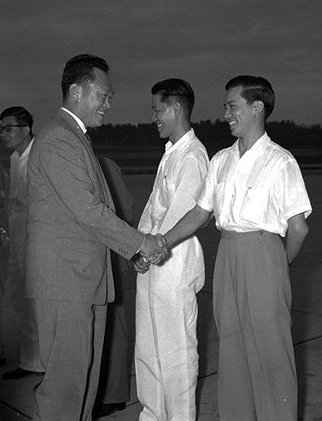
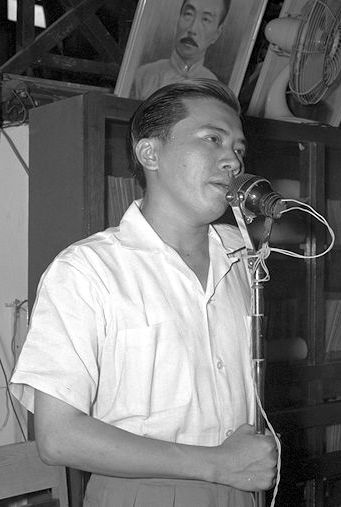
The Man Who Almost Became Prime Minister
“Chin Siong was introduced to me by Lee Kuan Yew. Kuan Yew came to visit me in my little office underneath the stairs and said, “Meet the future Prime Minister of Singapore!” I looked at Lim Chin Siong and I laughed. LKY said, “Don’t laugh!” He is the finest Chinese orator in Singapore and he will be our next Prime Minister!” - David Marshall
Lim Chin Siong is an elusive figure in Singapore’s history. He was a charismatic catalyst to the mass movements of the 1950s and early 1960s, and his political personality helped define an era. To Lee Kuan Yew, Lim Chin Siong was probably his greatest adversary that he respected. Lim did what LKY could not do in the 1950s: mobilize tens of thousands ethnic Chinese just by his words. Lim Chin Siong, was not recognized but is one the founding members of the PAP. His very presence in our history shaped not only our independence but also how the concept of detention without trail (by ISD) and the affiliation of the labour union (eg: NTUC) to the PAP.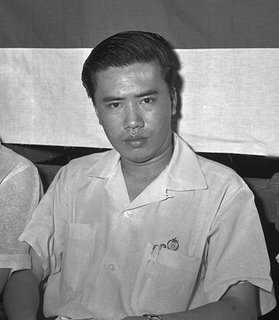 Time
and time again, I’ve mentioned that history is often written by
victors, victors of a political dogfight and victors of unfair
competition. The winners will get titles that remain across time
encapsulating their distinguished successes but not their failures. The
losers sometime suffer a fate worse than death, which is that their
name being erased of annals. Simply, their lives and their
accomplishments never existed. If one mentioned about Dr Goh Keng Swee,
the title of “the architect of Singapore’s economic success” comes to
mind. Similar, Lee Kuan Yew, the “founder of Modern Singapore”. But if
one mentioned about Lim Chin Siong, it might be a slate of blank. At
most, he is remembered as the “Communist” or the “vanquished”
(mentioned in Lee’s Lieutenants). Personally, I would favour the title
“the Man Who Almost Became Prime Minister” for Lim. For this article,
I’ll be drawing information from “Comet in our Sky – Lim Chin Siong n
History” by Tan Jing Quee (published by INSAN press Kuala Lumpur) and
Melanie Chew’s interview with Lim Chin Siong himself.
Time
and time again, I’ve mentioned that history is often written by
victors, victors of a political dogfight and victors of unfair
competition. The winners will get titles that remain across time
encapsulating their distinguished successes but not their failures. The
losers sometime suffer a fate worse than death, which is that their
name being erased of annals. Simply, their lives and their
accomplishments never existed. If one mentioned about Dr Goh Keng Swee,
the title of “the architect of Singapore’s economic success” comes to
mind. Similar, Lee Kuan Yew, the “founder of Modern Singapore”. But if
one mentioned about Lim Chin Siong, it might be a slate of blank. At
most, he is remembered as the “Communist” or the “vanquished”
(mentioned in Lee’s Lieutenants). Personally, I would favour the title
“the Man Who Almost Became Prime Minister” for Lim. For this article,
I’ll be drawing information from “Comet in our Sky – Lim Chin Siong n
History” by Tan Jing Quee (published by INSAN press Kuala Lumpur) and
Melanie Chew’s interview with Lim Chin Siong himself.
The Making of the Hokkien Hero
Lim Chin Siong was born in Telok Ayer in the Hokkien heartland of Singapore’s Chinatown in 28 February 1933. Life was harsh in his early years, and had to stop school during the Japanese Occupation when he was around 9 years old. It was during this hardship that shaped his political inclinations and to be supportive to radical anti-colonial causes mashed with Chinese Nationalism.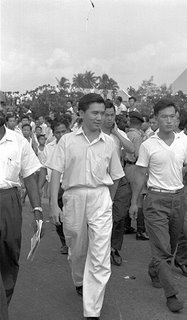 When
the war ended, Chin Siong returned to school at Pei Chun and completed
his primary school education; he had lost three years and was
considerably older than he would have been if not for the war. The
Malayan Communist Party (MCP) had emerged from the war as an ally of
the British in the prosecution of the anti-Japanese was and was
accorded honours and lawful status in the political life of the
country. However, in 1948, MCP’s relations deteriorated to breaking
point; widespread labour demonstrations and strikes, arrested and
political organization bans led to retaliation, murders and open
declaration of war. The MCP was outlawed and took to the jungle to wage
an armed guerilla struggle.
When
the war ended, Chin Siong returned to school at Pei Chun and completed
his primary school education; he had lost three years and was
considerably older than he would have been if not for the war. The
Malayan Communist Party (MCP) had emerged from the war as an ally of
the British in the prosecution of the anti-Japanese was and was
accorded honours and lawful status in the political life of the
country. However, in 1948, MCP’s relations deteriorated to breaking
point; widespread labour demonstrations and strikes, arrested and
political organization bans led to retaliation, murders and open
declaration of war. The MCP was outlawed and took to the jungle to wage
an armed guerilla struggle.
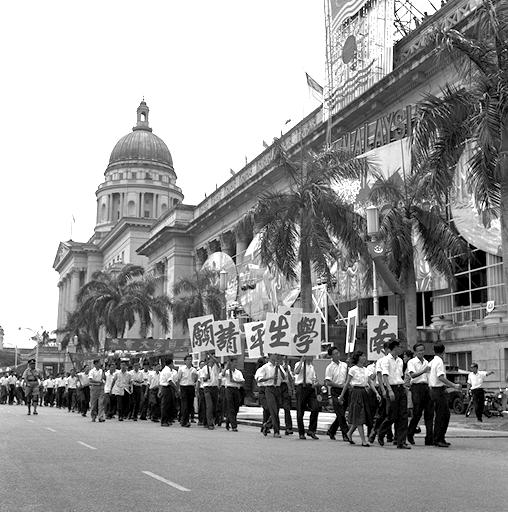
In 1949, Chin Siong enrolled into Catholic High School. He soon found school life there restrictive and transferred himself to Chinese High School. He was now sixteen years old and began to show interest in Chinese patriotism, national salvation and social justice, leading him to read writers like Lu Xun and Lao She. He would soon make his mark as an active student leader, espouse radical causes, and become firm friends with Fong Swee Suan, his classmate in Chinese High School.
Baptism of Politics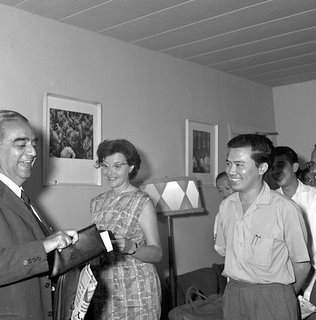 In
1951, they were in Junior Middle III and required to sit for an
external examination, before graduating or advancing to Senior Middle
School. This common external examination was a throwback to the
pre-1949 Kuomintang era and precondition for access to further
education in China. With the China Revolution in 1949, admission to
higher education was closed in Mainland China. Hence, the retention and
continuance of such common examination was an attempt by the British to
limit further education to the Chinese left-wing students.
In
1951, they were in Junior Middle III and required to sit for an
external examination, before graduating or advancing to Senior Middle
School. This common external examination was a throwback to the
pre-1949 Kuomintang era and precondition for access to further
education in China. With the China Revolution in 1949, admission to
higher education was closed in Mainland China. Hence, the retention and
continuance of such common examination was an attempt by the British to
limit further education to the Chinese left-wing students.
Chin Siong and Fong organized a body called, “Students Opposing The Junior Middle III Examinations, galvanizing support for boycotting the examinations. They wrote pamplets, made speeches condemning colonialism and advocated fair and equal treatment for Chinese schools and students. It was in these years, Chin Siong joined the Anti-British League (ABL). These activities eventually caught the attention of the Special Branch (British version of ISD). Chin Siong was detained for a week in August 1951 and again in October 1951 over the examination boycott. He was released, but was expelled from school, together with more than eighty students in the class of 1951.
Singapore Factory and Shop Workers Union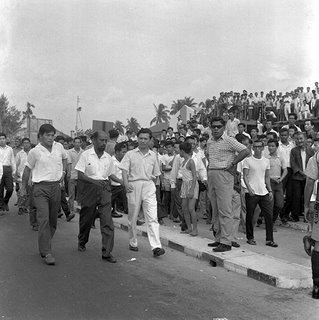 In
1954, an innocuous event would transform and catapult Chin Siong into
greater prominence. He was elected Secretary of a small union bearing
the grandiose name of Singapore Factory and Shop Workers Union (SFSWU)
with a membership of barely 300 members. Within a brief period of just
a year, the membership of SFSWU had expanded rapidly to more than
30,000, making it one of the most powerful trade unions in Singapore at
that time.
In
1954, an innocuous event would transform and catapult Chin Siong into
greater prominence. He was elected Secretary of a small union bearing
the grandiose name of Singapore Factory and Shop Workers Union (SFSWU)
with a membership of barely 300 members. Within a brief period of just
a year, the membership of SFSWU had expanded rapidly to more than
30,000, making it one of the most powerful trade unions in Singapore at
that time.
Chin Siong would be prominent enough to attract the attention of Lee Kuan Yew and colleagues when they were looking around for grassroots leaders to form a new political Party. Chin Siong was inducted into the fortnightly discussion group in the basement of LKY’s house at Oxley Road to work out an agreement to launch the People’s Action Party (PAP).
Mountain with Two Tigers: Lee Kuan Yew & Lim Chin Siong The
newly established PAP decided to contest the elections on 2 April 1955
in four constituencies. The four were, Lee Kuan Yew (Tanjong Pagar),
Goh Chew Chua (Punggol-Tampines), C.V. Devan Nair (Farrer Park) and Lim
Chin Siong (Bukit Timah). It was then when the beacon of Lim Chin Siong
shined brighter than Lee Kuan Yew’s. James Puthucheary, who was in
charge of PAP publicity for the elections recalled the first rally held
in a remote Chinese village.
The
newly established PAP decided to contest the elections on 2 April 1955
in four constituencies. The four were, Lee Kuan Yew (Tanjong Pagar),
Goh Chew Chua (Punggol-Tampines), C.V. Devan Nair (Farrer Park) and Lim
Chin Siong (Bukit Timah). It was then when the beacon of Lim Chin Siong
shined brighter than Lee Kuan Yew’s. James Puthucheary, who was in
charge of PAP publicity for the elections recalled the first rally held
in a remote Chinese village.“Toh Chin Chye spoke first, in English! No response from the crowd. Ong Eng Guan was next, in Hokkien, but not very good. The crowd was restless. Then, Chin Siong stood up. He was brilliant and the crowd was spellbound.”
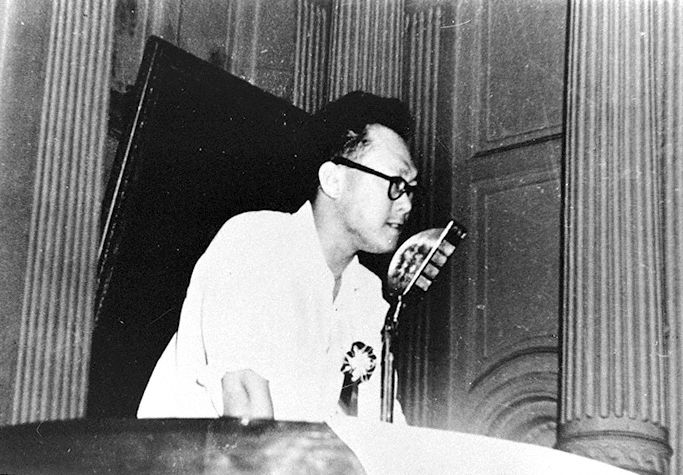
In Lee Kuan Yew’s book, The Singapore Story, he mentioned his experiences and impression of Lim Chin Siong during the election.“One man emerged from this election as a powerful public speaker. He was young, slim, of medium height, with a soft face but a ringing voice that flowed beautifully in his native Hokkien. The girls adored him, especially those in the trade union. Apart from Chinese culture, his themes were the downtrodden workers, the wicked imperialists, the Emergency Regulations that suppressed the rights of the masses, free speech and free association. Once he got going after a cold start at the first two meetings, there was tremendous applause every time he spoke. By the end of the campaign, Lim Chin Siong was seen as a charismatic figure and a person to be reckoned with in Singapore politics and, what was of more immediate concern, within the PAP.”
LKY later describe Chin Siong’s speeches as having a “hypnotic effect” on the crowd.
Behind the Singapore’s Independence Talk’s Failure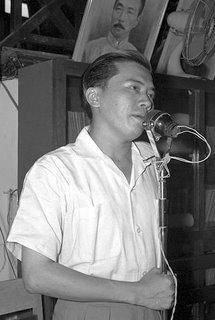 Chin
Siong was elected to his seat in the Bukit Timah constituency and
entered the Legislative Assembly at the youthful age of 22 years old.
At the time, the Legislative Assembly only permitted the use of English
in debates. Chin Siong’s hesitant English became a safe target for
red-baiting, which he handled as well as he could, but without damage
to his standing among the non-Chinese speaking population. During that
time, he has his colleague, Devan Nair to draft his parliamentary
speeches. Having won 10 of the 25 elected seats in the 1955 Elections,
David Marshall emerged as Chief Minister.
Chin
Siong was elected to his seat in the Bukit Timah constituency and
entered the Legislative Assembly at the youthful age of 22 years old.
At the time, the Legislative Assembly only permitted the use of English
in debates. Chin Siong’s hesitant English became a safe target for
red-baiting, which he handled as well as he could, but without damage
to his standing among the non-Chinese speaking population. During that
time, he has his colleague, Devan Nair to draft his parliamentary
speeches. Having won 10 of the 25 elected seats in the 1955 Elections,
David Marshall emerged as Chief Minister.
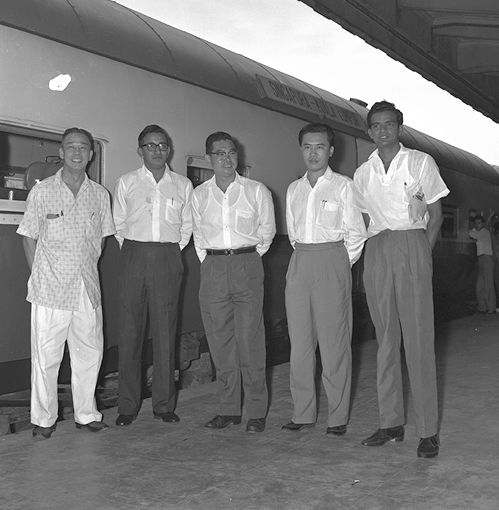
In April 1956, David Marshall led a 13 man all-party delegation to London for the scheduled constitutional talks. Lee Kuan Yew and Lim Chin Siong represented the PAP in the delegation. Despite the rhetoric of “Independence talks”, this underlying premise on the urgency to curb the left wing in Singapore, implicitly accepted as the programmatic consensus for the next phase of constitutional advance by all members of the delegation, except Lim Chin Siong. The talks eventually collapse when the British refused to compromise with the proposal of a Malayan chairman of the Defence and Security Council to oversee internal security. The British wanted control over the Internal Security. The talks collapse on this single issue.
Repression by Lim Yew Hock
The failure of the talks had major consequences on Singapore politics. David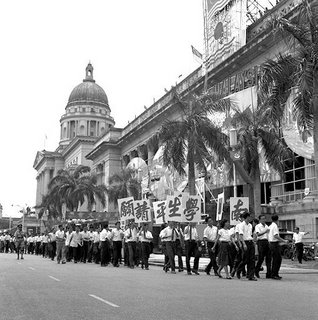 Marshall
resigned and Lim Yew Hock took over, initiating a new wave of detention
without trial to suspect left-wing activists. Meanwhile, 8 July 1956,
Lim Chin Siong was elected to the Central Executive Committee (CEC) of
the PAP with the largest number of votes, ahead of Lee Kuan Yew and Toh
Chin Chye. But he was not on stage or at the photo taking as he was
advised by LKY from it as he has a record of detention which might harm
the Party. Months later, Lim Chin Siong and the rest have been made
scapegoats for the later success independence talks with the British.
Marshall
resigned and Lim Yew Hock took over, initiating a new wave of detention
without trial to suspect left-wing activists. Meanwhile, 8 July 1956,
Lim Chin Siong was elected to the Central Executive Committee (CEC) of
the PAP with the largest number of votes, ahead of Lee Kuan Yew and Toh
Chin Chye. But he was not on stage or at the photo taking as he was
advised by LKY from it as he has a record of detention which might harm
the Party. Months later, Lim Chin Siong and the rest have been made
scapegoats for the later success independence talks with the British.
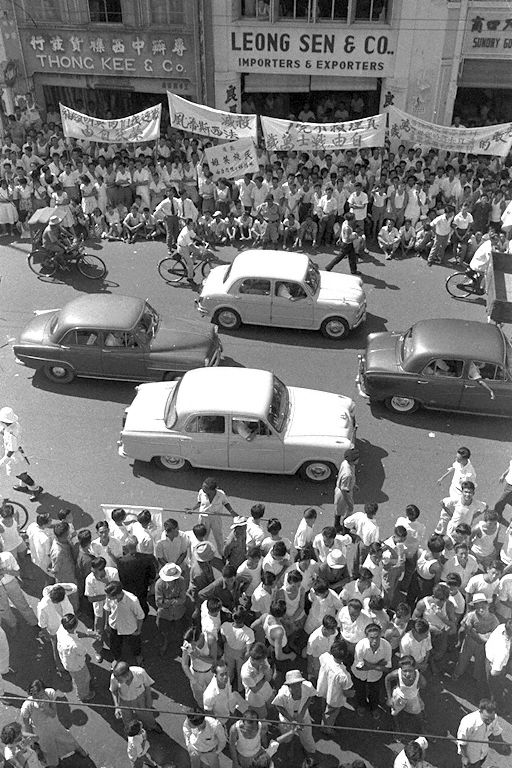
In October 1956, Lim Yew Hock ordered six persons to be arrested under banishment orders from the Chung Ching High School, with several unions being banned. The Special Branch detained Chia Ek Tian, a CEC member in PAP and Soon Loh Boon. At a rally
at Happy World Stadium to celebration the anniversary of the SFSWU,
Chin Siong denounced the repression. But the repression escalated
further when Minister of Education Chew Swee Kee issued orders to the
management committees of the Chung Ching High School and Chinese High
School to expel 142 students. When the students went on strike, the
Government ordered the closure of schools. At the PAP rally held at
Beauty World Park, Bukit Timah, Chin Siong condemned the repression and
urged support for the besieged students. Singapore was in the state of
riot. 13 people died and 123 injured. All the major Middle Road trade
union leaders were detained, including Lim Chin Siong, Fong Swee Suan,
Devan Nair, James Puthucheary, S. Woodhull and Chen Chiaw Thor.
rally
at Happy World Stadium to celebration the anniversary of the SFSWU,
Chin Siong denounced the repression. But the repression escalated
further when Minister of Education Chew Swee Kee issued orders to the
management committees of the Chung Ching High School and Chinese High
School to expel 142 students. When the students went on strike, the
Government ordered the closure of schools. At the PAP rally held at
Beauty World Park, Bukit Timah, Chin Siong condemned the repression and
urged support for the besieged students. Singapore was in the state of
riot. 13 people died and 123 injured. All the major Middle Road trade
union leaders were detained, including Lim Chin Siong, Fong Swee Suan,
Devan Nair, James Puthucheary, S. Woodhull and Chen Chiaw Thor.
The arrest effectively excluded Chin Siong from participation in the PAP deliberations regarding the new rounds of constitutional talks led by Lim Yew Hock. Only Lee Kuan Yew would represent the PAP. A clause would be adopted prohibiting Chin
Siong and his detained colleagues from contesting the first elections
under the new constitution. The result was obvious: the popularity of
Lim Yew Hock sank with each new repression, just as Lee Kuan Yew’s star
continued to rise with each successive debate. Lee Kuan yew’s
identification with the detained left wing leaders strengthened his own
popularity and public image as champion of the dispossessed. The
spotlight was on him alone, benefiting from the repression launched by
Lim Yew Hock. LKY had added confidence knowing that he would be the
more natural and obvious choice for the British for the mantle of power
as he continued to ride the wave of the martyrdom of his detained left
wing colleagues.
Chin
Siong and his detained colleagues from contesting the first elections
under the new constitution. The result was obvious: the popularity of
Lim Yew Hock sank with each new repression, just as Lee Kuan Yew’s star
continued to rise with each successive debate. Lee Kuan yew’s
identification with the detained left wing leaders strengthened his own
popularity and public image as champion of the dispossessed. The
spotlight was on him alone, benefiting from the repression launched by
Lim Yew Hock. LKY had added confidence knowing that he would be the
more natural and obvious choice for the British for the mantle of power
as he continued to ride the wave of the martyrdom of his detained left
wing colleagues.
The Straits Times report of 5 April 1957 on the return of the conquering heroes summed up the mood of the people back home. “It was an unexpected silent crowd. There was a marked absence of the usual spontaneous shout of Merdeka.” David Marshall described the new constitution as a “fraud” and nineteen trade unions lobbied the PAP leadership to withdraw the mandate given to Lee Kuan Yew to accept the new constitution. LKY took up Marshall’s challenge in By-elections contesting based on the constitution. Marshall lost and quit politics.
Released from Detention
After assuming power, the PAP government released eight left wing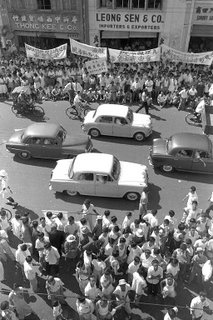 leaders
on 4 June 1959, after ensuring that they were excluded from
participation in the parliamentary elections to the central committee.
Five were appointed as political secretaries, but with little real
substantial power to initiate or influence polices. More significantly,
none of them were made cadre members, which meant that they would never
be in any position to challenge the leadership in future party
elections. When Chin Siong was released, he was only 26 years old.
leaders
on 4 June 1959, after ensuring that they were excluded from
participation in the parliamentary elections to the central committee.
Five were appointed as political secretaries, but with little real
substantial power to initiate or influence polices. More significantly,
none of them were made cadre members, which meant that they would never
be in any position to challenge the leadership in future party
elections. When Chin Siong was released, he was only 26 years old.
Here, LKY played his political cards to perfection. Being the solicitor of the detainees, he was seen as the freer of the oppressed. Putting Chin Siong and the rest in political office, he could ride their popularity amongst the Chinese population without giving Chin Siong and the rest any power. In that, LKY would not be threatened by his popular rival, but not for long.
PAP: The Empty Shell
Soon after assuming power, the PAP government formed a ten-men secretariat of the Trade Union Congress to reorganize the labour movement. Lim Chin Siong returned to his old post as supreme of the Middle Road Unions. A duel power situation developed; while LKY faction controlled the state and the party, Chin Siong’s faction was dominant in the trade union and other mass organizations.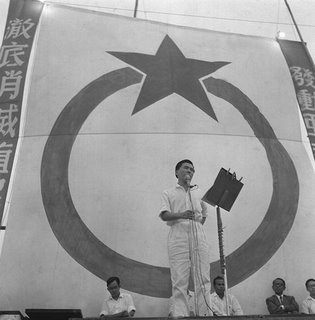 By
mid-1961, following two humiliating defeats for the PAP at Hong Lim and
Anson by-elections, it was clear that a decisive break was inevitable.
LKY’s government sought a vote-of-confidence at the Legislative
Assembly meeting on 20 July 1961. 13 PAP Assemblymen abstained from the
vote and were promptly expelled from the party. The expelled men joined
forces with the left wing trade unions to form the Barisan Socialis. In
August 1961, they formed a rival party, the Barisan Sosialis, led by Dr
Lee Siew Choh and Lim Chin Siong. They took 35 branch committees, 19 of
the 23 organizing secretaries and an estimated 80 percent of the
membership. PAP under LKY was a mere shell, according to Dr Lee.
By
mid-1961, following two humiliating defeats for the PAP at Hong Lim and
Anson by-elections, it was clear that a decisive break was inevitable.
LKY’s government sought a vote-of-confidence at the Legislative
Assembly meeting on 20 July 1961. 13 PAP Assemblymen abstained from the
vote and were promptly expelled from the party. The expelled men joined
forces with the left wing trade unions to form the Barisan Socialis. In
August 1961, they formed a rival party, the Barisan Sosialis, led by Dr
Lee Siew Choh and Lim Chin Siong. They took 35 branch committees, 19 of
the 23 organizing secretaries and an estimated 80 percent of the
membership. PAP under LKY was a mere shell, according to Dr Lee.
The PAP government was on the verged of being toppled. Every session, the opposition would motion of no confidence. But across the shores, the Prime Minister of the Federation of Malaya, Tengku Abdul Rahman, watched the events and feared that Singapore was about to become a Communist State, a “second Cuba” and a danger to Malaya. Thus, this was the start of the intense and frantic, Battle for Merger.
Tunku: LKY’s Last Dice
Barisan Sosialis held sway in Singapore but it knew that in a wider Malaysia
they would be crushed. On the other hand, PAP needed Malaysia to break
the Barisan’s hold on the Singapore Electorate. Thus, they enlisted
Malayan Tengku and the British as allies, playing on their long
standing fear of Communism.
Malaysia
they would be crushed. On the other hand, PAP needed Malaysia to break
the Barisan’s hold on the Singapore Electorate. Thus, they enlisted
Malayan Tengku and the British as allies, playing on their long
standing fear of Communism.
On July 1962, the Barisan Sosialis, led by David Marshall and Dr Lee Siew Choh, appealed against the merger in the United Nations in New York. The Merger Referendum, issued in 1962, was testimony to the murkiness of the Battle. It was deliberately ambiguous. It asked voters to choose what kind of merger they wanted, not whether indeed they wished for a merger. The referendum was not to be a simple YES or NO response to the merger, but included three choices:
Option A endorse merger on terms suggested by the White Paper.
Option B distorted the Barisan Sosialis formula and threatened to disenfranchise 250,000 Singapore citizens
Option C purportedly represent the position of the Singapore Peoples Alliance, which neither it not any other political party advocated or adopted.
25% rallied to the call of Barisan and cast blank votes, objecting to the manner in which the exercise had been carried out. 71% chose Option A. With this controversial tactic, the PAP won the Battle for Merger.
Operation Coldstore: Wiping out Lim Chin Siong Tengku
then decided to clean out the Left Wing with “Operation Cold Store”.
Hundreds of arrest was made and effectively decapitated the Left Wing
Barisan Sosialis. Nearly the entire central executive committee of the
Barisan Sosialis, including Chin Siong, was arrested. Chin Siong was
just shy of thirty years old at the time of his third detention. In the
decade spanning his entry into the political fray in 1954 and 1963, he
had already spent more years in jail than outside.
Tengku
then decided to clean out the Left Wing with “Operation Cold Store”.
Hundreds of arrest was made and effectively decapitated the Left Wing
Barisan Sosialis. Nearly the entire central executive committee of the
Barisan Sosialis, including Chin Siong, was arrested. Chin Siong was
just shy of thirty years old at the time of his third detention. In the
decade spanning his entry into the political fray in 1954 and 1963, he
had already spent more years in jail than outside.
A snap elections was called, under the protection of the Malaysian Security Council, produced a clear PAP victory. The Barisan, with most of their leaders in prison, garnered only 13 out of 51 seats. On September 1963, the PAP government had won its battle against the Left. By 1965, Singapore was kick out of the Federation after a mere 1071 days in Malaysia. As foreseen by Chin Siong, the merger was never what it was meant to be but could be just an excuse to eliminate political opponents.
End of a Great Singaporean Chin
Siong would remain in jail and suffer severe depressions, until
physically broken and mentally traumatized. He announced his decision
to quit politics and took off in exile in London (in 28 July 1969), his
physical health ruined and his political life destroyed. He married
Wong Chui Wan in London, in 1970, had two sons in his marriage. He
struggled earning a living doing odd jobs and would continued to suffer
bouts of depression. He never recovered. In 1979, he decided to return
to Singapore and stayed in Serangoon Gardens until his death in 5
February 1996. Former political colleagues, political foes, former
ministers, trade union leaders and ordinary citizens came to pay their
last respects to the man who almost became Prime Minister of Singapore.
Chin
Siong would remain in jail and suffer severe depressions, until
physically broken and mentally traumatized. He announced his decision
to quit politics and took off in exile in London (in 28 July 1969), his
physical health ruined and his political life destroyed. He married
Wong Chui Wan in London, in 1970, had two sons in his marriage. He
struggled earning a living doing odd jobs and would continued to suffer
bouts of depression. He never recovered. In 1979, he decided to return
to Singapore and stayed in Serangoon Gardens until his death in 5
February 1996. Former political colleagues, political foes, former
ministers, trade union leaders and ordinary citizens came to pay their
last respects to the man who almost became Prime Minister of Singapore.
Many (former and present) leaders have condemned Lim Chin Siong as a Communist. But this was one charge that Chin Siong never acknowledged. In his words, “To brand someone as Communist at that stage was the best and most convenient way to put him in jail.” Perhaps his view on detention without trial was the most awakening,“The fact is that all of us were detained, without trial for ages. Not knowing when we would be coming out. That, I would say is a torture. A torture. You are detained for years, until such a time that you are willing to humiliate our own integrity. Until you are humiliated publicly. So much so, when you come out, you cannot put your head up, you cannot see your friends. Alright, then they may release you. It is a very cruel torture. It is worse than in Japanese time, when with a knife, they slaughter you. One shot, you die. But this humiliation will carry on for life. It is very cruel.”
He died a broken man, 23 days short of his 63rd birthday and forgotten by Singaporeans today. -
Did he deny outright that he was not a commie? We could have become another North Korea. As for detention without trial, almost every country has it, e.g. Patriot law in USA. At least he wasn't like Aung Suu Kyi, kena almost whole adult life in house arrest
-
James Puthucheary, who was in charge of PAP publicity for the elections recalled the first rally held in a remote Chinese village.
“Toh Chin Chye spoke first, in English! No response from the crowd. Ong Eng Guan was next, in Hokkien, but not very good. The crowd was restless. Then, Chin Siong stood up. He was brilliant and the crowd was spellbound.”
The leadership of Singapore did not go to the group that was with the majority.
It did not go to the hokkien group.
It felt into the hands of the english speakers and baba group.
From that date onwards, Singapore's fate was sealed.
If the hokkien group developed Singapore, Singapore could have developed into a version similar to what Taiwan is today.
This did not happen.
The dialects were suppressed, an alien language imposed, cultural life weakened and all the problems of self identity, nation building, migration etc developed.