nice plane
-
The plane that is featured is the Russian Sukhoi S-37 Berkut, as mentioned in the article it utilises a radical FSW (Forward Swept Wing) design.

However, this design is not really new, in that it was first tested and tried by aircraft designers in NAZI Germany during WWII, that program was eventually abandoned due to the insufficient strength of metal materials used in those days. -
The Americans also had a similar program, the Grumman X-29A,

but after building two jets, that program also folded. -
The Russians seem to be having more luck with the S-37 Berkut but whether it will eventually be put into service is still in doubt as it faces stiff competition from the rival MiG 1.42/1.44 project which was started to produce an aircraft capable of combating the American F-22 Raptor.

The MiG 1.42/1.44 designers are gambling on a new unproven technology to make this jet 'stealth'. Inside the fuselage, designers have installed a system to create Plasma Stealth. This sounds like science fiction but it's actually being done. What Plasma Stealth does is it ionizes a layer of air around the aircraft, this layer of ionized gas then absorbs radar waves making it invisible to radar. If this new technology works, this jet will probably beat the S-37 Berkut. -
i thought it was active stealth which the french,euro and US plane designers are trying to do also
-
while it is super cool, the S-37 actually will be nothing more than a technology demonstrator. sukhoi has decided it is impractical to produce the S-37 as a fighter and will instead go ahead with a simplified version with a more traditional (and stealthy) diamond-shaped wing planform. at the moment it is called the Su-40something or Su-4x; exact designation remains unknown. the S-37 is on the left, and Su-4x on the right.

-
No, the Russian Plasma Stealth is documented as something totally diferent from Active Stealth (also known as Active Radar Cancellation). In simple terms, Radar involves the emission of radio waves which will reflect off other aircraft back to the transmitting aircraft, thus giving a signal on the original aircraft's radar screen.Originally posted by |-|05|:i thought it was active stealth which the french,euro and US plane designers are trying to do also
The various types of (known) stealth technologies are:
1) RAM (Radar Absorbing Materials): This is the most well known and comes in the form of paint or paneling found on the B-2 Spirit and F-117A Nighthawk. Basically, the materials used absorb the radar waves so less radar waves bounce back to the transmitting aircraft.
2) Active Radar Cancellation (what the French, European & US are experimenting): Active Radar Cancellation, to put this simply, an air defense radar is transmitting at a certain frequency; the signal is bouncing off the aircraft; a receiver aboard the aircraft picks up the signal and a computer analyses its base frequency and modulations and an out-of-phase signal is generated by onboard systems to cancel out the enemy radar signal. In other words, it uses new radar waves to cancel out the transmitting aircraft's radar waves.
3) Plasma Stealth: As mentioned, this uses electrically ionized gas as a radar absorbing layer, probably works like RAM.
Of the three methods, Active Radar Cancellation is probably the most complex as positioning the transmitting antennae aboard the aircraft to cover the entire aircraft (since the enemy radar signal is reflected from a multitude of points on the airframe and it's reflected differently from every one of them) is extremely difficult.
As the term Active Stealth is an informal name and is fairly broad in it's meaning. Many may confuse it to mean just Active Radar Cancellation. -
cool..

-
Active Plasma Shielding.. for the Sukhois..
EMP shielding to fry incoming HEAT rounds to be fitted on UK Challenger tanks
Unmanned CAVs..The future is becoming more and more like science fiction.If you read the ST today, there's a report on Peterson Air Force Base in Colorado having just launched a Satellite Jamming device for operational use. -
EMP shield seems to sound like Phase shift armour in gundam SEED
-
the two bulbs at the s37 engine nozzles are rear facing radars, used to launch rear facing missles in a dog fight. the x-29 program folded because there weren't enough purposes to fully utilise the FSW. the FSW incredible computing power and material strength. i doubt any planes, even modern ones have the capability. and not as if normal swept wings and other gadgets such as rear facing and off bore sight missles can't do the work orginally desgined for the FSW.
-
These new Russian planes are such a beauty! Any more pics on the Su-4x or the Mig 1.42/1.44?

-
MiG 1.42/1.44 pics:Originally posted by tankee1981:These new Russian planes are such a beauty! Any more pics on the Su-4x or the Mig 1.42/1.44? 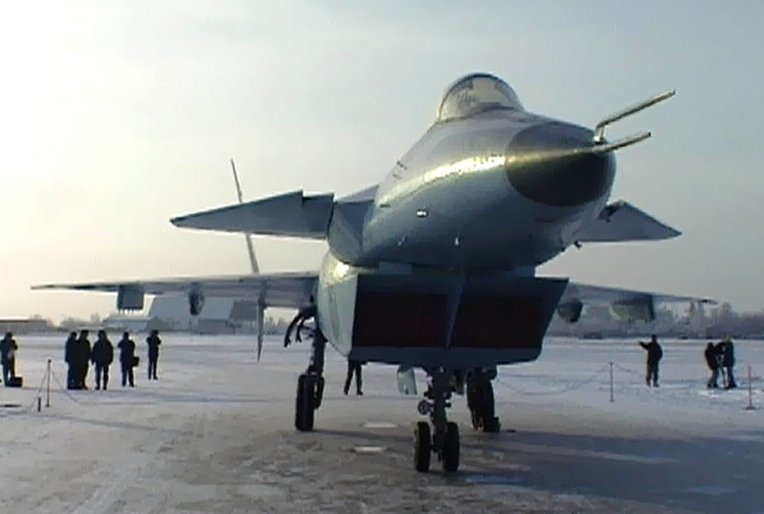
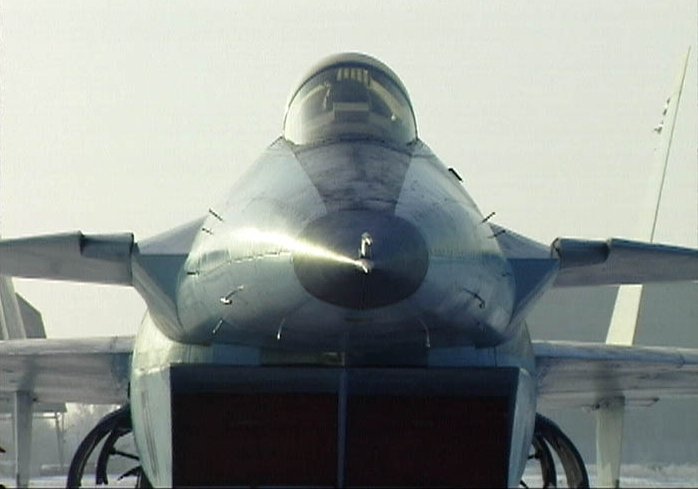
-
All pic of the stealth SU-47!!!
-
Wow, very nice. Really very nice.