Foreign Intelligence Agents
-
Given that we have foreign intelligence agents spying on us,what is it that prohibits our counter-espionage departments from making them 'disappear' or liquidating these agents?
I see no problem with it.They are foreign citizens caught trying to compromise our security.Given,they should then be liquidated and their remains deported to the intelligence agency of their home country.
Imagine an enemy spy sent back to their employer as a pile of ashes or as body parts.A strong message that you do not mess with Singapore.
Alternatively,perhaps Sg should set up a special section dedicated to counter-terrorism and counter-espionage black ops,where missions such as assassinating foreign ambassadors or liquidating traitors or enemy spies and other sensitive tasks would be handled.
Of course,you would then have all the problems associated with diplomacy,human rights violations,'incidents' with other countries and the problem of the director of such a special unit becoming power hungry.
It's just a personal view that we should do more to foreign spies than just deport them.How about giving them 24 lashes before dporting them.It sends a clearer message than any other not to tarry with us.To quote Lee Kuan Yew - 'you play ducks and drakes with us,I play ducks and drakes with you'.However,we should punish traitors selling information to opponents or even allies even harder,or with liquidation.The sea would make a very good disposal point for any liquidated traitors or foreign personnel.Simply add concrete to their feet.Similarly,their bodies could simply be dumped into an incinerator.
"...Slay one to scare a hundred.." - Anon -
I'm interested in being a spy for singapore. I'm serious, but we got no direct recruitment, so I dunno how to go about doing that?
-
Be a regular firstOriginally posted by [G]oggles:I'm interested in being a spy for singapore. I'm serious, but we got no direct recruitment, so I dunno how to go about doing that?
-
Given that we have foreign intelligence agents spying on us,what is it that prohibits our counter-espionage departments from making them 'disappear' or liquidating these agents?
Sometimes, it is good to let them know somethings but not all things, tell them report alittle about our light but not to reveal all light. Our MSD have their own way of doing and we should have faith in them. I wont be surprise if foreign intelligence is scanning world wide defense forums as intelligence gathering from non-human sources is in fact the most widely used form of gathering. So sometimes, we know their existence but it doesnt mean that we have to liquidate them. Their existence might be a blessing both for their owner and for us. Simply, we can also perform intelligence on them. We want to know how they sent encrypted msg, their code, their operation style. We prefer to break the den, not so much on subdueing the individuals. We might also want to know what they are here for, what they want and how they got to know what they want.
So all in all, their existence is there somewhere and something their pressence is felt, but it doesnt mean that we should pin them down immediately. Let them know CAT 5 secrets, trade it off with some intelligence and deterrents. However dun misunderstand my point. Unless it is not neccesary, we should crack them under certain crucial circumstances. As i had said, ISD and MSD have their way.Imagine an enemy spy sent back to their employer as a pile of ashes or as body parts.A strong message that you do not mess with Singapore.
You talk as if it is so direct and simply. You must know the diplomatic consequences behind those actions. For example, we discovered chinese spys in Singapore. Are we to shoot them and destroy our relation or we have a little 'trading'.....

Alternatively,perhaps Sg should set up a special section dedicated to counter-terrorism and counter-espionage black ops,where missions such as assassinating foreign ambassadors or liquidating traitors or enemy spies and other sensitive tasks would be handled
.
There are."...Slay one to scare a hundred.." - Anon
No matter how much u slay, how many you scare, they will just keep coming. You can dun slp, dun eat but you can never stop them. -
You dun have to go to them. They will find you.Originally posted by [G]oggles:I'm interested in being a spy for singapore. I'm serious, but we got no direct recruitment, so I dunno how to go about doing that? -
So we got chinese spies in singapore?
I guess taiwan and china spies each other the most..
What the hell would china's spies be doing , in singapore?
lets just get rid of those spies,regardless of nationality!!
Anyway,if indonesia wants information or something, it will be ultra tough as well , but if we want information , its much more easier, indonesians love $$ ..
and furthermore, key "positions" here who hold the military sensitive information..are not their "cousins"
But anyway, with $$, pple will betray their conscience..
Don't forget...last time Chinese pple work as spies for the Kempeitai.. -
Why not.Originally posted by SibeiSuayKia:So we got chinese spies in singapore?.
Just think.... -
Its a sad truth that allies spy on allies,and enemies will always spy on enemies.even neutral/non-aligned countries will spy on other countries.it's a reality of international relations.
Of course,I just don't like having ppl spy on us. -
Given that our name is larger than our size on the world map, i'd worry what kind of message we'd want anybody sending a spy here to recieve.Originally posted by Sardaukar:Imagine an enemy spy sent back to their employer as a pile of ashes or as body parts.A strong message that you do not mess with Singapore.
It's just a personal view that we should do more to foreign spies than just deport them.How about giving them 24 lashes before dporting them.It sends a clearer message than any other not to tarry with us.To quote Lee Kuan Yew - 'you play ducks and drakes with us,I play ducks and drakes with you'.However,we should punish traitors selling information to opponents or even allies even harder,or with liquidation.The sea would make a very good disposal point for any liquidated traitors or foreign personnel.Simply add concrete to their feet.Similarly,their bodies could simply be dumped into an incinerator.
"...Slay one to scare a hundred.." - Anon
Say for example a PRC spy, caught, "liquidated", and sent back as ashes.
How much do you want to bet the next thing we'd see all sorts of tricks being pulled by PRC government?
Oh no your singaporean, we can't very well sell you this.
Oh no your singaporean, we can't let you perform here (it has been done).
It's a good idea, but remember this.
Agency A sends Agent B to Country C.
Given orders to stay there for long time and to report if anything happens.
Never reports for a long long time.
Logically, Country C found them out.
Who to point fingers?
And as some people have candidly stated, we don't need to suffer a military invasion to paralyse us. Just a simple cut off of eggs will do it.
I hold Minister Lee with great respect, but i worry that if we play ducks and drakes with someone who can squash us with a breath, they'd play dungeons and dragons with us.
Do read the newspaper today, i remember a certain quote about China. Basically it said that if ONE percent of China's graduates focused on something, there'd be 200 thousand people working on it. -
wah lau, u all dunno history huh....last time got spies caught, got deported back to the country of origin and barred from entering SG.....u think we so barbaric so burn them and send back the ashes....duh.
didn't violate OSA cos was published on ISD webby. -
By the way, it's not a clever idea to do something and tell the parent agency:
We found your agent.
We captured him.
We burnt him in a incinerator.
Here's the ashes.
Have fun.
Is there any faster way to goad them on or to tell them their spy got discovered? -
russia and usa did do that to each other's agents..
taiwan and china oso same thing...published in news somemore -
Nah, dun think so far... usually captured spies are traded for the release of friendly spies or they become double agents, killing a spy is not as common as you think as there can be more profitable options at times.
-
I'm not expert on spy issues, but I do know for a fact that China used to execute spies caught. However, today they have changed that policy to long term imprisonment.

Why don't execute spies anymore? Well, its just a job for the individual doing the spying.
Are there spies in S'pore? Hell yah! S'pore is know for its economy & its situated in the middle of ASEAN coutnries.
Its not always about military intel that a spy is after, sometimes its about the policies of that coutry or trade secrets that are of interest.
There are overt spies that you can look up in S'pore, just go to any embassy & you'll most likely spot them. If you're desprate, go into the U.S embasst & ask to speak to the CIA station chief. For the Brits embassy, ask to speak to the foregin affairs officers( cover for MI-6 ). Malaysian embassy also has its own overt spy officer in S'pore. In fact, most embassies would have a embassy spy to either recruit local informals or update the embassador on local issues.
But before you decide to actually look up a spy in any embassy, please be informed that S'pore counter-spy agency would already be spotting you from across the road.
On the other hand, covert spies, would not be located in an embassy for their own personnal security as well as the security of their ops.
Spies don't usually carry out assassination as this would blow off their cover & put themselves at risk of being picked up by counter-spies who already know about them. Usually assassinations are done by 'outsiders', who enter the country 2 weeks or 1 day before the hit & then depart immediately after. Sometimes the assassin could be a local thug hired to the job.
Hmm! Did you know S'pore has its own spies?
Anyway, I read that Indonesia recently started an International school for spies. Why not enrol for a degreed or diplomma on spying. Hahaha... -
I just want to add that if you want to be a spy, it would be best if you're a woman with no moral about using your body to your advantage. Not that all spy masters are women but they are indeed good at the game. Why are spy master usually male, cause this are the chaps who know how to play the game & avoid the horny traps.
But don't go thinking of beinging a spy is like being James Bond because you may encounter horny traps but it won't include all the other cool stuff you see in the movies. If you can't avoid the horny trap, your career as a spy is over. -
If you wish to spy for Singapore, contact ISD. They are very selective, and you will most likely not make it, but you can always try.
Why don't we kill off foreign spies? Many reasons. Firstly, it is against our own laws to do so. We have higher morals than that. Secondly, many foreign spies are embassy staff and have diplomatic immunity. It would be illegal to prosecute them -- we can only deport them and declare them persona non grata (PNG). Fourthly, it can be considered an act of war or aggression. Lastly, it makes things more dangerous for our own spies. There is a certain understanding between spy agencies.
Also, most foreign operatives here are "handlers" -- they control a network of Singaporeans (traitors) that actually provide the information. Examples would be SAF officers that hand over secret documents, cleaning personnel in bases that install and recover bugs, or restaurant staff who hear loose talk at their establishments. We can come down on the Singaporeans with the OSA and other laws, and definitely do. Very few foreign operatives actually go out and do anything outright illegal -- not easy, and no need when you can cultivate locals to do it for you. So what can you kill them for? Talking to a kopitiam uncle who overheard SAF personnel talking about this or that? -
I think you first need to be specialist in something. Intelligence work is not like 007 james bond carry a gun with all sorts of gadgets & having every piece of a ss trying to jump into bed with you.Originally posted by [G]oggles:I'm interested in being a spy for singapore. I'm serious, but we got no direct recruitment, so I dunno how to go about doing that?
Normally the kind that gets recruited are News people, Journalist and foreign news corresspondents or business people, bankers, secret society etc ...
why? Well these people know and deal frequently with lots of people normally maintain large network of aquaintances, they also make and use friends naturally. In other words they are gifted in making friends and people are attracted to them and hence privy to lots of information.
If you know Thai boxing, JUDO or TKD done 4 and commando in army or ex french legionaire but know nuts abt making friends and using people then I dun think you are a likely candidate but maybe can find work as a bodyguard or assasin. -
Put up Eli Cohen here, the most successful israeli spy. With his charming good looks and the lavish parties he hosted and generousity with $$$ He made powerful friends in high places. It was also heavily rumoured that he had as many as 40 lovers many of whom were daughters, wives and mistresses of powerful people from whom he gathered his intel.
The entire text is too long, I have edited to shorten it.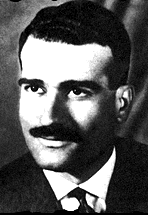 Eli Cohen was first sent to Buenos Aires, Argentina, to establish his cover as a Syrian emigre. He soon established himself in the social and cultural life of the Syrian community of Buenos Aires and was known as a wealthy businessman who was generous, tipped well, and loved the night life. He soon became accepted, well-liked and respected, and made contacts with politicians, diplomats and military officials working out of the Syrian Embassy. One of them was Colonel Amin al-Hafaz, a supporter of the secular-leftist Ba'ath party.
Cohen's contacts, nurtured through a string of lavish dinner parties, social occasions, and friendships with those in high places, led to invitations to visit Damascus and to set up a business venture there. He was promised support in any venture he might wish to undertake, and the generous sums of cash which he appeared to possess appealed to the unscrupulous who thought he could provide "grease" to their financial ambitions, as well as patriotic Syrians who hoped for an infusion of foreign capital into the Syrian state.
Nine months later, in late 1961, Eli came back to Israel for a visit with his wife Nadia. But he spent most of his time in Tel Aviv "perfecting his cover and being briefed on Aman's requirements of him in Syria, as well as last-minute intelligence data needed for his mission." Needless to say, his success in effectively penetrating the Syrian social and political/diplomatic/military strata already wildly exceeded Aman's expectations of him
Cohen arrived in Damascus in February 1962, posing as a businessman from Argentina who had returned to his native land. At the end of 1961 Syria dissolved its union with Egypt, which had lasted a mere three years. The Ba'ath party was rising to power and Eli Cohen wanted to be there when it actually took power. He carefully cultivated contacts with the Ba'ath leadership, which included the Syrian military attache in Argentina, General Amin al-Hafaz. He continued his social life, spending a lot of time in cafes listening to political gossip. He also held parties at his home, which turned into orgies for high-placed Syrian ministers, businessmen, and others, who used Eli's apartment "for assignations with various women, including Defense Ministry secretaries, airline hostesses, and Syrian singing stars." At these parties such highly-placed officials would "talk freely of their work and army plans. Eli, who would feign intoxication, remained sober and listened carefully." In addition to providing loans to government officials and acting as an avid host, he was asked for advice by government officials, who were often intoxicated by the alcohol he freely provided. Eli himself was not above the spicier part of a spy's life either. "The 'husband hunters' among the Damascus rich and influential flocked to the handsome Ta'abet, hoping that their almond eyes, Byzantine beauty, and olive skin would secure a future of wealth and power: He became the most sought after bachelor in the Syrian capital. He did not object, in fact, to the idea of a ladies' man reputation. He had seventeen lovers in Syria, all dazzling beauties with a fair degree of family power." Eli hoped as did Israeli Intelligence - that these women "would help him escape in time of crisis."
end of Part 1 -
Part 2
With time he was taken even more into the confidence of the highest echelons of power. He became a confidante of George Saif, high up in the Ministry of Information. "The complete trust Cohen enjoyed among his unwitting informants is illustrated by the following incident, which might have serious consequences for the Israeli agents.
One day Cohen was sitting in Saif's office reading a classified document while the Syrian was on the phone. One of the ministry's directors entered the room unannounced.
'How is it that you dare allow a stranger to read a classified document?' he angrily asked Saif.
Saif calmly replied, 'There's nothing to worry about. He's a trusted friend.'"
When the Ba'ath took power in 1963, Eli was firmly entrenched in Syrian high society. Meanwhile, every few days he transmitted important information to his Israeli handlers via a radio transmitter he had hidden in his room.
Periodically Eli would return to Israel to speak with his Israeli handlers and visit his wife and small children. Altogether, he returned to Israel three times between 1962 and 1965.
At the beginning of this lecture we talked about the Syrian project to divert water from the headwaters of the Jordan away from Israel. Eli was friends with two highly placed Army officers, Colonels Hatoum and Dali, who were fully informed about the scheme. In early 1964, Eli was able to radio Tel Aviv that the channel was being dug along the entire length of the Syrian Heights to receive the diverted flow of the Baniyas River - one of the Jordan's major sources - and empty into Jordanian territory." Eli carefully spelled out all the details of the project and passed them on to Israeli Intelligence. Due to this information, the Israeli Air Force was able to obliterate the Syrian plans for the diversion scheme by shelling and bombing the bulldozers and other equipment used for the scheme in early 1964.
Eli's connections enabled him to be taken to the Golan Heights - a major strategic asset for Syria from 1948-67. As we saw, the Syrians continually harassed Israel's northern settlements from 1948-67. The Golan Heights defenses were top-secret and closed only to top military staff. "Nevertheless, Kamal Amin Ta'abet (Eli Cohen) succeeded in visiting each and every position. With senior staff officers acting as guides, Eli Cohen was provided an in-depth intelligence briefing of monumental proportions." They even photographed Eli on the Golan Heights, looking over into Israel, alongside the most high-ranking Syrian officers. He remembered and passed on to Israeli Intelligence the "positioning of every Syrian gun, trench, and machine-gun nest in each Golan Heights fortification; tank traps, designed to impede any Israeli attack, were also identified and memorized for future targeting." One of the more famous aspects of his spying regarded a trip he took to the Golan Heights. As the Syrian Army officer explained to Eli the fortifications the Syrian Army had built, Eli suggested that the Syrians plant trees there to deceive the Israelis into thinking it was unfortified, as well as to provide shade and beauty for the soldiers stationed there. The Syrian officer readily agreed - and Eli immediately passed the information onto Israel. Based on the eucalyptus trees, Israel knew exactly where the Syrian fortifications were.
Eli's friendship with Amin al-Hafez proved very valuable. After Hafez became Prime Minister, Eli was even considered to be named the Syrian Deputy Minister of Defense.
But changes were taking place in the Syrian Government that alarmed Eli. In addition, the commander of Syrian Intelligence, Colonel Ahmed Su'edani trusted no one and disliked Eli. Eli expressed his fear and wish to terminate his assignment in Syria during his last visit to Israel in November 1964. Still, Israeli Intelligence asked him to return to Syria one more time. The information he had been providing them for years was too good to forego.
Eli did go back to Syria, but his behavior changed. He became far less careful in his transmissions to Israel, sometimes calling once or even twice a day - and almost always at the same time, at 8:30 in the morning. The transmissions became longer as well. Some attributed this to a sense of cockiness (despite the fears he had expressed in November 1964), due to the ability and ease he had moved about in the highest echelons of Syrian power. Others have attributed the carelessness to an almost suicidal tendency - perhaps, it was later surmised, he had been in the undercover world too long, but knew he couldn't get out of it. Because of that, perhaps he just tired of the whole charade.
The Syrians and their Russian advisers were alarmed by the intelligence that was seeping out of the country. The highly vigilant Russian security experts, equipped with very sensitive technical intelligence-gathering equipment, pinpointed the source of the transmissions in the Syrian capital - and it was Eli's home. One day in January 1961, Syrian intelligence broke into his home in the middle of a transmission. The leading figure in the break-in was the head of Syrian Intelligence, Colonel Ahmed Su'edani - Eli's nemesis.
Eli was caught in the act and there was nothing he could do. He was tortured, but he wouldn't give away any incriminating information about Israel. His captors later remarked on his noble bearing and his courage despite the horrific Syrian interrogation methods.
He then underwent a show trial, like the Operation Susannah spies had in Egypt 12 years before., Like them, his verdict was predetermined.
World leaders, wealthy individuals, the Israeli government, the Pope, and others all intervened on his behalf. To no avail. He was hanged on May 18, 1965. He wrote a last letter to his wife before he mounted the scaffold to a seething crowd. The execution was broadcast on Syrian television. After his execution, a white parchment filled with anti-Zionist writing was put on his body and he was left hanging for six hours.
Eli Cohen provided an incredible amount of intelligence data to the Israeli Army over a period of three years. In 1967, the Israelis were able to conquer the Golan Heights in two days - in part due to the intelligence he provided. As Intelligence Chief Meir Amit said, Eli "succeeded far beyond the capabilities of most other men."
What is perhaps most amazing about Eli Cohen is that he was genuinely liked - even loved - by so many of the top Syrian leaders. He had an input into and an impact on Syrian national defense, and was privy to almost all of their secrets. He genuinely fit into life in the Syrian capital and he was never suspected of being a spy until almost the very end.
It is for these reasons Eli Cohen is known as Israel's greatest spy.
Enjoy lah -
No need to contact ISD, anyway the kind of spy work you're looking for is not ISD (which does work like the MI5) internal security, catch the bad guys etc. Interestingly ISD was used to look more at policitcal trouble makers than foreign spies.Originally posted by dkhoo:If you wish to spy for Singapore, contact ISD. They are very selective, and you will most likely not make it, but you can always try.
Try MSD or other hush hush departments (cannot say out loud). Our president was once chief of intelligence (civi side).
Look out for papers advert Mindef for certain jobs (won't tell) or civil service - Min foreign affairs.
Forget all the james bond stuff, the most sucessful spies are those never noticed. Only the black bag jobs require TKD 2nd or 3rd dan black belt (forget your blue green belt), marksman weapons handling, IPPT gold as minimum. Most of time gangster types do the dirty cleaning up etc. As a spy if have to do james bond heorics, already fail.
BTW most of spy work involves counting things, taking pictures of boring things like power lines, fuel tanks, not of nubile women in bikinis.
I think ppl should stop thinking counterstrike is anything close of anti-terror activities etc -
Speaking of this sort of thing, my doctorate class was rather interesting. We had one military intelligence instructor from Israel, a military psychologist from the UAE, plus one more from Indonesia. The Indonesian fellow was attached to Kopassus, and we had a jolly good time trading tall stories over drinks about our first airborne jumps. The Israeli fellow was stationed as a plainclothes officer in Lebanon until he got made - they shipped him back out to Israel ASAP and he finished his service as an instructor. In any case, all of these guys were pretty cagey about security, and watching all of them in the same classroom was a barrel of laughs.
Anyway, back to the topic. Now, forgive me for with mixing business strategy with political/military strategy, if I discovered a liability, the first thing I'd be thinking about would be how to turn that liability into an asset.
Short of busting into the room while the spy is transmitting the message, it is possible to keep the discovery of the spy a secret from the spy him/herself. Now would an unaware spy not be more useful feeding our misinformation back to their country than being sent back in pieces as a message? Personally, I'd be happier having my enemy foot the bill while I run rings around him feeding him the wrong data.
Of course, I would only do this if the spy was strictly in the business of collecting information. If the fellow was planning to carry out an attack, I'd just liquidate him very quietly if possible. There's no need to advertise that sort of thing - investor confidence can be shaken by the knowledge that you're definitely the target of a terrorist attack. Besides, there's nothing that gives the bad guys more heebie-jeebies than the unknown. -
What you've explained reminds me of a saying I heard, ' keep your friends close but keep you enemies closer..', something to that effect.Originally posted by Gedanken:Speaking of this sort of thing, my doctorate class was rather interesting. We had one military intelligence instructor from Israel, a military psychologist from the UAE, plus one more from Indonesia. The Indonesian fellow was attached to Kopassus, and we had a jolly good time trading tall stories over drinks about our first airborne jumps. The Israeli fellow was stationed as a plainclothes officer in Lebanon until he got made - they shipped him back out to Israel ASAP and he finished his service as an instructor. In any case, all of these guys were pretty cagey about security, and watching all of them in the same classroom was a barrel of laughs.
Anyway, back to the topic. Now, forgive me for with mixing business strategy with political/military strategy, if I discovered a liability, the first thing I'd be thinking about would be how to turn that liability into an asset.
Short of busting into the room while the spy is transmitting the message, it is possible to keep the discovery of the spy a secret from the spy him/herself. Now would an unaware spy not be more useful feeding our misinformation back to their country than being sent back in pieces as a message? Personally, I'd be happier having my enemy foot the bill while I run rings around him feeding him the wrong data.
Of course, I would only do this if the spy was strictly in the business of collecting information. If the fellow was planning to carry out an attack, I'd just liquidate him very quietly if possible. There's no need to advertise that sort of thing - investor confidence can be shaken by the knowledge that you're definitely the target of a terrorist attack. Besides, there's nothing that gives the bad guys more heebie-jeebies than the unknown. -
Exactly - why fight hard when you can fight smart?Originally posted by John Ching:What you've explained reminds me of a saying I heard, ' keep your friends close but keep you enemies closer..', something to that effect. -
well...that Eli guy certainly broke the hearts of many israelis and the hearts of syrians..
-
you must understand, they lost a war and a strategic asset with info leaking out like an open tap it's become an embarassment of their security apparatus. In other words they need a scapegoat or somebody in their intelligence community is gonna become one.Originally posted by Gedanken:Short of busting into the room while the spy is transmitting the message, it is possible to keep the discovery of the spy a secret from the spy him/herself. Now would an unaware spy not be more useful feeding our misinformation back to their country than being sent back in pieces as a message? Personally, I'd be happier having my enemy foot the bill while I run rings around him feeding him the wrong data.
Furthermore with such a cunning spy nearly penetrated syrian defence ministry do you think you would dare to let him continue to run around freely more likey he would find out whats going on then run you around in circles and feed you wrong info instead.