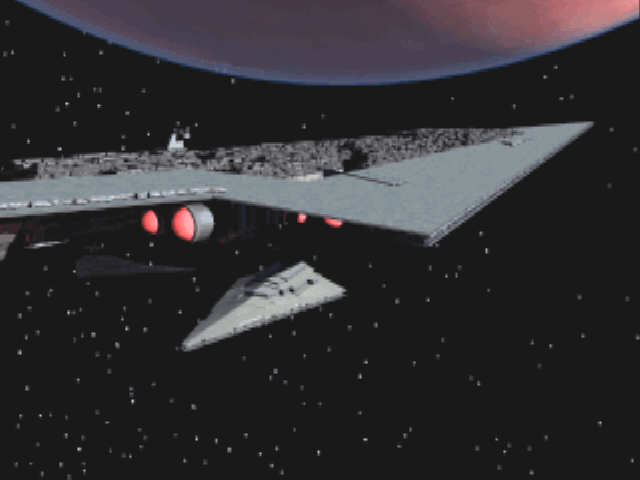
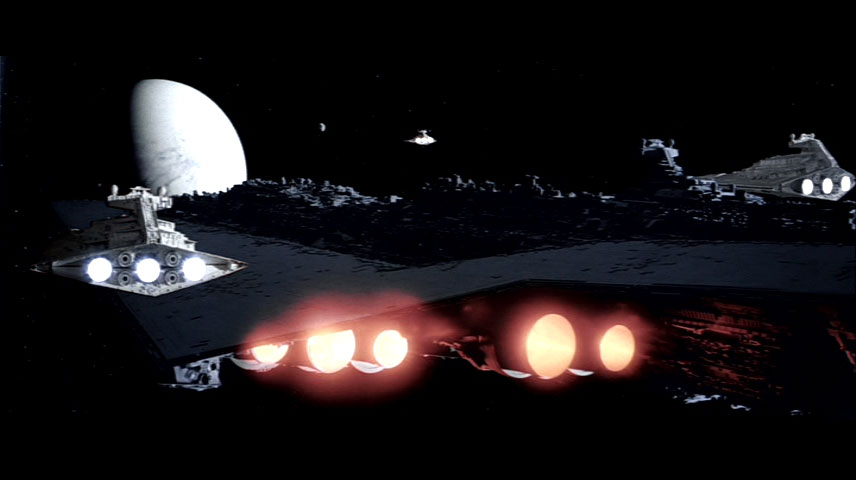
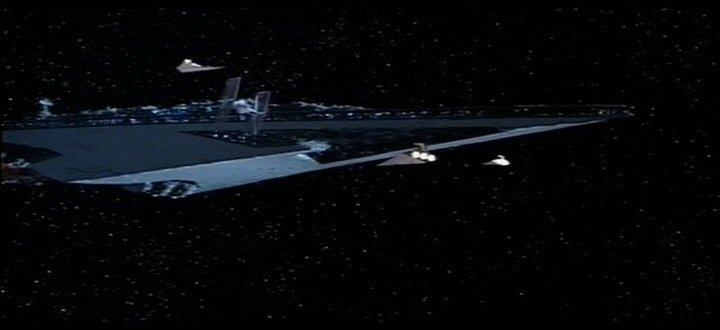
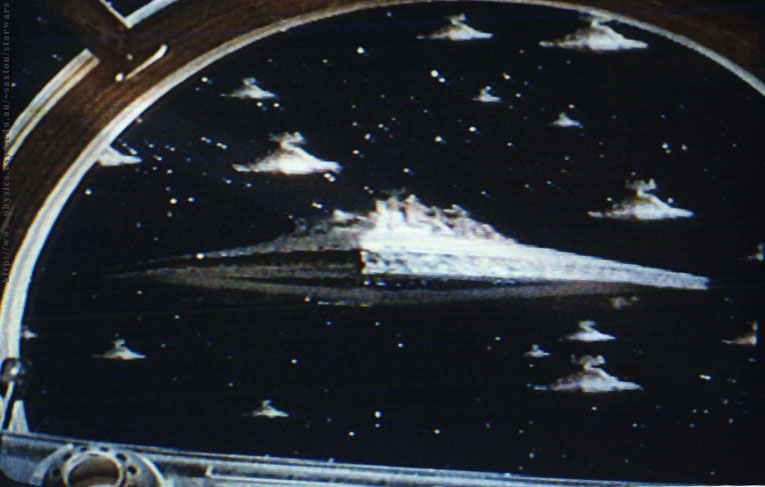
The first four Executor-class ships were constructed in the months following the Battle of Yavin and the destruction of the first Death Star. Before the Battle of Yavin Imperial Navy engineer Lira Wessex designed these sleek, dark, immense vessels to inspire dread in any possible opponent. It is claimed that they are larger than any previously constructed warship, with the exception of the Death Star. While it is difficult to believe that this boast could hold against every warship built throughout the twenty-five thousand year history of the Galactic Republic, the colloquially-named "Super Star Destroyers" dwarfed all other vessels in the fleets of the Empire and the Rebel Alliance / New Republic until the appearance of the shorter but more massive Eclipse and Sovereign classes six years after the Battle of Endor.
At their conception, the Executor-class star dreadnoughts were controversial. It seems that many important figures within the Imperial Admiralty favoured the construction of well-proven, smaller and more numerous warships. Manufacturing an Executor-class command ship reportedly costs roughly twenty times as a star destroyer, despite being well over a hundred times as massive. Lord Vader's interest in this KDY design gave its development impetus [Classic STAR WARS comics] and construction of the first ship began at the shipyards of Fondor. Among Lord Vader's secretive detractors within the Imperial Navy, several fleet admirals were quick to oppose the Executor project. As usual, the wishes of the Emperor's enforcer prevailed. After unsuccessful rebel saboutage attempts, Lord Vader took the first of these ships, the Executor, as his own flagship for coordinating the eradication of the Rebel Alliance the more personal search for his long-lost son.
In the following months the Executor-class gained recognition and proved its value as an instrument for inspiring awe and dread. The Emperor authorised the construction of additional ships of the class. Eventually the mighty command ship was regarded as the grand epitome of a newly revitalised Imperial Navy. While they never approached the abundance of the Empire's tens of thousands of common star destroyers, by the time of the Battle of Endor a large number of these vessels had entered service.
In the years following the establishment of the New Republic the number of Executor-class command ships in Imperial use dwindled as the Empire's remnants lost control of shipyards, fought amongst themselves and with the ever-growing New Republic Navy. By the time Grand Admiral Thrawn returned to rally the Imperial Navy, no ships of this size were available to him. Each had either been destroyed, captured by the New Republic, regional governments and neutral forces, or retreated to the Deep Core regions of the Empire which did not recognise Thrawn's authority. It can be assumed that Kuat Drive Yards produced these vessels and even newer classes of command ships for the New Republic Navy and its subordinate sector navies, once the new government consolidated its power in the Core sectors.
Unfortunately the first President of the New Republic, Mon Mothma, ordered a halt to the production and use of these grand warships at some time during her seven-year tenure. The strategic imprudence of this public-relations gesture was brutally exposed several years later when the New Republic forces were shown to be badly outgunned in the Black Fleet Crisis. Whether Princess Leia Organa-Solo, as Mothma's successor, eventually learned from and rectified the mistake is unclear at this time. General Cracken's formation of a special acquisitions team to retrieve the lost Guardian a year after the Koornacht Crisis, and the fact that New Republic warships supporting the operation used ion cannons only, indicates a sensible change of policy.
The immense bulk and powerful shields of an Executor-class command ship makes it all but unassailable. The armaments of each of these vessels are individually at least as powerful as equivalent weapons on Imperator-class ships, and many times as numerous. Nevertheless Executors rarely engage in space combat because few foes would dare a direct confrontation. Instead they serve as mobile command bases for the coordination of larger fleet actions and the supervision of ground forces.
The standard complement of starfighters is claimed to be two wings, totaling 144 fightercraft, although the size of the mothership's docking cavities indicate that it could easily accommodate dozens or perhaps hundreds of times more. During the years before the Battle of Hoth each wing typically included one squadron of TIE Interceptors and one of TIE Bombers. In later times more advanced starfighter models (eg. the elite TIE Avenger and TIE Defender fighters) would have become a greater component. TIE assault craft, shuttles, ground assault dropships and service / maintenance vehicles bring the total number of carried ships to over two hundred. For surface actions 25 AT-AT, 50 AT-ST walkers and similar numbers of other ground assault vehicles are reportedly carried. Three spare prefabricated garrison bases are kept aboard each Executor-class command ship for rapid assembly on planets which need lasting pacification measures.
In the years following the Battle of Endor the New Republic forces learned much about the weaknesses of these formidable warships. One of these potential weaknesses is the distribution of weaponry. Although the total number of guns is immense and the sleek dagger-like hull design gives most of these batteries a clear shot in almost any direction, the nett density of guns is much sparser than on a common mile-long destroyer [at least according to unverified published statistics]. Enemy starfighters very close to the hull are sometimes able to find shelter from most of the turbolaser batteries, especially in the midst of the canyonous structures which dominate the central regions of the ventral and dorsal surfaces. This weakness seems to have been inadvertently exploited against the Executor at the Battle of Endor, when rebel fighters were able to reach the bridge by flying close to the dorsal hull. Of course, surviving to reach the warship's hull is a major problem in the absence of the kind of cover provided by the general chaos and confusion prevailing at Endor.