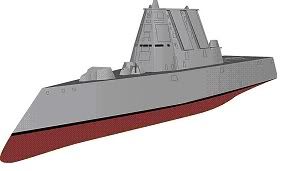
DD(X) CLASS MULTIMISSION DESTROYER, USA
In November 2001, the US Department of Defense announced that the DD 21 program for the Future Surface Combatant had been revised and would now be known as DD(X). The program focus would now be on a family of advanced technology surface combatants, rather than a single ship class. A revised Request for Proposals was issued and in April 2002, Northrop Grumman Ship Systems, Ingalls was selected as the lead design agent for DD(X). Northrop Grumman led the "Gold Team" which included Raytheon Systems Company as the systems integrator. The "Gold team" proposal incorporates "Blue team" leader Bath Iron Works (a General Dynamics company) as a subcontractor for design and test activities. Other major subcontractors include Lockheed Martin, United Defense Limited Partnership (UDLP) and Boeing.
The DD(X) program will build on work already carried out for DD 21 and provide a foundation for development of the DD(X), the CG(X) cruiser and also the smaller Littoral Combat Ship (LCS), with emphasis on common hullform and technology. LCS is expected to be the first to enter service and the Navy requirement is for about 60 LCS ships. In May 2004, it was announced that Lockheed Martin and General Dynamics Bath Iron Works will each build two LCS vessels to commission between 2007 and 2009.
Northrop Grumman is to complete DD(X) system design and 11 engineering development models (EDM) by 2005. The EDMs include: advanced gun system, integrated power system, composite deckhouse, peripheral vertical launch system, integrated sonar system (with advanced towed array and high-frequency active sonar) and dual band radar suite. A decommissioned Spruance Class destroyer (USS Arthur W. Radford) will serve as the test platform for the DD(X).
The USN is expected to hold a competition for the construction contract before the end of 2005. Initial operating capability is planned for 2013.The number of ships required is expected to be between eight and 12.
DD(X) replaces the DD 21 Zumwalt program which was for a class of 32 multimission destroyers to replace Oliver Hazard Perry class frigates (FFG 7) and Spruance class destroyers (DD 963) from 2012. Unlike previous classes of destroyer, which were primarily to counter deep water threats, the DD 21's primary mission would be to provide land attack support for ground forces and also to carry out traditional destroyer missions of anti-air, anti-surface and undersea warfare.
DESIGN
DD(X) will have a "tumblehome" hull form, i.e. a design in which hull slopes inward from above the waterline. This will significantly reduce the radar cross section since such a slope returns a much less defined radar image rather than a more hard-angled hull form.
Requirements for the Integrated Deckhouse EDM is that it is fully EMC (Electromagetic Compatibility) shielded with reduced infrared and radar signatures. Measures to fulfil these conditions include an all-composite superstructure, low signature electronically steered arrays, an integrated multi-function mast and low radar and infrared signatures. Other measures to reduce the vessel's infrared signature include the development of an exhaust suppressor.
Harris Corporation has been awarded a contract for the development of the Common Data Link (CDL) X/Ku-band phased array antenna systems, which will be integrated into the Integrated Deckhouse Assembly. The multi-beam electronically-steered antenna will allow connectivity with up to eight CDL terminals.
The DD(X) is planned to have a displacement of around 12,000t, less than the 14,000t or more of the DD-21, with a sustained speed of around 30 knots.
CREW
The number of crew for DD(X) is yet to be defined. DD-21 was to have a crew of 95, including the helicopter detachment. This represented major theoretical cost saving compared to crew levels of 330 on Spruance destroyers and 200 on Oliver Hazard Perry frigates.
WEAPONS
DD(X) will have a sensor and weapons suite optimised for littoral warfare and for network centric warfare. Northrop Grumman has put forward a solution based on a Peripheral Vertical Launch System (PVLS). The solution consists of a number of four-cell PVLS situated round the perimeter of the deck, rather than the usual centrally located VLS. This would reduce the ship's vulnerability to a single hit. The Advanced Vertical Launch System (AVLS) that forms the basis of the PVLS is being developed by United Defense and Raytheon and has been designated the Mk 57 VLS.
Missile systems under consideration include Tactical Tomahawk (intended to succeed Tomahawk TLAM), Standard Missile SM-3 and the Evolved SeaSparrow Missile (ESSM) for air defence.
United Defense has been awarded the contract to develop the EDM for the ship's Advanced Gun System (AGS), building on development work carried out for DD-21. The vessel's two 155mm guns will be able to fire up to 100 nautical miles at a sustained rate of 12 rounds per minute. It will be equipped with a fully automated weapon handling and storage system and a family of advanced munitions and propelling charges, including the GPS-guided Long Range Land Attack Projectile (LRLAP). Lockheed Martin has been awarded the contract for the LRAP EDM. The family of munitions is expected to include land attack and ballistic projectiles. Technologies derived from the US Navy's extended range guided munition (ERGM), the US Army 155mm XM-982 projectiles and the DTRA 5in projectile are being studied for incorporation into the projectile suite.
United Defense is developing advanced gun barrel technologies for the new AGS, with improvements to barrel life, overall system performance and life cycle costs.
The ship's Close-In Gun System (CIGS) will be the United Defense 57mm Mk 110 naval gun.
RADAR
The radar suite will consist of a dual band radar for horizon and volume search, an L-band volume search radar (VSR) integrated with the AN/SPY-3 multi-function radar already being developed by Raytheon for the US Navy. The two radars are to be integrated at waveform level for enhanced surveillance and tracking capability. The AN/SPY-3 Multi-Function Radar (MFR) is an X-band active phased-array radar designed to detect low-observable anti-ship cruise missiles and support fire-control illumination for the ESSM and Standard Missiles.
SONAR
At the heart of the ship's Integrated Undersea Warfare System will be a dual (high frequency/medium frequency) frequency bow array and a multi-function towed array. The US Navy has already set up the IUSW-21 program to develop technologies including multifunction hull array, mine avoidance and shallow water ASW.
AIRCRAFT
The DD(X) ship design includes two landing spots for helicopters.
PROPULSION
It is envisaged that the DD(X) would have an all-electric drive with an integrated power system, (IPS) based on in-hull permanent magnet synchronous motors (PMMs) with Advanced Induction Motors (AIM) as a possible backup solution. The provision of electric drive eliminates the need for drive shaft and reduction gears and brings benefits in acoustic signature reduction, an increase in available power for weapon systems and improvements in the quality of life for crew.
The IPS would supply power to other ship systems such as the combat systems and allow the rapid reconfiguration of power requirements.
DRS Technologies Power Technology unit has received development contracts for the PMM motors, electric drive and control system for the IPS. The Rolls-Royce MT30 36MW gas turbine generator set has been selected to power the IPS EDM and Rolls-Royce delivered the first set in February 2005. The MT30 has 80% commonality with the Rolls-Royce Trent 800 aero engine and Rolls-Royce states that it is the most powerful marine gas turbine in the world. CAE will supply the integrated platform management system.