fr STimes 02.11.2005
Unveiled last Friday, the Singapore Artillery's Pegasus guns are its lightest
that fire its biggest shells. The gun was developed to answer a Singapore Army
demand in 1994 for a heli-portable 155mm gun. Nothing available made the cut,
so engineers designed one from scratch. David Boey reports
NO OTHER army in the world has a weapon like it - the world's first
heli-portable heavy artillery gun with its own engine.
Named Pegasus, after the immortal winged horse of Greek mythology, the
Singapore Artillery's new pride and joy was unveiled last Friday after years of
tests.
The concept is completely new.
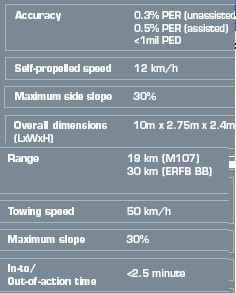
The 5.4-tonne gun, which has a maximum 30km firing range, can be dropped on
the battle field by a CH-47 Chinook heavy-lift helicopter and immediately moved
into position at speeds of up to 12kmh using its mounted engine.
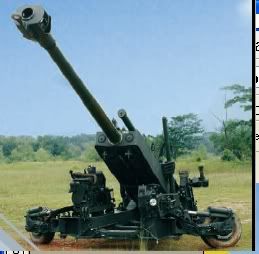
Its flimsy, no-frills appearance belies its ruggedness.
This gun has undergone some serious testing by its creators, the Defence
Science and Technology Agency (DSTA), weapons-maker Singapore Technologies
Kinetics and the Singapore Armed Forces (SAF).
Two prototypes of the Pegasus were driven across 800km of terrain, from the
dusty deserts in South Africa to the muddy tracks near Pasir Laba Camp here to
test its durability.
Close to 4,000 shells were fired during three years of live-firing trials in
Singapore and South Africa to test the gun's range, accuracy and reliability
The South Africa trials tested the engineers' endurance, too.
Temperatures there plunged to sub-zero during the winter, while tests at the
Safti live-firing area and in the South African desert were routinely conducted
in blazing 40 deg C heat.
Pegasus' uniqueness lies in its engine.
Some armies have 155mm guns that can be dropped into battle from
helicopters, but they cannot be moved from their landing site without tow
trucks.
Mr Kenneth Quek, the DSTA project manager who helped design Pegasus, said
the project started in 1994 after a worldwide search revealed that nothing met
the SAF's special requirements.
'We started designing the weapon from a clean sheet of paper,' Mr Quek said.
Though DSTA and its partners have amassed considerable experience in
designing artillery guns such as the 30km-range FH-88, the Pegasus design team
scored a first when it brought in aerospace engineers.
Mr Quek said the tripartite design team enlisted the help of Singapore
Technologies Aerospace engineers to find the best way to transport the gun and
its ammunition underneath a Chinook helicopter.
Mr Teo Chew Kwee, a vice-president for engineering at ST Kinetics, said: 'We
can't have things loosened midway during the flight or moving about on its own
- it might endanger the helicopter.'
Advice from aerospace engineers helped gun designers decide where to place
the lifting rings on the Pegasus, which attach the gun and its ammunition to
straps hung under the Chinook.
By last year, the design team was satisfied Pegasus could go into
production.
To save weight, the gun was stripped to its bare essentials, giving it a
distinctive, if unusual, appearance.
With a long barrel pointing forward, four wheels for mobility and a gunner
seated in the middle of the gun to steer the weapon, it looks a little like
someone riding a mechanical camel.
In fact, the camel nickname caught on and has stuck ever since.
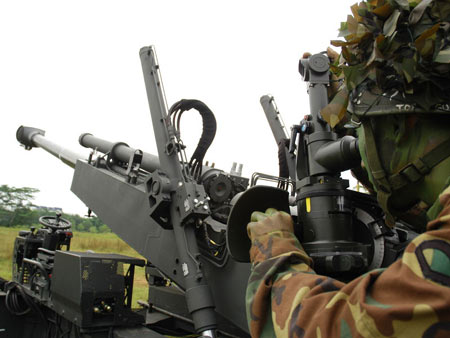
Lance Corporal Abdul Hamid, 20, a full-time national service gunner with the
23rd Battalion Singapore Artillery, the first artillery unit equipped with
Pegasus, said: 'The gun looked funny to me when I saw it for the first time.
But I've a lot more confidence in the weapon after learning how to handle it,
and about its capabilities.'
Colonel Lim Chin, the Army's Chief of Artillery, believes his new gun is a
hit.
He said: 'I think the team of engineers has such a creative way of
overcoming the weight problem and mobility issues. It may not look very pretty,
but it serves its purpose.'end of quote