Singapore's SOF
-
good nightOriginally posted by Innocent_Malaysian:tell and explain 2 morow..im sleeping now -
sure we have SOF..by different names..
They are called : republican guard, paramilitary, what ever...ha ha
-
wat's in a name....
-
Our SOF is actually called Uncle SUNNY
while there are oso a naval SOF called Auntie Rainy -
And all along I thought ARV means "Armoured Recovery Vehicle"Originally posted by Innocent_Malaysian:aerial recon vehicle -
funny, i didn't know their's are manned.
-
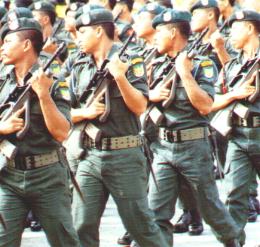
Malaysian SOF consists of Grup Gerak Khas (GGK), Pasukan Khas Laut (Paskal), VAT 69 and Unit Tindakan Khas (UTK). Malaysia also has an elite Rapid Deployment Force (a size of a Brigade) called Pasukan Aturgerak Cepat (PAC), but it was not considered as a Special Operations unit.
GGK is the largest SOF element in Malaysia. It is basically a commando regiment in the Malaysian Army Corps. The mission of the GGK is to provide a squadron to locate, report, harass and disrupt the enemy through long range infiltration as well as operating in close collaboration with guerilla or partisan forces. GGK will also plan, prepare for, and when directed, deploy to conduct unconventional warfare, internal defense, special reconnaissance and direct actions etc. in support of Government policy objectives within designated areas of responsibility.
GGK continually train to conduct unconventional warfare in any of its forms - Guerilla / Anti-Guerilla Warfare, Escape and Evasion, Subversion, Sabotage, Counter Terrorist and their most highly regarded expertise - Jungle Warfare. It has an awesome reputation in operations against the communist terrorists. The troopers are also schooled in direct action operations and special reconnaissance. Currently, there are 3 fully equipped regiments (21st, 22nd & 11st GGK). GGK had seen action in Cambodia, Somalia, western Sahara, Namibia and Bosnia among others.
The Royal Malaysian Navy set up its sea commando unit called Special Naval Force or Paskal by its Malay acronym in 1980. The unit was established using commando-trained officers and men from the services Security Regiment. Some of its personnel are stationed in man-made 'islands' in the Spratlys and in strategic areas within the country's Exclusive Economic Zone (EEZ). Paskal is equipped with the latest hi-tech weaponry as their operations is partly supported by a group of oil consortium (one of the Paskal's main missions is to protect oil rigs in the Malaysian coastal area).
In those days of communist insurgency, Malaysian police had a paramilitary arm called Pasukan Polis Hutan (PPH). They had several battalions and among them was the elite one, known as 69th Commando Battalion or VAT 69. It was actually formed in 1969 (hence the name - 69). The normal police too had an elite unit - Unit Tindakan Khas (UTK). UTK had a SWAT-like function as well as close protection roles. After the communist terrorist laid down arms in 1989, VAT 69 had problems finding a proper role. Finally on December 1997, the PPH was renamed as Pasukan Gerakan Am (PGA) while UTK and 69th Commando Battalion was disbanded and merged. It was then called Pasukan Gerakan Khas (PGK).
The Royal Malaysian Air Force once had a commando unit codenamed Handau or (maybe) Pasukan Khas TUDM. Officially, Handau is not recognized as an SOF unit by the Malaysian Armed Forces. The tentative "special forces" designation is probably due to the unit's airborne capability. Some GGK members were also roped in to join Handau at its formation. Lately, the RMAF had formed a regiment called the Regimen TUDM containing Handau as well as the CART (Combat Air Rescue Team). The purpose of Regimen TUDM is to conduct combat search and rescue mission (CSAR) to recover downed pilots behind enemy lines or hostile territory, but they are much more popular with life-saving services to the civilians (courtesy flights etc.). Other than that, Regimen TUDM may also search and eliminate enemy troops who execute sabotage against RMAF air bases. -

Grup Gerak Khas
In handling the problems arising from the Confrontation in 1965, the Honorable Tun Abd Razak bin DatoÂ’ Hussien who was the Defence Minister, issued a specified instruction to form an experimental task force unit. The Ministry of Defence then came out with instructions for volunteers and a number of volunteers from the Army and the Navy took the challenge. On 25th of February 1965, an introductory training was conducted by 40th British Royal Marine Commando at Majidee Camp, Johore Baharu, Johore.
From the 300 volunteers who enrolled, only 15 were selected to undergo the 6 weeks Basic Commando course. On completion, only 4 Officers and 9 Other Ranks managed to get through. They were:
Major Abu Hassan bin Abdullah (Colonel Retired)
Lieutenant Mohd Ramli bin Ismail (Major General Retired)
Second Lieutenant Ghazali bin Ibrahim (Major General Retired)
Second Lieutenant Hussin bin Awang Senik (Colonel Retired)
6842 Sergeant Ariffin bin Mohamad
300152 Sergeant Anuar bin Talib
4861 Sergeant Zakaria bin Adas
201128 Sergeant Yahya bin Darus
202072 Corporal Silva Dorai
203712 Corporal Moo Kee Fah
13852 Lance Corporal Johari bin Haji Morhd Siraj
10622 Lance Corporal Sabri bin Ahmad
This achievement proved that Malaysians were capable of undertaking whatever roles and tasks given. With the guidance from the instructors from the 40th British Royal Marine Commando, the Special Service Group began expanding and in that year alone, they conducted 6 courses of Basic Commando.
Major Abu Hassan bin Abdullah was the First Commanding Officer of the The Malaysian Special Service Group (MSSG), and Sergeant Ariffin became the first Squadron Sergeant Major. In late 1965, the strength of MSSG was 70%. In keeping with the development of the Armed Forces; officers and other ranks were sent abroad for specialized courses such as airborne, rigger, special operations forces, ranger and amphibious.
MSSG also conducted joint training with foreign Special Operations Forces. MSSG took part in operations in East Malaysia and during the 13 May 1969 incident. After the Confrontation in 1967, there were discussions whether to disband or continue the special forces unit. The argument was that the financial implication of MSSG unit is similar to that of maintaining two Infantry Battalions. Despite the argument, MSSG was moved to Segenting Camp, Port Dickson in 1968.
The confrontation and the 13 May incident proved that the MSSG is an asset to the government and should remain and further expanded to a regiment. In deploying all the new units and elements, MSSG was then moved to Sungai Udang Camp, Malacca and on 1 August 1970, the first Special Service Regiment was formed. The Special Service Group was accredited in 1971 but its members still belonged to their respective 'corps'. This situation however caused problems in the personnel career planning. To avoid these problems, volunteers were enlisted to join the Special Forces. In 1973, the ‘corps’ was assigned with 6 officers. -
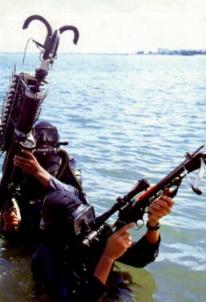
Paskal
History of Paskal or Pasukan Khas Laut began in 1975, when The Royal Malaysian Navy saw a need for a security regiment trained in modern maritime warfare. It's main purpose is to protect naval bases all over Malaysia. At that time, the RMN main base was still at KD Malaya (Woodlands, Singapore).
The first batch of 30 officers and men were sent to Surabaya, Indonesia and they were initially trained by instructors from KOPASKA (TNI-AL / Indonesian Navy Underwater Combat Unit ).
On 1st October 1980, Paskal was officially established when the Government started to enforced the EEZ (Exclusive Economic Zone) on Malaysian waters. Other than that, there was also a requirement to protect Malaysian offshore stations near the islands of dispute, Spratly. Paskal was actually the first team sent to occupy Layang-Layang atoll on behalf of the Government. -

VAT 69 / UTK
In those days of communist insurgency, The Royal Malaysian Police had a paramilitary arm called Pasukan Polis Hutan (PPH). They had several battalions and among them was the elite one, known as 69th Commando Battalion or VAT 69. The normal police too had an elite unit - Unit Tindakan Khas (UTK). UTK had a SWAT-like function as well as close protection roles. After the communist terrorist laid down arms in 1989, VAT 69 had problems finding a proper role. Finally on December 1997, the PPH was renamed as Pasukan Gerakan Am (PGA) while UTK and VAT 69 was disbanded and merged. It was then called Pasukan Gerakan Khas (PGK).
The history of VAT 69 began when the Honorable Allahyarham Tun Dr. Ismail who was the Minister of Home Affairs and Internal Security, proposed the formation of a special unit trained for fighting the communist terrorist. It was actually formed in 1969 (hence the name - 69). The establishment of VAT 69 was inline with Royal Malaysian Police requirement to create a small combat unit with the same tactics and technique just like the communist terrorist.
In October 1969, about 1600 PPH personnel from several battalions volunteered to join VAT 69. After the selection process, only 60 personnel were qualified to undergo basic commando training. As the formation of VAT 69 were highly classified, all training was conducted at Fort Kemar, located deep in the jungle of Perak where transportation are limited to helicopter and small aircraft only.
The first training was supervised by a group of instructors from British SAS (Special Air Service). On completion, only 30 personnel managed to get through. They actually formed the first troop of 69th Commando Battalion. In 1977, New Zealand SAS was involved in training 3 new squadrons of VAT 69. A special course to train VAT 69's own instructors were also conducted. Finally, the expansion program completed in 1980 in which VAT 69 now had 4 fully equipped infantry squadrons with it's own logistic unit.
It was not known when actually the UTK had been formed. UTK were also trained by British SAS and they operate in a very different way from the typical American SWAT teams. They have approximately 100 plus members and the selection phase is so tough that the passing rate was supposedly 20 - 10% only. Even the selection process reflects SAS influence. UTK personnel mostly uses handguns / pistols (Sig-Sauers) and prefer to be in undercover roles. Just like GGK, the UTK were also involved in The 16th Commonwealth Games security measures.
Both VAT 69 and UTK have very good records and they are very low profile, especially - the UTK. As for VAT 69, they were used against the pirates who terrorized the coastal towns of Sabah, one of the states in East Malaysia. After the deployment of VAT 69, the piracy attacks had almost stopped. -
Singapore Naval Diving Unit (NDU)
Diving into the unknown
“It was very dark. Visibility was zero. The current was quite strong at that point in time. You couldn’t have known what you would be bumping into. The conditions were worse than what you would have encountered in Singapore.
“Slowly, you would come across bits and pieces of the wreckage. You could only feel for clothing, identity cards and wallets, because you couldn’t even see anything. If you felt something sharp, it would probably be part of the aircraft. You just had to bring everything up.”
SSG Frankie Chong was describing his first-hand experience in Palembang during the SilkAir crash in Dec 97, when he was involved in the 24-hour search and recovery operations in the Musi River. A veteran diver, SSG Wong is currently a training wing instructor in NDU.
The only unit in the SAF that specialises in diving, the bulk of NDUÂ’s responsibilities lie in search and rescue (SAR), explosives ordnance disposal (EOD) and general salvage work.
Readily responsive to calls for assistance, our naval divers are also involved in less critical situations, such as “evidence recovery.”
MSG Norris Charles, another veteran instructor, said: “There was once in 1994 when we spent five hours below Anderson Bridge recovering a gun which was accidentally dropped by a robber!”
A diver descending from a Super Puma during a currency drill.
Underwater demolition man
One of the most challenging tasks for the EOD divers took place in 1990 when a team of 60 divers worked around the clock for three days to clear 21 World War Two bombs in the waters off Pulau Brani.
Said MSG Charles who specialises in EOD: “Mine clearance is a very long process, as it can take days, weeks or months. All EOD divers have to attend a specialised course before they qualify as mine clearance divers.”
He emphasised: “Of course, safety is top priority. We inspect every single diver before diving to ensure that his equipment is fully demagnetised to prevent any explosions when approaching underwater mines.
“On top of that, every mine clearance diver goes through currency drills under close supervision every quarter so that he is thoroughly familiar with all the standard operating procedures.”
Similarly for SAR divers, currency drills are held every quarter. For example, drills are carried out in tandem with the Air Force for the SAR stand-by team stationed in NDU 24 hours a day, 365 days a year.
Naval divers are as good out of water as they are in it.
SSG Alvin Chia, a salvage specialist, explained: “When we are activated, we will put on the required diving gear. A chopper will land on the parade square at NDU to bring us to the site, where we will carry out SAR operations. The first team to be deployed to Palembang was actually this stand-by force.”
Versatile frogmen
Although naval divers operate primarily underwater, they are certainly not “fishes out of water” and will surface in times of need.
NDUÂ’s combat capabilities include shipboarding, force swimming (groups of divers swimming in formation) and close quarter combat. Such capabilities are necessary when hostages have to be rescued from hijacked ships or when ships suspected of carrying contraband cargo have to be boarded and searched.
Said SSG Eric Tay, a combat-trained NDU diver: “Compared to normal salvage jobs, combat diving is a different ball game altogether. There are special tactics that you need to learn. In order to be a good combat diver, you must also possess situational awareness and survival instincts.”
He added: “Fitness also plays a part, because you are not just diving. You also have equipment and weapons, and you will have to swim fast. The diver’s mental state is also very important, as in how much you can motivate yourself to achieve your objectives.”
Pushing to the limits
A firm grounding in physical fitness and mental agility is provided to all trainee divers during the training process at NDU. As in all cases, training builds the competence required to perform the job. However, it is a little different in the NDU, where every trainee diver knows that the training will either “make or break” him, depending on his determination to persevere through the rigorous training.
It takes about six months for a trainee diver coming straight from Basic Military Training to complete his Class 2 Diving Course, where theoretical and practical knowledge on diving is imparted.
To build up the traineesÂ’ water confidence level and their knowledge of how their equipment would perform underwater, a pool competency course is conducted in the first half of the course. Under the watchful eyes of the safety officer, trainee divers are subjected to simulated stress akin to actual underwater conditions.
Each diverÂ’s performance is closely monitored to ensure that he is competent in managing potential underwater problems. During these drills, all trainees must maintain a cool composure and alert mind to be able to extricate themselves from the problems that they face underwater.
After he clears this stage, a week of sweat and toil awaits him. Popularly known as ‘hell week’, the old adage - the survival of the fittest - certainly applies here. Hell week means a gruelling 120 hours of non-stop physical exertion both on land and in water, with trainees allowed three hours of sleep only on the third day. Only the best will make it.
SSG Tay said: “The aim of hell week is to let each individual know that he can be pushed beyond his limits. There is a saying that the human brain is about 10 times stronger than the body. There’s no way you can test a person’s psychological strength until you break his physical strength first.
A diver in a drown-proofing exercise being supervised by a safety diver
“So the first three days of hell week are very physical. However, you must keep on going if you want to succeed. Those who quit will be deemed unsuitable to be naval divers. You have to be a team player to survive. There’s no ‘Rambo’ in the Navy.”
If you thought that hell week would be the culmination of training, guess again. Naval divers have to brace themselves for another three months of basic combat training before they can graduate from the course.
In this last phase, trainees are taught the rudiments of combat tactics. In an exercise called drown-proofing, trainee divers are dumped unceremoniously into the pool with their hands and legs tied. They are then required to bob up and down in the pool, swim for about 100 metres and perform manoeuvres like somersaults underwater.
Navigating overseas
Of course, being a naval diver is not just sweat and toil - it also comes with its perks. Said SSG Alvin Chia: “The good thing about being in the Navy is that we get to travel a lot and get exposed to different cultures.
“Many of us have been on overseas training and exercises. Each attachment can last at least half a year. You seldom get an opportunity to stay overseas that long. We also venture overseas regularly on our training exercises.”
Some of the courses regular naval divers attend include the Basic Underwater Demolition Course (BUDS) conducted in the United States, the EOD course, deep diving course and the diving supervisor course.
So far, the overseas exposure has paid off. SSG Chia emphasised: “Through observing how other navies operate, we have been able to improve on our own operations. For example, the concept of hell week came from the US. So did the pool competency training course.”
A fighting force
The unit, which also boasts some of the youngest warrant officers in the SAF, relies heavily on its warrant officers and specialist ratings (WOSRs) for its operations and routine training activities. In fact, it is the professionalism of the specialists, rather than the new training facilities in Sembawang, which has created a greater impression with visitors to the unit.
Said Commanding Officer, LTC Chng Ho Kiat: “The greatest assets of the unit are not the equipment and weapons, but the personnel who are carefully and painstakingly nurtured with many years of intensive training.”
Without a doubt, our naval divers are all set to create a deep impact in the new millennium. “Nothing stands in our way” was the motto adopted by NDU in 1995 to reflect the daring and “can-do” attitude of the divers. You can be sure that with the tenacity, grit and determination of our naval divers, nothing will stand in their way.
[/img] -
-
Singapore SOF

The Special Operation Force (SOF) is a unit within the Commando Formation that is specially trained for Counter-terrorist actions. Members of this unit are specially selected and have to undergo a long period of Counter-Terrorist training before they can accepted as troopers.
CALL OF DUTY
Their calling came. "Five minutes was all the four Pakistani terrorists who hijacked a Singapore Airlines plane gave the authorities on Tuesday, March 26 1991 to meet their demands. Failing that, they threatened to start killing one hostage every ten minutes. But barely had three of those minutes gone by when the order was given for the SOF to storm the plane. Commandos went in at 6:50 am; and it was over in 30 seconds - the four hijackers dead, none of the 123 hostages hurt. For their bravery displayed, HQ Commando was awarded the Medal of Valor and a Unit citation.
The exact nature of the training a Commando undergoes is seldom revealed, however the actions undertaken by Commandos often speak louder than words. Commandos have been called many times for hazardous assignments; operations such as the Laju ferry hijack and the Cable Car tragedy are some of the better known Commando operations. Courage, tenacity and stealth are hence traits associated with the Commandos. -
-
so is it called SOF only?
note:arv can also stand for aerial recon vehicle.--im not wrong -
So is it cpnfirmed that the SAF's SOF are called Singapore Special Operation Force.?
And they dont have any specific name? -
nope no name just SOF..thats the name they go by and the name their training goes underOriginally posted by Innocent_Malaysian:So is it cpnfirmed that the SAF's SOF are called Singapore Special Operation Force.?
And they dont have any specific name?
But like the rangers they are housed within Commando HQ -
wat about the indonesian SOF? thais? bruneis? phillipine?
-
Hmm lets seeOriginally posted by Innocent_Malaysian:So is it cpnfirmed that the SAF's SOF are called Singapore Special Operation Force.?
And they dont have any specific name?
Rapaid airborne deployment we have the guards... (Not republican guards.... just guards) Deployable from super pumas and chinooks. Armed with sar-21 LSV and vickers 155mm air portable howizters. Possbility in getting light armour in the future in the wheeled vehichle similar to that of the LAC III used in the states. Also new equipment include 155mm air portable, self propelled howizters.. As for the rest no one knows.
Navy special ops.. Its called the Naval Diving Unit or NDU...
Army commandos... They are called commandos and are similar to that of the british armys paratroopers.. They are the only official troops certified to use the parachute. No one knows much about them.
SOF... This is a specialised force.... No public info on them