Any WW2 Fighter Aircraft Fans here?
-
After looking at most of the pictures i see here i notice something.That most naval planes have a bigger/fatter bodies then the land planes....Is there any reason for that?Bigger engine or more range?And how did all these carrier based fighters match up againest land based planes??
-
Well, yes and no. Remember that there were naval version of the Supermarine Spitfire and German's Bf-109. Although these were not as powerful as their land base counterparts because their engines were smaller. But if you look at the 1st page and see the F4U Corsair, you'll notice that its extremely sleek for a carrer based fighter/attacker... Its engines were also one of the most powerful during its time... (Wasp radial 2800) being able to outclimb "zeros", using energy fighting tactics to destroy the slower moving planes...Originally posted by |-|05|:After looking at most of the pictures i see here i notice something.That most naval planes have a bigger/fatter bodies then the land planes....Is there any reason for that?Bigger engine or more range?And how did all these carrier based fighters match up againest land based planes??
Because of the Corsair's powerful torque effects of its engine, it was nicknamed "Ensign Eliminator" by its pilots.
Also to add, the FM-2 / F4F "Wildcat" has plenty of armor due to its extremely fat body. This allows US pilots to adope an aerial combat manuever (ACM) called the "Teche weave[/color]". In this manuever, 2 "Wildcats" will fly abreast each other and will weave back and fourth. When a "Zero" saddeled on one of the "Wildcat's" tail, his wingman will then be able to get into a advantage attack position when they cross each other in the weave.
Those above points are how naval planes defend themselves... either using speed, armour or wingman tactics...
Also you might want to know that most naval planes have terrible range... land based fighters such as the P-51 Mustang have far greater range than those of the sea... -
Thanks to bear and co. for the pic of the meteor. tink i prefer the german meteor rather than the brit one. cooler looking... hmmm, was the comet rocket powered?
-
the Komet?

yah. i think it was.. supposedly top speed of something like 950km/h
not very useful -
Viper 52: "Yes its true, records have shown that there were at least 4 Imperial Japanese Navy Kokutais (Flight Regiments) with various models of Zeros based in Singapore at different times of the war. One of those was a carrier-based Kokutai based at Seletar for crew training in 1943-44 and was decimated in the Battle of Philippine Sea in June 1944 (better known as the Marianas Turkey Shoot)"
hmmm, viper, u seem to be pretty good with your history....
yeah... my grandpa said he had seen zeros before, but i found it hard to believe. why would the japs send their top fighters over when there was little action here... afterall the brits didn't have any really good fighters based here during that time.
btw, someone asked if i'm spanish becos of my nick (i'm singaporean lar). does your nick refer to the vipers blk 52 (commonly referred to as F16)? does this mean it is your fav fighter? -
Lim Wei Ming and bear, you both seem to have very good knowledge of WW2 aircraft. thanks for sharing man!
"yah. i think it was.. supposedly top speed of something like 950km/h. not very useful"
The pic of Komet seems quite cartoon-ish. did it really look like that and why was it not useful? looking at its speed, could it have broken the sound barrier in a dive? -
nah.. just some guy who reads too much crap

oh, for WWII German Jets, go to this site => German Jets
coz it's a tripod site, it's erratic as all heck..Originally posted by espanol_man:
Lim Wei Ming and bear, you both seem to have very good knowledge of WW2 aircraft. thanks for sharing man!
[b]"yah. i think it was.. supposedly top speed of something like 950km/h. not very useful"
The pic of Komet seems quite cartoon-ish. did it really look like that and why was it not useful? looking at its speed, could it have broken the sound barrier in a dive?[/b] -
Bear, u at home too?
thanks for the link... will go explore it... anyway, i prefer modern jets or WW2 props than jets in WW2. but i think the germans were really way advanced in that era. did they build the first jet fighter? i know they built the first surface - surface missile (V1). -
yah.. work starts at 3pm today...
history of their jet engine things? i've forgotten already
as for surface to surface missile, the V1 and V2 right?Originally posted by espanol_man:Bear, u at home too?
thanks for the link... will go explore it... anyway, i prefer modern jets or WW2 props than jets in WW2. but i think the germans were really way advanced in that era. did they build the first jet fighter? i know they built the first surface - surface missile (V1). -
the most tragic plane in WWII
the Ohka..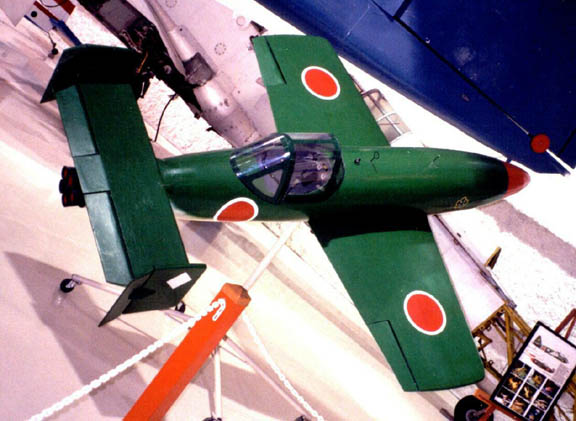
-
Bear: "work starts at 3pm today"
wah lau.. u work what one? so late... i'll be prepping for my nite Ex at 3pm... i.e. koonzzzzzz
"the V1 and V2"
yup... i believe those were the first missles rite?
"the most tragic plane in WWII. the Ohka.. "
huh? why and what's so tragic? the pilot always does a Homer izzit? (slaps forehead and goes "D'oh!!!")
-
that, is a flying piloted missile...
the purpose-built kamikaze plane carried to about 50 miles of its target by a bomber and released... the pilot then glides a while, fires the rocket-booster, and slams into the target...Originally posted by espanol_man:
Bear: [b]"work starts at 3pm today"
wah lau.. u work what one? so late... i'll be prepping for my nite Ex at 3pm... i.e. koonzzzzzz
"the V1 and V2"
yup... i believe those were the first missles rite?
"the most tragic plane in WWII. the Ohka.. "
huh? why and what's so tragic? the pilot always does a Homer izzit? (slaps forehead and goes "D'oh!!!") [/b] -
"the purpose-built kamikaze plane carried to about 50 miles of its target by a bomber and released... the pilot then glides a while, fires the rocket-booster, and slams into the target... "
wah lau, u gotta be kidding lar... damn tragic man... i wonder what goes thru the pilot's mind during his last moments of flight? what a way to go.... so sad....
-
i'm not kidding.. just read up on the history of it.. punch in "ohka", "baka" and "kamikaze" in any search engine and have a read..
it's really tragic but at that time, they went with the way of the warrior code of Bushido.. the highest honour for a Samurai is to die a violent death in battle on the battlefieldOriginally posted by espanol_man:
[b]"the purpose-built kamikaze plane carried to about 50 miles of its target by a bomber and released... the pilot then glides a while, fires the rocket-booster, and slams into the target... "
wah lau, u gotta be kidding lar... damn tragic man... i wonder what goes thru the pilot's mind during his last moments of flight? what a way to go.... so sad.... [/b] -
Actually, the correct name is the "Thatch Weave". It is a defensive manouever used in the Battle of Midway which was named after Lieutenant Commander John S. Thatch. Realising that his F4F Wildcats were no match against the Zeros in single fights, his solution is to fight in pairs and the best way to fight using pairs is using the weave.Originally posted by Lim Wei Ming:Also to add, the FM-2 / F4F "Wildcat" has plenty of armor due to its extremely fat body. This allows US pilots to adope an aerial combat manuever (ACM) called the "Teche weave[/color]". In this manuever, 2 "Wildcats" will fly abreast each other and will weave back and fourth. When a "Zero" saddeled on one of the "Wildcat's" tail, his wingman will then be able to get into a advantage attack position when they cross each other in the weave.
Those above points are how naval planes defend themselves... either using speed, armour or wingman tactics...
Also you might want to know that most naval planes have terrible range... land based fighters such as the P-51 Mustang have far greater range than those of the sea... -
Originally posted by espanol_man:
Well, it can't break the sound barrier. The ME-163 is rocket-powered and after around 7.5-8.0 minutes of flight, oops, no rocket fuel. Think the pilots who flew the "Komet" in battle could have thought of ideas to survive.
Lim Wei Ming and bear, you both seem to have very good knowledge of WW2 aircraft. thanks for sharing man!
[b]"yah. i think it was.. supposedly top speed of something like 950km/h. not very useful"
The pic of Komet seems quite cartoon-ish. did it really look like that and why was it not useful? looking at its speed, could it have broken the sound barrier in a dive?[/b] -
Bear: "it's really tragic but at that time, they went with the way of the warrior code of Bushido.. the highest honour for a Samurai is to die a violent death in battle on the battlefield"
Warrior code my azz, man! is it their highest honour to kill old folks and rape defenceless women (even young kids) for gratification? what about kidnapping gals as sex slaves?! they dun need to die a violent death in battle on the battlefield to have the highest honour
  just kiss my big fat hairy ASS!!!
 -
who knows?
their morality is not my morality is not your morality...
until they force their morality on others, it's their own business.. and when they do, it's just fascism..
protect your freedoms... it is a fundamental human right, not a privilege as many lea-duhs would have you believe... even those in our own country...Originally posted by espanol_man:
Bear: [b]"it's really tragic but at that time, they went with the way of the warrior code of Bushido.. the highest honour for a Samurai is to die a violent death in battle on the battlefield"
Warrior code my azz, man! is it their highest honour to kill old folks and rape defenceless women (even young kids) for gratification? what about kidnapping gals as sex slaves?! they dun need to die a violent death in battle on the battlefield to have the highest honour just kiss my big fat hairy ASS!!! [/b] -
" The ME-163 is rocket-powered and after around 7.5-8.0 minutes of flight, oops, no rocket fuel"
why izzit that these pple have some kind of death wish? train so hard to become a pilot so that they can kill themselves?? nothing better to do? aiyah... just come look for me, i 'll pass them 2 pieces of cardboards to fix onto their arms and jump out the window.... -
very simple reason, how much space is there for longer aircraft in a carrier, the way to save space is to use radial enginesOriginally posted by |-|05|:After looking at most of the pictures i see here i notice something.That most naval planes have a bigger/fatter bodies then the land planes....Is there any reason for that?Bigger engine or more range?And how did all these carrier based fighters match up againest land based planes?? -
since every is so enthusiastic about WW2, I'll share some online free books that I've found so far
Halsey-Doolittle Raid on Tokyo -- official USAAF reports
United States Strategic Bombing Survey: Campaigns of the Pacific War
United States Strategic Bombing Survey: Summary Report (Pacific)
United States Strategic Bombing Survey: Summary Report (Europe)
The Battle of Midway
The Battle of the Coral Sea
Early Raids in the Pacific Ocean
Time of the Aces: Marine Pilots in the Solomons, 1942-1944
The Rise and Fall of the German Air Force -
Originally posted by espanol_man:
Its not that they have their death wish...The ME-163's primary task, i think, is to shoot down the Allied bombers and to get as much kills, of course they must stay at the fight as long as they can. So they 'float', speeding towards the enemy flight and kill the rocket boost, floating towards the bombers. Certainly the Komets are having a death wish if flying by themselves, so they have the 109s or the 190s to cover their backs. Who knows how they land, since they jettison the wheels when taking off.
[b]" The ME-163 is rocket-powered and after around 7.5-8.0 minutes of flight, oops, no rocket fuel"
why izzit that these pple have some kind of death wish? train so hard to become a pilot so that they can kill themselves?? nothing better to do? aiyah... just come look for me, i 'll pass them 2 pieces of cardboards to fix onto their arms and jump out the window.... [/b] -
Espanol_man, thanks, my interest in Singapore aviation history pre-1965 was piqued by the 4 years I spent in Australia, where I had access to lots of aviation literature not usually found in Singapore.Originally posted by espanol_man:hmmm, viper, u seem to be pretty good with your history....
yeah... my grandpa said he had seen zeros before, but i found it hard to believe. why would the japs send their top fighters over when there was little action here... afterall the brits didn't have any really good fighters based here during that time.
btw, someone asked if i'm spanish becos of my nick (i'm singaporean lar). does your nick refer to the vipers blk 52 (commonly referred to as F16)? does this mean it is your fav fighter?
Little threat to Singapore during the Occupation, true, but this was the Japanese Southern Area HQ, and there were things to defend too, the oilfields in Borneo and Sumatra needed defending, and needed planes and pilots. From what I gather, Singapore was used as a training area as well as a holding point for war material (replacement aircraft, units etc).
Well, the Block 52 is not my favourite plane, but it certainly was the inspiration for my nick!
-
More Singapore aviation history trivia. When the Japanese surrendered in 1945, the Allies found a large stock of Ohkas in Singapore. They were apparently stored here and planned for use when the Allies invaded Malaya and Singapore (plans were afoot but the surrender meant it was never carried out). Which was also the reason why Japanese presence here was strong.Originally posted by the Bear:the most tragic plane in WWII
the Ohka..
In addition, the British also found numerous Japanese aircraft here, in various condition (some wrecked some airworthy). The Allied Technical and Intelligence Unit - South East Asia (ATAIU-SEA) took over several of these aircraft (some A6M Zeros, a couple of J2M Raidens 'Jacks', a A6M2-N Rufe floatplane, a G4M Betty bomber and a Ki-46 Dinah recon) and put them through technical evaluations in Tebrau, just across the Johor Straits from Singapore.
Several pictures exist of these aircraft being flown with British markings and "ATAIU-SEA" painted on them! -
When landing, they released a "skid" which is below the aircraft and landed on a field, much like wake-boarding!! Many a time the wing tip will dip when the a/c is still at high speed and when the wing tip hit the ground you can imagine what will happen!!Originally posted by superspitfire:Its not that they have their death wish...The ME-163's primary task, i think, is to shoot down the Allied bombers and to get as much kills, of course they must stay at the fight as long as they can. So they 'float', speeding towards the enemy flight and kill the rocket boost, floating towards the bombers. Certainly the Komets are having a death wish if flying by themselves, so they have the 109s or the 190s to cover their backs. Who knows how they land, since they jettison the wheels when taking off.
I read somewhere that more pilots were killed during landing in training/operation than killed in combat.