Kuala Lumpur Bus Routes
-
Feel free to post any KL Bus routes here.
RapidKL has 100 routes(including new routes)
Most RapidKL buses uses Dennis Darts(AC and NAC)
RAPID KL currently has a total fleet of 1,055 buses (not very sure). -
To start off, i would like to introduce some new routes that were introuced on 18 July 2005.
Route No
Destination
Bus Stops
Operation Time
27A
Jalan Sultan to Bangkok Bank
Jln Sultan, Jln Yong Shook Lin, Jln Pencala, Jln Othman, Jln Templer, JKL, Pangsapuri Permai, Taman Seri Manja Terminal, Jln Seri Sentosa 8 & 9, Jln Klang Lama, Jalan Syed Putra (Mid Valley, Jln Cheng Lock & Tun H S Lee
6.00 am to 22.15 pm
(Jln Sultan)
6.10 am to 23.15 pm
(Jln Tun H S Lee)
17
Flat Ukay Perdana to Jalan Hang Kasturi (Pasar Seni)
Jln Ukay Perdana, Jln Sg Sering, Jln Ulu Kelang, Jln 2/27A, Jln 1/27A, Jln Malinja 2, Jln Genting Klang, Jln Pahang, Jln Rahman,Jln Hang & Kasturi
6.00 am to 22.30 pm
(Flat Ukay Perdana to Pasar Seni)
6.40 am to 23.15 pm
(Pasar Seni to Flat Ukay Perdana)
844
Flat Taman Connaught to Sinar Kota
Flat Taman Connaught, Jejantas Lebuhraya Timur Barat, Jln Bee Eng 1, Taman Segar, Taman Mutiara, Taman Midah, Velodrom, Flat Sri Sabah, Stadium Badminton Cheras, LRT Maluri, Maluri, Klinik Bandar Raya, Batu 3 ½, JKR, Pasar Pudu, Plaza Magnum and Sinar Kota
6.30 am to 21.15 pm
(Flat Taman Connaught to Sinar Kota)
7.05 am to 22.00 pm
(Sinar Kota to Flat Taman Connaught)
209
OUG Heights to Jln Sultan Mohd
OUG Heights Jln 4/155, Bukit OUG Jln 3/155, Jln Awan Cina, Jln Tan Yew Lai, Jln Puchong, Jln Klang Lama, Jln Syed Putra, Jln Sultan Mohd (Pasarama Kota)
6.20 am to 19.00 pm
(OUG Heights to Jln Sultan Mohd)
7.10 am to 20.00 pm
(Jln Sultan Mohd to OUG Heights)
13
TUDM Sg Besi to Terminal Sultan Mohd
TUDM Sg Besi, Jln Lapangan Terbang, Jln Istana, Jln Lapangan Terbang – DBP LT2, Jln Hang Tuah, Jln Hang Jebat, Terminal sultan Mohd
6.20 am to 23.21 pm
(TUDM Sg Besi to Terminal Sultan Mohd
6.00 am to 23.00 pm (Terminal Sultan Mohd to TUDM Sg Besi) -
U living there isit?

Dont think the guys here that free leh -
Information only.Originally posted by SBS9828X:U living there isit?
Dont think the guys here that free leh -
JB is enough for us. or the nearest since many ppl goes to JB regularly.. i can start on Penang ones as well..
-
Piangz... then others will start on every state... including sabah and sarawakOriginally posted by Townlink 268:JB is enough or us also.. i can start on Penang ones as well.. -
It would be good if there is a Penang Bus Route.Originally posted by Townlink 268:JB is enough for us. or the nearest since many ppl goes to JB regularly.. i can start on Penang ones as well.. -
ok. i put it up soon.. need to find the list..Originally posted by SBS9889U:It would be good if there is a Penang Bus Route. -
Buses departing from Terminal PUTRA Gombak:
911A
911B
911C
911D Batu Caves(longest frequency of all 4 buses)
 -
Requesting following info:
No. of bus companies in KL
Names of various interchanges in KL (Wilayah Persekutuan only)
Websites of various bus companies (if any) Suggestions:
Include bus fare of various routes (between major places of the route) as mentioned (if you know).
Certain buses in KL do served the Klang Valley (Selangor), hope to see the Klang Valley routes included under this thread.
Bus tickets can post here if any. -
All feeders operated by PUTRALINE has a flat fare of RM0.50.
The main bus company of KL is of course RAPIDKL and most buses are operated by PUTRALINE. There are also GO GENTING EKSPRESS services from Genting Lower Skyway Station B4 to Terminal PUTRA Gombak/ KL Sentral and 2-3 other destination. -
-
i noe of a feeder 804 from Bandar Tasik Selatan Rail Interchange.
RapidKL does operate feeder services connecting estate to its stations. i noe of 60A, 60B and 60C. anyone care to put their routes.
also, can put service number or headings as bold, underlined or something. make it more readable. -
I have seen 60C using a back green coloured desto with yellow words(Dennis Darts) . I saw it on an expressway(expressway to North- South Highway). It also uses the validator like Sinapore has once used (on the left side). I am not sure about the fares but if it is a feeder service, its fare will be RM0.50.Originally posted by ^tamago^:i noe of a feeder 804 from Bandar Tasik Selatan Rail Interchange.
RapidKL does operate feeder services connecting estate to its stations. i noe of 60A, 60B and 60C. anyone care to put their routes.
also, can put service number or headings as bold, underlined or something. make it more readable. -
I know Intrakota is the only bus fleet in this part of the world with a fleet of Turbocities. These are unique as their exhaust pipes are on the rooftop.
Some routes I know:
Intrakota:
Route 2 - From Bandar Baru Sentul to Kota Raya via Jln Ipoh & Chow Kit
Route 3 - From Taman Datuk Senu to Kota Raya via JlnIpoh and Chow Kit
Route 5 - From Klang Bus Station to Bangsar via KL Sentral
Route 10 - From Bandar Baru Selayang to Pasar Seni via Jln Ipoh & Chow Kit
Route 11D - From Taman Jasa to Pasar Seni via Jln Ipoh and Chow Kit
Route 14 - From Sri Gombak to Pasar Seni via Jln Pahang and Chow Kit
Route 16 - From AU3 Keramat to Bangkok Bank via Mindef & Chow Kit
Route 21A - From Bandar Utama to Chow Kit via Pusat Bandar Damansara
Route 21C - From Bandar Utama to Kota Raya via Pusat Bandar Damansara
Route 21D - From Kota Damansara to Kota Raya via Pusat Bandar Damansara
Route 25A - From Kampung Pandan to Chow Kit via Lot 10
Route 25C - From Kampung Pandan to Kota Raya via Jln Pudu
Route 26 - From Jinjang Utara to Bangkok Bank via Jln Ipoh & Chow Kit
Route 29 - From Taman Sri Sinar to Lot 10 via Jln Ipoh and Chow Kit
Route 32 - From Taman Segar to Chow Kit via Jln Pudu (always take this to my aunt's house, uses full Turbocity fleet)
Route 33 - From Kelana Jaya to Chow Kit via Federal Hwy & Bangsar
Route 35 - From PJ Old Town to Chow Kit via Federal Hwy and Bangsar
Route 37 - From Segambut Dalam to Pasar Seni via Jln Ipoh and Chow Kit
Route 41 - From Sri Gombak to Lot 10 via Jln Pahang and Chow Kit
Route 43B - From Manjalara to Lot 10 via Jln Ipoh and Chow Kit
Route 46 - From Pantai Dalam to Kota Raya via Bangsar
Route 46D - From Angkasapuri to Kota Raya via Bangsar
Route 47 - From Subang Airport to Pasarama Kota via Federal Hwy and Bangsar
Route 49 - From Wangsa Maju to Lot 10 via Chow Kit
Route 55D - From Selayang Maju to Bangkok Bank via Jln Ipoh and Chow Kit
Route 56 - From Lembah Maju to Kota Raya via Jln Pudu
Route 62 - From Taman Bukit Anggarek to Jln Silang via Jln Pudu
Route 63 - From Sri Segambut to Bangkok Bank via Jln Ipoh and Chow Kit
Route 66 - From Ampang Jaya to Jln Hang Lekiu via KLCC & Lot 10
Route 68 - From Puchong Jaya to Kota Kaya via Old Klang Rd
Route 75 - From Damansara Damai to Bangkok Bank via Jln Ipoh & Chow Kit
Route 91 - From UIA Gombak to Pasar Seni via Chow Kit
Route 113 - From Desa Petaling to Jln Silang via Jln Sungai Besi & Jln Pudu
Route 122 - From Cheras Flats to Jln Silang via Jln Pudu
Route 133 - From Serdang Lama to Jln SIlang via Jln Sungei Besi and Jln Pudu
Route 259 - From AU3 Keramat to Lot 10 via KLCC
Route 337B - From Taman Sri Muda to Klang Bus Station via Federal Hwy and Bangsar
Route 337C - From Taman Alam Megah to Klang Bus Station via Federal Hwy and Bangsar
Route 338 - From UITM Shah Alam to Klang Bus Station via Federal Hwy and Bangsar -
let's make this into some comprehensive guide. there are so far no such guides on buses in KL (a lot of rail though).
KL Transit Map (Rail)
Map of KL City Centre (circa. 1999, rail lines circa. 2005 added by me. i'm trying to get one tat goes all the way to Klang Valley, but i only have printed versions, not suitable for scanning.)
-
On the line terminating at Seremban, there is a station called UKM, what does UKM means? In KL, there's also another place called UPM, what does it means? Thanks.Originally posted by ^tamago^:let's make this into some comprehensive guide. there are so far no such guides on buses in KL (a lot of rail though).
KL Transit Map (Rail)
http://www.kiat.net/malaysia/images/kltransit4.gif -
UKM - Universiti Kebangsaan MalaysiaOriginally posted by tranquilice:On the line terminating at Seremban, there is a station called UKM, what does UKM means? In KL, there's also another place called UPM, what does it means? Thanks.
UPM - Universiti Putra Malaysia -
Maybe can say something about KTM Kommuter services.
There are 2 lines which will interchange around KL Sentral (also Kuala Lumpur, Bank Negara and Putra). The 2 lines runs from Sentul to Port Klang and Rawang to Seremban.
Commuters will need to know which direction they are travelling to. In addition, at KL Sentral, which has 6 platforms, it is essential to know which platform is the right one. There are LED's to display such information throughout the station and platform.
While KL Sentral uses the 'island' configuration for platforms, most other stations use the 'side' configuration, with an overhead bridge linking up the 2 sides. Sometimes, the ticketing platform is often on the bridge itself.
Printed schedules are available for the arrival time throughout the day, and these trains, for the large part, adhere to the schedule very well, with observation deviation of not more than 5 minutes.
Nevertheless, during peak periods, trains do tend to be late, though i would not suggest arriving late thus. this is because the frequencies of the train lies anywhere between 10 to 30 minutes. imagine missing a train or alighting at the wrong stop!
These air-conditioned trains are often packed due to the longer frequency, but it is their way of maximising returns, maybe. Seats are made of hard plastic with thin layer of 'furry' cushion, like those Vogel-Sitze's.
They travel at top speeds of nearly 90kph, and practically maintains this speed for most of the journey since the station-to-station distances are pretty far as u move away from KL itself. However, along the way, sometimes the train will slow due to track problems.
As with other interchanges in KL, they are never quite seamless. You have to exit from one line, walk the exit to another line, queue to buy another ticket and get into the line. In certain cases, you might have to walk up to 500m to another nearby station (Dang Wangi & Bt Nanas) but other alternatives may not be more feasible.
Machines are available for dispensing of tickets, but other than KL Sentral, expect long queues for these tickets, especially at the interchanges. These machines accept a single note and multiple combination of coins. Change is available, if any. Manual ticketing kiosks are also around. Tickets are of paper with a magnetic strip type, much like the MRT concession passes last time.
An example. A ride from KL Sentral to Seremban will cost you RM6, and will take you about 90 minutes. (Not much difference from a coach ride). The distance travelled here is about 100km.
These trains are equipped with handicapped-friendly features.
You can differentiate these Kommuter trains from their Andarabandar counterparts from their bright yellow-coloured front and their 8-door passenger cabins.
Some info about other stations:
KUALA LUMPUR: The old main station for KL city. Nostalgic.
SUBANG JAYA: Alight here to go Sunway Lagoon. There's also Giant here.
SEPUTEH: This station is no longer in use. It is replaced by MIDVALLEY station a few hundred metres away, which opened early this year. (This map is not updated.)
NILAI: Alight here for a shuttle coach to KLIA, if you prefer the cheap way of not using KLIA Ekspres to get to KLIA.
(BANDAR) TASIK SELATAN: The interchange station between KLIA Ekspres, Star Line and KTM Kommuter.
Image courtesy of Wikipedia.org
KL SENTRAL. Image courtesy of Wikipedia.org
Now to Star LRT ('Sistem Transit Aliran Ringan').
This line has opened progressively since 1996, before completion in Dec 1998.
This line uses 5-car (i hope i didn't remember wrongly) Merecdes-Benz EMU's. The design and construction is from an Australian company, if I'm not wrong. The rail tracks are also the normal rail types u can find in SMRT, i.e. 2 rails plus a third electrified rail. It is operated by Syarikat Prasarana Negara Berhad (SPNB), which means it now comes under RapidKL, though it still retains its old nice livery.
Technicalities aside, this train is ultra noisy on the outside. Wherever it is passing by, you can find the ground vibrate. The viaducts and platforms vibrate even more, like as though the tracks are not straight at all or there is a lot of friction. It's nowhere near SMRT's. But interestingly it is relatively quiet on the train itself. It is air-conditioned, of course.
The line runs from Sentul Timur southwards to Chan Sow Lin, which is a double-platform, 3-track station. This is where it splits to 2 branches, one to Sri Petaling and the other to Ampang. The trains to 2 branches run alternately, thus there is no worry of having to wait too long. Frequencies are not really anything to worry about as the trains come fast, about 3 - 6 mins on non-branched sectors. It is unlikely that you'll ever need to travel to the branches, and they are residential estates anyway.
If I'm not wrong, fares range from RM0.80 to RM2.60 and they run from 6am to midnight. Machines are available for ticket dispensing (one note, multiple coins) or you can get one by queuing at the station control room.
To get to Pudaraya Bus station (for intercity coaches, incl those to Singapore and JB Larkin), Chinatown and Kota Raya, alight at PLAZA RAKYAT.
Image courtesy of Wikipedia.org
Putra LRT. This line has since been under the RapidKL umbrella and all its trains have changed to new liveries. The new livery does indeed looks nicer. It was formerly also operated by Syarikat Prasarana Negara Berhad (SPNB). This line was fully operational by June 99, before the final 'piece', the KL Sentral station was opened on 1st April 2001.
The line makes use of Advanced Rapid Transit Mark II technology from Bombardier. The trains are comfortable but they tend to emit a frictional noise too.
This 29km line is the third longest fully-automated driverless metro system in the world. There are no branches on this line. 5 of the stations are underground, i.e. Masjid Jamek (interchange with Star), Dang Wangi (interchange with Monorel), Kampong Bahru, KLCC and Ampang Park. Only Sri Rampai remains closed due to undevelopment. A full-directional ride will take you about 45 minutes, but you get to get the full front view like the NEL.
Other than from Pasir Seni to Masjid Jamek which uses the cut-and-cover method, the other tunnels are bored type (round).
Here they use magnetic tickets like our old farecards. Fares range from RM0.80 to RM2.60, if my memory doesn't fail me. Like other lines, machines are available for ticket dispensing (one note, multiple coins) or you can get one by queuing at the station control room. Manual paper tickets are also available over the counter, but is losing popularity fast.
Image courtesy of Wikipedia.org
My favourite, the Ekspres Rail Link (ERL).
This line was opened on 14 Apr 2002, with the Transit service commencing on 23rd August on the same year.
It is also known as KLIA Ekspres, but here can clarify what each means. ERL is the working name for the line, much like NSL and EWL. There are 2 services that run on this line, the KLIA Ekspres and KLIA Transit. there you see the difference. but many Malaysians like to refer it as the ERL.
These Siemens Desiro 4-car trains are powered by overhead pantographs and is manually driven. They run at a maximum speed of 160kph, and KLIA Ekspres can get you from KLIA to KL Sentral (or vice versa) in 28 minutes. They leave on the hour, 15th, 30th and 45th minute during peak hours and on the hour, 20th minute and 40th minute during off peak hours (10am - 4pm i think). KLIA Ekspres will skip all stations along the line.
KLIA Transit will stop at all stops along the route (Bandar Tasik Selatan, Cyberjaya/Putrajaya and Salak Tinggi). The journey will now take 36 minutes and they typically leave 5 minutes after a KLIA Ekspres train has left. Note that it is not cheaper to get from KL Sentral to KLIA (or vice versa) by KLIA Transit so please take KLIA Ekspres at KL Sentral. Salak Tinggi station is actually the depot of the line so no one would really stop there anyway. KLIA Transit trains are also less comfortable, and I think there are no LCD TV's for you to watch. Also, KLIA Transit has its own platform at KLIA, which is further for passengers but more convenient for staff.
Ticket costs RM35 for adults and RM15 for child under 12 for the KL Sentral to KLIA run. The ticket type is paper with magnetic strip. Note that from KLIA, if your train is leaving very soon, you can board the train first and tickets can be bought at KL Sentral itself as you need a ticket to exit through the gate.
Image courtesy of New Straits Times
Opened on Malaysia's National Day on 2003, the 8.6km, RM 1.2bln KL Monorail serves the popular south-eastern suburbs of the KL Golden Triangle. To get to KL Sentral Monorel station, you actually have to take a 200m walk out. These manually-driven trains run at a maximum speed of 55kph, and will bring you in air-conditioned comfort to the shopping and pubbing districts of Berjaya Times Square (Imbi), Bukit Bintang, Raja Chulan and Bangsar. One point to note, Imbi and Bt Bintang are very close to each other, but Imbi was built so as to allow a direct connection to Times Sq. thus, to get between the 2 places, just cross the road and walk through Sungei Wang Plaza.
Magnetic farecard tickets are only available over the counter, and fares range from RM1.20 to RM2.50. Trains run from 6am to midnight and frequency is erratic, and lies anywhere from 3 - 12 minutes. Platforms use 'side' configuration with a bridge on top or a underpass below the tracks.
Every station on the line is sponsored by one company for a specific period of time and their advertisements can be spotted extensively on the station.
Image coutesy of Wikipedia.org
TRAVEL PLANNER
Here -
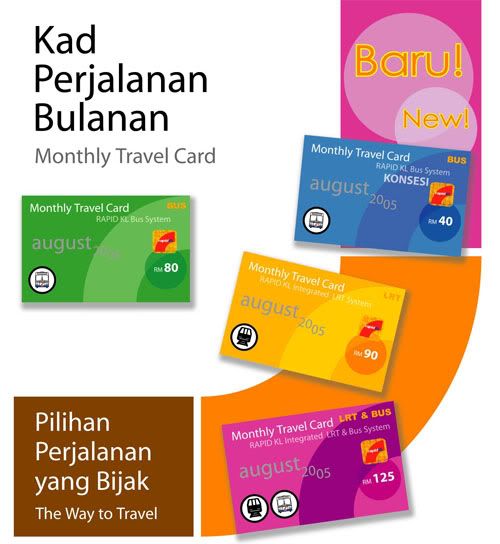
New monthly travel card for RapidKL
-
MISC Regarding tamago's post:
STAR LRT fare:
RM0.50 RM2.60
RM2.60 is for Single Trip tickets only while RM0.50 is only for students.
PUTRA LRT Fare:
RM0.70 RM2.50
(took recently) -
The 2 main bus companies that became part of Rapid KL are Park May Cityliner and Intrakota. Both do not have Dennis Darts in their fleet. Putraline do have Dennis Darts but it is not much compared to the Mercedes OH1318, Iveco Turbocity and MAN SL252, inherited from Cityliner and Intrakota, which make the bulk of Rapid KL's bus fleet. All are air-conditioned.Originally posted by SBS9889U:Feel free to post any KL Bus routes here.
RapidKL has 100 routes(including new routes)
Most RapidKL buses uses Dennis Darts(AC and NAC)
Another operator using Dennis buses in KL is Triton with the Lance and Dart models. Triton also uses the Dennis Javelin for their interstate express services. -
Some routes i found out:
114, 124 and 91, frequency of 15 minutes. Route 91 is from Terminal Central Market to Terminal UIA at Universiti Islam Antarabangsa in Gombak. Buses are available from 5.45 am to 10.00 pm with a maximum fare of RM1.60. Route 124 and 114 both begin from Terminal Jalan Silang to Terminal Taman Maju Jaya and Terminal Cheras Flat respectively. Both routes will start from 6 am to 10.30 pm daily with the maximum fare of RM1.20. -
Anyone has the exact info for hthe SG-KL route? I feel that the price will be $10++(guess) as from Tuas Checkpoint to KL (NS highway) toll plaza, it is 300+km. I wonder how they calculate their fares.
-
You mean the Handal Indah service? Which terminal will it call at? Some southbound routes start operations from Terminal Pasar Rakyat near Jln Imbi.Originally posted by SBS9889U:Anyone has the exact info for hthe SG-KL route? I feel that the price will be $10++(guess) as from Tuas Checkpoint to KL (NS highway) toll plaza, it is 300+km. I wonder how they calculate their fares.
