Do you think Singapore should have a tram system?
-
After visiting many other cities, I notice that trams are an attractive form of transportation. They are quiet, smooth, clean, and fast. They can blend into the traffic when space constraints prevent the widening of roads, and they can travel on dedicated non-stop tracks when spaces are available. They are also cheaper than MRT or LRT, and yet they can carry more people than buses. In some cities, trams can even serve as tourist attraction (like the double-decker trams in Hong Kong).
Singapore used to have a tram system (before WW2) but the tram system was scrapped due to competition from bus companies and the presence of messy overhead cables. But now, modern trams no longer require overhead cables, and there are many areas which have a high residential/industrial density but no rail services (e.g. Marine Parade, Bedok Reservoir/Kaki Bukit, Changi/Loyang, Upper Thomson, Bukit Timah, etc). Or alternatively, Singapore can introduce historic-looking trams in the downtown area (something like San Francisco's cable car) to bring some nostalgic atmosphere, and scrape the expensive and useless Citybuzz services... Haha... -
haha,constructive. Write in to SBST and tell us wad happenz next.Originally posted by autumncs:After visiting many other cities, I notice that trams are an attractive form of transportation. They are quiet, smooth, clean, and fast. They can blend into the traffic when space constraints prevent the widening of roads, and they can travel on dedicated non-stop tracks when spaces are available. They are also cheaper than MRT or LRT, and yet they can carry more people than buses. In some cities, trams can even serve as tourist attraction (like the double-decker trams in Hong Kong).
Singapore used to have a tram system (before WW2) but the tram system was scrapped due to competition from bus companies and the presence of messy overhead cables. But now, modern trams no longer require overhead cables, and there are many areas which have a high residential/industrial density but no rail services (e.g. Marine Parade, Bedok Reservoir/Kaki Bukit, Changi/Loyang, Upper Thomson, Bukit Timah, etc). Or alternatively, Singapore can introduce historic-looking trams in the downtown area (something like San Francisco's cable car) to bring some nostalgic atmosphere, and scrape the expensive and useless Citybuzz services... Haha... -
Whats the point of having a tram system? Think we damn rich ar?
-
somemore threr's this bt timah mrt , east region mrt line coming up in the future so dun think got chance for tramsOriginally posted by autumncs:After visiting many other cities, I notice that trams are an attractive form of transportation. They are quiet, smooth, clean, and fast. They can blend into the traffic when space constraints prevent the widening of roads, and they can travel on dedicated non-stop tracks when spaces are available. They are also cheaper than MRT or LRT, and yet they can carry more people than buses. In some cities, trams can even serve as tourist attraction (like the double-decker trams in Hong Kong).
Singapore used to have a tram system (before WW2) but the tram system was scrapped due to competition from bus companies and the presence of messy overhead cables. But now, modern trams no longer require overhead cables, and there are many areas which have a high residential/industrial density but no rail services (e.g. Marine Parade, Bedok Reservoir/Kaki Bukit, Changi/Loyang, Upper Thomson, Bukit Timah, etc). Or alternatively, Singapore can introduce historic-looking trams in the downtown area (something like San Francisco's cable car) to bring some nostalgic atmosphere, and scrape the expensive and useless Citybuzz services... Haha... -
Must say you really did study a lot of cities with trams .Originally posted by autumncs:After visiting many other cities, I notice that trams are an attractive form of transportation. They are quiet, smooth, clean, and fast. They can blend into the traffic when space constraints prevent the widening of roads, and they can travel on dedicated non-stop tracks when spaces are available. They are also cheaper than MRT or LRT, and yet they can carry more people than buses. In some cities, trams can even serve as tourist attraction (like the double-decker trams in Hong Kong).
Singapore used to have a tram system (before WW2) but the tram system was scrapped due to competition from bus companies and the presence of messy overhead cables. But now, modern trams no longer require overhead cables, and there are many areas which have a high residential/industrial density but no rail services (e.g. Marine Parade, Bedok Reservoir/Kaki Bukit, Changi/Loyang, Upper Thomson, Bukit Timah, etc). Or alternatively, Singapore can introduce historic-looking trams in the downtown area (something like San Francisco's cable car) to bring some nostalgic atmosphere, and scrape the expensive and useless Citybuzz services... Haha...
However, this is Singapore and NOT Hong Kong. Trams would be IMPOSSIBLE in Bedok Rsvr/Kaki Bt and highly unfeasible in the areas that you mentioned. The city is already congested enough and hence there wont be enough space for a tram service. Tram may be possible perhaps only at East Coast/West Coast. -
anything which is not tried and tested will not do in our country.
anything which is not profitable is a no-no.
anything more than 20 years old, except humans, is considered antique.
sad -
Tram...
They need dedicated space -
Singapore had trams on 2 occasions and both were deemed as failures. The steam tram functioned for 9 years only from 1885-1894. The electric tram fared a little better, lasting for 22 years from 1905-1927. Competition didn't come from the bus companies because of an ordnance which prohibits private bus companies to operate within the trams' area of operation. Rickshaws were the biggest threat followed by the pirate taxis. Track degradation was the main problem for the electric tram mainly because of the poor road condition and the extreme tropical monsoon climate. Maintenance costs were high and so trolleybuses were brought in, starting from 1925, to replace the trams. And so, throughout the years until 1941, the Singapore Traction Company takes pride in having "The Largest Trolleybus System in the World".
Although the infrastructure was largely destroyed during the war, much effort had been made to restore the system, by both the Japanese and later the British, but it never regained to its pre-war state. The lost sectors were substituted with motor buses. Traffic improvements within the city in the 1950s saw some roads converted into one-way streets and this posed a problem as one of the trolley bus lines along these streets would now be heading against the flow of traffic. Around this period also saw the coming of more modern trolleybuses to replace the aged and battered pre-war vehicles. These new buses faced another problem. Being longer than their predecessor, they have a wider turning diameter and this posed problems at the turning points and at some junctions. It was not uncommon for a bus to 'come off the wire' and at the narrow junctions, the driver had to back up a little in order to complete the turn. Now, the Chinese bus comapnies were having a share in the city area and with their cheaper fares, commuters would tend to prefer the 'Chinese bus' rather than the trolleybus. Slowly but surely, the trolleybus routes were being replaced by motor buses until only the Geylang sector remained. The hammer blow came with the proposed development of Geylang. And so, it was decided to end the trolleybus system and the buses ran into the depot for the final time on the night of 10th November 1962. -
What's the point of having trams? Our buses are problematic enough already.
Imagine waiting half-an-hour for a stupid bus.
-
Stupid idea.
-
Hmm... It seems Singaporeans don't like the idea of trams. I actually thought of this idea after seeing trams in many cities in Europe (e.g. Frankfurt, Vienna, Prague, etc) and North America (e.g. Portland, San Diego, Calgary, etc). I just find trams elegant and cool. (Maybe I'm the only weird person who thinks so. Haha.) You can just board a tram just like a bus without going through all the ticket gates and escalators. The ride is also quieter and smoother. It's also cheaper and more convenient to build than MRT.
Of course, I must say that trams also have problems. If there's a tram breakdown or collision, not only the tram service is disrupted, the normal road traffic is also affected because trams use the same road space as other vehicles. (Cannot imagine a tram breaking down in the middle of Orchard Road... LOL) Also, trams cannot be as fast as MRT, as trams are affected by traffic jams and traffic lights. Trams also cannot drive around obstructions like a bus. In fact, the tram in HK is so slow during peak hour that it's faster to walk.
But HKers still take the tram because it's cheap (HK$2 per ride, or SGD 40cents), and the HK tram attract a lot of tourists because a tram ride is a good way to see the streets and the life of HK. In fact many people see the DD tram as a symbol of HK. (Similarly, people see the San Francisco cable car as a symbol of SF, red buses as a symbol of London, tut-tut as a symbol of Bangkok, etc)
For Singapore, I can't really think of a mode of transport which people see as a symbol of Singapore. Maybe foreigners are impressed with the efficient and spotless MRT, the driver-less NEL, or the presence of both DD and articulated buses. But these transports are not really "uniquely Singapore"... Perhaps we don't really need a mode of transport to "represent" Singapore, since Singapore already have many famous symbols such as Merlion, Changi Airport, Esplanade, etc. Haha. (I better stop here now. I think my comments are getting more and more stupid... :p) -
Zi4 Da3 Zi4 Zao1. Your comments are actually not stupid at first until u say about what symbol of Singapore and you could even be happy about the fact that you are stupid. Evidence "more stupid... :p".Originally posted by autumncs:Of course, I must say that trams also have problems. If there's a tram breakdown or collision, not only the tram service is disrupted, the normal road traffic is also affected because trams use the same road space as other vehicles. (Cannot imagine a tram breaking down in the middle of Orchard Road... LOL) Also, trams cannot be as fast as MRT, as trams are affected by traffic jams and traffic lights. Trams also cannot drive around obstructions like a bus. In fact, the tram in HK is so slow during peak hour that it's faster to walk.
For Singapore, I can't really think of a mode of transport which people see as a symbol of Singapore. Maybe foreigners are impressed with the efficient and spotless MRT, the driver-less NEL, or the presence of both DD and articulated buses. But these transports are not really "uniquely Singapore"... Perhaps we don't really need a mode of transport to "represent" Singapore, since Singapore already have many famous symbols such as Merlion, Changi Airport, Esplanade, etc. Haha. (I better stop here now. I think my comments are getting more and more stupid... :p) -
er... isn't one-north having trams (a newer version called the PRT, or Personal Rapid Transit) next time? or if u want the fake type, go to Sentosa.
-
Pls.. No Trams... looks so untidy with the wires flying all over...
-
I agree that taking a tram is a unique experience. So far, I have only taken trams in Zurich and it was a great way to see the city sights. But for the sake of Singapore's urban re-development, the tramlines simply had to go. I can't hardly imagine what the City would look like if the trams had stayed. Plus, with the tram's overhead wires, Singapore may not have DDs and that would not be good.

-
Sometime when something stuck on the overhead wire the tram driver need to use a pole to clear it off to improve the contact.
-
I dun think the tram system is feasible. The transport system is already so advanced.. why shld we go back to the past? Hongkong transport system is already in a mess with MRT, buses , minibuses and trams. Why shld we follow the mess?
-
PRT electricity is charged from side rails like Sengkang/Punggol LRT and CGA People Mover System (PMS).Originally posted by gingerbreadman:Pls.. No Trams... looks so untidy with the wires flying all over... -
Trams are also found in certain parts of Japan too, also known as streetcars.
These pictures are taken by me during my trip to Toyama.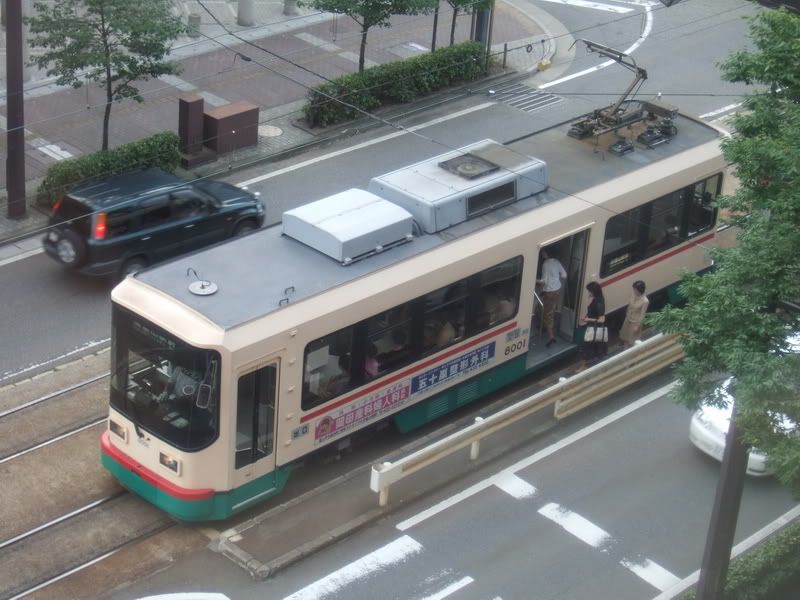
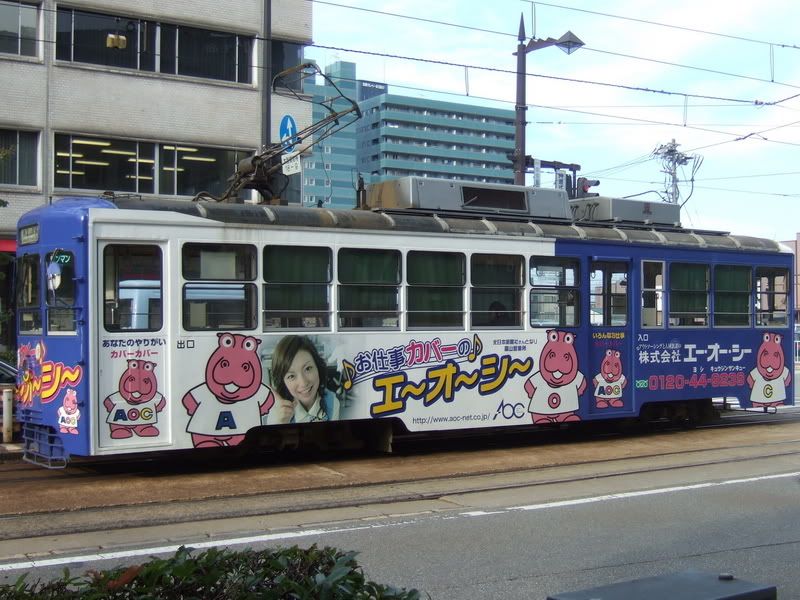
-
- duplicate post -
-
i beg to differ in argument. the tram system in hong kong supplements the mtr. plus we now can widen roads to accomodate the trams. i dun see why if hong kong have trams we cannot
however installing a antique tram system may be quite silly. but i think thats the way to go. something old and nice like Hk ones so that people will find it nostalgic. its best if the tram system is placed along chinatown and then turn up into orchard. and import or built the trams old style like back in the days.
overhead wires are an obstruction yes but in HK whcih is super duper building congested and road congested cna do it we can do it.
how about peak tram?
HK has one gg up victoria peak. why not we get one for mount faber. again has to be pore war model and be installed with the necessary modern refinements (like peak tram)
zyx -
Get antigrav airspeeders.
Uniquely Singapore.
-
Dun think this appeals to the government...
now they digging the ground for MRT lines... -
LOL... Then the histroy of the tram will be a bit "fake"... Moreover, HK has some newer trams now (the green and white ones), but they suck at ventilation...Originally posted by ZYX2005:however installing a antique tram system may be quite silly. but i think thats the way to go. something old and nice like Hk ones so that people will find it nostalgic. its best if the tram system is placed along chinatown and then turn up into orchard. and import or built the trams old style like back in the days. -
If I'm not wrong, I once heard that there was a proposal to build a kind of a people-mover system in East Coast Park. I think a non-air conditioned tram system (or one that is partially air-conditioned) could be a good choice for that. Maybe the whole of East Coast Park Service Road be turned into a right-of-way for the trams (converting them into tram trackage). Cars going into East Coast Park could instead park at one of the proposed underground carparks instead of the current messey roadside and surface parking configurations, and people could then transfer to the tram system to go where they exactly want in the park. The tram line could mostly follow East Coast Park Service Road, but in a few places it could wind into the park itself (the tracks "embedded" into the grass, somewhat like this), and then could make a stop witin the park itself. Stations need not be a grand affair - even a simple concrete patch alongside the tracks long enough for the trams with a paved path will do (Although some decor is recommended)! Some places where stations can be located include the Big Splash, near Bedok Jetty, East Coast Park Hawker Centre, the resort and the adjacient area where the McDonalds is located (not sure what is that area's name), and the lagoon.
How about our old friend the 401? Well, a bus-to-tram terminal can be set up near the area where route 401 enters East Coast Park from Bedok, and passengers can alight there and transfer to the tram to go to where they want to go. Route 401 can then go onto the expressway, and then go out onto Marine Parade, following the same route as it does now, and then drop off the passengers at the East Coast Park end of Fort Road, where another bus-to-tram terminal can be set up, before turning back along the same route to Bedok.