Bus whose body is diagonally oriented when going straight ?!
-
An engine with 15078 cc is definitely a V8 , well for the case of MB . The only engine that came close to this capacity and is not a V8 is Volvo's D16 , the engine used in the Volvo FH16 truck . It produces a whopping 660BHP maximum . Can't remember the torque tho .Originally posted by hseochin:You can say i've seen the chassis, but with the bodywork on it. Having noted the 15078 cc capacity i know Daimler does not have that engine in any other configuration except V8. You see 4 valve covers over 2 opposing rows on the engine so you know 4x2 = 8 cylinders.
As for performance, i naturally won't expect any problems up here in this class. I do believe in the latest 2nd generation Travego 3-axle coach Daimler has developed this engine further by increasing it to ~ 16000 cc, change to 4-valve per cylinder, add charge-cooling & additives to make it Euro-4 compliant yet still keeping output @ 476 BHP & 2000++ Nm !!
However the M-B V8's used by SJE & in Malaysia i think is the 'tamer' version because of it's earlier less developed design but it's nice to know Daimler hasn't abandoned bus V-engine production & still offers the V8 as it's top end engine option. To me it's not merely the performance alone that makes me prefer the V8, but rather the 'overall' engine 'experience' expressed in terms of the superior refinement factor thru the generally low noise, vibration & harshness levels over the performance spectrum of the engine. Because if you only want performance, nowadays i believe you already have the new generation MAN & Scania in Malaysia with 4-valve/cylinder charge-cooled 12000 cc engines of only in-line 6 cylinders producing say up to 422 BHP, which is quite close to the new M-B V8's of 476 BHP. BUT the 'problem' i'll expect from these in-line 6 smaller cc engines is the lack of the feel of the above mentioned 'refinement class' which only tends to come from big cc V8 engines. Something like why they still make cars with V-12 engines when in-line 6 cylinder engines can be modified also to produce quite close performance levels but minus the classy 'refinement' factor which only the V-type engines can offer.
As for the M-B V8's in Malaysia, i believe Genting Resorts operates some departing from KL Sentral & Pudu Raya many times daily. Unlike the newer charged-cooled small cc engines, the big cc V8's can make do with quite low RPM's yet still move smoothly, quietly with strong torque uphill without the absolute need to rev hard. Of course if they rev it hard then the potency increases without the need to 'struggle' unlike the smaller cc's.
Besides Genting Resorts other operators i know include Transtar, 5-Star, Sri Maju not forgetting an operator (name forgotten) who even changed the exhaust to AMG twin-type !! Nowadays i'll take it via Sri Maju for the KL-SGP trip & of course via SJE if between JB-SGP. Those on Transtar seem noisier to me while those on Sri Maju are quieter even @ the extreme rear just next to the engine. I'll put it as due to different coachworks used by these different operators. But whatever the case, i always get this 'one up' sensation when aboard a V8 vehicle in that you know you're like 1 class up over the rest with only 6-cylinders ! That itself, to me, more than compensates for forgoing any of the questionable frills like massaging seats, individual videos etc. on the newer but only 'lowly' in-line 6-cylinder coaches.
If taking it within Singapore, i think the peak hour private bus service on 640 has at least 1 unit. Seen it along Selegie Road with passengers. They changed the M-B star to a gold plated version (perhaps to reflect the V8 status) using Kassbohrer Setra coach headlamps.
Wow. If one of these companies actually zhng the bus , and installed twin turbo , think the bus will really zip thru the expressway like no other ! V-engines are one of the few engines that can be installed with twin turbo .
-
Actually I don't see why V8 will be smoother than in-line 6s..
V6s and V8s are actually a compromise in Vee-configuration engines..they aren't exactly very smooth..
The smoothest vee-configuration engine has got to be the V12..it's the most inherently balanced engine configuration..it's even more inherently balanced than the in-line 6 design..the in-line 6 is already the most inherently well-balanced engine among other in-line configuration.. -
haha... some of you really can talk and look professional.
The bus crooked laterally yet going straight. Actually it's forced to go straight with a loosely mounted torsion rod.
Worn mounting bush for torsion rod (aka Panhard rod).
The bus slanted vertically to one side yet going straight.
Corroded bellow plate so bellow not sitting properly.
if there is air leak in one of the bellow, the bellow will still be unable to rise to the proper height. The 4 way protection valve will still feed the pressurized air to the air suspensions. In extreme cases, it can lead to insufficient pressure in the air system and causes brake binding. (by here, most BC will report the fault). Brake biding if ignored yet continued to drive can cause fire in the brake drums or tyre explosion (which happened before). However, during brake binding, the bus will show significant brake swing to one side during braking and lack of driving force. This is enough to poise most BC to report to OCC/CRS for help.
These are very common problems found in the autmotive industries for older buses. I have already dealt with countless of these problems before. But still these problems are potential hazards on the road and must be dealt with. These are classified as Critical faults. The highest of the 3 classes. -
This happened to SBS 3753S lately on svc 52 that the BC immediately stop the bus and call for OCC for help. But I gotta a qns, why some SBST Mercz MB 0405 would slant a bit to the left side, does it mean that it is starting to have the same problem?Originally posted by MS:haha... some of you really can talk and look professional.
The bus slanted vertically to one side yet going straight.
Corroded bellow plate so bellow not sitting properly.
if there is air leak in one of the bellow, the bellow will still be unable to rise to the proper height. The 4 way protection valve will still feed the pressurized air to the air suspensions. In extreme cases, it can lead to insufficient pressure in the air system and causes brake binding. (by here, most BC will report the fault). Brake biding if ignored yet continued to drive can cause fire in the brake drums or tyre explosion (which happened before). However, during brake binding, the bus will show significant brake swing to one side during braking and lack of driving force. This is enough to poise most BC to report to OCC/CRS for help.
. -
I see. So...it has nothing to do with:Originally posted by MS:haha... some of you really can talk and look professional.
The bus crooked laterally yet going straight. Actually it's forced to go straight with a loosely mounted torsion rod.
Worn mounting bush for torsion rod (aka Panhard rod).
1. People not moving to the rear of the bus
2. The weight of the bus not distributed to the rear axle
To conclude, this fault can happen to any bus of any brand, either with 2 axles or 3 axles, and it doesn't matter which axle the traction is coming from.
It is always best to let the real experts answer. Thank you, MS sensei. -
Thank You MS for your prompt explanation,This is what i've been thinking too.Thus ending all the hoo haas here.Originally posted by MS:haha... some of you really can talk and look professional.
The bus crooked laterally yet going straight. Actually it's forced to go straight with a loosely mounted torsion rod.
Worn mounting bush for torsion rod (aka Panhard rod).
The bus slanted vertically to one side yet going straight.
Corroded bellow plate so bellow not sitting properly.
if there is air leak in one of the bellow, the bellow will still be unable to rise to the proper height. The 4 way protection valve will still feed the pressurized air to the air suspensions. In extreme cases, it can lead to insufficient pressure in the air system and causes brake binding. (by here, most BC will report the fault). Brake biding if ignored yet continued to drive can cause fire in the brake drums or tyre explosion (which happened before). However, during brake binding, the bus will show significant brake swing to one side during braking and lack of driving force. This is enough to poise most BC to report to OCC/CRS for help.
These are very common problems found in the autmotive industries for older buses. I have already dealt with countless of these problems before. But still these problems are potential hazards on the road and must be dealt with. These are classified as Critical faults. The highest of the 3 classes. -
I have to disagree with your conclusions, because it appears you still haven't got the concept clear based on the symptoms i've observed.
Please re-read my post dated 31 Dec 2007 @ 4:43 to better understand the 'picture'. Forget for a moment my own speculative explanations but just focus & try to see the picture i saw as if you're there.
Unfortunately i've no photo taken to show as it was totally unexpected & happened very fast. I last saw the bus stopping (body still diagonally oriented) @ the bus-stop after the traffic crossing next to 7-11 store. Probably upon leaving later it managed to regain the normal parallel orientation when the 3rd (driven) axle managed to 'push' the vehicle in the parallel (with the bodywork) way it wants to go thus causing the driver to steer right to hence cancel the diagonal slant ? I didn't stay long enough to observe so won't be able to comment on how the bus appeared after that.
If you can understand exactly what i saw (never mind what i think about it), then you should be able to conclude that (exact) situation can happen to any brand of bus with 2 or 3 axles BUT provided it has minimum 2 steerable axles, which effectively cancels out the majority of bus & coach models in the market. Besides Leyland & Volvo, there's some other makes with 2 steerable axles but these have 4 axles overall with all the steerable axles in the front portion of the coach so therefore does not fit in the exact situation i saw so i'll ignore these in this context.
Therefore (even if ignoring what i think about it, which doesn't really matter as the actual facts are more important) it does however matter which axle supplies the traction simply because the vehicle needs traction to 1) get moving & 2) go in the direction it's supposed to go. Also, traction depends on the weight applied on the wheel, which in turn is dependent on the payload acting over the driven wheels, which in turn is somewhat dependent on the physical distribution (i.e. location) of the variable payloads (i.e. people/goods) on the vehicle.
Even the real experts need real accurate descriptions of the symptoms in order to give an answer which is specifically relevant rather than for some other general / common problems.Originally posted by The_Bus_Guide:I see. So...it has nothing to do with:
1. People not moving to the rear of the bus
2. The weight of the bus not distributed to the rear axle
To conclude, this fault can happen to any bus of any brand, either with 2 axles or 3 axles, and it doesn't matter which axle the traction is coming from.
It is always best to let the real experts answer. Thank you, MS sensei. -
I'm only able to see your diagram now as earlier on it didn't load when i viewed your post.
Your diagram is generally correct but to be accurate there should be 3 axles shown with the front & mid axle wheels protruding out leftwards such that only these wheels are parallel to the road with the 3rd axle wheels remaining parallel to the bodywork, which is diagonally slanted as shown on your diagram.Originally posted by XiaoTaro:I understand what u meant, but i believe the threadstarter is talking about the alignment of the bus while driving straight (correct me if i am wrong)
Heres a illustration of what i have interpreted:
[Bird's eye view]
Threadstarter, pls correct me if this is not what u mean... -
I agree that a V8 is not as smooth sounding as an in-line 6.
Generally i find V-type engines rough but tough sounding instead.
The 'punch' factor seems more pronounced & when crusing / coasting it tends to be more quiet than a lower cc in-line 6. Therefore i find them more enjoyable engines to have a trip on !!
But surprisingly i found the V10 on the Daewoo Royal original bodied CBU coach quite smooth, more smooth than on the M-B & just about any other V8's i've come across.
Taking about engine smoothness i'll rank (as smoothest) the in-line 6, followed by (in-lines) 5, 4, 3. Overall the V-type engines are either @ the bottom of this scale or they simply need another way (say like 'solidness of engine' feel ? etc.) to better describe them ?!Originally posted by alleggerita:Actually I don't see why V8 will be smoother than in-line 6s..
V6s and V8s are actually a compromise in Vee-configuration engines..they aren't exactly very smooth..
The smoothest vee-configuration engine has got to be the V12..it's the most inherently balanced engine configuration..it's even more inherently balanced than the in-line 6 design..the in-line 6 is already the most inherently well-balanced engine among other in-line configuration.. -
In the Volvo's case, their 660 BHP output is compliant to which exhaust emission level ? I notice (with some exceptions) that for basically the same engine i.e. same cc & aspiration mode, with earlier emission standards the output tends to be higher but with more stringent emissions, the output is lowered. M-B also has a top-end truck in the 600+ BHP class which i believe is also based on the same 16-litre V8 as their coach. MAN also has representation in this class.
Actually it shouldn't be too expensive & not technically impossible to do an engine upgrade as the bus-chassis was originally available with basically the same engine but with naturally aspirated, turbocharged & charged-cooled versions. Perhaps some operator in Malaysia can buy some such 2nd hand engines to retrofit ? In Malaysia things tend to be more 'flexible', so i believe that can be a reality.
I'll definitely want a trip on such an upgraded V8 coach. Can forget about all the massaging seats, individual video's & waitress service etc. however !!Originally posted by Scania N113CRB luver:An engine with 15078 cc is definitely a V8 , well for the case of MB . The only engine that came close to this capacity and is not a V8 is Volvo's D16 , the engine used in the Volvo FH16 truck . It produces a whopping 660BHP maximum . Can't remember the torque tho .
Wow. If one of these companies actually zhng the bus , and installed twin turbo , think the bus will really zip thru the expressway like no other ! V-engines are one of the few engines that can be installed with twin turbo . -
Hi Hseochin, do you know what are you talking in regards to the technical aspect? Because it doesn't make sense at all.Originally posted by hseochin:I have to disagree with your conclusions, because it appears you still haven't got the concept clear based on the symptoms i've observed.
Please re-read my post dated 31 Dec 2007 @ 4:43 to better understand the 'picture'. Forget for a moment my own speculative explanations but just focus & try to see the picture i saw as if you're there.
Unfortunately i've no photo taken to show as it was totally unexpected & happened very fast. I last saw the bus stopping (body still diagonally oriented) @ the bus-stop after the traffic crossing next to 7-11 store. Probably upon leaving later it managed to regain the normal parallel orientation when the 3rd (driven) axle managed to 'push' the vehicle in the parallel (with the bodywork) way it wants to go thus causing the driver to steer right to hence cancel the diagonal slant ? I didn't stay long enough to observe so won't be able to comment on how the bus appeared after that.
If you can understand exactly what i saw (never mind what i think about it), then you should be able to conclude that (exact) situation can happen to any brand of bus with 2 or 3 axles BUT provided it has minimum 2 steerable axles, which effectively cancels out the majority of bus & coach models in the market. Besides Leyland & Volvo, there's some other makes with 2 steerable axles but these have 4 axles overall with all the steerable axles in the front portion of the coach so therefore does not fit in the exact situation i saw so i'll ignore these in this context.
Therefore (even if ignoring what i think about it, which doesn't really matter as the actual facts are more important) it does however matter which axle supplies the traction simply because the vehicle needs traction to 1) get moving & 2) go in the direction it's supposed to go. Also, traction depends on the weight applied on the wheel, which in turn is dependent on the payload acting over the driven wheels, which in turn is somewhat dependent on the physical distribution (i.e. location) of the variable payloads (i.e. people/goods) on the vehicle.
Even the real experts need real accurate descriptions of the symptoms in order to give an answer which is specifically relevant rather than for some other general / common problems.
From what you're saying, you do not have any idea about the buses chassis technology.
You need to study how the chassis technology works before coming to comment further on this issue.
I'm sorry for sounding blunt. But I think it is only right to correct misconceptions. -
Don't call me sensei. The automotive technology is my ricebowl. Having spent years from workshop to management and now as a manufacturer level, I still have a lot to learn from my seniors. Technology is without depth. Because the moment you thought you know something, something new will come out of the blue one day and you need to upgrade yourself.Originally posted by The_Bus_Guide:I see. So...it has nothing to do with:
1. People not moving to the rear of the bus
2. The weight of the bus not distributed to the rear axle
To conclude, this fault can happen to any bus of any brand, either with 2 axles or 3 axles, and it doesn't matter which axle the traction is coming from.
It is always best to let the real experts answer. Thank you, MS sensei.
But you are right to say the above as in (1) and (2)
You are also right to say that this fault can happen to both 2 and 3 axled buses.
The bus with a healthy working air spring will be able to read the movement of load in the vehicle cabin. Then as the air spring of the same axle compresses more than the other, compressed air will be fed to the more compressed air spring to heighten up and allow the cabin to be levelled.
Bus weight has distribution has been a challenge to vehicle chassis builders. When vehicles are going through the process of developement, the weight distribution must be one of the top priorities to be tackled. A vehicle with poor weight distribution can lose control easily.
Also, you need to understand that vehicle cabin is suspended from the vehicle chassis. The weight distribution is governed by the effectiveness of the suspensions. And so, with pressurized air, the air springs (air bellows) suspends the vehicle cabin and the shock absorber dampens the oscilliation movement of the air springs to ensure comfort and road hugging capabilities.
Bus advanced suspensions systems can even read terrain condition & driver's driving style to automatically mechatronically adjust the damping characteristics to optimize operational condition. The commands are received from accelerometers to the suspension ECU before returning to the shock absorbers for actual mechanical action. The speed of these adjustments can be as quick a fraction of a second. This system is also known as PDC (Pneumatic Damping Control)
A bus going straight with a diagionally oriented body is due to a worn torsion bar mounting bush. If the bus still can be movable, the bar should not break. If the bar breaks, the axle will immediately go disoriented. these kind of incidences are rare.
The axle is still considered to be in the 'forward' direction but has come disoriented from the vehicle chassis. But strictly speaking, the axle is in danger of breaking as differential units in the axle system will not be able to operate normally.
Steerable axles are equipped with tie roads and mounted to the double wishbone with a king pin. if the torsion bar of the steerable axle is loose, chances of a broken axle is even more imminent. This is due to the dynamic movement of the axle in view of the steering capability. -
nonsense. ***Faints***Originally posted by hseochin:Up to the time of your post, seems you're the only person who precisely get my point.
I don't think all the others before you really understood my observations despite that i went into quite some background details.
I wish to add that the road was normally dry, the bus didn't seem to be skidding (i.e. no screaming sounds from the tyres & no skid marks) & it was even trying to accelerate to maintain speed as it went pass me.
The funny thing is that i was looking @ a near VERTICAL standing double-decker BUT whose bodywork is slanted diagonally (from the point of view looking @ the front of the vehicle) in the LATERAL plane & the whole thing was moving forwards in a STRAIGHT path with the front & middle tyres judding out as if it was going to turn left but it just went straight on !
Perhaps by now the picture becomes clearer ??
My own analysis of this observation would be that as the bus seem fully packed with people (sitting + standing) the bulk of the vehicle's weight was transferred to mainly the front & middle axles & the bus-chassis may not then be as 'straight' as it should be if the weight distribution was more even.
Therefore in this situation the chassis may have sagged down between the front & mid axles thereby causing the 3rd (driven) axle wheels to become less in contact with the road i.e. less driving traction than normal which may explain why the driver was trying to accelerate just to maintain speed on that flat road. ADDED to this situation any possible FAILURE of the mid-axle lateral wheel lock which enabled the 4-wheel steering to be ON even when the road speed was higher than 20 km/h collectively resulted in the bus moving straight in the direction guided by the parallel aligned wheels in the front & mid axles while momentarilly 'ignoring' the direction of the wheels in the 3rd driven axle since those have less weight acting on them to 'grip' the road then ?!
The fact that Selegie Road is straight before a SLIGHT BEND towards the LEFT after the traffic junction with Middle Road may explain why the steered wheels were oriented towards the left (instead of right) when i saw the bus coming straight on the later straight stretch of Selegie Road, where i made my observations while walking along that road.
Hopefully by now the picture is even clearer. But you have to read carefully in order to understand..
get below the vehicle and see whats going on before you make such comments. -
A practical approach always truimphs a theoretical one.
-
I do understand what you meant right from the start. Please re-read my posts dated 29 Dec 2007 @ 01:09 PM (my personal observation of a O405 with a similar problem) and 31 December 2007 @ 10:38 AM (explaining again what I observed). My conclusion was verified by MS. Please read the post by him, with further explanations, dated 09 January 2008 @ 09:07 PM.Originally posted by hseochin:I have to disagree with your conclusions, because it appears you still haven't got the concept clear based on the symptoms i've observed.
.....
Even the real experts need real accurate descriptions of the symptoms in order to give an answer which is specifically relevant rather than for some other general / common problems. -
Hi Bus_guide,Originally posted by The_Bus_Guide:I understood what you meant right from the start. Please re-read my posts dated 29 Dec 2007 @ 01:09 PM and 31 December 2007 @ 10:38 AM. What happened is either:
a) My explanation wasn't described clearly
b) You did not understand what I posted
The real expert have given the precise conclusion and I thanked him for that.
actually I also dun understand what was hseochin saying. because his posts dun make sense at all.
Perhaps the pictures below which I took will be able to shed some light towards the misconceptions.
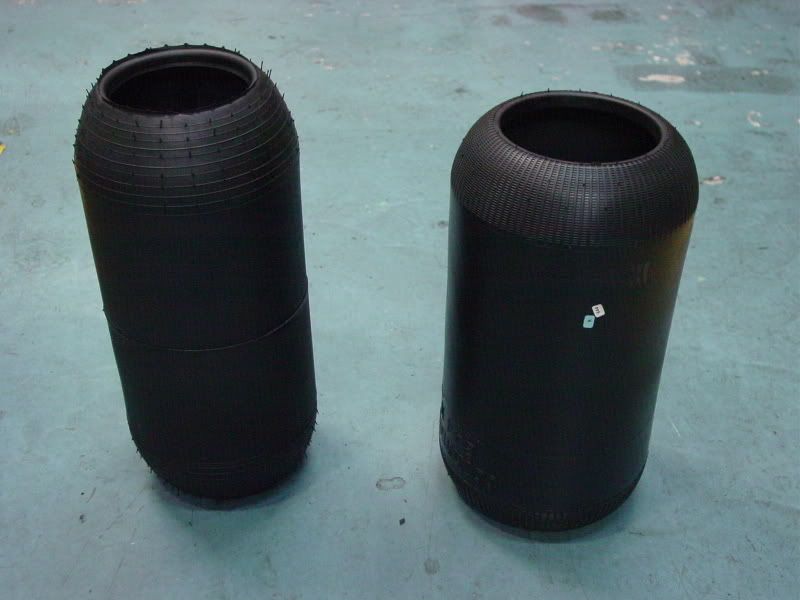
http://i115.photobucket.com/albums/n298/arakyo/bellows2.jpg
Air spring (bellows) brand new.
http://i115.photobucket.com/albums/n298/arakyo/rearaxledamperbellow2.jpg
air spring (bellow) mounted. bellow plates are 1 on top 1 below.
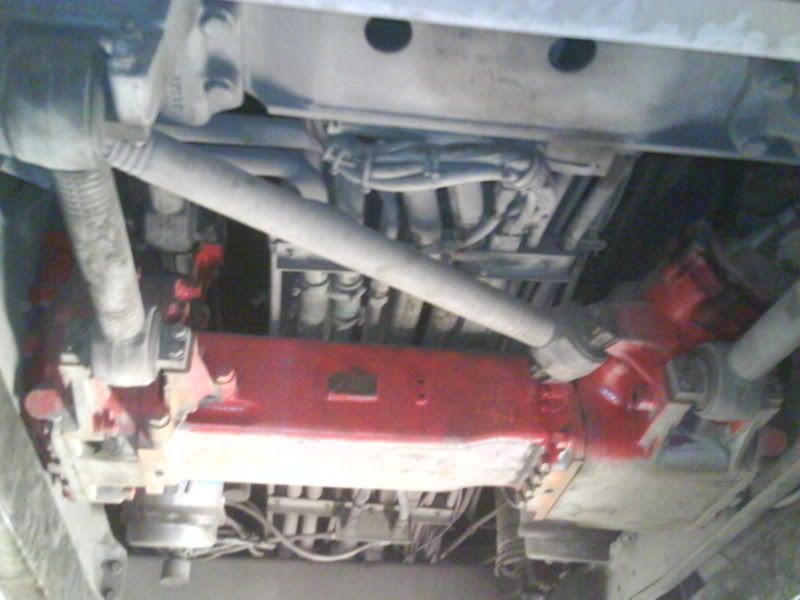
http://i115.photobucket.com/albums/n298/arakyo/VolvoRearaxlestabilizerrods.jpg
stabilizer rods. (torsion bar, panhard rods etc) different people call it differently. See how it locates and keeps the axle in place. -
Hi MS,
Thank you for the pictures. I searched further regarding the panhard rod and found that it prevents the lateral movement (side to side) of the axle. The diagonal rod in the 3rd picture should be the one. The other rod, which is connected perpendicular to the axle, prevents the axle from moving longitudinally (front to back). I believe there are 2 rods for this, one on the right and the other on the left? -
bingo! you hit it on bull's eye. Saves me the trouble of elaborating on the pictures.Originally posted by The_Bus_Guide:Hi MS,
Thank you for the pictures. I searched further regarding the panhard rod and found that it prevents the lateral movement (side to side) of the axle. The diagonal rod in the picture should be the one. The other rod, which is connected perpendicular to the axle, prevents the axle from moving longitudinally (front to back). I believe there are 2 rods for this, one on the right and the other on the left?
The mountings which I mentioned worn are those joints at the end of the rods. These parts if worn allows free play on the rod which in the first place is supposed to be rigid and dead. With play, the rod will move and unable to keep the axle in place properly. -
The Panhard rods on the front axle of the O405s are visible right?Originally posted by MS:bingo! you hit it on bull's eye. Saves me the trouble of elaborating on the pictures.
The mountings which I mentioned worn are those joints at the end of the rods. These parts if worn allows free play on the rod which in the first place is supposed to be rigid and dead. With play, the rod will move and unable to keep the axle in place properly. I always see a straight rod linking to the front axle , but i can't figure out what rod that is.
 -
Please note that i was disagreeing with Bus-Guide's conclusions but NOT specifically your feedback, which of course makes sense from the technical-micro point of view but which takes the view of the axles being in risk of being disoriented from their original location during production onto the chassis due to wear & tear of their supporting elements with usage.
In that scenario, i'll agree it (i.e. axle moving 'straight' but bodywork 'slanted') can happen to just about ANY vehicle whether with 2 or 3 axles & even if with only 1 steerable axle.
I would have agreed with Bus-Guide's conclusions IF i were to think along this line of possible axle dislocation. However i was making use of my knowledge of the fact (i'm sure given your strong technical background & long experience you should be able to verify it's FACT ?) that the bus model i mentioned i saw (i.e. Olympian) has front & mid axles steerable & only the rear-most axle driven, to take on a more macro i.e. 'big picture' or broader approach to analyse what i saw, perhaps leading to other possible explanations which can result in such a diagonally oriented bus going straight other than the 'common' faults, which you've given fairly good overview on ??
Going along the macro approach i've taken (instead of the obvious already taken by others here), that's why (from my other reply posts to others under this topic) i also stated my observations of 3-axle coaches with mid & not last axle driven with only 1 steerable axle, as is the case with the MAN's & Scanias in Malaysia. Also about the concept of FWD trucks (very few around i know) as well as the ideas on traction, weight & payload etc. which reasonably cannot be 'nonsense' ?!? You mean all that makes no sense & is just rubbish ?
Cannot be or else they won't exist in the 1st place.
If i don't have any idea of bus chassis technology, then in the 1st place i won't be able to even tell the difference between which one is driven, trailing or steered axles ?! I don't think i'm professor of bus yet but on the other hand i reasonably know my theortical & practical 'ideas' on bus chassis technology is not 'zero' either.
If i had not known the above of the Olympian as fact then i would have simply agreed with Bus-Guide's conclusions.
It's ok to sound blunt with me because i'm also a very direct person.
I don't stand too much on ceremony.Originally posted by MS:Hi Hseochin, do you know what are you talking in regards to the technical aspect? Because it doesn't make sense at all.
From what you're saying, you do not have any idea about the buses chassis technology.
You need to study how the chassis technology works before coming to comment further on this issue.
I'm sorry for sounding blunt. But I think it is only right to correct misconceptions. -
LOL

-
haha... OKOK.Originally posted by hseochin:Please note that i was disagreeing with Bus-Guide's conclusions but NOT specifically your feedback, which of course makes sense from the technical-micro point of view but which takes the view of the axles being in risk of being disoriented from their original location during production onto the chassis due to wear & tear of their supporting elements with usage.
In that scenario, i'll agree it (i.e. axle moving 'straight' but bodywork 'slanted') can happen to just about ANY vehicle whether with 2 or 3 axles & even if with only 1 steerable axle.
I would have agreed with Bus-Guide's conclusions IF i were to think along this line of possible axle dislocation. However i was making use of my knowledge of the fact (i'm sure given your strong technical background & long experience you should be able to verify it's FACT ?) that the bus model i mentioned i saw (i.e. Olympian) has front & mid axles steerable & only the rear-most axle driven, to take on a more macro i.e. 'big picture' or broader approach to analyse what i saw, perhaps leading to other possible explanations which can result in such a diagonally oriented bus going straight other than the 'common' faults, which you've given fairly good overview on ??
Going along the macro approach i've taken (instead of the obvious already taken by others here), that's why (from my other reply posts to others under this topic) i also stated my observations of 3-axle coaches with mid & not last axle driven with only 1 steerable axle, as is the case with the MAN's & Scanias in Malaysia. Also about the concept of FWD trucks (very few around i know) as well as the ideas on traction, weight & payload etc. which reasonably cannot be 'nonsense' ?!? You mean all that makes no sense & is just rubbish ?
Cannot be or else they won't exist in the 1st place.
If i don't have any idea of bus chassis technology, then in the 1st place i won't be able to even tell the difference between which one is driven, trailing or steered axles ?! I don't think i'm professor of bus yet but on the other hand i reasonably know my theortical & practical 'ideas' on bus chassis technology is not 'zero' either.
If i had not known the above of the Olympian as fact then i would have simply agreed with Bus-Guide's conclusions.
It's ok to sound blunt with me because i'm also a very direct person.
I don't stand too much on ceremony.
I don't like to be hailed as whatever expert or anything. In this line of engineering, technology is mutating everyday. What we know today may be obselete quickly. So I welcome everyone to bring up their views in the mode of discussion and everyone be open for discussion. In this way, everyone benefits from the exchange of knowledge. On top of that, I don't like the idea of because of who I am, my explanation is final. I also started off knowing nothing of automotive engineering many years ago. My learning path was plagued with thorns before I achieved what I have today. And even so, the path before me to seek for a better tomorrow is no easier .
Please allow me to recommend that you need to understand that you've portrayed an explicit lack of technical knowledge. And by commenting on the issues you're ignorant of, you've encouraged a perception of error for the rest to absorb.
Also, everyone makes mistakes. So do I. But it is about how we learn from our mistakes and not to wriggle with the words to sustain the pride which is the main contributing factor towards your ignorance.
If you're interested to know more about vehicle chassis technology, you may want to refer to the following manufacturers for help. These are currently some of the most popular and technologically leading brands in this aspect. They have contributed greatly towards the development of the global automotive engineering sector form Ferraris to Hinos.
- Lemforder
You can ask about undercarriages linkages, steering systems for both passenger cars and commercial vehicles.
- ZF Parts
You can learn about steering systems for passenger cars.
- SACHS
The technological leading suspensions and drivetrain specialists. -
-
0478G.Originally posted by xunmeng: -
Bellow plate corroded.Originally posted by xunmeng:
So the bellow cannot sit properly.
Common fault in the MB0405 since the bus is already very old.
Refurbishment can be done to salvage the situation.