Bus Trivia Challenge: anyone can open new question Part 3
-
Originally posted by jayh272416:
A to K are 11 basic services operated by either SBST or SMRT. A-G have DD while H-K do not.
A has B9TLs. A goes to only one train station and goes by an industrial area. In additon A meets B and H at a road but B and H do not call at the same stop together.
B has SLBP control. B has only one perm batch 1 KUB and several batch 2s.
C ends at the same int/ter as B in town T1. C has the longest routing in town T2 which is the other end.
D uses the same int/ter as A. There are two more A-D meetings, both near MRT tracks, however the two svcs do not call at the same stop except the int/ter. D also meets E at one of the two meetings.
E goes from a depot to a terminal.
F is a square number. F shares an int/ter with D. F will meet D again near M1 Station and duplicate until M2 station. They then split up and do not meet again.
G is a prime number. It meets F for two stops in either direction in town T3. They also meet again in the central area of singapore.
H goes between two terminals. From one end, after two left turns, H meets F. H uses and expressway and goes within walking distance from the other end, which is also served by E.
I used to go to the city area but was shortened. Currently I makes a u turn and does not serve any NSL or EWL stations. I meets D at a junction.
J does not meet any other services in this trivia. J runs almost identical to another service F+C-H however J uses a road with two stops, exclusive to J near one end and the two services use two parallel roads at another.
K and E are the only two basic svcs at road R1. K is a loop service which makes a U turn. K shares one end with B.
What are:
svcs A B C D E F G H I J K?
Towns T1, T2, T3?
Stations M1, M2?
Road R1?B is 52 or 185.
-
Originally posted by jayh272416:
H uses and expressway and goes within walking distance from the other end, which is also served by E.
the other end of what? E?
-
Originally posted by bus555:
haha yeah.. ok one more, what is wrong in this pic (Nothing to do with the shot that I taken just fyi)
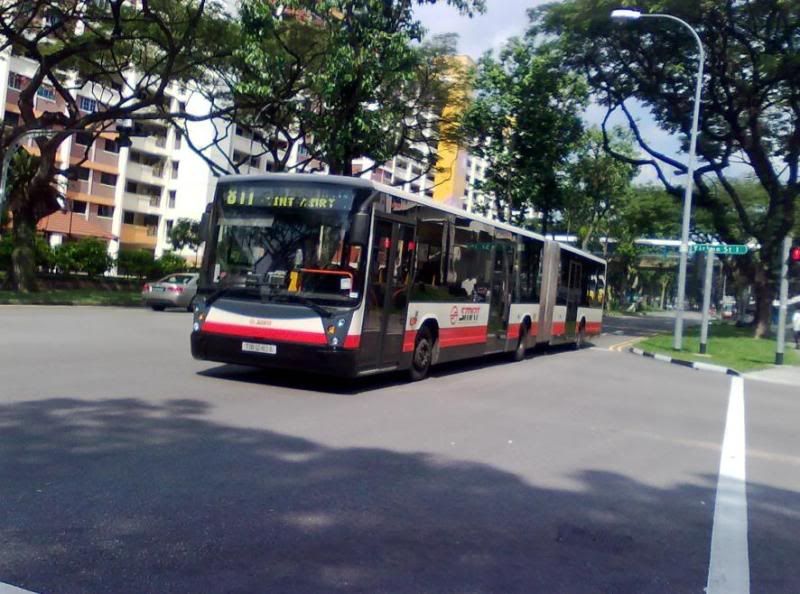
I believe is the Yishun St 1?
-
Trivia
A 16 is a service that plies a road with a height restriction.
B 111 is a service that makes a loop in the city.
B 111 adopts a jump bus system and all of A 16 and B's 111 buses originate from one depot/bus park.
A, 16 B, 111 C, D and E all intercept on this road, but C and D do not call at the same bus stop at all along this road.
C and D will meet again at a cross junction but C and D will turn right from opposite directions.
D does not share ending point with anyone (A-L).
E will cross intercept C at 2 road junctions before meeting at the road where A-E meet. E is also known to meet C at the opposite direction of E after the 2 cross-interceptions.
E also plies an expressway.
F intercepts B 111, J and K all will meet up altogether at this road for only 1 stop.
F, G and H will enter this road at the same and ply all the bus stop on this road before leaving this road at the same time.
F is known not to meet any other service (A-L) thereafter.
G and H share one ending point that all the other services (A-L) do not.
H meets many services (A-L).
I is a long loop service known to intercept J for 4 stops at the first 10 minutes of its journey.
I and M is known to intercept H on both directions but H will only call together with I and M on 1 stop on 1 direction and none for the other.
J will meet A 16 when it turns right onto this road and separate when A turns right out of this road and J continues going straight. A 16 and J do not call at any bus stop together.
J and K's service numbers have 2 identical digits, one of which is the last one. example, sv143 and sv543.
L meets all services except E.
L is known to intercept D for at least 6 stops before splitting and meeting again for at least 6 stops.
H, B and L are the only SBST Trunk known to ply this road along with M.
M shares one ending point with L and the other with A and C.
M will intercept with I for many stops at one point of time and 1 or 2 stops at the next time they meet.
-
Originally posted by SBS8033D:
I believe is the Yishun St 1?
yeah supposed to be st 11. on the left is a shell petrol station and my church's youth building.
-
Originally posted by jayh272416:
A to K are 11 basic services operated by either SBST or SMRT. A-G have DD while H-K do not.
A has B9TLs. A goes to only one train station and goes by an industrial area. In additon A meets B and H at a road but B and H do not call at the same stop together.
B has SLBP control. B has only one perm batch 1 KUB and several batch 2s.
C ends at the same int/ter as B in town T1. C has the longest routing in town T2 which is the other end.
D uses the same int/ter as A. There are two more A-D meetings, both near MRT tracks, however the two svcs do not call at the same stop except the int/ter. D also meets E at one of the two meetings.
E goes from a depot to a terminal.
F is a square number. F shares an int/ter with D. F will meet D again near M1 Station and duplicate until M2 station. They then split up and do not meet again.
G is a prime number. It meets F for two stops in either direction in town T3. They also meet again in the central area of singapore.
H goes between two terminals. From one end, after two left turns, H meets F. H uses and expressway and goes within walking distance from the other end, which is also served by E.
I used to go to the city area but was shortened. Currently I makes a u turn and does not serve any NSL or EWL stations. I meets D at a junction.
J does not meet any other services in this trivia. J runs almost identical to another service F+C-H however J uses a road with two stops, exclusive to J near one end and the two services use two parallel roads at another.
K and E are the only two basic svcs at road R1. K is a loop service which makes a U turn. K shares one end with B.
What are:
svcs A B C D E F G H I J K?
Towns T1, T2, T3?
Stations M1, M2?
Road R1?i think I is 103
-
Originally posted by jayh272416:
A to K are 11 basic services operated by either SBST or SMRT. A-G have DD while H-K do not.
A has B9TLs. A goes to only one train station and goes by an industrial area. In additon A meets B and H at a road but B and H do not call at the same stop together.
B has SLBP control. B has only one perm batch 1 KUB and several batch 2s.
C ends at the same int/ter as B in town T1. C has the longest routing in town T2 which is the other end.
D uses the same int/ter as A. There are two more A-D meetings, both near MRT tracks, however the two svcs do not call at the same stop except the int/ter. D also meets E at one of the two meetings.
E goes from a depot to a terminal.
F is a square number. F shares an int/ter with D. F will meet D again near M1 Station and duplicate until M2 station. They then split up and do not meet again.
G is a prime number. It meets F for two stops in either direction in town T3. They also meet again in the central area of singapore.
H goes between two terminals. From one end, after two left turns, H meets F. H uses and expressway and goes within walking distance from the other end, which is also served by E.
I used to go to the city area but was shortened. Currently I makes a u turn and does not serve any NSL or EWL stations. I meets D at a junction.
J does not meet any other services in this trivia. J runs almost identical to another service F+C-H however J uses a road with two stops, exclusive to J near one end and the two services use two parallel roads at another.
K and E are the only two basic svcs at road R1. K is a loop service which makes a U turn. K shares one end with B.
What are:
svcs A B C D E F G H I J K?
Towns T1, T2, T3?
Stations M1, M2?
Road R1?
isnt this and the other trivia a math question combine with knowledge of buses and routes ?
too diffct for me. lets try cracking one by one then it will get easier and easier

for a start, i think I is 82 ?

-
Originally posted by disappear:
C is 154, D is 151?pass by those schools along bukit timah area
151 from hougang south move to hougang central int
correct
-
Originally posted by SBS8033D:
I believe is the Yishun St 1?
finally yeahSBS9888Y - o.0
-
Originally posted by .SBS9888Y.:
the other end of what? E?
edit: H uses an expressway. H's other end, which is also served by E, is within walking distance from F.
-
Originally posted by disappear:
isnt this and the other trivia a math question combine with knowledge of buses and routes ?too diffct for me. lets try cracking one by one then it will get easier and easier
for a start, i think I is 82 ?
mmhmm.
-
Originally posted by sbs8104h:
Simplest Quiz(i think) FOWARDED
F is a semi-express service that was in 2003. It has long express route. Recently, it was made to ply in the North West area along with E before going on separate ways and it meets A at this stop and has suppliment trips from a bus.It faces overcrowing situations during peak hours but is rather empty at other times. What is F? On what day was F introduced? Name the town that it was extended to and when did it start to take effect?Fowarded
F is a semi-express service that was in 2003. It has long express route. Recently, it was made to ply in the North West area along with E before going on separate ways and it meets A at this stop and has suppliment trips from a bus.It faces overcrowing situations during peak hours but is rather empty at other times. What is F? On what day was F introduced? Name the town that it was extended to and when did it start to take effect?
-
Originally posted by jayh272416:
edit: H uses an expressway. H's other end, which is also served by E, is within walking distance from F.
erm H's other end is with walking distance from F's ending point or F's route?
-
Originally posted by .SBS9888Y.:
erm H's other end is with walking distance from F's ending point or F's route?
route. lol...
-
Originally posted by jayh272416:
A to K are 11 basic services operated by either SBST or SMRT. A-G have DD while H-K do not.
A has B9TLs. A goes to only one train station and goes by an industrial area. In additon A meets B and H at a road but B and H do not call at the same stop together.
B has SLBP control. B has only one perm batch 1 KUB and several batch 2s.
C ends at the same int/ter as B in town T1. C has the longest routing in town T2 which is the other end.
D uses the same int/ter as A. There are two more A-D meetings, both near MRT tracks, however the two svcs do not call at the same stop except the int/ter. D also meets E at one of the two meetings.
E goes from a depot to a terminal.
F is a square number. F shares an int/ter with D. F will meet D again near M1 Station and duplicate until M2 station. They then split up and do not meet again.
G is a prime number. It meets F for two stops in either direction in town T3. They also meet again in the central area of singapore.
H goes between two terminals. From one end, after two left turns, H meets F. H uses and expressway and goes within walking distance from the other end, which is also served by E.
I used to go to the city area but was shortened. Currently I makes a u turn and does not serve any NSL or EWL stations. I meets D at a junction.
J does not meet any other services in this trivia. J runs almost identical to another service F+C-H however J uses a road with two stops, exclusive to J near one end and the two services use two parallel roads at another.
K and E are the only two basic svcs at road R1. K is a loop service which makes a U turn. K shares one end with B.
What are:
svcs A B C D E F G H I J K?
Towns T1, T2, T3?
Stations M1, M2?
Road R1?E is 185
K is 181
R1 is Jrg west ave 3 ? -
Originally posted by .SBS9888Y.:
Trivia
A is a service that plies a road with a height restriction.
B is a service that makes a loop in the city.
A and B adopts a jump bus system and all of A and B's buses originate from one depot/bus park.
A and C share the same ending point at one end.
A, B, C, D and E all intercept on this road, but C and D do not call at the same bus stop at all along this road.
C and D will meet again at a cross junction but C and D will turn right from opposite directions.
D does not share ending point with anyone (A-L).
E will cross intercept C at 2 road junctions before meeting at the road where A-E meet. E is also known to meet C at the opposite direction of E after the 2 cross-interceptions.
A and E will intercept near this shopping mall all the way till it meets at the road where all A-E meet at.
E also plies a highway and an expressway.
F intercepts B, J and K all will meet up altogether at this road for only 1 stop.
F, G and H will enter this road at the same and ply all the bus stop on this road before leaving this road at the same time.
F is known not to meet any other service (A-L) thereafter.
G and H share one ending point that all the other services (A-L) do not.
H meets many services (A-L).
I is a long loop service known to intercept J for 4 stops at the first 10 minutes of its journey.
I and M is known to intercept H on both directions but H will only call together with I and M on 1 stop on 1 direction and none for the other.
J will meet A when it turns right onto this road and separate when A turns right out of this road and J continues going straight. A and J do not call at any bus stop together.
J and K's service numbers have 2 identical digits, one of which is the last one. example, sv143 and sv543.
L meets all services except E.
L is known to intercept D for at least 6 stops before splitting and meeting again for at least 6 stops.
H, B and L are the only SBST Trunk known to ply this road along with M.
M shares one ending point with L and the other with A and C.
M will intercept with I for many stops at one point of time and 1 or 2 stops at the next time they meet.
A - 16
B - 111 -
Originally posted by sinicker:
A - 16
B - 111correct.
-
Originally posted by sbs8104h:
Fowarded
F is a semi-express service that was in 2003. It has long express route. Recently, it was made to ply in the North West area along with E before going on separate ways and it meets A at this stop and has suppliment trips from a bus.It faces overcrowing situations during peak hours but is rather empty at other times. What is F? On what day was F introduced? Name the town that it was extended to and when did it start to take effect?
F is 966. introduced on 16 Nov 2003.recently made to stop at Bukit Panjang bus stops. with effect from 18 jan 09.
-
Originally posted by .SBS9888Y.:
Trivia
A 16 is a service that plies a road with a height restriction.
B 111 is a service that makes a loop in the city.
B 111 adopts a jump bus system and all of A 16 and B's 111 buses originate from one depot/bus park.
A, 16 B, 111 C, D and E all intercept on this road, but C and D do not call at the same bus stop at all along this road.
C and D will meet again at a cross junction but C and D will turn right from opposite directions.
D does not share ending point with anyone (A-L).
E will cross intercept C at 2 road junctions before meeting at the road where A-E meet. E is also known to meet C at the opposite direction of E after the 2 cross-interceptions.
E also plies an expressway.
F intercepts B 111, J and K all will meet up altogether at this road for only 1 stop.
F, G and H will enter this road at the same and ply all the bus stop on this road before leaving this road at the same time.
F is known not to meet any other service (A-L) thereafter.
G and H share one ending point that all the other services (A-L) do not.
H meets many services (A-L).
I is a long loop service known to intercept J for 4 stops at the first 10 minutes of its journey.
I and M is known to intercept H on both directions but H will only call together with I and M on 1 stop on 1 direction and none for the other.
J will meet A 16 when it turns right onto this road and separate when A turns right out of this road and J continues going straight. A 16 and J do not call at any bus stop together.
J and K's service numbers have 2 identical digits, one of which is the last one. example, sv143 and sv543.
L meets all services except E.
L is known to intercept D for at least 6 stops before splitting and meeting again for at least 6 stops.
H, B and L are the only SBST Trunk known to ply this road along with M.
M shares one ending point with L and the other with A and C.
M will intercept with I for many stops at one point of time and 1 or 2 stops at the next time they meet.
E is 36?
-
Originally posted by azharjj:
E is 185
K is 181
R1 is Jrg west ave 3 ?
yeahs -
Originally posted by disappear:
E is 36?
nope.
-
Originally posted by jayh272416:
A to K are 11 basic services operated by either SBST or SMRT. A-G have DD while H-K do not.
A has B9TLs. A goes to only one train station and goes by an industrial area. In additon A meets B and H at a road but B and H do not call at the same stop together.
B has SLBP control. B has only one perm batch 1 KUB and several batch 2s.
C ends at the same int/ter as B in town T1. C has the longest routing in town T2 which is the other end.
D uses the same int/ter as A. There are two more A-D meetings, both near MRT tracks, however the two svcs do not call at the same stop except the int/ter. D also meets E at one of the two meetings.
E goes from a depot to a terminal.
F is a square number. F shares an int/ter with D. F will meet D again near M1 Station and duplicate until M2 station. They then split up and do not meet again.
G is a prime number. It meets F for two stops in either direction in town T3. They also meet again in the central area of singapore.
H goes between two terminals. From one end, after two left turns, H meets F. H uses and expressway and goes within walking distance from the other end, which is also served by E.
I used to go to the city area but was shortened. Currently I makes a u turn and does not serve any NSL or EWL stations. I meets D at a junction.
J does not meet any other services in this trivia. J runs almost identical to another service F+C-H however J uses a road with two stops, exclusive to J near one end and the two services use two parallel roads at another.
K and E are the only two basic svcs at road R1. K is a loop service which makes a U turn. K shares one end with B.
B is 52.
-
Originally posted by jayh272416:
A to K are 11 basic services operated by either SBST or SMRT. A-G have DD while H-K do not.
A has B9TLs. A goes to only one train station and goes by an industrial area. In additon A meets B and H at a road but B and H do not call at the same stop together.
B has SLBP control. B has only one perm batch 1 KUB and several batch 2s.
C ends at the same int/ter as B in town T1. C has the longest routing in town T2 which is the other end.
D uses the same int/ter as A. There are two more A-D meetings, both near MRT tracks, however the two svcs do not call at the same stop except the int/ter. D also meets E at one of the two meetings.
E goes from a depot to a terminal.
F is a square number. F shares an int/ter with D. F will meet D again near M1 Station and duplicate until M2 station. They then split up and do not meet again.
G is a prime number. It meets F for two stops in either direction in town T3. They also meet again in the central area of singapore.
H goes between two terminals. From one end, after two left turns, H meets F. H uses and expressway and goes within walking distance from the other end, which is also served by E.
I used to go to the city area but was shortened. Currently I makes a u turn and does not serve any NSL or EWL stations. I meets D at a junction.
J does not meet any other services in this trivia. J runs almost identical to another service F+C-H however J uses a road with two stops, exclusive to J near one end and the two services use two parallel roads at another.
K and E are the only two basic svcs at road R1. K is a loop service which makes a U turn. K shares one end with B.
What are:
svcs A B C D E F G H I J K?
Towns T1, T2, T3?
Stations M1, M2?
Road R1?E is 185. K is 91?
-
Originally posted by .SBS9888Y.:
nope.
700? 700A? -
Originally posted by disappear:
700? 700A?nope, not that either.