Dragons
-
Originally posted by An Eternal Now:Nagas are described in the scriptures, they are animals with supernormal powers and protects the three treasures. Meaning dharma protectors.

In Chinese, the equivalent is the dragons, and the descriptions and appearance is also similar to the Indian Nagas. Dragons DO exist. Last time my master's monastery open, many many people witnessed dragons flying above the monastery. They are the dharma protectors. I also read in E-Sangha before, the same thing happened in another monastery in Singapore. Also many people witnessed nagas flying in the sky.
We cannot see nagas usually, nagas have the power not to appear or to appear to us, to become small or turn very big, etc.
The Nagas dwell in the celestial planes and in the sea. And although they are animals with the most blessings in the Animal Realm, they can still be preyed by a type of celestial bird called Garudas. That's how Garuda Airlines (the Indonesia airline) came about. (thanks sanarth for reminding me )
) -
Originally posted by An Eternal Now:http://www.theepochtimes.com/news/5-8-7/31030.html
http://epochtimes.com/gb/5/8/5/n1008756.htm - see enlarged photo of naga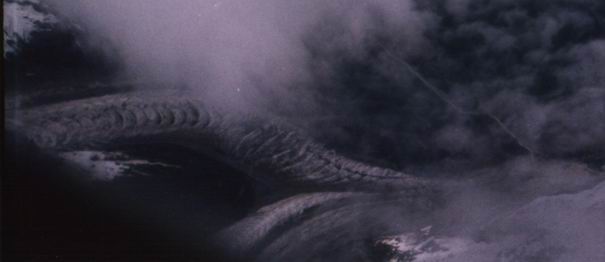
Above the Himalayas. (www.dajiyuan.com)
A photo of two peculiar dragon-shaped objects taken from a plane flying over TibetÂ’s Himalayas piqued many usersÂ’ interest when displayed on a Chinese website. The photographer is an amateur.
On June 22, 2004, the photographer went to TibetÂ’s Amdo region to attend the Qinghai-to-Xizang Railroad laying ceremony, and then took a plane from Lhasa to fly back inland. When flying over the Himalayas, he accidentally caught these two "dragons" in a picture that he took. He called these two objects "the Tibet dragons."
Looking at the photo, these two objects appear to have the characteristics of crawling creatures: The bodies seem to be covered by scales, the backs have spine-like protuberances, and also they have gradually thinning rear ends. Although the photo caught only a portion of the entire scene, it was sufficient to create the appearance of two gigantic dragons flying in the clouds.
This photo, shown on some websites such as post.baidu.com and other forums, aroused the website visitors’ curiosity. One person commented, “No wonder that China is the homeland of the dragon! Nature is truly mysterious and powerful, it can always produce spectacular sights beyond people's expectations.”
“Is it really true? Is it possible there is an ancient civilization that we don’t know about preserved in places that are sparsely populated?”
“It really looks like the dragons in fables, and I really hope it is.”
Certainly, most website visitors hoped that someone could confirm the authenticity of the dragons in the photo.
Photo of dragons taken from an airplane above the Himalayas. (www.dajiyuan.com)
In Chinese fairy tales, the dragon is a kind of rare heavenly creature. Fables say that it can conceal or reveal itself. It ascends to heaven in the spring breeze and dives and hides in deep water in the autumn wind. It can promote clouds and bring about rain. It also became the symbol of imperial authority later on; all emperors of previous dynasties self-designated as dragons, utensils were also decorated with dragons.
Culturally, the dragon is the Chinese ancestors' totem. Nearly all races in China had fables and stories with dragons as the main subject, such as dragon boat races, the dragon lantern dance to celebrate holidays, sacrificial offerings to the dragons to implore timely wind and rain for good crops.
Whether this kind of creature really exists is still an unsolved riddle. In the previous dynasties in China, there had been many documents recording eyewitness accounts of magical dragons. The most amazing events are the various "falling dragons," dragons that suddenly fell to the ground under peculiar circumstances, and were witnessed by many. A relatively recent tale occurred in the puppet Manchuria regime in August, 1944. A black dragon fell to the ground at the Chen FamilyÂ’s Weizi Village, about 9.4 miles northwest of Zhaoyuan County, on the south shore of the Mudan River (the old name of a section of Songhua River) in Heilongjiang province. The black dragon was on the verge of death. The eyewitness said that this creature had a horn on its head, scales covering its body, and had a strong fishy smell that attracted numerous flies.
The records from previous dynasties also mentioned the connection between the emergence of these kinds of mysterious creatures, “dragons,” and the transition of dynasties on earth. The appearance of Tibet’s magical dragon invites our curiosity and imagination. -
NiceOriginally posted by paperflower:
drew this graphic image of a pheonix out of appreciation for its flexibility and unique characteristics. actually got the idea of this design from some webs but i modify it myself to suit how it would pose if i'm within it. took about 10hours to finish but its lacking one more long feather tail
and..... i had it tattooed on my back......
till now, i still had no regrets..... -
thank you very much sinweiy. truly appreciate, will cherish it!Originally posted by sinweiy:very difficult to practice in the form of animal.
all beings that have not escape samsara will still undergo rebirth.
http://online.sfsu.edu/~rone/Buddhism/BuddhistDict/BDE.html
/\
may you & every being be always guided well, protected and be blessed and receive your freedom soon!
no mo shakyamuni buddha -
thanks for the compliments, harryryan and an eternal now. its way far from perfection glad you appreciated the beauty of their existence depicted through the ordinary sketch.
-
thanks justdoit77 for your compliments.Originally posted by justdoit77:wow, you did a very nice drawing.
If you like to see real dragon or other celestial creatures so much, then practise hard lor and sooner or later you will be able to see.
btw, can you see the tattoo on your back? might as well put it somewhere so you can see it more often.
of cos i can't see it from my back, but i can always use a mirror to look at it if i want.
it is unnecessary to be visible or accessable.
truly appreciating an artform is being in the simplest modest contented way unshaken by any opinions or conditions. i wear clothes that covers and/or partly covers my back sometimes, so its like now you see it now you don't kekeeeee both doesn't matter at all.
 -
Be careful man, the "kay ang mohs" might come after you and accuse you of being a Chinese Chauvanists!Originally posted by concerned_man:I am proud to be a decendant of the Dragon.
Long De Chuan Ren.
BTW, just curious if these forums can support Chinese characters? I see you guys (and gals) using pinyin all the time... -
Honestly speaking, being proud as a chinese can't be regarded as chauvinist. Jews and Japanist are all very proud of their ethnic identity and culture, no one ever condemn them of being chauvinist. Today you see, how advance is their country and how united is their community.Originally posted by Beyond Religion:Be careful man, the "kay ang mohs" might come after you and accuse you of being a Chinese Chauvanists!
BTW, just curious if these forums can support Chinese characters? I see you guys (and gals) using pinyin all the time...
If there is "kay ang moh" coming in, I will take care of that.
This forum doesn't support chinese character, I have been to so many forum, none of them has this kind of weird restriction. -
I know... that is the problem with a sizable Chinese population in South East Asia. It might be that the majority of Chinese here still retain the colonial mentality, and thinks very highly of everything Western while degrading our own Chinese roots...Originally posted by justdoit77:Honestly speaking, being proud as a chinese can't be regarded as chauvinist. Jews and Japanist are all very proud of their ethnic identity and culture, no one ever condemn them of being chauvinist. Today you see, how advance is their country and how united is their community.
You see people frowning on all things Chinese, including Chinese names, Chinese ancestral practices, Chinese wah yang operas, language, TCM, etc etc. Heck, even the term "cheena" is invented to reflect this kind of negative sentiments. The sad thing is that you will not find any other races that actually feel proud to be alienating their own mother-culture. You certainly cannot find any "kay ang mohs" in Malays, Japanese, Indians etc.
Culture and religion are inseparable. There is obviously also a cross-over in religious implications. The exodus of joss-stick Taoists/ Buddhists to embrace Christianity might be another manifestation of this "kay ang moh" mentality, but that is another matter.
Some Chinese I know not only adopted Anglo-saxon names, but also changed the spelling of their surname to appear "ang moh"-ish. Eg, spelling surname "Lowe" instead of "Loh" etc. In one particularly jarring incident, my (Chinese) colleague commented to me that "Oh, Chinese characters are sooooo squarish and soooo cute!" If I hadn't know better, I would have thought that she is a foreigner seeing Chinese hanzi for the first time, but the fact is that she is a home-grown and home-educated Chinese Singaporean!
It is a sad state of affair to be sure.
Note that I don't mean to 'bash' those whose command of the Chinese language is poor, I am certainly not proclaiming that the Chinese culture is superior to all others. I am just lamenting that in Singapore, you cannot even proclaim your "Chineseness" without being branded a Chauvanist by the "kay ang mohs". -
I stand for what I believe and I am proud of what I said. It's my roots and I know what is it for me. I am proud to be a Chinese and my Parents and Ancestors are Chinese. I have no worries and not afraid.
What others say or do is really none of my business, because their lives are none of my concerned. I know what I want. It's a lifestyle and a beautiful culture I want to preserve and keep.
"What others say is not important. What I think of what others say is more important."Originally posted by Beyond Religion:Be careful man, the "kay ang mohs" might come after you and accuse you of being a Chinese Chauvanists!
BTW, just curious if these forums can support Chinese characters? I see you guys (and gals) using pinyin all the time... -
To beyond religion
i dont think this forum can support chinese characters
-
That is indeed a sad case. It is infact because of some political factors or incidents that caused people to despise its own culture.Originally posted by Beyond Religion:I know... that is the problem with a sizable Chinese population in South East Asia. It might be that the majority of Chinese here still retain the colonial mentality, and thinks very highly of everything Western while degrading our own Chinese roots...
You see people frowning on all things Chinese, including Chinese names, Chinese ancestral practices, Chinese wah yang operas, language, TCM, etc etc. Heck, even the term "cheena" is invented to reflect this kind of negative sentiments. The sad thing is that you will not find any other races that actually feel proud to be alienating their own mother-culture. You certainly cannot find any "kay ang mohs" in Malays, Japanese, Indians etc.
Culture and religion are inseparable. There is obviously also a cross-over in religious implications. The exodus of joss-stick Taoists/ Buddhists to embrace Christianity might be another manifestation of this "kay ang moh" mentality, but that is another matter.
Some Chinese I know not only adopted Anglo-saxon names, but also changed the spelling of their surname to appear "ang moh"-ish. Eg, spelling surname "Lowe" instead of "Loh" etc. In one particularly jarring incident, my (Chinese) colleague commented to me that "Oh, Chinese characters are sooooo squarish and soooo cute!" If I hadn't know better, I would have thought that she is a foreigner seeing Chinese hanzi for the first time, but the fact is that she is a home-grown and home-educated Chinese Singaporean!
It is a sad state of affair to be sure.
Note that I don't mean to 'bash' those whose command of the Chinese language is poor, I am certainly not proclaiming that the Chinese culture is superior to all others. I am just lamenting that in Singapore, you cannot even proclaim your "Chineseness" without being branded a Chauvanist by the "kay ang mohs".
Sometimes also because of the "chop roots to beg for mercy" kind of thinking although it doesn't work. For instance, indonesian chinese can't even speak mother tounge, but it doesn't spare them from being rapped and killed in racial riots.
Despising own culture and mother tounge is an unfilial act. Buddha has said that being filial is a root of all good deed. It not only benefits ourselves and parents, but the good karma will also benefit our children. Saints in chinese history, for example Kong Zi. He has contributed a lot good philosphy to we chinese even to Japan and Korea. With this good karma, all his 79 descendants are rich and in the elite group, even after so many change of dynasty, government and war.
That's why buddhism never go against worshopping of ancestor or even deities like Tu Di Gong or Tai Shang Lau Jun. Tu Di Gong is the ancient emperor Da4 Yu3 that save people from flood and Lau Jun is the philosopher Lau2 Zi3. -
There is a very wonderful picture of where Kuan Yin is standing on a Dragon (Xiang2 Long2) in the sky.
Anyone knows the link to the photo? -
Is it this one?Originally posted by concerned_man:There is a very wonderful picture of where Kuan Yin is standing on a Dragon (Xiang2 Long2) in the sky.
Anyone knows the link to the photo?
I seen a few before, this is the one that I like most. -
Yes. This is the one.
Thanks.Originally posted by justdoit77:Is it this one?
I seen a few before, this is the one that I like most. -

-
Culture was one thing , but during the Communist Upheaval period , many have to avoid being implicated with chinese nameOriginally posted by Beyond Religion:I know... that is the problem with a sizable Chinese population in South East Asia. It might be that the majority of Chinese here still retain the colonial mentality, and thinks very highly of everything Western while degrading our own Chinese roots...
You see people frowning on all things Chinese, including Chinese names, Chinese ancestral practices, Chinese wah yang operas, language, TCM, etc etc. Heck, even the term "cheena" is invented to reflect this kind of negative sentiments. The sad thing is that you will not find any other races that actually feel proud to be alienating their own mother-culture. You certainly cannot find any "kay ang mohs" in Malays, Japanese, Indians etc.
Culture and religion are inseparable. There is obviously also a cross-over in religious implications. The exodus of joss-stick Taoists/ Buddhists to embrace Christianity might be another manifestation of this "kay ang moh" mentality, but that is another matter.
Some Chinese I know not only adopted Anglo-saxon names, but also changed the spelling of their surname to appear "ang moh"-ish. Eg, spelling surname "Lowe" instead of "Loh" etc. In one particularly jarring incident, my (Chinese) colleague commented to me that "Oh, Chinese characters are sooooo squarish and soooo cute!" If I hadn't know better, I would have thought that she is a foreigner seeing Chinese hanzi for the first time, but the fact is that she is a home-grown and home-educated Chinese Singaporean!
It is a sad state of affair to be sure.
Note that I don't mean to 'bash' those whose command of the Chinese language is poor, I am certainly not proclaiming that the Chinese culture is superior to all others. I am just lamenting that in Singapore, you cannot even proclaim your "Chineseness" without being branded a Chauvanist by the "kay ang mohs".
In indonesia,when the Partai Kommunis Indonesia staged a coup, many chinese have no choice but to change their allegiance to Chinese nationalist (or rather Republic of China) and not PRC
Communist Revolution still left scars on the chinese diaspora for years -
Dragon is the best breed , that is why we have dragon horse , which is the best breed of horse
I am sure many of your have heard of Long2 Ma4 Jing1 Sheng2
Long2 Xiang2 means wat?
it means Great auspicious man and not elephant
like in the Ming Dynasty ,the four master of Buddhism are regarded as great Buddhist master who helped revived Buddhism after the years of neglect from the mongolian emperors
of course there is Nagarjuna the Patriach of the 8 school of Buddhism
http://en.wikipedia.org/wiki/Nagarjuna -

-
This pic is beautiful, portrays the elegance, power and compassion of Kuan Yin!Originally posted by concerned_man: -

-
In the olden days of China, embracing Buddhism/Taoism is easily accepted as the cultural and teachings are somewhat similar.
Nowadays, the crossover occurs because of the spread of english langauge. Easy to understand some holy book and so on.
The westerners are learning the eastern culture but we easterners are looking towards the west. -
body width of a dragon as wide as the length of an aeroplane AE-EMV, possible?
-
from http://www.amitabha-gallery.org

-
from http://www.amitabha-gallery.org/

No Dragon, but very nice.

