Japanese Zen Buddhism
-
http://www.cuke.com/dchad%20misc/dchad.html
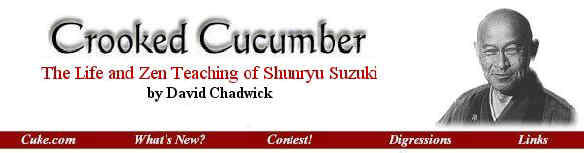
the picture of Shunryu Suzuki the famous zen master in 1970s which brought zen buddhism to the American in San Francisco
It all begin when the Chinese Chan Buddhism was brought back by Japanese Monk Dogen to Japan
Japanese Zen is a meditation-based school
Shunryu Suzuki (â�ľ ¿¡Â¡ Suzuki Shunry¨±, dharma name Shogaku Shunryu) (May 18, 1904 - December 4, 1971) was a Japanese Zen master of the Soto school, who played a major role in establishing Buddhism in America. The Japanese Soto-shu religious organization sent him to San Francisco, USA in 1959 to attend the needs of a small Japanese-American temple, Sokoji, in San Francisco's Japantown.
At the time of Suzuki's arrival, Zen had become a hot topic amongst some groups in the United States, especially beatniks. San Francisco counterculturalists found Suzuki and asked him to explain Zen. Suzuki limited his explanation to an invitation to sit zazen. "I sit zazen every day here at 5:40AM," he is quoted as having said, "and if you're here, you can sit, too."
The predominantly Caucasian group that joined Suzuki to sit eventually formed the San Francisco Zen Center with Suzuki. The Zen Center raised money to buy a hot springs resort, Tassajara, which they turned into a monastery. Soon thereafter, they bought a building at 300 Page Street in San Francisco's Haight-Fillmore neighborhood and turned it into a Zen temple. Suzuki left his post at Sokoji to become the first abbot of the first Buddhist training monastery outside of Asia. A collection of his teishos (Zen talks) were bundled in the books Zen Mind, Beginner's Mind and Not Always So: Practicing the True Spirit of Zen. His lectures on the Sandokai are collected in Branching Streams Flow in the Darkness. Suzuki's biography is captured in David Chadwick's 1999 book Crooked Cucumber.
Adapted from wikipedia on shunryu suzuki
http://en.wikipedia.org/wiki/Shunryu_Suzuki -
more zen master from japan will be introduced
in the meantime ,feel free to ask any question on zen

-
My first impression of Japanese Zen Buddhism is after watching a 'documentary'-like tape on a Japanese Zen monastery played in my dharma centre... which talks about what they do etc. Really interesting and I liked it. Very strict monastic routine too

-
Yah , I recall seeing such a video .Outside is snowing like madOriginally posted by An Eternal Now:My first impression of Japanese Zen Buddhism is after watching a 'documentary'-like tape on a Japanese Zen monastery played in my dharma centre... which talks about what they do etc. Really interesting and I liked it. Very strict monastic routine too
and the monk is meditating
then i saw one monk cleaning the meditation room with just one rag
very tedious job -
oh yes. that monastery outside snowing very very heavilyOriginally posted by bohiruci:Yah , I recall seeing such a video .Outside is snowing like mad
and the monk is meditating
then i saw one monk cleaning the meditation room with just one rag
very tedious job very cold place.. -
i like zen arts
-
yeah ,here is oneOriginally posted by neutral_onliner:i like zen arts  hope u like it
the zen monastery garden
-
Daiseki T . Suzuki on Zen Buddhism which brings about the beginning of wave of Interest in the western world

Is Zen a religion? It is not a religion in the sense that the term is popularly understood; for Zen has no God to worship, no ceremonial rites to observe, no future abode to which the dead are destined, and, last of all, Zen has no soul whose welfare is to be looked after by somebody else and whose immortality is a matter of intense concern with some people. Zen is free from all these dogmatic and "religious" encumbrances. ...
As to all those images of various Buddhas and Bodhisattvas and Devas and other beings that one comes across in Zen temples, they are like so many pieces of wood or stone or metal; they are like camellias, azaleas, or stone lanterns in my garden. Make obeisance to the camellia now in full bloom, and worship it if you like, Zen would say. There is as much religion in so doing as in bowing to the various Buddhist gods, or as sprinkling holy water, or as participating in the Lord's Supper. All those pious deeds considered to be meritorious
http://www.pbs.org/wgbh/questionofgod/voices/suzuki.html -
The famous stylish zen master in the ancient period ,should be attributed to Ikkyu

Ikkyu was born during the Ashikaga shogunate, during the time known as the Muromachi period, when the capital of Japan was restored to Kyoto from Kamakura. At the age of 21, he sought out Kaso, a well-regarded Zen monk. Under his tutelage in the seminal Daitoku-ji temple in Kyoto, Ikkyu came up against Yoso, a more senior student who eventually came to run the monastery. In Ikkyu's poems, Yoso appears as a character unhealthily obsessed with material goods, who sold Zen to increase the prosperity of the temple.
After a falling out with Yoso and his materialistic methods, Ikkyu left the temple and gradually retreated into the countryside. He was not alone there, however, as he had a regular circle of notable artists and poets from that era. Around this time, he established a relationship with a blind singer Mori who became the love of his later life.
http://en.wikipedia.org/wiki/Ikkyu