Dalai Lama - Winner Of Nobel Prize in Peace
-

I believe that whether a person follows any religion or not is unimportant, he must have a good heart, a warm heart. This is essential for a happy life, which is much more important than Buddhahood. This is part of what I call 'secular ethics'.
-Dalai Lama
Basically, a human being is a social animal. So, if you create some short moment of happiness for people, you get deep satisfaction
--Dalai Lama
Dalai Lama en Costa Rica
The basic fact is that all sentient beings, particularly human beings, want happiness and do not want pain and suffering.
--Dalai Lama -

Dalai Lama in Wiesbaden
So the smart brain must be balanced with a warm heart, a good heart--a sense of responsibility, of concern for the well-being of others.
-Dalai Lama
His Holiness the XIV Dalai Lama at
UBC's Chan Centre
We are human beings, and we have this marvelous brain and marvelous heart, so there is potential to develop a proper mental attitude, through which we can have a happy, more peaceful life.
--Dalai Lama
All sentient beings have the seed of the Buddha within them
--Dalai Lama -

The Dalai Lama greets the crowd on his arrival at the Gyuto monastery, 30 kilometres from Dharmsala, India
As far as ignorance is concerned, not just Buddhism, every religion recognizes it as the source of suffering.
-- Dalai Lama
NYC Gets Dalai Lama with it
Compassion automatically brings happiness and calmness. Then, even if you receive disturbing news, it will be easier to take, as your mind is still.
-- Dalai Lama
wiesbaden
If we utilize our favorable circumstances, such as our good heal or wealth, in positive ways, in helping others, they can be contributory factors in achieving a happier life.
---- Dalai Lama -

His Holiness the 14th Dalai Lama greets children lining his path on Monday at the Wood River High School football field in Hailey
So the first step in seeking happiness is learning. We first have to learn how negative emotions and behaviors are harmful to us and how positive emotions are helpful.
--Dalai Lama

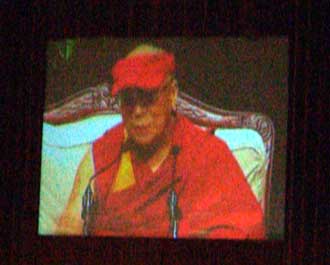
Erwin Events Center
I believe that it is essential to appreciate our potential as human beings and recognize the importance of inner transformation.
----Dalai Lama -
i wonder what will happen to the next dalai lama... will he be chosen like his ancestors was.... or no more dalai lama...

-
hmmm...i think there r 2 successorsOriginally posted by mhcampboy:i wonder what will happen to the next dalai lama... will he be chosen like his ancestors was.... or no more dalai lama... 
-
i tot suppose be reincarnate first then the 'officials' will look for the reincarnated dalai lama?? no meh??Originally posted by neutral_onliner:hmmm...i think there r 2 successors
like tat lost the beauty essence of being a dalai lama already... -

Scotland UK
The beautiful setting on stage for the last day of Dalai Lama's teachings which included Mitrupka initiation.
There were many stalls selling buddhism videos
and souvenirs, and informing people
about the plight of Tibet.
Isabel Losada signs copies of her new book
- For Tibet, With Love.
Buddhist monks mingle and chat amongst the many
thousands who came to hear the Dalai Lama's teachings.
World economies are always so tenuous and we are subject to so many losses in life, but a compassionate attitude is something we can always carry with us.
--Dalai Lama -
well my pal u see the problem here is one is choosen by dalai lama the other one by PRCOriginally posted by mhcampboy:i tot suppose be reincarnate first then the 'officials' will look for the reincarnated dalai lama?? no meh??
like tat lost the beauty essence of being a dalai lama already... -
ok. but still... isnt the dalai lama suppose to be dead first then reincarnate in a new body??Originally posted by neutral_onliner:well my pal u see the problem here is one is choosen by dalai lama the other one by PRC 
-


There are five billion human beings and in a certain way I think we need five billion different religions
--Dalai Lama -
i think u hav some misconception here.Actually there r many of them.And from them one will be chosen to become the new successor.Originally posted by mhcampboy:ok. but still... isnt the dalai lama suppose to be dead first then reincarnate in a new body??
For more detail ...ermm..so sorry mi not so sure as mi not tibetan buddhist.Maybe someone else here will ans ur doubts -
A lot? Yes...there is a lot of Lamas. But isnt there suppose to be only one Dalai Lama?Originally posted by neutral_onliner:i think u hav some misconception here.Actually there r many of them.And from them one will be chosen to become the new successor.
For more detail ...ermm..so sorry mi not so sure as mi not tibetan buddhist.Maybe someone else here will ans ur doubts Upon the death of the Dalai Lama, his monks institute a search for the Lama's reincarnation, or yangsi (yang srid), a small child. Familiarity with the possessions of the previous Dalai Lama is considered the main sign of the reincarnation. The search for the reincarnation typically requires a few years.
The current Dalai Lama has repeatedly stated that he will never be reborn inside territory controlled by the People's Republic of China [1], and has occasionally suggested that he might choose to be the last Dalai Lama by not being reborn at all. However, he has also stated that the purpose of his repeated incarnations is to continue unfinished work and, as such, if the situation in Tibet remains unchanged, it is very likely that he will be reborn to finish his work
Does it mean there is no future Dalai Lama's?It is also worth mentioning that the 14th Dalai Lama has stated "Personally, I feel the institution of the Dalai Lama has served its purpose.
Can anyone explain the concept of Dalai Lama? -
Does anyone able to explain the concept of Dalai Lama to our fren mhcampboy? ThnksOriginally posted by mhcampboy:Can anyone explain the concept of Dalai Lama? -
i never like the tibetian monks. i dont really think they are monks.
do you know what you are in for if you worship the unknown instead of seeking the truth withnin yourself?
you will be as ignorant as the rest of them out there -
it takes a holy person to identify another holy person. if a so called 'holy' person is worshipped by the likes of laymen as holy too. then that person is not really 'holy'.
think about it. -
the dalai lama look as if his kung fu is very strong, dont mess with him.
-
me too.
i am dong fang bu bai in disguse. -
Originally posted by killstyle:me too.
i am dong fang bu bai in disguse.
-
Yasser Arafat kung fu oso very powerful.
-
?Originally posted by killstyle:it takes a holy person to identify another holy person. if a so called 'holy' person is worshipped by the likes of laymen as holy too. then that person is not really 'holy'.
think about it.
Buddhists do not worship anyone, not even Buddha, let alone Dalai Lama.
But we have deep respect for him, his teachings, and his deeds. -
I am a simple Buddhist monk: Dalai Lama
by Percy Fernandez, TIMES NEWS NETWORK, July 6, 2006
Dharmsala, India -- As a young boy of 25, the Dalai Lama, Tenzin Gyatso arrived in India 46 years ago. He turned 71 on the July 6, 2006. Last year, three days after his birthday he delightfully spoke at length on Mao, his boyhood memories, his commitment to spreading human values and his admiration for the Chinese people in an exclusive interview.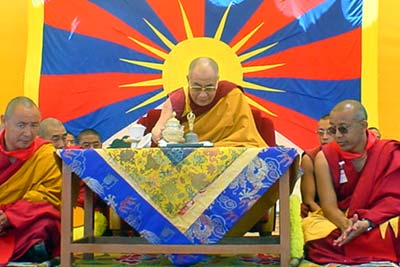
Contrary to rumour mills that the Dalai Lama is ailing, this reporter found the spiritual leader hale and hearty, strong and robust and with a firm grip. He is swift, full of life, and laughs his heart out. He is undoubtedly awe-inspiring, yet most humble. Most importantly he has a great sense of humour.
Much has changed since 2005. Early this year, the Dalai Lama expressed his desire to visit China on a 'pilgrimage' and wanted to observe the changes from the time he fled Tibet as a young boy.
He was really happy with the Berne round of talks between Tibet and China in Switzerland last June since the resumption of direct contacts since 2002.
But he continues to be problematic for the Chinese leadership. They are irritated whenever he travels to the US or incensed whenever he visits Japan, China's historical enemy. Hundreds of students from Taiwan and other countries descend to McLeodganj, above Dharamsala to receive his teachings and blessings. Recently, India's foreign secretary Shyam Saran called on the Dalai Lama at his official residence and not much is known about what transpired between them.
Because of his peripatetic schedule his doctors have advised him rest and hence the Dalai Lama has cancelled his European tour beginning from Helsinki next week. Later this year, in September the Dalai Lama will attend the largest gathering of Nobel Peace Prize winners in Denver alongside Desmond Tutu, Rigoberta Menchu Tum, Aung San Suu Kyi among others.
Curiously, the tickets for the Denver gathering will go on sale on the July 6 and so is the reopening of Nathu La. And it happens to be the birthday of the Dalai Lama.
Many many happy returns of the day. You have just completed 70 years. How does it feel to look back?
Like any other human being, some painful experiences and some satisfactory. But it has been more of satisfaction even in a life of exile that has brought me and my people a lot of opportunities.
I have had a chance to meet so many people from various walks of life. It has been very helpful in enriching my own way of thinking. I think I have made a little contribution to the Tibetan issue, its people and Tibetan culture. These are sources of my satisfaction.
Promotions of human values, religious harmony and peace have been my three commitments to humanity. I have been able to promote them through my writings, lectures and speeches.
I carry different names like counterrevolutionary, god king, Nobel Laureate and splittist among others. In the sixties, the Chinese media described me a wolf in a Buddhist robe, a great honour for someone who practiced tolerance and patience.
Tibetans think that you are also a political leader apart from their spiritual head.
It is almost 400 years after the Dalai Lama became the spiritual and temporal head of Tibetans. In my case, at the age of 16, I took the responsibility of both.
After we came to India, during the early sixties, we adopted a draft constitution which says that the Dalai Lama's powers can be abolished by two-thirds of majority in the assembly.
Three years back, we already established an elected political leadership. Since then my position is one of semi-retirement. May be, I am an ex-politician. But you don't mix the kind of politics which I involve with party politics. My politics is one of nationalist struggle.
What lies at the core of your identity?
A simple Buddhist monk. In my dreams, I feel that I am a Buddhist monk, not the Dalai Lama. Most people describe me as a Nobel Laureate. Many invite me because I am a Nobel Laureate and not because I am a monk or the Dalai Lama. They do that may be to ward off the Chinese pressure.
Once Bishop Desmond Tutu told me that it was difficult for him to reach the White House and after he received the Nobel Peace Prize, the path was cleared for his visit. (Laughs)
The life of late Pope John Paul II and yours have been compared. The Pope fiercely campaigned against the Communist empire. Did your find similarities in the cause both of you were pursuing?
His Holiness Pope John Paul II was a man I held in high regard. His experience in Poland and my own difficulties with communists gave us an immediate ground.
The Pope was very sympathetic to the Tibetan problem. Of course, as the head of an institution trying to establish good relations with China and seriously concerned about the status of millions of Christians in china he could not express this publicly or officially.
But right from the start of our friendship he revealed to me privately that he had a clear understanding of the Tibetan problem because of his own experience of communism in Poland. This gave me great personal encouragement.
Do you think tolerance and non-violence succeeds in this world?
Ultimately yes. It depends on situations. It will take time. In spite of taking time, it is the only way. Every issue is a complex one. There is no easy solution.
In the twentieth century leaders like Stalin, Hitler or Chairman Mao, took the simple method of elimination but never achieved their goals. It is impossible to eliminate all your enemies because you eliminate one, another will be born. It is possible may be in animals, but not with human beings.
If a father is eliminated, his children and grand children may carry those memories.
They will carry a sense of revenge. Bin Laden, if we handle him with hatred and handle violently, there will be 100 Bin Laden in ten or twenty years. It is possible.
Gandhi's idea of non-violence was not only morally correct but also practically realistic.
This violence somehow has to stop. From where should it stop? It is very difficult to expect from the other side to stop. This side, we should create some positive atmosphere.
In our own Tibetan case, we are fully committed towards non-violence and the middle-way approach. Even though we have been victims, we have created a conducive atmosphere. Now the powerful side, the Chinese side, has to act.
The Chinese say development inside Tibet is necessary because of globalization. What are your views?
Whether you call it globalization or economic development, some form of development is necessary. We need development and it is most welcome. But the Chinese way of development is concentrated only in pockets, like in India. Everybody is concentrating in Bangalore.
The rural India is still undeveloped. India is predominantly agriculture based. I have a strong feeling that rural India must transform.
In Taiwan, the farming and agriculture is mechanized, all of them have good education and health and the standard of living is good. India should also develop in this manner.
This reminds me of one conversation with one Chinese leader in 1954-55 in Shanghai, then Mayor and later the Foreign Minister.
He told me one late evening that he has no interest in further developing Shanghai. The countryside is not developed in Tibet. -
Skewed development may create a gap between the rich and poor which is not good. I was told by a Tibetan recently the present population in Lhasa is 300,000 and according to a plan, Lhasa city should expand to 800,000. Out of the 300,000, only 100,000 are Tibetans and the rest are Chinese.
The real economic development of the local Tibetans and their economy is really in question if you analyze in depth and look at the picture carefully and closely. The real picture will emerge when people will be able to speak without fear.
In a recent televised interview, you said you liked Chairman Mao, what made you say that?
Yes. He is quite calm and composed. When he speaks, each word carries some weight. Some people talk a lot and convey little. Each word of Chairman Mao's carried some meaning.
I was impressed with him. Though my knowledge of Chinese was limited, I could understand the importance of what he said through a good Chinese interpreter. Mao considered me almost like my son.
He was very close to me. I was impressed by his simplicity. He used wear worn-out clothes. Not like Zhou Enlai who looks to be very honest.
Later several books and documents have portrayed a different picture of Mao as a tyrant and one who was responsible for 800,000 deaths of Chinese in the recent book Mao: The Unknown Story by Jung Chang and her husband, Jon Halliday....
Do you think the current Chinese leadership has acquired a forward looking policy to find a solution for the Tibetan issue?
I think the Chinese policy on the Tibetan issue is linked to their overall policy. The current leadership has changed and the situation is different than what it used to be thirty years before.
Much has progressed. In the early fifties, they just emphasized the importance of ideology regardless of the reality. After Deng Xiaoping, reality has become more important, which I think has been a remarkable change.
It has been like two steps forward and one step backward, though I am not a specialist on China. On the Tibet issue, there has been no clear policy by the Chinese government. They also know 99% of Tibetans are against Chinese rule.
I think the Chinese government eventually will realize this. But then they themselves don't know how to tackle it. So the only way out for them is to politically tighten the grip and sanction lots of economic incentives.
They think this is the best policy. I don't think this will work. People in Basque (Spain) are economically well off but politically not satisfied.
Similarly in Quebec (Canada) in spite of a separatist movement, people want Quebec to remain in Canada. And also the case with Scotland.
They would want to remain with Great Britain provided they are satisfied. if people are satisfied, they would want to remain within Great Britain.
Political dominance will not succeed. Tibet will remain within People's Republic of China, that's my middle way of approach.
Give us meaningful autonomy, give us respect and trust us. In the meantime, economic development can continue and we will see what will benefit us. It is important a nation handles its citizens with respect.
The Chinese leadership seems to be unhappy because you keep meeting world leaders and going to countries who they don't like, for example Japan and Taiwan?
(Laughs) In that case, India should get protests on a daily basis. I am a guest of the Indian government for the past 46 years. (Laughs) The Indian Government has been taking care of the Tibetan community in the maximum possible way, including preservation of Tibetan culture.
The preservation of Tibetan culture, particularly Tibetan spirituality is quite successful. I think the most important part is Buddhist study and knowledge, it has been fruitful particularly in south India. They have major Buddhist learning centres. I gave some teachings last year to 12000 monks. Most of them were students which was very encouraging.
Do you think time is on your side when it comes to the Tibetan issue?
Oh.I don't think. I don't think. It is difficult to say although people from China as a whole are changing. In the transformation takes place quite rapidly, it will lead to a more positive outlook.
It will take time. May be 5 years, 10 years, or may be 20 years. If it should take 20 years then the survival of Tibet itself is in question. In Lhasa, the local population has become a minority.
The Tibetan language is not in use. Chinese is used in the shops, restaurants and everywhere. The official language is Chinese. Those students who have scored well in Tibetan are not promoted.
Only those Tibetans who speak Chinese get jobs easily. The present generation of Tibetans prefer to speak Chinese because of their job prospects.
Do you have something to say to the Chinese people?
Some of our Chinese brothers, even if they have a big letter in front of them can't read if they don't want to. Also they will only listen what they want to hear. Strange.
I have always admired the Chinese people and respect them. China is a great nation, the most populous nation and a very important member in the global community. They have an important role in the world.
Their 5000 year old history and civilization is equally important. There have been lots of ups and downs in the 20th century for them. Since 1949 there has been some stability.
But looking at stability alone is not sufficient. They must bring more openness, rule of law, democracy, religious freedom, human rights; these are important for their own interest and to be respected as important members of humanity. A closed society always creates fear amongst themselves and outside.
Take for example India and her big neighbour. It is a closed society, a nuclear power. Nuclear power is fine, but there should be freedom. It will be much better if it had religious freedom, transparency and rule of law, isn't? Perhaps I am conveying on behalf of India. What do you think? -
Tibet should belong to the free people ,and not under the rifle-carrying yellow --faced peopleOriginally posted by neutral_onliner:Skewed development may create a gap between the rich and poor which is not good. I was told by a Tibetan recently the present population in Lhasa is 300,000 and according to a plan, Lhasa city should expand to 800,000. Out of the 300,000, only 100,000 are Tibetans and the rest are Chinese.
The real economic development of the local Tibetans and their economy is really in question if you analyze in depth and look at the picture carefully and closely. The real picture will emerge when people will be able to speak without fear.
In a recent televised interview, you said you liked Chairman Mao, what made you say that?
Yes. He is quite calm and composed. When he speaks, each word carries some weight. Some people talk a lot and convey little. Each word of Chairman Mao's carried some meaning.
I was impressed with him. Though my knowledge of Chinese was limited, I could understand the importance of what he said through a good Chinese interpreter. Mao considered me almost like my son.
He was very close to me. I was impressed by his simplicity. He used wear worn-out clothes. Not like Zhou Enlai who looks to be very honest.
Later several books and documents have portrayed a different picture of Mao as a tyrant and one who was responsible for 800,000 deaths of Chinese in the recent book Mao: The Unknown Story by Jung Chang and her husband, Jon Halliday....
Do you think the current Chinese leadership has acquired a forward looking policy to find a solution for the Tibetan issue?
I think the Chinese policy on the Tibetan issue is linked to their overall policy. The current leadership has changed and the situation is different than what it used to be thirty years before.
Much has progressed. In the early fifties, they just emphasized the importance of ideology regardless of the reality. After Deng Xiaoping, reality has become more important, which I think has been a remarkable change.
It has been like two steps forward and one step backward, though I am not a specialist on China. On the Tibet issue, there has been no clear policy by the Chinese government. They also know 99% of Tibetans are against Chinese rule.
I think the Chinese government eventually will realize this. But then they themselves don't know how to tackle it. So the only way out for them is to politically tighten the grip and sanction lots of economic incentives.
They think this is the best policy. I don't think this will work. People in Basque (Spain) are economically well off but politically not satisfied.
Similarly in Quebec (Canada) in spite of a separatist movement, people want Quebec to remain in Canada. And also the case with Scotland.
They would want to remain with Great Britain provided they are satisfied. if people are satisfied, they would want to remain within Great Britain.
Political dominance will not succeed. Tibet will remain within People's Republic of China, that's my middle way of approach.
Give us meaningful autonomy, give us respect and trust us. In the meantime, economic development can continue and we will see what will benefit us. It is important a nation handles its citizens with respect.
The Chinese leadership seems to be unhappy because you keep meeting world leaders and going to countries who they don't like, for example Japan and Taiwan?
(Laughs) In that case, India should get protests on a daily basis. I am a guest of the Indian government for the past 46 years. (Laughs) The Indian Government has been taking care of the Tibetan community in the maximum possible way, including preservation of Tibetan culture.
The preservation of Tibetan culture, particularly Tibetan spirituality is quite successful. I think the most important part is Buddhist study and knowledge, it has been fruitful particularly in south India. They have major Buddhist learning centres. I gave some teachings last year to 12000 monks. Most of them were students which was very encouraging.
Do you think time is on your side when it comes to the Tibetan issue?
Oh.I don't think. I don't think. It is difficult to say although people from China as a whole are changing. In the transformation takes place quite rapidly, it will lead to a more positive outlook.
It will take time. May be 5 years, 10 years, or may be 20 years. If it should take 20 years then the survival of Tibet itself is in question. In Lhasa, the local population has become a minority.
The Tibetan language is not in use. Chinese is used in the shops, restaurants and everywhere. The official language is Chinese. Those students who have scored well in Tibetan are not promoted.
Only those Tibetans who speak Chinese get jobs easily. The present generation of Tibetans prefer to speak Chinese because of their job prospects.
Do you have something to say to the Chinese people?
Some of our Chinese brothers, even if they have a big letter in front of them can't read if they don't want to. Also they will only listen what they want to hear. Strange.
I have always admired the Chinese people and respect them. China is a great nation, the most populous nation and a very important member in the global community. They have an important role in the world.
Their 5000 year old history and civilization is equally important. There have been lots of ups and downs in the 20th century for them. Since 1949 there has been some stability.
But looking at stability alone is not sufficient. They must bring more openness, rule of law, democracy, religious freedom, human rights; these are important for their own interest and to be respected as important members of humanity. A closed society always creates fear amongst themselves and outside.
Take for example India and her big neighbour. It is a closed society, a nuclear power. Nuclear power is fine, but there should be freedom. It will be much better if it had religious freedom, transparency and rule of law, isn't? Perhaps I am conveying on behalf of India. What do you think?
I feel Buddhism should goes back and help the helpless ,desolate there
Buddhism is a world religion ,not the religion of the Middle Plain and the Han tribe people in China
and PRC have no rights to stop a Buddhist teacher from meeting his student around the world .
What then is PRC right in upholding confucian ethics of "Respecting the teaching and honour the teaching ?[zhun shi zhong dao]"
Similarly , it apply to Karmapa , Chetsun Rinpoche and all Tibetan Buddhist master -
With the opening of the Qinghai-Lhasa railway, we can foresee the gradual erosion of the pure, simple Tibetan Buddhist way of life. Though changes are inevitable, I'm sceptical on the benefits the native Tibetans will reap from this new development.Originally posted by bohiruci:Tibet should belong to the free people ,and not under the rifle-carrying yellow --faced people
I feel Buddhism should goes back and help the helpless ,desolate there
Buddhism is a world religion ,not the religion of the Middle Plain and the Han tribe people in China
and PRC have no rights to stop a Buddhist teacher from meeting his student around the world .
What then is PRC right in upholding confucian ethics of "Respecting the teaching and honour the teaching ?[zhun shi zhong dao]"
Similarly , it apply to Karmapa , Chetsun Rinpoche and all Tibetan Buddhist master
I've heard from my friend's father who visited the 4 Buddhist Mountain over these two years, that the places have became so commercialised that you could even find stores selling meat products in the temple compound. They even offer meat dishes to the newly erected Samantabhadra during the purification ceremony recently.
With the continuing existence of corruption and urbanisation of rural places, Tibetan culture will ended up like many other minorities, where you could only find them in cultural shows. Tibetan Buddhism will continue to flourish outside the land of China, as long as Dalai Lama continues to preach and spread the wonderfulness of Buddhism to the world.