What is REAL? (spinoff)
-
Like I said, you are trying to avoid the difficult questions.Originally posted by An Eternal Now:
I think you blur liao. See my previous post.
Does Buddhism say anything about what is REAL? -
Originally posted by casino_king:
the word 'Real' is too general, u have to be more specific. the range of answer is mutiple and not fixed. a table can be real to a person, but not to any person per se. like asking, if the animal is not elephant, wat animal is it?
I would suggest that you have no idea what is REAL because you cannot describe at all what REAL is.
Anyway if you cannot describe "REAL" at least show me how Buddhism describe the "REAL?"[/b]
however, if it's of "no origination or destruction", then i think u didn't read my post earlier.in the Mind-Only School (Yogacara), there are 94 you wei(have origination and destruction) and 6 wu wei (no origination or destruction). not sure the exact translation for the 6 wu wei though. real or not, eventually it is upto mind only.
to know the 6 wu wei (real) read the chinese text - first sentence. unless it's too profound already?
/\ -
What is real is becoming.Originally posted by casino_king:Like I said, you are trying to avoid the difficult questions.
Does Buddhism say anything about what is REAL? -
if the wuwei, youwei is too profound, then from a general level, the three characteristics of existence (impermanence , suffering and impersonality) is Real too.
this also have been posted many time already:A characteristic is a fact which tells us something about the nature of a things. If a fact is sometimes connected with a things and sometimes not, then it is not a characteristic and will not help us very much to understand the nature of that thing.
http://www.geocities.com/Tokyo/5215/uc.html
Heat, for example, is a fact. Heat is not characteristic of water, as water is not always hot. the heat of water depends upon other factors like sun or an electric stove. But heat is a characteristic of fire because fire is always hot and heat of fire does not depend on any other factors. Heat is always connected with fire and tells us something about the nature of fire.
When the Buddha taught that there are three characteristics of facts of existence. They are generally found in all that exists and so they can tell us something about the nature of existence.
The three characteristics of existence taught by the Buddha are impermanence , suffering and impersonality.
/\ -
frm another level - Abhidhamma
http://web.ukonline.co.uk/buddhism/articles/cosmos1.htmTHE COSMOS
/\
The cosmos is a vast space, unlimited in all directions and timeless i.e. without beginning and end. Any point in space can be the centre of the cosmos and any point of time can be the centre of time. Any length of space is short and any length of time is also short compared to the infinity.
As the cosmos is unlimited in space, there are unlimited number of universes, of galaxies, of solar systems and planets, of substances and living beings. (See Chart 1).
In this cosmos, there are six permanent things or ultimate realities (Paramathas). They are the space, units of mind and four basic abstract elements (or matter) viz, units of abstract earth, abstract waters, abstract air and abstract heat. They have no beginning and no end, too. The units of mind and basic elements are permanent in existence due to their inherent forces of continuous repetitions of birth, existence and death. They are so tiny and so abstract, that they cannot be discerned by any human sense organs or scientific instruments. Only the Buddhas can discern them. The four basic abstract elements should not be mistken as the ordinary earth, water, heat and wind. They are energies. -
- sorry can you please copy that post here on that which is of "no origination or destruction?"Originally posted by sinweiy:the word 'Real' is too general, u have to be more specific. the range of answer is mutiple and not fixed. a table can be real to a person, but not to any person per se. like asking, if the animal is not elephant, wat animal is it?
however, if it's of "no origination or destruction", then i think u didn't read my post earlier.
1. What is the link to the Mind-Only School (Yogacara) website that speaks of the 94 and 6?Originally posted by sinweiy:in the Mind-Only School (Yogacara), there are 94 you wei (have origination and destruction) and 6 wu wei (no origination or destruction). not sure the exact translation for the 6 wu wei though. real or not, eventually it is up to mind only.
to know the 6 wu wei (real) read the chinese text - first sentence. unless it's too profound already?
/\
2. When you say "eventually it is up to mind only" are you saying that the 94 and 6 are up to our own mind to accpet it or not only?
3. About the chinese words, are there english translations? -
samsara as described by the 60 verse is inherently non existing, what is inherently existing? REAL, not conditionally arisen; not inherently empty; not originate from somewhere else.Originally posted by sinweiy:if the wuwei, youwei is too profound, then from a general level, the three characteristics of existence (impermanence , suffering and impersonality) is Real too.
this also have been posted many time already:
http://www.geocities.com/Tokyo/5215/uc.html
/\ -
The COSMOS is not part of samsara?Originally posted by sinweiy:frm another level - Abhidhamma
http://web.ukonline.co.uk/buddhism/articles/cosmos1.htm
THE COSMOS
The cosmos is a vast space, unlimited in all directions and timeless i.e. without beginning and end. Any point in space can be the centre of the cosmos and any point of time can be the centre of time. Any length of space is short and any length of time is also short compared to the infinity.
As the cosmos is unlimited in space, there are unlimited number of universes, of galaxies, of solar systems and planets, of substances and living beings. (See Chart 1).
In this cosmos, there are six permanent things or ultimate realities (Paramathas). They are the space, units of mind and four basic abstract elements (or matter) viz, units of abstract earth, abstract waters, abstract air and abstract heat. They have no beginning and no end, too. The units of mind and basic elements are permanent in existence due to their inherent forces of continuous repetitions of birth, existence and death. They are so tiny and so abstract, that they cannot be discerned by any human sense organs or scientific instruments. Only the Buddhas can discern them. The four basic abstract elements should not be mistken as the ordinary earth, water, heat and wind. They are energies.
/\ -
- sorry can you please copy that post here on that which is of "no origination or destruction?"
ermm..did u recall coping over yourself already, in the second post? and i copy over again in one of my reply post.Originally posted by casino_king:
1. same as the one u copied. but in chinese, and too long to translate. if however u are intested, u can search the word "Yogacara".
1. What is the link to the Mind-Only School (Yogacara) website that speaks of the 94 and 6?
2. When you say "eventually it is up to mind only" are you saying that the 94 and 6 are up to our own mind to accpet it or not only?
3. About the chinese words, are there english translations?
2. the article said out of Mutual-division (form) and Observing-division (preception) of the mind consciousness, nothing(including the 94, 6, real or delusion) can be conditional.
3. no, as said before. the list of 94 was not listed. my rough translation for the 6 are, the first of the 6 is space, and the last is true/primordial mind. the rest got to do with non-extinguish-able, that are selection, non-selection, stillness, cognition (?)...not quite sure correct or not though.
/\ -
Originally posted by casino_king:
i suppose it's another label for reality. reality is made of conventional/samsara/94 youwei and ultimate/nirvanic/6 wuwei; physical and mental.
The COSMOS is not part of samsara?[/b]
/\ -
Originally posted by casino_king:
the 6 wuwei.
samsara as described by the 60 verse is inherently non existing, what is inherently existing? REAL, not conditionally arisen; not inherently empty; not originate from somewhere else.
i think i mistook "inherently existing(ben you)" as brilliantly existing(miao you). as brilliantly existing is also inherently emptiness(ben kong). brilliantly existing is still a illusion. "inherently existing(ben you)" is 6 wuwei.
/\ -
I am looking at the Yogacara and will get back to you. I think that you have not understood my question regarding what is REAL.
I am not talking about what is truth. I am talking about what is REAL. That is, eternal, non destructible, not arisen conditionally. -
Originally posted by casino_king:
? i more think you didn't understood my answer 'wuwei'. it is no origination or destruction (as i boldly written) .
I am looking at the Yogacara and will get back to you. I think that you have not understood my question regarding what is REAL.
I am not talking about what is truth. I am talking about what is REAL. That is, eternal, non destructible, not arisen conditionally.
u mean no origination or destruction is different from "eternal, non destructible, not arisen conditionally "?
Notably, Yogacara is in opposition to the Nargarjuna's Madhyamaka (Sanskrit: "Middle Way" ) school of Buddhism. While the Madhyamaka school asserted that there is no ultimately real thing, the Yogacara school asserts that only the mind is ultimately existent.
both side is not wrong though.
anyway i drew a graphic on Nargarjuna Â’s idea of samsara=nirvana.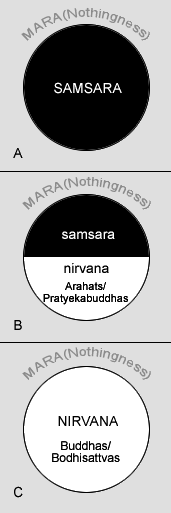
imho
/\ -
Nirvana is Samsara; not 2 not one.
Verse Seven
While the ignorant imagine that annihilation pertains to a created thing that is dissolved, the wise are convinced that annihilation of something created is an illusion.
(Nirvana is not about eliminating something. Nothing really exist, so nothing can really be annihilated. The causes of our suffering do not really exist, so how could they be real eliminated. It is just a matter of directly seeing their real nature.)
There is no real cessation (Liberation) because nothing is really existing in the first place
Your picture suggests that Nirvana replaces Samsara and people become Buddhas.
How can something that is non existing, Samsara, become existing and how can non existing people become existing Buddhas? -
simply because u took words for words, and misunderstood "non existence" (aka sunyata) to be literal? would help if u apply the 3 factors to understand sunyata.
u can try poking a needle on ur hand or something, see if u think u are "non existence"? wat happen to ur science?
"Nirvana is Samsara; not 2 not one" ....mean they both are within the same 'mental' dimension. therefore Nirvana and Samsara is more regarding on one's state of mind, rather than a 'place'. the Buddha who had purified His mind dwell in nirvana while those who are still defiled, dwell in samsara..even when they are at the same space/location. get it?
/\ -
well i hav been trying to point out his problem from the startOriginally posted by sinweiy:simply because u took words for words, and misunderstood "non existence" (aka sunyata) to be literal? would help if u apply the 3 factors to understand sunyata.
u can try poking a needle on ur hand or something, see if u think u are "non existence"? wat happen to ur science?
"Nirvana is Samsara; not 2 not one" ....mean they both are within the same 'mental' dimension. therefore Nirvana and Samsara is more regarding on one's state of mind, rather than a 'place'. the Buddha who had purified His mind dwell in nirvana while those who are still defiled, dwell in samsara..even when they are at the same space/location. get it?
/\
-
that's why it's not 2 not one, as one cannot say it's totally one or totally two. one need to be more specific per se.
"Nirvana is Samsara; not 2 not one" ....mean they both are within the same 'mental' dimension. therefore Nirvana and Samsara is more regarding on one's state of mind, rather than a 'place'. the Buddha who had purified His mind dwell in nirvana while those who are still defiled, dwell in samsara..even when they are at the same space/location. get it?
MOreover, NargarjunaÂ’s ARguement were directed to the hinayana buddhists who thought nirvana is seperated from samsara(diag B) . It's not directed to normal people who don't even know the basic Doctrine.
diag C mean:
"When one realised one's True self/mind/buddhanature, then all sentient beings are Buddhas. But if one lose one's True self/mind/buddhanature, then all Buddhas are sentient beings." - Huineng
They see even "bad" people to be also part of an overall display/act to enlighten/teach the deluded people per se.
/\ -
I can easily explain it to you. I think questioning you is still best. Please read the 60 verses before you answer.Originally posted by sinweiy:simply because u took words for words, and misunderstood "non existence" (aka sunyata) to be literal? would help if u apply the 3 factors to understand sunyata.
u can try poking a needle on ur hand or something, see if u think u are "non existence"? wat happen to ur science?
"Nirvana is Samsara; not 2 not one" ....mean they both are within the same 'mental' dimension. therefore Nirvana and Samsara is more regarding on one's state of mind, rather than a 'place'. the Buddha who had purified His mind dwell in nirvana while those who are still defiled, dwell in samsara..even when they are at the same space/location. get it?
/\
Yes, if you poke yourself, you feel pain, but
1. can you be broken to pieces (are you made up of something else? Made up of smaller parts?)
2. Is your existence conditional? (Will you cease to exists when the conditions are removed?)
If you are made up of smaller pieces and your existence is conditional, can you say that you exists even though you feel pain when you poke yourself with a needle? -
Page 142 & 143, 'Buddhism Plain & Simple''Nagarjuna, the brilliant Buddhist philosopher of second-century India, wrote,
Those who do not understand the distinction between [the] two truths do not understand the profound truth embodied in the Buddha's message.
These two truths are relative truth and Absolute Truth.
Relative truths are the day-to-day things and thoughts we can easily discuss, teach, sell and conceptualise. These include simple facts - a foot is twelve inches, oranges contain vitamin C, Mount McKinley is in North America. But feet, inches, oranges, rocks, birds, feelings and thoughts, are themselves also relative truths. Each one depends on a vast multiplicity of other things, other concepts, other relative truths for its existence - an existence which is, of course, one hundred percent conceptual.
Relative truths are the concepts we use to get an easy handle on the world. They help us in our everyday lives with a huge variety of practical matters. But the more closely we look at them, the less Real they show themselves to be.
Nevertheless, relative truths aren't to be avoided. They're not necessarily evil, or harmful, or wrong. Indeed, they're essential. In order to get through the day, we need to know things - telephone numbers, store hours, potatoes, growing seasons, fractions, love, speed limits, how to fasten shoes. We run into trouble when we forget that all these things, thoughts, and feelings. When we refer to "this book,” that is a relative truth. And we've already seen that the more closely we examine what "the book" is, the more we can't pin it down, and the more the "truth" of it dissipates like a morning mist after sunrise.
Relative truths are why we fight wars, why we fear people who aren't like us, and why we debate the abortion question but comes no closer to a resolution of it.
Ultimate Truth, on the other hand, is direct perception. And what is directly perceived (as opposed to conceive) is that no separate, individualised things exist as such. There's nothing to be experienced but this seamless, thoroughgoing relativity and flux.
In other words, there are no particulars, but only thus.Ultimate Truth can't be conceptualised or imagined. You cannot hold Ultimate Truth in your mind at all. You can only see it. You just can't hold It as an idea.
Ultimate Truth appears the same to all who see. It can't be countered or doubted or discounted because it is immediate, direct experience itself. It's not other-dependent. It has no "other." What's ultimately True can't be held in opposition to something else.
We can actually see this. We can (and, in fact, we do) see for ourselves, right now, Ultimate Truth, and Reality. Our only problem is that we ignore what we see. -
Ok, I decided to share more. Continued from page 143:
Ignorance is not the inability to see, but the act of ignoring what is really going on in favour of what we imagine. The nature of ignorance is like this. Consider a concave line like the one on the next page.
At this point you probably think of the line on the next page as concave because that's how I identified it - and, perhaps, because of the way it's oriented on the page. But there's nothing inherently concave about it. It could just as easily be considered convex. Just turn the book upside down. Indeed, if you draw a single concave line, you've also drawn a convex one.
[image of a concave line]
Our state of ignorance is analogous to noting only the concave and not taking into account the convex. We forget - or ignore - the fact that whenever we come up with any concept at all, we simultaneously create one or more opposite concepts. Each relative truth engenders other opposite relative truths. And if we take the opposing concepts for reality, they will inevitably cause misery.
Consider this well-known Zen story.
A monk as Tung Shan, "When cold and heat come upon us, how can we avoid them?"
Shan said, "Why don't you go to where there is no cold or heat?"
The monk said, "Where is there no cold or heat?"
Shan said, "When cold, let cold kill you; when hot, let hot kill you."
If you draw the one, you've drawn the other. If you feel one, you feel the other, If you identify one, you've identified the other - and the world "out there" in relation to it.
Reality, of course, is neither concave nor convex, neither cold nor hot, neither self nor other. If we conceive cold apart from the rest of Reality - not only apart from heat, but apart from ourselves as well - we suffer from it.
We ignore Wholeness because we're so fixed on our object - the thing we've drawn, the thing we feel, the thing we've identified. But we ignore the fact that whatever our object is not is present as well. By splitting Reality into parts, and then focusing on the single part, we've tuned out the Whole. We've set ourselves up for confusion and despair.
---------
page 145
When buddhas look at the world, they don't see solidity. They don't see selves. They see only flux.
This is not to say that the awakened no longer see forms like the rest of us. They do. But they see forms - or, rather, "formness" - as illusory. They see that all things arise together. They see that the apparent existence of anything is dependant on all that it is not. And they see this dependence as nothing other than change and motion themselves.
The Buddha called this phenomena dependant arising. Dependant arising is the formula, "When this arise, that becomes." When the days lengthen, spring flowers bloom. When days shorten, autumn colours appear and leaves fall from the trees. Spring flowers are inseparable from lengthening days; autumn colours are inseparable from days of less and less light. Indeed, spring flowers are the longer days; fall colours are the shorter days. In reality, all phenomena work together as a seamless whole.
Dependent arising is not vague, mystical, remote, intellectual stuff. The Buddha-dharma is very practical and down-to-earth. Just pay very close attention to your actual experience, and you'll see it for yourself.
----
page 147:
Our chronic problem has to do with intention. Because we ignore the Whole, we're taken in by the parts. We're seduced by the objects of our consciousness - our concepts - and, with longing and loathing, greed and anger, our minds start to lean toward and away. This is duhkha.
There's a way out of this dilemma. It's simply to watch your own mind, and know when it's leaning.
Earlier we visualised a leaf falling from a tree. We "saw" it land within a pattern of leaves upon the ground. While it's a pattern we cannot replicate by a simple act of will, nature has no trouble producing random patterns at all. What controls the placement of leaves in an utterly random way, yielding a pattern that is so strikingly beautiful? The Whole, of course.
We can't know all the details of the Whole. For example, if we knew everything about the weather system on this planet, we would be able to accurately predict the weather over an extended period. But to do this we would have to know every little detail, right down to the positions and movements of each atom - and, of course, we can't do that. Natural systems, like our planet's weather, are and will always be under the control of the intentionless Whole.
but while we can't know the details of the Whole, the fact that we - each one of us - already know the Whole itself. There's nothing mysterious about Reality - thus - at all. It is ever-present, clear, and obvious. Rather than trying to figure something out, trying to see, or trying to reunite with the Whole, all we have to do is to notice whether our mind is leaning or not.
When you notice that your mind is caught up in longing and loathing - leaning toward or away from something - don't try to stop it from leaning. As we've seen, trying to make a leaning mind stop leaning is just another form of leaning. ("I really want to not have a leaning mind." ) Just be aware when your mind is leaning, and realise what leaning of mind actually is. With practice and attention to this moment. your mind will, of its own accord, lean less.
As a leaf lands in the yard, so your mind will straighten up in a most natural way, and accord with Mind Itself - that is, the Whole. -
Regarding Nirvana - page 46:
Some people think the teaching of the awakened is nihilistic, as if it asserts a kind of nothingness. As if, somehow, nirvana is lapsing into a tranquil oblivion, a floating grayness, drifting in a shoreless sea. That is not nirvana.
Recall that everything we see, hear, feel, and think is constant flux and change. Nothing endures. We long for permanence and as a result we suffer, we find none. There seems to be only this coming and going, coming and going, this unending arising and ceasing.
We experience everything as motion. Indeed, physicists tell us that matter is literally nothing but motion. And no matter how we look at it, at any scale, our experience is always of motion, of change. This is true of everything in the physical world, including our bodies. Every cell - indeed, every atom of every cell - reveals nothing but ceaseless coming and going. Our bodies are re-made moment by moment, and in no two moments are they the same.
The same is true of our minds. The contents of our minds are in constant motion as well. Thoughts, feelings, judgements, and impulses arise, one after another, then bloom and fade away like flowers after their season.
Nirvana is seeing, thoroughly and completely, that this is so. -
What you have quoted only goes further in explaining the 60 verses. It does not tell us anything new. You too are in samsara; you too are "relative;" you too are only "motion;" so what if you can see all that? What remains? Realising THUS you become inherently existing? Seeing THUS you are no longer "relative?" Seeing THUS your existence is no longer "conditional?" What is REAL?
-
When we realise the emptiness nature, it is unconditioned, because all dharmas (phenomena) are empty, therefore no origination nor cessation, no birth and no death. Isn't that unconditioned?
So the nature of the conditioned is unconditioned emptiness. And even emptiness is empty so it must not be captured as merely a conceptual view. Emptiness only points, it tells you that the four extremes are illusory.
The "problem" lies in whether one sees it. -
After you see it? What that is real remains? According to the 60 verses, nothing is real or nothing that is real is discussed. Only that everything is empty of inherent existence... so what is real? What remains after you realised that all including yourself is "motion?"
-
When we say 'Empty', it does not mean that phenomenal world is empty and there is an opposite, an inherently existence essence that is not affected by the phenomenal world, some sort of 'Amness' that is inherently existent. Or Spirit. Or Mind. Even that is Empty by nature. That is why Thusness says, those who have certain experiences of 'Amness' have even greater difficulty to comprehend Emptiness because of a subtle attachment to their experience as truly inherently existent. We talk about 'Buddha Nature' as 'Luminosity and Emptiness inseperable'. So even Buddha Nature is empty by nature. ALL is Buddha Nature, all is Empty and Luminous.
This is what sets Buddhism different compared to other contemplative traditions.