Knowing the 'Genuine' Buddhism
-
In our world today, there are at least four different types of Buddhism.
The first type is the authentic Buddhism, the education of understanding the true face of life and the universe originally intended by Shakyamuni Buddha. Unfortunately, the authentic Buddha's education is rare nowadays, and difficult to encounter.
The second type of Buddhism is the religious Buddhism. Originally, Buddhism was not a religion, but now it has become one. We can no longer deny that there is a 'Buddhist religion' because everywhere we look, Buddhism is displayed as a religion. Unlike the monasteries in the past which held eight-hour classes per day and provided another eight hours for self-cultivation, today's Buddhist 'temples' no longer uphold such a perseverance of the Buddha's Teachings. Today we mainly see people offering to the Buddha statues and praying for blessings and fortune. In this way, Buddhism has been wrongly changed into a religion. (However time has changed many have buck up and start to spread dharma)
The third type of Buddhism is the philosophical study of the Buddha's teachings. Many universities today open courses on the study of Buddhist Sutras, considering the teachings as a philosophy. The content of the Buddha's education is actually a complete university of knowledge and wisdom. Philosophy is only one of its courses. Just as it is wrong to recognize an university as a single course, it is also inappropriate to think of and limit the Buddha's education as only a philosophy. The Buddha's education can help us resolve our problems - from family difficulties to the great issue of life and death. The Buddha's teachings are deep and vast, and teach us the truths of life and the universe. It should not be mistaken as only a philosophy.
The fourth type of Buddhism we see in our world today is the deviant and externalist Buddhism. This is an extremely unfortunate affair which only came to be in the past 30-40 years. We must know that the religious Buddhism persuades people to be decent, and the philosophical Buddhism pursues truth, neither cause much harm to the society. If Buddhism is changed into a deviant and externalist path, using the weakness of the human nature to cheat and harm living beings; disturbing the peace and safety of the society, then this conversion of Buddhism has gone too far. The speech and actions of these deviant and externalist paths can be very attractive and enticing. One should be very careful as not to be mislead by these deviant ways, or regretting it would be too late.
These four types of Buddhism exist in our society today, we should recognize them as they are and think carefully as to which way is most beneficial to us, and the one we will ultimately follow.
Latest development of Buddhism ...
Buddhism is gaining wide appeal across the globe. The large international membership of the World Buddhist Sangha Council is clear evidence. There are a growing number of internet sites that offer information about Buddhism. Many companies produce music, videos, and multi-media educational material on Buddhism. Buddhism has even influenced pop culture and permeated into the psyche of the masses. In Singapore too, Buddhism has not only retained its relevance, but is gaining popularly. Between 1990 and 2000, the percentage of Singaporeans above 15 years old who are Buddhists increased from 31% to 43%, the largest increase amongst all major religions. Dharma talks in Singapore are now also conducted in English, to reach out to young Singaporeans, including professionals. Devotees today do not just visit the temples to pray. They are eager to delve deeper into the Buddhist scriptures and reflect upon their philosophical and spiritual significance
http://www.4ui.com/eart/165eart2.htm -
i think buddishm as a form of study holds more weight then anything else
to practice you must understand
to understand you must probe and question first
to be able to probe and question you must explore widely
to explore widely will means you will treat it as academicaly as a subject
unless you are the few blessed ones thats born, and needs no studys to be able to understand profound buddism concepts and reach wonderful stages of enlightment like the 6th zen patriatch Hui nen who was illterate.
otherwise all must treat buddishm as study 1st before you are able to practice.
ornitofu. -
Originally posted by neutral_onliner:
Ok i found it, it is in here.
In our world today, there are at least four different types of Buddhism.
The fourth type of Buddhism we see in our world today is the deviant and externalist Buddhism. This is an extremely unfortunate affair which only came to be in the past 30-40 years. We must know that the religious Buddhism persuades people to be decent, and the philosophical Buddhism pursues truth, neither cause much harm to the society. If Buddhism is changed into a deviant and externalist path, using the weakness of the human nature to cheat and harm living beings; disturbing the peace and safety of the society, then this conversion of Buddhism has gone too far. The speech and actions of these deviant and externalist paths can be very attractive and enticing. One should be very careful as not to be mislead by these deviant ways, or regretting it would be too late.
So you are reminding everyone to beware of False propagation of Buddhism that is going on under Buddha name that cheat amnd harm living being.
These people are deviant & unscrupulous making False speech externally under Buddha name in bid to attract and entice people to them?
I am shocked.
-
are you shocked by own free will or by what others stated?Originally posted by White_Wolf_Thunder:Ok i found it, it is in here.
So you are reminding everyone to beware of False propagation of Buddhism that is going on under Buddha name that cheat amnd harm living being.
These people are deviant & unscrupulous making False speech externally under Buddha name in bid to attract and entice people to them?
I am shocked. -
I am shocked by these detailed informations i just learn about in here.Originally posted by paperflower:are you shocked by own free will or by what others stated? -
well said killstyle and neutral_onliner too.
May those who haven't enter the dharma door enter soon, those who already entered the dharma door start practising it. -
Let's just be fair here. This problem is not unique to Buddhism, it happenened to the other faiths too.Originally posted by White_Wolf_Thunder:Ok i found it, it is in here.
So you are reminding everyone to beware of False propagation of Buddhism that is going on under Buddha name that cheat amnd harm living being.
These people are deviant & unscrupulous making False speech externally under Buddha name in bid to attract and entice people to them?
I am shocked.
This is why as practising Buddhist, we must use our wisdom to learn and investigate with wisdom, not just believe in what we hear, and this is what Buddha preached.
If you are shock by this, probably means that you've never met the world before. This is Samsara, and everything is possible. -
You need to experience it

-
that guy is easily shocked.
-
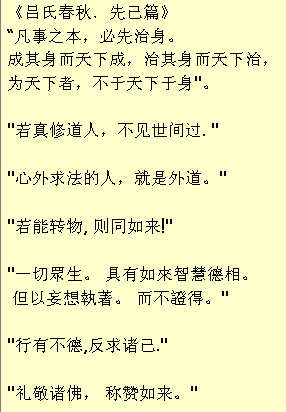
statement 3.
Buddha went straight to the Point, "unorthodox is when one seek the dharma(Truth) Outside the mind."
/\ -
In India, during Buddha time the followers of many orthodox religious groups tried to condemn the Buddha because of his liberal teachings which revolutionised the Indian society. Many regarded him as an enemy when increasing numbers of intellectuals as well as people from all ranks of society took up the religion. When they failed in their attempt to destroy him, they adopted the reverse strategy of introducing him as a reincarnation of one of their gods. This way they could absorb Buddhism into their religion.
Even today there are certain religionists who try to absorb the Buddha into their beliefs as a way of gaining converts among Buddhists. Their basis for doing so is by claiming that the Buddha himself had predicted that another Buddha would appear in this world, and that the latest Buddha will become even more popular. These groups of people advised Buddhists to give up their old Buddha and follow the so-called new Buddha. While it is good to see them giving the Buddha the same status as their own religious teachers, we feel that these attempts to absorb Buddhists into another faith by misrepresenting the truth are in extreme bad taste.
Those who claim that the new Buddha had already arrived are obviously misrepresenting what the Buddha had said. Although the Buddha predicted the coming of the next Buddha, he mentioned some conditions which had to be met before this can be possible. It is the nature of Buddhahood that the next Buddha will not appear as long as the dispensation of the current Buddha still exists. -
Merry Meet To All,
Thanks for sharing. Well "Genuine" Buddhism is not only through speech but its part of your daily live. Nothing on this Earthly plane is unknown or extraordinary as Great Wisdom is Boundless & Limitless! Theravada/Hinayana or Mahayana traditions are not important as they are all the same! There is no caste system in Buddhism so there is no we or others as all are followers of the Noble Truths & Disciples of Buddha, all are sentient beings are the same. Buddha is in our Heart & it does not matter what Forms "He" chose to emanate as a common feature of all Buddhist is the quest for true happiness and peace for all beings. However One must not misuse or abuse his name for personal gain or other selfish purposes.
The "Five Moral Precepts" which is one of the core belief of Buddhism incorporate them in your Daily lives.
Five Moral Precepts:
1. Abstain from killing.
2. Taking what has not been given.
3. Sexual misconduct.
4. False speech
5. Intoxicants that cloud the mind.
No point if your words & actions are incoherent. Don't you reckon that? Anyway that is only my personal perspective of it.
Blessed Be,
Oceanos -
[quote]Originally posted by OCEANOS:
[b][b]Merry Meet To All,
Thanks for sharing. Well "Genuine" Buddhism is not only through speech but its part of your daily live. Nothing on this Earthly plane is unknown or extraordinary as Great Wisdom is Boundless & Limitless! Theravada/Hinayana or Mahayana traditions are not important as they are all the same! There is no caste system in Buddhism so there is no we or others as all are followers of the Noble Truths & Disciples of Buddha, all are sentient beings are the same. Buddha is in our Heart & it does not matter what Forms "He" chose to emanate as a common feature of all Buddhist is the quest for true happiness and peace for all beings. [color=red]However One must not misuse or abuse his name for personal gain or other selfish purposes.
The "Five Moral Precepts" which is one of the core belief of Buddhism incorporate them in your Daily lives.
Five Moral Precepts:
1. Abstain from killing.
2. Taking what has not been given.
3. Sexual misconduct.
4. False speech
5. Intoxicants that cloud the mind.
No point if your words & actions are incoherent. Don't you reckon that? Anyway that is only my personal perspective of it.
Blessed Be,
Oceanos
you are not fit to talk about buddishm oceanos, someone of your character and motive will stain the buddha's teaching. -
Anything personal, pls use PM function. Thanks.
-
he and his 'witchcraft' he meant to profit from it. and here in sgforums.
teaching people the wrong things is a matter.
earning money in the process of doing so is another matter. -
Witchcraft is not part of Buddhism, and although as a Buddhist I do not recommend people to be into that, it is ultimately a personal choice (whether just practising or profiteering).Originally posted by killstyle:he and his 'witchcraft' he meant to profit from it. and here in sgforums.
teaching people the wrong things is a matter.
earning money in the process of doing so is another matter.
Anyway... anyone is free to post here to share dharma, whatever he practises. As long as he does not promote his practises in this forum or promote it under the name of Buddhism, I am fine with that. -
do not mislead others further for the sake of your own gains and profits oceanos. utimately you will answer for your own deeds. one way or another .
you are alreadly so old 1969. you are pathetic in that you need a young boy to tell you whats right and wrong. -
Pls, if this is a personal thing, use the PM function.
-
nothing personal. MLM is a scam right? agree? so we bash MLM here in the forums openly.Originally posted by An Eternal Now:Pls, if this is a personal thing, use the PM function.
same thing, i dont like that con-job, so i bash that piece of con-job, openly
i dont see the need for any PM as i got nothing to hide -
I do not think that there is an outright 'right or wrong' answer for these practises. Everyone should decide for themselves. For me, my Buddhist teachers and I are against such practises - that is the furthest I can comment, but I do not think we have the right to criticise others if they do not promote those practises under the name of Buddhism or in this Buddhist forum.Originally posted by killstyle:nothing personal. u hate MLM right? so we bash MLM here in the forums openly.
same thing, i dont like con-jobs, so i bash that piece of con-job, openly
i dont see the need for any PM as i got nothing to hide
Similarly, if you do not agree with Religion X (for example), you have the right to disagree and not practise it but you should not go overboard, we must have tolerance. We have freedom of religion and spirituality.
And even if you hate MLM, not everyone hates MLM. So what if you hate MLM? Anyway MLM is NOT a religion or a spiritual practise and therefore not protected under Religious Laws in Singapore - you can bash all you want without getting into trouble with the Law. When we come to things like Religion or Spirituality, it is very sensitive, we have to show restrains in our speech. Furthermore, this is not MLM forum. If you argue about MLM here, it will be considered off-topic and the topic will be closed. -
im not talking about MLM here. im talking about some scam jobs being carry out in the name of religion. you read

people come sgforums to disscuss topics and make friends ok. not to make money (out of religion somemore). oceanos is a very good example i just highlighted. he makes money by teaching people the wrong things -
I do not think that Oceanos carry out anything under the name of a religion, or Buddhism, what he practce belongs to 'pagan'/'new age'/'witchcraft'. Therefore it is inappropriate to comment it here - in a Buddhist forum. And whether it is scam job, I would say no, there are such practises.Originally posted by killstyle:im not talking about MLM here. im talking about some scam jobs being carry out in the name of religion. you read
people come sgforums to disscuss topics and make friends ok. not to make money (out of religion somemore). oceanos is a very good example i just highlighted. he makes money by teaching people the wrong things
And whether what others teaches is right or wrong, you can only agree or disagree, but you cannot criticise them. If you think 'Religion X' is teaching the wrong things, so be it, but do not go overboard because this is Singapore. -
bravo. in that case then. theres nothing more i will say to a friend of the con man.
-
Again, that is showing that your prejudiced views against some people or some spiritual practise. For example, you do not believe in Christianity, will you say that Jesus is a con man? I do not think you have the right to make such comments on others and their practises.Originally posted by killstyle:bravo. in that case then. theres nothing more i will say to a friend of the con man.
I will never say that anyone is a con man. If he is really a con man, then he would already have been punished under law.
But what you are saying here, could land yourself in trouble under law. -
christiany, islam, hidisim and buddishm the 4 mainstream religion i respect.
not some witchcraft crap which some conjobs teach others so as to make money.
as i said
teaching wrong things is a matter
making money in the process is another matter.
u care to think properly 1st before u defend that con friend of yours