Connection between science and Buddhism
-
Distinguished teacher Jeremy Hayward to speak about connection between science and Buddhism
By KELLI LACKETT, The Coloradoan, Jan 14, 2007
Fort Collins, CO (USA) -- There has been a great interest in recent years in the relationship between Buddhism and science. In 2005, the science of meditation was the subject of a Time magazine cover story.
Jeremy Hayward
A prominent Buddhist teacher will visit Fort Collins next week to talk about how and where science and Buddhism meet.
Jeremy Hayward is a senior teacher in the Shambhala tradition of Buddhism. Trained as a nuclear physicist and molecular biologist, Hayward - who helped found Boulder's Naropa University in 1974 - has written three books on science and Buddhism.
"Consciousness is the leading edge of science," Hayward said in a phone interview from Nova Scotia, where he teaches.
"Science has always looked at things from the third person point of view and tried to eliminate the subject of the experience," Hayward said. "Buddhism has dealt with the subject. What is the nature of the mind? It has developed techniques for examining that free from bias.
"The merging point of the outside and inside is perception. This 'I' perceives the object. How does this perception work? How does it perceive the outer world?" Hayward said. "Buddhism has a lot to say about perception."
In an event hosted by the Fort Collins Shambhala Meditation Center in conjunction with the Geller Center for Spiritual development at Colorado State University, Hayward will deliver a free public talk at 7 p.m. Thursday at CSU's Lory Student Center, Rooms 213 and 215. Another public talk about meditation as tool for mindfulness will be held at 7 p.m. Jan. 23 at the Armstrong Hotel, 259 S. College Ave. Hayward also will lead two daylong workshops on Jan. 20 and 21.
Hayward has long been part of the conversation between scientists and Buddhist teachers. He took part in the first dialogue with the Dalai Lama on science and Buddhism in 1987 in Dharamsala, India, and co-edited the proceedings in "Gentle Bridges; Conversations with the Dalai Lama on the Sciences of Mind."
"Of all the people I've ever met, (the Dalai Lama) is the most clear embodiment of incredible sharp intellect and deep compassion and friendliness," Hayward said. "He has contributed to and nourished the dialogue."
Hayward said that Buddhism itself is a science - a science of the mind.
"It's not a religion really," he said. "With Buddhism, you start with your experience. That is why scientists have a great deal to talk about when it comes to Buddhism." -
Buddhism, the only real science
by Ajahn Brahmavamso Mahathera, Lanka Daily News, March 28, 2007
Perth, Australia -- I used to be a scientist. I did Theoretical Physics at Cambridge University, hanging out in the same building as the later-to-be-famous Professor Stephen Hawking. I became disillusioned with such science when, as an insider, I saw how dogmatic some scientists could be. A dogma, according to the dictionary, is an arrogant declaration of an opinion.
Venerable Ajahn Brahmavamso Mahathera was born Peter Betts in London, United Kingdom on August 7, 1951. He is the chief prelate of Bodhinyana Monastery in Western Australia, the Spiritual Director of the Buddhist Society of Western Australia, Spiritual Adviser to the Buddhist Society of Victoria, Spiritual Adviser to the Buddhist Society of South Australia, Spiritual Patron of the Buddhist Fellowship in Singapore, and Spiritual Patron of the Bodhikusuma Centre in Sydney.
This was a fitting description of the science that I saw in the labs of Cambridge. Science had lost its sense of humility. Egotistical opinion prevailed over the impartial search for Truth. My favourite aphorism from that time was: "The eminence of a great scientist, is measured by the length of time that they OBSTRUCT PROGRESS in their field"!
To understand real science, one can go back to one of its founding fathers, the English philosopher Francis Bacon (1561 - 1628 ). He established the framework on which science was to progress, namely "the greater force of the negative instance".
This meant that, having proposed a theory to explain some natural phenomenon, then one should try one's best to disprove it! One should test the theory with challenging experiments. One must put it on trial with rigorous argument.
When a flaw appears in the theory, only then does science advance. A new discovery has been made enabling the theory to be adjusted and refined. This fundamental and original methodology of science understood that it is impossible to prove anything with absolute certainty. One can only disprove with absolute certainty.
For example, how can one prove the basic law of gravity that "what goes up comes down, eventually"? One may throw objects up one million times and see them fall one million times. But that still does not prove "what goes up comes down".
For NASA might then 'throw' a Saturn rocket up into space to explore Mars, and that never comes down to earth again. One negative instance is enough to disprove the theory with absolute certainty.
Some misguided scientists maintain the theory that there is no rebirth, that this stream of consciousness is incapable of returning to a successive human existence. All one needs to disprove this theory, according to science, is to find one instance of rebirth, just one!
Professor Ian Stevenson, as some of you would know, has already demonstrated many instances of rebirth. The theory of no rebirth has been disproved. Rebirth is now a scientific fact!
Modern science gives a low priority to any efforts to disprove its pet theories. There is too much vested interest in power, prestige and research grants. A courageous commitment to truth takes too many scientists out of their comfort zone.
Scientists are, for the most part, brainwashed by their education and their in-group conferences to see the world in a very narrow, microscopic, way. The very worst scientists are those who behave like eccentric evangelists, claiming that they alone have the whole truth, and then demanding the right to impose their views on everyone else.
Ordinary people know so little about science that they can hardly even understand the jargon.
Yet, if they read in a newspaper or magazine "a scientist says that?", then they automatically take it to be true. Compare this to our reaction when we read in the same journal "a politician says that?"! Why do scientists have such unchallenged credibility?
Perhaps it is because the language and ritual of science has become so far removed from the common people, that scientists have become today's revered and mystical priesthood.
Dressed in their ceremonial white lab coats, chanting incomprehensible mumbo jumbo about multi-dimensional fractal parallel universes, and performing magical rituals that transubstantiate metal and plastic into TVs and computers, these modern day alchemists are so awesome we'll believe anything they say. Elitist science, as once was the Pope, is now infallible.
Some know better. Much of what I learnt 30 years ago has now been proved wrong. There are, fortunately, many scientists with integrity and humility who affirm that science is, at best, a work still in progress.
They know that science can only suggest a truth, but can never claim a truth. I was once told by a Buddhist G.P. that, on his first day at a medical school in Sydney, the famous Professor, head of the Medical School, began his welcoming address by stating "Half of what we are going to teach you in the next few years is wrong. Our problem is that we do not know which half it is!" Those were the words of a real scientist.
Some evangelical scientists would do well to reflect on the (amended) old saying "Scientists rush in where angels fear to tread" and stop pontificating about the nature of the mind, happiness and even Nirvana. Neurologists are especially prone to such neuroses (Neurosis: an undue adherence to unrealistic ideas of things).
They are claiming that the mind, awareness and will, is now adequately explained by activity in the brain. This theory was disproved over 20 years ago by Prof. Lorber's discovery of the student at Sheffield University with an IQ of 126, a First Class degree in mathematics, but with virtually no brain (Science, Vol. 210, 12 Dec 1980)!
More recently, it was disproved by Prof. Pim Van Lommel, who demonstrated the existence of consciousness activity after clinical death, i.e. when all brain activity has ceased (Lancet, Vol. 358, 15 December 2001, p 2039).
Although there may be correlation between a measurable activity in part of the brain and a mental impression, such co-occurrence doesn't always imply that one is the cause of the other. For instance, some years ago, research showed a clear correlation between cigarette smoking and the non-occurrence of Alzheimer's disease.
It was not that smoking cigarettes somehow caused immunity from Alzheimer's, as much as the tobacco companies might have wished, it was only that many smokers did not live long enough to get Alzheimer's disease!
Thus a co-incidence of two phenomena, even when repeated, does not mean that one phenomenon is the cause of the other. To claim that activity in the brain causes awareness, or mind, is plainly unscientific.
Buddhism is more scientific than modern science. Like science, Buddhism is based on verifiable cause-and-effect relationships. But unlike science, Buddhism challenges with thoroughness every belief.
The famous Kalama Sutta of Buddhism states that one cannot believe fully in "what one is taught, tradition, hearsay, scripture, logic, inference, appearance, agreement with established opinion, the seeming competence of a teacher, or even in one's own teacher".
How many scientists are as rigorous in their thinking as this? Buddhism challenges everything, including logic.
It is worth noting that Quantum Theory appeared quite illogical, even to such great scientists as Einstein, when it was first proposed. It is yet to be disproved. Logic is only as reliable as the assumptions on which it is based. Buddhism trusts only clear and objective experience.
Clear experience occurs when one's measuring instruments, one's senses, are bright and undisturbed. In Buddhism, this happens when the hindrances of sloth-and-torpor and restlessness-and-remorse are both overcome. Objective experience is that which is free from all bias.
In Buddhism, the three types of bias are desire, ill will and sceptical doubt. Desire makes one see only what one wants to see, it bends the truth to fit one's preferences. Ill will makes one blind to whatever is disturbing or disconcerting to one's views and it distorts the truth by denial.
Sceptical doubt stubbornly refuses to accept those truths, like rebirth, that are plainly valid but which fall outside of one's comforting worldview.
pg1 -
In summary, clear and objective experience only happens when the Buddhist 'Five Hindrances' have been overcome. Only then can one trust the data arriving through one's senses.
Because scientists are not free of these five hindrances, they are rarely clear and objective. It is common, for example, for scientists to ignore annoying data, which do not fit their cherished theories, or else confine such evidence to oblivion by filing it away as an 'anomaly'.
Even most Buddhists aren't clear and objective. One has to have recent experience of Jhana to effectively put aside these five hindrances (according to the Nalakapana Sutta , Majjhima No. 6 . So only accomplished meditators can claim to be real scientists, that is, clear and objective.
Science claims to rely not only on clear and objective observation, but also on measurement. But what is measurement in science? To measure something, according to the pure science of Quantum Theory, is to collapse the Schroedinger Wave Equation through an act of observation.
Moreover, the "un-collapsed" form of the Schroedinger Wave Equation, that is before any measurement is made, is, perhaps, science's most perfect description of the world.
That description is weird! Reality, according to pure science, does not consist of well-ordered matter with precise massed, energies and positions in space, all just waiting to be measured. Reality is the broadest of smudges of all possibilities, only some being more probable than others.
Even basic 'measurable' qualities as 'alive' or 'dead' have been demonstrated by science to be invalid sometimes. In the notorious 'Schroedinger's Cat' thought experiment, Prof. Schroedinger's cat was ingeniously placed in a real situation where it was neither dead nor alive, where such measurements became meaningless. Reality, according to Quantum Theory, is beyond measurements. Measuring disturbs reality, it never describes it perfectly.
It was Heisenberg's famous 'Uncertainty Principle' that showed the inevitable error between the real Quantum world and the measured world of pseudo-science.
Anyway, how can anyone measure the measurer, the mind? At a recent seminar on Science and Religion, at which I was a speaker, a Catholic in the audience bravely announced that whenever she looks through a telescope at the stars, she feels uncomfortable because her religion is threatened.
I commented that whenever a scientist looks the other way round through a telescope, to observe the one who is watching, then they feel uncomfortable because their science is threatened by what is doing the seeing! So what is doing the seeing, what is this mind that eludes modern science?
A Grade-One teacher once asked her class "What is the biggest thing in the world?" One little girl answered "My daddy". A little boy said "An elephant", since he'd recently been to the zoo. Another girl suggested "A mountain".
The six-year-old daughter of a close friend of mine replied, "My eye is the biggest thing in the world"! The class stopped. Even the teacher didn't understand her answer. So the little philosopher explained "Well, my eye can see her daddy, an elephant, and a mountain too. It can also see so much else. If all of that can fit into my eye, then my eye must be the biggest thing in the world." Brilliant!
However, she was not quite right. The mind can see everything that one's eye can see, and it can also imagine so much more. It can also hear, smell, taste and touch, as well as think. In fact, everything that can be known can fit into the mind. Therefore, the mind must be the biggest thing in the world. Science's mistake is obvious now. The mind is not in the brain, nor in the body. The brain, the body and the rest of the world, are in the mind!
Mind is the sixth sense in Buddhism, it is that which encompasses the five senses of sight, hearing, smell, taste and touch, and transcends them with its own domain. It corresponds loosely to Aristotle's "common sense" that is distinct from the five senses.
Indeed, ancient Greek philosophy, from where science is said to have its origins, taught six senses just like Buddhism. Somewhere along the historical journey of European thinking, they lost their mind! Or, as Aristotle would put it, they somehow discarded their "common sense"! And thus we got science. We got materialism without any heart. One can accurately say that Buddhism is science that has kept its heart, and which hasn't lost its mind!
Thus Buddhism is not a belief system. It is a science founded on objective observation, i.e. meditation, ever careful not to disturb the reality through imposing artificial measurements, and it is evidently repeatable.
People have been re-creating the experimental conditions, known as establishing the factors of the Noble Eightfold Path, for over twenty-six centuries now, much longer than science. And those renowned Professors of Meditation, the male and female Arahants, have all arrived at the same conclusion as the Buddha.
They verified the timeless Law of Dhamma, otherwise known as Buddhism. So Buddhism is the only real science, and I'm happy to say that I'm still a scientist at heart, only a much better scientist than I ever could have been at Cambridge.
Courtesy: Buddhist Society of Western Australia. -
omg....very cheem...i don understand and im a buddhist.


-
Hmm.. what is it that you do not understand?Originally posted by TYING:omg....very cheem...i don understand and im a buddhist. -
Those interested on the topic of Buddhism and Science may look into the thread: Buddhism and Science article
Look for concerned_man's posted article, the talk given by Ajahn Brahmavamso. It is very well said.
-
14th Mind and Life conference begins in Dharamsala
By Phurbu Thinley, Phayul, April 9, 2007
Dharamsala, India -- A team of 12 leading scientists, accompanied by other researchers, are once again in the Northern Indian town of Dharamsala, home to the exiled 14th Dalai Lama of Tibet, to engage in a deeply engrossing dialogue with him on mind and life. The dialogue meeting with the Dalai Lama, including other Buddhist contemplatives, which commenced at his residence hall this morning, will continue till April 13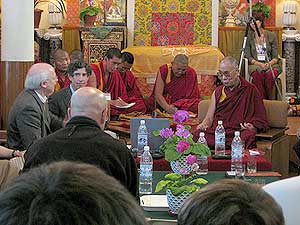
The conference titled, The Universe in a Single Atom kick-started with the inaugural talk by the Dalai Lama.
This is the 14th Mind and Life Meeting. The first meeting took place in 1987.
One of the primary pursuits of Mind and Life scientists is to study the effects of contemplative practices like meditation and mental training have on brain and behaviour.
The Mind and Life Dialogues were initially started to experiment whether a rigorous exchange could occur between leading modern scientists and the Dalai Lama. Series of regular successful experimental exchanges over the ensuing years lead to the formation of the Louisville based Mind and Life Institute (MLI).
The Dalai LamaÂ’s scientific autobiographical book, The Universe in a Single Atom: the Convergence of Science and Spirituality will be the central subject of dialogue on which the participating scientists will develop a deep and intimate dialogue with the Dalai Lama and other prominent Buddhist scholar-practitioners, including the Karmapa, who is also participating in the meeting.
In the book, the Tibetan spiritual and political leader in exile has highlighted intriguing issues he feels are most important in the “convergence of science and spirituality.” The issues and questions raised in the book will be the basis of the ongoing five-day long dialogue.
His Holiness, in his brief inaugural address, noted two impediments- political and scientific, which pose growing challenge against prevailing spirituality. While the former interference is of less concern for His Holiness, he spoke of adverse impact one-sided obsessive scientific approach is having on the essence of spirituality.
In addition to fundamental scientific questions; the dialogue meeting will deal with the larger philosophical, ethical and spiritual issues prompted by each field of science that need to be effectively addressed.
The MLI now has a number of scientific research programmes collaborated with contemplatives to conduct scientific investigation involving comprehensive strategy of the effects of the contemplative practices on brain, behaviour, and the translation of this data into effective tools to benefit people in all walks of life.
Of these, the Mind and Life Dialogues with the Dalai Lama is the foremost programme of the institute.
Hollywood Buddhist star, Richard Gere and, Robert Thurman, Buddhist scholar and author, and father of Hollywood actress, Uma Thurman, were among the other participants of the meeting drawing special attention of the onlookers.
Robert Thurman is co-founder and current President of Tibet House U.S., a cultural institution dedicated to preserving and promoting the wisdom and the arts of the distinctive and endangered Tibetan civilization.
The organisers noted that the study of the beneficial effects of contemplative practices on brain and behaviour is an emerging scientific investigation and claim that MLI is today a recognized world leader in this search.
For more on the Mind and Life Dialogues and, range of topics MLI has explored, visit www.mindandlife.org. -
I understand it's all about talking cock and singing song.

-
Mind power can affect moleculars in water so...maybe they want to find out more about the human brain from Buddhism
-
Originally posted by Herzog_Zwei:
Then that's probably because you can't even understand what they're talking about
I understand it's all about talking co[b]ck and singing song. [/b]
-
Buddhism - The New Prozac For scientists
Editor: The following article appeared in Sify News (AFP), USA, on 16 September 2003.
For Americans seeking to improve their health, the US surgeon general advises putting aside one hour, several times a week, for "compassionate " meditation and the elimination of destructive emotions. Actually, he doesn't. He prescribes 60 minutes of physical exercise. But noted molecular biologist Eric Lander, a leader of the Human Genome Project, believes the change is coming.
"It is certainly not inconceivable that 20 years from now, the US surgeon general might recommend 60 minutes of mental exercise five times a week," Lander told a conference of renowned scientists and Buddhist scholars at the prestigious Massachusetts Institute of Technology (MIT) this weekend.
Such a prediction from a man of Lander's stature at a venue like MIT is an indication of mainstream science's growing fascination with Buddhism, and especially with the preliminary but extraordinary results of state-of-the-art research into the Olympian mental athleticism of trained Buddhist monks.
Some of the data presented at the conference -attended by Tibet's spiritual leader the Dalai Lama, pointed not only to attention spans that would make an air-traffic controller weep with envy, but also meditation techniques that could actually "re-wire" the brain's neural pathways.
In the age of Prozac, the possible applications could leave mood-altering pills on the shelf.
Harvard-trained neuroscientist Richard Davidson showed brain-scan images of a monk who was able to push levels of activity in his left, prefrontal cortex - a part of the brain associated with positive emotions "off the chart" by using a technique known as compassion meditation.
In a different meditative state, the same monk could do what, until then, had been thought to be impossible and suppress the "startle reflex" - the involuntary response to a loud, sudden noise like a gunshot.
Paul Ekman, one of the world's most eminent experts on the science of emotion, described the monk's level of control as a "spectacular accomplishment. "
"We've never found anyone who can do that," Ekman said. "We don't have any idea of the anatomy that would allow him to suppress the startle reflex."
Another test showed advanced meditators to be capable of startlingly high speeds of cognition, correctly identifying the moods behind a series of facial expressions flashed onto a screen for just one-thirtieth of a second. They scored far higher than groups previously identified as the best performers, such as psychiatrists, customs officials and Secret Service agents.
Alan Wallace, a former monk and president of the Institute for the Interdisciplinary Study of Consciousness in Santa Barbara, believes Buddhist practices aimed at improving emotional and cognitive balance could be powerful tools, and not just in treating depression and mental illness.
"I see no reason why some of these techniques could not be introduced into the school system," Wallace said. "People will do better in education and a myriad of professions because they are happier, more balanced and more attentive,?he added. "It's a win-win situation. Not having that in the educational system is a disaster."
One obvious problem raised by several of the scientists at the conference was that the monks involved in the studies had honed their mental skills over the best part of a lifetime, putting in tens of thousands of hours of meditation.
"It's a wonderful achievement, but if it takes 15 years, it's not going to help most folks," said Daniel Gilbert, a professor of psychology at Harvard University. "I would be very surprised if there's a short-cut that could be developed; a sort of Buddhist pill that one could take and achieve all the same benefits," Gilbert said.
Another objection comes from those who believe there may be a price to pay in the Buddhist practice of reducing or eliminating negative or "afflictive" emotions, in favour of their positive counterparts. One argument suggests some of the emotions that fall in the negative camp - such as anger or fear, are important for survival and can have positive consequences. "Martin Luther King was an angry man and a lot of good things came from his anger," Gilbert said. "And evolutionary biologists have a word for animals that don't experience fear. It's called 'dinner'," he added. -
No, they are still unable to prove something that came from a culture instead of rigirous experimenting and proving.Originally posted by An Eternal Now:Then that's probably because you can't even understand what they're talking about -
Culture?! Obviously.. Buddhism is nothing about culture. Cultures changes, Buddhist truths remain. Buddhism in different places have so many different cultures and it is completely irrelevant (not important). Buddhism is universal among sentient beings. As long as there is human suffering and ignorance of the ultimate truth of reality, there is a need for Buddhism, for cultivating the dharma and attaining enlightenment.Originally posted by Herzog_Zwei:No, they are still unable to prove something that came from a culture instead of rigirous experimenting and proving.
Next, of course there is rigorous experimenting and proving -
Causes and Effects = Newton's Law
-
I hope I got the mental power to see wat's tonite TOTO lumber. I hope I got the Wisdom to understand why scientist r stupid.
-
-
Originally posted by T.Ryousuke:
URL: http://72.14.235.104/search?q=cache:fSW7xRmuBc0J:www.thubtenchodron.org/FAQ/index.html+thubten+clairvoyance&hl=en&ct=clnk&cd=1&gl=sg&client=firefox-a
I hope I got the mental power to see wat's tonite TOTO lumber.Can one develop clairvoyant powers through practicing Buddhism? Is this a worthwhile goal to pursue?
Yes, one can, but that isn't the principal goal of Dharma practice. Some people get very excited about the prospect of having clairvoyance. "Wait until I tell my friends about this! Everyone will think I'm special and will come to ask me for advice." What an egotistical motivation for wanting to be clairvoyant! If we still get angry and are unable to control what we say, think, and do, what use is running after clairvoyance? Desiring clairvoyant powers because we want to be famous and well-respected is not only a distraction to our practice, but antithetical to it. Becoming a kind and altruistic person benefits both ourselves and others much more.
Once a child asked me if I had clairvoyance. Could I bend a spoon through concentration? Could I stop a clock or walk through a wall? I told him no, and even if I could, what use would it be? Would that lessen the suffering in the world? In fact, the person whose spoon I ruined may suffer more! The point of our human existence isn't to build up our egos, but to develop a kind heart and a sense of universal responsibility working for world peace. Loving-kindness is the real miracle!
If one has a kind heart, then developing clairvoyant powers could be beneficial for others. However, sincere practitioners do not go around advertising their clairvoyance. In fact, most of them will deny they have such abilities and will be very humble. The Buddha warned against public displays of clairvoyance unless they were necessary to benefit others. Humble people are actually more impressive than boastful ones. Their serenity and respect for others shine through, and this gladdens our heart. People who have subdued pride, have loving-kindness toward others, and are developing their wisdom are people we can trust. Such people are working for the benefit of others, not for their own prestige and wealth.
~ Ven. Thubten ChodronI hope I got the Wisdom to understand why scientist r stupid.

Scientists are not stupid with the exception that some are very dogmatic and hold unto their old views though evidences may show that something is otherwise.
Whereas as Ajahn Brahmavamso said, Buddhism is about real science without dogmatism. -
Ignorance is bliss. Just because there is methodlogy in proving doesn't mean a religion is scientific. Just claiming that Buddhism is different from Hinduism doesn't mean that a religion is not connected culturally.Originally posted by An Eternal Now:Culture?! Obviously.. Buddhism is nothing about culture. Cultures changes, Buddhist truths remain. Buddhism in different places have so many different cultures and it is completely irrelevant (not important). Buddhism is universal among sentient beings. As long as there is human suffering and ignorance of the ultimate truth of reality, there is a need for Buddhism, for cultivating the dharma and attaining enlightenment.
Next, of course there is rigorous experimenting and proving