The utter simplicity of the present moment
-
This moment, which is eternal, is pure simplicity.
Why?
Because it is.
Nothing else can be said about it.
This moment appears to have an unending variety of content.
The content of the present moment is perpetually changing.
To identify with this content, to ascribe a meaning to it, is moving away from your true nature.
Let's take your situation with these discussion boards for instance.
You are here trying to get guidance from so called more enlightened individuals who are posting here also.
There are a tremendous amount of assumptions that went into that scenario that I just described.
The major assumption being made is that there is a separate person that needs guidance, that needs to be free.
It is also assumed that there is something called "a relationship" between the people posting on these boards.
It is even assumed that we are meeting in cyberspace.
It is also assumed (as a separate person) that intense feelings, pain, contraction, is a negative thing that is to be avoided if possible.
The truth of the matter is, is that the content of this present moment simply arises, and is there.
Nothing else can be said about it.
To say anything else is to move into assuming that there is a story attached to the content and that takes you away from your true nature.
Which is the "I am".
Which is the primordial fact that all there is, is this moment, nothing else.
All interpretation of the content of this moment leads to suffering.
Leads to a "separate individual" that can do something and has "a life", and is responsible in some way for what is happening.
-
I think I am having a problem here. We are often told to be "focusing on the present moment" during meditation because the past had already happened and the future has not arrived. But how long is this present moment? Or is no such thing as how long a present moment is?
In my point of view(which may be wrong), I feel that the present moment will the moment you are doing/thinking something. While eating dinner, the present moment will be eating dinner and not thinking of later what show's on the TV or not recalling that yesterday dinner was better than today. Focus on the dinner now and enjoy every bit of the food. Please bear with my coarse analogy but is this correct?
Cherrio -
Hi oldkid,
While eating dinner, the present moment will be eating dinner and not thinking of later what show's on the TV or not recalling that yesterday dinner was better than today. Focus on the dinner now and enjoy every bit of the food. Please bear with my coarse analogy but is this correct?
The present moment, which is your true nature, is the spaceousness in which everything happens.
It can also be called awareness.
While typing my reply to you now, I am listening to music, thinking about what I have to do later today, and I am feeling the sensations in my body since this post is bringing me closer to awareness of the present moment.
But truly the present moment emcompasses everything, all thoughts, sensations, actions which are occuring.
Needing to "focus on dinner now and enjoy every bit of food" is just an egoic attempt to become something else in the future, it is part of the dream of form.
See it for what it is.
Needing to "do" anything, to attain anything, is to deny your true nature which is totally free and present right now. -
After reading my previous post, the search may still continue.
There may still be focussing of the meal and trying to block out all thoughts and simply focussing on chewing the food, can you just "watch" as all this is happening?
Do you really need to identify with what is happening?
Can you just allow it to just unfold on it's own?
Your mind may try to "just watch" as all this is just happening, can simply allow the mind to make that effort and simply watch without being attached to the outcome?
The present moment unfolds beautifully on it's own.
Your job is to just allow it. -
Originally posted by oldkid:
There is no such thing as "how long". Time is just a mental fiction. The present moment is just the present moment. It is free of all mental content about past, present, future. There is just the display of empty-luminosity (luminosity being the 'clarity'/'knowing' aspect of our buddha nature) in our sensate reality. The moment ceases as it arises, and there is no self apart from this. Whatever you think you are, or what the past, present, future is or should be, is "content" and not reality.
I think I am having a problem here. We are often told to be "focusing on the present moment" during meditation because the past had already happened and the future has not arrived. But how long is this present moment? Or is no such thing as how long a present moment is?
Everything we call "the past" is, literally, nothing but present memories. Likewise, everything we call "the future" is nothing but present memories inverted, or rearranged, to form a prediction or expectation. The appearance of "time" is little more than a trick of memory, as the Avatamsaka Sutra (Flower Ornament Scripture) says. You can easily discern this for yourself: simply figure out what it is you consider "the past" and "the future." You will discover that it is nothing but thoughts--nothing but memories, nothing but expectations, nothing but mental commentary. It's "all in your head," so to speak. There's really no such thing as time. There is really only Now--an eternally present Present with no beginning and no ending. Everything is completely new, distinct, and original every instant, with no real "change" or "motion" at all. The mystic-philosopher Heraclitus, explaining this point, said, "A man cannot step in the same river twice."
Zen Buddhism, in particular, stresses this very significant insight. Here's the Sixth Patriarch, Ch'an Master Hui-neng:
"In this moment there is nothing that comes to be. In this moment there is nothing that ceases to be. Thus there is no birth-and-death to be brought to an end. Thus the absolute peace in this present moment. Though it is at this moment, there is no limit to this moment, and herein lies eternal delight."
......
And then, if you break through to complete, nondual Enlightenment, you discover that the frames of movie light ARE the screen--that the two aren't separate, or even essentially different in any way--and then you see that there is only Now, only the screen-and-present-frame Unity, and so whatever frame happens to be present is the only frame there is. "Past" and "future" are revealed to be mental fantasies--present mental fantasies--and the only reality is always the present reality, with no real "frames" existing anyway before or after it. So there's no frame somewhere of a ten-year-old version of you falling out of a tree; that's only a memory now, and that's all it is. It exists nowhere but in your mind. (For this analogy we've done away with the projection booth, the projector, the reel of film, the viewer of the movie, etc.) That's what Zen Master Seung Sahn meant by his "you see the whole world stop. Stop. Stop. Stop. Stop. . . ." When there is really ONLY the present moment, the present frame, then that's all you can see. And the present frame is always completely motionless, even though the frames give an illusion of sequential continuity (and your conceptual mind superimposes an illusion of movement and change). Enlightened people don't live "'frozen' contentedly in time," as you suggested, but rather fluid and alive beyond the illusion of time altogether!
--- http://72.14.235.104/search?q=cache:uJQW6EDJSmcJ:www.buddhistinformation.com/buddhism_and_the_illusion_of_time.htm+http://www.buddhistinformation.com/buddhism_and_the_illusion_of_time.htm&hl=en&gl=sg&ct=clnk&cd=1&client=firefox-aIn my point of view(which may be wrong), I feel that the present moment will the moment you are doing/thinking something. While eating dinner, the present moment will be eating dinner and not thinking of later what show's on the TV or not recalling that yesterday dinner was better than today. Focus on the dinner now and enjoy every bit of the food. Please bear with my coarse analogy but is this correct?
I think what JonLS is saying is that mindfulness is not a form of focusing, but is inclusive awareness. There is no 'shoulds' and 'shouldn't', the key is present moment awareness. You can multitask and still be aware, no problem. Like jonls said.. You can even be planning what to do next. Awareness is our natural state, not the result of focusing on anything or rejecting thoughts. There is nothing you (just an illusion) need to do to be mindful, Thusness said, No watcher needed, the process itself knows and rolls as Venerable Buddhaghosa writes in the Visuddhi Magga.
Cherrio[/b] Joan Tollifson (and Toni Packer) says,
This open being is not something to be practiced methodically. Toni points out that it takes no effort to hear the sounds in the room; it's all here. There's no "me" (and no problem) until thought comes in and says: "Am I doing it right? Is this 'awareness?' Am I enlightened?"; Suddenly the spaciousness is gone�the mind is occupied with a story and the emotions it generates.
---
More about mindfulness:
When you first become aware of something, there is a fleeting instant of pure awareness just before you conceptualize the thing, before you identify it. That is a stage of Mindfulness. Ordinarily, this stage is very short. It is that flashing split second just as you focus your eyes on the thing, just as you focus your mind on the thing, just before you objectify it, clamp down on it mentally and segregate it from the rest of existence. It takes place just before you start thinking about it--before your mind says, "Oh, it's a dog." That flowing, soft-focused moment of pure awareness is Mindfulness. In that brief flashing mind-moment you experience a thing as an un-thing. You experience a softly flowing moment of pure experience that is interlocked with the rest of reality, not separate from it. Mindfulness is very much like what you see with your peripheral vision as opposed to the hard focus of normal or central vision. Yet this moment of soft, unfocused, awareness contains a very deep sort of knowing that is lost as soon as you focus your mind and objectify the object into a thing. In the process of ordinary perception, the Mindfulness step is so fleeting as to be unobservable. We have developed the habit of squandering our attention on all the remaining steps, focusing on the perception, recognizing the perception, labeling it, and most of all, getting involved in a long string of symbolic thought about it. That original moment of Mindfulness is rapidly passed over. It is the purpose of the above mentioned Vipassana (or insight) meditation to train us to prolong that moment of awareness.
.............
Mindfulness is present time awareness. It takes place in the here and now. It is the observance of what is happening right now, in the present moment. It stays forever in the present, surging perpetually on the crest of the ongoing wave of passing time. If you are remembering your second-grade teacher, that is memory. When you then become aware that you are remembering your second-grade teacher, that is mindfulness. If you then conceptualize the process and say to yourself, "Oh, I am remembering", that is thinking.
I suggest you read the entire article: Mindfulness. It is very well written. -
Originally posted by paperflower:
[b]"Dzogchen is the Natural Buddha Meditation, based on seeing things as they are. We call this "resting in the View". The View is like the vast sky without limits, corners, distortions or bias. It's clear, radiant and complete. It's simple, profound, peaceful and naturally at rest. This is the nature of the sky; it is also the nature of mind. These are all qualities of nirvana itself. When we are able to rest in the View, seeing things as they are, boundaries drop away; we see into luminous infinity. All we have to do is open to the truth about who we are.
Stay open-minded and inclusive. Pure presence is a state of non-judgemental, non-interfering choiceless awareness or panoramic attention to the "is-ness" and "now-ness" of all things. Be open to your experience. Let go."
- Lama Surya Das (Awakening To The Sacred)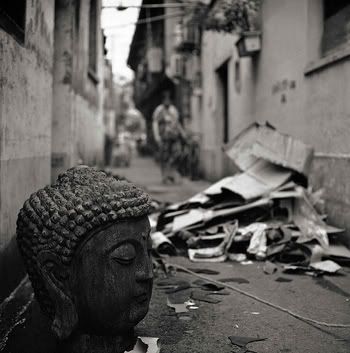
[/b] -
I found this article very good so I am pasting the whole thing here. (btw I have posted part of this in a topic created very long time ago, more than 2 years... in the first two months the forum was created.. here: The Eternal Now and Time doesn't exist. I just suddenly recalled about it)
Buddhism and the Illusion of Time
Questions and Answers from an interesting thread on Buddha's Village Forum
Answers from Tom Huston [email protected]
<< I've just read 'The end of time' by Julian Barbour which presents a fairly convincing theory that time is just an illusion and really the universe is just made up of infinite seperate 'instants', or different configurations of the Universe. Has anyone else read it and if so what do you think the implications are on Buddhism and the mind. The theory has got me quite depressed and so I would appreciate any replies.
Remmy>>
I haven't read it, but I just saw an ad for it in the new issue of Science News and decided to browse the web for more info. As for time being illusory and the universe being nothing but a series of separate "instants," like frames in a movie, that's basically correct. Everything we call "the past" is, literally, nothing but present memories. Likewise, everything we call "the future" is nothing but present memories inverted, or rearranged, to form a prediction or expectation. The appearance of "time" is little more than a trick of memory, as the Avatamsaka Sutra (Flower Ornament Scripture) says. You can easily discern this for yourself: simply figure out what it is you consider "the past" and "the future." You will discover that it is nothing but thoughts--nothing but memories, nothing but expectations, nothing but mental commentary. It's "all in your head," so to speak. There's really no such thing as time. There is really only Now--an eternally present Present with no beginning and no ending. Everything is completely new, distinct, and original every instant, with no real "change" or "motion" at all. The mystic-philosopher Heraclitus, explaining this point, said, "A man cannot step in the same river twice."
Zen Buddhism, in particular, stresses this very significant insight. Here's the Sixth Patriarch, Ch'an Master Hui-neng:
"In this moment there is nothing that comes to be. In this moment there is nothing that ceases to be. Thus there is no birth-and-death to be brought to an end. Thus the absolute peace in this present moment. Though it is at this moment, there is no limit to this moment, and herein lies eternal delight."
Zen Master Seung Sahn elaborated on this topic in his excellent book The Compass of Zen (p. 143):
"Everyone thinks that this is extremely difficult teaching, something beyond their reach or experience. How can things appear and disappear, and yet there is, originally, even in this constantly moving world, no appearing and disappearing? A student once asked me, 'The Mahaparinirvana-sutra seems very confusing. Everything is always moving. And yet everything is not moving? I don't understand this Buddhism . . .' But there is a very easy way to understand this: Sometime you go to a movie. You see an action movie about a good man and a bad man--lots of fighting, cars moving very fast, and explosions all over the place. Everything is always moving very quickly. Our daily lives have this quality: everything is constantly moving, coming and going, nonstop. It seems like there is no stillness-place. But this movie is really only a very long strip of film. In one second, there are something like fourteen frames. Each frame is a separate piece of action. But in each frame, nothing is moving. Everything is completely still. Each frame, one by one, is a complete picture. In each frame, nothing ever comes or goes, or appears or disappears. Each frame is complete stillness. The film projector moves the frames very quickly, and all of these frames run past the lens very fast, so the action on-screen seems to happen nonstop. There is no break in the movement of things. But actually when you take this strip of film and hold it up to the light with your hands, there is nothing moving at all. Each frame is complete. Each moment is completely not-moving action.
"Our minds and the whole universe are like that. This world is impermanent. Everything is always changing, changing, changing, moving, moving, moving, nonstop. Even one second of our lives seems full of so much movement and change in this world that we see. But your mind--right now--is like a lens whose shutter speed is one divided by infinite time. We call that moment-mind. If you attain that mind, then this whole world's movement stops. From moment to moment you can see this world completely stop. Stop. Stop. Stop. Stop. Stop. Like the film, you perceive every frame--this moment--which is infinitely still and complete. In the frame, nothing is moving. There is no time, and nothing appears or disappears in that box. But this movie projector--your thinking mind--is always moving, around and around and around, so you experience this world as constantly moving and you constantly experience change, which is impermanence. You lose moment-mind by following your conceptual thinking, believing that it is real."
When you transcend your thinking mind in the realization of your own pure, timeless, ever-present Awareness, then the illusion of time completely collapses, and you become utterly Free of the samsaric cycle of time, change, impermanence, and suffering. This, my friend, is nothing at all to be "depressed" about! Rather, the fact that your own Buddha Mind exists beyond time, in THIS very moment, is itself the key to your permanent and eternal (timeless) Liberation.
Hope that helps!
--Tom Huston
[email protected]
"To no longer resist the present is to see that there is nothing but the present--no beginning, no end, nothing behind it, nothing in front of it. When the past of memory and the future of anticipation are both seen to be present facts, then the slats to this present collapse. The boundaries around this moment fall into this moment, and then there is nothing but this moment, with nowhere else to go."
--Ken Wilber, No Boundary, pp. 158-159
<< Thanks for all that info Soulplex, I found it very helpful. There's just a couple of things I'm not too clear on. If I've missed the point somewhere please tell me. When you used the movie analogy, do you mean we see the whole of our lives at once which is 'played as a movie' to us so that the impression of impermenance and change appears, so that in effect impermenance does exist for someone who hasn't attained Nirvana? Or am I frozen in time? The latter scares me quite a bit - is there still a ten year old version of me in frozen agony after falling out of a tree? Or are only fully enlightened people 'frozen' contentedly in time?
Remmy >>
Okay, that's a good question, and I'll try to answer it as clearly as possible. First, impermanence does indeed exist for someone still trapped in Samsara (as well as suffering, attachment, death, etc.--all just names for the same condition), but it doesn't exist in Nirvana (and neither does its opposite, "permanence"). Nirvana is beyond the duality of motion and stillness, and the way that's experienced is that you feel that you (Buddha Mind) are absolutely still in the midst of a world of absolute motion, but the two don't feel different or separate. That's the nondual, Mahayana Nirvana, in which the relative dualities of nirvana-and-samsara, life-and-death, subject-and-object, matter-and-consciousness, form-and-spirit are seen to be nondual or "one," an inseparable unity. (In the dualistic, Theravadin, relative nirvana, the two--Buddha Mind and the world of form--are felt to be different and separate, which is why the Mahayana criticizes the Theravadin view as limited and incomplete.) -
(continued)
Let me break that down a bit: The whole world of form (samsara) is totally full of various degrees of motion and movement, so that even its "stillness" isn't absolutely still. It's only relatively still--relative to other movements, like the "stillness" you feel now sitting on a chair, even though you're zipping through space on a planetary body at thousands of miles per hour. The world of formlessness (nirvana), on the contrary, is absolutely still and tranquil, with no relative movement or relative stillness at all. So you have the relative world of relative stillness-and-motion (samsara), on the one hand, and the absolute world of absolute Stillness (nirvana), on the other. In the realization of nondual, Mahayana Enlightenment, these two worlds (relative samsara and relative nirvana, or relative form and relative emptiness) merge into a perfect Unity of Absolute Emptiness or Absolute Nirvana, and then there is neither motion nor stillness, or you can say that there is both of them together (as I explained in the first paragraph), or you can say neither of those and give the logically precise answer: silence. The Madhyamika Shastra (XV.3) put it best:
"It cannot be called void or not void,
Or both or neither;
But in order to point it out,
It is called ‘the Void.’ "
As for the filmstrip analogy . . . Yes, you do experience the whole of your life as "played at once," but all that really means is that your life only happens right now, always in this single, eternal context called Now (which is really just another name for the Absolute or Buddha Mind). The "now" when the Big Bang happened, the "now" when Gautama Buddha died, the "now" when you were born into this life, and the "now" when you'll be reading these words--these are one and the same moment, the same motionless Now.
You can picture this "Now"--which is your own Buddha Mind, your own natural Awareness--as a vast blue sky, and the world of time and change is just a little tiny cloud passing within it. The "Now" is eternal and still; it never changes or moves, since it is the infinite clearing or space in which all change and movement happens. The cloud arises, the cloud stays a bit, and the cloud goes, but the vast empty sky remains untouched by it.
This is exactly how your present experience is: you are the vast empty sky and this whole universe is a tiny cloud within you. Through the blinding power of innate ignorance, however, you have forgotten your true nature as the motionless sky and mistakenly identified yourself as the ever-changing cloud (or a small part of the cloud). A Theravadin-level enlightenment will reverse this mistake by showing you that you are really the empty sky, and a Mahayanin, nondual Enlightenment will show you that the sky and the cloud are not separate or different. The cloud arises out of, and within, the sky, and is ultimately made of "sky essence," so to speak. (It's the same as the old "mirror" analogy: your mind is perfectly clear mirror, and the world is reflected in it. You first must discover that you are the mirror and become free of the reflections; then you must discover that the reflections are not separate from the mirror. At that point you become Free as the Absolute Unity of mirror-and-reflections together.)
Now, to use the movie analogy, imagine that Awareness is a movie screen and this world of form is a projected display of light that appears on the screen. The frames appear on the screen, one at a time, in rapid succession, and the screen contains each of them as they appear. One frame of light appears on the screen, stays a fraction of a second, and disappears--and the screen only reflects one frame at a time.
Now here's where the analogy gets complicated (and where you got confused): The movie screen and filmstrip reel all occur in time; Awareness and the appearance of the world, however, are the genesis of time. There's really no "reel" or "strip" of film appearing on the screen all at once, but rather a single frame every instant, with each instantly replacing the previous one--even though its the same motionless screen they all appear on. So when you become identified with the screen (Awareness), you don't experience every single frame that ever appeared on the screen--they've all long since disappeared back into the nothingness from which they sprang. No, what you experience is the realization that this very screen is the same screen that has been reflecting frames of movie light since the beginning of the movie itself (and that the screen, naturally, also exists before and after the movie). You become identified with Awareness--which is completely beyond time--and you realize that it is eternal, that it is ever-present, that it has no beginning and no end, that it is the same "Now" in which all experiences have previously come and gone, presently come and go, and will in the future come and go, eternally so.
And then, if you break through to complete, nondual Enlightenment, you discover that the frames of movie light ARE the screen--that the two aren't separate, or even essentially different in any way--and then you see that there is only Now, only the screen-and-present-frame Unity, and so whatever frame happens to be present is the only frame there is. "Past" and "future" are revealed to be mental fantasies--present mental fantasies--and the only reality is always the present reality, with no real "frames" existing anyway before or after it. So there's no frame somewhere of a ten-year-old version of you falling out of a tree; that's only a memory now, and that's all it is. It exists nowhere but in your mind. (For this analogy we've done away with the projection booth, the projector, the reel of film, the viewer of the movie, etc.) That's what Zen Master Seung Sahn meant by his "you see the whole world stop. Stop. Stop. Stop. Stop. . . ." When there is really ONLY the present moment, the present frame, then that's all you can see. And the present frame is always completely motionless, even though the frames give an illusion of sequential continuity (and your conceptual mind superimposes an illusion of movement and change). Enlightened people don't live "'frozen' contentedly in time," as you suggested, but rather fluid and alive beyond the illusion of time altogether!
There's nothing extraordinary about this. In fact, whether you feel you're Enlightened or not, you're experiencing it right now (when else could you experience it? when else could you experience anything?). Right now, as you sit here reading these words, the whole world is completely motionless, completely new, and completely silent. Nothing is changing. Nothing is moving. Nothing is happening at all. In fact, nothing has EVER happened! Not now, and therefore not ever. The world is totally silent, and everything is at peace.
And yet--how can this be? It seems absurd, doesn't it? You can move your hands and arms around, perhaps you can crank up some loud rock music to drown out the supposed "silence," and it all seems perfectly obvious that things are happening, things are changing. But look a little closer. Hold your hand in front of you. Now clench your hand into a fist. Now release the fist and move your fingers around. It certainly appeared as though the hand were moving, didn't it? But we're not interested in appearances, here; we want the reality. And the reality of your hand-moving experiment is that it was a completely different hand every instant, even when "you" weren't moving it! -
On the surface, maybe this seems obvious: electrons in the hand were spinning at the speed of light; blood was flowing through the veins and capillaries; neurotransmitters were zipping instructions across the synapses, thereby engaging muscles to move. Lots of things about your supposedly static "hand" were changing. Of course, people can brush this off and say, "Yeah, okay, but it's still the same hand, even if it changes constantly." But take it even further: Were electrons really spinning, causing that subtle change in your "hand" every fraction of a nanosecond? Weren't the electrons themselves also changing, with quarks spinning and such, so that, going all the way down, to the level of universal gravitational influences or quantum nonlocality, everything even remotely related to your hand was changing? This leads to a rather shaky image of your outwardly static "hand," but perhaps we can solidify it somewhat if we analyze exactly what we mean by "change."
Basically, change means a transformation of some kind, of a single phenomenon transforming into a different arrangement of that same phenomenon. But are there any single phenomena? Didn't we just show, with the example of the quantum hand, that everything is interconnected, somehow affecting everything else in some manner, no matter how subtly? And, even if there are distinct and separate phenomena, do any of them actually change?
Take that same hand, for example. If we didn't have the mental concept "hand," how would we describe it? If we could see that the phenomenon is actually completely new and distinct every instant, with no static mental symbol (to say nothing of memories) to hold the distinct appearances together, would we perceive these new and distinct appearances as a changing phenomenon? With no concepts and no memories superimposed on the world, does anything really change? Are there even any separate "things" that could change? Isn't it all really just one seamless display--like, say, a movie frame--of a completely new and distinct universe, arising and disappearing in an infinitely rapid succession? (With a shutter speed of "one divided by infinite time," as Zen Master Seung Sahn says.)
"A man cannot step in the same river twice," said the Greek mystic Heraclitus, and the secret of life, the universe, and everything is contained in that simple statement.
--tom
p.s. Here are some quotes that may clear up any lingering confusion:
"This is not unchanging, yet it is not moving. It has never been void; there is no question of inside or outside, no separation of absolute and relative. Realize that this is your own original face: even if it appears as ordinary or holy, even if it divides into objective and subjective experiences, all comes and goes completely within it, all arises and vanishes herein. It is like the water of the ocean making waves; though they rise again and again, never is any water added. It is also like waves dying away; though they die out and vanish, not a drop is lost."
--Zen Master Keizan, Transmission of Light
"The life of a sentient being is a long dream. Existence only appears to be real. When one finally awakens, or attains Buddhahood, existence is seen for what it is--a sequence of illusions. Until that time, people will remain obsessed by the body, mind, and external phenomena, not realizing that they are illusory. You will live in a dream, thinking that it is reality. . . .
"Sentient beings mistakenly view their moment-to-moment illusory existence as a continuous, connected lifetime. Because they are unaware that their life is unreal, they do not attempt to wake up."
--ChÂ’an Master Sheng-yen, Complete Enlightenment, pp. 108-109
"If you are attached to your thinking, then everything has name and form. This is the world of opposites. But name and form are always changing, changing, changing. Because of this, everything is impermanent. Everything is like a dream, is like dew, is like a bubble or a flash of lightning. Nothing stays but is always in a process of change. Rather than being some constant, fixed reality, this whole universe constantly appears and disappears. But there is a way to experience the true nature of this constantly changing universe. Simply do not become attached to any outside world. DonÂ’t become attached to names and forms. If you keep that point, then your mind is not moving. You attain that names and forms are fundamentally empty. This whole universe is completely empty. You are completely empty. Nothing ever comes or goes. Nothing ever appears or disappears. When you keep this mind, you soon attain your true self."
--Zen Master Seung Sahn, The Compass of Zen, pp. 127-129
"It is like a cinema-show. There is the light on the screen and the shadows flitting across it impress the audience as the enactment of some piece. If in the same play an audience also is shown on the screen as part of the performance, the seer and the seen will then both be on the screen. Apply it to yourself. You are the screen, the Self has created the ego, the ego has its accretions of thoughts which are displayed as the world, the trees and the plants. . . . In reality, all these are nothing but the Self. If you see the Self, the same will be found to be all, everywhere and always. Nothing but the Self exists."
--Sri Ramana Maharshi
"To talk about the world as being made by God tomorrow or yesterday, would be talking nonsense. God makes the world and all things in this present now."
--Meister Eckhart
"Waking up from the dream means realizing that nothing ever happened. With Enlightenment there is no history. It has been burned out of existence. Time itself has been destroyed."
--Andrew Cohen
"It is like an image reflected in a mirror, it is seen but it is not real; the One Mind is seen as a duality by the ignorant when it is reflected in the mirror constructed by their memory. . . . The existence of the entire universe is due to memory that has been accumulated since the beginningless past but wrongly interpreted."
--The Lankavatara Sutra
"Just understand that things do not originate of themselves. All of them come into existence from your own single mental impulse of imagination mistakenly clinging to appearances.
"If you know that mind and objects fundamentally do not contact each other, you will be set free on the spot. Everything is in a state of quiescence right where it is; this very place is the site of enlightenment."
--Zen Master Pai-chang -
"There is nothing to overcome and nothing to prepare for¾you cannot prepare for where you already are.
"If you believe that some process in time will gradually release you from the illusion of samsara, then you are in a very secure position. But if you realize that the idea of time is the illusion of samsara then the whole business is finished up very quickly. As long as there is any investment in the future, you are a hundred billion miles away from home."
--Andrew Cohen, Enlightenment is a Secret
"There is only now. Everything we call the ‘past’ is absolutely nothing but present memory. Everything we call the ‘future’ is absolutely nothing but fantasy and commentary, that is, present memory rearranged. If we continue to pretend that there is some other time or place to be, besides right here, right now, we are cruelly and pathologically deluding ourselves."
--Scott Morrison, There Is Only Now
"Beginningless time and the present moment are the same. . . . You have only to understand that time has no real existence."
--Zen Master Huang Po
"Eternity is not, and cannot, be found tomorrow--it is not found in five minutes--it is not found in two seconds. It is always already Now. The present is the only reality. There is no other."
--Ken Wilber, No Boundary
"All temporal succession coincides in one and the same Eternal Now. So there is nothing past or future."
--Nicolas de Cusa
"If you want to know what eternity means, it is no further than this very moment. If you fail to catch it in this present moment, you will not get it, however many times you are reborn in hundreds of thousands of eons."
--Zen Master Seppo
"You examine the face of heaven and earth, but you have not come to know the one who is in your presence, and you do not know how to examine the present moment."
--Jesus Christ, The Gospel of Thomas, saying 91
"The idea of time is only in your mind. It is not in the Self. There is no time for the Self. Time arises as an idea after the ego arises. But you are the Self beyond time and space; you exist even in the absence of time and space."
--Sri Ramana Maharshi
>Thanks, I think I understand now.
- Remmy -
When I read this I got the impression immediately that the author of this article is somehow affiliated with Ken WilberOriginally posted by An Eternal Now:This is exactly how your present experience is: you are the vast empty sky and this whole universe is a tiny cloud within you. Through the blinding power of innate ignorance, however, you have forgotten your true nature as the motionless sky and mistakenly identified yourself as the ever-changing cloud (or a small part of the cloud). A Theravadin-level enlightenment will reverse this mistake by showing you that you are really the empty sky, and a Mahayanin, nondual Enlightenment will show you that the sky and the cloud are not separate or different. The cloud arises out of, and within, the sky, and is ultimately made of "sky essence," so to speak. (It's the same as the old "mirror" analogy: your mind is perfectly clear mirror, and the world is reflected in it. You first must discover that you are the mirror and become free of the reflections; then you must discover that the reflections are not separate from the mirror. At that point you become Free as the Absolute Unity of mirror-and-reflections together.)
Now, to use the movie analogy, imagine that Awareness is a movie screen and this world of form is a projected display of light that appears on the screen. The frames appear on the screen, one at a time, in rapid succession, and the screen contains each of them as they appear. One frame of light appears on the screen, stays a fraction of a second, and disappears--and the screen only reflects one frame at a time.
Now here's where the analogy gets complicated (and where you got confused): The movie screen and filmstrip reel all occur in time; Awareness and the appearance of the world, however, are the genesis of time. There's really no "reel" or "strip" of film appearing on the screen all at once, but rather a single frame every instant, with each instantly replacing the previous one--even though its the same motionless screen they all appear on. So when you become identified with the screen (Awareness), you don't experience every single frame that ever appeared on the screen--they've all long since disappeared back into the nothingness from which they sprang. No, what you experience is the realization that this very screen is the same screen that has been reflecting frames of movie light since the beginning of the movie itself (and that the screen, naturally, also exists before and after the movie). You become identified with Awareness--which is completely beyond time--and you realize that it is eternal, that it is ever-present, that it has no beginning and no end, that it is the same "Now" in which all experiences have previously come and gone, presently come and go, and will in the future come and go, eternally so.
And then, if you break through to complete, nondual Enlightenment, you discover that the frames of movie light ARE the screen--that the two aren't separate, or even essentially different in any way--and then you see that there is only Now, only the screen-and-present-frame Unity, and so whatever frame happens to be present is the only frame there is. "Past" and "future" are revealed to be mental fantasies--present mental fantasies--and the only reality is always the present reality, with no real "frames" existing anyway before or after it. So there's no frame somewhere of a ten-year-old version of you falling out of a tree; that's only a memory now, and that's all it is. It exists nowhere but in your mind. (For this analogy we've done away with the projection booth, the projector, the reel of film, the viewer of the movie, etc.) That's what Zen Master Seung Sahn meant by his "you see the whole world stop. Stop. Stop. Stop. Stop. . . ." When there is really ONLY the present moment, the present frame, then that's all you can see. And the present frame is always completely motionless, even though the frames give an illusion of sequential continuity (and your conceptual mind superimposes an illusion of movement and change). Enlightened people don't live "'frozen' contentedly in time," as you suggested, but rather fluid and alive beyond the illusion of time altogether! I think he articulated the Witness and No witness well... but I prefer not to call Witness as "Theravadin-level enlightenment " as many Theravadin practitioners (i.e Dharma Dan, Ajahn Maha Boowa) has very clearly written about their non dual insights and the illusion of Witness. Anyway I searched the net and found out that Tom Huston is a member of Ken Wilber's "Integral Institute".
 -
Yes.. labeling/conceptualising what you are doing and imposing "I shoulds" and "I shouldnts" are just more identifications, are in fact a form of dualistic fundamental attraction and aversion. Once not identified, everything self-arises and self-liberates.. So thusness once said something like shoulds and shouldnts are provisionals, not about our true nature.Originally posted by JonLS:After reading my previous post, the search may still continue.
There may still be focussing of the meal and trying to block out all thoughts and simply focussing on chewing the food, can you just "watch" as all this is happening?
Do you really need to identify with what is happening?
Can you just allow it to just unfold on it's own?
Your mind may try to "just watch" as all this is just happening, can simply allow the mind to make that effort and simply watch without being attached to the outcome?
The present moment unfolds beautifully on it's own.
Your job is to just allow it.
Of course when you are doing something formal, you have to follow the rules, there are "shoulds" and "shouldn'ts", or you are following a form of formal meditation, mindfulness should be utilised to stabilise the mind on the object (i.e the breathe), and not to wander. If there is no mindfulness, the mind will wander without awareness. The difference is that mindfulness is awareness, not a result of analysis or identification and then focusing or rejecting thoughts -- Mindfulness is at one and the same time both bare attention itself and the function of reminding us to pay bare attention if we have ceased to do so. Bare attention is noticing. It re- establishes itself simply by noticing that it has not been present. As soon as you are noticing that you have not been noticing, then by definition you are noticing and then you are back again to paying bare attention.
Therefore I think the main thing is to remain free from perceptions and content and stay at the level of 'bare attention'/present moment awareness. The moment you label "I am eating dinner" you have become identified with eating dinner. Identifications like "my mind is not empty now, I should be more empty", or "my mind is empty now", etc etc are also more unnecessary thoughts and is also due to grasping on an idea of a 'self', not seeing that 'self' is illusory. -
Oh, do you mean when having dinner, the thought of having dinner will arise. Watch how this thought come and how this thought go. With every bite of food, watch the sensation of the teeth chewing down the food and watch that sensation goes away. With the taste of food in food been salty or sweet, watch the sensation of taste comes and goes away... Not sure if I'm correct. But it seems like Vipassana meditation.Originally posted by An Eternal Now:Yes.. "I shoulds" and "I shouldnts" are just more identifications, are in fact a form of dualistic fundamental attraction and aversion. Once not identified, everything self-arises and self-liberates.. So thusness once said something like shoulds and shouldnts are provisionals, not about our true nature.
Of course when you are doing something formal, you have to follow the rules, there are "shoulds" and "shouldn'ts", or you are following a form of formal meditation, mindfulness should be utilised to stabilise the mind on the object, and not to wonder. If there is no mindfulness, the mind will wander without awareness. The difference is that mindfulness is awareness, not a result of analysis or identification.
However the main thing is to remain free from perceptions and content. The moment you label "I am eating dinner" you have become identified with eating dinner. Identifications like "my mind is not empty now, I should be more empty", or "my mind is empty now", etc etc are also unnecessary and is due to attachment to 'self', not seeing that 'self' is empty.
Cherrio -
I think the teaching of present moment and eternal now is so that we can stop imagining things.
-
ya , so u can stop imagining on SPiritual powerOriginally posted by Eric Cartman:I think the teaching of present moment and eternal now is so that we can stop imagining things. -
yaOriginally posted by bohiruci:ya , so u can stop imagining on SPiritual power -
In a way you are right. However it is not a form of mental knowing, or concept of 'coming' and 'passing', it is about perceiving reality as directly and accurately as possible. If you focus on noting mentally 'coming' and 'passing' but not on the ultimate realities, this is just focusing on a concept, and is a form of samatha practise leading to deep concentration states, however it is not an insight practise and therefore does not lead to any fundamental insights. Insight practise has a focus on the ultimate realities, the luminous-emptiness nature, meaning the awareness/clarity appearing as the sensations, and the emptiness of the sensations (i.e arising as it ceases, empty of self and inherent existence, etc), and is inherently a non dualistic practise. It is through Insight practise that we can gain enlightenment and liberation. Shamatha is still a dualistic practise and does not lead to enlightenment and liberation, but can be an aid to Insight practise.Originally posted by oldkid:Oh, do you mean when having dinner, the thought of having dinner will arise. Watch how this thought come and how this thought go. With every bite of food, watch the sensation of the teeth chewing down the food and watch that sensation goes away. With the taste of food in food been salty or sweet, watch the sensation of taste comes and goes away... Not sure if I'm correct. But it seems like Vipassana meditation.
CherrioKalu Rinpoche says in his book "Luminous Mind":
"When the mind abides in its natural state, its profound nature can gradually reveal itself, and all its qualities are uncovered. This is Vipassyana practise... Vipassyana...is to see clearly, to have insight into mind's nature and clear vision of its basic state.
...there are differences between the approaches of Shamatha and Vipassyana. Shamatha uses an object or reference, although a subtle one, upon which the mind meditates; a dualistic relationship is established between the mind and its object. In Vipassyana, however, mind and object are essentially one, not two, and remain this way.
...In Vipassyana, many thoughts go through the mind, but they are niether suppressed or followed. They arise and pass away without our having to interfere..Vipassyana...consists of letting go of thoughts, letting them be pacified and liberated by them selves..."
He mentions to always verify these experiences with a qualified teacher, to prevent from going astray.
JM/YTSome more about the difference between Samatha/Shamatha (Concentration) and Vipassana/Vipasshyana (Insight):
You mentioned about experiencing impermanence directly. But how to do that? Dharma Dan gave this advise this which I found very useful,
...There is a lot of confusion on the differences between concentration practices and insight practices. This may be caused in part by the “Mushroom Factor,” or may be due in part to other factors, such as concentration practice being easier than insight practices and distinctly more pleasant most of the time. Concentration practices (samatha or samadhi practices) are meditation on a concept, an aggregate of many transient sensations, whereas insight practice is meditation on the many transient sensations just as they are. When doing concentration practices, one purposefully tries to fix or freeze the mind in a specific state, called an “absorption,” “jhana” or “dyana.” While reality cannot be frozen in this way, the illusion of solidity and stability certainly can be cultivated, and this is concentration practice.
Insight practices are designed to penetrate the Three Illusions of permanence, satisfactoriness and separate self so as to attain freedom. (N.B., the illusion of satisfactoriness has to do with the false sense that continuing to mentally create the illusion of a separate, permanent self will be satisfactory or helpful, and is not referring to some oppressive and fun-denying angst trip). Insight practices (various types of vipassana, dzogchen, zazen, etc.) lead to the progressive stages of the progress of insight. Insight practices tend to be difficult and somewhat disconcerting, as they are designed to deconstruct our deluded and much cherished views of the world and ourselves, though they can sometimes be outrageously blissful for frustratingly short periods....
~ Dharma Dan
If you can perceive one sensation per second, try for two. If you can perceive two unique sensations per second, try to perceive four. Keep increasing your perceptual threshold in this way until the illusion of continuity that binds you on the wheel of suffering shatters. In short, when doing insight practices, constantly work to perceive sensations arise and pass as quickly and accurately as you possibly can. With the spirit of a racecar driver who is constantly aware of how fast the car can go and still stay on the track, you are strongly advised to stay on the cutting edge of your ability to see the impermanence of sensations quickly and accurately.
------------
These meditation objects and postures are not that important, but understanding impermanence directly is.
-------------
That's what this first characteristic means: that reality vibrates, pulses, appears as discrete particles, is like TV snow, the frames of a movie, a shower of vanishing flower petals, or however you want to say it. Some people can get all into complex wave or particle models here, but don't. Just look into your actual experience, especially something nice and physical like the motion and sensations of the breath in the abdomen, the sensations of the tips of the fingers, the lips, the bridge of the nose, or whatever. Instant by instant try to know when the actual physical sensations are there and when they aren't. It turns out they aren't there a good bit of the time, and even when they are there, they are changing constantly.
(btw, Thusness says that Dharma Dan's 'vibration', 'is the sensation, constantly poping in and out, without a background behind.' which is in fact the 'transparency' he was talking about)
We can put it in the way, if you are aware of the present moment, not caught up in content, not identified with anything, you will directly experience the moment ceasing as it arises. This is directly experiencing impermanence, not as a form of knowledge, but as a form of direct experience. This is also an important form of insight practise... entering through the door of Impermanence. There are two other doors but all these are inter-related, the two other doors being No-Self and Sufferings.
Basically Insight practise (in Theravada it is called Vipassana and in Mahayana and Tibetan Buddhism it is known as Vipashyana) means directly experiencing reality from moment to moment. Through insight practise you can directly experience and gain insight about the 3 dharma seals or Emptiness, and Luminosity.
But focus on the clarity, the luminosity. Reality is that instant of luminosity and it is gone. If this is thoroughly understood, you understand your nature. What is luminosity? For example if you practise breathing meditation, the luminosity is the very touch sensation of the air flowing in and out of the nostrils. That touching point is composed of the four primary material elements: hard or soft; liquidity or cohesion; hot or cold; movement or vibration. -
Yes so practise and stop wasting so much energy thinking about things that won't help you at all!Originally posted by Eric Cartman:ya -
im not thinking about it now.Originally posted by An Eternal Now:Yes so practise and stop wasting so much energy thinking about things that won't help you at all! -
Yes but you were just a few moments agoOriginally posted by Eric Cartman:im not thinking about it now. or maybe about an hour ago. -
I wasn't feeding to the habit but was killing it.Originally posted by An Eternal Now:Yes but you were just a few moments ago or maybe about an hour ago. -
Don't give excuses la... If you are mindful enough you will not be pulled by your momentum.Originally posted by Eric Cartman:I wasn't feeding to the habit but was killing it.
-
That is concept. I just do what I have to do.Originally posted by An Eternal Now:If you are mindful enough you will not be pulled by your momentum. -
Just plain ignoring doesn't help. We still need to meditate don't we.Originally posted by An Eternal Now:Don't give excuses la... If you are mindful enough you will not be pulled by your momentum. -
Momentum is very real, and you are not able to detect it because you did not do enough meditation and is not able to access the preconscious level. So don't anyhow sayOriginally posted by Eric Cartman:That is concept. I just do what I have to do.
You did what you did because you are unconsciously being led by your momentum.. means not mindful.