okay...more specifically...
-
Okay, I'd posted before about some questions I'd been having, and many of you said I needed to be a little more specific...so, I'm going to try to put it better.
What I've been feeling lately is just yearning. Just like my soul is stirring, and restless. I look around me, and it's just like everyone around me, even in my church, is just going through the motions. Like there's nothing below the surface.
I don't think the feelings I'm having are total doubts in my beliefs. I believe in Jesus, and what He stood for. But, look at His life. He didn't just fish, or do carpentry work every day to pay the bills, and on and on until He died. He lived to make a difference. I believe in what I've been taught, but I think there must be something more. I guess what I'm getting at, is if this is "the way," why doesn't it make more of a difference in people's life...
I think what interests me about Buddhism is that Buddhists you see are a lot more peaceful than most of the Christians I know...they don't seem to have the discontent that I'm feeling. That's the main thing, is I just want to find a peace within.
There's a lot of stuff going on in my mind and heart lately, but I guess that's the biggest part of it...
Bea -
Yo Bea,Originally posted by Bea:Okay, I'd posted before about some questions I'd been having, and many of you said I needed to be a little more specific...so, I'm going to try to put it better.
What I've been feeling lately is just yearning. Just like my soul is stirring, and restless. I look around me, and it's just like everyone around me, even in my church, is just going through the motions. Like there's nothing below the surface.
I don't think the feelings I'm having are total doubts in my beliefs. I believe in Jesus, and what He stood for. But, look at His life. He didn't just fish, or do carpentry work every day to pay the bills, and on and on until He died. He lived to make a difference. I believe in what I've been taught, but I think there must be something more. I guess what I'm getting at, is if this is "the way," why doesn't it make more of a difference in people's life...
I think what interests me about Buddhism is that Buddhists you see are a lot more peaceful than most of the Christians I know...they don't seem to have the discontent that I'm feeling. That's the main thing, is I just want to find a peace within.
There's a lot of stuff going on in my mind and heart lately, but I guess that's the biggest part of it...
Bea
Do not feel guilty about having a loss of faith in ur religion. Treat this as a positive opportunity in getting to know yourself.
Keep an open mind to explore spirituality of life. And perhaps one day, you will find the one that you can relate to and finding the peace within. -
That's right... my Buddhist master used to be a Christian pastor but after learning about the Buddhist teachings he became a Buddhist and renounced as a monk (he used to be a pastor active in preaching and wrote christian books as well... there's a story behind it).. He considers Jesus as a manifestation of a great Bodhisattva, and his great qualities like great compassion/love, sacrifices and generosity, are ought to be learnt from... but the best way to practise Jesus Christ's spirit would be to start learning and practising Buddhism. He also says that if Christianity were to learn the principles of Buddhism, Christianity would develope even faster. And if Christianity would learn from Buddhist principles and teach about non-violence, they wld avoid many wars.. as you might have known Buddhism is the only religion that does not have a history of wars fought in name of Buddhism..
If you seek peace of mind, you have also come to the right place.. the path of Buddhism leads to peace, but not only fleeting peace but through insights into the nature of our mind, the nature of reality, leading to complete and lasting liberation from all sufferings and the experience of abiding purity and the highest bliss of Nirvana. Buddhism alone emphasizes on liberation and mind purification. If you are able to awaken from our delusions (i.e illusion of a separate and permanent 'self') leading to various attachments and afflictive emotions and thoughts, we will find the highest bliss (of nirvana, of clarity) throughout our lives.
By the way I heard 'Living Buddha, Living Christ' by Thich Nhat Hanh is a good read.. you may want to grab it. You can read the reviews here: http://www.amazon.com/Living-Buddha-Christ-Thich-Nhat/dp/1573225681/ref=pd_bbs_sr_1/104-3976337-3288703?ie=UTF8&s=books&qid=1175111089&sr=8-1
I would suggest if you like to find out about Buddhism you can begin looking at some introductory books..
All About Buddhism ~ For Non-Buddhists and Buddhists
By the way you may also like to find out more about Buddhist meditative aspect of Mindfulness and Insight Practise... it contains valuable instructions and advise on meditation but this is not just restricted to formal meditations or sitting meditation alone, but about the meditative practise of Buddhism that is to be practised even in daily living.Originally posted by An Eternal Now:More good links for beginners:
http://www.buddhanet.net/e-learning/basic-guide.htm (Basic Buddhism Guide)
http://www.buddhanet.net/e-learning/qanda.htm (Good Questions, Good Answers - Q&A on Buddhist topics)
http://www.sinc.sunysb.edu/Clubs/buddhism/dhammananda/main.htm (What Buddhists Believe)
Some good introductory books for beginners: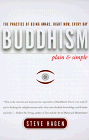
Buddhism Plain and Simple
Steve Hagen
Awakening the Buddha Within: Tibetan Wisdom for the Western World
Lama Surya Das
The Heart of the Buddha's Teaching
Thich Nhat Hanh
Buddhism for Beginners
Thubten Chodron
Mindfulness is not an easy concept to explain in words yet H. Gunaratana does a nice job of doing just that. First and foremost, this book is a beginner's guide to the practice of Vipassana (or Insight) meditation. Having it's roots in the Gutama Buddha's life over 2500 years ago, Vipassana meditation is a skill that takes only a short while to learn but a lifetime of dedication to master.
The introduction gives a brief look at the roots of the practice and tells the reader that meditation is intrinsically experiential so the best way to get started is to just sit and try it. In the following chapters, Gunaratana helps the reader to understand exactly what meditation is and what it isn't. From there he goes into more detailed instructions as to what your mind and body should be doing while you meditate. This is accompanied with useful tips on dealing with problems that may arise in your practice, including the 5 major hindrances that nearly all meditators face. The book wraps up with a more in depth look at exactly what "mindfulness" is and how to "take it from the cushion" and integrate it into our daily lives.
I found this book very easy to read and understand and feel it would be an excellent guide for people just getting into Buddhism and meditation. Already being the owner of a collection of books on Buddhism, this book didn't offer any new revelations but I was extrememly pleased with the sections on mindfulness and have already used some of the author's suggestions on integrating it into daily life. The main reason I did not give the book 5 stars is because it offers much more for the new reader than it does for one with more experience.
If you buy this book and still feel like you could use more detailed instructions on meditation, I recommend you also purchase "Change Your Mind: A Practical Guide to Buddhist Meditation" by Paramananda (ISBN: 0904766810). (an amazon review)
Reviews at amazon: http://www.amazon.com/Mindfulness-Plain-English-Updated-Expanded/dp/0861713214/ref=pd_bbs_sr_1/104-3976337-3288703?ie=UTF8&s=books&qid=1175115515&sr=1-1
I've pasted a chapter on 'mindfulness' from the book at the All About Buddhism ~ For Non-Buddhists and Buddhists thread. The book is also available for reading online at http://www.urbandharma.org/udharma4/mpe.html
By the way you may also want to read on Eckhart Tolle's books. Eckhart Tolle's teachings are popular and not restricted to any particular religion or school of thought but excludes none.. and the truths in it are universal. It can definitely help you find 'peace of mind'. There are also some attempts by the author to point out the meaning/essence behind Jesus's message, often misunderstood or misinterpreted. More details about his books (The Power of Now and A New Earth would be a nice read): http://www.eckharttolle.com/home.php?section=about&show=ABOUT%20-%20Power%20of%20now, and here's an introduction of 'The Power of Now': http://www.cygnus-books.co.uk/features/power_of_now.htm
So much book recommendations...
-
"The Way" doesn't make more difference to people's life because it depends on how much we want to apply it into our lives in order for a difference to be made. God has given us free agency - the freedom to choose. He doesn't force on us ma.
So people basically still got the freedom to decide how much of the Way they want to practise lor.......... !
-
yo this is just my personal opinion..Originally posted by Bea:Okay, I'd posted before about some questions I'd been having, and many of you said I needed to be a little more specific...so, I'm going to try to put it better.
What I've been feeling lately is just yearning. Just like my soul is stirring, and restless. I look around me, and it's just like everyone around me, even in my church, is just going through the motions. Like there's nothing below the surface.
I don't think the feelings I'm having are total doubts in my beliefs. I believe in Jesus, and what He stood for. But, look at His life. He didn't just fish, or do carpentry work every day to pay the bills, and on and on until He died. He lived to make a difference. I believe in what I've been taught, but I think there must be something more. I guess what I'm getting at, is if this is "the way," why doesn't it make more of a difference in people's life...
I think what interests me about Buddhism is that Buddhists you see are a lot more peaceful than most of the Christians I know...they don't seem to have the discontent that I'm feeling. That's the main thing, is I just want to find a peace within.
There's a lot of stuff going on in my mind and heart lately, but I guess that's the biggest part of it...
Bea
Once you have stopped looking for or craving for something and really start looking at what u have now, u will find contentment.
I just think that you are going through this phase, finding out what u needed ... which is good.
yeap i think u can ask any Q&A about buddhism here too : ) -
Just yesterday I downloaded an audiobook by Jack Kornfield, http://www.mininova.org/tor/557075
Description:
I think it's very good and would recommend those who are interested in Buddhist practise.
Keywords: Buddhism, psychology, philosophy, wisdom, meditation, audiobook, lectures.
If you have not listen to Jack Kornfield before you really should. This stuff is absolutely great. In my collection of spiritual/philosophical media i got many 100 gigabytes of data and i can honestly say that Jack Kornfields stuff is kind of the crown jewels of it all. The first time i initially heard Kornfield i kind of wondered which kind of sedative medication he was on, but after a very short while his personality really makes more than perfect sense. Intelligent, interesting, wise, and a lot of humour. He often illustrates stuff with some tales or legends or with stories from real life which is great because he is a absolutely wonderful storyteller.
Kornfield has been trained as buddhist monk in Burma, Thailand and India for many years and later got a Ph.D in psychology. You do not at all have to be into buddhism to find this material highly interesting and valuable.
THIS TORRENT CONTAINS:
o The audiobook "A Path with Heart" read by Kornfield
o The lecture/speech "The 10 Perfections", "Dharma Talks- Compassion",and "Working With The Heart in Troubled Times"
o The ebook "Eightfold Path For The Householder" and a really good ebook by Kornfields teacher Ajahn Chah
o A short 3 minute video with Jack Kornfield.
For more stuff by Kornfield:
http://thepiratebay.org/tor/3408201/%5BAudioBook%5D_Kornfield__Jack_--_Roots_of_Buddhist_Psychology_(Sou
http://thepiratebay.org/tor/3495688/Jack_Kornfield-Your_Buddha_Nature
http://thepiratebay.org/tor/3532806/Jack_Kornfield_-_The_Inner_Art_of_Meditation
Some reviews of 'A Path with Heart':
This is an excellent and sensitively written book by a former Buddhist monk and clinical psychologist. Jack Kornfield uses stories and lyrical language to weave a portrait of an authentic spiritual life characterized by insight, compassion and wisdom. He makes Buddhism accessible to modern people and shows us how it is relevant to modern life. This is no small task and Kornfield pulls it off brilliantly, with warmth and an entertaining style. I highly recommend this book for anyone who is looking for deeper meaning in their lives whatever their specific beliefs. It is also an important book that connects Western psychological thought to Eastern worldviews.
---
I arrived at this 1993 book after reading Jack Kornfield's more recent book, AFTER THE ECSTASY, THE LAUNDRY (2000). I enthusiastically recommend both books.
We must be a lamp unto ourselves, the Buddha said. We must find our own true way. This is really the point of Kornfield's book. As a former Buddhist monk, a psychologist, and a seasoned meditation teacher, Kornfield has the qualifications to help us on our journey through life. "What matters is simple," he writes. "We must make certain that our path is connected with our heart" (p. 11). To live a genuine spiritual life in this confusing world, and a society all too often "addicted to alcohol, drugs, gambling, food, sexuality, unhealthy relationships, or the speed and busyness of work" (p.23), we must bring our full attention to life. "To open deeply, as a genuine spiritual life requires," Kornfield says, "we need tremendous courage and strength, a kind of warrior spirit . . . We need a warrior's heart that lets us face our lives directly, our pains and limitations, our joys and possibilities" (p. .
.
Although written from a Buddhist perspective, this book will appeal to anyone interested in living an authentic life. It is filled with insightful passages. In Chapter Two, Kornfield encourages his reader to stop the war with oneself and make peace. He teaches his reader in Chapter Seven to name one's demons, e.g., greed, fear, doubt, judgment, confusion, anger, boredom, sleepiness, and restlessness, in order to gain power over them. "A genuine spiritual path does not avoid difficulties or mistakes," Kornfield observes in Chapter Six, entitled "Turning Straw into Gold," "but leads us to the art of making mistakes wakefully" (p. 72). (Facing the difficulties of one's spiritual life becomes the theme of Kornfield's current book, AFTER THE ECSTASY, THE LAUNDRY.) Learn to be a lamp unto yourself, he writes in Chapter Eleven, "our liberation and happiness arise from our own deep knowing" (p. 159). In Chapter Twenty--one of my favorite passages in this book--Kornfield writes: "Everything we do in life is a chance to awaken" (p. 291). He asks: "Can we bring the Buddha into the voting booth where we live; can we act as the Buddha, writing letters to our congressmen and congresswomen; can we share in feeding the hungry; can we walk like the Buddha to demonstrate for peace or justice or care for our environment? The greatest gift we can bring to the challenges of these areas is our wisdom and greatness of heart" (p. 293).
If you liked AFTER THE ECSTASY, you will like this book. Read it. It will become a well-travelled "Path" on your bookshelf.
G. Merritt
----
A Path with Heart, by Jack Kornfield: an masterwork. A must have. Vast, accessible, rich and deep. Buy this and read it twice, at least. A great place for both beginners and advanced meditators to start and finish. Only major problem is that is it so nicely written and gentle you might not realize how hard hitting it is. Assume it is very hard hitting and technical despite its friendly tone and you will get more out of it. (http://www.interactivebuddha.com/booklist.html)
You need a torrent software to download this, such as uTorrent.
Some other books useful for beginners: http://www.amazon.com/exec/obidos/ASIN/0743427084/cleverjsmusicias
How To Practice: The Way to a Meaningful Life
by The Dalai Lama
Editorial Review: As a primer on living the good life, few books compete with How to Practice, another profound offering from the exiled Tibetan Buddhist leader His Holiness the Dalai Lama. Westerners may be confused by the book's title, assuming that it focuses solely on Buddhist meditation and prayer techniques. Though it does address meditation and prayer, at its core this is a book that demonstrates how day-to-day living can be a spiritual practice.
* There are two ways to create happiness: The first is external. By obtaining better clothes, better shelter, and better friends we can find a certain measure of happiness and satisfaction.
* The second is through mental development, which yields inner happiness. However, these two approaches are not equally viable. External happiness cannot last long without its counterpart.... However, if you have peace of mind you can find happiness even under the most difficult circumstances.
As he has in previous books (An Open Heart, The Art of Happiness), the Dalai Lama reminds us that developing peace of mind means paying attention to our daily attitudes and choices as well as taking the time to meditate and be prayerful. The six-part book covers Buddhist meditation techniques and visualization exercises as well as daily thoughts and actions that foster morality and wisdom.