Nondual Thinking and the Mahayana Deconstruction of Time
-
Two days ago Thusness recommended me to read David R Loy's articles and books... and he is very impressed by this author's insights into non-duality. He's both a good non-dual experiencer as well as an academic, one who can explain that very well in terms of philosophy. As a result he is getting all his books and asked me to do a compilation of all the articles by this online articles into a single document file for him. (Over 1000 pages!) His online articles can be viewed at the bottom of this interview webpage with david loy: http://www.holosforum.org/davidloy.html.. he told me to read those articles as they are very well written. David Loy is both a Zen Teacher (he is qualified to teach within his Zen tradition but if I'm not wrong, has no students) and a scholar with a Ph.D (in Philosophy, I think).
Here I'm going to share two articles which I think is good... the second article I haven't read yet but Thusness told me it's good so I'm sharing it here as well. There's also another article I've read, it's a little long but I think the topic is interesting and is a good read, well written also. It's called "The Path of No-path: Shankara and Dogen on the Paradox of Practice"... But I will not post here as sgForums has a restrictive limit on text size. I will read the other articles gradually.
Hopefully these articles will shed some light about Reality, Buddhist practise, and Non-duality (of subject-object and discriminations), No-Self. "Nondual Thinking" also discusses about the self liberation aspect of phenomena & the non-dual reality & how we are tricked into believing in a separate self.
http://ccbs.ntu.edu.tw/FULLTEXT/JR-JOCP/jc26559.htm
Nondual Thinking
By David Loy
Journal of Chinese Philosophy
Vol. 13 (1986)
pp. 293-309
Copyright 1986 by Dialogue Publishing Company
________________________________________
I never think - my thoughts think for me. (Lamartine [1])
Much of Asian philosophy constitutes a radical critique of thinking as it usually occurs. It is commonly claimed that the superimpositions of thought-projection (vikalpa and prapanca) obscure the actual nature of experience. Given the emphasis on meditation, during which one "lets go" of thoughts, one might conclude that thinking has solely the negative effect of an interference that distorts reality, and hence that we should strive to eliminate or minimize it. This inference would be an error: thought is not to be rejected, but its actual nature must be clarified. If thought-construction distorts perception, so perception might be said to interfere with thought. When the thought-forming activity of the mind is preoccupied with a system of representation and intention, then something fundamental about the nature of thoughts is obscured also. In Ch'an, the fifth of Kuo-an Shih-yuan's Ten Oxherding Pictures describes a stage of enlightenment in which thoughts too are not to be rejected: "Enlightenment brings the realization that thoughts are not unreal since even they arise from our True-nature. It is only because delusion still remains that they are imagined to be unreal". [2]
The problem is not thoughts per se but more specifically a certain type of thinking, variously called "reasoning", "conceptualizing", "dualistic thinking", etc. But exactly what these terms refer to is not clear, especially if an alternative mode of thinking is supposed. What kind of thinking is left if we eliminate "reasoning"? If "conceptualizing" means "thinking that employs concepts", it is difficult to conceive of what thinking without concepts could be. Dualistic thinking is easier to understand: thinking which uses dualistic categories such as being and nonbeing, samsara and nirvana, pure and impure. The usual criticism of such thinking is that although distinctions are made in order to choose one half, the interdependence of the two terms means that to affirm one is also to maintain the other: in clinging to life I reveal my obsession with death, and my desire for success is equal to my fear of failure. But isn't all thinking dualistic in its alternation between assertion and negation? If such thinking is eliminated, what remains? What is "nondual thinking"? The concern of this paper is to characterize the difference between such problematic modes of thinking and whatever type is supposed to occur after enlightenment.
I. Prajna
Another nonduality, the nondifference of subject and object, is a crucial-perhaps the crucial-concept for several of those Eastern systems which criticize reasoning/conceptualizing-particularly Mahayana Buddhism, Advaita Vedanta, and Taoism. This suggests that a fruitful approach to the question of the true nature of thinking might be to investigate whether thinking is (or can be) nondual in this second sense-that is, without a thinker distinct from the thoughts that he thinks. The concept of prajna as developed in Mahayana seems to be an instance of this: Prajna is often defined as that knowing in which there is no distinction between the knower, that which is known, and the act of knowing. D.T. Suzuki begins his paper on "Reason and Intuition in Buddhist Philosophy" by thus distinguishing prajna from vijnana:
Prajna goes beyond vijnana. We make use of vijnana in our world of the senses and intellect, which is characterized by dualism in the sense that there is the one who sees and there is the other that is seen-the two standing in opposition. In prajna this differentiation does not take place: what is seen and the one who sees are identical; the seer is the seen and the seen is the seer. [3]
In his chart listing the various counterbalancing characteristics of prajna and vijnana, the former includes "Non-duality" in contrast to the latter's "duality". [4] The title of Suzuki's paper derives from his translation of the two Sanskrit terms: Vijnana he translates "reason or discursive under-standing", in contrast to prajna which is translated, perhaps unfortunately, as "intuition". The main philosophical meaning of intuition is "the immediate apprehension of an object by the mind without the intervention of any reasoning process" [5] -- as in Spinoza's scientia intuitiva, the third and highest form of knowledge, the perception of a thing "through its essence alone", which does not consist in being convinced by reasons but in an immediate union with the thing itself. Thus Suzuki's term is an appropriate one to describe nonduality. However, it may be unwise in that "intuition" more commonly suggests another faculty of mind apart from the intellect, whereas the function of "intuition" here is nothing other than the function of the intellect when it is experienced nondually. As Suzuki repeatedly emphasizes, prajna underlies vijnana:
...if we think that there is a thing denoted as prajna and another denoted as vijnana and that they are forever separated and not to be brought to the state of unification, we shall be completely on the wrong track. [6]
vijnana cannot work without having prajna behind it; parts are parts of the whole; parts never exist by themselves, for if they did they would not be parts-they would even cease to exist. [7]
The etymologies of vijnana and prajna are revealing. Both have the same root jna, "to know". The vi- prefix of vijnana (also in vi-kalpa and vi-tarka) signifies "separation or differentiation"; hence it refers to that type of knowing which functions by discriminating one thing from another--the most fundamental discrimination being that of the knower from the known. In contrast, the pra-prefix of prajna means "being born or springing up" [8] -- presumably by itself, evidently referring to a more spontaneous type of knowing in which the thought no longer seems to be the product of a subject, but is experienced as arising from a deeper nondual source. In such knowing the thought and that which is conscious of the thought are one. One important implication of this is that it is impossible to observe one's thoughts objectively. The Siksasamuccaya of Santideva contains a meditation on thought which dwells on this point: -
(continued)
...For thought, Kasyapa, cannot be apprehended, inside or outside, or in between both. For thought is immaterial, invisible,, non-resisting, inconceivable, unsupported and homeless. Thought has never been seen by any of the Buddhas, nor do they see it, nor will they see it. . . . A thought is like the stream of a river, without any staying power; as soon as it is produced it breaks up and disappears. ... A thought is like lightning, it breaks up in a moment and does not stay on....
Searching for thought all round, he does not see it within or without... Can then thought review thought? No, thought cannot review thought. As the blade of a sword cannot cut itself, as a finger-tip cannot touch itself, so a thought cannot see itself. [9]
But this seems contradicted by our experience. Surely thought can review itself; doesn't this happen often, whenever we ponder the logical implications of some thought as part of a sequence of reasoning? The point of the passage must be that the various thought-elements of such a sequence do not co-exist in the mind at the same time. At any moment there can be only one thought; a "review" of that thought, or any other thought that arises, is a completely new thought. The next section will explore the implications of this.
II. "An Unsupported Thought"
It thinks, one ought to say. We become aware of certain representations which do not depend on us; others depend on us, or at least so we believe; where is the boundary? One should say, it thinks,just as one says, it rains.
- Lichtenberg [10]
In the Western philosophical tradition, the denial of a thinker is even more radical than the denial of the subject as a perceiver or an agent. Modern philosophy begins with Descartes' postulation of the subject which functions autonomously as its own criterion of truth, and this subject is founded on the
fact that the act of thinking requires a thinker, an "I" to be doing it.
What of thinking? I find here that thought is an attribute that belongs to me: it alone cannot be separated from me. I am, I exist, that is certain. But how often? Just when I think; for it might possibly be the case if I ceased entirely to think, that I should likewise cease to exist.. . . I am, however, a real thing and really exist; but what thing? I have answered: a thing which thinks. [11]
Descartes argues that it is self-contradictory to doubt my own existence. "For it is so evident of itself that it is I who doubts, who understands, and who desires, that there is no reason here to add anything to explain it". [12] As a proof, this begs the question: To assume that "I" am doubting my own existence is to go beyond what is empirically given. What is experienced is thoughts, some of which involve the concept "I", but from this it is illegitimate to infer a thinker distinct from the thought. No cogito can be derived from cogitans.
In reaction, Hume's conception of the mind denies the existence of any identifiable self and emphasizes the "intentionality" of all consciousness, that consciousness is always consciousness of something:
I never catch myself at any time without a perception, and can never observe anything but the perception. When my perceptions are removed for any time, as by sound sleep, so long am I insensible to myself, and may truly be said not to exist. [13]
The intentionality of "dualistic" consciousness is essential to the nondualist, for this is implied by the claim that there is no self apart from its experience. John Levy has elaborated this concept into what is perhaps the classic argument against subject-object duality:
When I am conscious of an object, that is, of a notion or a precept, that object alone is present. When I am conscious of my perceiving, what alone presents itself to consciousness is the notion that I perceive the object: and therefore the notion of my being the perceiver also constitutes an object of consciousness. From this, a most important fact emerges: the so-called subject who thinks. and its apparent object, have no immediate relation.
... the notion, I am reading, does not occur while we are thus absorbed in reading a book: it occurs only when our attention wavers. . . .a little reflection will show that even when we are not thus absorbed for any appreciable lapse of time, the subject who afterwards lays claim to the action was not present to consciousness when the action was taking place. The idea of our being the agent occurs to us as a separate thought, which is to say that it forms an entirely fresh object of consciousness'. And since, at the time of the occurrence, we were present as neither the thinker, the agent, the percipient, nor the enjoyer, no subsequent claim on our part could alter the position...
If the notions of subject and object are both the separate objects of consciousness, neither term has any real significance. An object, in the absence of a subject, cannot be what is normally called an object; and the subject, in the absence of an object, cannot be what is normally called the subject. It is in memory that the two notions seem to combine to form an entirely new notion, I am the perceiver or the thinker. [14]
From this, Levy later concludes: "Memory and the consciousness of individual existence are therefore synonymous". [15] If this argument is valid, then originally there is no distinction between "internal" (mental) and "external" (physical), which implies just what Ch'an Masters Hsueh-Feng and Dogen claimed: trees and rocks and clouds, if they are not juxtaposed in memory with the "I" concept, are as much "my mind " as thoughts and feelings. Levy develops a point much stressed in Advaita: the Self is that which cannot be known, for to know it would be to make it into an object. What is usually overlooked about this point is that our usual sense-of-self is the result of exactly such an objectification. Levy's emphasis on memory as the source of duality is consistent with Sankara's reference to it in his famous definition of adhyasa, which may be restated as: Superimposition is the apprehension of something in the present as different than it actually is, due to the interference of memory-traces. [16] (There is also a parallel in the Lankavatara Sutra: "When the triple world is surveyed by the Bodhisattva, he perceives that its existence is due to memory [literally, 'perfuming'] that has been accumulated since the beginningless past, but wrongly interpreted"). [17] The usual function of memory as superimposition is to interpret the perception so that it is seen as... -- in this case, as a self-existing object. This process involves relating together perceptions and other mental events, including memory-traces and the notion of "I" (the subject). But what if memory were not relating together the distinct notions of precept and subject? Or-it amounts to the same thing-if the memory were experienced as it is, not superimposed but "an entirely fresh object of consciousness" quite distinct from the other thoughts and precepts which it relates together? The significance of the Siksasamuccaya passage, quoted at the end of Section I, becomes evident: If memory "wrongly interpreted" is "synonymous" with individual existence because it is a case of "thought reviewing thought", then the experience of each thought as autonomous will eliminate that sense of individual existence--that is, the sense of subject-object duality.
Nietzsche came to such a conclusion as a result of developing the implications of other reflections on causality:
"Causality" eludes us; to suppose a direct causal link between thoughts, as logic does-that is the consequence of the crudest and clumsiest observation...
"Thinking", as epistemologists conceive it, simply does not occur: 'it is quite an arbitrary fiction, arrived at by selecting one element from the process and eliminating all the rest, an artificial arrangement for the purpose of intelligibility-
The "spirit", something that thinks: ... this conception is a second derivative of that false introspection which believes in "thinking": first an act is imagined which simply does not occur, "thinking", and secondly a subject substratum in which every act of thinking, and nothing else, has its origin: that is to say, both the deed and doer are fictions. [18] -
We believe that thoughts as they succeed one another in our minds stand in some kind of causal relation: the logician especially, who actually speaks of nothing but instances which never occur in reality, has grown accustomed to the prejudice that thoughts cause thoughts-...
In summa: everything of which we become conscious is a terminal phenomenon, an end-and causes nothing; every successive phenomenon in consciousness is completely atomistic... [19]
Nietzsche relates the denial of a thinker to a denial of the process of thinking. Why; after all, do we believe that there is an act of thinking? Because that act is what the thinker does: stringing thoughts together by creating new thoughts on the basis of the old thoughts. If there is no such thinker, then there need be no such act. That leaves only thoughts, but one at a time, although the succession may be rapid.
The significance of Nietzsche's remarks for us is that we find the same claim in the Asian nondual philosophies, particularly in Ch'an Buddhism. In The Platform Sutra of the Sixth Patriarch, Hui Neng explains what prajna is:
To know our mind is to obtain liberation. To attain liberation is to experience the Samadhi of Prajna, which is ''thoughtlessness". What is "thoughtlessness"? Thoughtlessness is to see and know all Dharmas (things) with a mind free from attachment. When in use it pervades everywhere, and yet it sticks nowhere....When our mind works freely without any hindrance and is at liberty to "come" or to "go", we attain Samadhi of Prajna, or liberation. Such a state is called the function of "thoughtlessness". But to refrain from thinking of anything, so that all thoughts are suppressed, is to be Dharma-ridden, and this is an erroneous view. [20]
The term "thoughtlessness" would seem to recommend a mind free from any thoughts, but Hui Neng denies this: rather, "thoughtlessness" is the function of a mind free from any attachment. The implication is that for someone who is liberated thoughts still arise, but there is no clinging to them when they do. Why the term "thoughtlessness" can be used to characterize such a state of mind will become clear in a moment. But the question that arises first is in what way one can ever be attached to thoughts if, as the Siksasamuccaya says, a thought has no staying power, that like lightning it breaks up in a moment and disappears. Hui Neng answers this later in the Platform Sutra when he says more about "how to think":
In the exercise of our thinking faculty, let the past be dead. If we allow our thoughts, past, present and future, to link up in a series, we put ourselves under restraint. On the other hand, if we never let our mind attach to anything, we shall gain liberation.
(my emphasis [21])
One clings to a thought by allowing the thoughts to link up in a series, which means having one's next thought "caused", as it were, by the previous thoughts, rather than letting each thought arise spontaneously and nondually.
According to the autobiographical first part of the Platform Sutra, Hui Neng became deeply enlightened and realized that all things in the universe are his self-nature, upon hearing a line from the Diamond Sutra: "Let your thought arise without fixing it anywhere". [22] The passage just prior to this one-which Hui Neng must also have heard-puts this in context. Edward Conze translates it as follows:
Therefore then, Subhuti, the Bodhisattva should produce an unsupported thought, a thought which is nowhere supported, which is not supported (apratisthiti) by forms, sounds, smells, tastes, touchables, or objects of mind. [23]
A thought is "Unsupported" because it does not arise in dependence upon anything else, not "caused" by another thought ("mind-objects") and of course not "produced" by a thinker, which the Bodhisattva realizes does, not exist. Such an "unsupported thought", then, is prajna, arising by itself nondually.
Hui Neng's grandson in the Dharma, Ma-tsu, reinforces Hui Neng and the Diamond Sutra: "So with former thoughts, later thoughts, and thoughts in between: the thoughts follow one another without being linked together. Each one is absolutely tranquil". [24] That each such "unsupported thought" is absolutely tranquil is a new point, although probably implied by Hui Neng's term "thoughtlessness". So when one loses sense of self and completely becomes an unsupported thought, there is the Taoist paradox of wei-wu-wei, in which action and passivity are combined: there is the movement of nondual thought, but at the same time there is awareness of that which does not change. That is why such an experience can just as well be described as "thoughtlessness". The later Ch'an master Kuei-shan Ling-yu referred to this as "thoughtless thought": "Through concentration a devotee may gain thoughtless thought. Thereby he is suddenly enlightened and realizes his original nature". [25] "Thoughtless thought" is not a mind empty of any thought: "one thought is thoughtless thought."
An important parallel to this is found in the writings of a modern Advaitin, Ramana Maharshi:
The ego in its purity is experienced in the interval between two states or between two thoughts. The ego is like the worm which leaves one hold only after it catches another. Its true nature is known when it is out of contact with objects or thoughts. You should realize this interval as the abiding, unchangeable Reality, your true Being... [26]
The image of the ego as a worm which leaves one hold only after catching another might well have been used by Hui Neng and Ma-tsu to describe the way in which thoughts are apparently linked up in a series. The difference is that Mahayana Buddhism encourages the arising of "an unsupported thought", whereas Ramana Maharshi understands unchangeable Reality as that which is realized only when it is out of contact with all objects and thoughts. This is consistent with the general relation between Mahayana and Advaita: Nirguṇa Brahman is so emptied of any attribute ("neti, neti,...") that it becomes impossible to differentiate from Sūnyata. "It is difficult indeed to distinguish between pure being and pure non-being as a category". (S. Dasgupta). [27] But there is still a difference in emphasis. Mahayana emphasizes realizing the emptiness of all phenomena, whereas Advaita distinguishes between empty Reality and phenomena, with the effect of devaluing the latter into mere maya.
The image of a worm hesitant to leave its hold was used in a personal conversation I had in 1981 with a Theravada monk from Thailand, a meditation master named Phra Khemananda. This was before I discovered the passage from Ramana Maharshi; what Khemananda said was not prompted by any remark of mine, but was taught to him by his own teacher in Thailand. He began by drawing the following diagram: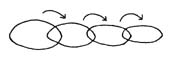
Each oval represents a thought, he said; normally, we leave one thought only when we have another one to go to (as the arrows indicate), but to think in this way constitutes ignorance. Instead, we should realize that thinking is actually like this: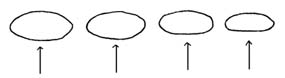
Then we will understand the true nature of thoughts: that thoughts do not arise from each other but by themselves.
This understanding of thoughts-not-linking-up-in-a-series but springing up nondually is consistent with D. T. Suzuki's conception of prajna:
It is important to note here that prajna wants to see its diction "quickly" apprehended, giving us no intervening moment for reflection or analysis or interpretation. Prajna for this reason is frequently likened to a flash of lightning or to a spark from two striking pieces of flint. "Quickness" does not refer to progress of time; it means immediacy, absence of deliberation, no allowance for an intervening proposition, no passing from premises to conclusion. [28] -
This gives insight into the many Ch'an dialogues in which students are criticized for their hesitation or praised for their apparently nonsensical but immediate replies. That the reply is immediate is not itself sufficient; what is important is that each response be experienced as a nondual "presentation of the whole". Hesitation reveals lack of prajna because it indicates either some logical train of thought or the self-conscious paralysis of all thought. That many approved replies are non-sequitur reveals one aspect of the enlightened mind, that its thoughts are free from reasoning and any methodology.
Even more important, this also explains how meditation functions, since the "letting-go" of thoughts breaks up the otherwise habitual linking together in a series. Huang Po: "... Why do they [Ch'an students] not copy me by letting each thought go as though it were nothing, or as though it were a piece of rotten wood, a stone, or the cold ashes of a dead fire"? [29]
III. Conclusion
We are now in a position to answer the problem posed at the beginning of this paper: How to characterize the difference between reasoning/conceptualizing/dualistic thinking and the type of thinking that occurs after realization: nondual thinking. The problem with reasoning/conceptualizing is that it involves thinking as a logical process leading to a conclusion--that is, as a series of linked thoughts. The distinct thoughts of such thinking never stand "unsupported" by themselves but depend upon and refer back to the previous thoughts, because apparently "caused" by them. The experience of prajna seems to be that, instead of my laboriously extracting the logical implications of one thought for another (for which process a self is assumed to be necessary), thoughts spring up full-grown, like Minerva from the forehead of Zeus.
There are two objections which spontaneously arises in reaction to this conception of nondual thinking: "Without the direction of a thinker to organize one's thoughts and relate them in a series, thoughts would arise randomly and chaotically, and we could not function in any meaningful way". This objection gains its force from our experience of the free-association that occurs during daydreaming, when the conscious controls which normally direct (or seem to direct) our thinking are relaxed. However, we should not equate concentration-of-mind with a thinker; the former-"one-pointed mind"-is much recommended in Ch'an for example, even as the self is denied (Wu-hsin) [a]. Prajna is an instance of the first because there is not the self-conscious "reviewing" of the second. A manifestation of this occurs in the dharma-combat which advanced Ch'an monks were expected to engage in with masters and other monks as a way of testing and "polishing" their own realization. When a monk was challenged with a "Ch'an question", his answer needed to be both immediate and appropriate to situation. The point here is that, contrary to our usual understanding, the mediation of reasoning is not necessary to choose the most appropriate response from among various alternatives, but what arises spontaneously in "prajna-intuition" will be appropriate if self-hesitation does not interfere This is no special process of "intuiting", but the natural function of mind for someone without the delusion of duality. There is certainly pattern in "my" mental life, but it is not something that "I" have imposed upon it, there has never been a thinker creating and linking thoughts.
But (this is a second objection) "how then do you explain away the sense of effort that we experience when we 'try to think'? You have denied not just the thinker, but the very act of thinking, which leaves only thoughts, whose nondual nature is, it has been claimed, to spring up spontaneously. If that is true, why is thinking ever effortful"?
To answer this, we must distinguish between types of "effort" in thinking. One type is that involved in rigorous logical thinking, but I suggest that much of the effort involved here is due to selecting and organizing into a rational pattern thoughts which naturally arise, which in themselves have no such pattern. The function of the "self' here is not creating thoughts but linking them into an acceptable logical sequence. As Nietzsche claimed in a passage quoted earlier, thinking as epistemologists conceive it is an arbitrary fiction, an artificial arrangement for the purpose of intelligibility in which certain thoughts are selected out and others ignored.
But I think that this does not explain all the effort which is indubitably connected with thinking. The example of Zen dharma-combat, used in answering the previous objection, is also helpful here. Even for one who sometimes experiences nondual prajna-intuition, effort is necessary, but this effort is to keep a one-pointed mind by avoiding and cutting through the various interferences that still arise and tend to distract. Again, this effort is not to produce thoughts but to eliminate or bypass the other mental processes (emotions, desires, memory-traces, etc.) which otherwise transform the creativity of prajna into discrimination of vijnana by filtering prajna through various organizing mechanisms. Perhaps the "sense of self" is this habitual process of organizing thoughts and linking them in series; if so, the sense of self constitutes a barrier which can be overcome only with effort.
This interpretation invites comparison with some philosophical views on telepathy. From his own researches, H.H. Price concluded:
It looks as if telepathically received impressions have some difficulty in crossing the threshold and manifesting themselves in consciousness. There seems to be some barrier or repressive mechanism which tends to shut them out from consciousness, a barrier which is rather difficult to pass, and they make use of all sorts of devices for overcoming it. .... It is a plausible guess that many of our everyday thoughts and emotions are telepathic or partly telepathic in origin, but are not recognized to be so because they ,are so much distorted and mixed with other mental contents in crossing the threshold of consciousness. [30]
This could serve as a description of how prajna is filtered and distorted into vijnana. It also raises the question whether psi phenomena such as telepathy and precognition are natural aspects of prajna-intuition (about whose function there is always something essentially mysterious) which has been freed from such distortions. Claims to psychic powers are traditional to all the nondual Asian traditions. For example, according to the Pali sutras the Buddha had such faculties as "heavenly ear", the ability to hear sounds very far away. Are mental powers such as telepathy perhaps the natural function of the mind when "interferences" are eliminated?
But prajna-intuition, as described in this paper, may seem too mysterious to be believable. Do we ever experience such nondual thinking? Of course: this is what is normally expressed by the term "creativity", which too is usually acknowledged to be essentially mysterious.
Has anyone at the end of the nineteenth century a clear idea of what poets of strong ages have called inspiration? . . . If one had the slightest residue of superstition left in one's system, one could hardly reject altogether the idea that one is merely incarnation, merely mouthpiece, merely a medium of overpowering forces.. .. One hears, one does not seek; one accepts, one does not ask who gives;like lightning, a thought flashes up, with necessity, without hesitating regarding its form-I never had any choice...
Everything happens involuntarily in the highest degree but as in a gale of a feeling of freedom, of absoluteness, of power, of divinity.
(Nietzsche [31])
The concept of nondual thinking as developed in this paper also seems a fruitful approach to Heidegger's later work (after the Kehre), which distinguishes between vorstellendes and ursprungliches Denken and insists that thinking must be "claimed by Being" so that it is not just about Being but is itself "an event of Being". "We never come to thoughts. They come to us". [32] But to expand on these issues would go beyond the bounds of this paper. [33] -
CHINESE GLOSSARY
a
Wu-Xin (No Mind)
NOTES
1. Quoted in Arthur Koestler, The Act of Creation, London: Hutchinson, 1963, p. 150.
2. Philip Kapleau, ed., The Three Pillars of Zen, Tokyo: Weatherhill, 1956, p. 306.
3. D.T. Suzuki, "Reason and Intuition in Buddhist Philosophy", in Charles A. Moore, ed., Essays in East-West Philosophy, University of Hawaii, 1951, p. 17.
4. Ibid., p. 35.
5. Oxford English Dictionary.
6. Suzuki, op. cit.; p. 34.
7. Ibid., p. 17.
8. See Monier-Williams' A Sanskrit-English Dictionary, Oxford: Clarendon Press, 1976.
9. Siksasamuccya 233-4, in Edward Conze, ed., Buddhist Texts Through the Ages Oxford: Cassirer, 1954, p. 163.
10. Quoted in Koestler, op. cit.
11. Rene Descartes, "Meditations on First Philosophy", in The Philosophical Works of Descartes, trans. Haldane and Ross, Cambridge University Press, 1931, p. 152.
12. Ibid., p. 154.
13. David Hume, A Treatise of Human Nature Book I, Part IV, Section VI, "Of personal Identity".
14. John Levy, The Nature of Man According to the Vedanta, London: Routledge and Kegan Paul, 1956, pp. 66-7.
15. Ibid., p. 69.
16. From the preamble to Sankara's Brahma-Sutra-Bhasya.
17. Quoted in Aldous Huxley, The Perennial Philosophy, London: Chatto and Windus, 1974, p. 216.
18. F. Nietzsche, The Will to Power, No. 477, trans. Kaufmann and Hollingdale, New York: Vintage, 1968, p. 264.
19. Ibid., No. 478, pp. 264-5.
20. Sutra Spoken by the Sixth Patriarch on the High Seat of "The Treasure of the Law", trans. Wong Mou-lam, Hong Kong Buddhist Book Distributor, no date, p. 35.
21. Ibid., p. 49.
22. My translation of this line; see ibid., p. 19.
23. Edward Conze, ed., Selected Sayings from The Perfection of Wisdom, Boulder, Colorado: Prajna Press, 1978, p. 90.
24. Ku-tsun-hsu Yu-lu 1:4 (Kosonshuku Goroku) Recorded Sayings of Ancient Worthies, Sung Dynasty, Fu-hsueh Shu-chu, Shanghai, no date; quoted in Alan Watts, The Way of Zen, Penguin edition, p. 102 fn. Compare: "The True is thus the Bacchanalian revel in which no member,i.e., no thought, is not drunk; yet because each member collapses as soon as he drops out, the revel is just as much transparent and simple repose". (From the Preface to Hegel's Phenomenology of Spirit, No. 37, trans. A.V. Miller.)
25. Chang Chung-yuan, Original Teachings of Ch'an Buddhism, New York: Vintage, 1971, p. 203. For more on wei-wu-wei, see "wei-wu-wei: nondual action", Philosophy East and West, Vol. 35, No. 1, January 1985.
26. Ramana Maharshi, Erase the Ego, Bombay: Bharatiya Vidya Bhavan, 1978, p.18.
27. Surendranath Dasgupta, History of Indian Philosophy, Delhi: Motilal Banarsidass, 1975, Vol. I, p. 493.
28. Suzuki, op. cit.; p. 18.
29. The Zen Teaching of Huang Po, trans. John Blofeld, London: The Buddhist Society, 1958, p. 54. Why do we link thoughts together, always needing to add one more? The answer, I think, is in the fact that the sense-of-self is not a thing but a process. In itself, the self is a nothing, and this is usually experienced as a lack; so the sense-of-self always tries to get ahead of itself by projecting the next thought, and the next... This constant thrust into the future is: the "self".
30. Quoted `in Arthur Koestler, Janus: A Summing Up, New York: Random House, 1978, p. 271.
31. F. Nietzsche, Ecce Home, trans. Walter Kaufmann, New York: Vintage, 1966, pp. 300-1.
32. See "Letter on Humanism", in David Farrell Krell, ed., Martin Heidegger: Basic Writings, New York: Harper and Row, 1977, p. 341.
33. That prajna-thoughts do not link-up-in-a-series does not deny that, from another perspective, previous thoughts "condition" later ones. But when one "forgets oneself" and becomes a nondual thought, then there is no longer any awareness that the thought is caused. This paradox--that the thought is both caused and unconditioned (see last Nietzsche quote)-is discussed in two other papers: "The Paradox of Causality in Madhyamika", International Philosophical Quarterly, Vol. 25, No.1, March 1985, and "The Mahayana Deconstruction of Time", Philosophy East and West, Vol. 36, No. 1, January 1986.
{End of "Nondual Thinking"} -
Let me also post some related articles by our forumer Longchen before I move on to the next article 'Mahayana Deconstruction of Time'..
These articles by Longchen are written from his insights gained on his path of self-realisation.
http://www.dreamdatum.com/doer-beingdone.html
Doer and the being done
In this article, I am describing a spiritual realisation. It can be rather difficult and uneasy to read. But I hope to challenge the Reader to question upon what is generally being accepted as true.
The question for ponderance is this: Does our personality has free will?
Below is my findings on this very important subject. Reading it may change the way you understand yourself. Please proceed with caution!
The thoughts in our mind come and go... we can't stop them, we can't will them. For example: can we stop how we feel? When we are feeling sad, can we stop the sadness instantaneously? The answer is an obvious NO.
Our 'sense of self'... give us a sense of personal decision-making and action-taking ability... The 'sense of self' seems to be in charge of these actions and decision-making... but is this really the case?
My opinion is that the ego/personality has no personal free-will. The sense of self is caused by the impression of continuity and connectivity of thoughts that gives the impression of coherence and personal-willing. In another word, the sense of self IS the sequence of thoughts itself... that is interspersed with the intelligence that make coherent meaning of this sequence of thoughts. This can be realised within deep meditation, when the arising of thoughts are clearly perceived... In such meditation, one will discover that there is really NO observer of these thoughts. The subsequent thoughts that arise after the previous thought are the 'observation' of their predecessors. All these are happening at lightning-fast rate, and therefore is perceptible only under deep clarity.
My view is that only the soul/oversoul/source has free-will (so to speak...)... because it is the state that held the impulses and intentions/desire/purpose for the incarnated personality. But, ironically... part of the soul/oversoul/source itself may not have a 'sense of self'.
'Sense of self/ego/personality' is only a part of the entire field of consciousness. The 'sense of self' is not the doer... it is part of the 'being done'.

However, this realisation does not imply that all in existence is fixed and static. In fact, the opposite is true. The visible (our conscious self/personality) works in partnership with the formless/invisible, in order to realise the potentials into physical manifestations. All of physical manifestation that is perceptible are in fact already 'being accomplished.'
Thanks for reading.
This is a major realisation. It is this insight that leads one towards the experience of non-duality.
Next Articles
These articles are parts of a series of spiritual realisation. Each article represents my understanding at that given stage and may not be fully reflective of the current state.
---------------------------
Excerpt from http://www.dreamdatum.com/no-eternalwitness.html
...So what causes the impression of the Witness?
From deep meditative observation, the witness is realised to be just an impression that is caused by subtle knowingness and sequential observation. Moment to moment arises in lightning fast speed. The second moment got a subtle imprint of the recently preceded one. This sequential change causes the sense of Subtle Witnessing known as the Eternal Witness.
There is no permanent unchanging Witness, but ever changing moment to moment witnessing. In another word, no permanent 'Eternal Witness' exist.
------
There are many great articles at http://www.dreamdatum.com/articles-path.html -
Yesterday I was watching an old video tape in my dharma center of my Taiwanese teacher giving a talk 7 years ago in America... he said Seeing, Hearing, Touching, Perceiving, etc are Awareness (a.k.a Buddha Nature and other countless names) in action... but (dualistic) thought arises and obscures us from knowing it directly. He then gave an example to let others have a better understanding of what is pure (nondual) awareness and what is a (dualistic) thought in a very simple way...Originally posted by An Eternal Now:When I am conscious of an object, that is, of a notion or a precept, that object alone is present. When I am conscious of my perceiving, what alone presents itself to consciousness is the notion that I perceive the object: and therefore the notion of my being the perceiver also constitutes an object of consciousness. From this, a most important fact emerges: the so-called subject who thinks. and its apparent object, have no immediate relation.
... the notion, I am reading, does not occur while we are thus absorbed in reading a book: it occurs only when our attention wavers. . . .a little reflection will show that even when we are not thus absorbed for any appreciable lapse of time, the subject who afterwards lays claim to the action was not present to consciousness when the action was taking place. The idea of our being the agent occurs to us as a separate thought, which is to say that it forms an entirely fresh object of consciousness'. And since, at the time of the occurrence, we were present as neither the thinker, the agent, the percipient, nor the enjoyer, no subsequent claim on our part could alter the position...
Someone used to ask him "What is Awareness?" He didn't reply him, but used a sharp object to poke him.. he immediately withdraw his hand and shouted "ouch!" Then my teacher asked him, why did you shout? He said "I was in pain." Then he said the perceiving of the pain, the immediate withdrawing and shouting are all (nondual) Awareness... the notion "I was in pain" is a (dualistic) thought. And then we have the Zen tradition and even Tibetan tradition that shouts Katz, Phat, in the most surprising moment to bring the student from dualistic thinking to a state of immediate pure presence
Which reminds me of another article on what is No-Mind, No-Thought...Originally posted by An Eternal Now:There is no need for awareness to turn anywhere. It's here! Everything is here in awareness! When there is a waking up from fantasy, there is no one who dos it. Awareness and the sound of a plane are here with no one in the middle trying to "do" them or bring them together. They are here together! The only thing that keeps things (and people) apart is the "me"-circuit with its separative thinking. When that is quiet, divisions do not exist.
~ The Silent Question: Meditating in the Stillness of Not-Knowing by Toni Packerhttp://www.angelfire.com/electronic/awakening101/shikantaza.html
III. Also distinctive of Dogen's account of Shikantaza is that it is the practice of "without thinking" (hishiryo): which is also called no-mind (mushin; wu-hsin), the essence of Zen Enlightenment. Here we shall discuss "thinking," "not-thinking"; and "without thinking."
A. THINKING (shiryo): This is our habitual tendency to stay in the mode of conceptualizing thought.
1. About "thinking" a) Noetic Attitude: positional (either affirming or negating); b) Noematic Content: conceptualized objects.
a) Noetic Attitude is positional (either affirming or negating): A subject is adopting an intentional stance toward an object and, specifically, thinking about it in either a positive or negative way: "This is an X" or "This is not an X," "Do X" or "Do not do X."
(1) Consciousness is an intentional vector proceeding from a subject to an object. The subject is a cognitive agent.
b) Noematic Content: X is an intentional object pointed to and conceived through our thoughts.
2. "Thinking" can be pictured as follows:
c) Aspects of "thinking":
(1) Subject-object division present: an active subject thinks an object.
(2) Non-immediacy: We do not experience the object immediately but only at a distance, as removed subjects, and only through the thoughts we have of the object.
(3) Non-fullness: We do not experience the object in its fullness or "suchness" but, rather, only as filtered through our thinking about it.
B. NOT-THINKING (fushiryo): About "not-thinking";: (1) noetic attitude: positional (only negating); (2) noematic content: thinking (as objectified).
1. Noetic attitude is positional (only negating): Subject is agent seeking to suppress its thinking.
2. Noematic content: The object is now the "second-order"; object "thinking about X."
"Not-thinking"; can be pictured as follows:
3. Aspects of "not-thinking";: Same as for "thinking."
a) Consciousness is still an intentional-vector proceeding from a subject to the object. The subject is still functioning as agent, even if one trying to bring an end to its own agency.
C. WITHOUT THINKING (hishiryo): This is no-thought (munen; wu-nien) or no-mind (mushin; wu-hsin): pure immediacy in the fullness of things as they are.
1. About "not-thinking";: (1) noetic attitude: nonpositional (neither affirming nor negating); (2) noematic content: pure presence of things as they are (genjokoan).
a) Noetic attitude is nonpositional (neither affirming nor negating): Consciousness is no longer an intentional vector proceeding from a subject to an object but is, rather, an open dynamic field in which objects present themselves.
b) Noematic content: The object is no longer an object that is the target of an intentional act but is, rather, the object itself as it presents itself within the open dynamic field of consciousness.
c) Aspects of "without thinking":
(1) No subject-object distinction: The subject has disappeared—this being the Zen interpretation of Buddhist anatta or no-mind.
(2) Immediacy: Without a subject standing back, the experience is one of immediacy within the dynamic field of consciousness.
(3) Fullness: Because the object is not filtered through an intentional act, it presents itself in its fullness.
(4) Such immediacy and fullness are genjokoan, "pure presence of things as they are."
It is a serious mistake in the understanding of Zen to refer merely to the "denial" or "cessation" of "conceptual thinking." Regardless of whether or not it can be proven than the pre-Buddhist Sanskrit etymology of the term Dhyana can be shown to have no-thought connotations, the main concern here is the semantic development undergone by the Chinese term ch'an in the course of the production of the Ch'an texts in East Asia.
It is quite clear that in Ch'an Buddhism, no-mind, rather than referring to an absence of thought, refers to the condition of not being trapped in thoughts, not adhering to a certain conceptual habit or position.
The error of interpretation made by many scholars (and by Zen practitioners as well) lies precisely in taking the term "no-thought" to refer to some kind of permanent, or ongoing absence of thought. While this assumption is routinely made, it is impossible to corroborate it in the Ch'an canon. If we study the seminal texts carefully, we do find a description of the experience of an instantaneous severing of thought that occurs in the course of a thoroughgoing pursuit of a Buddhist meditative exercise.
Nowhere in the Platform Sutra, Sutra of Perfect Enlightenment, Diamond Sutra, or any other major Ch'an text, is the term "no-mind" explained to be a permanent incapacitation of the thinking faculty or the permanent cessation of all conceptual activity. (source) -
Oh wise ones... anymore comments?
I'm going to the next article..
edit: wise ones refers to everyone except me...
-
http://ccbs.ntu.edu.tw/FULLTEXT/JR-PHIL/ew26578.htm
The Mahayana Deconstruction of Time
by David Loy
Philosophy East and West
Vol. 36, No. 1 (January, 1986)
pp. 13-23
Copyright 1986 by University of Hawaii Press
Hawaii, US
________________________________________
p. 13 The Mahayana Deconstruction of Time
David Loy is currently engaged in research in Kamakura, Japan.
All beings are impermanent, which means that there is neither impermanence nor permanence.
Nagarjuna[1]
I
One of the more interesting parallels between Eastern and Western philosophy is the same disagreement within each regarding the nature of time. More precisely, it is an ontological disagreement expressed in terms of how time is to be understood: is ceaseless change the "ultimate fact," or is there an immutable Reality behind or within such impermanence? The importance of this issue can hardly be exaggerated. In the former case, nothing escapes from the ravages of time, but with the latter time itself is in some sense illusory and unreal.
For both East and West, the answers given to this question have been fundamental to the subsequent development of philosophy, and hence of civilization itself. In ancient Greece, this disagreement found its sharpest expression in the pre-Socratic difference between Heraclitus and Parmenides.[2] Heraclitus claimed that the cosmos is in ceaseless flux, which he further identified as ever-living fire. Because of this, we cannot step into the same river twice -- a view amended by his disciple Cratylus, who argued that we cannot step into the same river once, since it is changing even as we dip our foot into it.[3] In contrast, and perhaps in response, Parmenides argued that "what is" is whole, immovable, unborn, and imperishable -- hence nontemporal -- in sharp distinction to "what is not," which is literally unthinkable.[4] This implied another distinction, between reason and the senses: one should not depend on the latter, which present the illusion of change, but should judge by the former.
Plato's "synthesis" was to combine these two alternatives into a hierarchical dualism favoring Parmenides. For example, the Timaeus distinguishes the visible world of changing and hence delusive appearances from the invisible and timeless world of mental forms which can be immediately apprehended by the purified intellect. His nod to Heraclitus is that the sensory world is granted a derivative reality -- things are the shifting shadows, as it were, of forms -- thus setting up a "two truths" doctrine which would have been anathema to Parmenides. How mystical Plato was -- what he meant by "the purified intellect" and its "immediate apprehension" -- is a controversy which will probably never be settled[5] but Western thought has yet to escape from the intellect-versus-senses duality that he reified. Few still accept the reality of such immaterial forms, but in a sense all the subsequent history of Western philosophy has been, until very recently, a search for the Being hidden within the world of Becoming.[6] Even science is a "footnote to Plato," for the same dualism can be observed in its enterprise of extracting atemporal (for example, mathematical) truths from changing phenomena. In many ways contemporary Western culture has reversed Plato's hierarchy, but we nonetheless remain largely determined by it.
The Eastern parallel to this is seen most clearly in the classical Indian opposition between the anitya (impermanence) of early Buddhism and the immutable Brahman of the Upanisads, as later systematized by the various Vedantic schools, most notably the Advaita Vedanta of Sankara. T. R. V. Murti has summarized their contrasting standpoints:
There are two main currents of Indian philosophy -- one having its source in the atma-doctrine of the Upanisads and the other in the anatma doctrine of Buddha. They conceive reality on two distinct and exclusive patterns. The Upanisads and the systems following the Brahmanical tradition conceive reality on the pattern of an inner core or soul (atman), immutable and identical amidst an outer region of impermanence and change, to which it is unrelated or but loosely related. This may be termed the Substance-view of reality (atmavada)....
The other tradition is represented by the Buddhist denial of substance (atman)and all that it implies. There is no inner and immutable core in things; everything is in flux. Existence for the Buddhist is momentary (ksanika), unique (svalaksana), and unitary (dharmamatra). The substance (the universal and the identical) was rejected as illusory; it was but a thought-construction made under the influence of wrong belief (avidya). This may be taken as the Modal-view of reality....[7]
When we look for a resolution of these two extreme positions, however, we find a solution very different from Plato's: a "middle way" radically different because it denies not only the dualism of Plato's synthesis but also the two original alternatives. Rather than accepting the reality of both permanence and change, by combining them in a hierarchy, Madhyamika criticizes and dismisses them both by revealing their interdependence. We are confronted with a paradox denying the very dualism that the problem takes for granted. One way to express this paradox is to say that, yes, there is nothing outside the flux, but, yes also, there is indeed that which does not change. Rather than being a contradiction, the first alternative implies the second as well, as we are able to understand once we realize the nonduality of time and "things."[8] The purpose of this article is to explain that paradox.
II
This article is the third in a series which analyzes the opposition between Advaita Vedanta and early Buddhism and concludes that their diametrically opposed positions are phenomenologically equivalent.[9] The contrast between the Brahmanical substance view and the Buddhist modal view has been approached through four sets of categories: self versus no-self, substance versus modes, no-causality versus all-conditionality, and now permanence versus impermanence. Both views are extreme positions, trying to resolve these problematic relations by conflating one set of terms into the other; so it is not surprising that the two turn out to be mirror images of each other.
The anatman doctrine of Buddhism is often contrasted with the Upanisadic identification of atman with Brahman (for example, tat tvam asi, "that thou art," in the Chandogya[10]), but these two extremes turn out to be identical: the Buddhist "no-self" is indistinguishable from the "all-Self" of Vedanta, for to shrink to nothing is to become everything.[11] Later Dogen expressed the point succinctly: "To learn the Buddhist way is to learn about yourself. To learn about yourself is to forget yourself. To forget yourself is to perceive yourself as all things."[12] This is consistent with the meditative practices of both traditions, in which students learn not to be attached to (identify with) any physical or mental phenomenon, but to "let go" of everything -- especially the dualistic sense of a subjective self (Jiva) confronting an external and objective world. Since the resulting experience is nondual, neither description is better or worse than the other.
Substance versus mode, the second set of categories, is also interdependent, with the consequence that both extremes -- the "only-Substance" of Advaita and the complete denial of svabhava in Buddhism -- converge in precisely the same way. Sankara is reduced to defining the substratum so narrowly that nothing can be predicated of Nirguna Brahman, which is approachable only through the via negativa of neti, neti. Brahman ends up as a completely empty ground, unchanging only because it is a Nothing from which all phenomena arise as ever-changing and hence deceptive appearances. From the perspective of Buddhism, this is Sunyata reified into an attributeless substance which, since it has no characteristics of its own, cannot really be said to be at all. -
too deep
please give me 4 words to summarise what this posting talking about
I am sure u can
-
But from the perspective of Vedanta, Buddhism ignored the fact that such a ground is necessary, for, as Parmenides pointed out, nothing can arise from nothing and it is meaningless to deny all substance: something must be real. More important than the difference is that, for both, the emptiness of this "ground" -- however otherwise understood -- is also fullness and limitless richness, for it is the lack of any fixed characteristics that makes possible the infinite diversity of the phenomena which arise from "it."[13]
The third issue is a controversy over the nature of causality. The pratityasamutpada of early Buddhism might be labeled "all-conditionality" because it explains all phenomena by locating them within a cause-and-effect relationship: "when X exists, then Y arises." Conversely, Advaitic vivartavada denies any real conditionality, since all effect-phenomena are merely illusory name-and-form superimpositions upon the immutable Brahman. In this case, however, the sharpest expression of the disagreement is found within Madhyamika itself, which paradoxically both asserts and denies causality: pratityasamutpada is used to refute svabhava and is identified with Sunyata itself, yet the causal relation is also shown to be incomprehensible and is dismissed as maya. The solution, again, is that complete conditionality is phenomenologically equivalent to a denial of all causal conditions. We use the category of causality to explain the relationships among "things," which means that the concepts of objects and causal relations are interdependent. Hence they stand or fall together. Once pratityasamutpada is used to "dissolve" svabhava, then the lack of "thingness" in things implies a nondual way of experiencing in which there is no awareness of cause-and-effect because one is the cause/effect. Again, each pole "deconstructs" the other, and what remains is inexpressible in the dualistic categories of language.
III
The arguments above are dialectical; to absolutize either term by eliminating the other does not work, because each half of the duality is dependent upon the other. If one is negated, so must the other be. This shows the convergence of the Mahayana and Advaitic descriptions, which together provide us with the most detailed and satisfactory accounts of the nondual experience.[14] The question now is whether permanence and change are susceptible to the same approach. Are they also interdependent, so that neither is comprehensible without the other? And since the answer will obviously be yes, what does this imply about the possibility of another way of experiencing time?
Consider a solitary rock out in the middle of an ocean current, protruding above the surface of the sea. Whether one is on the rock or floating by it, it is the relation between the two that makes both movement and rest possible. Obviously, the current will be measured by the rate of movement past the rock, but the rock can be said to be at rest only if there is something else defined as moving in relation to it -- a point modern physics makes by emphasizing the relativity of perspective. Analogous to this, the concept of impermanence -- "time changing" -- also required some fixed standard against which time is measured, although such "temporal juxtaposition" is very different: I am able to determine that precisely one hour has passed only because, in looking at a clock, I compare the hand positions now with my memory of where they were before. Conversely, the concept of permanence is dependent upon impermanence because permanence implies that which persists unchanged through time -- that is, while other things change. But what is the phenomenological significance of this interdependence?
In Indian philosophy, the rock represents more than permanence and unchanging substance; it also symbolizes the self. For both Vedanta and Buddhism, the self is that which does not change, although they disagree about whether this concept corresponds to anything existent. What is most important of all is that they agree in denying any duality between rock and current, although of course they negate this duality in different ways. Buddhism denies that there is a rock, asserting that there is only a flux. The rock is a thought construction and the sense of self might be compared to a bubble which flows like the water because it is part of the water. In contrast, Advaita denies that there is anything flowing. Change cannot be ignored, but ultimately it is subrated as illusory in the realization of immutable Brahman. But neither Buddhism nor Vedanta affirms the rock in relation to the current: both deny the rock as jiva, an ego-self counterposed to something objective. Vedanta absolutizes the rock: it negates the flux by expanding to incorporate it -- phenomena are maya because they are only transient name-and-form manifestations of Brahman -- but the rock can only do this by simultaneously emptying itself of all particular characteristics.
In terms of the analogy, then, Advaita and Buddhism end up with much the same thing. Whether the rock disappears or expands to encompass everything by becoming nothing, all that can be experienced in either case is the water flowing, although devalued to a greater (maya) or lesser (Sunya) degree. But -- and here we reverse the dialectic -- if there is no rock (permanence), what awareness can there be of any current (change)? If everything is carried along together in the current, then in effect there is no current at all. This is the crucial point, to which we return in a moment.
Despite its claim of anitya, Buddhism does not merely accept time and change as we usually experience them. For all schools, samsara is literally the temporal cycle of birth-and-death which is in some sense negated in nirvana. For both Advaita and Buddhism, as in "illuminative" traditions everywhere, time is a problem: not an abstract problem, but a very personal and immediate one. In fact, the basic anxiety (duhkha) of our lives can be expressed in terms of the contradiction between permanence and impermanence: on the other hand, we somehow feel that we are immortal and timeless, yet we are also all too aware of our inescapable temporality: illness, old age, death.
What is the genesis of this problem? It is the mind, or, more precisely, the ways in which our minds usually work: "... time is generated by the mind's restlessness, its stretching out to the future, its projects, and its negation of 'the present state.'"[15] But there is no future without a past; expectations and intentions are determined by previous experiences -- more precisely, by the seeds (vasanas and samskaras) -- that remain from them. So Vedanta and Buddhism also emphasize the role of memory "wrongly interpreted": identifying with such memories provides the illusion of continuity -- a "life history" -- necessary to sustain a reified sense-of-self.[16] Thus past and future originate and work together to obscure the present, usually negating it so successfully that we can hardly be said to experience it -- which is extremely ironic, of course, since from another perspective all experience can only be in the present: my action may be determined by a samskara, and I may anticipate some coming event, but both samskara and expectation can only be experienced now. The ceaseless stream of intentionality devalues the present into simply one more moment in the sequence of causal relations, as an effect of past causes and a cause of future effects. For example, thinking usually consists of linking-thoughts-in-a-series, thus missing something about the origin and nature of this thought because it is understood only in logical (which in effect is also temporal) relation to other thoughts.[17]
The effect of this devaluation of the present is that time becomes objectified through a reversal taking place. Instead of past and future being understood as a function of present memories and expectations, the present becomes reduced to a moment within a "time-stream" which is understood to exist "out there" - a "container," as it were, like space, within which things exist and events occur. But in order for time to be a container, there must be a contained -- something that is "in" it -- which must be objects. And in order for objects to be "in" time, they must in themselves be atemporal -- that is, self-existing. In this way a delusive bifurcation occurs between time and "things" generally, as a result of which each gains a spurious "reality."[18] -
The first reified object, and the most important thing to be hypostatized as atemporal, is the "I," the sense of self as something permanent and unchanging. So the "objectification" of time is also the "objectification" of self, which discovers itself in the anxious position of being an (apparently) atemporal entity nonetheless inextricably "trapped" in time.
The best philosophical expression of this intuitive notion of "objective" time is found in Newton's conception of an absolute linear time which flows smoothly regardless of what events occur, and which is infinitely divisible.[19] This goes beyond the devaluation of the present and eliminates it completely: the present becomes a durationless instant -- or rather, a mere dividing line -- between the infinities of past and future, from which it is rescued (but only psychologically) by the "specious present" (an ironic term indeed) of E. R. Clay and William James.
IV
If we are thus trapped in time, how can we escape? The paradoxical nondual solution is to eliminate the dichotomy dialectically by realizing that I am not in time because I am time, which therefore means that I am free from time.
Much of our difficulty in understanding time is due to the unwise use of spatial metaphors -- in fact, the objectification of time requires such spatial metaphors -- but in this case another spatial metaphor is helpful. We normally understand objects such as cups to be "in" space, which (as explained above in relation to time) implies that in themselves they must have a self-existence distinct from space. However, not much reflection is necessary to realize that the cup itself is irremediably spatial. All its parts must have a certain thickness, and without the various spatial relations among the bottom, sides, and handle, the cup could not be a cup. Perhaps one way to express this is to say that the cup is not "in" space but itself is space: the cup is "what space is doing in that place," so to speak. The same is true for the temporality of the cup. The cup is not an atemporal, self-existing object that just happens to be "in" time, for its being is irremediably temporal. The point of this is to destroy the thought-constructed dualism between things and time. When we wish to express this, we must describe one in terms of the other, by saying either that objects are temporal (in which case they are not "objects" as we usually conceive of them) or, conversely, that time is objects -- that is, that time expresses itself in the manifestations that we call objects. Probably the clearest expression of this way is given by Dogen: "The time we call spring blossoms directly as an existence called flowers. The flowers, in turn, express the time called spring. This is not existence within time; existence itself is time."[20] This is the meaning of his "being-time" (uji):
"Being-time" means that time is being; that is, "Time is existence, existence is time." The shape of a Buddha-statue is time.... Every thing, every being in this entire world is time.... Do not think of time as merely flying by; do not only study the fleeting aspect of time. If time is really flying away, there would be a separation between time and ourselves. If you think that time is just a passing phenomenon, you will never understand being-time.[21]
Time "flies away" when we experience it dualistically, with the sense of a self that is outside and looking at it. Then time becomes something that I have (or do not have), objectified and quantified in a succession of "now-moments" that cannot be held but incessantly fall away. In contrast, the "being-times" that we usually reify into objects cannot be said to occur in time, for they are time. As Nagarjuna would put it, that things (or rather "thingings") are time means that there is no second, external time that they are "within."
This brings us to the second prong of the dialectic. To use the interdependence of objects and time to deny only the reality (svabhava) of objects is incomplete, because their relativity also implies the unreality of time. Just as with the other dualities analyzed earlier in section II, to say that there is only time turns out to be equivalent to saying that there is no time. Having used temporality to deconstruct things, we must reverse the analysis and use the lack of a thing "in" time to negate the objectivity of time also: when there is no "contained," there can be no "container." If there are no nouns, then there can be no temporal predicates because they have no referent. When there are no things which have an existence apart from time, then it makes no sense to speak of" them" as being young or old: "so the young man does not grow old nor does the old man grow old" (Nagarjuna).[22] Dogen expressed this in terms of firewood and ashes:
... we should not take the view that what is latterly ashes was formerly firewood. What we should understand is that, according to the doctrine of Buddhism, firewood stays at the position of firewood.... There are former and later stages, but these stages are clearly cut.[23]
Firewood does not become ashes; rather, there is the "being-time" of firewood, then the "being-time" of ashes. But how does such "being-time" free us from time?
Similarly, when human beings die, they cannot return to life; but in Buddhist teaching we never say life changes into death.... Likewise, death cannot change into life.... Life and death have absolute existence, like the relationship of winter and spring. But do not think of winter changing into spring or spring into summer.[24]
Because life and death, like spring and summer, are not in time, they are in themselves timeless. If there is nobody who lives and dies, then there is no life and death -- or, alternatively, we may say that there is life-and-death in every moment, with the arising and disappearance of each thought, perception, and act. Perhaps this is what Heraclitus meant when he said that "both life and
death are in both our living and dying."[25] Certainly it is what Dogen meant when he wrote that we must realize that nirvana is nothing other than life-and-death, for only then can we escape from life and death.
In terms of time, this paradox can be expressed in either of two contradictory ways. We may say that there is only the present: not, of course, the present as usually understood -- a series of fleeting moments which incessantly fall away to become the past -- but a very different present which incorporates the past and the future because it always stays the same.
We cannot be separated from time. This means that because, in reality, there is no coming or going in time, when we cross the river or climb the mountain we exist in the eternal present of time; this time includes all past and present time.... Most people think time is passing and do not realize that there is an aspect that is not passing. (Dogen)[26]
Dogen's "eternal present of time" -- the "standing now" (nunc stans) of medieval Western philosophy -- is eternal because there is indeed something which does not change: it is always now. Alternatively, this nondual way of experiencing time may be described as living in eternity: of course, not eternity in the usually sense, an infinite persistence in time which presupposes the usual duality between things and time. There is an "eternity on this side of the grave" if the present is not devalued:
For life in the present there is no death. Death is not an event in life. It is not a fact of the world. If by eternity is understood not infinite temporal duration but non-temporality, then it can be said that a man lives eternally if he lives in the present.[27] -
So the eternity we seek has always been "with" us -- closer to us than we are to ourselves, to paraphrase Eckhart -- for all we need to do is forget ourselves and realize that which we have always been. But because of the habitual restlessness of our minds, we are not able to experience the present -- to be the present -- and so we over look something about it. Due to anxious thought construction and thought projection, our kangaroo minds seize on one thing and then jump to another. In this state of attachment, we experience the true nature neither of that thing reified by our fixation, nor of the mind which fixates, nor of the "eternal now" within which all these fixations must occur -- for if we did experience their true nature we would realize these three to be the same "thing."
What would such a nondual experience be like? Not the static "block universe" which has been unfairly attributed to Parmenides, for there would still be transformation, although experienced differently since one is the transformation rather than an oberserver of it. In fact, such change would be a smoother, more continuous flux, since the mind would not be jumping, staccato-fashion, from one perch to another in order to fixate itself. In one way, nothing would be different: "I" still get up in the morning, eat breakfast, go to work, and so forth. But there would be something timeless about all these activities: "in changing it is at rest" (Heraclitus, fragment 84a). In place of the apparently solid "I" that does them, there would be an empty and immovably serene quality to them.[28] The experience would not be of a succession of events (spring does not turn into summer) but of just this one thing (tathata) which effortlessly transforms itself into another just-this-one-thing.[29] To live (in) the Now-which-does-not-fall-away is freedom, for in the "eternal present" there is nothing to gain or lose. Gain and loss are the external projections of hope and fear, which "hindrances in the mind" (Heart sutra) depend on negating the Now.
So Heraclitus/Buddhism and Parmenides/Vedanta are both right: there is nothing outside the incessant flux, yet there is also something which does not change at all: the "standing now." That which transcends time turns out to be time itself. This breathes new life into Plato's definition (one of the oldest) in the Timaeus: time is indeed the moving image of eternity, provided that we do not read into this any duality between the moving image and the immovable eternity. In Buddhist terms, life-and-death are the "moving image" of nirvana. This paradox is possible because, as with all other instances of subject-object nonduality, to forget oneself and become something is at the same time to realize its emptiness and "transcend" it.[30]
The problem with this conclusion, from a Madhyamika point of view, is that it leaves us with something: "both ... and," however paradoxical and anti-hierarchical, is still a solution. And as long as we identify any view as correct, our attachment to such ideas keeps us from the nondual experience to which it points. Therefore it seems better to turn each half of the assertion against the other, in order to negate any attempt at a successful description: no, there is nothing permanent, for everything is in flux; and no, also, there can be no flux if there is nothing to be in it. Each alternative deconstructs the other, leaving no residue of "lower truth" to interfere with the inexpressible "higher truth." In classical Madhyamika fashion, the analysis is parasitic upon the problematic duality and ends in a silence which reveals a different way of experiencing. In this way, the philosophical problem of time -- fundamentally, the relation between "things" and "time" -- is not answered, but it is ended.
NOTES
1. Nagarjuna, Sunyatasaptati, verse 58.
2. Such, at least, is the traditional interpretation of their views, which has recently been questioned -- notably by Heidegger, who claims there is no such disagreement. This article could be used to support such a reinterpretation, for it could be argued that its conclusions are compatible with the fragments that remain of both Heraclitus and Parmenides, and perhaps even offers a more consistent interpretation of their claims.
3. For the same reason, Cratylus also concluded that language can never describe reality, since words are an attempt to fix that which never stops changing. So at the end of his life he no longer spoke but just "wagged his finger."
4. Aristotle's description of Parmenides is as accurate a summary Nagarjuna:
Some earlier philosophers, e.g., Melissus and Parmenides, flatly denied generation and destruction, maintaining that nothing which is either comes into being or perishes; it only seems to us as if this happens. (De Caelo, 298 B14)
They say that no existing thing either comes into being or perishes because what comes into being must originate either from what exists or from what does not, and both are impossible: what is does not become (for it already is), and nothing could come to be from what is not. (Physics, 191 A27)
5. Thomas McEvilley makes a strong case for Plato as a Madhyamika, in "Early Greek Philosophy and Madhyamika," Philosophy East and West 31, no. 2 (April 1981): 149-152. -
6. Nietzsche was the first to emphasize this, and even his own "Eternal Recurrence" may be seen as yet another, and more desperate, attempt to wrest a Being from the flux of Becoming.
7. T. R. V. Murti, The Central Philosophy of Buddhism (London: Alien and Unwin, 1960), pp. 10-11.
8. That Sankara's and other Vedantic systems were elaborated after Madhyamika, and even utilized much of Nagarjuna's dialectic, does not deny the fact that Madhyamika is a synthesis of the two extremes, as Murti has shown. With regard to historical influence, the comparison with Plato is also apt: the Mahayana resolution did not prevail in India, but its influence elsewhere -- Tibet and environs, China, Mongolia. Korea, and Japan -- has been incalculable.
9. "Enlightenment in Buddhism and Advaita Vedanta: Are Nirvana and Moksha the Same?" International Philosophical Quarterly 22, no. I (March 1982); "The Paradox of Causality in Madhyamika," International Philosophical Quarterly 25, no. I (March 1985).
10. Chandogya Upanisad, Vl.viii.7ff.
11. Of course this insight is not confined to the Indian tradition: "As long as I am this or that, or have this or that, I am not all things and I have not all things. Become pure till you neither are nor have either this or that; then you are omnipresent and, being neither this nor that, are all things" (Eckhart). "Here we see that solipsism coincides with pure realism, if it is strictly thought out. The I of solipsism shrinks to an extensionless point and what remains is the reality coordinate with it...." "... [A]t last I see that I too belong with the rest of the world, and so on the one side nothing is left over, and on the other side, as unique, the world. In this way idealism leads to realism if it is strictly thought out" (Ludwig Wittgenstein, Notebooks 1914-1916 (Oxford: Blackwell, 1961), 2.9.16 and 15.10.16).
12. Dogen Zenji, Shobogenzo, Vol. I, trans. Nishiyama and Stevens (Sendai, Japan: Daihok-kaikaku, 1975), p. 1.
13. Perhaps Heraclitus is making the same point in fragments 67 and 65: "God is ... fullness/emptiness." "Fullness and emptiness are the same thing."
14. They are so similar that some scholars perceive them as two moments in the evolution of the same nondual philosophy: "Buddhism and Vedanta should not be viewed as two opposed systems but only as different stages in the development of the same central thought" (Chandradhar Sharma, A Critical Survey of Indian Philosophy (Delhi: Motilal Banarsidass, 1976), chap. 17, p. 318, defends this point of view). "I am led to think that Sankara's philosophy is largely a compound of Vijñanavada and Sunyavada Buddhism with the Upanisad notion of the permanence of the self superadded" (S. Dasgupta, A History of Indian Philosophy (Delhi: Motilal Banarsidass, 1975), Vol. I, pp. 493-494). Sharma is sympathetic to this nondualist tradition; Dasgupta is critical of it.
15. Hannah Arendt, The Life of the Mind (New York: Harcourt Brace Jovanovich, 197, vol. 1, p. 45. Arendt is describing Plotinus and Hegel, but the quotation also fits the nondualist Eastern traditions.
16. For example, the Lankavatara Sutra attributes samsara to memory "wrongly interpreted," and Sankara's definition of maya in the Brahmasutrabhasya makes the same point in terms of superimposition (adhyasa).
17. "In the exercise of our thinking faculty, let the past be dead. If we allow our thoughts, past, present and future, to link up in a series, we put ourselves under restraint. On the other hand, if we never let our mind attach to anything, we shall gain deliberation" (Hui Neng, Platform Sutra, chap. 4). This is issue is discussed in detail in "Nondual Thinking," forthcoming in the Journal of Chinese Philosophy.
18. Heidegger finds the same duality at the origin of Greek philosophy:
"... even the very relation between presencing and what is present remains unthought. From early on it seems as though presencing and what is present were each something for itself. Presencing itself unnoticeably becomes something present.... The essence of presencing, and with it the distinction between presencing and what is present, remains forgotten.
The oblivion of Being is the oblivion of the distinction between Being and beings." ("The Anaximander Fragment," in Early Greek Thinking, trans. Krell and Capuzzi (New York: Harper and Row, 1975), p. 50; Heidegger's emphasis)
So Heidegger sees the interdependence of presencing and what-is-present, but he does not further deconstruct the duality because he still wants to maintain an ontological distinction between Being and beings.
19. A possible objection here, that I am confusing "psychological time" with "objective (e.g., Newtonian) time," presupposes the very duality that this article challenges.
20. Masunaga Reiho, The Soto Approach to Zen (Tokyo: Layman Buddhist Society Press, 195, pp. 68-69.
21. Shobogenzo, op. cit. pp. 68-69.
22. Mulamadhyamikakarika, XIII 5.
23. Dogen, Shobogenzo, p. 2.
24. Ibid.
25. And perhaps not. The source is Sextus Empiricus (Pyrr. Hyp. Ill 230): "Heraclitus says that both life and death are in both our living and dying; for when we live our souls are dead and buried in us, but when we die our souls revive and live." The gloss makes the first statement much more pedestrian, but it may not be Heraclitus' own.
26. Dogen, Shobogenzo, pp. 69, 70.
27. Wittgenstein, Notebooks 1914-1916, p. 75e, 8.7.16.
28. This is the wu-wei of Taoism, discussed further in "Wei-Wu-Wei: Nondual Action," Philosophy East and West 35, no. 1 (January 1985).
29. The argument of this article uses Madhyamika dialectic, but the same points could be made in terms of Yogacara's trisvabhava doctrine. The imaginary world of parikalpita is our usual dualistic experience of a collection of discrete things causally interacting in space and time. The interdependent world of paratantra is experiencing a space/time continuum of causal interrelationships, distinguishable but no longer separable (Indra's web). The perfected world of parinispanna negates space/time and causality: there is just this one thing (each interstice-jewel contains the whole of Indra's web).
30. This suggests a "solution" to Zeno's paradoxes, which presuppose a realist -- that is, objectified -- conception of time. Quantification into a succession of finitely (atomism) or infinitely (continuum) divisible moments is inevitable if time is a "thing" and thus obviously composed of parts, but no collection of such units can ever add up to the flux of an event. As Nagarjuna also pointed out, the basic problem is that continuity can never be established between such discrete moments, regardless of their duration. The error was to presuppose that the "now" is merely a unit of time, one of a sequence of moments successively falling away. Of course, this does not refute Zeno. His paradoxes prove just what he wanted: as his teacher Parmenides argued, time as something objective, that things are "in" is unreal. -
If I summarise like that then some people wouldn't want to read the entire article already... what I want is for everyone to read the entire articles themselves and contemplate them... it will be pointless for me to summarise for othersOriginally posted by bohiruci:too deep
please give me 4 words to summarise what this posting talking about
I am sure u can -
Related article by Dharma Dan, an arhat.. from 'Mastering the Core Teachings of the Buddha', http://www.interactivebuddha.com/mctb.html
23. NO-SELF VS. TRUE SELF
This is one of those questions that tends to arise when Hinduism or Christianity come in contact with Buddhism. However, perhaps it should arise more when Buddhism is thinking about itself. I include this discussion here because it addresses some points that are useful for later and previous discussions. True Self and no-self are actually talking about the same thing, just from different perspectives. Each can be useful, but each is an extreme. Truly, the truth is a Middle Way between these and is indescribable, but I will try to explain it anyway in the hope that it may support actual practice. It may seem odd to put a chapter that deals with the fruits of insight practices in the middle of descriptions of the samatha jhanas, but hopefully when you read the next chapter you will understand why it falls where it does.
For all you intellectuals out there, the way in which this chapter is most likely to support practice is to be completely incomprehensible and thus useless. Ironically, I have tried to make this chapter very clear, and in doing so have crafted a mess of paradoxes. In one of his plays, Shakespeare puts philosophers on par with lawyers. In terms of insight practice, a lawyer who is terrible at insight practices but tries to do them anyway is vastly superior to a world-class philosopher who is merely an intellectual master of this theory but practices not at all.
Remember that the spiritual life is something you do and hopefully understand but not some doctrine to believe. Those of you who are interested in the formal Buddhist dogma anyway should check out the particularly profound suttas, #1, The Root of All Things, in The Middle Length Discourses of the Buddha, as well as sutta #1, The Supreme Net (What the Teaching is Not), in The Long Discourses of the Buddha.
Again, realize that all of this language is basically useless in the end and prone to not making much sense. Only examination of our reality will help us to actually directly understand this, but it will not be in a way accessible to the rational mind. Nothing in the content of our thoughts can really explain the experience of the understanding I am about to point to, though there is something in the direct experience of those thoughts that might reveal it. Everything that I am about to try to explain here can become a great entangling net of useless views without direct insight.
Many of the juvenile and tedious disputes between the various insight traditions result from fixation on these concepts and inappropriate adherence to only one side of these apparent paradoxes. Not surprisingly, these disputes between insight traditions generally arise from those with little or no insight. One clear mark of the development of true insight is that these paradoxes lose their power to confuse and obscure. They become tools for balanced inquiry and instruction, beautiful poetry, intimations of the heart of the spiritual life and of oneÂ’s own direct and non-conceptual experience of it.
No-self teachings directly counter the sense that there is a separate watcher, and that this watcher is an “I” that is in control, observing reality or subject to the tribulations of the world. Truly, this is a useful illusion to counter. However, if misunderstood, this teaching can produce a shadow side that reeks of nihilism, disengagement with life and denial. People can get all fixated on eliminating a “self,” when the emphasis is supposed to be on the words “separate” and “permanent,” as well as on the illusion that is being creating. A better way to say this would be, “stopping the process of mentally creating the illusion of a separate self from sensations that are inherently non-dual, utterly transient and thus empty of any separate, permanent self.”
Even if you get extremely enlightened, you will still be here from a conventional point of view, but you will also be just an interdependent and intimate part of this utterly transient universe, just as you actually always have been. The huge and yet subtle difference is that this will be known directly and clearly. The language “eliminating your ego” is similarly misunderstood most of the time.
You see, there are physical phenomena and mental phenomena, as well as the “consciousness” or mental echo of these, which is also in the category of mental phenomena. These are just phenomena, and all phenomena are not a permanent, separate self, as they all change and are all intimately interdependent. They are simply “aware,” i.e. manifest, where they are without any observer of them at all. The boundaries that seem to differentiate self from not-self are arbitrary and conceptual, i.e. not the true nature of things. Said another way, reality is intimately interdependent and non-dual, like a great ocean.
There is also “awareness”, but awareness is not a thing or localized in a particular place, so to even say “there is also awareness” is already a tremendous problem, as it implies separateness and existence where none can be found. To be really philosophically correct about it, borrowing heavily from Nagarjuna, awareness cannot be said to fit any of the following descriptions: that it exists, that it does not exist, that it both exists and does not exist, that it neither exists nor doesn’t exist. Just so, in truth, it cannot be said that: we are awareness, that we are not awareness, that we are both awareness and not awareness, or even that we are neither awareness nor not awareness. We could go through the same pattern with whether or not phenomena are intrinsically luminous.
For the sake of discussion, and in keeping with standard Buddhist thought, awareness is permanent and unchanging. It is also said that, “All things arise from it, and all things return to it,” though again this implies a false certainty about something which is actually impenetrably mysterious and mixing the concept of infinite potential with awareness is a notoriously dangerous business. We could call it “God,” “Nirvana,” “The Tao,” “The Void,” “Allah,” “Krishna,” “Intrinsic Luminosity,” “Buddha Nature,” “Buddha,” “Bubba” or just “awareness” as long as we realize the above caveats, especially that it is not a thing or localized in any particular place and has no definable qualities. Awareness is sometimes conceptualized as pervading all of this while not being all of this, and sometimes conceptualized as being inherent in all of this while not being anything in particular. Neither is quite true, though both perspectives can be useful.
If you find yourself adopting any fixed idea about what we are calling “awareness” here, try also adopting its logical opposite to try to achieve some sense of direct inquisitive paradoxical imbalance that shakes fixed views about this stuff and points to something beyond these limited concepts. This is incredibly useful advice for dealing with all teachings about “Ultimate Reality.” I would also recommend looking into the true nature of the sensations that make up philosophical speculation and all sensations of questioning.
While phenomena are in flux from their arising to their passing, there is awareness of them. Thus, awareness is not these objects, as it is not a thing, nor is it separate from these objects, as there would be no experience if this were so. By examining our reality just as it is, we may come to understand this. -
So much to read

Btw, who is this Nietzsche? Is he a philosopher? -
Further, phenomena do not exist in the sense of abiding in a fixed way for any length of time, and thus are utterly transitory, and yet the laws that govern the functioning of this utter transience hold. That phenomena do not exist does not mean that there is not a reality, but that this reality is completely inconstant, except for awareness, which is not a thing. This makes no sense to the rational mind, but that is how it is with this stuff.
One teaching that comes out of the Theravada that can be helpful is that there are Three Ultimate Dharmas or ultimate aspects of reality: materiality (the sensations of the first five sense doors), mentality (all mental sensations) and Nirvana (though they would call it “Nibbana,” which is the Pali equivalent of the Sanskrit). In short, this is actually it, and “that” which is beyond this is also it. Notice that “awareness” is definitely not on this list. It might be conceptualized as being all three (from a True Self point of view), or quickly discarded as being a useless concept that solidifies a sense of a separate or localized “watcher” (from the no-self point of view).
Buddhism also contains a strangely large number of True Self teachings, though if you told most Buddhists this they would give you a good scolding. Many of these have their origins in Hindu Vedanta and Hindu Tantra. All the talk of Buddha Nature, the Bodhisattva Vow, and that sort of thing are True Self teachings. True Self teachings point out that this “awareness” is “who we are,” but it isn’t a thing, so it is not self. They also point out that we actually are all these phenomena, rather than all of these phenomena being seen as something observed and thus not self, which they are also as they are utterly transient and not awareness. This teaching can help students actually examine their reality just as it is and sort of “inhabit it” in a honest and realistic way, or it can cause them to cling to things as “self” if they misunderstand this teaching. I will try again...
You see, as all phenomena are observed, they cannot possibly be the observer. Thus, the observer, which is awareness and not any of the phenomena pretending to be it, cannot possibly be a phenomenon and thus is not localized and doesnÂ’t exist. This is no-self. However, all of these phenomena are actually us from the point of view of non-duality and interconnectedness, as the illusion of duality is just an illusion. When the illusion of duality permanently collapses in final awakening, all that is left is all of these phenomena, which is True Self, i.e. the lack of a separate self and thus just all of this as it is. Remember, however, that no phenomena abide for even an instant, and so are empty of permanent abiding and thus of stable existence.
This all brings me to one of my favorite words, “non-dual,” a word that means that both duality and unity fail to clearly describe ultimate reality. As “awareness” is in some way separate from and unaffected by phenomena, we can’t say that that unity is the true answer. Unitive experiences arise out of strong concentration and can easily fool people into thinking they are the final answer. They are not.
That said, it is because “awareness” is not a phenomena, thing or localized in any place that you can’t say that duality is true. A duality implies something on both sides, an observer and an observed. However, there is no phenomenal observer, so duality does not hold up under careful investigation. Until we have a lot of fundamental insight, the sense that duality is true can be very compelling and can cause all sorts of trouble. We extrapolate false dualities from sensations until we are very highly enlightened.
Thus, the word “non-dual” is an inherently paradoxical term, one that confounds reason and even our current experience of reality. If we accept the working hypothesis that non-duality is true, then we will be able to continue to reject both unitive and dualistic experiences as the true answer and continue to work towards awakening. This is probably the most practical application of discussions of no-self and True Self.
No-self and True Self are really just two sides of the same coin. There is a great little poem by one Kalu Rinpoche that goes something like:
We live in illusion
And the appearance of things.
There is a reality:
We are that reality.
When you understand this,
You will see that you are nothing.
And, being nothing,
You are everything.
That is all.
There are many fine poems on similar themes presented in Sogyal RinpocheÂ’s The Tibetan Book of Living and Dying. It is because we are none of this that freedom is possible. It is because we are all of this that compassionate action for all beings and ourselves is so important. To truly understand this moment is to truly understand both, which is the Middle Way between these two extremes (see NisargadattaÂ’s I Am That for a very down-to-earth discussion of these issues). While only insight practices will accomplish this, there are some concentration attainments (the last four jhanas or Formless Realms) that can really help put things in proper perspective, though they do not directly cause deep insights and awakening unless the true nature of the sensations that make them up is understood. -
You may want to start reading the first article I posted firstOriginally posted by alexkusu:So much to read
Btw, who is this Nietzsche? Is he a philosopher? -- Nondual Thinking. I myself haven't finished reading the second article on 'Mahayana Deconstruction of Time'.
Nietzsche is a German Philosopher... see http://en.wikipedia.org/wiki/Friedrich_Nietzsche -
Some comments... Regarding David Loy's book "Non Duality: A Study in Comparative Philosophy", Thusness says This a very good book. correctly describe what non-duality is and how vedanta and buddhism can come together as one."
However he also said that the implications of failure to understand Emptiness and Dependent Origination intuitively will lead to being stuck at early-middle stages of non-dual experience, but one may fail to understand the emptiness nature of non duality and how spontaneous manifestation arise.. and other systems of contemplation outside Buddhism may neglect this aspect.
Perhaps Thusness would like to comment... -
I just finished Mahayana Deconstruction of Time.. so far he's the best in explaining the paradox of time and how time and objects are non-dual.. that we and everything are really time itself... great stuff.
Also see a very early thread in this forum that was created by Longchen in 2004: The Eternal Now and Time doesn't exist
Do read the entire article, also very well written: http://www.buddhistinformation.com/buddhism_and_the_illusion_of_time.htm -
Ai Yooh...Originally posted by An Eternal Now:Some comments... Regarding David Loy's book "Non Duality: A Study in Comparative Philosophy", Thusness says This a very good book. correctly describe what non-duality is and how vedanta and buddhism can come together as one."
However he also said that the implications of failure to understand Emptiness and Dependent Origination intuitively will lead to being stuck at early-middle stages of non-dual experience, but one may fail to understand the emptiness nature of non duality and how spontaneous manifestation arise.. and other systems of contemplation outside Buddhism may neglect this aspect.
Perhaps Thusness would like to comment...
Don’t get the idea that I know anything about self liberating aspect of our nature. What I meant is we have underestimated the implications and impacts of ‘the sense of Self’ can have on the quality of non-dual experience. There is no division in non duality, there is only the 'sense of self' that prevents one from fully experiencing our nature.
Forms are merely that ‘thingness’ and that ‘thingness’ is tightly bonded by propensities. It is these propensities that create and give the solidness and boundaries but in reality, it is empty. We mistaken these ‘thingness’ as real, material as real and not know that what is real is empty, unborn, uncreated, without a center and non local. This is taking the illusionary as real. It is easy to understand what that is being said in terms of knowledge, but to understand dissolution of ‘thingness’ as a bond from intuitive experience is entirely different. The quality of a non-dual experience will be greatly enhanced when:
1. That ‘thingness’ of ‘Self as background’, as container is eliminated. There is only one, not two. Thoughts and perceptions continue to hover but the background is gone.
2. That ‘thingness’ of ‘Body’ is eliminated. Thoughts and perceptions reduced tremendously. The background is clearly gone, the body is also gone. The ‘thingness’ in the inmost consciousness is greatly loosen. This is the experience of crystal transparency without a center, not only without a who, there is also no where. There is crystal clarity, realness in phenomenal manifestation.
3. That ‘thingness’ as subtle personalities of beginingless past is eliminated.
There can be no compromised for the dissolution on 'the sense of self'.
It is good to learn something about self-liberating aspect of our nature from this David Loy article and he did outline some important points. However we should not be misled to think that we have understood the gist of self-liberation. I have many times emphasized that self-liberating aspect of our nature is easily and mostly misunderstood. A person who cannot feel the ‘strength’ of these bonds cannot be said to know what consciousness is all about from a practitioner point of view, much less self-liberation. I must emphasize that if one has not eliminated the bond level 1 and 2, there is no way he can understand what self-liberation is all about. After bond level 1 and 2 are stabilized, non-locality aspects of our nature will somehow manifest. It is also due to the manifestation of these non-local qualities of our nature that help clear some very subtle propensities, without these non-local experiences, breaking and loosening these propensities can be difficult.
Normally self-liberated aspect of our nature is disclosed by fully enlightened sages as they really seen the truth of their nature, unborn, uncreated and lucidly clear. There are people of great caliber, great bodhisattvas taking birth will little propensities and bonds, cream of the crops among the enlightened, these people after the initial non-dual experience due their lack of attachments are able to attained fearless Samadhi and transformed consciousness into wisdom immediately. For propensities are the results of subtle attachments and without attachments, all is realized at once. But it is not for everyone. So without attachments, we are already liberated!
But for normal lays like us, we cannot truly understand self liberating aspect of our nature when we are still slave to our own attachments and preys of our own karmic propensities. We canÂ’t even move one step away from the 3 bonds stated above that create the sense of self. Delicate time to practice hard; have enough quality time to experience the non-duality during meditation (walking, standing or sitting), otherwise it would be just empty talks. -
I see... thanks a lot for your elaborated replyOriginally posted by Thusness:Ai Yooh...
Don’t get the idea that I know anything about self liberating aspect of our nature. What I meant is we have underestimated the implications and impacts of ‘the sense of Self’ can have on the quality of non-dual experience. There is no division in non duality, there is only the 'sense of self' that prevents one from fully experiencing our nature.
Forms are merely that ‘thingness’ and that ‘thingness’ is tightly bonded by propensities. It is these propensities that create and give the solidness and boundaries but in reality, it is empty. We mistaken these ‘thingness’ as real, material as real and not know that what is real is empty, unborn, uncreated, without a center and non local. This is taking the illusionary as real. It is easy to understand what that is being said in terms of knowledge, but to understand dissolution of ‘thingness’ as a bond from intuitive experience is entirely different. The quality of a non-dual experience will be greatly enhanced when:
1. That ‘thingness’ of ‘Self as background’, as container is eliminated. There is only one, not two. Thoughts and perceptions continue to hover but the background is gone.
2. That ‘thingness’ of ‘Body’ is eliminated. Thoughts and perceptions reduced tremendously. The background is clearly gone, the body is also gone. The ‘thingness’ in the inmost consciousness is greatly loosen. This is the experience of crystal transparency without a center, not only without a who, there is also no where. There is crystal clarity, realness in phenomenal manifestation.
3. That ‘thingness’ as subtle personalities of beginingless past is eliminated.
There can be no compromised for the dissolution on 'the sense of self'.
It is good to learn something about self-liberating aspect of our nature from this David Loy article and he did outline some important points. However we should not be misled to think that we have understood the gist of self-liberation. I have many times emphasized that self-liberating aspect of our nature is easily and mostly misunderstood. A person who cannot feel the ‘strength’ of these bonds cannot be said to know what consciousness is all about from a practitioner point of view, much less self-liberation. I must emphasize that if one has not eliminated the bond level 1 and 2, there is no way he can understand what self-liberation is all about. After bond level 1 and 2 are stabilized, non-locality aspects of our nature will somehow manifest. It is also due to the manifestation of these non-local qualities of our nature that help clear some very subtle propensities, without these non-local experiences, breaking and loosening these propensities can be difficult.
Normally self-liberated aspect of our nature is disclosed by fully enlightened sages as they really seen the truth of their nature, unborn, uncreated and lucidly clear. There are people of great caliber, great bodhisattvas taking birth will little propensities and bonds, cream of the crops among the enlightened, these people after the initial non-dual experience due their lack of attachments are able to attained fearless Samadhi and transformed consciousness into wisdom immediately. For propensities are the results of subtle attachments and without attachments, all is realized at once. But it is not for everyone. So without attachments, we are already liberated!
But for normal lays like us, we cannot truly understand self liberating aspect of our nature when we are still slave to our own attachments and preys of our own karmic propensities. We canÂ’t even move one step away from the 3 bonds stated above that create the sense of self. Delicate time to practice hard; have enough quality time to experience the non-duality during meditation (walking, standing or sitting), otherwise it would be just empty talks.
I agree meditation practise is really quite important and I am lacking practise in that...
-
In the light of Wisdom, when sentient thoughts arise, neither follow or seek them (i.e 'linking them up' as David said) nor reject them.. that thought self-liberates As David said -- The term "thoughtlessness" would seem to recommend a mind free from any thoughts, but Hui Neng denies this: rather, "thoughtlessness" is the function of a mind free from any attachment. The implication is that for someone who is liberated thoughts still arise, but there is no clinging to them when they do. Why the term "thoughtlessness" can be used to characterize such a state of mind will become clear in a moment. But the question that arises first is in what way one can ever be attached to thoughts if, as the Siksasamuccaya says, a thought has no staying power, that like lightning it breaks up in a moment and disappears. Of course like what Thusness just said before, bonds has to be eliminated which is why meditational practices are necessary even though my teachers always stress practise should be both in Dong (i.e living daily lives) and Jing (i.e sitting), quality time to practise the dharma is needed... for instance my taiwanese and local teacher stress importance of daily meditation (for newcomers we may not stress this but those who receives 'dharma transmissions' are asked to do meditation) sometimes get his students to sit 1-2 hours with him. Personally he sits 6 hours a day if I'm not wrong... as he has retired and move to his dharma center to live alone and has more time to himself.
I also posted this in http://buddhism.sgforums.com/?action=thread_display&thread_id=196831&page=15..
Was reading this article by David Loy... and this part really 'rings a bell' for me... because my Taiwanese Teacher often say that the essence of Buddhism is not about getting rid of delusion and seeking the truth (qu4 wang4 qiu2 zhen1)... that would still be delusive.. But the essence is to see everything (known as wisdom), even ignorance and thoughts as self-arising and self-liberating spontaneously.. Not to grasp and neither to reject anything, and not to seek anything else... what is manifesting is enough, itself is the activities of our Buddha Nature/the Dharmadhatu and is pure as it is, and like Avatamsaka Sutra said -- Mind, Buddha and Sentient Beings are not three different things! (they are all equal in essence!)Originally posted by An Eternal Now:Anyone here goes to a Buddhist library often? Can help do us a favour... go check if there is the book "Non Duality - A Study in Comparative Philosophy" by David Loy? Thusness is searching for it and said.. "david loy has a strong clarity in the meaning of non-dual, no-self. He would be a good candidate to put it in philosophy terms and discussions."
Anyway here is it: The Path of No-path: Sankara and Dogen on the Paradox of PracticeSo the Self cannot be known, and the Way is not a matter of knowing or not knowing. In accordance with its affirmation of "empty'' form, Mahayana does not accept the nirguna state of pure formlessness. Some Ch'an masters, such as Te-shan (who burned his commentaries on the Diamond Sutra), are traditionally criticized for being "too empty," for emphasizing the emptiness of form over the form of emptiness. So quietism is not encouraged. But when we look for another alternative, a "middle way" between these extremes, we discover another paradox: if the Way is neither a matter of knowing something, nor blankly dwelling in not-knowing-anything, then there is no dualism between delusion and enlightenment. Commenting on Hsuan-sha's statement that "all the universe is one bright jewel," Dogen concludes:
Another topic I made about the fault of Sixth Patriarch Hui Neng's original fault of leaning to voidness.. Bodhi Tree & Bright Mirror (Part 2)
Even if there is perplexed or troubled thinking, it is not apart from the bright jewel. It is not a deed or thought produced by something that is not the bright jewel. Therefore, both coming and going in the Black Mountain's Cave of Demons [that is, in delusions] are themselves nothing but the one bright jewel. [44]
Of course, insofar as everything is the complete manifestation of Buddhanature, this must be the case, but the point is more subtle that that. It is clearer in Yung-Chia's Song of Enlightenment, which begins:
Have you not seen a man of Tao at his ease
In his non-active (wu-wei) and beyond learning states
Who neither suppresses thoughts nor seeks the real? To him
The real nature of ignorance is Buddhata;
And the non-existent body of illusion is Dharmakaya. [45]
To reject delusion and accept the truth is just another form of delusion. Yung-Chia says later, for such discrimination between rejecting and accepting is still dualistic; "one who practices in this way mistakes a thief for his own son." The Way is not a matter of escaping delusion, because there is nowhere to escape except to an equally delusive quietism. It is rather a matter of liberating delusion, as Dogen might say. The difference is that with our usual delusion there is the anxious compulsion to grasp something, a desire which is just as problematic whether it is a craving for sense objects or the spiritual need To Know The Truth. What distinguishes "liberated" delusion is the utter freedom of the mind to "dance" from one sunya thing to another, from one set of concepts to a different and perhaps contradictory set. The difference is not necessarily in the concepts themselves -- they may be the same -- but how effortlessly the mind is able to play with them without getting stuck. To the extent that the mind thinks there is an objectifiable Truth (whether already grasped or not yet), or to the extent that it thinks dwelling in blankness-of-mind is the Truth, this freedom is not realized: the mind trips over itself, sticks at this, jumps to that, and does not want to let go because it still understands its fundamental task as finding and dwelling in a secure "home" for itself.
Should your mind wander away, do not follow it, whereupon your wandering mind will stop wandering of its own accord. Should your mind desire to linger somewhere, do not follow it and do not dwell there, whereupon your mind's questing for a dwelling-place will cease of its own accord. Thereby, you will come to possess a non-dwelling mind -- a mind which remains in the state of non-dwelling. If you are fully aware in yourself of a non-dwelling mind, you will discover that there is just the fact of dwelling, with nothing to dwell upon or not to dwell upon. This full awareness in yourself of a mind dwelling upon nothing is known as having a clear perception of your own mind or, in other words. as having a clear perception of your own nature. A mind which dwells upon nothing is the Buddha-Mind, the mind of one already delivered, Bodhi-Mind, Uncreate Mind ... you will have attained to understanding from within yourself -- an understanding stemming from a mind that abides nowhere, by which we mean a mind free from delusion and reality alike. (Hui Hai) [46]
p.s. anyway Thusness thinks David R. Loy is so good at he's going to collect all his books... -
Firewood Does Not Turn into Ashes
An Interview with Toni Packer by Craig Hamilton
"Firewood Does Not Turn into Ashes" first appeared in What Is enlightenment? magazine, issue 23, Spring/Summer 2003, as part of the article "Enlightenment at the Speed of Life."
-------
Craig Hamilton: As humanity heads into the third millennium, the world is changing in ways that would have seemed like good science fiction only decades ago. From biotechnology to nanotechnology, from the information revolution to the deterioration of the biosphere, from globalization to global warming, life in the twenty-first century is becoming increasingly complex, chaotic, and unpredictable. The challenge of keeping up with the speed of life has never been greater, and according to most futurists, we haven't seen the half of it. They tell us that the rate of change itself is increasing exponentially, and shows no sign of slowing down anytime soon. This recognition has led many of the most forward-looking thinkers of our time to the conclusion that in order to meet the increasing demands of life in our evolving world, new capacities are going to be required of all of us - not the least of which will be an unprecedented willingness to change and keep changing in order to respond to new life conditions as they emerge.
You are a teacher of what has traditionally been called "enlightenment" - the life-transforming realization of our ultimate nature, which is widely considered to be not only the summit of all spiritual seeking but the greatest and final aim of human existence. This profound spiritual awakening has often been described as the realization of the changeless, the timeless, the unborn, the uncreated - the absolute reality that remains forever untouched by anything that happens in the world of time, evolution, and becoming. What I would like to ask you is this: What does the discovery of this timeless dimension of being have to tell us about how to respond to the challenges of a world in which time itself seems to be accelerating out of control? How can the realization of the changeless help us to navigate a future in which constant change may well be the only constant?
Toni Packer: Right now as we are sitting here, where are we? Are we in this timeless presence without division, without "you" and "me"? Is this from where we're going to look and talk? Or are we engaged in this accelerating, changing world? Because it makes a big difference whether we speak and look and ask and listen from the timeless or from involvement in the changing, in time, which includes wanting things to change, wanting to change ourselves - which is all part of the changing relative world the Easterners speak of. This, to me, is essential. Because the timeless presence - emptiness, if you will, or wholeness - that does not do anything. That does not operate in the usual way that we are accustomed to. It just beholds, observes, listens, understands, realizes. Zen Master Dogen once said, "Firewood does not turn into ashes." When I heard that the first time, I didn't know what he was talking about because obviously firewood turns into ashes. I mean, we've all experienced it. So the next time I was at a campfire, I watched and observed, and the time quality fell away. It was just being there, and there was no change from fire to ashes; it was just what was: fire, and then sometimes it collapses, and there are some sparks, and it seems to turn black. But when you're really there, timelessly, it is not a process of time that is observed but presence: eternal, everlasting, without time.
If you are established in this timeless presence, if you are in touch with it , you don't have to navigate and negotiate. You're just here, and a response will come out of this intelligent or wise presence. One's response will be intelligent. That presence does not even perceive change as change. That's already an evaluation of what's going on. it just responds to what is here. If there is this timeless quality in one's perception, then it's not that one sees that something is changing from this to that. One simply sees what is and responds.
There cannot be any prescription for how to respond to what is going on in the world, but we are responding every moment, from moment to moment. So is there some awareness of how we're responding, what is going on in ourselves, in the world, in each other? Is there some clarity about it so that the response is appropriate?
You see, it's not that we have to become something different or go to the other shore. We are here. We have to wake up to that fact, and then there is a different response to what we call the relative world. It's seen through for what it is. It's like when you watch a politician on television - can't you see through the face, see what the person is all about? No words are needed to realize it. If you're taking part in it - if you're taking this position or that - then you project onto the other. But the beauty is that when there's no projection, then things and people appear the way they are, unvarnished.
From this vast, unprejudiced, and nonpreferential perspective, from this presence, the relative world spins and spins according to the unfathomable patterns. But this Earth is part of a huge, vast cosmos of stars exploding, and stars newly created out of hot gases. So what are we trying to do? To change this? Can we? Or is it possible just to behold wisely what goes on here and see whether it will not go out of control? the changes come and go like the tide. If war doesn't break out here, it breaks out someplace else. We haven't really changed fundamentally. But let me make it clear, I'm not pessimistic at all. On the contrary, I'm full of serenity and good cheer - not about events in the world that you're talking about as running out of control, but about this potential for a human being to wake up to what we are, changelessly.
~ Toni Packer, "The Silent Question: Meditating in the Stillness of Not-Knowing"