Buddhism in Korean
-

Leave aside BOA, and the Material world of South Korea
Korean Buddhism is a small percentile of the majority Christian and Catholic Faith Country
Inspiring Leader like Master Soen Sa have attracted many westerner to practise and now many American monk received the Inka by Korean Buddhist Master
Korean is a country which went thru a rough patch when Japanese Invaded for nearly 50 yrs and the subsequent Korean War which tears the countries into 2 as a outcome of the Cold War of Communism and Nationalism
but Korean Buddhism retain the much expected serenity and the tradition since the Chinese Tang Dynasty
-
I think you made a mistake.Originally posted by bohiruci:Korean Buddhism is a small percentile of the majority Christian and Catholic Faith Country
According to 2006 statistics compiled by the South Korean government, about 34.3% of citizens profess to follow no particular religion. Christians account for 14% of the population and Buddhists 50.7%.[1] http://en.wikipedia.org/wiki/Religion_in_South_Korea -
Originally posted by An Eternal Now:I think you made a mistake.
According to 2006 statistics compiled by the South Korean government, about 34.3% of citizens profess to follow no particular religion. Christians account for 14% of the population and Buddhists 50.7%.[1] http://en.wikipedia.org/wiki/Religion_in_South_Korea
But in 2003 ,A military officer told tat Buddhism is only 5%(I think that military officer mean real practitioner )
most of the korean isnt keen to understand the teaching of Buddha
anyway the post goes on
Anyway ,Wikipedia content are bound to be controversial
becos of no -governing body on the fact behind each poster -
Though majority of Korean is Buddhist (22%), only 3.5% goes to monastary regularly.Originally posted by An Eternal Now:I think you made a mistake.
According to 2006 statistics compiled by the South Korean government, about 34.3% of citizens profess to follow no particular religion. Christians account for 14% of the population and Buddhists 50.7%.[1] http://en.wikipedia.org/wiki/Religion_in_South_Korea
Korea, Republic of
International Religious Freedom Report 2006
Released by the Bureau of Democracy, Human Rights, and Labor
Section I. Religious Demography
The country has an area of 38,023 square miles, and its population is approximately forty-eight million. According to a 2005 government survey, when the population stood at 47,041,000, the number of adherents of the predominant religions were: Buddhism, 10,726,000; Protestantism, 8,616,000; Roman Catholicism, 5,146,000; Confucianism, 105 thousand; Won Buddhism, 130 thousand; and other religions, 247 thousand. A total of 22,071,000 citizens did not practice any religion. The percentage of adherents of each faith has remained approximately the same in recent years.
No official figures were available on the membership of other religious groups in the country, which included Jehovah's Witnesses, the Church of Jesus Christ of Latter-day Saints (Mormons), Seventh-day Adventist Church, Daesun Jinrihoe, and Islam.
Buddhism has approximately twenty-seven orders. The Catholic Church had sixteen dioceses. The Christian Council of Korea reported that there were an estimated fifteen Protestant denominations, including the Methodist, Lutheran, Baptist, Presbyterian, and Anglican churches, and the Korean Gospel Church Assembly. Within these Protestant denominations there were approximately 121 Protestant subgroups, an estimated 80 percent of which were Presbyterian subdivisions.
According to Gallup Korea's 2004 survey on the state of religion in the country, 36.0 percent of those who practiced a faith reported that they attended religious services or rituals at a church or temple more than once a week, 10.6 percent attended two to three times per month, 20.6 percent attended once or twice a year, and 4.9 percent did not attend services.
Of those who attended religious services more than once a week, Protestants had the highest attendance rate with 71 percent, Catholics 42.9 percent, and Buddhists 3.5 percent.
Foreign-based missionary groups operated freely. Protestant groups included: Overseas Mission; Overseas Missionary Fellowship; Campus Crusade for Christ, Youth Mission; Global Mission Bible Translator; World Wide Evangelization for Christ; and Serving in Mission for Christ. Catholic groups included: Missionaries of Guadeloupe; Maryknoll Fathers; Little Brothers of Jesus; Claretian Missionaries; Consolate Missionaries; Divine Word Missionaries; and Missionaries of Charity Brothers. In 2005 the country sent more than fourteen thousand missionaries abroad, making it the second largest source of missionaries after the United States.
Released on September 15, 2006 -
Originally posted by coolbluewater:
ya a sad fact of korean buddhism
Though majority of Korean is Buddhist (22%), only 3.5% goes to monastary regularly.
[b]Korea, Republic of
International Religious Freedom Report 2006
Released by the Bureau of Democracy, Human Rights, and Labor
Section I. Religious Demography
The country has an area of 38,023 square miles, and its population is approximately forty-eight million. According to a 2005 government survey, when the population stood at 47,041,000, the number of adherents of the predominant religions were: Buddhism, 10,726,000; Protestantism, 8,616,000; Roman Catholicism, 5,146,000; Confucianism, 105 thousand; Won Buddhism, 130 thousand; and other religions, 247 thousand. A total of 22,071,000 citizens did not practice any religion. The percentage of adherents of each faith has remained approximately the same in recent years.
No official figures were available on the membership of other religious groups in the country, which included Jehovah's Witnesses, the Church of Jesus Christ of Latter-day Saints (Mormons), Seventh-day Adventist Church, Daesun Jinrihoe, and Islam.
Buddhism has approximately twenty-seven orders. The Catholic Church had sixteen dioceses. The Christian Council of Korea reported that there were an estimated fifteen Protestant denominations, including the Methodist, Lutheran, Baptist, Presbyterian, and Anglican churches, and the Korean Gospel Church Assembly. Within these Protestant denominations there were approximately 121 Protestant subgroups, an estimated 80 percent of which were Presbyterian subdivisions.
According to Gallup Korea's 2004 survey on the state of religion in the country, 36.0 percent of those who practiced a faith reported that they attended religious services or rituals at a church or temple more than once a week, 10.6 percent attended two to three times per month, 20.6 percent attended once or twice a year, and 4.9 percent did not attend services.
Of those who attended religious services more than once a week, Protestants had the highest attendance rate with 71 percent, Catholics 42.9 percent, and Buddhists 3.5 percent.
Foreign-based missionary groups operated freely. Protestant groups included: Overseas Mission; Overseas Missionary Fellowship; Campus Crusade for Christ, Youth Mission; Global Mission Bible Translator; World Wide Evangelization for Christ; and Serving in Mission for Christ. Catholic groups included: Missionaries of Guadeloupe; Maryknoll Fathers; Little Brothers of Jesus; Claretian Missionaries; Consolate Missionaries; Divine Word Missionaries; and Missionaries of Charity Brothers. In 2005 the country sent more than fourteen thousand missionaries abroad, making it the second largest source of missionaries after the United States.
Released on September 15, 2006
[/b]
but .... I remember Wilber famous words in the Movie "Meet the Robinson"
keep moving forward !
-
Today's ST mentioned in a caption that Buddhists made up of almost one-third of the country's population. Sad fact for a country that used to be predominantly Buddhists as recently as 70 years ago.Originally posted by bohiruci:ya a sad fact of korean buddhism
but .... I remember Wilber famous words in the Movie "Meet the Robinson"
keep moving forward ! -
In history ,doesnt mean the Buddhism made up the minority,
the Buddhist dwindle , we are looking at a new level of religious exchange and quality assurance
well it might be a good sign after all -

Seung Sahn Soen-sa (1927-2004) was a Korean Zen Buddhist monk, and the 78th patriarch in his lineage of Korean Zen (or Korean S?n) Buddhism.(See Buddhist Patriarch) He was the founder of the Kwan Um School of Zen, an international Buddhist organization and order.
Contents [hide]
1 Biography
2 Death
3 See Also
4 External link
[edit] Biography
He was born in Sŭnch'?n, North Korea to Protestant Christian parents. In 1944, at the age of 18, he joined the underground Korean independence movement in response to the overbearing Japanese military rule in his homeland. Within a few months he was captured by Japanese soldiers, imprisoned, and barely avoided a sentence of death.
Following World War II, Seung Sahn took up studies in philosophy at the renowned Dong Guk University in Seoul, South Korea. Frustrated with his life and seeing the pointlessness of politics and philosophy, he set off into the mountains on a quest for absolute truth. He began the study of many classic Confucian texts, hoping to find the answers he sought in their words. Ultimately these works did not satisfy him. A friend who was a monk studying at a Zen temple in the nearby mountains gave him a copy of The Diamond Sutra, -
I don't think it's a sad fact really. If you look really closely at the reason, you'll realised that alot of the older Mahayana buddhist organisations has over emphasised on ritual chanting. If you asked those older generatioin buddhists what the teachings are, chances are you'll see them stumbled infront of you. They were probably taught that they must pray to buddha so that they will get blessings for themselves and their kids. So when younger generation approached them for answer in Buddhism, they will shun them and say :"aiyah, dun ask so much, jus follow so that buddha and god will protect u", probably after the chanting session, they'll have a meal of chilli crab together. To the young ones who couldn't get much out of it, they'll turn to the other source of spiritual food provider, and as we can see other religion is jamming up their attraction through music, books, talks, it's no surprise that younger ones will turn to them for comfort.Originally posted by Beyond Religion:Today's ST mentioned in a caption that Buddhists made up of almost one-third of the country's population. Sad fact for a country that used to be predominantly Buddhists as recently as 70 years ago.
Chanting are suppose to engrave the teachings into our mind, to make us realise what's right and what's not. But these ceremony were mostly coupled with elaborate rituals, that nobody seems to understand what it is for.
70 years ago, this is acceptable. 70 years later, the population gets more and more educated, the younger generations are asking alot more questions, and those who can answer them will win their trust and faith.
I feel that statistics are just statistics. Most important thing is to really practise the Buddhadharma. Only when you are liberated, you can come back and educate the rest. -
actually you can ask the korean Zen master Kae Bong Sunim(American White)Originally posted by path_seeker:I don't think it's a sad fact really. If you look really closely at the reason, you'll realised that alot of the older Mahayana buddhist organisations has over emphasised on ritual chanting. If you asked those older generatioin buddhists what the teachings are, chances are you'll see them stumbled infront of you. They were probably taught that they must pray to buddha so that they will get blessings for themselves and their kids. So when younger generation approached them for answer in Buddhism, they will shun them and say :"aiyah, dun ask so much, jus follow so that buddha and god will protect u", probably after the chanting session, they'll have a meal of chilli crab together. To the young ones who couldn't get much out of it, they'll turn to the other source of spiritual food provider, and as we can see other religion is jamming up their attraction through music, books, talks, it's no surprise that younger ones will turn to them for comfort.
Chanting are suppose to engrave the teachings into our mind, to make us realise what's right and what's not. But these ceremony were mostly coupled with elaborate rituals, that nobody seems to understand what it is for.
70 years ago, this is acceptable. 70 years later, the population gets more and more educated, the younger generations are asking alot more questions, and those who can answer them will win their trust and faith.
I feel that statistics are just statistics. Most important thing is to really practise the Buddhadharma. Only when you are liberated, you can come back and educate the rest.
He received Inka from Master Seung Sahn
and He will be in Singapore during Versak
for a better understanding of situation in Korea
Kwan Inn Chan Lin is inviting him -
As society modernises, materialism prevails, and yet people still cannot find bliss in their lives, they will turn to true spirituality to find out more about their true nature and to seek liberation (i.e rather than just ritual chanting)
The western world is in fact the first... they were even faster to 'spiritualise' than south east asia or other parts of asia.. thats why Buddhist missionaries are growing so fast in West for some time.. and why there is such a such a need there. The rest of Asia are following. -
BuddaÂ’s Birthday to Be Marked Nationwide in South Korea
By Greg Hong, The Seoiul Times, May 20, 2007
2551st birthday of Buddha: Lotus Lantern Parade in front of Jogyesa Temple
Seoul, South Korea -- On the occasion of Buddha's Birthday on May 24, 2007, a host of events celebrating the 2551st anniversary of the Buddha's birth, are scheduled to take place at hundreds of Buddhist temples around the nation.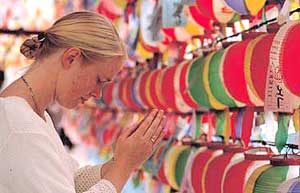
A western devotee prays in front of lanterns in a Seoul temple on Buddha's Birthday.
One of the most important events is a street parade of lotus lanterns or Yeondungnori to be held in front of Jogyesa Temple (www.jogyesa.org : 02-732-2183) in downtown on May 19 and May 20, 2007. The parade of lanterns will be displayed along the street of the temple from 7 p.m. to 9 p.m. on May 19, 2007.
Jogyesa Temple is where South Korea's largest and most famous order "Jogye" is headquartered. The temple is the symbol of Korean Buddhism. Nearly one fourth of 45 million South Koreans are identified as believers of Buddhism.
On May 20, 2007 on the same street in front of the temple a series of events will take place from noon till 8 p.m. The events include contest of lotus lantern making for foreigners, international Buddhism lecture, traditional or Buddhism music, and traditional or Buddhism style food event.
On the same day between 4:30 p.m. and 6:30 p.m. some 50,000 people will gather at Dongdaemun Ball Park near the Big East Gate (Dongdaemun) in Seoul for a variety of performance as well as Buddhist ritual.
A grand parade of Buddhist lanterns will follow the event between 7 p.m. and 9:30 p.m. on the day on the Jongno street from Dongdaemun all the way to the Jogyesa Temple. Hundreds of foreign tourists are expected to join the lantern parade. They will include 150 Dutch tourists.
Concert will follow the parade at Jonggak intersection. Local female vocalist Maya, local dance group Clone, local percussion group of Yadan, local popular singer Choi Jin-Suk will appear on the stage.
A traditional lantern exhibition will be held at Bongeunsa Temple (www.bongeunsa.org : 02-511-6070) in Samsung-dong, Gangnam-gu in the southern part of Seoul. The exhibition will run from May 18 to May 24, 2007.
The main ritual for Buddha's Birthday will be held at 10 a.m. on May 24, 2007 at all the temples around the nation as well as at Jogyesa Temple.
For details or inquiries please contact Celebration Committee for Buddha's Birthday at 02-2011-1747 or at the website (www.LLF.or.kr).