New Zealand's Buddha Boom
-
New Zealand's Buddha Boom
By Vanessa Walker, New Zealand Herald, July 21, 2007
Auckland, New Zealand -- Thousands of New Zealanders from all walks of life have one thing in common: they are followers of Buddhism. Twenty-four years ago, Charlotte Wrightson used to thrash around angrily in an Auckland punk band called The Plague, making a commotion about the evils of private property, capitalism and conformity.
Around the same time, in Hong Kong, businessman Scott Wong had a recurring dream that led him to question the monks at a monastery he would visit during business trips on the mainland.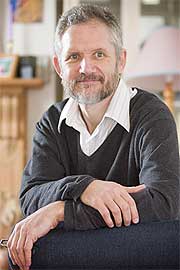
Simon Harrison
Going back further, to the mid-1970s, Simon Harrison was studying pure mathematics at Oxford University and living in a "free-thinking" house in Britain when he met someone who changed the course of his life.
Today these seemingly disparate people are connected by a faith that is growing quietly in New Zealand. According to the latest census 52,394 people identified themselves as Buddhist - an increase of nearly 11,000 since 2001. That's small compared with the 2 million-strong Christian population, but deduct the 37,590 Buddhists who brought their beliefs with them when they migrated here, mainly from Asia, and it emerges nearly 15,000 New Zealanders have converted to Buddhism, a faith with which they have little evident connection. Buddhism is the largest religion apart from Christianity and Hinduism (nearly 64,000), and outsizes all the religions that attract more attention, such as Islam (approximately 36,000), Brethren (18,000) and Scientology (357).
And many more are curious about its fundamental message. When one of Buddhisms most visible adherents, the Nobel-prize winning Dalai Lama, last month made his fourth visit to New Zealand, 10,400 people who filled Aucklands Vector Arena and 4300 in Wellingtons TSB Arena paid to hear him talk. Peel back the numbers and it transpires New Zealand hosts the gamut of Buddhist traditions; from monks living in semi-silent solitude in a forest valley in Wellington, to Zen adherents trying to penetrate their innermost consciousness using koan (paradoxical questions that cannot be answered by the discursive intellect), to outwardly ordinary people taking up meditating and seeking instruction from Tibetan lamas on how to liberate oneself from the cycle of birth and death.
There are small thriving nunneries that, in style and substance, are indistin-guishable from their counterparts in Asia, but there are also Buddhist groups such as Friends of the Western Buddhist Order who have attempted to modernise Buddhism and indigenise their centres with kauri and puriri trees. Auckland has the countrys largest Buddhist temple, an ornate 3.6ha complex that resembles a small town and provides almost as many services as such to its thousands of attendees.
What unites these groups are the five ethical tenets: not killing, not stealing, refraining from sexual misconduct, not using harmful speech and not taking intoxicants that cloud the mind. Further pledges include not gossiping about the faults of others; not praising oneself and disparaging others; not to withhold spiritual or material aid but to practise generosity: not to become angry but to practise forbearance and to uphold the Buddhist way.
Buddhists believe not in divine intervention but in the law of cause and effect (karma), in rebirth, and that the path to enlightenment is achieved through an individuals thought transformation. For the New Zealanders who have converted to Buddhism, it is less a religious label than a cohesive set of principles to help them navigate life.
pg1 -

Amala Wrightson
Former punk Charlotte Wrightson - who once played naked except for a coating of yellow paint at the Nambassa rock festival is now 47-year-old Zen priest Amala Wrightson. She established the Auckland Zen Centre, a collection of three draughty rooms at the former Sanitarium Factory in Royal Oak. Here some 40 practitioners - ranging from Westerners, Asians, Eastern Europeans and Americans - take instruction from her. A further 300 subscribe to the groups mailing list.
As is the case with many people who have adopted Buddhism, Wrightson's transformation began when she was in her 20s and faced her first big life challenge. She was raised an Anglican, and her then boyfriend, now husband, poet Richard von Sturmer, had gone on what was supposed to be an exciting trip to Italy to study at a reputable theatre school. "But it sort of ended up being a crisis year. We had trouble finding a place to live and we ended up in a cold room looking after the son of the theatre director.
Richard got writer's block and suffered from insomnia," she says. "That made us realise we needed to get a bit more sorted out in terms of our ability to cope with things."
By chance one of the books they took with them was The Three Pillars of Zen. It precipitated a trip to Stockholm to hear author Roshi Philip Kapleau speak and that led Wrightson to her first three-week retreat in 1988. For the former punk the routine was strenuous; participants rose at 4.30am: their meditation and work was conducted in silence, interrupted only by simple meals until they fell into bed at 9.30pm.
But the intense singularity of the experience opened up her mind. "I remember going into the dormitory bathroom to brush my teeth and turning on the tap and hearing the water as if for the first time. I realised how much noise there usually was in my mind, that normally I don't live or experience my life.
"Just a little thing like that gave me faith to keep going. It's not always like that - often it's just a struggle - but I got a sense of how effective the practice was."
For the next 15 years, Wrightson and her husband lived between New Zealand and Roshi Kapleaus centre in upstate New York. In 1999 Wrightson became a Zen priest, making the study and teaching of Buddhism her life's vocation. Being a priest means she can remain married because unlike nuns she has not taken a vow of celibacy. She returned to New Zealand in 2003 to establish the centre.
Wrightson acknowledges there are varying levels of dedication from those who say they are Buddhist, but says most of her students are seriously studying the dharma (Buddhas teachings). "Zen is not as exotic as other traditions because you basically get told to go and sit and face a wall," she says. "The emphasis in Zen is on direct experience not the theory."
Buddhism, she says, has benefited her enormously. "I'm able to stay on an even keel through life's ups and downs. More able to really be with other people and help other people, I hope. I have a little bit more clarity and direction." Yet her decision to dedicate her life to the Zen path hasn't come without sacrifices - the hardest, she says, was the decision not to have children. "I couldn't have done what I've done if I had them. You can't do everything. There are points where you have to leave something behind."
Hugh Kemp is a Victoria University student who is writing his PhD thesis on Buddhism in New Zealand. A Christian who was raised in India, he recently traversed the country interviewing Buddhists from all walks of life to find why it appeals to such a diverse range of people.
He says immigrants find some degree of cultural solace in the traditional Buddhist rituals, as well as an identity which connects them to their country of origin. Those who have converted to Buddhism are largely Pakeha (although he notes there are 1836 Maori Buddhists), baby-boomers in their 40s and 50s, many of whom have a "cut and paste" approach to the beliefs rather than wholesale adoption of its teachings. It is possible to blend Buddhism with secular life and other religions; there are, for example, Jewish and Catholic Buddhists who see the dharma as an additional facet to their lives, not a contradiction.
"[Converts] especially use meditation as a tool to cope with the crazy mixed-up world we live in," Kemp says. "A lot of people also told me that they find that it gives them an opportunity to take responsibility for their own spiritual development, unlike some other religions - and they also like the fact there is no over-arching hierarchy."
He believes the seeds of Buddhism's growth began with travellers to Asia during the 1960s and 70s. "My hunch is that Kiwis travelling through Asia had an exotic attraction to Buddhism. As a mindset, New Zealanders are curious and like different-ness. Also we tend to support the underdog, hence the anti-nuclear thing with the US and we also think Tibet should not be bullied by China." He believes that among the attractions of New Zealanders to the Dalai Lama's Tibetan tradition, there is a strong political nuance. Many also talk about the charisma of the lamas.
Simon Harrison is a case in point. He was instrumental in bringing the Dalai Lama to New Zealand this time, the culmination of a dramatic meeting as a 22-year-old with a Tibetan lama.
It was 1976 and Harrison was studying pure mathematics at Oxford University. As a mathematician he always had a question about how love, compassion and altruism fitted into logic so a friend took him to a Buddhist centre. There he learnt its logical basis but "on the last day [a Tibetan teacher called] Lama Yeshe came up the path. I was on the lawn and he simply said 'good morning' and that was love and compassion without needing any explanation," he says. "Meeting Lama Yeshe was the point at which I could never let go and it has sustained me since."
This is the essence of the lamas' significance in Buddhist practice - the simplest of exchanges can have a resonance beyond the ordinary. For Harrison, the seemingly mundane conversation became something much more significant; Lama Yeshe seemed the embodiment of goodness.
pg2 -
For 25 years Harrison has worked as secretary and treasurer of Auckland's Dorje Change Institute, a Tibetan Buddhist centre, while building up a successful business. He meditates for 40 minutes each morning, has an altar in his study and is a vegetarian who tries not to kill insects, spiders and other sentient beings. As a supply chain consultant for companies such as Fonterra, he says he hasn't had to struggle with being a Buddhist in corporate life. There are parts of corporate life I don't get into, such as drinking parties, but I feel that as much as possible I maintain my ethics given my work. In sales situations, sometimes people have wanted me to say things that I didn't want to but I've found it more effective to be honest. The aspect of karma that I live my life by is personal responsibility and that means I cannot get away from the consequences of my actions.
He has turned down projects such as working for Tegel Chicken as well as excusing himself from working on a meat industry project. "But at the same time I have worked on projects for New Zealand Breweries."
Like many others he was attracted to Buddhism because of its promise of overall happiness, a state he has achieved. But despite its benefits he says there are aspects that remain a struggle.
"Scepticism will always be a hallmark of western philosophical thought and wherever it came from I'll always have it with me," Harrison says. He cites the Tibetan Buddhist practice of guru devotion, whereby after having accepted someone as their primary teacher a student must view him or her as an enlightened Buddha, doing whatever is asked of them because the guru can comprehend its eventual spiritual benefit.
"With guru devotion you have to put scepticism aside. I understand why that's necessary, I just can't do it. So what I end up doing is offering service through administration, such as organising the Dalai Lama's visit."
During that trip Harrison arranged for Amala Wrightson to meet the Buddhist leader and ask for his blessing to set up New Zealand's first Buddhist Council. She has approached various Buddhist groups in the hope that for the first time Buddhists can contribute to issues such as the Government's current review of immigration policy and the move to introduce education about all religions into schools.
In contrast, 55-year-old Scott Wong professes to 100 per cent faith in the teachings. A teacher at the Tsi Ming temple in Greenlane, he decided to investigate Buddhism after a recurring dream featuring various Buddhist symbols. Then living in Hong Kong, he approached the monks at a temple on the Chinese mainland to decipher its meaning and began to inquire about Buddhist beliefs.
His path was slow and laborious, thoroughly investigating Buddha's teachings every step of the way. A retired businessman, he had started studying the basic tenets, taking three years to finish reading and understanding the seminal Mahayana text Path to Enlightenment. It took him one-and-a-half years to study the five precepts, making sure he understood exactly what they required of him. In decades of study he has accumulated 4000 books on Buddhism. He spends around six hours on study and four hours reciting mantras, meditating and studying the sutras (Buddhist scripture) every day. Through an interpreter he says the main benefits are simply in his thoughts and clarity of mind. My mind has broadened so I have a wider perspective and a clearer picture. My heart and body are relaxed. I feel light, not burdened.
pg3 -

Karen Lee
47, migrated from Malaysia four years ago and attends New Zealand's largest temple, Fo Guang Shan.
"I was born in Malaysia and there we follow our parents into a Buddhist way of life, going to the temple and making offerings to the deities. My parents' parents were also Buddhist. When we were young we didn't really learn about Buddhist practice we just went to the temple to pray. I would also see my mother meditate and chant for two hours every morning. She is 84 but so healthy. My mother didnt know how to teach us about the sutras but I was able to learn by her actions. When I came to New Zealand I started going to the temple, mainly for tradition but then I got to learn more about Buddhism in a serious manner. I enjoy going to the temple because I found a new way of learning and I started to take Buddhism classes. I understand more about what is our religion is and how to practice. I go to the temple every Sunday and then I also volunteer my service there and in my daily life I read the sutras and do short mantras [short praises]. I also try and live by the five Buddhist precepts now that I comprehend the practice."
Rohan Bush
38, with daughter Maeve, 9 months. An adviser on sustainable architecture who attends Friends of the Western Buddhist Order (FWBO)
"I was attracted to Buddhism because a friend of mine was involved and I could see the benefits it was bringing to her life. I remember sitting down and googling Buddhism centres and the first one that popped up was the FWBO. The fact it was called Western Buddhist Order was good because I was unsure how I would respond to the ethnic dimension of Buddhism as I wasn't familiar with eastern cultures. My career took a slide towards a more ethical kind of architectural practice, which happened at the same time as getting involved in Buddhism. It's nice to be involved in something that's simply good - but that's not to say that people doing more ethically complex jobs are doing anything wrong. Buddhism has had a strong impact on the kind of relationships I have. I do things differently than before - not in an overtly alternative kind of way but in a more deeply thoughtful way. It's been incredibly useful to have a set of principles that I have confidence in. Raising Maeve a Buddhist is not something my partner and I have discussed. Buddhism is something you investigate yourself, it's something you have to practice, no one can practice for you. I hope she will see the benefits it's brought to me and be curious to find out about it but I also think there's real value in children not doing what their parents do and exploring everything else and perhaps coming back later."
Ajahn Tiradhammo
58, Thai forest monk and Abbot of Bodhinyanarama Monastery in Wellington
"I was studying engineering at university in Vancouver when I visited a monastery in Sri Lanka, spending one month there. It was an intense practice with very little sleep. One day my mind was going crazy and I told it to shut up and it just stopped - from there I realised it was possible to be free of this endless chatter of the mind. I thought I'd take one more year in Thailand, do a retreat, get enlightened and go home but I ended up spending nine years in a forest monastery and taking monks vows.
In New Zealand I live in a little hut in the forest. It has a big room about 4m long and 3m wide, with a kitchen and water tank, a gas stove and heater. I am in silence much of the time. For my daily schedule I rise at 4.30am for meditation until 6.30am then do clean-up, have breakfast and work until 10.15am. Our main meal is at 10.30am - we don't have solids after midday - and I study sutras during the afternoon. After tea we [the monks] might meet for chanting and meditation. We are supported through donations from our supporters, who pay about $6000 per month for the upkeep of the monastery. As Theravadan monks we don't handle money ourselves.
I've now been meditating for 33 years. It's given me the possibility of understanding how the mind works. If you don't know how the mind works you can't control it. You are a product of your moods and fancies."
pg4