Do you believe in Reincarnation ?
-
Hi guys,
Yes. I definitely believe in reincarnation. If we have done lots and lots of bad deeds in this birth, we are bound to born again and again till we settle those deeds.
Many events in our lives are destined, beginning with our birth and the family that we are born into. One is born into a family, where conditions are conducive to undergo one?s destiny and where one has significant give-and-take account with each member of the family.
According to the law of Karma every positive deed generates a ?merit? while every negative deed generates a ?demerit? or a sin. Subsequently one has to reap the results of one?s actions. Whenever one does a good deed to others, it is bound to give a positive return (in the form of some happiness), apart from a simple thank you from that person! Whenever one inflicts harm, it is bound to give negative return in the form of sorrow in some form. It cannot be undone by a simple ?Sorry?!
The law of Karma is infallible. It is something like Newton?s third law of motion, which states, ?For every action there is an equal and opposite reaction?.
Throughout our lives we are either settling an old account or creating a new one. If the account cannot be settled in this birth it is carried over to the next. We are not consciously aware of the give-and-take accounts generated in our previous births.
Besides, the status of the relationship and the sex of the individual may change with subsequent births. So a father of a person in one birth can be born as a daughter of the same individual in the next.
any other people opinion??? -
no....we only live once.
-
Believe it or not... there's this man, whos psychic ability is so powerful, one look into a person's eyes, and he can see/feel/experience all that person's past lives, all within that one moment...
This remarkable man, whose name is Charles Breaux, has written a book on his experiences. Check out the detailed accounts he gives of 12 different people's series(es) of past lives.
Charles Breaux's "The Way of Karma"
http://infinity.usanethosting.com/Heart.Of.God/WayOfKarma/index.htm -
yes i do. thats why classes and elites are here
-
it depends on one's religion actually.
-
agreed depends on religion , i'm free so i dun really believe in it ...
-
i do believe in reincarnation, more or less is like, wad were we before now, wad are we after now..
without past there is no present, without present there is no future.
but still it goes down to ur own belief, u belief there is they will be, u dont then there wont be.. -
to be reincarnated as a human being is very fortunate, to reincarnate to born in singapore or much fortunate. how many life forms do we come across each day. do all liveforms have souls? how many bacteria, insects, cockraochs, animals we kill each day? do they get to reincarnate? if people can reincarnated to become animals, so could animals reincarnate to become human. how many percent are they in earth human stand compare to other living organism? not even 0.01% i would say.
So wad are the chances u think u will reincarnated to become a human in your next life? -
nope, i dun believe

-
You can read Professor Weiss bookOriginally posted by MarkWeiMing:Hi guys,
Yes. I definitely believe in reincarnation. If we have done lots and lots of bad deeds in this birth, we are bound to born again and again till we settle those deeds.
Many events in our lives are destined, beginning with our birth and the family that we are born into. One is born into a family, where conditions are conducive to undergo one?s destiny and where one has significant give-and-take account with each member of the family.
According to the law of Karma every positive deed generates a ?merit? while every negative deed generates a ?demerit? or a sin. Subsequently one has to reap the results of one?s actions. Whenever one does a good deed to others, it is bound to give a positive return (in the form of some happiness), apart from a simple thank you from that person! Whenever one inflicts harm, it is bound to give negative return in the form of sorrow in some form. It cannot be undone by a simple ?Sorry?!
The law of Karma is infallible. It is something like Newton?s third law of motion, which states, ?For every action there is an equal and opposite reaction?.
Throughout our lives we are either settling an old account or creating a new one. If the account cannot be settled in this birth it is carried over to the next. We are not consciously aware of the give-and-take accounts generated in our previous births.
Besides, the status of the relationship and the sex of the individual may change with subsequent births. So a father of a person in one birth can be born as a daughter of the same individual in the next.
any other people opinion???
<>
-
I don't believe in Reincarnation but i believe in reborn.
For me, There is only one life here. After this life, you are reborn to be somebody else with an entire new life..
In fact, we reborn at every minutes and seconds. For example, Cell renewal and regeneration, growing older and even subtle changes in personality can happen in and at every moment. -
Isis is right, buddhism is refering to Reborn rather than reincarnation. reincarnation got a soul that move from one body to the next.
reborn is like the change of substance for example water can be in the cyclic state of stream, liquid and ice. changing and changing of energy flux is agreeable with science.
this was posted some time ago.
/\Originally posted by concerned_man:Reincarnation - Interesting videos from the west, by the west
Part 1
http://www.youtube.com/watch?v=_EWwzFwUOxA
Part 2
http://www.youtube.com/watch?v=5965wcH2Kx0 -

-
Is reincarnation true?
Yes. We repeatedly are reborn on earth taking up another life using another body and with a different "personality".
Are we ever reborn as an animal?
No. That is a misunderstanding in some traditions. (The original teachings of those traditions did not hold this view.) Once an individual has reached the level of complexity of a human being, he or she must reincarnate as a human being to continue to work out the relationships of the past and to develop and grow in an environment of suitable complexity.
By the way, you mention "he or she". Could I have been one of the opposite sex in a previous reincarnation?
Yes, definitely. The soul is sexless. It may reincarnate in either sex and it may change from one to the other gender in different lives.
When I die, do I come back immediately?
No. There is a definite cycle of life as a whole. Our life from infant to old-age is a part of that cycle. Death itself is a process divided into recognizable stages. There is a period of long rest between "lifetimes". Typically, for the mass of humanity, that period of rest is about 1,000 to 1,500 years. Then the individual is reborn.
But exactly what is reborn?
A "higher" spiritual part of us is reborn. Theosophy says the "personality" was left behind at the previous death. Certain of that personality's tendencies, lessons learned, character and pure spirit are assimilated from the previous life and remain with the "individual" to be reborn again. The important distinction is between "personality" and "individuality". Over the course of lives, the individuality increases and the personality becomes of less importance. Theosophy has much more detailed information on this question. For the best introduction to that information see How can I learn more described below.
Strictly speaking, we should not say we "have" a soul. Rather, we are a soul and the soul "has" a body it has aquired and is working through. Part of our task is to become aware of this truth.
Why don't I remember my previous lives?
It was a different brain that knew the details of your previous life - so that life and the preceeding ones are not normally remembered in detail. The influences of those lives will of course remain. However at the moment of death we will sometimes see the past life details and as we progress in our individual evolution we come to be able to remember the past lives that had previously been forgotten. -
Originally posted by MarkWeiMing:
note to Buddhists: all and all wat MarkWeiMing stated is based on a Newage Theosophy rather than the idea from Traditional Buddhism that is based on suttas/sutras.
[snipped]
/\ -
Yes I have seen myself fighting for food with other animals

-
I mean its okie to share rite ?Originally posted by sinweiy:note to Buddhists: all and all wat MarkWeiMing stated is based on a Newage Theosophy rather than the idea from Traditional Buddhism that is based on suttas/sutras.
/\
Sinweiy ,by doing such thing, isnt it abit narrow , rather we let him share than point blank at the hard fact .
That drives people away ,even people genuinely interested in Buddhism
note you are a moderator ,so please be a Mahasattva in your words and action -
Originally posted by bohiruci:
if i mind, i'll had deleted already, right anot?
I mean its okie to share rite ?
Sinweiy ,by doing such thing, isnt it abit narrow , rather we let him share than point blank at the hard fact .
That drives people away ,even people genuinely interested in Buddhism
note you are a moderator ,so please be a Mahasattva in your words and action
though one can share, but as a moderator i also need to highlight and/or differentiate.
/\ -
Hi MarkWeiMing, what you copied from is the understanding of the Theosophy society -- however we do not agree much with them. Theosophy is Not Buddhism.
Originally posted by MarkWeiMing:
Actually, based on the original teachings of Buddha, a person will be reborn according to one's karma and therefore it is entirely possible due to the karma of ignorance to be reborn in the lower realms such as the animal realm AND ghost realms... and even hellish realm. The higher realms consists of: Human realm, Asura realm, and Heaven.
Is reincarnation true?
Yes. We repeatedly are reborn on earth taking up another life using another body and with a different "personality".
Are we ever reborn as an animal?
No. That is a misunderstanding in some traditions. (The original teachings of those traditions did not hold this view.) Once an individual has reached the level of complexity of a human being, he or she must reincarnate as a human being to continue to work out the relationships of the past and to develop and grow in an environment of suitable complexity.
There are altogether 6 realms of rebirth that one is reborn to according to one's karma.. and is subdivided into 31 planes of existence. Please read up to find out more...By the way, you mention "he or she". Could I have been one of the opposite sex in a previous reincarnation?
Yes one can be of a different sex in a previous birth. However it is wrong to say that 'the soul is sexless' -- no permanent entity called 'the soul' can be found. Please read further.
Yes, definitely. The soul is sexless. It may reincarnate in either sex and it may change from one to the other gender in different lives.When I die, do I come back immediately?
Not true. One is reborn within 49 days after death, otherwise, one turns into a ghost.
No. There is a definite cycle of life as a whole. Our life from infant to old-age is a part of that cycle. Death itself is a process divided into recognizable stages. There is a period of long rest between "lifetimes". Typically, for the mass of humanity, that period of rest is about 1,000 to 1,500 years. Then the individual is reborn.But exactly what is reborn?
In Buddhism, this is where our understanding of Rebirth differs vastly from other religions' ideas. Other religions teach reincarnation, however, Buddhism teaches rebirth.
A "higher" spiritual part of us is reborn. Theosophy says the "personality" was left behind at the previous death. Certain of that personality's tendencies, lessons learned, character and pure spirit are assimilated from the previous life and remain with the "individual" to be reborn again. The important distinction is between "personality" and "individuality". Over the course of lives, the individuality increases and the personality becomes of less importance. Theosophy has much more detailed information on this question. For the best introduction to that information see How can I learn more described below.
I wrote this in another forum: ...in Buddhism, we do not teach the reincarnation of a separate and permanent self. No such thing can be found. Instead, we teach Rebirth. Rebirth is not the reincarnation of a self, but like all phenomena is merely process and activities, i.e simply a mere happening --
In the traditional Buddhist languages of Sanskrit and Pāli, there is no word corresponding exactly to the English "rebirth". A rebirth, that is, the state one is born into, is referred to as jāti, i.e. simply "birth", also referring to the process of being born or coming into the world in any way. The entire process of change from one life to the next is called punarbhava (Sanskrit) or punabbhava (Pāli), literally "becoming again"; it is also known simply as bhava, i.e. "becoming". The process seen from a universal perspective, encompassing all living beings, is called saṃsāra.
Rebirth is a process -- something that is happening all the time, moment to moment, and life after life (as long as the karmic propensities, or some people call it deep conditionings, are still there and the knot of ignorant perception is still tangled, rebirth happens every moment)
Here's something Thusness/Passerby wrote a long time ago:
http://simpo.proboards20.com/index.cgi?board=insight&action=display&thread=1103708952
Life (Self) is nothing other than the continuous flow of the Now Moment.
The Now Moment ceases as it arises. This moment must completely ceased
and serves as the CAUSE for the next moment to arise.
Therefore Self is a process of series Self1, Self2, Self3, Self4, Self5, Self6...etc
A fixed entity 'Self' does not exist, what really exists is a momentary Self.
Under deep meditation, one is able to observe and sense the karmic and mental factors from moment to moment,
it is these factors that are succeeded from moment to moment and life and life but not a fixed entity.
When the karmic and mental factors subsides, it is known as "The True and Only (and Inherently egoless) Conscious Light (Itself)".
----------
And if you still remember the article "Nondual Thinking" by David Loy:
http://ccbs.ntu.edu.tw/FULLTEXT/JR-JOCP/jc26559.htm
...The image of a worm hesitant to leave its hold was used in a personal conversation I had in 1981 with a Theravada monk from Thailand, a meditation master named Phra Khemananda. This was before I discovered the passage from Ramana Maharshi; what Khemananda said was not prompted by any remark of mine, but was taught to him by his own teacher in Thailand. He began by drawing the following diagram: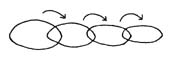
Each oval represents a thought, he said; normally, we leave one thought only when we have another one to go to (as the arrows indicate), but to think in this way constitutes ignorance. Instead, we should realize that thinking is actually like this: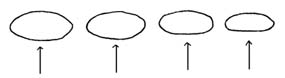
Then we will understand the true nature of thoughts: that thoughts do not arise from each other but by themselves.... -
Strictly speaking, we should not say we "have" a soul. Rather, we are a soul and the soul "has" a body it has aquired and is working through. Part of our task is to become aware of this truth.
Again, this is wrong, and is founded by a false belief in an Atman or an inherently existing Self. In reality no such Self can be found -- and the realisation that there is No-Self is Enlightenment.
This is the right way to understand it: Each moment (Self1, Self2, Self3) is complete and entire of its own. Self1, Self2, Self3, each arise in a Spontaneous and Disconnected fashion... and each arising of a Self1, Self2, this is Arising, re-Birth, etc. There is no fixed entity 'Self' at all -- there is no self to be found, apart from Self1, Self2, Self3, Self4, Self5, etc, arising in a spontaneous and disconnected way. There is no movement in changes -- movement implies that Self exists in a connected way. No. No such Self can be found -- all things including your Self is empty of inherent existence.
Moments of mental states always change as Iron darts hit:
Observing the abrupt Change of all States discloses their discrete nature:
When continuity is disrupted means, when it is exposed by observation of
the perpetual alteration of states as they go on occurring in succession.
For it is not through the connectedness of states, that the characteristic of
impermanence becomes apparent to one who rightly observes rise and fall,
but rather the characteristic becomes properly evident through their discrete
disconnectedness, regarded as if each moment were iron darts, hitting in on
reality one by one separately, instead of as a continuous flow of slow change.
VismA. 824
However, due to karmic propensity, the habitual momentum to act, correlate, and chain in a linear way, we see 'Self' as an entity... and furthermore we see in a dualistic way, as if there is an agent, doer, and experiencer in the world. This must be dissolved through insights.
Please read: http://www.shambhalasun.com/index.php?option=com_content&task=view&id=1677
...A somber day, isn't it? Dark, cloudy, cool, moist and windy. Amazing, this whole affair of the weather!
We call it weather, but what is it really? Wind. Rain. Clouds slowly parting. Not the words spoken about it, but just this darkening, blowing, pounding and wetting, and then lightening up, blue sky appearing amid darkness, and sunshine sparkling on wet grasses and leaves. In a little while there'll be frost, snow and ice covers. And then warming again, melting, oozing water everywhere. On an early spring day the dirt road sparkles with streams of wet silver. So—what is weather other than this incessant change of earthly conditions and all the human thoughts, feelings and undertakings influenced by it? Like and dislike. Depression and elation. Creation and destruction. An ongoing, ever-changing stream of happenings abiding nowhere. No real entity weather exists anywhere except in thinking and talking about it.
Now, is there such an entity as me or I? Or is it just like the weather—an ongoing, ever-changing stream of ideas, images, memories, projections, likes and dislikes, creation and destruction, that thought keeps calling I, me, Toni, and thereby solidifying what is evanescent? What am I really, truly, and what do I merely think and believe I am?
Are we interested in exploring this amazing affair of myself from moment to moment? Is this, maybe, the essence of this work? Exploring ourselves attentively, beyond the peace and quiet that we are seeking and maybe finding occasionally? Coming upon an amazing insight into this deep sense of separation that we call me and other people, me and the world, without any need to condemn or overcome?...
-----------------------
Here's another good read: http://www.budsas.org/ebud/mahasi-anat/anat04.htm
THE STORY OF THE BHIKKHU SATI
At the time of the Blessed One there was a disciple named Sati who mistook consciousness to be self, and clung to the wrong view of self. The monk Sati declared that he had understood and grasped what the Buddha had taught thus:
Tadevidam vinnanam sandhavati samsarati anannam.
"It is this same consciousness that has been transmigrating and wandering about from existence to existence, no other."
This was his understanding of the Buddha's teaching. He based his views on the Jataka stories such as King Vessantara, Chaddan the elephant king, and Bhuridatta the Naga king, who were said to be some of the Buddha's previous existences. In his last existence as Buddha, there were no material aggregates of King Vessantara, nor of the elephant king or the Naga king, but Sati believed that the consciousness of the last existence as Buddha was the same that had existed previously as King Vessantara, the elephant king and the Naga king; it had remained undestroyed, enduring, and stable throughout the rounds of existence. This was how he understood and transmitted the Buddha's teaching. His belief was simply nivasi atta, clinging to consciousness as a continuous self.
The learned disciples of the Buddha tried to explain to him that his view was wrong, but Sati remained adamant, believing that he knew the Dhamma better than the other monks. It is not easy to point out the true Dhamma to those holding wrong views. They are apt to look down on their well-wishers as antiquated and behind the times, unlike their leader who innovates a new interpretation. As a matter of fact, anyone claiming to be of Buddhist faith should ponder well to see whether his or her views are in accordance with the teaching of the Buddha. If we hold onto views which do not accord with the Buddha's teaching, we are then outside the dispensation.
Having failed to persuade Sati to abandon his wrong views, some of the monks went and reported the matter to the Blessed One, who then sent for Sati. When asked by the Blessed One, Sati repeated his views: "Based on the Jataka stories as recounted by the Blessed One, I see that the present consciousness is the same as that one which had existed in previous lives. That consciousness has not reached destruction but passed on from existence to existence. This is how I understand."
The Buddha asked him what he meant by consciousness.
He replied, "Lord, consciousness is that which expresses, which feels, which experiences the fruits of good and bad deeds (now here, now there) in this existence, in that existence."
"To whomever, you stupid one, have you heard me expounding the doctrine in this manner?" remonstrated the Blessed One. "I have explained consciousness as arising out of conditions; that there is no arising of consciousness without conditions. In spite of that you have wrongly interpreted my teaching and attribute that wrong view to me. You have caused the arising of many bad deeds; your holding this wrong interpretation of my teaching and so talking about it will cause distress and suffering to you for a long time to come."
Sati, however, refused to give up that view. Dogmatic views are frightening. Sati was a monk, a disciple of the Buddha. He followed the Buddha's teaching and claimed to have understood it. Yet we find him obstinately refusing to give up his wrong views even when exhorted by the Buddha himself, which of course amounted to not having faith in the Buddha. Nowadays, too, there are some "religious teachers" teaching that there is no need to keep the five precepts or to practice meditation. They say it is enough just to understand the teaching. When wellintentioned learned people try to point out the true teaching to such "teachers," they are said to have replied scornfully that they would not abandon their views even if the Buddha himself came to teach them.
There are many instances where non-Dhamma is being handed around as Dhamma. It is essential to scrutinize any such teaching so as to weed out what is not the teaching, a concise statement of which is given below: (continued in URL) -
Yes everyone is welcomed to share any articlesOriginally posted by bohiruci:I mean its okie to share rite ?
Sinweiy ,by doing such thing, isnt it abit narrow , rather we let him share than point blank at the hard fact .
That drives people away ,even people genuinely interested in Buddhism
note you are a moderator ,so please be a Mahasattva in your words and action Cos we are all still learning. By sharing something even if it is not Buddhist, we can then correct them and provide the Buddhist understanding of the subject matter. -
The Buddha taught that we have such countless past lives, that there is no other sentient being that has not been your Mother before.Originally posted by MarkWeiMing:So a father of a person in one birth can be born as a daughter of the same individual in the next.
Viewing things in such manner, we should treat all sentient beings with compassion -- as if they are our mother. -
Where do we go when we die?? here are the fact below:
What happens when we die, and where do we go? Are the near-death experiences that many people report relevant to students of A Course in Miracles?
The "transition" to death can be likened to the following: 1) shifting from one sleeping dream to another; 2) completing the viewing of one video tape and beginning another; 3) changing channels from one television station to another at the completion of a program, or even before its completion if one so chooses; or finally 4) leaving one room and going into another, as was taught by the great 19th-century Indian sage Ramakrishna. Since consciousness is inherent in the split mind, and not found in the brain or body (although it is experienced there), physical death is but an illusion of an end to one's mental state, which is retained at death. Despite this thought of separation being projected onto the body, it still remains within its source: the wrong mind. Therefore, one does not go anywhere at death. Returning to the analogy of changing television channels, one physically remains in the living room chair, even though one's attention has shifted from the location seen on one television channel to another.
Moreover, it is important to realize that what we call death does not bring about a state of enlightenment or peace. If one does not complete the letting go of the ego's thought system in its entirety, thereby letting go of the wrong mind, enlightenment or resurrection cannot be attainable. In fact, Jesus specifically cautions against such an escapist view of death:
What could you choose between but life or death, waking or sleeping, peace or war, your dreams or your reality? There is a risk of thinking death is peace, because the world equates the body with the Self which God created. Yet a thing can never be its opposite. And death is opposite to peace, because it is the opposite of life. And life is peace. Awaken [the meaning of resurrection] and forget all thoughts of death, and you will find you have the peace of God (T-27.VII.10:1-6; italics ours).
A recent variation of this belief that physical death brings freedom or release from the body is found in many people's "near-death" experiences, and questions about these experiences often are raised during our classes and workshops. The reports usually include the person's experience of leaving the body and proceeding through a dark tunnel to a circle or being of light, often identified as Jesus. This all-loving and gentle presence sometimes reviews the life with the person, and then "sends" the person back to complete lessons, accept certain responsibilities, or assume an important function (always a favorite of the ego's specialness needs).
It is not for anyone to judge these near-death experiences, and it would be foolish to deny the very positive effects such experiences have had for people. However, one can comment on the "theology" of such experiences and the conclusions drawn from them about the meaning of life, death, and the so-called after-life, or "life after life."
The reader must keep in mind that A Course in Miracles states quite clearly that the mind is not in the body, though it certainly can appear otherwise. For example, from the workbook:
The mind can think it sleeps, but that is all. It cannot change what is its waking state. It cannot make a body, nor abide within a body. What is alien to the mind does not exist, because it has no source....
What seems to be the opposite of life is merely sleeping. When the mind elects to be what it is not [the body], and to assume an alien power which it does not have, a foreign state [the body] it cannot enter, or a false condition not within its Source, it merely seems to go to sleep a while. It dreams of time; an interval in which what seems to happen never has occurred, the changes wrought are substanceless, and all events are nowhere. When the mind awakes, it but continues as it always was (W-pI.167.6:1-4; 9; italics ours).
And from "Beyond the Body" in the text:
The home of vengeance [the body] is not yours; the place you set aside to house your hate is not a prison, but an illusion of yourself. The body is a limit imposed on the universal communication that is an eternal property of mind. But the communication is internal. Mind reaches to itself. It is not made up of different parts, which reach each other. It does not go out. Within itself it has no limits, and there is nothing outside it. It encompasses everything. It encompasses you entirely; you within it and it within you. There is nothing else, anywhere or ever (T-I 8.VI.8:2-11; italics ours in sentences 5,7). -
(split up to make it readable)
Therefore, when we consider such near-death experiences from the perspective of A Course in Miracles, we can see that they make no sense on the level of form. How can one leave one's body, travel through a tunnel, and greet a great light, if one were never in the body in the first place? Remember that the self remains in the mind and not the body, just as a dreamer's self is not in the dream, though parts of this self are reflected there. Again, this is not to deny or invalidate a personal experience, but it is to say that however valid an experience is for the person, the interpretation is purely subjective and should not be taken for "objective" truth. For example, everyone experiences the sun as rising and setting every day, and many people report very significant aesthetic and even spiritual feelings associated with sunrises and sunsets. And yet, we know scientifically that the sun does not rise or set, but rather it is the earth that does the movement: rotating on its axis and revolving around the sun. The experience is contrary to the true explanation. Similarly, we all experience the earth as flat as we go through our daily lives, even though we understand intellectually that it is round. And so, one's experience of a near-death occurrence, or of a place to which one goes upon death (or near death) does not necessarily mean that what is understood as the experience is what truly is. And again, when one looks at such experiences through the lens of A Course in Miracles, one would understand them quite differently: expressions of forgiveness that were projected from the mind onto the body and its world of life, death, and near death.
As we have seen, therefore, there cannot in truth be an out-of-body experience since the mind is never in the body to begin with. And so the mind cannot leave the body, travel through a tunnel, and meet with Jesus after having left the body. Moreover, there is a danger in believing this way, because it strongly suggests -- as do many people who have had such an experience -- that such peace, joy, and happiness can only come to a person after having "died" and left the body. The whole focus of A Course in Miracles is on choosing and having a holy instant right now, on choosing Jesus or the Holy Spirit instead of the ego. One does not have to die to go to Heaven, since Heaven is an awareness of perfect Oneness, within the mind, and nothing else besides that. The wonderful experience of forgiveness that is frequently reported can be had in a holy instant, again, without having left the body, going through a tunnel, etc. Holding up near-death experiences to be idealized and sought for (as was depicted in the popular movie Flatliners) actually serves well the ego's fundamental strategy of first making the body real, and then turning it into a repulsive thing. This sets up a situation in which people would wish to be free of its prison of darkness, yearning to escape into the non-corporeal light. And all the while, the ego's thought system of separation, guilt, and specialness nestles comfortably in the mind, protected by the belief that there is indeed a body that is real, and one that truly exists in the physical world.
Thus, believing in the reality of such experiences is the very compromise with truth -- giving light and darkness equal power and reality -- that Jesus cautions against in A Course in Miracles. We see a clear statement of such a caution in the section on death in the manual for teachers, and we quote from this extremely important passage now. It begins with a reference to the standard religious belief that upon death the soul is freed to return to God, or to continue on its journey as in the Catholic doctrine of purgatory. However, the contemporary interest in near-death experiences, as we have just seen, falls into the same category of not recognizing the illusory nature of the entire physical universe and of individual existence -- body, mind, and what is mistakenly referred to as "spirit":
The curious belief that there is part of dying things [i.e., a soul, or "life force"] that may go on apart from what will die, does not proclaim a loving God nor re-establish any grounds for trust. If death is real for anything, there is no life. Death denies life. But if there is reality in life, death is denied. No compromise in this is possible. There is either a god of fear or One of Love. The world attempts a thousand compromises, and will attempt a thousand more. Not one can be acceptable to God's teachers, because not one could be acceptable to God. He did not make death because He did not make fear. Both are equally meaningless to Him.
The "reality" of death is firmly rooted in the belief that God's Son is a body. And if God created bodies, death would indeed be real. But God would not be loving. There is no point at which the contrast between the perception of the real world and that of the world of illusions becomes more sharply evident....
"And the last to be overcome will be death" [the famous statement of St. Paul from his first letter to the Corinthians, 15:26]. Of course! Without the idea of death there is no world. All dreams will end with this one. This is salvation's final goal; the end of all illusions. And in death are all illusions born. What can be born of death and still have life? But what is born of God and still can die? The inconsistencies, the compromises and the rituals the world fosters in its vain attempts to cling to death and yet to think love real are mindless magic, ineffectual and meaningless. God is, and in Him all created things must be eternal. Do you not see that otherwise He has an opposite, and fear would be as real as love?
Teacher of God, your one assignment could be stated thus: Accept no compromise in which death plays a part. Do not believe in cruelty, nor let attack conceal the truth from you. What seems to die [the body that had been "alive"] has but been misperceived and carried to illusion. Now it becomes your task to let the illusion be carried to the truth. Be steadfast but in this; be not deceived by the "reality" of any changing form. Truth neither moves nor wavers nor sinks down to death and dissolution, And what is the end of death? Nothing but this; the realization that the Son of God is guiltless now and forever. Nothing but this. But do not let yourself forget it is not less than this (M-27.4:1-5:4; 6-7; italics ours).
In conclusion, therefore, we can understand that anything that seems to live and then die, that changes, grows, and subsequently deteriorates, or that appears to be separate from others, cannot be of God and therefore cannot be real. And so all categories that relate to bodies in any way -- including death and near death -- have no true meaning because they do not truly exist. Their only meaning within the illusion comes in their serving as classrooms in which we learn the lesson of discerning between the meaningless and the meaningful. -
Finished reading.
I think this article is not talking about rebirth, but about how life and death is illusory. However it leans towards the concept and belief in a personal Creator God, which Buddhism and Buddha avoids teaching such concepts. We do not teach about a personal Creator God.
Also I think statements like "God is, and in Him all created things must be eternal." makes no sense at all. All things that are born are temporal, only the unborn is undying. Ultimately Emptiness/Unborn is the nature of all phenomena, there is no eternality, only timelessness.
My suggestion is if one wishes to understand the topic of Rebirth, please read from reliable Buddhist sources. There are lots of confusing articles and essays out there and many do not give the right understanding of this subject.