I am already a good person, why must I practise dharma?
-
Oh yeah, btw just to share...
"Correct reflection" on the Dharma or life in general will lead to happiness.
"Wrong reflection" on the Dharma or life in general will lead to suffering.
While insight meditation does not teach people to think but remember, to observe reality without judgement, as it is. -
OK let's get back to topic. herzog if u want to continue create a second thread

-
So can we conclude that a good person doesn't need to practice Buddha-dharma.Originally posted by An Eternal Now:OK let's get back to topic. herzog if u want to continue create a second thread -
So we can conclude herzog is talking nonsense and trolling as usual again.Originally posted by Herzog_Zwei:So can we conclude that a good person doesn't need to practice Buddha-dharma. -
Wrong, since being good and evil doesn't make a person any different in the eyes of Buddhism, we can safely assume Buddha-dharma is of no consequence in one's life.Originally posted by An Eternal Now:So we can conclude herzog is talking nonsense and trolling as usual again. -
Originally posted by Herzog_Zwei:
Crap. Whoever said so?
Wrong, since being good and evil doesn't make a person any different in the eyes of Buddhism,we can safely assume Buddha-dharma is of no consequence in one's life.
http://buddhism.sgforums.com/?action=thread_display&thread_id=240316&page=1
...So therefore in Buddhism, Buddha showed us the path leading to the complete ending of all sufferings, finding the abiding purity and bliss of Nirvana, to become liberated from the cycle of rebirth in Samsara. Buddha taught that the Buddhas of past and future all teach Buddhism as "avoid all evil, doing all good, and purifying the mind". Most religions only teach "avoid all evil and doing all good", but only Buddhism teaches about liberation and the purification of the mind. The problem with just "avoiding all evil and doing all good" is that as a result we accumulate a lot of good karma and avoid creating bad karma, meaning we can be reborn in the higher realms or even the celestial realms like the heavens, however we still cannot attain nirvana, we cannot be liberated from the cycle of samsara.. and our enjoyment in these higher realms are also limited and transient. Similarly as described just now even if our lives are very good, there is still bound to be unsatisfactoriness and sufferings.. if we cannot be liberated moment to moment. Therefore when we practise Buddhism, also we practise purification of the mind... through mindfulness we become aware of and disidentify from all our sentient thoughts, our habitual tendencies of the mind, the afflictive emotions and so on due to identification with a false sense of self, and the identification is also known as the false 'ego'. Our Buddha Nature is like a clear mirror, our pure awareness, which unfortunately is obscured from us because of a layer of dust, or mental defilements. Through Buddhism we clean the mirror of its defilements to reveal the clear bright mirror underneath. Therefore through practising Buddhism we gain insights into the nature of reality, the nature of our minds, our Buddha Nature, and through awakening from our delusions we find the nirvanic bliss of clarity and liberation from all sufferings in our lives... -
No more off topic posts. Any more pls start new threads or get deleted.
-
Originally posted by An Eternal Now:
Then purify your mind from living in this moment.
http://buddhism.sgforums.com/?action=thread_display&thread_id=240316&page=1
...So therefore in Buddhism, Buddha showed us the path leading to the complete ending of all sufferings, finding the abiding purity and bliss of Nirvana, to become liberated from the cycle of rebirth in Samsara. [b]Buddha taught that the Buddhas of past and future all teach Buddhism as "avoid all evil, doing all good, and purifying the mind". Most religions only teach "avoid all evil and doing all good", but only Buddhism teaches about liberation and the purification of the mind. The problem with just "avoiding all evil and doing all good" is that as a result we accumulate a lot of good karma and avoid creating bad karma, meaning we can be reborn in the higher realms or even the celestial realms like the heavens, however we still cannot attain nirvana, we cannot be liberated from the cycle of samsara.. and our enjoyment in these higher realms are also limited and transient. Similarly as described just now even if our lives are very good, there is still bound to be unsatisfactoriness and sufferings.. if we cannot be liberated moment to moment. Therefore when we practise Buddhism, also we practise purification of the mind... through mindfulness we become aware of and disidentify from all our sentient thoughts, our habitual tendencies of the mind, the afflictive emotions and so on due to identification with a false sense of self, and the identification is also known as the false 'ego'. Our Buddha Nature is like a clear mirror, our pure awareness, which unfortunately is obscured from us because of a layer of dust, or mental defilements. Through Buddhism we clean the mirror of its defilements to reveal the clear bright mirror underneath. Therefore through practising Buddhism we gain insights into the nature of reality, the nature of our minds, our Buddha Nature, and through awakening from our delusions we find the nirvanic bliss of clarity and liberation from all sufferings in our lives...[/b] -
I have no idea what you are talking about.Originally posted by Herzog_Zwei:Then purify your mind from living in this moment.
Diamond sutra says, past mind, present mind, future mind are ungraspable. So if you mean purify yourselves from such clingings, then yes. -
See how you like to twist my words... I ask you to purify your mind from living in the present, but you end talking about past mind, present mind and future mind.Originally posted by An Eternal Now:I have no idea what you are talking about.
Diamond sutra says, past mind, present mind, future mind are ungraspable. So if you mean purify yourselves from such clingings, then yes. -
You have never lived out of the present, ever. To think otherwise is merely false illusions.Originally posted by Herzog_Zwei:See how you like to twist my words... I ask you to purify your mind from living in the present, but you end talking about past mind, present mind and future mind. -
Then why bother about changes? There always be another future to change.Originally posted by An Eternal Now:You have never lived out of the present, ever. To think otherwise is merely false illusions. -
Change happen but change also happens as present moment, never a past nor a future. When change occurs, it occurs in the present. When results occur, they occur in the present.. AS the present moment. There never was anything that happened outside the present moment, if you think there is it merely is an illusion due to the poverty of the analytical mind -- and of course, the analytical mind too, functions in the Present. There is NO movement in time, and no 'thing' that ever moves or changes, because there is only change, and each moment of change is a disjoint, spontaneous and complete arising of a single (present) moment.Originally posted by Herzog_Zwei:Then why bother about changes? There always be another future to change.Buddhism and the Illusion of Time
As for time being illusory and the universe being nothing but a series of separate "instants," like frames in a movie, that's basically correct. Everything we call "the past" is, literally, nothing but present memories. Likewise, everything we call "the future" is nothing but present memories inverted, or rearranged, to form a prediction or expectation. The appearance of "time" is little more than a trick of memory, as the Avatamsaka Sutra (Flower Ornament Scripture) says. You can easily discern this for yourself: simply figure out what it is you consider "the past" and "the future." You will discover that it is nothing but thoughts--nothing but memories, nothing but expectations, nothing but mental commentary. It's "all in your head," so to speak. There's really no such thing as time. There is really only Now--an eternally present Present with no beginning and no ending. Everything is completely new, distinct, and original every instant, with no real "change" or "motion" at all. The mystic-philosopher Heraclitus, explaining this point, said, "A man cannot step in the same river twice."Nothing Exists Outside The Now
Aren't past and future just as real, sometimes even more real, than the present? After all, the past determines who we are, as well as how we perceive and behave in the present. And our future goals determine which actions we take in the present.
You haven't yet grasped the essence of what I am saying because you are trying to understand it mentally. The mind cannot understand this. Only you can. Please just listen.
Have you ever experienced, done, thought, or felt anything outside the Now? Do you think you ever will? Is it possible for anything to happen or be outside the Now? The answer is obvious, is it not? Nothing ever happened in the past; it happened in the Now. Nothing will ever happen in the future; it will happen in the Now. What you think of as the past is a memory trace, stored in the mind, of a former Now. When you remember the past, you reactivate a memory trace - and you do so now. The future is an imagined Now, a projection of the mind. When the future comes, it comes as the Now. When you think about the future, you do it now. Past and future obviously have no reality of their own. Just as the moon has no light of its own, but can only reflect the light of the sun, so are past and future only pale reflections of the light, power, and reality of the eternal present. Their reality is "borrowed" from the Now.
The essence of what I am saying here cannot be understood by the mind. The moment you grasp it, there is a shift in consciousness from mind to Being, from time to presence. Suddenly, everything feels alive, radiates energy, emanates Being.
~ The Power of Now, Eckhart Tolle -
As the change happens, the future is becoming the present.Originally posted by An Eternal Now: -
There is absolute NO movement at all. And there is absolutely no variable called time that exists separate from each moment of arising that chains up past to future.Originally posted by Herzog_Zwei:As the change happens, the future is becoming the present.
http://www.buddhistinformation.com/buddhism_and_the_illusion_of_time.htm
Zen Master Seung Sahn elaborated on this topic in his excellent book The Compass of Zen (p. 143):
"Everyone thinks that this is extremely difficult teaching, something beyond their reach or experience. How can things appear and disappear, and yet there is, originally, even in this constantly moving world, no appearing and disappearing? A student once asked me, 'The Mahaparinirvana-sutra seems very confusing. Everything is always moving. And yet everything is not moving? I don't understand this Buddhism . . .' But there is a very easy way to understand this: Sometime you go to a movie. You see an action movie about a good man and a bad man--lots of fighting, cars moving very fast, and explosions all over the place. Everything is always moving very quickly. Our daily lives have this quality: everything is constantly moving, coming and going, nonstop. It seems like there is no stillness-place. But this movie is really only a very long strip of film. In one second, there are something like fourteen frames. Each frame is a separate piece of action. But in each frame, nothing is moving. Everything is completely still. Each frame, one by one, is a complete picture. In each frame, nothing ever comes or goes, or appears or disappears. Each frame is complete stillness. The film projector moves the frames very quickly, and all of these frames run past the lens very fast, so the action on-screen seems to happen nonstop. There is no break in the movement of things. But actually when you take this strip of film and hold it up to the light with your hands, there is nothing moving at all. Each frame is complete. Each moment is completely not-moving action.
"Our minds and the whole universe are like that. This world is impermanent. Everything is always changing, changing, changing, moving, moving, moving, nonstop. Even one second of our lives seems full of so much movement and change in this world that we see. But your mind--right now--is like a lens whose shutter speed is one divided by infinite time. We call that moment-mind. If you attain that mind, then this whole world's movement stops. From moment to moment you can see this world completely stop. Stop. Stop. Stop. Stop. Stop. Like the film, you perceive every frame--this moment--which is infinitely still and complete. In the frame, nothing is moving. There is no time, and nothing appears or disappears in that box. But this movie projector--your thinking mind--is always moving, around and around and around, so you experience this world as constantly moving and you constantly experience change, which is impermanence. You lose moment-mind by following your conceptual thinking, believing that it is real."
http://www.sgforums.com/?action=thread_display&thread_id=247058Originally posted by An Eternal Now:The image of a worm hesitant to leave its hold was used in a personal conversation I had in 1981 with a Theravada monk from Thailand, a meditation master named Phra Khemananda. This was before I discovered the passage from Ramana Maharshi; what Khemananda said was not prompted by any remark of mine, but was taught to him by his own teacher in Thailand. He began by drawing the following diagram: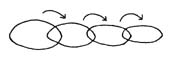
Each oval represents a thought, he said; normally, we leave one thought only when we have another one to go to (as the arrows indicate), but to think in this way constitutes ignorance. Instead, we should realize that thinking is actually like this: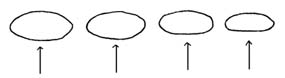
Then we will understand the true nature of thoughts: that thoughts do not arise from each other but by themselves.
This understanding of thoughts-not-linking-up-in-a-series but springing up nondually is consistent with D. T. Suzuki's conception of prajna: -
http://atheism.sgforums.com/?action=thread_display&thread_id=270598 (Newsflash: Time May Not Exist):
Interesting read, thanks....Time, in this view, is not something that exists apart from the universe. There is no clock ticking outside the cosmos. Most of us tend to think of time the way Newton did: “Absolute, true and mathematical time, of itself, and from its own nature, flows equably, without regard to anything external.” But as Einstein proved, time is part of the fabric of the universe. Contrary to what Newton believed, our ordinary clocks don’t measure something that’s independent of the universe. In fact, says Lloyd, clocks don’t really measure time at all.
Nondual Thinking and the Mahayana Deconstruction of Time
“I recently went to the National Institute of Standards and Technology in Boulder,” says Lloyd. (NIST is the government lab that houses the atomic clock that standardizes time for the nation.) “I said something like, ‘Your clocks measure time very accurately.’ They told me, ‘Our clocks do not measure time.’ I thought, Wow, that’s very humble of these guys. But they said, ‘No, time is defined to be what our clocks measure.’ Which is true. They define the time standards for the globe: Time is defined by the number of clicks of their clocks.”
Rovelli, the advocate of a timeless universe, says the NIST timekeepers have it right. Moreover, their point of view is consistent with the Wheeler-DeWitt equation. “We never really see time,” he says. “We see only clocks. If you say this object moves, what you really mean is that this object is here when the hand of your clock is here, and so on. We say we measure time with clocks, but we see only the hands of the clocks, not time itself. And the hands of a clock are a physical variable like any other. So in a sense we cheat because what we really observe are physical variables as a function of other physical variables, but we represent that as if everything is evolving in time.
“What happens with the Wheeler-DeWitt equation is that we have to stop playing this game. Instead of introducing this fictitious variable—time, which itself is not observable—we should just describe how the variables are related to one another. The question is, Is time a fundamental property of reality or just the macroscopic appearance of things? I would say it’s only a macroscopic effect. It’s something that emerges only for big things.”
The problem, in brief, is that time may not exist at the most fundamental level of physical reality...
....If we are thus trapped in time, how can we escape? The paradoxical nondual solution is to eliminate the dichotomy dialectically by realizing that I am not in time because I am time, which therefore means that I am free from time.
Much of our difficulty in understanding time is due to the unwise use of spatial metaphors -- in fact, the objectification of time requires such spatial metaphors -- but in this case another spatial metaphor is helpful. We normally understand objects such as cups to be "in" space, which (as explained above in relation to time) implies that in themselves they must have a self-existence distinct from space. However, not much reflection is necessary to realize that the cup itself is irremediably spatial. All its parts must have a certain thickness, and without the various spatial relations among the bottom, sides, and handle, the cup could not be a cup. Perhaps one way to express this is to say that the cup is not "in" space but itself is space: the cup is "what space is doing in that place," so to speak. The same is true for the temporality of the cup. The cup is not an atemporal, self-existing object that just happens to be "in" time, for its being is irremediably temporal. The point of this is to destroy the thought-constructed dualism between things and time. When we wish to express this, we must describe one in terms of the other, by saying either that objects are temporal (in which case they are not "objects" as we usually conceive of them) or, conversely, that time is objects -- that is, that time expresses itself in the manifestations that we call objects. Probably the clearest expression of this way is given by Dogen: "The time we call spring blossoms directly as an existence called flowers. The flowers, in turn, express the time called spring. This is not existence within time; existence itself is time."[20] This is the meaning of his "being-time" (uji):
"Being-time" means that time is being; that is, "Time is existence, existence is time." The shape of a Buddha-statue is time.... Every thing, every being in this entire world is time....Do not think of time as merely flying by; do not only study the fleeting aspect of time. If time is really flying away, there would be a separation between time and ourselves. If you think that time is just a passing phenomenon, you will never understand being-time.[21]
Time "flies away" when we experience it dualistically, with the sense of a self that is outside and looking at it. Then time becomes something that I have (or do not have), objectified and quantified in a succession of "now-moments" that cannot be held but incessantly fall away. In contrast, the "being-times" that we usually reify into objects cannot be said to occur in time, for they are time. As Nagarjuna would put it, that things (or rather "thingings"Wink are time means that there is no second, external time that they are "within."....[/url] -
So why the hell are you living? I thought your heart and lungs do not need to move for you to survive?Originally posted by An Eternal Now: -
Change happens in this way:Originally posted by Herzog_Zwei:So why the hell are you living? I thought your heart and lungs do not need to move for you to survive?
NOT this way:
Therefore there is no movement and no 'thing' moved.
There is only change, and change is the universe as one whole undivided process. -
No more off topics otherwise will be deleted. Final warning. Create new topics of necessary.
-
Oops...Originally posted by An Eternal Now:No more off topics otherwise will be deleted. Final warning. Create new topics of necessary.
Can't help to assist AEN on his explanation about the so call time.Time dont exist. it is a condtioned aspect of the earth revolving around the sun and the earth turning on its axis. if we lived on mars and it turned on its axis every 36 hours and revolved around the sun every 400 days the conditioning would be changed. which is correct. the universe has no time.
Ok... No more off topics otherwise will be deleted. Final warning. Create new topics of necessary
-
Off topic message deleted.
-
So a good person doesn't need to practice dharma. Confirmed and proven.Originally posted by Herzog_Zwei:Off topic message deleted. -
Originally posted by Herzog_Zwei:So a good person doesn't need to practice dharma. Confirmed and proven.
+ confirmed and provenOriginally posted by An Eternal Now:So we can conclude herzog is talking nonsense and trolling as usual again.