Gen. the pure mind without relying on anything vs non-abidin
-
this two comes with a similar point
As Buddha always want us to generate Pure mind .
Non-abiding sounds to be in a deeper level ,into the state of emptiness
neither good nor bad thoughts
-
The Diamond Sutra stated,
"Therefore then, Subhuti, the Bodhisattva should produce an unsupported thought, a thought which is nowhere supported, which is not supported (apratisthiti) by forms, sounds, smells, tastes, touchables, or objects of mind."
David loy explains (and you can find lots of good stuff from his article Nondual Thinking) that "A thought is "Unsupported" because it does not arise in dependence upon anything else, not "caused" by another thought ("mind-objects") and of course not "produced" by a thinker, which the Bodhisattva realizes does, not exist. Such an "unsupported thought", then, is prajña, arising by itself nondually."
The Siksasamuccaya of Santideva contains a meditation on thought which further explains the nature of thoughts:
"...For thought, Kasyapa, cannot be apprehended, inside or outside, or in between both. For thought is immaterial, invisible, non-resisting, inconceivable, unsupported and homeless. Thought has never been seen by any of the Buddhas, nor do they see it, nor will they see it. . . . A thought is like the stream of a river, without any staying power; as soon as it is produced it breaks up and disappears. ... A thought is like lightning, it breaks up in a moment and does not stay on....
Searching for thought all round, he does not see it within or without... Can then thought review thought? No, thought cannot review thought. As the blade of a sword cannot cut itself, as a finger-tip cannot touch itself, so a thought cannot see itself."
As for pure mind, my Master teaches that pure mind in contrast to the largely misunderstood notion that one must purify one's evil, and unwholesome thoughts, is actually something altogether different. It is refering to THOUGHTLESSNESS/NO-MIND (wu xin, wu nian/wu wu nian) -- it is not a question of morality but is about liberation.
However this 'thoughtlessness' is again very much misunderstood. It does not refer to an absence of thoughts altogether which then we will no longer be able to function as a human being, but it refers to thoughts arising in a spontaneous, unsupported and nondual manner -- merely a functioning of Prajna.
As my local dharma teacher told us, when facing circumstances there is 'Xin' that functions (a functioning of Prajna), a Bodhisattva facing the multitudes of sentient beings will also have mind and thoughts which simply arise according to the conditions and needs, but there is no 'nian' or 'wang nian', because while the former is merely a spontaneous functioning of Prajna, the later is attached thinking which as she said, is really chaining and linking up one thought to another.
Which would then again remind me of the poem written by Hui-Neng in reply of Wo-Lun:
I, Wo-luan, know a device
Whereby to blot out all my thoughts:
The objective world no more stirs the mind,
And daily matures my Enlightenment!
~ Wo-lun
I, Hui-neng, know no device
My thoughts are not suppressed:
The objective world ever stirs the mind,
And what is the use of maturing Enlightenment?
~ Hui-neng
While the former aims to suppress one's mind from thoughts altogether, the other sees thoughtlessness as the spontaneous functioning of Prajna, in which Prajna produces an 'unsupported thought', free from dualistic attachment.. or as David Loy said, "The term "thoughtlessness" would seem to recommend a mind free from any thoughts, but Hui Neng denies this: rather, "thoughtlessness" is the function of a mind free from any attachment."
The meaning of 'thoughtlessness' will later be explained in the next post. -
Here is a very important passage from 'nondual thinking' (the rest of the passage are equally impt) regarding the spontaneous, self-liberating and uncaused/unsupported nature of thoughts:
Originally posted by An Eternal Now:
Nietzsche relates the denial of a thinker to a denial of the process of thinking. Why; after all, do we believe that there is an act of thinking? Because that act is what the thinker does: stringing thoughts together by creating new thoughts on the basis of the old thoughts. If there is no such thinker, then there need be no such act. That leaves only thoughts, but one at a time, although the succession may be rapid.
The significance of Nietzsche's remarks for us is that we find the same claim in the Asian nondual philosophies, particularly in Ch'an Buddhism. In The Platform Sutra of the Sixth Patriarch, Hui Neng explains what prajna is:
To know our mind is to obtain liberation. To attain liberation is to experience the Samadhi of Prajna, which is ''thoughtlessness". What is "thoughtlessness"? Thoughtlessness is to see and know all Dharmas (things) with a mind free from attachment. When in use it pervades everywhere, and yet it sticks nowhere....When our mind works freely without any hindrance and is at liberty to "come" or to "go", we attain Samadhi of Prajna, or liberation. Such a state is called the function of "thoughtlessness". But to refrain from thinking of anything, so that all thoughts are suppressed, is to be Dharma-ridden, and this is an erroneous view. [20]
The term "thoughtlessness" would seem to recommend a mind free from any thoughts, but Hui Neng denies this: rather, "thoughtlessness" is the function of a mind free from any attachment. The implication is that for someone who is liberated thoughts still arise, but there is no clinging to them when they do. Why the term "thoughtlessness" can be used to characterize such a state of mind will become clear in a moment. But the question that arises first is in what way one can ever be attached to thoughts if, as the Siksasamuccaya says, a thought has no staying power, that like lightning it breaks up in a moment and disappears. Hui Neng answers this later in the Platform Sutra when he says more about "how to think":
In the exercise of our thinking faculty, let the past be dead. If we allow our thoughts, past, present and future, to link up in a series, we put ourselves under restraint. On the other hand, if we never let our mind attach to anything, we shall gain liberation.
(my emphasis [21])
One clings to a thought by allowing the thoughts to link up in a series, which means having one's next thought "caused", as it were, by the previous thoughts, rather than letting each thought arise spontaneously and nondually.
According to the autobiographical first part of the Platform Sutra, Hui Neng became deeply enlightened and realized that all things in the universe are his self-nature, upon hearing a line from the Diamond Sutra: "Let your thought arise without fixing it anywhere". [22] The passage just prior to this one-which Hui Neng must also have heard-puts this in context. Edward Conze translates it as follows:
Therefore then, Subhuti, the Bodhisattva should produce an unsupported thought, a thought which is nowhere supported, which is not supported (apratisthiti) by forms, sounds, smells, tastes, touchables, or objects of mind. [23]
A thought is "Unsupported" because it does not arise in dependence upon anything else, not "caused" by another thought ("mind-objects") and of course not "produced" by a thinker, which the Bodhisattva realizes does, not exist. Such an "unsupported thought", then, is prajna, arising by itself nondually.
Hui Neng's grandson in the Dharma, Ma-tsu, reinforces Hui Neng and the Diamond Sutra: "So with former thoughts, later thoughts, and thoughts in between: the thoughts follow one another without being linked together. Each one is absolutely tranquil". [24] That each such "unsupported thought" is absolutely tranquil is a new point, although probably implied by Hui Neng's term "thoughtlessness". So when one loses sense of self and completely becomes an unsupported thought, there is the Taoist paradox of wei-wu-wei, in which action and passivity are combined: there is the movement of nondual thought, but at the same time there is awareness of that which does not change. That is why such an experience can just as well be described as "thoughtlessness". The later Ch'an master Kuei-shan Ling-yu referred to this as "thoughtless thought": "Through concentration a devotee may gain thoughtless thought. Thereby he is suddenly enlightened and realizes his original nature". [25] "Thoughtless thought" is not a mind empty of any thought: "one thought is thoughtless thought."
An important parallel to this is found in the writings of a modern Advaitin, Ramana Maharshi:
The ego in its purity is experienced in the interval between two states or between two thoughts. The ego is like the worm which leaves one hold only after it catches another. Its true nature is known when it is out of contact with objects or thoughts. You should realize this interval as the abiding, unchangeable Reality, your true Being... [26]
The image of the ego as a worm which leaves one hold only after catching another might well have been used by Hui Neng and Ma-tsu to describe the way in which thoughts are apparently linked up in a series. The difference is that Mahayana Buddhism encourages the arising of "an unsupported thought", whereas Ramana Maharshi understands unchangeable Reality as that which is realized only when it is out of contact with all objects and thoughts. This is consistent with the general relation between Mahayana and Advaita: Nirguṇa Brahman is so emptied of any attribute ("neti, neti,...") that it becomes impossible to differentiate from Sūnyata. "It is difficult indeed to distinguish between pure being and pure non-being as a category". (S. Dasgupta). [27] But there is still a difference in emphasis. Mahayana emphasizes realizing the emptiness of all phenomena, whereas Advaita distinguishes between empty Reality and phenomena, with the effect of devaluing the latter into mere maya.
The image of a worm hesitant to leave its hold was used in a personal conversation I had in 1981 with a Theravada monk from Thailand, a meditation master named Phra Khemananda. This was before I discovered the passage from Ramana Maharshi; what Khemananda said was not prompted by any remark of mine, but was taught to him by his own teacher in Thailand. He began by drawing the following diagram: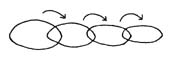
Each oval represents a thought, he said; normally, we leave one thought only when we have another one to go to (as the arrows indicate), but to think in this way constitutes ignorance. Instead, we should realize that thinking is actually like this: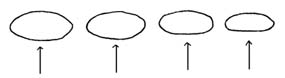
Then we will understand the true nature of thoughts: that thoughts do not arise from each other but by themselves.
This understanding of thoughts-not-linking-up-in-a-series but springing up nondually is consistent with D. T. Suzuki's conception of prajna:
It is important to note here that prajna wants to see its diction "quickly" apprehended, giving us no intervening moment for reflection or analysis or interpretation. Prajna for this reason is frequently likened to a flash of lightning or to a spark from two striking pieces of flint. "Quickness" does not refer to progress of time; it means immediacy, absence of deliberation, no allowance for an intervening proposition, no passing from premises to conclusion. [28][/b] -
http://www.dharmaweb.org/index.php/The_Zen_Teaching_of_Instantaneous_Awakening_By_Hui_Hai
38. Q: The Vimalakirti Nirdesha Sutra says: ‘Whosoever desires to reach the Pure
Land must first purify his mind.Â’ What is the meaning of this purifying of the mind?
A: It means purifying it to the point of ultimate purity.
Q: But what does that mean?
A: It is a state of beyond purity and impurity.
Q: Please explain it further.
A: Purity pertains to a mind, which dwells upon nothing whatsoever. To attain to this without so much as a thought of purity arising is called ‘absence of purity’; and to achieve that without giving it a thought is to be free from absence of purity also. -
Originally posted by An Eternal Now:
nice!
[b]http://www.dharmaweb.org/index.php/The_Zen_Teaching_of_Instantaneous_Awakening_By_Hui_Hai
38. Q: The Vimalakirti Nirdesha Sutra says: ‘Whosoever desires to reach the Pure
Land must first purify his mind.Â’ What is the meaning of this purifying of the mind?
A: It means purifying it to the point of ultimate purity.
Q: But what does that mean?
A: It is a state of beyond purity and impurity.
Q: Please explain it further.
A: Purity pertains to a mind, which dwells upon nothing whatsoever. To attain to this without so much as a thought of purity arising is called ‘absence of purity’; and to achieve that without giving it a thought is to be free from absence of purity also.
cannot find is found!
/\ -
Yup. The 'The Zen Teaching of Instantaneous Awakening' by Chan Master Hui Hua is a v gd read.Originally posted by sinweiy:nice!
cannot find is found!
/\ My master would often use that to explain dharma.
 -
My answer is even simpler:
Why bother??? -
When there is suffering, you will always be bothered. Only when you are freed from suffering, can you remain not bothered.Originally posted by Herzog_Zwei:My answer is even simpler:
Why bother???
So the short answer is: suffering and liberation. -
Even simpler, when you are free from living, you will never be bothered. Now let's get back to topic.Originally posted by An Eternal Now:When there is suffering, you will always be bothered. Only when you are freed from suffering, can you remain not bothered.
So the short answer is: suffering and liberation. -
Now that's completely off topicOriginally posted by Herzog_Zwei:Even simpler, when you are free from living, you will never be bothered. Now let's get back to topic.
Anyway, death does not mean freedom from living.
No more off topic msgs, continue in separate threads if necessary. -
this reminds me: "Suffering" in Buddhism refers not only to physical pain, aging, sickness, and death, and to emotional pain like fear, loss, jealousy, disappointment, and unrequited love, but also to the existential sense that, somehow, deep down, life is permanently out of joint. Everything is touched by the shadow of dissatisfaction, imperfection, disappointmentOriginally posted by An Eternal Now:Here is a very important passage from 'nondual thinking' (the rest of the passage are equally impt) regarding the spontaneous, self-liberating and uncaused/unsupported nature of thoughts:
..... can't quote here
and Instead of seeing each moment as it is, we react to each moment from our past pain and frustration; then we react to the pain and frustration; then we react to that reaction; and so on and on. In this way a special form of mental torment is created that consists of seemingly endless layers of pain, negative emotion, self-doubt and self-justification--known in Buddhism as "samsara," the illusory world we think of as real. It is what, in honest moments, many people might call "normality."
But in reality each moment arise independently from one another...
am i correct to say there.. ? -
But then from samsara, it is what makes the human spirit so strong as it would try and right the wrongs in the world.Originally posted by Isis:this reminds me: "Suffering" in Buddhism refers not only to physical pain, aging, sickness, and death, and to emotional pain like fear, loss, jealousy, disappointment, and unrequited love, but also to the existential sense that, somehow, deep down, life is permanently out of joint. Everything is touched by the shadow of dissatisfaction, imperfection, disappointment
and Instead of seeing each moment as it is, we react to each moment from our past pain and frustration; then we react to the pain and frustration; then we react to that reaction; and so on and on. In this way a special form of mental torment is created that consists of seemingly endless layers of pain, negative emotion, self-doubt and self-justification--known in Buddhism as "samsara," the illusory world we think of as real. It is what, in honest moments, many people might call "normality."
But in reality each moment arise independently from one another...
am i correct to say there.. ? -
Originally posted by Herzog_Zwei:
i have no objection.
But then from samsara, it is what makes the human spirit so strong as it would try and right the wrongs in the world.
it's part of learning.
that's to say a charcoal need to undergo hardship before it can refine into diamond.
/\ -
Maybe I redefine my statement: that samsara is part and parcel of life and trying to escape from it is a futile attempt. ie. Buddhism does not allow a person to end his sufferings in samsara.Originally posted by sinweiy:i have no objection.
it's part of learning.
that's to say a charcoal need to undergo hardship before it can refine into diamond.
/\ -
Of course it is possible to be liberated and freed from sufferings and samsara, and countless people have done it, and the Buddha showed the way. But due to your dogmatism you refuse to listen.Originally posted by Herzog_Zwei:Maybe I redefine my statement: that samsara is part and parcel of life and trying to escape from it is a futile attempt. ie. Buddhism does not allow a person to end his sufferings in samsara. -
But the other end of the story is that countless people hasn't been from suffering or escape from samsara.Originally posted by An Eternal Now:Of course it is possible to be liberated and freed from sufferings and samsara, and countless people have done it, and the Buddha showed the way. But due to your dogmatism you refuse to listen. -
Of course. People like you who refuse to listen are part of them.Originally posted by Herzog_Zwei:But the other end of the story is that countless people hasn't been from suffering or escape from samsara. -
We listerned and experimented and realised it's all nonsense.Originally posted by An Eternal Now:Of course. People like you who refuse to listen are part of them. -
Nope, you are lying. You did not even listen and experiment. You did not practice.Originally posted by Herzog_Zwei:We listerned and experimented and realised it's all nonsense. -
Wrong guess. If not, why would I bother to post here?Originally posted by An Eternal Now:Nope, you are lying. You did not even listen and experiment. You did not practice. -
Originally posted by Herzog_Zwei:
You cannot possibly have practiced and you also do not know what Buddhism and Buddhist practice is about.
Wrong guess.
Anyway, lots of REAL Buddhist practitioners can testify that their practice has worked.If not, why would I bother to post here?
How would I know? -
Throughout history, there are just as many people who tried to experiment with Buddhism and the result is the same, Buddhism is not a cure-all.Originally posted by An Eternal Now:How would I know? -
I am certain they will see results through practice.Originally posted by Herzog_Zwei:Throughout history, there are just as many people who tried to experiment with Buddhism and the result is the same, Buddhism is not a cure-all. -
Yoh, boss, such people used their whole lifetimes to experiment and the result is otherwise. So how many people you can name achieved enlightement, I am sure I can name just as many who proved otherwise.Originally posted by An Eternal Now:I am certain they will see results through practice. -
I never said they will certainly attain enlightenment by practicing for a fixed amount of time. Some may take months, some take years, some take decades and may not be enlightened before death. (but that's ok as Buddhist scripture accepts that for some people it will take lifetimes of practice before enlightenment)Originally posted by Herzog_Zwei:Yoh, boss, such people used their whole lifetimes to experiment and the result is otherwise. So how many people you can name achieved enlightement, I am sure I can name just as many who proved otherwise.
It is an eventuality that everyone will become enlightened if they practice and learn the dharma, but each person has individual capacities, ability, talent, etc, much like learning piano varies for person to person. A prodigy may take 1/10 of the time a normal person takes to master piano, while those who are slower may take longer time. Same goes to practitioners, each has different capacities. Some people become enlightened by listening to a verse of dharma, some people take decades of practice.
But I said, they will definitely see results if they practice -- even in the beginning phases of their practice.