Review
"The words of
Dakpo Tashi Namgyal are unique. Adorned with plenty of pithy advice out
of his personal experience, practitioners are greatly benefited by his
instructions on how to remove hindrances and progress further. His
methods for practicing Mahamudra are preeminent. This book is
indispensable as it focuses exclusively on practice."
- Khenchen Thrangu Rinpoche
Book Description
A practical manual for both teacher and student alike, Clarifying the Natural State covers the path from mindfulness to complete enlightenment, simply and
methodically. Presenting the profound and ultimate instructions of
Mahamudra, it embodies the realization of India and Tibet's greatest
masters.
Recommended Reading, Good Dharma Books
-
Hey guys. I'm starting this thread for anyone who have a wish to share some of the good dharma books that you have read.
So, I'm starting with one I am currently reading... bought it from Pearl Center's Evergreen Buddhist bookshop, and now Thusness and another friend of ours are getting their copies. After that it will be out of stock so if anyone wishes to buy, you may have to check out Awareness Place, not sure if they have it.
Both me and our moderator Thusness found it profound and a great guide, the book is full of insights, good advices, and will be a valuable guide for a practitioner/meditator and Thusness thinks that the author is deeply enlightened. The book is very practical and invites us to investigate and discover for ourselves our natural state, rather than being an intellectual or philosophical understanding -- this is a practical, practice manual. Coming from the Mahamudra tradition, the book contains a very detailed step by step manual starting with the various stages of Shamatha (calm-abiding) and Vipashyana (insight) meditation. Very clear and direct.
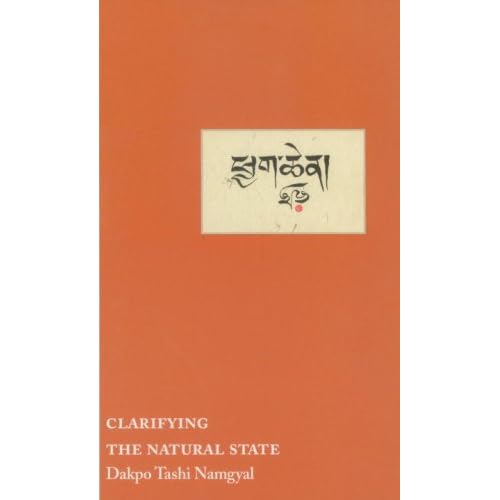
"A practical manual for both teacher and student alike, Clarifying the Natural State covers the path from mindfulness to complete enlightenment, simply and methodically. Presenting the profound and ultimate instructions of Mahamudra, it embodies the realization of India and Tibet's greatest masters."
--------------------------------Elevate your experience and remain wide open like the sky.Expand your mindfulness and remain pervasive like the earth.Steady your attention and remain unshakable like a mountain.Brighten your awareness and remain shining like a flame.Clear your thoughtfree wakefulness and remain lucid like a crystal.~ Dakpo Tashi Namgyal16th Century--------------------------------Reviews:1 of 1 people found the following review helpful: Wonderful, November 27, 2007This is a wonderful translation of very pithy instructions on the stages of Mahamudra meditation. A very detailed step by step manual starting with the various stages of Shamatha and Vipassana meditation. Very clear and direct. This is the pith of the instructions and will be a great aid in working with your Lama in a more detailed fashion. Every time I read this text I get more and more out of it, it clearly fills any gap in understanding or clearly indicates what needs to be addressed with ones teacher. A must have, so go ahead and buy it!
By dharmaman "dharmaman" (new jersey) - See all my reviews
20 of 21 people found the following review helpful: Stages of meditative maturation, March 10, 2005This is one of the best step-by-step elucidations of the stages of unfolding rigpa, or "natural, timeless awareness," minus the usual obfuscating overhead of Tibetan/Buddhist trappings. Offers exceptional clarity in differentiating each stage from the next, and gives helpful markers to discern when you're there, and when you're not. Extremely helpful on the path!By Tejasi (San Francisco) - See all my reviews
13 of 17 people found the following review helpful: Referenced Mahamudra text, December 13, 2004This book contains a very fine description of the "Natural State" or "Ordinary Mind" of Mahamudra -- quite similar to the view of Dzogchen. Interestingly, it's referenced in Khenchen Thrangu Rinpoche's recent work, "An Ocean of the Ultimate Meaning." The author's work, "Mahamudra: The Quintessence of Mind and Meditation" (though his name is spelled "Takpo" vs. "Dakpo" I believe it's the same author) originally entitled "Moonbeams of Mahamudra" is also in print; translated and annotated by Lobsang P. Lhalungpa. It is a much larger work (close to 500 pages). I have seen it referenced numerous times in contemporary works (e.g. Khenchen Thrangu Rinpoche's). I own one but haven't read it yet.By Neal J. Pollock (VA USA) - See all my reviews


14 of 15 people found the following review helpful: Very good, November 19, 2004This is a short effective book, with a good attempt at the pointing out instructions.By Bindu Madhavan (Los Angeles) - See all my reviews
If not treated as a "how-to" manual, it does a marvelous job of being a signpost of the "natural state." -
Can make this a stickie ? Otherwise this thread will just be forgotten in time.
-
Ok.
-
Thanks !
-
Hi all;
Here is the path to Nibbana.I got it from Mogoke Sayadaw(U Vimala) link who extracted the original true buddha scripts in myanmar. After Mogoke Sayadaw passed away in 1962, his burnt body remains the relics below for the people to worships.His main teaching is described below including part 1,2,3 and 4.


unburnable relics( eye) unburnable relics(From bone)


unburnable relics (hair) unburnable relics(tooth)


Part One
The Twelve Parts
The Paticcasamuppada, or the Cycle of Dependent Origination, summarizes the Buddha's teaching on the conditionality of all physical and mental phenomena of living beings.
The cycle has 12 parts, which are:
1. Avijja - ignorance or delusion
2. Sankhara - kamma-formations
3. Vinnana - consciousness
4. Nama-rupa - mind and matter
5. Salayatana - six sense bases
6. Phassa - contact or impression
7. Vedana - Feeling
8. Tanha - craving
9. Upadana - clinging
10. Bhava - becoming
11. Jati - rebirth
12. Jara-marana - old age and death
The 12 parts form a cycle, in which each part is conditioned by the preceding part, and in turn, conditions the part that follows.
The formula of Paticcasamuppada is as follows:
1. Avijja paccaya Sankhara: through Ignorance are conditioned the Sankharas, that is, the rebirth producing kamma-formations.
2. Sankhara paccaya vinnana: through the kamma formations is conditioned Consciousness.
3. Vinnana paccaya nama-rupam: through Consciousness are conditioned Mind and Matter.
4. Nama-rupa paccaya salayatana: through the physical and mental phenomena are conditioned the 6 Bases.
5. Salayatana paccaya phasso: through the 6 Bases is conditioned (sensorial) Impression.
6. Phassa paccaya vedana: through Impression is conditioned feeling.
7. Vedana paccaya tanha: through Feeling is conditioned Craving.
8. Tanha paccaya upadana: through Craving is conditioned Clinging.
9. Upadana paccaya bhavo: through Clinging is conditioned the process of kamma-formations and becoming (kammabhava and Upapattibhava).
10. Bhava paccaya jati: through the process of kamma formation (kammabhava) is conditioned Rebirth.
11. Jati paccaya jara-maranam-soka-parideva dukkha-domanassa-upayasa sambhavanti: through Rebirth are conditioned Old Age, Death, Sorrow, Lamentation, Suffering, Grief and Despair.
Evametassa kevalassa dukkhakhandhassa sumudayo hoti: thus arises this whole mass of suffering.

Part Two
The four groups
The cycle of Dependent Origination can, from another view point, be considered as consisting of four groups, being past causes, present resultants, present causes, and future resultants. The four groups are:
Group 1. Past life
Avijja (Ignorance)
Sankhara (Kamma-formations)
Vinnana (Consciousness)
Group 2. Present life
Nama-rupa (Mind and Matter)
Salayatana (Six Bases)
Phassa (Impression)
Vedana (Feeling)
Group 3. Present life
Tanha (craving)
Upadana (Clinging)
Bhava (kammabhava)
(kamma formations)
Group 4. Future life
Jati (Rebirth)
Jara-marana (old age-death)
Rebirth being the passive process of becoming or upapatti Bhava.
Group One relates to a past life. Group Two and Three relate to this present life. Group Four relates to a future life in Samsara, the Wheel of life and death. The Doctrine of Paticcasamuppada shows the conditionality and dependent nature of the uninterrupted flux of all the physical and psychical (mental) phenomena that make up individual existences. An understanding of the Doctrine is essential if we are to really understand the Buddha's teaching.
We will look at each Group of the Paticcasamuppada and then we will review "Life" and "Existence" as it is considered in the Doctrine of Paticcasamuppada and in the Abhidhamma
Group One
Group one of the Paticcasamuppada is made up of Avijja and Sankhara. Avijja is ignorance of what really constitutes individual existence. It is delusion regarding Truth and Reality of existence, that in all the bodily and mental phenomena of existence, there is nothing that can ultimately be regarded as a satisfying, self-reliant, independent, abiding "self" or "ego". Ignorance is not to understand suffering, its origin, its extinction, and the path leading to its extinction. Because of ignorance and delusion regarding existence, we are constantly engaged in Sankharas, or kamma-formations, which are wholesome or unwholesome deeds, of body, speech and mind. Kamma-formations are deeds born of our volitions, or our wishes and desires.
Most people are thus engaged in all kinds of activities without an understanding of what really constitutes individual existence; they are proceeding like the blind. They are unable to think correctly, they are unable to act correctly and they are unable to speak correctly. They will never get to where they wish to go. It is only the Ariya, or Noble Disciples, of the Buddha who have been able to penetrate into the truth of existence, into the understanding of the related nature of mind and matter, of the cause and effect of all mind and matter, and the impersonality (lack of abiding self) of all such phenomena. In the Buddha's dispensation, there are four stages of purity or sainthood, namely the stages of Sotapanna, Sakadagami, Anagami and Arahanta or fully purified saint, who is no longer bound by any fetters or defilements.
What then is "life" or "Existence"?
Looking at Group One of the Paticcasamuppada, we can say that life or existence, for most people, is "delusion and kamma-formations or delusion and activities which is with delusion". Our delusions keep us always active, always making new kamma.
Group Two
Group Two comprises 5 components, namely vinnana, nama-rupa, salayatana, phassa, and vedana, or, in English, consciousness, mind and matter, six bases, impression, and feeling. We will look at each component to deepen our understanding of the continuous flux of life or existence.
Consciousness appears for the first time at conception in the mother's womb. Consciousness is to be aware of something. It is Consciousness which brings into effect the interplay of mind and matter, which is existence. Mind and matter in turn are linked to the six bases. The six bases are the 5 sense bases, namely, the eye-base for sense of sight, the ear-base for sense of hearing, the nose-base for sense of smell, the tongue-base for the sense of taste, and the body-base for sense of touch, and finally, the sixth base is the mind-base, which is the sense of knowing or being aware of sensual impression.
When a visual object comes into contact with the eyebase, there is consciousness or being aware of this visual object. This however is a very brief look at the process of becoming conscious of a visual object. The Abhidhamma teaches that 14 subtle subfunctions come into play in the process of becoming conscious of an object (vinnana kicca). Similarly for the other bases. Because of the six bases, there is a continuous stream of consciousness; consciousness of sights, sounds, smells, tastes, bodily feelings, and thoughts and fantasies.
What then is "Life" or "Existence"
Because of the Six Bases, we spend our time seeing and enjoying visual form, hearing and enjoying sounds, smelling and enjoying scents, tasting and enjoying flavours, touching and enjoying bodily feelings, thinking and fantasizing and enjoying thoughts, imaginings, day-dreams. From the time we wake up, until we fall asleep again at night, because of the six bases, we spend our time looking, listening, smelling, tasting, feeling, or lost in thoughts and fantasies. There is no rest at all from these activities. We are led by the six bases into spending all our time and all our energies, whether these activities are wholesome or unwholesome, whether they are of use or no use at all. From the day of our birth until the day we are put into our coffins, the six bases take up all our time, How else do we spend our time, if not with our six bases?
"Life" or "existence", from two points of view, is therefore nothing but the six bases leading us into all kinds of physical, verbal and mental activities.
Group Three
Group Three of the Paticcasamuppada consists of tanha, upadana, and kamma-bhava, in English. craving, clinging, and volitional acts. Bhava here refers to kamma-bhava, all the volitional activities that cause becoming into existence. (upapatti-bhava is the resultant rebirth or the coming into existence or Jati of Group Four.)
Craving, clearly, is to desire, to want, and to long for somethings. But not to want somethings, or to dislike somethings, is also a form of craving. If we dislike the heat, it may be because we like cold. If we dislike the colour green, it may be because we like the colour red.
Clinging is strong attachment to something. It is compulsive or obsessive craving. We refuse to let go. Even if we do not actually possess something, we are mentally obsessed by it. We think of it constantly. We will do anything to get it. Do we therefore not create more kamma formations? Thus, upadana paccaya bhavo; "through clinging is conditioned the process of volitional acts".
We have look at the Group Three constituents. What do they tell us about "Life" or "Existence"?
Group Three tells us that Life is nothing but likes and dislikes. We meet with something we like and we are all smiles. We meet with something we dislike and we are all frowns. So life is nothing but likes and dislikes, smiles and frowns. We meet with something we like, and we be come strongly attached to it. We cling to it mentally, and we react. We react if we like something, and we react if we dislike something. This is kammabhava.
If we wish to judge a person's character, we need only look at his behaviour, and how he reacts physically and verbally to external stimuli. It is said that the famous palmist Cheiro once said that he could judge a person by looking at his hands. Regarding this, Napoleon, the famous French general, is reported to have replied that he judged a person by looking at his face. It is a person's face that betrays his clinging (upadana) to his likes and dislikes, and to his views and opinions.
To summarize, what does Group three tell us about life? Group Three constituents, tanha, upadana and kamma bhava, tell us that "life" is nothing but our likes and dislikes, and resulting smiles or frowns. In other words, life is nothing but our reacting to external stimuli. We like some thing and we react in a certain way. We dislike something and we react in another way.
Group Four
Group Four is concerned with future resultant period. Group Four constituents are Jati, and jara-marana; in English, rebirth, and old age-death. What then is "life" according to Group Four? Group Four tells us that "life" is to be born, and then to die. This, very briefly and very truly, is what life is. "Life" starts with birth, and it ends with death.
Once, there was a King, and he one day summoned his Prime Minister and ordered that biographies of all the learned men in the world be compiled. The Prime Minister in turn sent orders to all the writers and scholars throughout the kingdom to begin compiling this great work. There was no such thing as writing paper as we know it today. All this great compilation was done on the finest leather parchments available. There were, even then, a great many learned men in the world, and it was some years before the compilation of the biographies was completed. The Prime Minister then informed the King. The king was much pleased. He would read the biographies and at last, he would know all there was to know about all the learned men of the world. The King decided that he would review the biographies on a special day, and when the day arrived, the King and his ministers gathered in the great reception hall of the palace. The order was given for the biographies to be brought before the King, and carriage after carriage rolled into the palace grounds.
There was such a great number of carriages that a great cloud of dust was raised. It was as if an invading army had entered the Palace grounds. Carriage after carriage was filled to capacity with leather parchment biographies. What was the King to do? There was no way he could read all the biographies. He turned to his Prime Minister and ordered, "Make a summary of all the compilations!" What now was the Prime Minister to do. He too had neither the time, nor the inclination, to read the biographies. It would take his whole lifetime. However, the Prime Minister was a wise man, and he had some knowledge of the Abhidhamma. The next day, he presented the King with a summary of the biographies of all the learned men in the world. The summary had three lines. The King read the three lines, and was so pleased with what he read that a great smile spread across his face. The King had read:
1. Learned men were born.
2. Learned men lived.
3. Learned men died.
You cannot get a closer summary than that! And this is what Group Four of the Paticcasamuppada tells us too. "Life" has three parts; is to be born, to live, and then to die, or Jati, jara, marana.
When we look at the Paticcasamuppada, we see two constituents that belong to the future, namely, Jati and jara-marana. If we, in our present life, are unable to rid ourselves of the causes, tanha, upadana, kamma bhava, then unfailingly, we will reap these two results, which are Jati and jara-marana. As the Prime Minister wisely realized, no matter how many lives are left to us before we realize the Eternal Bliss of Nibbana, we can say for certain that we will be born, and we will die. Birth and death. There is no need to elaborate, no need to say more than this. It is the biography of all men.
In this world, man is faced with all kinds of troubles, problems, pain and misery. It is no wonder that people wish to be reborn as celestial beings in the deva world or the brahmas world. But even in the deva and Brahma worlds, where some constituents such as our gross mind-matter component may not be present as in the human world, all remain subject to Jati and jara-marana, birth and death. There is no need to elaborate, no need to say more than this. It is the biography of humans, devas and Brahmas. According to the Abhidhamma, life or existence is nothing more than an unending sequence of discrete phenomena, which arise and then pass away. Phenomena come into being or arise (uppada), they exist for an infinitesimally short moment (thiti) and then they pass away and disappear (bhanga). There is nothing else apart from these three phases. People in an intensive retreat for insight meditation should strive to realize this truth.
Part Three
Eight Points of View
In studying how and why an individual life can come into existence, there are different ways of looking at the cause-and-effect links in the Paticcasamuppada?
View One : Two original causes
Two original causes or two original evils are avijja and tanha - why an individual life comes into being. Rid your self of avijja and tanha and you can bring the cycle of existence to a stop.
View Two: Two truths
Life having started, what is the truth of existence - there are just two truths regarding existence 1) Dukkha-sacca, the truth of dukkha, that existence is suffering and misery, and 2) Samudaya-sacca, the truth of the origin of suffering. And what is the truth of origin of suffering? The truth of the origin of suffering is that it is craving - tanha - which is the cause of all suffering.There is nothing else apart from these two truths in our life.
View Three: Four main groups
Existence can be viewed as simply consisting of Four Groups, namely, past causes, present results, present caues, future results. Past causes give rise to present results. Dependent on present results, present causes arise, and because of present causes, there arises future result.
View Four: Twelve components
Once life or existence has come into being, there comes into being at the same time, the twelve components of the Paticcasamuppada, each dependent on the previous, and giving rise to the following. Each is both cause and effect, and it is impossible to say which component is the dominant or driving force. But together, they perpetuate an unending cycle of repeated life, suffering, and rebirth.
View Five: Three main connectors or links
Existence can also be viewed as formed by three main connectors.
1. Between sankhara and vinnana, because sankhara (kamma-formations) gives rise to consciousness in a new birth.
2. Between vedana and tanha, because it is vedana that causes tanha.
3. Between kamma-bhava and Jati, because it is our kamma (deeds) that bring about rebirth.
Time-wise we can look upon the links as being:
1. between past causes and present results
2. between present effects and present causes
3. between present causes and future effects.
View Six: Three circles
We may look at the Paticcasamuppada as consisting of:
1. circles of defilements (kilesa vatta),
2. circles of volitional activities (Kamma vatta), and
3. circles of resultants (vipaka vatta).
Kilesa vatta consists of avijja, tanha, and upadana.
Kamma vatta consists of sankharaand kamma-bhava.
Vipaka vatta connsists of vinnana, nama-rupa, salayatana, phassa, vedana, jati, upapatti-bhava, jara-marana.
The causal kilesavatta and kammavatta give rise to resultant vipaka vattas. Using the vipaka components, we create more causal kilesavatta and kammavatta. Like waves breaking onto the beach just as one wave breaks onto the beach, countless others are forming out at sea, ready to follow onto the beach, one after another in an endless and unending succession. So this too is what life or existence is all about.
View Seven: Three time periods
Existence can be considered as comprising past , present and future time periods. Past causes give rise to present effects. We reap what we sow. But we are unable to meet these effects with poise and equanimity. We cannot let them just remain what they are, which is, the effects or results of past causes. Rather, we react to them. We allow these effects to anger us, or to seduce us, and we react verbally or bodily, or we let our minds become lost in imaginings and fantasies, thereby creating more causes. We allow present effects to become present causes. The body that we now have become a link between past cause and future effects.
View Eight: Twenty components
Existence can also be viewed as consisting of twenty components. This is an expansion of the twelve as originally taught by the Buddha.
Thus, five past causes are avijja, sankhara, tanha, upadana, and kamma bhava. They give rise to five present effects, namely, vinnana, nama-rupa, salayatana, phassa and vedana. We use these five effects to create five present causes, tanha, upadana, kammabhava, avijja and sankhara. As a result, we reap in the future five effects, which are vinnana, nama rupa, salayatana, phassa and vedana.
To summarize our understanding of the Paticcasamuppada, existence can be viewed as being composed of:
1. Two original causes, avijja and tanha.
2. Two truths, dukkha sacca and samudaya sacca.
3. Four main groups, past causes, present results, present causes and future results.
4. Twelve components, as originally enumerated by the Buddha.
5. Three main connectors or links, sankhara-vinnana, vedana-tanha, kamma bhava-Jati.
6. Three circles (vattas) of kilesas, kammas, and vipakas.
7. Three time periods, past, present and future.
8. Twenty components in four groups of five.
Part Four
The view of life through Paticcasamuppada
How individual lives vary greatly
We have said that all biographies can be summarized as:
They were born.
They lived.
They died.
Individual lives of course vary greatly in detail. Some are born into wealthy families. Some are born poor. But wealth is not all. Rich people can have lives filled with difficulties, hardships, great unhappiness, while materially poor people can have lives that are filled with happiness. Some are born with excellent health. Some are sickly. Some are long-lived, some are short-lived. Some are born with happy dispositions, or with inborn courage; others are easily agitated, frightened or worried. Some are born good- looking, some are ill-formed. Some are intelligent, other are less so. The list of differences between people is endless.
And each of us lead lives, no two of which can be identical. Shakespeare wrote, "All the world's a stage." But who is the stage-master who assigns to each of us our roles? This stage-master is none other than our kamma, for the Buddha has said, "Beings are heirs to their kamma." To help us understand individual existences better, let us review Paticcasamuppada in reverse order. The Abhidhamma examines the experience of death in detail, but here, we will consider just two kinds of death, a good death, and a bad death. A good death is one in which a dying person recalls or thinks about wholesome deeds. If a person of bad character remembers or performs a good deed just before dying, he may receive a good rebirth.
Alternatively, a good person may remember or do a bad deed before dying and thereby get a bad rebirth. Generally speaking, a person's death will be a reflection of how he has lived. To have lived well is generally to die well, and to have lived badly is generally to die badly. If a person desires a good death, he should live a good moral life, with goodwill and compassion towards all. If a person has lived in an agitated way, if greed, anger, delusion, self-deceit, envy, pride and self-interest have been the dominant and controlling factors in his life, then he is unlikely to have a gentle and peaceful death. Paticcasamuppada teaches us "Jatipaccaya Jaramaranam" The stage of becoming creates different deaths. It is because of the great variety and complexity of past deeds, or kamma, that there are a great variety and complexity of lives. Who is responsible for our well being in life? Who is to be blamed for our troubles? Who is to be thanked for our comforts. The truth is that our deeds are responsible for our present conditions in life. This is a basic tenet of the Buddha's teachings. A good Buddhist realizes that no one else is responsible for the conditions of his present life. He does not blame any one else for his troubles. They are self-made, the fruits of his past deeds.
In general, past good kamma will give rise to good things in the present, and conversely, past bad kamma will give rise to bad things. If we have committed both good and bad things in the past, then we can expect our life to have ups and downs, like the flight of a wood pecker which is said to be high one moment, and low the next. But whatever ups and downs you may encounter, don't point the finger of blame at other people. Instead, review your past actions. Review your past states of mind to determine whether it is mostly goodwill or anger that has governed your deeds. This proposition teaches that wholesome and unwholesome kamma-formations are the cause of future rebirth and destiny. Also, "bhavapaccaya Jati"- through the process of volitional acts is conditioned rebirth. This proposition teaches that through the whole some and unwholesome kamma process (kamma-bhava) is conditioned the rebirth-process (upapatti-bhava).
By kamma is meant not only actions in a past life, but past actions in this present life, and even actions in lives before the previous life. A person will do a great many deeds in a lifetime. Good or wholesome deeds, motivated by goodwill, compassion, faith, wisdom or knowledge, duty; and bad or unwholesome deeds motivated by desire, greed, anger, fear, envy, pride, selfish interest, and so on. There will be deeds done with great enthusiasm, or deeds done half-heartedly, or without interest. There will be deeds done with mindfulness, and deeds done in a careless or automatic way. People may appear to be carrying out similar actions, such as praying at the pagoda, or giving alms or donations, or cooking a meal, or speaking to friends, but what cannot be seen or guessed at will be their inner thoughts. Their outward actions may look the same, but their states of mind will vary greatly. And in all these acts, it is volition or "cetana' which is of great importance - "cetana', which is unseen, unknown to others, and varying greatly from one person to another.
In any one situation, there is a great variety and complexity of acts being carried out by many people, each with different states of mind. Even within just one person, state of mind is extremely complex varying constantly, not just from hour to hour, but even from one moment to another. Even in the act of worship, in the calm of the early morning, many people are unable to maintain concentration and mindfulness but vagrant thoughts must flit constantly across their minds. Having come into a new existence, as we have stated previously, past kamma will bear fruit when the time and conditions are appropriate. There is no escaping kamma, although the interplay of kamma is so complex that weak kamma may be replaced or cancelled by stronger opposing kamma, or strengthened by similar kamma. Thus, a person may be enjoying a period of great comfort or success in life due to past wholesome kamma being in effect, when suddenly, counter-active or opposing kamma may come into play, bringing illness, or material loss. On the other hand, a person leading a rather miserly existence due to past unwholesome kamma may unexpectedly find life taking a turn for the better as past wholesome kamma come into effect.
King Kusa and Princess Pabhavati
To illustrate the working of kamma, we here digress a little with the story of King Kusa, the Bodhisatta, and Princess Pabhavati (Papawati), who was in a later life to be Princess Yasodhara.
In a previous lifetime, the Bodhisatta was the younger of two brothers, and lived with his elder brother. One day, he returned home late to find a cake meant for him had just been put into the bowl of a Pacceka-Buddha (silent Buddha) by his sister-in-law. He therefore spoke angrily to her, and snatched back his cake from the monk's bowl. Thereupon, his sister-in-law filled the monk's bowl with fresh butter, and made this wish: "As a result of this gift, may I be reborn beautiful, and not ever again have to live in the same household as this rude person (her brother in-law)". Not to be outdone, the younger brother put back the cake in the monk's bowl and wished: "And however far away she may be reborn, may I have with the power to make her my bride." The sister-in-law was reborn as Princess Pabhavati, the eldest and most beautiful daughter of a king. The younger brother was reborn as King Kusa. For first angrily snatching back the cake from the monk's bowl, he was born ugly,
-
Written by U Kyaw Thein
Translated by Dr. Tin Htut (UK)The following dialog between the venerable Mogok Mogok SayadawU Vimala and U Kyaw Thein, the author of the Mogok Sayadaw’s biography and the method is a glimpse on the practice at the Mogok Vipassana Centre. It was given on a day in September 1957 (1318 Burmese era) at the Mingalar Monastery in Amarapura, Burma.
Mogok Sayadaw: Have you come to practice meditation?
U Kyaw Thein: Yes Sire, I have come to practice meditation.
Mogok Sayadaw: All right, does your family give you the permission?
They gave me the permission Sire.
Mogok Sayadaw: Why do you come to meditate, is it that I have only asked you?
I want to be free of the suffering in Samsara, my lord.
Mogok Sayadaw: Have you developed faith (Saddha) in your mind as well?
I have the faith Sire.
Mogok Sayadaw: If that’s the case you must decide in your mind that you have the rarest opportunities for being a human who is born in the Buddha’s Sasana, and to have the chance to practice Vipassana that I am going to give you. You must also develop faith in you mind that it will help you to escape from the Samsaric sufferings of old age, ailments, death, and other misfortunes and make up your mind to follow the instructions meticulously.
Yes my Lord.
Mogok Sayadaw: Maung Kyaw Thein, you must also decide not to think of your business and your family. Try to be detached from these by using wisdom.
Yes Sire, I will renounce them.
Mogok Sayadaw: You must rely on the three main principles (Adipadhi).
All right, but what are these three principles Sire?
Mogok Sayadaw: Yes, I will tell you. Firstly, you must remember that you need to rely on yourself; that you practice meditation not for your livelihood, but to release from the suffering of old age, disease, death, misfortunes and inconveniences. This is the Attadipadhi (self-reliance principle).
Yes Sire.
Mogok Sayadaw: Secondly, you must regard life as your next principle (Lokadipadhi). You must not pretend to meditate and think of all your life affairs. Don’t be lazy, apathetic, asleep and don’t let your mind roam. Don’t do anything that is not right for your guardian angel, good Devas and those who have Abhinna (super natural powers) know. So you must be shameful of yourself if you are not leading a good life.
Yes Sire.
Mogok Sayadaw: You must regard Dhamma as the third principle (Dhammadipadhi). You must pay respect to the Dhamma and try to experience insight wisdom (Vipassana nana) directly. You must know that if you were not enlightened it was not that there was no Dhamma, but it was your fault that you did not pay due respect to the Dhamma principle. You must decide to have faith in this principle and strife with all your might.
Yes Sire. If I take these as the main principles and meditate shall I be awakened in this very life, my Lord?
Mogok Sayadaw: Have you committed the Panchanandriya kamma (five cardinal sins)? Have you killed an Arahat?
No Sire.
Mogok Sayadaw: Have you killed your mother or your father?
No Sire.
Mogok Sayadaw: Have you ever caused a split among Sangha?
No I haven’t Sire.
Mogok Sayadaw: All right, I won’t ask you whether you have caused any physical harm to the Buddha as it is not relevant now. If you have not committed any of these sins just try your best in the practice. It will take only seven years if a person is very dull, seven months for an average and seven days for very bright persons with the right practice. It won’t happen without practice. You must work hard with faith, mindfulness, concentration, energy, and wisdom (Saddha, Sati, Samadhi, Viriya and Panna).
Yes my Lord, I will work hard and follow your instructions.
Mogok Sayadaw: All right then. You take the eight precepts.
[ After taking the eight precepts (refrain from killing, stealing, practising celibacy, refraining from telling lies, taking intoxicants, taking solid food after mid-day, and refraining from sensual indulgences such as perfume, cosmetics, music & dancing, and handling money & financial matters) ]
Mogok Sayadaw: Now you need to do the five rituals (Pubbakissa) during meditation.
- Devote yourself to the Buddha both, physically as well as mentally.
- Ask for pardon if you have done any wrong to parents and holy people either physically, verbally or with your mind.
- Propagate loving kindness towards all sentient beings including your guardian angel and those who watch over your property, your city and the Sarsana.
- Make a wish (Adithanna) for all the merits that you have gained during this life and in previous lives to result in enlightenment.
- Try to realise the nature of dying (Marananussati) by thinking that you have died in your uncountable past existences and that you will have to die some day. Try to realise and persuade yourself that you must work hard before death arrives and thereby develop the effort and energy to meditate. Do you understand?
Yes Sire.
Mogok Sayadaw: Do you know how to differentiate between matter (Rupa) and mind (Nama)?
I have only the theoretical knowledge, Sire.
Mogok Sayadaw: All right, I’ll tell you. When you consider vision you have the eye and the object, which are Rupa and the image that developed in your mind is the Nama. Likewise, all six sense organs and their objects are Rupas and the sensations developed by their interactions are Namas (Eyes, ears, nose, tongue, body and thoughts).
Yes Sire.
Mogok Sayadaw:
- You must recognise and differentiate between mind and matter in the present sensation that develops. This is called Nataparinana.
- You must recognise and realise the impermanence, suffering and impersonal qualities (Anissa, Dukkha and Anatta) of the present sensation. This is called Tiranaparinana.
- You must realise that the present sensation is neither your body, nor your mind and try to avoid clinging (Tanha) and self conceit (Mana) and delusion or wrong view of regarding consciousness as your soul (Ditthi). This is called Pahanaparinana.
Yes my Lord.
Mogok Sayadaw: You must differentiate between mind and matter. Then do not go after the Jhana way (for attaining super natural powers). If a Yogi wants to overcome live and death and become awakened he needs concentration of the mind just enough to develop Samadhi. Then he must practise Vipassana.
Yes Sire.
Mogok Sayadaw: Switching over to Vipassana is just like a locomotive changing rails from one to another. The contemplation of the mind is moved from Samatha (one point) to the arising and dissolving phenomenon of the current Rupa-Nama (sensation). You must remember that this is led by the mind.
Yes Sire.
Mogok Sayadaw: You must do the contemplation of breathing (Anapanna) first. It is mindfulness of the incoming and outgoing breath. You must breathe in normally and fully. Do not force it or reduce it, but breathe in and out regularly.
Yes Sire.
Mogok Sayadaw: You can focus your mind on the lips at the tip of nostrils or at the sternum, but it is better to keep it at the tips of nostrils (to be sharper in developing concentration). Whatever site you have chosen you must try to be mindful continuously.
Yes Sire.
Mogok Sayadaw: Anapanusatti is the mindfulness that occurs when contemplated on the incoming and outgoing breaths. A Yogi practising Anapananusatti fixes the mind strongly on the breathing while taking breaths regularly and normally. He first focuses the mind on the tip of nostrils and watches as the air goes in and out.
Yes Sire.
Mogok Sayadaw: Apart from this mindfulness of the touch of air he must not divert his attention to any other object.
Yes Sire.
Mogok Sayadaw: A Yogi who has developed concentration after practising Anapana must know that the person is not "you, I, male or female," but a collection of Rupa (matter) and Nama (mind) and a collection of the five aggregates. Then the Yogi must realise that the mind that registers this knowledge is the Nama. This Nama dwells in the heart. The physic that is in sitting meditation is the Rupa. You will come to know this reality by direct experience.
After this differentiation of Rupa and Nama you must understand that the collection of twenty-four physical objects is the Rupatkhanda. The consciousness that knows is the Vinnanakhanda. Feelings that associate with the mind when contemplated on sensations are the aggregate of Vedanatkhanda. Recognition of the sensations that associate with the mind is the aggregate of Sanatkhanda. The other fifty concomitants of the mind, which include all volitional perceptions except consciousness and recognition, are known as the aggregate of Sankharatkhanda.
I will need to explain further using the Paticca Samupadda to differentiate cause and effect relationships, as you may not understand thoroughly.
Yes Sire, its getting more and more clear by your explanations.
Mogok Sayadaw: That’s right. It is better to let a Yogi know the basics before giving the practical aspects.
Yes Sire.
Mogok Sayadaw: After you know the five aggregates you must also understand roughly that the past Avijja-Tanha (ignorance and attachments) are the causes of Rupa-Nama (body and mind).
Yes my Lord.
Mogok Sayadaw: Now you repeat what I said to request for the meditation method.
"Kammathanan mae bhante detha sansara vatta dukkhataw mawcanatthaya"
Bhante please give me with compassion, the right method of meditation in order to be free of the samsaric suffering. Repeat this three times. Now go and practise for an hour on what I have just taught you.
SECOND PART
[ U Kyaw Thein paid respect to the Mogok Sayadaw and went to his allotted place, which was not far from the Sayadaw’s room. He then started to practise Anapana as he was instructed, but could not prevent his mind from roaming for the first half an hour. He over heard the dialog between the Mogok Sayadawand a traditional medicine practitioner who was attending to the Mogok Sayadawin his room. The practitioner was discussing about a certain medicine text and the Mogok Sayadaw:told him that Metta was even more effective than medicine. U Kyaw Thein (KT)could not help his mind from overhearing the conversation and began to divert his attention to eaves drop the discussion. ]
Then the Mogok Sayadaw warned him from his room. "Maung Kyaw Thein, you are not mindful. Try to keep your mind from wandering."
[ KT was amazed when he heard the Sayadaw’s voice as it was not possible for the Mogok Sayadaw:to see him from his room. There was another room in between his place and that of the Sayadaw. He did not know how he was caught, but became very astonished and concerned and tried his best to build up the concentration. He could not remember how long he had been meditating when he was summoned to see the Sayadaw. ]
Mogok Sayadaw: Maung Kyaw Thein did you practise as I told you?
Yes I did. I have kept my mind at the sternum Sire.
Mogok Sayadaw: Did it stay where it was kept then?
No Sire, it didn’t at the beginning, but it stayed there later on.
Mogok Sayadaw: When Anapana is practised for an hour and have obtained Samadhi, it was not possible if you did not have perseverance. That is Viriya (effort) and with this effort you have managed to sit for an hour. This is called Samma vayama, the right effort.
Did your mind notice the movement of air at the sternum while you were breathing?
Yes Sire, I did.
Mogok Sayadaw: Right, you noticed the movement of air as you were mindful. This is called Samma sati, the right mindfulness.
Yes Sire.
Mogok Sayadaw: When you were practising Anapana did you mind wander to your home? Where did it go?
No Sire, it didn’t go anywhere. It stayed at the sternum where it was kept.
Mogok Sayadaw: Right, that was Samma samadhi, the right concentration. Your mind has stayed where it was kept.
Yes Sire.
Mogok Sayadaw: All right, you have developed Samadhi. However, you need to develop it further by breathing through the nose, but not through the mouth. When you are breathing do not try to notice if you are breathing with your right or left nostril, but try to develop Samadhi. You don’t need to follow other Samatha methods. If you breathe through the nose you must know that it is through the nose and if you take a deep breath you must know that you are doing so.
Very well, Sire.
Mogok Sayadaw: You have been instructed to keep your mind to the sternum at first. Now you must watch as the air touches the nostrils, sternum and umbilicus while you breathe in and vice versa as it goes out.
Yes Sire.
Mogok Sayadaw: You must notice the outgoing and incoming air as if through the bellows and as a string of a lathe-file rubs the stick you must continuously watch the air at the place where it touches. You must notice when you breathe faster, and must know when it is slow. You must be aware when you breath is long/deep and also knows when it is short/shallow. However, you don’t need to watch the breath in a continuos stream. Just watch at the point of contact as if a saw cuts through the timber, but not along the edge of the saw. You must focus your mind at the point of contact of the air with the nostrils.
I will, Sire.
Mogok Sayadaw: If you practise in this way and be mindful you can develop Samadhi within fifteen minutes when you become accustomed to it.
Yes Sire.
Mogok Sayadaw: You need to know that it is the Rupa (matter) that was doing the breathing and it is the Nama (consciousness) that knew what you were doing. When you can differentiate between Nama and Rupa the knowledge developed is called Namarupa pariccheda nana (analytical knowledge of mind and matter). Cleansing of views is also involved simultaneously, which is known as Ditthi visuddhi. Remember this carefully.
Yes Sire.
Mogok Sayadaw: When you meditate you must know the followings.
- You need to know that there are two components of the mind. Mental factors (Cetisaka) and consciousness (Citta).
- The mental factor (thought) must be in line with the consciousness when you contemplate.
- Do not let the mental factor go astray from the consciousness.
- Do not think of anything while meditating. Don’t let any thoughts come into the mind. If you can master your mind you can eliminate defilement (Kilesa). If you don’t you will neither be successful in your life nor can you eradicate the 1500 Kilesas.
Yes Sire.
Mogok Sayadaw: I will give you an example how to master your mind.
Suppose a herd tender wanted to tame a raw cow he needs to put a post firmly into the ground, insert a rein into the cow’s nose, and tie it to the post and tame her. Likewise, you must tame your mind by fixing it to the cord of mindfulness (Sati) and tie it up to the post of the object of contemplation in your practice. Do you understand?
Yes Sire.
Mogok Sayadaw: I’ll give you another example. If you want to catch a lizard that went into a burrow that had six holes, you need to close five holes and wait at the sixth. The analogy to this procedure would be to close all the five sense doors, namely your ears, eyes, nose, body, your tongue and then to wait at the last door, which is your mind. You will surely catch the thought as it occurs, just like you catch the lizard. Is that clear?
Very well, Sire.
Mogok Sayadaw: All right, you keep them aside for a while. You go back and continue your practice to develop the concentration further. Then you can sleep after it.
[ U Kyaw Thein paid his respects and did as he was told. ]
[ The next day he went to see the Mogok Sayadaw at five in the morning while the Sayadaw was having breakfast. There were other experienced Yogis who came to meditate and they were interviewed and assessed by the Sayadaw after the breakfast. When his turn came the Sayadaw paid more attention, as he was a beginner. ]
Mogok Sayadaw: Maung Kyaw Thein when did you start the meditation last night and when did you stop?
I started at 11.30 PM and stopped at 1AM, Sire.
Mogok Sayadaw: How was your Samadhi?
I could manage to get it Sire, but barely.
Mogok Sayadaw: Why was that?
I must admit that I felt sleepy Sire.
Mogok Sayadaw: Shame on you. That was due to excess in your determination. You must have persisted to meditate in your sitting posture. You should have changed it and did walking meditation instead, if you felt sleepy.
Yes Sire.
Mogok Sayadaw: It is all right to change the posture for beginners. As you become more experienced you may not need to change the posture when you feel sleepy.
How would I do it Sire? I don’t know how to evade sleepiness without changing posture.
Mogok Sayadaw: When you become sleepy how was your breathing? Was it quicker or slower?
It was slow and shallow, Sire.
Mogok Sayadaw: Right, the breathing will be slower and you feel sleepy. Then what about your Sati at that time?
It was poor, Sire. I was not mindful at that time.
Mogok Sayadaw: "Ca catawva acasati, ca tawva pacasati." As mentioned in the Maha Satipatthana Sutta a Yogi who practises Anapana must breathe in and out with mindfulness. But you have lost mindfulness, you must never let it go.
I admit I lost mindfulness, Sire.
Mogok Sayadaw: You must breathe in fully and then breathe out fully. (You must notice as soon as the breathing becomes slower and correct it by breathing fully again. If you do not notice as soon as the breathing gets slower you may go into torpor and soon become sleepy) You must never let the mindfulness escape. If you breathe fully in this way for ten to fifteen minutes you can become alert again.
Yes Sire, now I understand.
Mogok Sayadaw: Another thing is, when you become angry don’t you breathe more harshly?
Yes I do, Sire.
Mogok Sayadaw: Right, why does the breathing become quick and harsh?
I have no idea, Sire.
Mogok Sayadaw: Maung Kyaw Thein, you note this down well. When you are angry your blood in the heart is bright red and hot. As the heart needs to beat faster it needs more energy and you have to breathe much faster. (Thus, the blood became redder and hot due to increased turbulence and flow)
Yes Sire.
Mogok Sayadaw: When you recover from anger don’t you feel that your body is weary and tired?
It is, Sire.
Mogok Sayadaw: Why is that?
I don’t know, Sire.
Mogok Sayadaw: Because your heart beats much faster, but you do not realise it during the anger as you are not aware. Only after it you came to know about the situation and you become weary and tired.
Exactly Sire, I have the experience.
Mogok Sayadaw: Sometimes when you are carried away by greed or desire, you say you do not have the time to become tired, don’t you?
Yes I do, Sire.
Mogok Sayadaw: That is you have followed your desires instead of your mind.
Yes sire.
Mogok Sayadaw: When you meditate Anapana you must relax your body and your muscles. Only then you can breathe regularly and correctly. The Buddha said "Pacambayan Kayasankharan." That is you must breathe neither slowly nor quickly, and neither shallow nor deep, but regularly.
Yes Sire, I will follow your instructions, but what shall I pay more attention?
Mogok Sayadaw: You remember this very carefully. It is only Sati (concentration) that is never in excess. Saddha, Samadhi, Viriya, Panna (faith, concentration, effort and knowledge) must be developed simultaneously. If you could not develop them simultaneously and equally they would not be well balanced and either Uddhacca (distraction) or Htina middha (torpor or sloth) would result. At present, you have been instructed to meditate just to develop Samadhi. Don’t let it mix with anything else!
Yes Sire.
THIRD PART
Mogok Sayadaw: You continue with the meditation after you have your breakfast. Only then you will develop the Samadhi. When you meditate let faith, knowledge, concentration and effort be well balanced as I have told you earlier. I am taking my time to explain in detail as you are a beginner. What’s so difficult to about practising Anapana. Go and practise till your Samadhi is strong and then come back.
[ When the Mogok Sayadaw left U Kyaw Thein had his breakfast and continued his practice from six to eight in the morning. However, he did not have strong Samadhi despite the extended practice and he had to try repeatedly using all available means. ]
[ After eight o’clock U Kyaw Thein helped preparing the meal for the Mogok Sayadaw together with those who came to the monastery for offering the necessities for Sangha. When everything was done he went to the Mogok Sayadaw:at nine o’clock to be assessed on his progress. ]
Mogok Sayadaw: How are you doing Maung Kyaw Thein? Have you developed good Samadhi?
Yes my Lord, I have developed a strong Samadhi now.
Mogok Sayadaw: What position have you taken to meditate?
Sire, I have done sitting meditation at the first hour and then did the walking meditation for the rest of the time.
Mogok Sayadaw: You didn’t look like you have strong Samadhi though you said so.
Can you, my Lord, tell exactly if a person has Samadhi or not just by looking the external appearances?
Mogok Sayadaw smiled and replied "Dear Maung Kyaw Thein, I will explain to you later how different a person looked if he had the Samadhi. Take a bath after you have your meal and then make sure that you have no inconveniences. Otherwise you may have to disrupt the practise if you have the call of nature while meditating. These things are very interfering with the practice."
[ Only then U Kyaw Thein realised his fault of having inconveniences while he was meditating earlier as he did not go to the loo before the six o’clock sitting. Now he did as he was advised and started the meditation from twelve noon till two o’clock. Later on he went to see the Mogok Sayadaw:in his room. Being a beginner he was given a special privilege to visit the Mogok Sayadawas often as he wished if he had any problems. ]
Mogok Sayadaw: Have you developed a strong Samadhi now?
Yes sire.
Mogok Sayadaw: Right, you now have the Samadhi, but you must remember that Samadhi is like a column of mercury in a thermometer. It can go up and down according to the condition. When you are in meditation it is good. However, if you encounter with crude sensuality it can go down again.
Yes Sire, but I have a strong Samadhi now.
Mogok Sayadaw: All right, it’s enough. You can change over to Vipassana. First you must try to develop good Samadhi and then go to Vipassana.
Yes Sire.
Mogok Sayadaw: You are asked to do Samadhi not to encourage you to practise Samatha. You must let go of the mindful breathing as soon as the mind is calm and then contemplate on any sensation that develops without any breach. If you contemplate more and more on sensations you will come to a point where you can overcome them. You will no longer register them as sensations, but only as arising or dissolving phenomenon. You will realise that all sensations including pleasant ones, unpleasant ones and neutral ones dissipate and come to an end. When you contemplate on sensations Vedana will appear, but when you watch them with analytical knowledge you will come to know that they are impermanent (Aniccha). If this wisdom is developed it can be regarded as the overcoming of Vedana (sensual perception). If you couldn’t comprehend the impermanence of sensual perceptions you haven’t overcome Vedana as yet. When a Yogi has surpassed Vedana or has eliminated them the Yogi will feel light, agile and fresh even after the meditation is over. That is why one needs to try hard to overcome Vedana. Mindfulness of breathing in Samatha is just to make the mind calm, but it cannot lead to Nibbana. You must remember this very well.
Yes my Lord.
Mogok Sayadaw: Vipassana is to keep the mind on the wisdom path and watch and realise the phenomenon of mind and matter as they are. The physical body that we have at present is continuously forming and decaying from cradle to coffin. It must be comprehended that impermanence (Aniccha), suffering (Dukkha) and impersonal characteristics (Anatta) are the only realities that can be found.
Yes Sire.
Mogok Sayadaw: When Rupa and Nama (body and mind) are comprehended as Aniccha, Dukkha and Anatta repeatedly, and the arising and dissolving phenomenon are perceived it is known to have reached the Udayabbaya nana. You remember? Do you understand?
Yes my Lord.
Mogok Sayadaw: You need to know these facts clearly. If they are not clarified beforehand using acquired knowledge your progress will not be substantial. So I will have to go further to remove false views (Ditthi) and doubts (Vicikccha). Maung Kyaw Thein, if you want to be a stream winner (Sotapanna) what should you remove first?
Yes Sire, I need to remove Ditthi and Vicikiccha first.
Mogok Sayadaw: Right, where do false views and doubts lie?
I have no idea, Sire.
Mogok Sayadaw: Ditthi and Vicikiccha are attached with the five aggregates of mind and matter.
Yes Sire, now I know.
Mogok Sayadaw: Now you know that they are attached to the five aggregates. If you do not know where these five aggregates come from and how they are arising and dissolving, you could not remove false views and doubts by any means.
All right, my Lord.
Mogok Sayadaw: You may have the book knowledge or have acquired from teachers that the five aggregates are Rupakhanda, Vedanakhanda, Sannakhanda, Sankharakhanda and Vinnanakhanda, but if you do not know the causes and reasons for their becoming and disintegration false views would adhere to you despite the acquired knowledge. That is why you need to know Paticcasamupadda, the cycle of dependant arising first if you want to have insight into the five aggregates. So, I will teach you the Paticcasamupadda. Go and fetch the cycle of dependant arising chart from my room. Do you still remember anything about Paticcasamupadda?
Yes Sire, I could remember only a few aspects.
[ When he brought the chart]
The Mogok Sayadaw said "Right, place it in front of you. I’ll show you. What you have learnt about dependant arising in the past was only an acquired knowledge."
I have only the book knowledge, Sire.
Mogok Sayadaw: If you do not know Paticcasamupadda there is no way you can know the aggregates. If you do not know the aggregates, false views will adhere. That’s why you need to comprehend Paticcasamupadda. Book knowledge is not enough.
Yes Sire, I will try to understand it.
Mogok Sayadaw: Do you still remember it by heart?
Yes I do, Sire.
Mogok Sayadaw: In that case I won’t elaborate on it (Please refer to Paticcasamupadda on the web site). You must remember that there are two forms of dependant arising. What you know from the book about Paticcasamupadda is one thing and there is also another Paticcasamupadda that is arising and dissolving in the body. You must understand the Paticcasamupadda of the body in order to make progress. Do you follow me?
Yes Sire.
Pointing at the diagram of the circle of dependent arising The Mogok Mogok Sayadawcontinued "That’s why I am going to show you the causes and reasons for arising and dissolving of the five aggregates. Do you know that your volitional responses (Sankhara) of the past existence, which were carried out without wisdom (Avijja) have resulted in the body that you have it now?"
Yes Sire.
Mogok Sayadaw: Those were in the past and therefore they were out of your control. They were past Paticcasamupadda and did not concern you. Again the future Paticcasamuppada has not arrived yet and so it does not concern you. The most important thing is to understand the present Paticcasamupadda. Is that clear?
Yes Sire.
Mogok Sayadaw: Which Samupadda concerns you?
The present one my Lord.
Mogok Sayadaw: What about the past?
It doesn’t concern us, Sire.
Mogok Sayadaw: And the future?
No Sire.
Mogok Sayadaw: Where do false views and doubts attach?
To the five aggregates, Sire.
Mogok Sayadaw: Right, they are attached to the five aggregates. If I ask you whose hair is this, you will answer that it is your hair. The false view attaches to Rupakhanda, the hair. If I say that the tea is very nice, it attaches to Vedanakhanda, the feeling or taste. If I say that this sentence is written by me, I note down this line, then the false view attaches to Sannakhanda, the interpretation of a feeling. When I say that my weaving is exceptionally good, then the false view attaches to Sankharakhanda, the reaction to a feeling. And if I say "Don’t you dare try me" then the false view attaches to the Vinnakhanda, the consciousness or self esteem. These are the places of attachment, do you follow me?
Yes sire.
Mogok Sayadaw: Then you must detach the false views and doubts from the aggregates. Theoretically, if Rupa and Nama (matter and mind) can be differentiated they say that false views are detached. However, there is one more thing to understand.
Only when you understand the cause of Paticcasamupadda and the effect of Paticcasamupadda you will detach yourself from false views and doubts. If you know the cause of aggregates you can eliminate the false views. If you don’t, the false views will stay. If you know that the effect (of anything that happens in you) is due to the causes of aggregates, then you can eliminate the false views totally.
Yes Sire.
Mogok Sayadaw: If you understand that there are only causes and effects, but no persons and beings (non-personalised view) you can eliminate the false views.
Very well, Sire.
Mogok Sayadaw: What you need to work is the present Paticcasamupadda. It doesn’t mean the whole day, but what you see or hear at the present moment. It is important to watch the present moment when you meditate now. Don’t recall the past and don’t look forward to the future, but watch what is happening at present. By the way, how old are you now?
Forty, Sire.
Mogok Sayadaw: Right, even if your are forty you may consider that you have the same appearance as you were in your younger age, then it is Sassata Ditthi, the unchanging perverted view.
Yes Sire
Mogok Sayadaw: If you consider that you can risk your life for money, that you do not care about your life as you think that there is nothing after dying (dying is better than suffering), then it is Uccheda Ditthi, the annihilation view. You must not consider like this as well. Do you understand?
Yes, my Lord.
Mogok Sayadaw: You must cleanse of these two false views (Sassata and Uccheda dtithi) first before you meditate.
Yes, I’ll do it, Sire.
Mogok Sayadaw: If you know the disintegration phenomena of mind and matter you cleanse the Sassata ditthi, and if you know the arising phenomena you cleanse the Uccheda ditthi.
I’ve cleansed them, Sire.
Mogok Sayadaw: Right, it is only with the book knowledge. Is that clear? Don’t attach yourself to mind and matter as "You, me."
Very well, Sire. I will no longer get attached.
Mogok Sayadaw: Then it is enough. Go to a quiet place and start the meditation. You practise Samatha only to get a good Samadhi (concentration). Sit straight, know the incoming and outgoing breaths, the Samadhi will become good, then you must not lax the effort at that time. Let the awareness (Sati) and knowledge (Panna) go together, the physical body will start showing changes and you will notice sensations (Vedana). Try to overcome the feeling that arises, if you watch your mind focus on the thoughts. If a sound is heard while watching thoughts you must notice that it is heard.
Very well, Sire. I will watch and register whatever comes.
Mogok Sayadaw: Right, after you register it you must consider that your mind is your consciousness. Then contemplate on the incoming and outgoing breaths with your consciousness and consider that those are the two hosts of consciousness. If you hear a sound while watching it is the hearing consciousness, if you smell anything with your nose it is the smelling consciousness. Likewise you register your taste consciousness with your tongue and seeing consciousness with your eyes. If you feel a pleasant sensation on your body it is the pleasant consciousness, if it is unpleasant it is the unpleasant consciousness.
"Dukkha sahagata kayaVinnana sukha sahagata kayaVinnana" as the literature goes, there will be an unpleasant feeling on the body sometimes and a pleasant feeling on the body. There are altogether six consciousness including these two on the body. You note it down.
Yes sire.
Mogok Sayadaw: Are these six thoughts always occurring in the mind?
No Sire.
Mogok Sayadaw: They occur occasionally, so they must be regarded as "External Visiting Consciousness."
Right Sire.
Mogok Sayadaw: When one thought occurs the other five thoughts do not arise. If a mosquito bites you while watching (your two hosts) breathing consciousness, an itching or an unpleasant consciousness may follow, then watch that itching consciousness.
Yes Sire.
Mogok Sayadaw: How many external visiting thoughts are there altogether?
Six, Sire.
Mogok Sayadaw: Right, are these thoughts always there?
No Sire.
Mogok Sayadaw: Next, there are five "Internal Visiting Thoughts" that associate with consciousness. They are thoughts of greediness (Loba), anger (Dosa), delusion (Moha), absence of grasping (Aloba), and absence of aversion (Adosa). Amoha is not included here as it is the consciousness that must watch other thoughts. Therefore, the five internal visitors and six external visitors, altogether eleven visiting thoughts must be watched whatever that arises in the consciousness. When one thought arises the other five do not arise. Just watch the existing thought that occurs.
Yes Sire.
Mogok Sayadaw: Right, if none of these thoughts occur go back to the consciousness of breathing in and out and watch continuously. These two are the hosts consciousness, remember?
Yes I do, Sire.
Mogok Sayadaw: You must follow the example of a spider while meditating. Spiders make webs and wait in the middle to catch any insects that are caught in the web. They go after whatever insect that is caught in the web, devour them and return to the middle. As a spider waits in the middle when there is no insect, you must also do the same and watch your breath when there is no thought.
Yes Sire.
Mogok Sayadaw: When you contemplate on consciousness a thought that tells you to start meditating will arise first. Watch that first thought and you will notice that it arises and falls subsequently. It will disappear as soon as you sit down to meditate.
Yes Sire.
Mogok Sayadaw: Try to see it with your mind. When you contemplate on it you will know that it has disappeared. This sort of knowing of actual phenomena (what’s happening) is called Yathabuta nana.
Yes Sire.
Mogok Sayadaw: If there is no thought arising, you watch the incoming and outgoing breaths alternately. You need to watch this very carefully. If you can follow this quickly you will progress, but if you are less aware of it your progress will be slow. If there is a defilement (Kilesa) in-between the two breathing consciousness you won’t progress. Try to prevent the Kilesa intervention. If there is no object of meditation and you don’t watch, Avijja can come in. You must be aware of this fact. Do you understand? Now go and meditate.
Very well, Sire.
LAST PART
After having the instructions U Kyaw Thein departed and practised meditation from 2 to 4PM. Together with a huge crowd he listened to the Sayadaw’s discourse given to the public at four o’clock. Then at eight in the evening he went to the Sayadaw’s kuti in order to be assessed. While attending to the Sayadaw (Sayadaw let male Yogis to massage him to give them a chance of gaining merit) he was asked of his progress.
Mogok Sayadaw: Did you get good Samadhi?
Yes my Lord, and I also saw the Divine light.
Mogok Sayadaw: Oh no, you don’t have to bother these. When Samadhi is good you can experience all Panata nimita (conditioned signs such as light, halo, smoke, rapture etc.) as well as Paramatta nimita (unconditioned signs). You do not have to follow these (as they can retard the progress).
Yes Sire. Mogok Sayadaw: Did you experience Vedana as well? Yes I did, Sire.
Mogok Sayadaw: How did you experience?
When I sat for a long period my legs became painful, Sire.
Mogok Sayadaw: Did you follow that?
Yes I did, Sire.
Mogok Sayadaw: You have created yourself pain unnecessarily. You need to know the right posture for sitting meditation.
Yes Sire, I do not know how to sit properly.
Mogok Sayadaw: Sit in a cross-legged position, put your spine straight, don’t lean to either the front or to the side. Don’t let your head bend either. When your body above the spine moves back and forth or sideways, the spinal column doesn’t stay in alignment and you will feel pain often. If that was the case you couldn’t get Samadhi, let alone to overcome Vedana. The lower part of the body should also not to be under severe pressure. Don't’ let the legs press each other (semi-lotus position). If you let the legs pressed, they will become numb and painful as the vessels are occluded. If you do not sit in the proper position you create pain unnecessarily. Do you understand? These facts are important for beginners like you. The Sayadaw let the Yogis meditate in whatever posture they prefer, but he recommended sitting posture as it could give concentration easily. For those who haven’t started the practise yet they should consider their health in choosing the posture. Sayadaw mostly used layman terms and examples to suit the audience. The following dialog has been written from U Kyaw Thein’s notes while he attended the Sayadaw every night. The author expressed his responsibility if there were any errors.
Mogok Sayadaw: The incoming and outgoing breaths must be regular. If they are too harsh or too rapid it will be like a self-torture. When you inhale your breath air and heat (Tejo) enters the lungs through the pharynx, larynx, trachea, right and left bronchus. It then reaches the air sacs through very small tubes and the energy (Tejo) is transferred to the various parts of the body. So, you must sit straight to let the lungs expand. Only when the air sacs are filled with air you can sit for hours. If you cannot fill or empty the lungs fully you can become breathless and tired. This is important for those who meditate.
Yes Sire.
Mogok Sayadaw: When you take a breath the heart beats four times. You breathe approximately sixteen to eighteen times per minute, then the heart beats from sixty four to seventy two times. If you breathe rapidly just imagine how much the heart has to beat. You may get ailments instead of the Dhamma.
Yes Sire we are sure to get disorders instead.
Mogok Sayadaw: A Yogi meditates in order to attain Nibbana that is free of all sufferings. It is not possible to acquire the objective by an extreme practice such as self-mortification. The Buddha had admitted that he did not obtain Magga and Phala nana when he practised Dukkhacariya (self-mortification). That’s why you need to strive moderately following the Middle Path (Majjima padipadda, in-between the two extremes of self-indulgence and self-mortification).
Yes Sire, I will strive moderately.
Mogok Sayadaw: Right, I will tell you further how the body functions. Powered by Tejo, energy obtained through the lungs, nourishment is produced in the intestinal tract and it is distributed towards all parts of the body (the arising phenomenon). The blood carries back the waste products that are harmful and toxic. They are excreted from the respective organs and are disposed off as sweat, gasses, faeces and urine (the dissipating phenomenon). The toxic and bad gasses must be disposed off through the lungs with the expired air. Blood is pumped through the vessels by the beating of the heart and is therefore rising and falling as well. The bad blood that is foul and dark is pumped to the lungs and the purified red blood that carries new Tejo comes back to the chamber of the heart. This excretion and purification process goes on and on and we call this as staying alive. (The Sayadaw explained the physiology that he had experienced in layman’s terms)
Yes Sir only with your explanation I now know how we are staying alive.
Mogok Sayadaw: Our heart is about the size of a fist. It has a dry red colour and has a hollow chamber. In this chamber there is a fistful of red blood. This good blood is pumped towards various parts of the body four times during a singl
-
I and my moderators Thusness and Longchen all liked very much a book by an authorised teacher, an Arhat, from the Mahasi Sayadaw tradition, "Dharma Dan" --
This author is clearly experienced and provides a very good guide for all fellow practitioners.
http://www.interactivebuddha.com/mctb.shtml
Daniel Ingram's Free Book and Handouts
Nearly all of my earlier writings have been compiled, edited, expanded and integrated into a work called Mastering the Core Teachings of the Buddha, An Unusually Hardcore Dharma Book. I think it is one of the more practical and technically detailed manuals for high-level insight and concentration practice available, and its maps of spiritual terrain and advice for navigating in unusual territory are world-class. It is available in Adobe (.pdf) format for download below and is about 1.4 megabytes. When printed, the book is about 392 pages. In 2007 and 2008 I rewrote a substantial portion of the chapter on the Models of the Stages of Enlightenment.
The book is also available in blog format (blook) to make for easier browsing and on-line reading for those who don't want to download one of the files below.
Aeon Pulications, a division of Karnac, out of London, will be publishing the book sometime this year if all goes well. I'll let you know when it is done.
My book has parts of it that are suitable for beginners, but some of it is likely to be somewhat daunting unless you are into hardcore practice.
Many books that are very suitable for beginners may be found in my book list.
You may quote my book if you reference it properly, do not alter the text you quote, and do not use quotes out of context. Please realize that it is bound by the standard limitations of language and the author.
Enjoy! To download, click the link below...
Also available is a simple 2-page handout on basic insight practice in Word (.doc) format: Insight Practice Instructions #1.
A legal-size 2-page handout of insight practice with slightly more information than the one above is also available:
- Insight Practice Instructions, Legal-Size, Adobe (.pdf)
- Insight Practice Instructions, Legal-Size, Microsoft Word (.doc)
-
Hi Eternal Now
I have a lot of Dhamma book,audio and video with Myanmar and Parli language.But I have difficulties to translate into English.I now start learning usage of English in Buddhism.How do you think of an Arhat ?
For Mahashi teacher book link
http://www.dhammaweb.net/dhammabook/author.php?author=Mahasi%20Sayadaw
For Pa Auk teacher book link
http://www.dhammaweb.net/dhammabook/author.php?author=Pa%20Auk%20Sayadaw
For Webu teacher book link
http://www.dhammaweb.net/dhammabook/author.php?author=Webu%20Sayadaw
For Ledi teacher book link
http://www.dhammaweb.net/dhammabook/author.php?author=Ledi%20Sayadaw
For Dr Mehn Min Tin Mon book link
http://www.dhammaweb.net/dhammabook/author.php?author=Mehm%20Tin%20Mon,%20Dr
-
Originally posted by sofital:
Hi Eternal Now
I have a lot of Dhamma book,audio and video with Myanmar and Parli language.But I have difficulties to translate into English.I now start learning usage of English in Buddhism.How do you think of an Arhat ?
For Mahashi teacher book link
http://www.dhammaweb.net/dhammabook/author.php?author=Mahasi%20Sayadaw
For Pa Auk teacher book link
http://www.dhammaweb.net/dhammabook/author.php?author=Pa%20Auk%20Sayadaw
For Webu teacher book link
http://www.dhammaweb.net/dhammabook/author.php?author=Webu%20Sayadaw
For Ledi teacher book link
http://www.dhammaweb.net/dhammabook/author.php?author=Ledi%20Sayadaw
For Dr Mehn Min Tin Mon book link
http://www.dhammaweb.net/dhammabook/author.php?author=Mehm%20Tin%20Mon,%20Dr
I see... thanks for the resources. Where do you live by the way?
Regarding arhat,
http://www.interactivebuddha.com/arahats.shtml
...The basics about arahats:
- Arahat is a Pali word that gets spelled a lot of ways and translated a lot of ways, such as Saint, Conquerer, Holy One, etc.
- Arahatship is the goal of Theravada Buddhism, which some people call Hinayana Buddhism.
- Arahatship designates the perfection of mastery of training in Wisdom, the Third Training in Buddhism, with the other two trainings being Morality and Concentration.
- Saying one his an arahat is the same as saying that one has directly and completely realized the Truth of Things that is beyond conditions.
- Another way of saying it is that the process of falsely imputing a "self" from the sensations that make up the body, mind, and world has stopped because these sensations have been directly perceived as they are.
- Theravada Buddhism defines 5 basic stages of awakening, called the Four Paths and Buddhahood, with some subcategories noted on occasion.
- The Four Paths are increasingly complete perceptions of Ultimate Reality.
- The Four Paths are, in order of increasing understanding, and with Pali names in parenthesis:
- Stream Entry, a.k.a First Path (Sotapanna)
- Once Returner, a.k.a Second Path (Sakadagami)
- Never Returner, a.k.a Third Path (Anagami)
- Pick your favorite traslation as above, a.k.a Fourth Path (Arahat).
- Arahatship is also called the opening of the Wisdom Eye, as differentiated from the Dharma Eye which opens at stream entry. These are simply fine points that poetically restate what those realizations entail.
- There is a phenomena in which the Wisdom Eye may open, which qualifies one as an arahat, but then close again. These people are arahats, but they are a lesser subcategory of arahats. Full arahats have had the Wisdom Eye open and stay open, meaning that they have obtained the understandings listed below and those have not faded.
- Arahatship designates an understanding that has the following characteristics:
- The arahat has seen through the sense that there is a continuous, separate, or special controller, doer, observer, or centerpoint that is "who they are" in a very direct perceptual way that is not merely an intellectual or conceptual understanding.
- They know the sensations that seemed to imply these to be just more sensations arising and vanishing according to conditions as they always have been.
- This is not something they have to work to maintain, but instead is something that has stopped.
- The arahat knows in real time and directly what is meant by such phrases and concepts as:
- "in the thinking is only the thought, in the seeing is only the seen, etc."
- intrinsic luminosity
- the emptiness of phenomena
- that Nibbana is found in Samsara
- and a whole host of other poetic metaphors and attempts as description.
-
Near Bukit Batok Mrt station.
-
Originally posted by sofital:
Near Bukit Batok Mrt station.
I see..