Om Pra,Ma Ni Da Ni So Ha
-
I wish to encourage everyone to recite this Di Zang Wang Pusa Mantra.It can bring joy and peace to the world and helps prevent natural diseasters.Amituofo.
-
Who is Mr Di Zang??
-
ok, noted

-
Did u say... Mantra ?
-
Originally posted by angel7030:
Who is Mr Di Zang??
He is Earth Store Bodhisatva, a popular deity in Buddhism.You can find him in hell.Because he is a judge governing the hell.
-
Originally posted by Ongsoosiang:
He is Earth Store Bodhisatva, a popular deity in Buddhism.You can find him in hell.Because he is a judge governing the hell.
huh! i thot my ah ma told me hell is rule by the Yen Mo Wang?? So he is the CEO there ya?Wha lau, chinese stuff, very confusing, so is he a bodhisatva or deity??
-
wrong forum..
so wrong.
-
Originally posted by Ongsoosiang:
He is Earth Store Bodhisatva, a popular deity in Buddhism.You can find him in hell.Because he is a judge governing the hell.
No.. Di Zhang Wang Pu Sa (Ksitigarbha Bodhisattva) is not a deity, and he is not a judge governing hell. He is there to guide and save sentient beings from the sufferings of hell.
Regarding the differences between Buddhas, Bodhisattvas and Deities, I posted this elsewhere:
In Buddhism, Buddha and bodhisattvas are not gods, because gods are still among the 6 realms of existence. Buddha have transcended the 6 realms, and he is the teacher of Gods and Men. He is higher than every single unenlightened sentient being whether men or gods still transmigrating within the 6 realms of samsara, and he is free from all sufferings.
As Buddhists, we all strive to attain the same enlightenment as the Buddha, the same liberation the Buddha has attained.
Thus, we do not worship him as if he is a deity -- instead, we treat the Buddha as our teacher, whom we hope to achieve and reveal ourselves, as our innate Buddha Nature is already complete but temporarily obscured. However, we do pay our respects by prostrating and bowing to the Buddha.Bodhisattvas are enlightened beings on the path to perfect Buddhahood, they have attained enlightenment and liberation but did not enter into their personal nirvana like an arhat, but instead practices the bodhisattva way and saves numberless sentient beings out of great compassion.
Back to the deities.
Deities or gods are of different kinds, some so called deities are actually powerful spirits but belonging to the ghost realm and are worshipped by some people (not Buddhists however). Some deities live in the celestial/heaven realm, but even though they have a long lifespan they will eventually die and be reborn again to various different realms according to his karma. The deities and gods take Buddha as their teacher as well.
Anyway, this might be an interesting read:
http://www.accesstoinsight.org/lib/authors/jootla/wheel414.h tml
Teacher of the Devas
* I. Introduction
* II. The Buddha Teaches Deities
* III. Devas and Brahmas Honor the Buddha
* IV. The Role of Devas in the Buddha's Career
* V. Liberation for Humans, Devas, and Brahmas
* Notes
* Abbreviations
* Bibliography -
your mother
-
IN before the LOCK. lol
-
so buddhism pwns taoism then.
-
can post in Buddhism forum leh
-
better encourage ppl to recite any mantra that is very powerful to protect yourself from demon ..
-
ok,
thanks
but...
wrong forum...
very very wrong
-
Originally posted by Zarks:
better encourage ppl to recite any mantra that is very powerful to protect yourself from demon ..
If one is morally upright and have confidence in oneself, one shall not be harmed from demon. So you need no protection. -
Originally posted by An Eternal Now:
No.. Di Zhang Wang Pu Sa (Ksitigarbha Bodhisattva) is not a deity, and he is not a judge governing hell. He is there to guide and save sentient beings from the sufferings of hell.
Regarding the differences between Buddhas, Bodhisattvas and Deities, I posted this elsewhere:
In Buddhism, Buddha and bodhisattvas are not gods, because gods are still among the 6 realms of existence. Buddha have transcended the 6 realms, and he is the teacher of Gods and Men. He is higher than every single unenlightened sentient being whether men or gods still transmigrating within the 6 realms of samsara, and he is free from all sufferings.
As Buddhists, we all strive to attain the same enlightenment as the Buddha, the same liberation the Buddha has attained.
Thus, we do not worship him as if he is a deity -- instead, we treat the Buddha as our teacher, whom we hope to achieve and reveal ourselves, as our innate Buddha Nature is already complete but temporarily obscured. However, we do pay our respects by prostrating and bowing to the Buddha.Bodhisattvas are enlightened beings on the path to perfect Buddhahood, they have attained enlightenment and liberation but did not enter into their personal nirvana like an arhat, but instead practices the bodhisattva way and saves numberless sentient beings out of great compassion.
Back to the deities.
Deities or gods are of different kinds, some so called deities are actually powerful spirits but belonging to the ghost realm and are worshipped by some people (not Buddhists however). Some deities live in the celestial/heaven realm, but even though they have a long lifespan they will eventually die and be reborn again to various different realms according to his karma. The deities and gods take Buddha as their teacher as well.
Anyway, this might be an interesting read:
http://www.accesstoinsight.org/lib/authors/jootla/wheel414.h tml
Teacher of the Devas
* I. Introduction
* II. The Buddha Teaches Deities
* III. Devas and Brahmas Honor the Buddha
* IV. The Role of Devas in the Buddha's Career
* V. Liberation for Humans, Devas, and Brahmas
* Notes
* Abbreviations
* BibliographyThese are strictly from a buddhist's point of view.
-
Originally posted by Ongsoosiang:
He is Earth Store Bodhisatva, a popular deity in Buddhism.You can find him in hell.Because he is a judge governing the hell.
In the Chinese/Taoist tradition, the Deity that is in charge of the underworld is 东岳大� (Lord of the Eastern Mountains), not Earth Store Bodhisattva.
In Buddhism, the only 'judge' is the person's own kamma and a person reborn due to his/her own kammic strengths.
In Chinese/Taoist traditin, the Deity-in-charge will then judge a person's merits and demerits and then decide on the person's rebirth. Sometimes, they will give the decease a chance to redeem for their misdeeds.
Very different idealogy. Don't mix.
-
Originally posted by magical_wen:
ok,
thanks
but...
wrong forum...
very very wrong
I agree that this is on a very very very very very wrong forum...Haha...
-
Originally posted by yamizi:
I agree that this is on a very very very very very wrong forum...Haha...
Yah. Very wrong forum... TS, next time please post Buddhism related topics in Buddhism Wisdom Bliss. -
Originally posted by angel7030:
Who is Mr Di Zang??
地è—�è�©è–©ï¼Œä¹Ÿç¨±åœ°è—�王è�©è–©ï¼Œæ¢µèªžç¨±ç‚ºã€Œä¹žå�‰åº•è˜—婆ã€�(Ksitigarbha)。是佛教八大è�©è–©ä¹‹ä¸€ï¼Œä»¥ã€Œå¤§é¡˜ã€�著稱,故å�ˆè¢«ç¨±ç‚ºå¤§é¡˜åœ°è—�王è�©è–©ï¼Œå› å…¶è² è²¬æ•‘æ¸¡åœ°ç�„眾生,一般尊稱祂為「幽冥教主ã€�。
據地è—�è�©è–©æœ¬é¡˜ç¶“記載,地è—�è�©è–©åœ¨å¿‰åˆ©å¤©å®®å�—釋迦牟尼佛的å’�囑,在釋迦牟尼佛涅槃後與彌勒佛未é™�生人間å‰�的這段時間內的å…é�“一切眾生由地è—�è�©è–©ä¾†æ•™åŒ–。祂自誓度盡å…é�“眾生,方乃æˆ�佛,誓願化度地ç�„眾生,而有大悲願:「地ç�„ä¸�空,誓ä¸�æˆ�佛;眾生度盡,方æˆ�è�©æ��ã€�由於地è—�è�©è–©åœ¨é�ŽåŽ»ä¹…é� ä¸�å�¯èªªä¸�å�¯èªªåŠ«å‰�曾在師å�奮迅具足è�¬è¡Œå¦‚來å�Šè¦ºè�¯å®šè‡ªåœ¨çŽ‹å¦‚來處所發大å®�願è¦�渡眾生,所以精進努力修行æˆ�就大願。
地è—�è�©è�¨æ›¾å�—释迦牟尼佛的嘱托,è¦�在释迦ç�度å�Žã€�弥勒佛é™�诞å‰�çš„æ— ä½›ä¹‹ä¸–ç•™ä½�世间,教化众生度脱沉沦于地狱ã€�饿鬼ã€�畜生ã€�阿修罗ã€�人ã€�天诸é�“ä¸çš„众生。而且他å�‘誓“地狱未空,誓ä¸�æˆ�ä½›”。有情众生å�ªè¦�念诵其å��å�·ï¼Œç¤¼æ‹œä¾›å¥‰å…¶åƒ�ï¼Œå°±èƒ½å¾—åˆ°æ— é‡�功德的救济。
http://zh.wikipedia.org/wiki/%E5%9C%B0%E8%97%8F%E8%8F%A9%E8%90%A8
http://en.wikipedia.org/wiki/Ksitigarbha
http://baike.baidu.com/view/15971.htm
-
how can confident protect u from evil ?
Will believing in God and confident in God will protect u from evil.
-
梵語音è¯æ˜¯ä¹žå�‰åº•è—¥æ²™Kshitigarbha。在忉利天å�—釋迦如來付屬, æ¯�日晨æœ�å…¥æ�’沙禪定,觀察眾機於二佛ä¸é–“, 無佛世界教化å…é�“眾生之大悲è�©è–©ä¹Ÿã€‚安å¿�ä¸�動如大地,é�œæ…®æ·±å¯†å¦‚秘è—�, æ•…å��地è—�ï¼›å�ˆåœ¨å¯†æ•™å…¶å¯†è™Ÿç‚ºæ‚²é¡˜é‡‘剛或稱與願金剛, 在金剛界示ç�¾å�—方寶生如來之幢,è�©è–©åœ¨èƒŽè—�界則為地è—�院ä¸ä¹�尊之ä¸å°Šã€‚
地è—�薩埵也在地è—�è�©è–©æœ¬é¡˜åŠŸå¾·ç¶“,囑累人天å“�曰:「地è—�記å�¾ä»Šæ—¥åœ¨å¿‰åˆ©å¤©ä¸ ,於百å�ƒè�¬å„„ä¸�å�¯èªªä¸�å�¯èªªï¼Œä¸€åˆ‡è«¸ä½›å¤©é¾�八部大會之ä¸ï¼Œ å†�以人天諸眾生ç‰æœªå‡ºï¼Œä¸‰ç•Œåœ¨ç�«å®…ä¸è€…付囑於æ±�, 無令是諸眾生墮惡趣ä¸ç™¾ä¸€å¤œã€‚ã€�
地è—�å��輪經一曰:「æ¤å–„ç”·å�一日æ¯�晨æœ�時,為欲æˆ�熟, 諸有情故入殑伽河沙ç‰è«¸å®šï¼Œå¾žå®šèµ·å·²æ–¼å��方諸佛國土, æˆ�熟一切所化有情其所應利益安樂。ã€�
   地�本願經下曰:「��未來天人眾, �令慇懃付屬�以大神通方便度,勿令墮在諸惡趣。�地��輪經一曰:「 安��動猶如大地,�慮深密猶如秘�。�
地è—�講å¼�曰: 「梵號å�‰åº•ä¿±èˆ�密,亦號悲願金剛,今號地è—�薩埵也,彼胎è—�ç•Œç�¾ä¹�尊之主, 伴度ä¹�界亡情,æ¤é‡‘剛列寶生會舉大悲之幢導三有迷途。ã€�
案地è—�è�©è–©å��在釋迦既滅以後,彌勒未生以å‰�,眾生賴以救苦自誓, 必盡度å…é�“眾生,始願æˆ�佛,ç�¾èº«æ–¼äººå¤©åœ°ç�„之ä¸ï¼Œä»¥æ•‘è‹¦é›£å…¶ç‹€åœ“é ‚ï¼Œ 手æŒ�寶ç� å�ŠéŒ«æ�–或云。 å�³é–»ç¾…王之化身也圖佛滅度一å�ƒäº”百年,地è—�é™�生新羅國主,家姓金號喬覺。
永徽四年,年二å��å››æ²ç¥�髮攜白犬, å–„è�½èˆªæµ·è€Œä¾†ï¼Œè‡³æ±Ÿå�—æ± å·žåºœæ�±é�’陽縣ä¹�è�¯å±±ï¼Œç«¯å��ä¹�å±±é 七å��五載; 至開元å��å…年七月三å��夜æˆ�é�“,計年ä¹�å��ä¹�æ²æ™‚,有閣è€�ã€� é–”å…¬ç´ æ‡·å–„å¿µæ¯�齋百僧,必虛一ä½�請洞僧(å�³åœ°è—�也)足數僧, 乃乞一袈娑地公許衣,å��覆ä¹�å³°é€�盡喜æ�¨å…¶å�求出家å�³é�“明和尚公後, 亦離俗網å��禮其å�為故。今ä¾�åƒ�å·¦é�“明å�³é–”å…¬è�·ï¼Œæ¤æ•…也è�©è–©ï¼Œ 入定二å��年至至德二年七月三å��顯é�ˆèµ·ï¼Œå¡”至今æˆ�大é�“圖, ä¹�è�¯å±±ä¹‹è‚‰èº«æ®¿ç›¸å‚³ç‚ºåœ°è—�æˆ�é�“之處,有磴八å��一級緣練以登峻ã€�險ä¸�å ªè¨€ç‹€ï¼Œ 其化æˆ�寺å�³åœ°è—�王宮ä¸å˜åœ°è—�之é�ºè·¡ç”šå¤šã€‚
   å�°å…‰æ³•å¸«æ–‡éˆ”續編曰:「無知愚人妄謂地è—�è�©è–©æ˜¯æš¹ç¾…國太å�, 其肉身塔é�‡é–�大七月,彼國之王親來開塔,豈知æ¤ä¿‚新羅國王æ—�出家姓金å��喬覺 ,於å”�玄宗時來ä¹�è�¯æ•¸å��年後,å��脫肉身ä¸�壞,é€�以全身入塔,絕無開塔之說。 當å”�之時高麗有三國,一高勾麗ã€�二新羅ã€�三百濟後高勾麗å�žæ»…二國, 而但å��高麗耳近時,愚人ä¸�知新羅é€�訛作暹羅å”�時,亦無暹羅之å��。 彼係兩國一暹國一羅斛國後併為一,é€�å��暹羅,æ¤åƒ§äº‹è·¡å…·è¼‰ä¹�è�¯å¿—宋高傳。ã€�
è—�傳佛教å°�地è—�è�©è–©çš„信仰,å�Œå°�待顯教的其它è�©è–©ä¸€æ¨£ (文殊ã€�觀音ã€�大勢至外),沒有什麼特殊的地方, 多åƒ�八大è�©è–©ä¸€é‹ªä¾›å¥‰ï¼Œæˆ–在阿彌陀佛è�–眾圖ä¸é¡¯ç¤ºï¼Œå��åƒ�ç«‹åƒ�å�‡æœ‰ï¼Œå½©å¡‘ã€� 銅鑄éŽ�金ã€�繪畫俱足。地è—�è�©è–©çš„標誌,是å�³æ‰‹æ�§ä¸€å¯¶ç� 。
source:http://www.ucchusma.net/samanta/kshitigarbha/ -
地���心咒咒轮
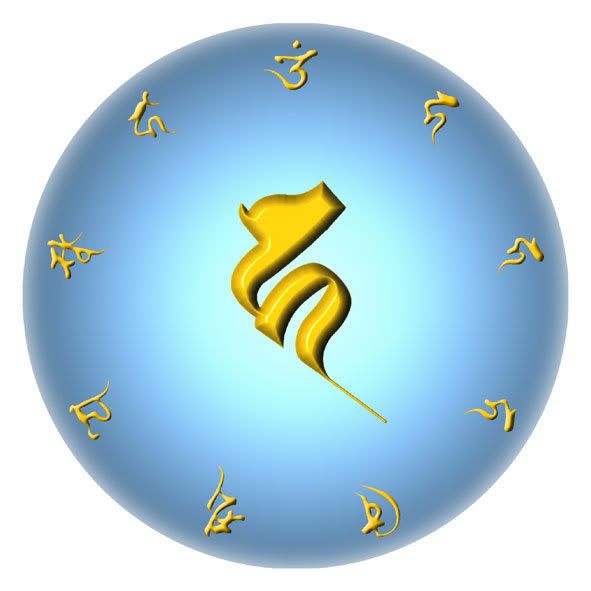
-
Extracted from my forum(Bodhi Hut Buddhism forum)
http://bodhihut.17.forumer.com/viewtopic.php?t=218
This is the mantra that Ksitigarbha heard from Buddhas equaling the number of sand grains of the river Ganga. He made offerings to them and then received this mantra. This mantra is to be used for any difficulties, problems; it is the best one to do for any problems in any situation. Even reciting four or five times, just a few times, it is very powerful. It is powerful to recite or just to think of the name of the bodhisattva. It is very, very powerful.
tsimbo tsimbo / dze tsimbo / aga ga tsimbo / bagara tsimbo / om ah bara tsimbo / bara tsimbo / badzira tsimbo / aroga tsimbo / dehama tsimbo / tsatewa tsimbo / sadenewa tsimbo / bewaroga sharwa tsimbo / owashama tsimbo / nyana tsimbo / bagasama moni ran-nga tsimbo / chana tsimbo / begimaba ria tsimbo / shashe dala maba tsimbo / bea dahso / dama haley / dombay abbey / satasey / satabasaley / geley / gela garaba / bara baretey / hasaley / barebey / paresata bendaney / benra / tsatsa tsatsa / heleneley / agata / take takelo / tare tare / nelematey / nemtey gulemela / om gutsibatey / arregerey / gutashamaley / dunga dunga dungurey / huru huru huru / gunodumeley / marito / naretey / mendata / harakam rem / huru huru //
Alternative mantra, which Rinpoche advised to do in preference to the above one:
tayata muni mo re / muni gha bhe / muni ki li dha ye / muni rogi ba tza le / muni hali de / muni gha me shu bha khye / mirla bhag / khe bhaa la la bhag khye / so ri kirta / tor na kir tsa le / bha tag sha kir te / ku ku la mir le / ava khya sa re / er ha ki li bha / muni bhaa thaba soha
Short Mantra
om ah kshiti garbha thlim hum (Sanskrit)
om ah khyiti garbha thaleng hung (Tibetan transliteration)
Chinses Version
嗡 缽 囉 末 鄰 陀 寧 娑 婆 訶 ㄨㄥ ㄅㄛˊ ㄌㄚˋ ㄇㄛˋ ㄌㄧㄣˊ ㄊㄨㄛˊ ㄋㄧㄥˊ ㄙㄨㄛ ㄆㄛˊ �ㄜ
請常誦『�無大願地�王�薩�
地�心咒
�密:
唵 訶 訶 訶 尾 娑 摩 曳 娑 婆 賀
-- -------- -- ----- -- --------
On Ka Ka Ka Bi Sanma E Sowa Ka
æ„�è¯:
â—�極讚(å�³æ¸å‘½)
訶訶訶��神力尊��就�祥�。
on kakaka bisanmae sowaka
â—�敬禮(å�³æ¸å‘½) ä¸‰ä¹˜è¡Œå› å¥‡å“‰å¥‡å“‰ æˆ�å°±
â—�唵ã€�ha ha ha(笑è�²)æ“�æœ‰å¾ˆå°‘å¾·è¡Œçš„ä½ æˆ�å°±å�§ã€‚
────────────────────────
 �密:
 地�心咒:  
嗡 請 嘿 拉 渣 沙 哇 悉 地 �
-- ---------- ------ ------ ------ --
Om Ching Hei La Ja Sa Wa Si Di Hum
地è—�å¿ƒå’’åŠ æŒ�誦
嗡 請 嘻 拉 渣 沙 哇 悉 地 �
-- ---------- ------ ------ ------ --
Om Ching He La Ja Sa Wa Si Di Hum
地è—�è�©è–©æ»…定æ¥çœŸè¨€ï¼š
è—�傳è¯éŸ³:
嗡 � 拉 嘛 尼 打 累 娑 哈
-- ------ ------ ------ ------
Om Bla Ma Ni Da Rei So Ha
å�¤æ¢µæ–‡è¯éŸ³:
嗡 缽 囉 末 鄰 陀 寧 娑 婆 訶
-- ------ ------ ------ ----------
Om Bla Mo Lin To Nin So Bo Ho