Any Comments On Mr. Xiao Pingshi?
-
eh.... getting personal here. Hoping to see debate Mr Xiao's theory, so back to the topic please.
-
Originally posted by coolbluewater:
eh.... getting personal here. Hoping to see debate Mr Xiao's theory, so back to the topic please.
I hope to go back on the topic too.
-
I think let's stop planting more seeds into our alaya conscious.
If you don't like a person so much, your subscious will want to come back next life again to scold that person.If you want to plant more seeds also fine, let me be the middle man, if yami and bohi want to talk, let me be the middle person middlerator.
-
Originally posted by Display Name:
I think let's stop planting more seeds into our alaya conscious.
If you don't like a person so much, your subscious will want to come back next life again to scold that person.If you want to plant more seeds also fine, let me be the middle man, if yami and bohi want to talk, let me be the middle person middlerator.
Thank you for the offer.
It's not about me wanting to talk to bohi or not, it's just that, if we're discussing a particular topic on a thread, we should stay focus.
You can try to search some past posts, whenever I started to contribute, bohi would bring in the part about me criticising pureland and vajrayana which is totally out of the discussion.
I am only concerned about this part and not about whether bohi likes me or not.
That's why I am seeking clarification from the moderator(s), whether is it that me being not agreeing totally with pureland and vajrayana would render me a lesser right to comment in this forum. If it is so, I will gladly leave the forum; if it is not, I hope the moderator(s) would do something to bohi's comments on me.
That simple =)
By the way, I don't lose anything if I cannot contribute in this forum.
-
Hi Yamizi, this forum welcomes everyone regardless of beliefs, schools, or even religions.
We should not get personal here (see forum rules, stickied).
Anyway lets get back to topic.
-
Next time, all personal attacks/discussions irrelevant to topic will be deleted straight away without notice.
I am not doing my job well enough as a moderator.
This is because this forum has been quite peaceful for some time and I didn't need to take any actions as a moderator (and I may not have edited or closed a topic since last year)... so kinda got used to just reading the posts.
http://buddhism.sgforums.com/forums/1728/topics/202797
Rules & Regulations
1) Treat all posters with respect. Always check your karma and its fruit from participating in this forum.
2) No posting with multiple identities (clones).
3) ~Buddhism: Wisdom Bliss~ reserves the right to publish, republish, delete or modify all discussions without asking for permission to do so.
4) Do not use offensive or vulgar language. Any postings of insulting texts, urls, images will be removed by moderators without any notices.
5) Do not engage in personal attacks. Posts of such nature will be removed by moderators without any notices.
6) Everyone regardless of religions or beliefs are welcome to post in our forum, but there shall be no promotion of Non-Buddhism materials, products, or religions/spiritual practices unless exceptional cases and received permission by moderators. All URLs related to the various traditions not recognised by our forum will also be removed without notice. (See: Schools/Traditions/Sects NOT Recognised In Our Forum)
7) Chit chat topics should be posted in “Lounge” threads in the forum, in order to reduce off-topic replies in various threads. -
Originally posted by An Eternal Now:
Hi Yamizi, this forum welcomes everyone regardless of beliefs, schools, or even religions.
We should not get personal here (see forum rules, stickied).
Anyway lets get back to topic.
Thank you for your prompt reply =)
-
I am still here.Just have to read several times the posts here, especially AEN's.
I do apologise if my thread is not useful.I am not trying to initiate a cyber brawl,just feel that he and his followers do have some points,especially when they refer to the Canon for support.
Please don't disparage the individuals,just stick to the points being discussed.Truth becomes clearer listening to both sides.No emotionalism,please,or we may become potential asuras.............
Like a university debate,don't get personal, if one considers oneself a true BuddhistIf you think you are right while the opposite camp isn't,why the need for vexations?Instead,you should have more compassion if you think they are treading on the wrong path.
-
I am still here.Just have to read several times the posts here, especially AEN's.
I do apologise if my thread is not useful.I am not trying to initiate a cyber brawl,just feel that he and his followers do have some points,especially when they refer to the Canon for support.
Please don't disparage the individuals,just stick to the points being discussed.Truth becomes clearer listening to both sides.No emotionalism,please,or we may become potential asuras.............
Like a university debate,don't get personal, if one considers oneself a true BuddhistIf you think you are right while the opposite camp isn't,why the need for vexations?Instead,you should have more compassion if you think they are treading on the wrong path.
-
There is something wrong with the "Save Reply" button?I wasted another half hour typing just now,like previously.My response did not appear again.
To return to the thread topic,dear friends here can try this:
http://tw.myblog.yahoo.com/jauh-chen/article?mid=5376&next=5269&l=f&fid=11
Sorry it is in Chinese.Because I'm still trying to understand certain things posited by both sides,I need to read them again and again as I'm not a smart person.Hence my belated responses.
-
It appears that the "I AM" experience is what Mr. Xiao and his apostles are attempting to refute;what they term常���的离念�知��识觉知心.They say this falls into the eternalism trap,and is not Dharma.But like you(AEN)said,they themselves seem to fall into the same trap by maintaining that the 8th Consciousness truly exists.Hence, they may not agree that the Dharmakaya is one and the same with Tathagatagarba,"ru lai zang".
Are Dharmakaya and Tathagatagarba one and the same?And how can the element of sentient beings be the Dharmakaya,something that Yong Jia Zen Master also asserts in his "Song of Enlightenment"?
They also cite the Lanka to support their stand.Could both sides be arguing over mere words and not the realities behind those words?
I need to read your posts and theirs again,repeatedly.
9
-
Originally posted by Uncreated:
I am still here.Just have to read several times the posts here, especially AEN's.
I do apologise if my thread is not useful.I am not trying to initiate a cyber brawl,just feel that he and his followers do have some points,especially when they refer to the Canon for support.
Please don't disparage the individuals,just stick to the points being discussed.Truth becomes clearer listening to both sides.No emotionalism,please,or we may become potential asuras.............
Like a university debate,don't get personal, if one considers oneself a true BuddhistIf you think you are right while the opposite camp isn't,why the need for vexations?Instead,you should have more compassion if you think they are treading on the wrong path.
This is true.
-
Originally posted by Uncreated:
There is something wrong with the "Save Reply" button?I wasted another half hour typing just now,like previously.My response did not appear again.
To return to the thread topic,dear friends here can try this:
http://tw.myblog.yahoo.com/jauh-chen/article?mid=5376&next=5269&l=f&fid=11
Sorry it is in Chinese.Because I'm still trying to understand certain things posited by both sides,I need to read them again and again as I'm not a smart person.Hence my belated responses.
I have not encountered such problems before, but next time please try to save your replies into a document first in case anything happens.
-
Originally posted by Uncreated:
It appears that the "I AM" experience is what Mr. Xiao and his apostles are attempting to refute;what they term常���的离念�知��识觉知心.They say this falls into the eternalism trap,and is not Dharma.But like you(AEN)said,they themselves seem to fall into the same trap by maintaining that the 8th Consciousness truly exists.Hence, they may not agree that the Dharmakaya is one and the same with Tathagatagarba,"ru lai zang".
Are Dharmakaya and Tathagatagarba one and the same?And how can the element of sentient beings be the Dharmakaya,something that Yong Jia Zen Master also asserts in his "Song of Enlightenment"?
They also cite the Lanka to support their stand.Could both sides be arguing over mere words and not the realities behind those words?
I need to read your posts and theirs again,repeatedly.
The �识觉知心 he is talking about is our transient thoughts and personality. This can hardly be called the I AM. He is saying that we should not mistake these transient thoughts and personality as eternal.
But the problem is he thinks that beyond our transient thoughts and personality, there is something totally real, something that is formless and permanent -- he calls it Alaya. It looks as if it is a boundless container where all experience arise and subsides from It. This real has always been unmoved and unchanging. Thoughts and personality changes over time, while this Alaya is unchanging and everpresent. This unchanging container is the I AM. So he clearly sees a duality.
Next, Tathagathagarbha is generally known as a potential, to transform into Dharmakaya. When full enlightenment is achieved, Tathagathagarbha transforms into Dharmakaya.
As for the Song of Enlightenment, I think it is more like a potential. If we all truly manifest Dharmakaya, Sambhogakaya and Nirmanakaya already then we are already Buddhas and there is no need to practice, which doesn't make sense. We have to practice a long time in the Bodhisattva path in order to manifest all the 3 bodies. And simply a realisation of ultimate reality is not enough, even Arhats can realise ultimate reality.
As Nirvana Sutra says,
"Child of the lineage, I have said that ‘curd exists in milk’, because curd is produced from milk, it is called ‘curd’.
Child of lineage, at the time of milk, there is no curd, also there is no butter, ghee or ma.n.da, because the curd arises from milk with the conditions of heat, impurities, etc., milk is said to have the ‘curd-nature’."Finally, there is no doubts that Mr Xiao Pingshi from the works I have quoted are speaking from the understanding and experience of the I AM. This is not at all the meanings of the sutras, and if you have read carefully, I have given a few examples of how he twisted the words and make it skewed to his MISunderstandings. I also showed how the true meaning of One Mind is being mistaken.
If you haven't, but I think you had, go read our moderator Thusness's Six Stages of Experience: http://awakeningtoreality.blogspot.com/2007/03/thusnesss-six-stages-of-experience.html
-
David Loy (a highly enlightened and qualified Zen teacher and academic):
http://ccbs.ntu.edu.tw/FULLTEXT/JR-PHIL/david.htm
That sa�s�ra is nirv�ṇa is a major tenet of Mah�y�na philosophy. "Nothing of sa�s�ra is different from nirv�ṇa, nothing of nirv�ṇa is different from sa�s�ra. That which is the limit of nirv�ṇa is also the limit of sa�s�ra; there is not the slightest difference between the two." [1] And yet there must be some difference between them, for otherwise no distinction would have been made and there would be no need for two words to describe the same state. So N�g�rjuna also distinguishes them: "That which, taken as causal or dependent, is the process of being born and passing on, is, taken noncausally and beyond all dependence, declared to be nirv�ṇa." [2] There is only one reality -- this world, right here -- but this world may be experienced in two different ways. Sa�s�ra is the "relative" world as usually experienced, in which "I" dualistically perceive "it" as a collection of objects which interact causally in space and time. Nirv�ṇa is the world as it is in itself, nondualistic in that it incorporates both subject and object into a whole which, M�dhyamika insists, cannot be characterized (Chandrakīrti: "Nirv�ṇa or Reality is that which is absolved of all thought-construction"), but which Yog�c�ra nevertheless sometimes calls "Mind" or "Buddhanature," and so forth.
.
.
.
http://www.hsuyun.org/Dharma/zbohy/Sruti-Smriti/Shastras/awakening-of-faith.html
A. Mind in Terms of the Absolute
The Mind in terms of the Absolute is the one World of Reality (dharmadhatu) and the essence of all phases of existence in their totality. That which is called "the essential nature of the Mind" is unborn and is imperishable. It is only through illusions that all things come to be differentiated. If one is freed from illusions, then to him there will be no appearances (lakshana) of objects regarded as absolutely independent existences; therefore all things from the beginning transcend all forms of verbalization, description, and conceptualization and are, in the final analysis, undifferentiated, free from alteration, and indestructible. They are only of the One Mind; hence the name Suchness.
All explanations by words are provisional and without validity, for they are merely used in accordance with illusions and are incapable of denoting Suchness. The term Suchness likewise has no attributes which can be verbally specified. The term Suchness is, so to speak, the limit of verbalization wherein a word is used to put an end to words. But the essence of Suchness itself cannot be put an end to, for all things in their Absolute aspect are real; nor is there anything which needs to be pointed out as real, for all things are equally in the state of Suchness. It should be understood that all things are incapable of being verbally explained or thought of; hence the name Suchness.
Question: If such is the meaning of the principle of Mahayana, how is it possible for men to conform themselves to and enter into it?
Answer: If they understand that, concerning all things, though they are spoken of, there is neither that which speaks, nor that which can be spoken of, and though they are thought of, there is neither that which thinks, nor that which can be thought of, then they are said to have conformed to it. And when they are freed from their thoughts, they are said to have entered into it. Next, Suchness has two aspects if predicated in words. One is that it is truly empty (sunya), for this aspect can, in the final sense, reveal what is real. The other is that it is truly nonempty (a-sunya), for its essence itself is endowed with undefiled and excellent qualities.
1. Truly Empty
Suchness is empty because from the beginning it has never been related to any defiled states of existence, it is free from all marks of individual distinction of things, and it has nothing to do with thoughts conceived by a deluded mind. It should be understood that the essential nature of Suchness is neither with marks nor without marks; neither not with marks nor not without marks; nor is it both with and without marks simultaneously; it is neither with a single mark nor with different marks; neither not with a single mark nor not with different marks; nor is it both with a single and with different marks simultaneously. In short, since all unenlightened men discriminate with their deluded minds from moment to moment, they are alienated from Suchness; hence, the definition "empty"; but once they are free from their deluded minds, they will find that there is nothing to be negated.
2. Truly Nonempty
Since it has been made clear that the essence of all things is empty, i.e., devoid of illusions, the true Mind is eternal, permanent, immutable, pure, and self-sufficient; therefore, it is called "nonempty". And also there is no trace of particular marks to be noted in it, as it is the sphere that transcends thoughts and is in harmony with enlightenment alone.
.
.
.
Zen Master Huang Po:
25. The term unity refers to a homogeneous spiritual brilliance which separates into six harmoniously blended 'elements'. The homogeneous spiritual brilliance is the One Mind, while the six harmoniously blended 'elements' are the six sense organs. These six sense organs beome severally united with objects that defile them -- the eyes with form, the ear with sound, the nose with smell, the tongue with taste, the body with touch, and the thinking mind with entities. Between these organs and their objects arise the six sensory perceptions, making eighteen sense-realms in all. If you understand that these eighteen realms have no objective existence, you will bind the six harmoniously blended 'elements' into a single spiritual brilliance -- a single spiritual brilliance which is the One Mind. All students of the way know this, but they cannot avoid forming concepts of 'a single spiritual brilliance' and 'the six harmoniously blended elements'. Accordingly they are chained to entities and fail to achieve a tacit understanding of original Mind.
-
Originally posted by Uncreated:
There is something wrong with the "Save Reply" button?I wasted another half hour typing just now,like previously.My response did not appear again.
To return to the thread topic,dear friends here can try this:
http://tw.myblog.yahoo.com/jauh-chen/article?mid=5376&next=5269&l=f&fid=11
Sorry it is in Chinese.Because I'm still trying to understand certain things posited by both sides,I need to read them again and again as I'm not a smart person.Hence my belated responses.
Oh, it seems the guy is quoting from Lankavatara Sutra. This sutra is the major propenent of the teaching of All is Mind. This also happens to be our moderator Thusness's favourite sutra.
Thusness, in a 2.5 hours discussion on Lankavatara Sutra in January 2007, transcript typed by me:
http://buddhism.sgforums.com/forums/1728/topics/262408
...Now, the entire thing about Lankavatara Sutra can be summarised into something like Reality is only Mind. That is, when we talk about Reality is only Mind, those who study Buddhism will know that there is the Cittamatra and then there is the Vijnaptimatra. We have to be very very careful about this thing. It is not going to be very scientific because you will sound stupid, you see. How can the external objects, the external reality, the objective reality that is so clearly outside, out there, be said to be the Mind? The manifestation of the Mind? How can you say that? ArenÂ’t you talking something that is not scientific? How is it possible? When you hear the sound, it is very obvious it is out there. When you touch the table, it is very clear that it is out there. The objective world exists with or without your intervention. Now, this casts many doubts of how do we account for these experiences, for experience the Lankavatara Sutra is stating all these. And I am only interested in this. And we have to differentiate this experience with another experience by what we call the Realists, by saying that everything is Perception. By saying No, it is actually your thoughts that is important, your perception, they are just perception of what you are thinking. Lankavatara Sutra is Not talking about this. DonÂ’t misunderstand. These are the concepts of philosophers. These are not the real experiences of one that has entered Non-Duality.
So it comes to the first chapter, of what the Lankavatara Sutra said. The chapter is about discriminations. Ok, in Lankavatara Sutra, they talk about the Five Dharmas. Mainly the names, the appearances, the discriminations, right knowledge, and then reality. I think this is very very important. What is appearance? Appearance is only phenomena that arises when the five senses come into contact. This is what is appearance. But it is before the formation of perception. This means whenever you sense something, before the formation of perception, that means before you identify it with object, that is what I call appearance. Then it comes to identification with an object, and that is perception, and this is the layer of what I call the symbolic world. And these are names. How I see Lankavatara Sutra. Then you can discriminate, that is discrimination, and that is duality. And then comes the right knowledge of what is it? And how do we experience reality.First of all we have to understand that what is meant by All is Mind is different from what is meant by All is Perception. Wei-Xin-Lun (Mind-Only Doctrine) is not the same as Wei-Shi-Lun (Consciousness-Only Doctrine). When we say that you are young till now. LetÂ’s say you are an old person. Everything that you experience, and everything that you touch, feel, or experience from an experiential point of view is the Mind. This means every single thoughts, every single things, including when you scoop the sand, when you touch the sand, and when you feel the texture of the sand, is the Mind. This is the kind of experience that Lankavatara Sutra is talking about. So do not confuse that hey, it is a thought in your mind. No it is not talking about this. Many people misunderstand this. It is not talking about this. So first, we must be very clear that it is this experience that they are talking about. It is the experience that is Non-Duality.
A person when first enters into meditation.. the first things that come to mind are thoughts. Streams of thoughts, never-ending thoughts. It never stops, never cease. Now, how are we going to understand what reality is all about, when we are covered by this layer of thoughts? And why going beyond this layer of thoughts is important to feel and to see what Reality is? The question that the objective world is so real outside you is mainly due to an attachment. Why do I say that? Many of us are unable to go beyond what I call the body. That is, your body. Because of this body, we acquire all our knowledge through the Five Senses and we make interpretations. It creates what I call a sense of boundary, that there is some restrictions, and therefore beyond this restriction it is outside, and within this restriction it is me, this is mental. But this is not actually the case when someone experiences what I call a moment of Presence. There are many people who had experienced Presence before. It is a state of clear luminosity and clarity. What is this experience all about? This experience is the first experience when one engages in a spiritual life that something is very very real. Something that is alive, and yet there is no thoughts. Something very very real. Something is extremely alive, you know that you are not a machine, you are not a body. Very real. So we ask, what is this? Now, it is this experience that serves as the condition that led many people to continue searching in the spiritual path. It is this experience that is misunderstood by many people as what they call the Eternal Witness, or they call the I AM.Now a person must come to this awareness first, of the Presence, this Reality, this Presence, what is it? Before they can proceed to the next step. This is important, because this is the first time you do not understand anything by knowledge. You do not understand anything by thoughts. You do not understand anything by the process of thinking. Everything just stops, and yet, there is Existence. So this is a moment, this is a form of touch, of what they call the Transcendental. This is important. But very soon, this experience is being distorted, completely distorted, by something that is very strong. This is what I call the momentum. This momentum is often overlooked by many practitioners. This momentum is very strong. To the objective world, it might not be. But to consciousness, it is very very strong. And it is so strong that we cannot identify what is real. And it is so strong that it bonds us life after life. How strong is it? It prevents us from knowing what that we touch, what that we feel, what that we sense and what that we see. This is how strong it is. The very moment when a person experience Presence and straight away they think that they are the I AM. This is the Eternal Soul. This is the Spirit. And this is what in Lankavatara Sutra states: It is the propensities, the habit energy. But it is so fast that even after you experience the Presence, you cannot go beyond it. You are still affected by it. And the world that you perceive suddenly becomes, still dualistic. But it becomes spiritual, but it is dualistic. This means that there is a subject and there is an objective world and there is a subjective world. This Ultimate Subject is God. This Ultimate Subject is the One that is behind, and everything is taking place, it is the Observer. This Subject that all is experiencing is actually an illusion. Why do I say that? Why do I say that it is an illusion? It is because of the momentum....
-
Originally posted by Uncreated:
But like you(AEN)said,they themselves seem to fall into the same trap by maintaining that the 8th Consciousness truly exists.
BTW when we talk about emptiness of alaya, the point is not that Alaya, or Buddha-Nature, or Mind, or whatever you want to call it; does not exist, as we all know that existence, non-existence, both existence and non-existence, and neither existence nor non-existence, are all the 4 extremes, are all false views. Emptiness means empty of these extremes. The luminosity and presence is not denied, what is necessary however is to see the bond of Self, how it distorts our experience..
What is being pointed out is not to deny any experience, but rather that we musn't categorise and separate form and formless, permanence and impermanence. When we attribute 'formlessness', 'permanence', into an entity and make it the void background reality, it becomes dualistic. And Mr Xiao Pingshi (unfortunately) refutes anyone who doesn't agree with his dualistic framework of understanding.
As I posted what Thusness said in http://awakeningtoreality.blogspot.com/:
The Transience

The arising and ceasing is called the Transience,
Is self luminous and self perfected from beginning.
However due to the karmic propensity that divides,
The mind separates the ‘brilliance’ from the ever arising and ceasing.
This karmic illusion constructs ‘the brilliance’,
Into an object that is permanent and unchanging.
The ‘unchanging’ appears unimaginably real,
Only exists in subtle thinking and recalling.
In essence the luminosity is itself empty,
Is already unborn, unconditioned and ever pervading.
Therefore fear not the arising and ceasing.
-------------
There is no this that is more this than that.
Although thought arises and ceases vividly,
Every arising and ceasing remains as entire as it can be.
The emptiness nature that is ever manifesting presently
Has not in anyway denied its own luminosity.
Although non-dual is seen with clarity,
The urge to remain can still blind subtly.
Like a passerby that passes, is gone completely.
Die utterly
And bear witness of this pure presence, its non-locality.
~ Thusness/Passerby
And hence... "Awareness" is not anymore "special" or "ultimate" than the transient mind. -
Re:The �识觉知心 he is talking about is our transient thoughts and personality.
No,if you read all the Chinese words I posted there,and not just this"�识觉知心",he is asserting that even the ordinary mind empty of all thoughts is not to be understood as eternally abiding,perhaps something akin to what those Thai forest Achaans have attained in vipassana.This is what I think he means by the "I Am",those he may not use this phrase.It is a state of total inner peace as there are no thoughts,hence no differentiations of "good","bad","beautiful","ugly"etc....He is trying to refute this state,which he sees perhaps people like the Achaans clinging to as something fundamental,abiding, enduring,unchanging,and hence eternal.
I think he is influenced by the Surangama Sutra,which describes different degrees of deep,inner peace during meditation,but admonishes meditators not to become unwittingly and subtlely attached to them,as they are demonic states(50 of them).However if all is ultimately empty,these states must be empty too,so there is really nothing demonic?
You mentioned this "luminosity" and "Presence".Are they eternal?Could this be what he is trying to expound?
Thank you so much for your precious time.I've learned(and also unlearned) alot.
-
Re:The �识觉知心 he is talking about is our transient thoughts and personality.
No,if you read all the Chinese words I posted there,and not just this"�识觉知心",he is asserting that even the ordinary mind empty of all thoughts is not to be understood as eternally abiding,perhaps something akin to what those Thai forest Achaans have attained in vipassana.This is what I think he means by the "I Am",those he may not use this phrase.It is a state of total inner peace as there are no thoughts,hence no differentiations of "good","bad","beautiful","ugly"etc....He is trying to refute this state,which he sees perhaps people like the Achaans clinging to as something fundamental,abiding, enduring,unchanging,and hence eternal.No, this is not the realisation of the Ajahns. And this is not the I Am that I'm talking about, and I doubt this is the sort of realisation of the Masters that Mr. Xiao Pingshi is criticising on. On the other hand Mr. Xiao Pingshi's description of Alaya is clearly the I AM that I am talking about. As for what is the I AM that I am talking about, you have to read this article, this is the clearest: http://awakeningtoreality.blogspot.com/2007/03/mistaken-reality-of-amness.html
For the Ajahns, their understanding/experience is that there is an eternal luminous unborn Citta... the unchanging background substance and the witness of all phenomena. In the case of the Ajahns they seem to have non-dual (of knower and known) experiences but still, more like the Advaita kind of experience and understanding. He still sees the unborn, undying Citta as an essential knowing separate from all skhandas. Therefore it is not the understanding of One Mind, and not the understanding of the empty nature and the inseparability of presence and conditions.
A quote from one of the Ajahns...
OF FOREMOST IMPORTANCE IS THE CITTA, the mind’s essential knowing
nature. It consists of pure and simple awareness: the citta simply
knows. Awareness of good and evil, and the critical judgements
that result, are merely activities of the citta. At times, these activities
may manifest as mindfulness; at other times, wisdom. But the
true citta does not exhibit any activities or manifest any conditions
at all. It only knows. Those activities that arise in the citta, such as
awareness of good and evil, or happiness and suffering, or praise
and blame, are all conditions of the consciousness that flows out
from the citta. Since it represents activities and conditions of the
citta that are, by their very nature, constantly arising and ceasing,
this sort of consciousness is always unstable and unreliable..
.
The citta forms the very foundation of saÿsãra; it is the essence
of being that wanders from birth to birth. It is the instigator of the
cycle of existence and the prime mover in the round of repeated
birth and death. Saÿsãra is said to be a cycle because death and
rebirth recur regularly according to the immutable law of kamma.
The citta is governed by kamma, so it is obliged to revolve perpetually
in this cycle following kamma’s dictates. As long as the citta
remains under the jurisdiction of kamma, this will always be the
case. The citta of the Arahant is the sole exception, for his citta
has completely transcended kamma’s domain. Since he has also
transcended all conventional connections, not a single aspect of
relative, conventional reality can possibly become involved with
the Arahant’s citta. At the level of Arahant, the citta has absolutely
no involvement with anything.
Once the citta is totally pure, it simply knows according to its
own inherent nature. It is here that the citta reaches it culmination;
it attains perfection at the level of absolute purity. Here the
continuous migration from one birth to the next finally comes
to an end. Here the perpetual journey from the higher realms of
existence to the lower ones and back again, through the repetitive
Citta—The Mind’s Essential Knowing Nature 97
cycle of birth, ageing, sickness, and death, totally ceases. Why
does it cease here? Because those hidden, defiling elements that
normally permeate the citta and cause it to spin around have been
completely eliminated. All that remains is the pure citta, which
will never again experience birth and death..
.
When everything permeating the citta has finally been removed,
we have reached the ultimate stage. Separation at this
level is a permanent and total disengagement that requires no
further effort to maintain. This is true freedom for the citta. When
the body suffers illness, we know clearly that only the physical
elements are affected, so we are not concerned or upset by the
symptoms. Ordinarily, bodily discomfort causes mental stress. But
once the citta is truly free, one remains supremely happy even amid
intense physical suffering. The body and the pain are known to be
phenomena separate from the citta, so the citta does not participate
in the distress. Having relinquished them unequivocally, body and
feelings can never again intermix with the citta. This is the citta’s
absolute freedom..
.
BEING INTRINSICALLY BRIGHT AND CLEAR, the citta is always ready
to make contact with everything of every nature. Although all
conditioned phenomena without exception are governed by the
three universal laws of anicca, dukkha, and anattã, the citta’s true
nature is not subject to these laws. The citta is conditioned by
anicca, dukkha, and anattã only because things that are subject to
these laws come spinning in to become involved with the citta and
so cause it to spin along with them. However, though it spins in
unison with conditioned phenomena, the citta never disintegrates
or falls apart. It spins following the infl uence of those forces which
have the power to make it spin, but the true power of the citta’s
own nature is that it knows and does not die. This deathlessness is
a quality that lies beyond disintegration. Being beyond disintegration,
it also lies beyond the range of anicca, dukkha, and anattã and
the universal laws of nature. But we remain unaware of this truth
because the conventional realities that involve themselves with
the citta have completely surrounded it, making the citta’s nature
thoroughly conform to theirs..
.
...There is only that essential knowing, with
absolutely nothing infiltrating it. Although it still exists amid the
same khandhas with which it used to intermix, it no longer shares
any common characteristics with them. It is a world apart. Only
then do we know clearly that the body, the khandhas, and the citta
are all distinct and separate realities.p.s. Vipassana leads all the way to full enlightenment and the realisation of non-duality and emptiness, so practiced properly and with right understanding, it leads to full enlightenment (and that means Arhat or Buddha according to which tradition you follow)
-
I think he is influenced by the Surangama Sutra,which describes different degrees of deep,inner peace during meditation,but admonishes meditators not to become unwittingly and subtlely attached to them,as they are demonic states(50 of them).However if all is ultimately empty,these states must be empty too,so there is really nothing demonic?
They become demons only when you objectify them and make them an object of attachment. Actually they [projection of externality/objectivity] are all mentally created illusions. In reality, all is (One) Mind. Scenery, bird chirping, touching the keyboard, even suffering, all is It. When bird chirps, there is no I and no bird, only chirping. The world seen as it is, as One Mind, is itself Nirvana. 'Demons' only arise in duality.
When we discriminate, perceive and objectify what we experience into 'things' separate from ourselves ('Self'). This is the subject/object dichotomy/duality. If duality is true, there cannot be only One Mind. But all along, there is no duality, there is only One Mind.
http://ccbs.ntu.edu.tw/FULLTEXT/JR-PHIL/david.htm
That sa�s�ra is nirv�ṇa is a major tenet of Mah�y�na philosophy. "Nothing of sa�s�ra is different from nirv�ṇa, nothing of nirv�ṇa is different from sa�s�ra. That which is the limit of nirv�ṇa is also the limit of sa�s�ra; there is not the slightest difference between the two." [1] And yet there must be some difference between them, for otherwise no distinction would have been made and there would be no need for two words to describe the same state. So N�g�rjuna also distinguishes them: "That which, taken as causal or dependent, is the process of being born and passing on, is, taken noncausally and beyond all dependence, declared to be nirv�ṇa." [2] There is only one reality -- this world, right here -- but this world may be experienced in two different ways. Sa�s�ra is the "relative" world as usually experienced, in which "I" dualistically perceive "it" as a collection of objects which interact causally in space and time. Nirv�ṇa is the world as it is in itself, nondualistic in that it incorporates both subject and object into a whole which, M�dhyamika insists, cannot be characterized (Chandrakīrti: "Nirv�ṇa or Reality is that which is absolved of all thought-construction"), but which Yog�c�ra nevertheless sometimes calls "Mind" or "Buddhanature," and so forth.
.
.
Zen Master Huang Po:
25. The term unity refers to a homogeneous spiritual brilliance which separates into six harmoniously blended 'elements'. The homogeneous spiritual brilliance is the One Mind, while the six harmoniously blended 'elements' are the six sense organs. These six sense organs beome severally united with objects that defile them -- the eyes with form, the ear with sound, the nose with smell, the tongue with taste, the body with touch, and the thinking mind with entities. Between these organs and their objects arise the six sensory perceptions, making eighteen sense-realms in all. If you understand that these eighteen realms have no objective existence, you will bind the six harmoniously blended 'elements' into a single spiritual brilliance -- a single spiritual brilliance which is the One Mind. All students of the way know this, but they cannot avoid forming concepts of 'a single spiritual brilliance' and 'the six harmoniously blended elements'. Accordingly they are chained to entities and fail to achieve a tacit understanding of original Mind.
.
.
http://www.hsuyun.org/Dharma/zbohy/Sruti-Smriti/Shastras/awakening-of-faith.html
A. Mind in Terms of the Absolute
The Mind in terms of the Absolute is the one World of Reality (dharmadhatu) and the essence of all phases of existence in their totality. That which is called "the essential nature of the Mind" is unborn and is imperishable. It is only through illusions that all things come to be differentiated. If one is freed from illusions, then to him there will be no appearances (lakshana) of objects regarded as absolutely independent existences; therefore all things from the beginning transcend all forms of verbalization, description, and conceptualization and are, in the final analysis, undifferentiated, free from alteration, and indestructible. They are only of the One Mind; hence the name Suchness.
All explanations by words are provisional and without validity, for they are merely used in accordance with illusions and are incapable of denoting Suchness. The term Suchness likewise has no attributes which can be verbally specified. The term Suchness is, so to speak, the limit of verbalization wherein a word is used to put an end to words. But the essence of Suchness itself cannot be put an end to, for all things in their Absolute aspect are real; nor is there anything which needs to be pointed out as real, for all things are equally in the state of Suchness. It should be understood that all things are incapable of being verbally explained or thought of; hence the name Suchness.
Question: If such is the meaning of the principle of Mahayana, how is it possible for men to conform themselves to and enter into it?
Answer: If they understand that, concerning all things, though they are spoken of, there is neither that which speaks, nor that which can be spoken of, and though they are thought of, there is neither that which thinks, nor that which can be thought of, then they are said to have conformed to it. And when they are freed from their thoughts, they are said to have entered into it. Next, Suchness has two aspects if predicated in words. One is that it is truly empty (sunya), for this aspect can, in the final sense, reveal what is real. The other is that it is truly nonempty (a-sunya), for its essence itself is endowed with undefiled and excellent qualities.
1. Truly Empty
Suchness is empty because from the beginning it has never been related to any defiled states of existence, it is free from all marks of individual distinction of things, and it has nothing to do with thoughts conceived by a deluded mind. It should be understood that the essential nature of Suchness is neither with marks nor without marks; neither not with marks nor not without marks; nor is it both with and without marks simultaneously; it is neither with a single mark nor with different marks; neither not with a single mark nor not with different marks; nor is it both with a single and with different marks simultaneously. In short, since all unenlightened men discriminate with their deluded minds from moment to moment, they are alienated from Suchness; hence, the definition "empty"; but once they are free from their deluded minds, they will find that there is nothing to be negated.
2. Truly Nonempty
Since it has been made clear that the essence of all things is empty, i.e., devoid of illusions, the true Mind is eternal, permanent, immutable, pure, and self-sufficient; therefore, it is called "nonempty". And also there is no trace of particular marks to be noted in it, as it is the sphere that transcends thoughts and is in harmony with enlightenment alone.
You mentioned this "luminosity" and "Presence".Are they eternal?Could this be what he is trying to expound?
Sometimes the word 'permanent' or 'eternal' is used, but it is a very very confusing term. There must be the correct understanding. But Presence is abiding, unmoving. But this abiding/unmoving is not in separation from change and impermanence, and IS Impermanence. Without the understanding of non-duality, it can very easily become the view of the Eternalist, such as those who experienced the pure I AMness.
As our moderator Thusness said, and I posted (with slight editing) in http://awakeningtoreality.blogspot.com/2007/03/mistaken-reality-of-amness.html ,
Although there is non-duality in Advaita Vedanta, and no-self in Buddhism, Advaita Vedanta rest in an “Ultimate Background” (making it dualistic), whereas Buddhism eliminates the background completely and rest in the emptiness nature of phenomena; arising and ceasing is where pristine awareness is. In Buddhism, there is no eternality, only timeless continuity (timeless as in vividness in present moment but change and continue like a wave pattern). There is no changing thing, only change..
.
Thoughts, feelings and perceptions come and go; they are not ‘me’; they are transient in nature. Isn’t it clear that if I am aware of these passing thoughts, feelings and perceptions, then it proves some entity is immutable and unchanging? This is a logical conclusion rather than experiential truth. The formless reality seems real and unchanging because of propensities (conditioning) and the power to recall a previous experience. (See The Spell of Karmic Propensities)
There is also another experience, this experience does not discard or disown the transients -- forms, thoughts, feelings and perceptions. It is the experience that thought thinks and sound hears. Thought knows not because there is a separate knower but because it is that which is known. It knows because it's it. It gives rise to the insight that isness never exists in an undifferentiated state but as transient manifestation; each moment of manifestation is an entirely new reality, complete in its own..
.
In naked awareness, there is no splitting of attributes and objectification of these attributes into different groups of the same experience. So thoughts and sense perceptions are not disowned and the nature of impermanence is taken in wholeheartedly in the experience of no-self. ‘Impermanence’ is never what it seems to be, never what that is understood in conceptual thoughts. ‘Impermanence’ is not what the mind has conceptualized it to be. In non-dual experience, the true face of impermanence nature is experienced as happening without movement, change without going anywhere. This is the “what is” of impermanence. It is just so.
Zen Master Dogen: "Impermanence is Buddha-Nature."And as our moderator Longchen said,
Do you know how present moment feels like? It feels that everything is not moving. This is because awareness is fully aligned with changes at the precise present moment. It is not because the mind has being stopped.http://www.dreamdatum.com/nondual-experience.html
Non-duality is NOT the same as a state of Witnessing Presence observing Phenomenality. An Eternal Witnessing Presence that is apart from Phenomena cannot be said to be non dual as there are two components here (witness and phenomena). This experience is characterised by a non-judging watcher observing the world and mind. I had this experience before. And now, I must say that true non-duality is distinctively different from this. The witness/watcher is really not separated from the rest of the world . It (this witness) is not unchanging, but is simply a knowingness that is not apart from the flow of phenomenality.
Non duality can only be stably experienced when the 'sense of self' and the 'Eternal Witness' are correctly understood for what they are.and
http://www.dreamdatum.com/no-eternalwitness.html
Is there an Eternal Witness?
During deep meditative states, an all-pervading Presence is detectable. This Presence, is most often experienced when thoughts are momentarily suspended. In this state, we sense the Eternal Witness.
But does the Eternal Witness truly exist? No.
In the past, I would have thought that it existed... as our true self. Not anymore.So what causes the impression of the Witness?
From deep meditative observation, the witness is realised to be just an impression that is caused by subtle knowingness and sequential observation. Moment to moment arises in lightning fast speed. The second moment got a subtle imprint of the recently preceded one. This sequential change causes the sense of Subtle Witnessing known as the Eternal Witness.
There is no permanent unchanging Witness, but ever changing moment to moment witnessing. In another word, no permanent 'Eternal Witness' exist.
For your necessary ponderance. Thank you for reading.
Thank you so much for your precious time.I've learned(and also unlearned) alot.
You're welcomed.. I too have much to learn and unlearn.
-
(Post split into 3 parts because there are problems editing them.)
......
BTW there is something equally important as the understanding of our Luminosity. It is the understanding of our Karmic Propensities. It is the reason why we make luminosity into an eternally abiding entity or a Self. As our moderators Thusness and Longchen previously said, it's the working of the imprints and subtle recalling that makes us sink back to the illusion of a permanent background Source, Witness, Self... and thus fail to see that the Appearance is the Source.
As I wrote in http://awakeningtoreality.blogspot.com/2007/07/spell-of-karmic-propensities.html
The Spell of Karmic Propensities
The following article is a summary (by me) of some of the conversations Thusness had with me on the topic of Karmic Propensities/Karmic Momentum/Deep Conditionings and how it blinds us and completely affects the way we see phenomena.
Karmic Propensities is what blinded us from seeing the ultimate reality. Our entire mind is affected by karmic propensities such that our entire system of enquiry, even when we want to inquire on reality, we cannot know beyond "Who", "When", "What", "Where". Our mind is always thinking dualistically, in terms of subject and object (an I and a Not-I/an Observer apart from the Object of Observation, which cannot be found in reality). It is a momentum that cannot be located, yet it can be directly felt and experienced, and the momentum arises every moment and affect the entire way we see things. When we are affected by momentum the mind cannot know the ultimate reality (Emptiness).Because our momentum is at work, we will always assume a subject-object duality. That is, there is a Self, an Agent, and observer, doer, thinker of thoughts. A self that persists in time in a connected way... experiencing things... It blinds us into seeing self and objective world as 'entities', as 'things' with inherent existence, as a separate and permanent 'me'.
So when momentum is in action, we cannot help but react with our karmic patterns. If we were to ask, "If you lost your shoe, are you still you?" or "If you lost your hands, do you still exist?". It almost seems certain to say "Yes, of course I am still I." because we always assumed there is a truly existing "Self" experiencing changes. This momentum can continue even after experiences of transcendental Presence, and distorting the experience.
Dharma Dan calls the karmic propensities of seeing subject/object division, or a separate Agent that is the observer, the "fundamental knot of perception". (See: The Non-Duality Models of Enlightenment by Dharma Dan)
Because it is our habit energy that made us think that way, we are so used to thinking in terms of subject object duality that it has become so deeply part of us, deeply imprinted into our consciousness.
If we were to eliminate this bond, then we can begin to realise, there is no "Self". In reality, there is only Self1, Self2, Self3, moment to moment our mental and karmic factors arise spontaneously but not in a connected way. We are not a permanent self, we are momentary selves and nothing stays, everything is ever flowing. (Also see What is Self? and What Is The "Me"?)
Without seeing things as 'entities', we can begin to realise the nature of Dependent Co-Arising, Conditionality, Interdependence, etc, i.e Emptiness. The nature is always so, but our karmic propensities obscure us from seeing the truth, distorting the way we see things, enquire things, and perceive things. It is this bond that bonds us life after life in Samsara.
To eliminate the bond we have to feel it, feel the power of the bond, experience it. To eliminate the bond is a matter of insights, the insight into our true nature, the insight into self-liberation, etc. Not only must we eliminate the bond, we must be able to see how "Propensities" blinds us, and that is through naked awareness.
How can naked awareness lead to the insight of our "Propensities"?
Space, time, life, death, in and out are all ‘deeply held’ impressions. We are seldom aware of the “deeply held” until we are able to rest adequately in naked awareness. The nakedness creates the big contrast that provides us the condition for the arising of the insight of the 'deeply held'. The insight into the full power of our ‘propensities’ and resting in naked awareness are both equally crucial in our understanding of our non-dual (no subject-object duality, no separate permanently existing self) and non-local (emptiness of locality) nature.
To consciousness 'propensities' (deep conditioning or imprints) are all that matters. It is the only 'force' that blinds, bonds and prevents a liberating experience. Once formed it remains latent and only surface when conditions are riped for fruition. We are unable to get rid of it by will. Therefore to know consciousness, it is also to know the impact of deep conditioning, how it is formed and how it subsides. There is really no 'why', it is just how consciousness works.
If we drop our body, we experience astral body.
If we drop our thoughts, we experience “I AM”.
If we drop ‘I’, we experience non-duality.
Every major dropping results in a totally new experiential reality. Perhaps that is why Lao Tze teaches us to eliminate until none to experience Tao.To drop the bondage/deep conditionings, the mind MUST realise that another way of 'knowing' is possible; an effortless, total sensing and experience of wholeness. Next the experiences of the joy, bliss and clarity of wholeness. Without the insight into the possiblity and the experience of the positive factors, the mind will not release itself from holding.
Even open pure and innocent inquiry is a deep conditioning. Makes the mind chatters incessantly. Every what, when, where and why by itself is a distancing from start. Freeing itself from such mode of inquiry aka 'knowing', the mind rests. The joy of this resting must be experienced for the 'willingness' to arise. :)
P.S. there are different types of meditative bliss/joy/rapture.
Like samatha meditation, each jhana state represents a stage of bliss associated with certain level of concentration; the bliss experienced from insight into our nature differs.
The happiness and pleasure experience by a dualistic mind is different from that experienced by a practitioner. “I AMness” is a higher form of happiness as compared to a dualistic mind that continuously chatters. It is a level of bliss associated with a state of ‘transcendence’ – a state of bliss resulting from the experience of “formlessness, odorless, colorless, attributeless and thoughtlessness’.No-self or non-dual is higher form of bliss resulted from the direct experience of Oneness and no-separation. It is related to the dropping of the ‘I’. When non-dual is free from perceptions, that bliss is a form transcendence-oneness. It is what Thusness called transparency of non-duality. -
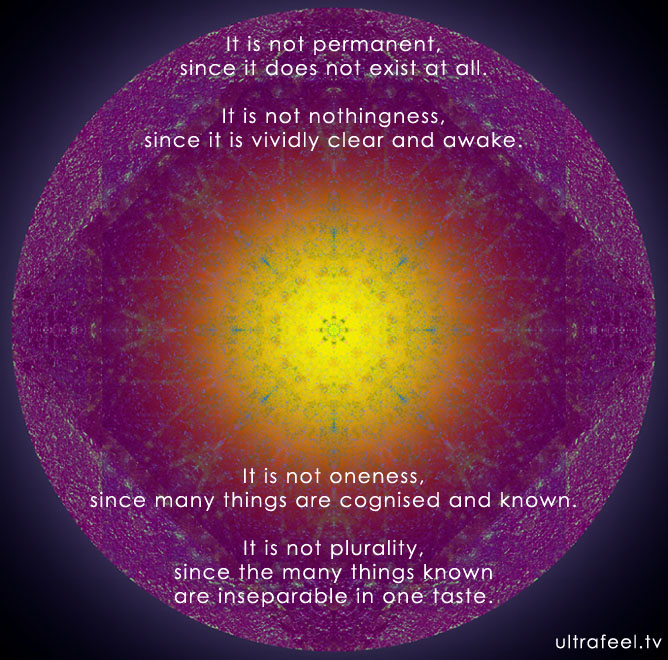
art (cr)eated by h.r.foxIt is not permanent, since it does not exist at all.
It is not nothingness, since it is vividly clear and awake.
It is not oneness, since many things are cognised and known.
It is not plurality, since the many things known are inseparable in one taste.
(Shabkar Tsokdrug Rangdrol)
