Jogye Order says Korean government of favoring Christianity
-
Originally posted by Maggie.meepok:
Hi all, I read your posts with interest.
Korean is a hotbed for fundamental Christianity, unfortunately. Do you know of the Christian cult group called "the Moonies"? I believe this group is banned in Singapore and it refers to the Unification Church founded by Korean Rev Sun Myung Moon. It grew to have much influence and Rev Moon even said that the Jewish halocaust during WWII was fair justice visited on the Jews for rejecting Jesus. This is such cruel and wrong thinking!
I am a Christian and I feel sad that Jesus' message of love and compassionate has often been corrupted by fundamentalists who make use of religion for selfish political ends.
But I must congratulate the Buddhist movement in Singapore in sharing the Dharma actively eg Kong Meng San Park Kor See has many free publications in good, clear English. I feel that the Buddhist movement has gained many headways in sharing the spiritual path with others. I am one of those who have gained from reading Buddhist books in English. It helped me to be a clearer-visioned Christian.
Some of you have expressed alarm and even fear that Buddhism is loosing out to Christianity and feel that you must do something. When we feel that our turf is being trampled on, we tend to react in fear and anger - this is against the spirit of Buddhism. What I admire about Buddhism is that you share the dharma not to "extend the kingdom" of Buddha but you share out of love and compassion - to help someone end his suffering.
Continue to speak against fundamentalism and extremism of all forms and not be silent. But hold on to the spirit of love and compassion taught by Buddha and Jesus, even while you see the tide of fundament Christianity sweeping across Korea. Try to see that these fundamental Christians are suffering too due to wrong thinking and ignorance. Even Jesus has said compassionately of those who persecuted him and put him on the cross:"Father, they know not what they do."
Let us use this forum for strengthening each other in our spiritual paths, whether Buddhists or Christians, in tolerance, acceptance and love.
Om shanti (peace) to all.
Hi Maggie.meepok
Oh yes, the Moonies, that's clearly a cult. Should be nothing to do with Christainity but unfortunately, they are rather "successful" in recruiting followers...True, ignorance is our greatest obstacle to realise the ultimate truth of life. Let's work hard to attain the ultimate wisdom and be liberated from all sufferings one day.

-
Cults are obstacles in humanity. They brainwash followers to do things that onli brings suffering to their followers in the end.
-
Originally posted by An Eternal Now:
Oh you studied in Singapore before? didn't know.. interesting
yes, near boon lay, supposingly should be four year finish the course but i delayed for one and half year more, -
Originally posted by cycle:
Hi Maggie.meepok
Oh yes, the Moonies, that's clearly a cult. Should be nothing to do with Christainity but unfortunately, they are rather "successful" in recruiting followers...True, ignorance is our greatest obstacle to realise the ultimate truth of life. Let's work hard to attain the ultimate wisdom and be liberated from all sufferings one day.
Certainly I do not think Christianity deliberately promotes cults. But interestingly, many cults have some basis in traditional religions. For instance, the Ku Klux clan in which advocated white supremacy was strongly influenced by fundamental Christian ideas. Then there is also the Branch Dravidians (the infamous Waco case in USA) where more than 80 people commited suicide at the instruction of their leader David Koresh. It also has its roots in pseudo-Christians ideas.
The core of Christianity promotes peace and love but some people choose to interpret the bible according to their own purposes. They also do not consider the old testament is an ancient people's subjective understanding of their experience of God so when they win a war they believe that God is on their side. I do not believe in such a naive and literal reading of the bible.
What is boils down to is that many religions, especially the monotheistic ones (single god religions) tends to appeal strongly to faith and emotions, unlike Buddhism which to me (a Christian) seems more logical and rational. Thus, the faithful in monotheistic religions are more open to the dangers of charismatic leaders while Buddhists have been taught by Buddha to question even the teachings of your teachers to see if they make sense before acceptance.
Monotheistic religions such as Judaism, Christianity and Islam (they all come from the same roots) have a historical record of violence not just in the form of cults but also against each other and against others. Some exampls from the Christian tradition are the Crusades, the Spanish Inquisitions and the Salem witch hunts in USA all condoned by the religions establishments of their day. Here a site on Christian terrorism: http://en.wikipedia.org/wiki/Christian_terrorism
Strangely, when I google "Buddhist terrorism" there is almost nothing much, except that all the sites point the Buddhism is against terrorism. I am sure there are some errant monks or abbotts throughout history who have used violence for his own political ends. But it is likely to be more on an individual basis rather than the mass actions that we have historically seen among those who claim to be Christians and Muslims. Maybe someone can enlighten me if there is anything on this scale in Buddhist history. It seems as a whole, there is no major war fought in the name of Buddha, haha.
So why am I, a Christian, saying all these things seemingly against my own religion and still remain a Christian?
Because I feel that fundamental Christians have missed the point of the Jesus' key message. Because I feel that fundamental Christianity has a very aggressive streak. Because I feel that many Christians are not objective enough for fear of criticising God. Because I feel many fundamental Christian elements and wrong beliefs have entered mainstream Christianity.
Jesus' message of love has been hijacked.
-
Originally posted by Maggie.meepok:
Certainly I do not think Christianity deliberately promotes cults. But interestingly, many cults have some basis in traditional religions. For instance, the Ku Klux clan in which advocated white supremacy was strongly influenced by fundamental Christian ideas. Then there is also the Branch Dravidians (the infamous Waco case in USA) where more than 80 people commited suicide at the instruction of their leader David Koresh. It also has its roots in pseudo-Christians ideas.
The core of Christianity promotes peace and love but some people choose to interpret the bible according to their own purposes. They also do not consider the old testament is an ancient people's subjective understanding of their experience of God so when they win a war they believe that God is on their side. I do not believe in such a naive and literal reading of the bible.
What is boils down to is that many religions, especially the monotheistic ones (single god religions) tends to appeal strongly to faith and emotions, unlike Buddhism which to me (a Christian) seems more logical and rational. Thus, the faithful in monotheistic religions are more open to the dangers of charismatic leaders while Buddhists have been taught by Buddha to question even the teachings of your teachers to see if they make sense before acceptance.
Monotheistic religions such as Judaism, Christianity and Islam (they all come from the same roots) have a historical record of violence not just in the form of cults but also against each other and against others. Some exampls from the Christian tradition are the Crusades, the Spanish Inquisitions and the Salem witch hunts in USA all condoned by the religions establishments of their day. Here a site on Christian terrorism: http://en.wikipedia.org/wiki/Christian_terrorism
Strangely, when I google "Buddhist terrorism" there is almost nothing much, except that all the sites point the Buddhism is against terrorism. I am sure there are some errant monks or abbotts throughout history who have used violence for his own political ends. But it is likely to be more on an individual basis rather than the mass actions that we have historically seen among those who claim to be Christians and Muslims. Maybe someone can enlighten me if there is anything on this scale in Buddhist history. It seems as a whole, there is no major war fought in the name of Buddha, haha.
So why am I, a Christian, saying all these things seemingly against my own religion and still remain a Christian?
Because I feel that fundamental Christians have missed the point of the Jesus' key message. Because I feel that fundamental Christianity has a very aggressive streak. Because I feel that many Christians are not objective enough for fear of criticising God. Because I feel many fundamental Christian elements and wrong beliefs have entered mainstream Christianity.
Jesus' message of love has been hijacked.
Hi Maggie.meepok,
Buddhism is very profound. Along the spiritual path, one will also be able to understand what is the nature of 'God' and its 'relationship' to the apparent physical world that we are living in.
Strangely, our consciousness and beingness are not what it appears to be

Can God separate itself from its creations? If that is possible, then Space will be before God... because for any separation to occur... space must be present to apply distance and differences in location. If that is the case, Space will be the creator of God. Can you see the dichotomy?
Buddhism is profound in that the very assumption of your own existence is throroughly investigated and explored.
I hope that i am not being too hard-selling here. Just wish that you can give this area an investigative relook. Not easy and quite fearful for one to break away from the comfort zone.
regards
-
Originally posted by longchen:
Hi Maggie.meepok,
Buddhism is very profound. Along the spiritual path, one will also be able to understand what is the nature of 'God' and its 'relationship' to the apparent physical world that we are living in.
Strangely, our consciousness and beingness are not what it appears to be
Can God separate itself from its creations? If that is possible, then Space will be before God... because for any separation to occur... space must be present to apply distance and differences in location. If that is the case, Space will be the creator of God. Can you see the dichotomy?
Buddhism is profound in that the very assumption of your own existence is throroughly investigated and explored.
I hope that i am not being too hard-selling here. Just wish that you can give this area an investigative relook. Not easy and quite fearful for one to break away from the comfort zone.
regards
Hi longchen,
If I am not wrong, you are saying in a very, very tactful way to me to question if there is such a thing as a personal, creator God which the Christians believe in, correct?

Actually, in the liberal circles of Christianity, there are thinkers who challenge the traditional, theistic concept of God. A theistic god is one that is external to you, like some God in heaven who is like a person, who can comfort or punish you like a parent and who can, at will, interfere with the laws of nature and create miracles.
American transcendentalist movements in the 19th century believe that the spiritual is in all creation and within your depths, and that this transcends beyond the physical and empirical and beyond the doctrines of traditional religion.
A current day leading advocate who challenge the traditional idea of a personal, creator god is John Selby Spong who was the Bishop of the Episcopal (Anglican) Church at Newark, USA. Maybe he does not have the vocab for it like the yogis do, but he talks about God as a 'ground of being' within you not external to you, of finding something that is true inside of yourself like what the yogis call "purusha" or true nature.
You are right that it being hard (for me) to leave one's comfort zone, to give up the idea of a personal, creator God that one is used to for so long. But I am on a journey of learning and exploration and I'd have to see how it goes. Yogic ideas and some readings on quantum physics (little bit only lah) do give very interesting possibilities.
Even Jesus has said: "The kingdom of God of cometh not with outward show; neither shall they say, Lo here! or, Lo there! for behold, The kingdom of God is within you."
So, it seems that Jesus also said that heaven is not an external place but a state of being.
-
Originally posted by Maggie.meepok:
Even Jesus has said: "The kingdom of God of cometh not with outward show; neither shall they say, Lo here! or, Lo there! for behold, The kingdom of God is within you."
So, it seems that Jesus also said that heaven is not an external place but a state of being.
Hi Maggie.meepok,
Yes, that is what I am trying to convey.
This 'Kingdom of God' is not a place elsewhere in the universe. It is a state of Being that can be experienced here and now.
It has been miscontrued by people who did not have the direct experience, giving rise to all kinds of horrendous misinterpretations that creates much unnecessarily sufferings.
-
Originally posted by longchen:
Hi Maggie.meepok,
Yes, that is what I am trying to convey.
This 'Kingdom of God' is not a place elsewhere in the universe. It is a state of Being that can be experienced here and now.
It has been miscontrued by people who did not have the direct experience, giving rise to all kinds of horrendous misinterpretations that creates much unnecessarily sufferings.
-
Hi all.
Once, we are having social studies and we had a discussion on the conflicts in northern ireland. There is a conflict between Protestants and Catholics. My classmates said that there is alot of problem with christian, and terrorists using islam to kill whereas buddhist did nothing and were neutral. My teacher disagreed and replied that Buddhist also have problem, you can see in myanmar the case of monks protesting. This triggered lots of emotions in me. Now, there's a case on
Korea. If we looked at this problem at different views, one can conclude that the monks have much intergrity and wish to protect Buddhism whereas in another point of view, the monks are just trying to stir up problems and people will think bad of buddhism for what the monks are doing. This will give Buddhism a bad reputation in another word.There's a rise in the convertion of buddhists to christians in Singapore, or Southeast Asia in whole. As i am studying in a buddhist school, every morning the buddhists are suppose to recite the morning recital. Which means, we have to put our palms together and recite. However, the number of people putting their hands together decreases drastically as i observed. Many of my friends are devoted christians i can say. Though i am a buddhist, i believe that there's God, but what i lack is proof. I rely more on the teachings of buddhism, so i am a buddhist and not that i believe there are so many shen xian.
What the monks are doing... is for the Buddhism's good? Or for their own egoism?
To an outsider, is it considered a right act? or a way to gain popularity? or a bad act?
-
Originally posted by AsimpleKid:
Hi all.
Once, we are having social studies and we had a discussion on the conflicts in northern ireland. There is a conflict between Protestants and Catholics. My classmates said that there is alot of problem with christian, and terrorists using islam to kill whereas buddhist did nothing and were neutral. My teacher disagreed and replied that Buddhist also have problem, you can see in myanmar the case of monks protesting. This triggered lots of emotions in me. Now, there's a case on
Korea. If we looked at this problem at different views, one can conclude that the monks have much intergrity and wish to protect Buddhism whereas in another point of view, the monks are just trying to stir up problems and people will think bad of buddhism for what the monks are doing. This will give Buddhism a bad reputation in another word.There's a rise in the convertion of buddhists to christians in Singapore, or Southeast Asia in whole. As i am studying in a buddhist school, every morning the buddhists are suppose to recite the morning recital. Which means, we have to put our palms together and recite. However, the number of people putting their hands together decreases drastically as i observed. Many of my friends are devoted christians i can say. Though i am a buddhist, i believe that there's God, but what i lack is proof. I rely more on the teachings of buddhism, so i am a buddhist and not that i believe there are so many shen xian.
What the monks are doing... is for the Buddhism's good? Or for their own egoism?
To an outsider, is it considered a right act? or a way to gain popularity? or a bad act?
Hi,
unfortunately i don't think your teacher knows why the monks in Myanmar, Tibet and S Korea are protesting. If not, he/she wouldn't have made such a statement. In Myanmar and Tibet the ordinary folk, of whom are mostly Buddhists, are being supressed by the authoritarian govts there.
Monks in these two places are like the "spokespeople" and are highly respected by the laypeople there. So in fact they feel that it is their duty to protect the Buddha-Dharma; same lies in S Korea, because the persistent discrimination (and it's not recent but has been like that even under past presidents, only that the current one has crossed the border-line). However, there were not acts of terror, what happened in Myanmar and Tibet started off as peaceful demonstrations until the police and govt authorities used hard-handed means to suppress that it escalated, so it's not due to the fault of the monks there.
Unfortunately, being in a Buddhist school does not mean one will ultimately become a Buddhist; same as in a Christian Mission school. However, there needs to be a lot of improvement on how Buddhism is being taught. My friend, who was a teacher at Manjusri, told me how "boring" the class on Buddhism was and how uninterested the students were. So it's no surprise that they get "turned off". Likewise, friends of mine who attended mission schools also got "turned off" during bible classes.
Gassho
-
Hi sanath.. that's cool... i will like to know who the teacher is
because i am from Manjusri... that teacher should voice out her opinion to the principal. Some of the lessons are boring but not all... -
Originally posted by AsimpleKid:
Hi sanath.. that's cool... i will like to know who the teacher is
because i am from Manjusri... that teacher
should voice out her opinion to the principal. Some of the lessons
are boring but not all...Hi,
not convenient to tell you my friend's name because he's already transferred to another school sometime last year.
Gassho
-
These just came in:
South Korean Buddhist monk slashes himself in protest
The Associated Press, August 30, 2008
SEOUL, South Korea -- A Buddhist monk slashed himself in South Korea's capital Saturday to protest alleged religious discrimination by the country's Christian president.
The 60-year-old monk used a knife to slit his stomach at Seoul's Jogye Temple, headquarters of South Korea's largest Buddhist sect bearing the same name, said sect official Lee Mi-ran.
The monk, identified by his Buddhist name, the Venerable Sambo, was taken to a hospital and his condition was not life-threatening, Lee said.
She said the monk left a note written in blood that read, "The government of (President) Lee Myung-bak should stop oppressing Buddhism."
Many Buddhists have accused Lee of favoring Christianity over their religion and filling most of his Cabinet and top presidential posts with other Christians.
Kinds of reminds me of the monks of South Vietnam in the 1960s who burnt themselves in protest of the persecution of Buddhism by the then president, a Roman Catholic.
Also,South Korea: Buddhists' Protest Poised for Long Haul
By Han Sang-hee, The Korea Times, Sept 1, 2008
Protest held by 10,000 temples on Sunday against the government’s alleged favoritism toward Christianity
Seoul, South Korea -- Buddhists repeated their demand Monday for President Lee Myung-bak to apologize for alleged discrimination against their beliefs. They announced that they are preparing for a drawn out protest against the administration.
``If the government continues to neglect our demands, it will have to take full responsibility for the terrible situation that may follow,'' Ven. Seungwon, the spokesperson of the Jogye Order said at a press conference held at Jogye Temple Monday.
He also added that the Buddhist community will strengthen its countermeasure commission and make it a permanent organization.
``Buddhist leaders will hold a meeting Wednesday and make specific decisions,'' he said.
The leaders of the Buddhist community held ``protest'' services at temples nationwide Sunday. Ten thousand temples of 27 Buddhist orders simultaneously held a religious service across the nation to protest what they called the government`s religious bias.
Around 9:30 a.m., the temples rang their bells simultaneously to start the service. Buddhist monks said the incumbent administration is biased toward Christianity and urged religious harmony, and followers took turns in criticizing the government.
Between 2,000 and 3,000 followers attended the service at leading temples in Seoul and other areas. Ten monks burned fluffs on their arms in a self-purification ceremony at Hwagye Temple in Seoul. Temples that missed the service will hold a similar one today.
The organizers of the Buddhist service will discuss holding another rally after the Chuseok holidays once their representatives review the government`s response after Wednesday.
President Lee, a Presbyterian, has been criticized for filling his Cabinet with member of his church and for not sending a congratulatory messages on Buddha's birthday, which was later explained as a technical error.
The Buddhist leader mentioned that despite the ongoing efforts demanding an apology and the prevention of similar religious discriminations at a Buddhist rally Thursday, the President invited New Right leaders to Cheong Wa Dae the following day.
Regarding Ven. Sambo's suicide attempt Sunday, Ven. Seungwon advised fellow Buddhists that they should express their demands in a peaceful way.
``Ven. Sambo attempted to disembowel himself based on the `webeopmanggu' (willing to hurt the flesh for justice and law) spirit. Our beliefs of trying to end religious discrimination and realize public harmony must be carried out peacefully and abide by Buddhist teachings, not radical actions,'' he added.
The monk concluded that if the government does not offer a convincing response, Buddhists will continue their protests and rallies starting in Daegu and North Gyeongsang Province after Chuseok, or Korean Thanksgiving.
Finally, another commentary in the newspapers,South Korea: Who’s Really to Blame for Religious Bias?
Chosun Ilbo, Aug 31, 2008
Seoul, South Korea -- The Ministry of Public Administration and Security says it will offer classes to all public servants on how to avoid religious bias. From September, they will be trained in how to avoid religious bias in their daily work with classes being offered in regular monthly addresses to staff at central and provincial governments and during special education hours.
And starting next year, classes in religious neutrality will be mandatory.
A few days ago, Minister of Culture, Sports and Tourism Yu In-chon announced that he intends to pursue the passage of a law to prevent religious bias and would set up regulations banning such bias and to punish public servants who break the rules. He also vowed to include programs on religious neutrality in training for public servants. With Buddhists demanding regulations to prevent religious bias among government officials, the government has chosen frontline public servants as the first to be scolded.
But the government’s “religious bias,” as cited by Buddhists, is not due to the behavior of low-level public servants, but from the words and actions of senior officials. Buddhists suspect that religious preferences played a large role in the selection of many high-ranking officials.
One man who used to be a pastor was appointed as a presidential secretary and went on to compare protesters to “Satan’s minions.” The president personally attends or sends videotaped messages of congratulation to evangelical events. But Buddhists say a presidential message of congratulation either arrived late on the Buddha’s Birthday or a ward official delivered the leader’s offerings instead.
There were several incidents that incited the Buddhist community. For instance, a large poster advertising an evangelical rally for police held by a large church displayed the police commissioner’s picture and was posted on the walls of police stations across the country. Also provoking the Buddhist community, the chief of presidential security said his dream was to spread “Christianity” through all of the government’s branches. These incidents did not happen because of the mistakes of rank-and-file officials.
The educational programs to prevent religious bias among public servants must seem to Buddhists and the government workers who will have to endure them as a preposterous game of pass-the-buck. It also shows that the government is still not taking the situation seriously. To calm seething discontent among Buddhists and resolve the situation quickly, the government should take measures to deal with the fundamental causes of the problem.
(Taken from The Buddhist Channel) -
Originally posted by sanath:
These just came in:
South Korean Buddhist monk slashes himself in protest
The Associated Press, August 30, 2008
SEOUL, South Korea -- A Buddhist monk slashed himself in South Korea's capital Saturday to protest alleged religious discrimination by the country's Christian president.
The 60-year-old monk used a knife to slit his stomach at Seoul's Jogye Temple, headquarters of South Korea's largest Buddhist sect bearing the same name, said sect official Lee Mi-ran.
The monk, identified by his Buddhist name, the Venerable Sambo, was taken to a hospital and his condition was not life-threatening, Lee said.
She said the monk left a note written in blood that read, "The government of (President) Lee Myung-bak should stop oppressing Buddhism."I am quite sure self-mutilation is against the teachings of Buddhism. It is a tad puzzling that the venerable would resort to practices not in accord with Buddhist teachings to protest against government oppression to the practice of Buddhism.... But on the other hand, this just shows how desperate the Buddhist community in Korea has become...
Perhaps the lesson we can learn here is to more actively propagate the dharma, lest we Buddhist become an oppressed minority in Singapore.
-
Of course, self-mutilation is not condoned in Buddhist practice per se but since ancient times there have been cases where both Sangha and Lay members have sacrificed their lives for the Buddha-Dharma.
For example, in the 1960s quite a number of Sangha and Lay members (i think around 20 in total, but can't really remember the exact number) in South Vietnam immolated themselves to protest against the persecution of Buddhism by both the then president of South Vietnam who was a Catholic, and by the Communist North Vietnam. The "self-immolations" became very famous when some American journalists took pictures and published it in the newspapers in the US. There was even a book published in Taiwan about them, i think i read it at the Singapore Buddhist Lodge (Jushilin) Library.
-
Originally posted by sanath:
Of course, self-mutilation is not condoned in Buddhist practice per se but since ancient times there have been cases where both Sangha and Lay members have sacrificed their lives for the Buddha-Dharma.
For example, in the 1960s quite a number of Sangha and Lay members (i think around 20 in total, but can't really remember the exact number) in South Vietnam immolated themselves to protest against the persecution of Buddhism by both the then president of South Vietnam who was a Catholic, and by the Communist North Vietnam. The "self-immolations" became very famous when some American journalists took pictures and published it in the newspapers in the US. There was even a book published in Taiwan about them, i think i read it at the Singapore Buddhist Lodge (Jushilin) Library.
I remember reading that after the Vietnamese Buddhists' self-immolation, the First Lady commented something along the lines that if Buddhists want to barbeque themselves then she is quite happy to provide the charcoal! In other words, the government is totally unmoved.
I admire members of the Sangha and Lay community who has the courage and devotion to sacrifice themselves for the Buddha-Dharma, but I am concernerd that these ultimate acts of sacrifice may be in vain... I really do hope that I am wrong, but I fear that all these acts would have accomplished is to detract from Buddha's teachings against any form of extremism, and to reduce our numbers. In the incident you mentioned above, the Vietnamese Buddhist community lost 20 of its most devoted members through self-immolation, this plays directly into the hands of the pro-Catholic government who cannot wait to have the entire Buddhist populace exterminated.
-
Originally posted by Beyond Religion:
I remember reading that after the Vietnamese Buddhists' self-immolation, the First Lady commented something along the lines that if Buddhists want to barbeque themselves then she is quite happy to provide the charcoal! In other words, the government is totally unmoved.
I admire members of the Sangha and Lay community who has the courage and devotion to sacrifice themselves for the Buddha-Dharma, but I am concernerd that these ultimate acts of sacrifice may be in vain... I really do hope that I am wrong, but I fear that all these acts would have accomplished is to detract from Buddha's teachings against any form of extremism, and to reduce our numbers. In the incident you mentioned above, the Vietnamese Buddhist community lost 20 of its most devoted members through self-immolation, this plays directly into the hands of the pro-Catholic government who cannot wait to have the entire Buddhist populace exterminated.
I think i remember reading that she wouldn't mind eating their meat! Well anyway...
Actually, the Buddhist community there became more strengthened. However, as we all know, unfortunately a few years later the Vietnam War broke out and the Communists from North Vietnam won.
Of course, these are acts of extremism that preferably, should never have happened. But it does show one thing - that Buddhists should not always be removed, docile and play duck. Rather, we should be engaged in the society, and when the need arises, stand up and make our voices known.
-
New -
South Korea: President Must Reassure Buddhists
Chosun Ilbo, Sept 4, 2008
Seoul, South Korea -- The conflict between the government and Korea’s largest religious group has lasted for more than two months. On July 3, Buddhist demanded that officials involved in what they see as discrimination are fired and basic remedies offered.
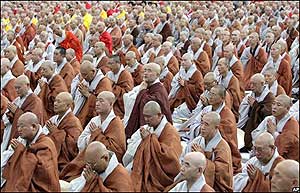 On
Aug. 27, some 200,000 Buddhist monks and laymen held a large-scale
rally denouncing the government in the heart of the capital. Yet no way
has been found to resolve the conflict.
On
Aug. 27, some 200,000 Buddhist monks and laymen held a large-scale
rally denouncing the government in the heart of the capital. Yet no way
has been found to resolve the conflict.Grand National Party chairman Park Hee-tae notes flaws in the administration's responses on a daily basis, and lawmakers suggest that the administration deal with the issue more actively. But there is no sign that the government is doing anything other than mutter of “misunderstandings” and repeat that the president has already expressed regret. No wonder there are concerns that the administration does not realize how serious the situation is.
All religions exist on the foundation of saving mankind. Because religions embrace such a basic human problem, conflicts between religions preaching limitless love and unending mercy invite extreme dichotomies, dividing people involved in disputes into good and evil. That is why conflict between religions ignite annihilating hatred and lead to bloodshed.
<!-- google_ad_client = "pub-7782858898060907"; google_ad_width = 336; google_ad_height = 280; google_ad_format = "336x280_as"; google_ad_type = "text"; //2007-03-22: bc-content google_ad_channel = "9968622564"; google_color_border = "FFFFFF"; google_color_bg = "FFFFFF"; google_color_link = "336699"; google_color_text = "000000"; google_color_url = "000000"; //-->Because all religions have such a dual nature, it is taboo in civilized societies to drag religion into politics or for politics to interfere in religion. Once the taboo is broken, national and social misfortune follows, and the wounds may never heal. There have been many countries in this unfortunate situation, both in history and in the world today.
The Korean Constitution stipulates that no state religion is recognized and that religion is separate from politics. It is because of that historical lesson that most modern states uphold separation of religion from politics.
The administration must take positive steps to alleviate the growing unease in our minds. A stitch in time saves nine, they say, and with good reason. If a mishap is repeated time after time, it takes on the appearance of intent. Take the omission of temples from a public transport information site covering the Seoul metropolitan area, prepared by the Ministry of Land, Transport and Maritime Affairs: the same thing was repeated in an online map prepared by the Ministry of Education, Science and Technology. Judgement on government actions is often passed based on subjective and emotional factors, and protestations that the government “didn’t mean it” fall on deaf ears.
Thus the suspicion that a certain religious group was favored in appointments to important government posts, the invitation to the presidential office of other religious leaders in the wake of a Buddhist protest rally, the appearance of the police commissioner in a poster for an evangelical event, and a rude search of a car in which the leader of the Jogye Order was traveling: they add up to a pattern. Separately, all the incidents may have been accidents and misunderstandings, but it is hard to congratulate the government for having done the right thing.
The president has already said several times that it was all unintentional and has pledged to educate public servants in avoiding bias against any religion. But what is really needed is not some vague program at the working level but a genuine attempt at the highest level to reassure, specifically, Buddhists.
Given that the president's own evangelical religion is entangled in the current situation, it would be sensible for Lee, never mind right or wrong, to visit Buddhist leaders and listen to them. Once hearts are pacified, other issues, major and minor, can be resolved through mutual concessions. What both sides should pay particular attention to in the process is mutual respect: they must ensure that no needless provocation or insult to the other’s religion is committed.
(from The Buddhist Channel)
-
South Korean President Lee apologises to South Korean Buddhists over alleged bias
AFP, September 9, 2008
SEOUL, South Korea -- South Korea's President Lee Myung-Bak apologised Tuesday to the nation's Buddhists following nationwide protests against alleged religious bias by his administration.
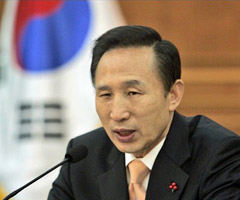 << South Korean President Lee Myung-Bak
Lee, a Christian, was speaking at a Cabinet meeting, which approved regulations banning religious discrimination by public servants.
"It is deeply regrettable that some government officials offended the Buddhist community -- even if they did not not mean to -- with such words and behaviour as could cause misunderstanding about a religious bias," he said.
Leaders of the country's 10 million Buddhists -- outnumbered by 13.7 million Christians -- had threatened more mass protests unless Lee apologised.
The Buddhist dispute, rare in a country that guarantees freedom of religion, follows months of street rallies against US beef imports, which rocked Lee's administration.
<!-- google_ad_client = "pub-7782858898060907"; google_ad_width = 336; google_ad_height = 280; google_ad_format = "336x280_as"; google_ad_type = "text"; //2007-03-22: bc-content google_ad_channel = "9968622564"; google_color_border = "FFFFFF"; google_color_bg = "FFFFFF"; google_color_link = "336699"; google_color_text = "000000"; google_color_url = "000000"; //-->Buddhists have been uneasy over what they see as a Christian bias since Lee, a Presbyterian Church elder, came to power on February 25.
The largest Order, the Jogye, lists on its website 23 cases of alleged favouritism, including the appointments of Protestants to major government posts.
An online map published by two ministries, showing Seoul's churches but not major Buddhist temples, also sparked anger.
Tensions grew in July when police stopped a car carrying Jigwan, the Jogye Order's head monk, outside the temple and searched the boot.
Police were then searching for illegal anti-US rally organisers who had taken refuge in the Jogyesa temple.
Tens of thousands of Buddhists staged a massive rally in Seoul in late August, demanding that the police chief be sacked, and Lee apologise and enact a law to ban religious discrimination.
Police chief Eo Cheong-Soo, who is Christian, has apologised and disciplined two senior officers.
Lee told Cabinet ministers on Tuesday to ensure officials stay neutral in religious matters but did not address the demands to sack Eo.
However, he instructed the police chief to visit the Jogyesa temple to apologise to the head monk.
"Regardless of the motives behind the search, the police chief has to visit Buddhist leaders and offer an apology. He must also promise to prevent the recurrence of similar incidents," he said.
The president was expected to reiterate his determination to maintain religious neutrality during a 100-minute "town hall" meeting starting at 10pm (1300 GMT) and to be televised live.
-
Actually religion is the choice of a person, no amount of favourism by the government is going to affect how one choose a religion. Its not like they are going to give tax reliefs or benefits to those who are Christian.
-
Originally posted by crimsontactics:
Actually religion is the choice of a person, no amount of favourism by the government is going to affect how one choose a religion. Its not like they are going to give tax reliefs or benefits to those who are Christian.
I am quite sure the buddhists in Southern Vietnam during the Ngo Dinh Diem era will not agree with you.If the current trend of Buddhist persecution in Korea is not arrested by the Buddhist protests, South Korea may well be heading in the same direction as Vietnam in the 1960s. As it is, there are already many reported cases in Korea of Christians destroying Buddhist temples and sutras... and I believe if you do a youtube search, you can find many vids of Korean Christians praying for the destruction of Buddhist temples.
-
-
Originally posted by sanath:
Looks like they really hate the Buddhists so much...Quite over the top. How come? A bit abnormal. I mean why they behaved as if they came from the communist era of the past? Can this means that if the fundamentals of any religions or ideology are incomplete( ä¸�了义), such a scenario is not suprising? It's just a matter of time for the catalyst to appear, be it in the form of a person, an harmless incident, or anything.But i guess it's really becos sentient beings are getting more and more defiled, æ²¡æœ‰å–„æ ¹ï¼Œcannot see clearly anymore...
-
Just to share with u guys a incident that happened to my mom on her Korea trip many years ago.
She and the other tourists were on a tour bus going to some destination, then when their bus stopped for traffic lights or something, a group of ppl suddendly appeared from nowhere and started waving their bibles and shouting ( i think they r just trying to get the tourists attention) at the bus. Some even banged the bus with their hands. Everyone on the bus were shocked. The tour guide said those were christains trying to share their bible knowlegde with the tourists. Of cos the driver didn't open the door to let them in but zoomed away as fast as possible.

-
Originally posted by cycle:
But i guess it's really becos sentient beings are getting more and more defiled, æ²¡æœ‰å–„æ ¹ï¼Œcannot see clearly anymore...
Yeah it is depressing... Maybe that is precisely why we are headed for the dharma ending age.