Anatta (Non-self) and Kamma (Karma) - The Best Kept Secret..
-
Thusness (John) found this article and commented to me in 5th November 2005:
[01:23] <^john^> very good site.http://www.katinkahesselink.net/tibet/anatta_jagaro.html
Anatta (Non-self) and Kamma (Karma)
The Best Kept Secret in the Universe
by Ajahn Jagaro
The teaching on Anatta or non-self is one of the most fundamental aspects of Buddhism, and may be the most important feature which makes the Buddha's teaching quite unique. The other aspect of the teaching which is sometimes seen to be difficult to reconcile or explain, interms of anatta, is the teaching of kamma or the law of kamma, which is the law of cause and results. The causes we create through our actions of body, speech and mind, and the consequences that arise from these actions. The law of kamma states that as we sow so shall we reap, and whatever kamma we shall do, we will be the heirs that inherit it. This to many people seems some what of a contradiction. On the one part we have the teaching of anatta, that there is no self or a personal permanent constant entity. So how can there be someone who inherits the results of what they do now?
So this evening I would like to speak on these two aspects of the teaching and also how they relate to each other, possibly illustrate how there is no contradiction at all. It is quite the opposite in fact, for to understand one it does require the other. Actually when the Buddha taught the teaching of anatta or non-self, it needed or required the law of kamma, the law of conditionality, and the law of dependent origination to fill in the gap.
The concept of anatta or non-self is of great importance in Buddha's teaching, and it is the one aspect of the teaching which is quite often found by newcomers to Buddhism, or even traditional Buddhists, to be very difficult to understand. Elusive, abstract and foreign. These terms could be used to describe how we react to this teaching when we hear it, and rightly so. There is nothing from our experience - the way we experience life, perceive life, think and communicate - which would give the secret away. It is the best kept secret in the universe. Only a Buddha or someone with the qualities and perfections of a Buddha could possibly penetrate this mystery or the secret without the guidance of another. That is why it is rare for a Buddha to arise in the world to penetrate this particular fundamental truth. It is so difficult because their are no hints. Even Sherlock Holmes could not have solved this one. It is completely contrary to what the appearance seems to indicate, and this is the teaching of non-self.
What the teaching says is, that within this human being, consisting of mind and body, or consisting of body and the mental attributes of feeling, perception, mental formations and consciousness, there is no permanent, personal entity which can be called a self or soul or ego. It does not sound right. Our experience seems to point back to someone in here, who is the experiencer, who owns "me" and "mine."
This is the appearance which seems real. Even when people develop high states of meditation, as they did before the Buddha in India, where there were many different systems of religious teachers, spiritual seekers with their own systems of training of the mind, who were very accomplished, they simply were stuck on this appearance of a permanent self. There was a centre to all this subjective experience. There was a self, a centre point. Someone in there who is experiencing. Therefore every teaching that came out of India seemed to revolve around this one form or another dealing with this atman or atta or self or ego. In Christianity we have the soul. So there are many different notions about this core which is the real me, and everything else are attributes of me - my things, my body, my thoughts or my feelings. The me was the root of all these. So the Buddha in his teaching has burst the bubble and realised for himself that there was really no self, no real point that was a centre, and there was no self as such, and taught the teaching of no-self. But non-self is not meaning nothing, no personality. Of course you are you, the person sitting there. There is a mind and body, there is a personality, but there is no permanent entity. No aspect of that which you take yourself to be, which is permanent, or personal in the sense of being independent. And I will elaborate on this.
What do we mean by what we call atta or self? What attributes should a self or soul have? A self or soul, if it is really you, should have, in order to have any significance or meaning so that it is really you, the following characteristics:
- It has to be independent; otherwise how could it be really you. If other things can make it change, how can it be really you? So it has to stand independently.
- If it is really yours, it must be completely in your power.
This is a reasonable definition of me, which must be fulfilled for me to be real. If this 'me' does not fulfil this definition or does not have these attributes, then it is a fantasy. An 'I' or soul or 'me' dependent on other things, which changes dependent on other things, cannot be much of a 'me'. How can it be mine if I cannot completely control it? For example, consider an object which I possess like a watch. You can speak about it and say that this is my watch. None of you will disagree with that. It's my watch. That is the appearance in conventional reality, but if you look more closely, is it true? Is it really my watch in an absolute sense, other than in a conventionally accepted sense or merely for normal usage? In an absolute sense, it is not my watch, because I am going to lose it one day. Something will happen to it or it will get stolen, or I will die and somebody will inherit it. So in an absolute sense it is not mine, but something that will be with me temporarily. It really belongs where it comes from -the resources of the planet. Where will it go back - to the resources of the planet, like the matter of the universe. That is where it comes from and it will go back there. It is mine temporarily. So it is not mine in an absolute sense.
Let us apply the same analogy to internal phenomena. That which is closest to me, 'my body', and we find that in actual fact when you apply this analysis, it is no different than the watch. As far as where the body comes from and where it goes back to, it is the same as the watch. Because of its changeability you can't say that it is mine. If it is mine I would make it different to what it is. It does not behave as I want it to, neither does your body behave as you want it to. You would notice this when we apply the same standards. If it is mine, I must have complete power to make it as I wish and I would wish everything that is mine be just as I wanted always, and I would be perfectly happy. Of course no one has ever been able to do that. But we all try and we all feel tremendous frustration at our inability to succeed.
So not mine are the emotional feelings, perceptions, mental formations, thoughts, consciousness itself and the way the mental process operates. We'll apply the same analysis and see whether you can make your feelings as you want them to be and your thoughts to be as you want them to be. How many times a day do you feel what you don't want to feel, and remember what you don't want to remember, and think what you don't want to think? Your consciousness may dwell on some state of mind you do not want to have. The more you do not want to have, the more it comes out. Is this I really yours? And what is it in there that is you? What is it in this being that is sitting here 'you'? Am I the centre 'me' standing independently of everything else or is there anything else? The Buddha said no, and he stated it in no confusing terms. He stated very clearly - anatta, not self over and over again. Somebody might try to reinterpret the teaching of the Buddha as if there is some other self. In the Buddha's teaching there is no self to be found in this mind and body, of any form or any shape either in it or out of it anywhere. No self - full stop.
But this is not to be accepted through belief, but to be realised through careful investigation. It is a well kept secret and only a mind which is extraordinarily well trained and disciplined and also knowledgeable can break through to this truth. The signs are not so easy to read. The conditioning is so strong. However we are fortunatethat we have the seeds. The seeds are being planted in our minds through the Buddha's teaching. You have heard the possibility, rather than hearing over and over again that the real you is within you, the soul - and after it dies it will go to heaven or hell. That is the real self. You believe it whether you understand or not. Maybe actually there is nobody there, nobody at home at all. So you can't forget that now. So when your mind is strong enough, through the practice of meditation, this inquiry will start. What is it that is me? What is it that I take myself to be? Look with clarity and attention, and it is possible to realise directly the teaching of non-self. The only time that one can really understand is when you see it with insight. Until then we can appreciate logically and intellectually, think about it, but we cannot have that direct seeing. Until we have that direct seeing we do not have right view. We cannot have the right view with regard to the nature of the body and mind. So one needs to get this as a personal subjective experience through insight. However it is sufficient for now to dwell and point out what the Buddha taught about anatta.
There is no self in this body or in the mind process. I stress the word process because the body and the mind is not one lump of stationary matter and stationary mental states. It is an ongoing process, dynamically moving, changing always, and becoming something else, and this is when we come to the other aspects of the teaching of the Buddha. When there is no self how can this continue, how can it keep going? What is there if there is no self, if there is no one there? How does this function? Here the Buddha mentions the fundamental laws that operate in the universe. They are not created by anybody. They are not dependent on somebody's power. The existence of samsara implies these laws. The laws imply samsara. This is what samsara is. These are the laws that control it. These fundamental laws can be broken down into several. The broadest one is the law of conditionality. Usually we say that this is the law of cause and effect. This is not a good terminology because it is much more complicated than that. It is the law of conditionality. Broadly speaking, what it means is that, whatever arises, arises from conditions. When the conditions are there the result comes about. When the conditions are not there the result cannot come about. The Buddha expressed in a very succinct statement:When this is, that is.
When this arises, that arises.
When this is not, that is not.
When this ceases, that ceases.
You can apply this to a whole range of phenomena, physical and mental, internal or external, animate or inanimate. It is just a fundamental law that operates all the time without somebody ruling over it. That is all inclusive. There is nothing outside it. According to the law of conditionality based on conditions the results come about. When the conditions are not there the results cannot come about.
I often repeat this story - how a Buddhist and a Christian may perceive something. When I was in Perth monastery, it was raining and some people came to the monastery with some children. They were Christian children. Only the parents were Buddhist. I asked the children why it is raining, and they said because God makes the rain. I said I don't believe that. They asked me what I think about why it rains. I said because the conditions are right for it to rain - the atmospheric conditions, the temperature, wind and the clouds, and because everything is right for it to rain and it rains. Not because it is somebody's will to make it rain. This is an impersonal law, it is not biased. Completely unbiased and fair in its operation. It operates at the internal level too.
The law of kamma basically is that dependent on what we intentionally do, through body, speech and mind, there will be results. The nature of these results will be determined by the nature of the intention. If the intention behind the action is wholesome, the result will be pleasant or wholesome. If the nature of the action is unwholesome, the result will be unpleasant. This is the specific application of the law of conditionality. Dependent on the causes the result will come about.
Volition is one area of consciousness where the human mind has the ability to will. We can will the body to action, we can will our speech or thought. Quite often this is the mental attribute that people identify most strongly with as mine. If you have been meditating for some time you will probably know what I mean. When you look into yourself or listen to yourself, what does me identify mostly with? I 'will', so it must be me. I am the one who is doing this. I am the one who is asking and I am the one who is answering. I can choose to stand up or sit down. This must be me. We identify strongly with our will, intention or volition, because it appears to be the centre. But this is also no-self, and this is where you have to apply your attention very carefully. Even the volition is conditioned. Why do you will something? Why do you choose something? Why do you choose to come to the BSV and not go somewhere else? You have a choice. There is a volition there. That volition was conditioned by previous experience, thoughts, feelings and previous volition etc. So that volition or choice is not an independent thing. The choice that we make is also conditioned. Why do you think, why do you act, and speak the way you do, the choices you make? It is the result of past conditioning.
So even our choice (cetana), intention, or volition is kamma. This aspect of our mind is conditioned by the past. The fundamental force that drives us to make choices is the quest for happiness. Your volition comes from the quest for happiness. Your experience in the quest for happiness helps to shape your volitions, and in what directions they will drive you. So when you have this volition, intention to do, to speak and think, it is a force. Having spoken, having acted, having thought, is a force set in motion. It will have its consequences. It will shape something in the future. Immediately it will shape the state of your mind psychologically. You think an angry thought, or speak angrily, you will feel associated with it a negative state of mind. Psychologically you get a reaction almost immediately. But there will probably be other results, which can come later on, because you have set something in motion, and that will or intention is like sowing a seed. It will bring some growth with results and fruits. This is the law of kamma. Each volitional act will bring results which psychologically may be very quick, but quite often may take some time, to come about. The Buddha said that some results come in this life and some in future lives. The nature of the volition will determine the nature of the result.
Now at the time of death what will happen? Imagine how strong this force is. See it now in your life while you are living. This will or force that animates this body to walk around, drive it for how many years, to do this and that. Do you think at death this force will just expire and go into nothingness? The Buddha said it does not. This force, this volition which is kamma, at the time of death will in itself, just like any other force, cause the arising of a new conscious moment, as it does in the present existence. Consciousness is an arising and a ceasing. It is flowing, but that does not mean it is smooth. It is always arising and ceasing. Every conscious state of mind is flicking into existence and passing away. If you pay attention you can see that.
At the time of death as the mind ceases, the last ceasing consciousnessin this body causes the arising of consciousness in a new body, with a new physical base. And what arises is determined by the quality of the consciousness at the time of death. The quality of the previous consciousness conditions the arising of the new consciousness.
Now if there is no self, if there is no one there, can this process really continue like this on and on? The question that is often put is, if there is no self, the person who is going to inherit the kamma is a different person than that who he now is. Is it not? Why should I care? I am not going to get the results. I can do what I want. That poor guy down the road is going to get all the results.
It is interesting as an abstract thought. You can contemplate what you are experiencing now. Who is experiencing if there is no self? There is still experience. There is pleasure and pain, pleasant and unpleasant experience. There is no self, but the feeling is real, the state of mind is real, the happiness and unhappiness is real. These are real states of the mind though there is no self experiencing them. These states come about from past causes. The person who caused those conditions for the present state was you, or someone else. It does not matter. You are experiencing it now and it is a reality.
The Buddha's teaching is that there is an individuality in this process. The individuality of the process is there, the continuity of the mind and body in this life, conventionally speaking. You are the mind and the body process and there is a continuity and an individuality of the process. It's your mind and body and not my mind and body which continues from birth to death in this life. But there is the same continuity and individuality into the next life. You don't get cross wires. Your stream of mind and body does not get mixed up with my stream of mind and body. My state of mind and body does not get mixed up in what is in your account and vice versa. It stays in each person's account. There is a continuity in this stream of mind and body and this is the law of kamma. The individuality is there but there is no individual in it. So what you do now will bring about results down the road.Who will experience it?
You will be there just as much as you are here now. You are here now just as much as you were present in this stream 100 years ago or a thousand lifetimes ago. You were just as much you then, as you are now. And as long as you are this stream now you will be the same stream a thousand lifetimes in the future.
What is the experiencing?
There is the pleasure, there is pain, there is suffering and happiness. How do you feel about pain and suffering now? It is not liked by anyone, whether it is you or another. It is the same a thousand lifetimes before, as now. The relationship with the experience is the same. No one likes pain. Even though there is no you like a constant personal entity in this stream, still there is this relationship that pain and unhappiness is not wanted. It is difficult to bear. So we don't create conditions that bring about this suffering. The person who is sitting here now is not completely different from the person who came here last week, but not completely the same person either. Dependent on the past the present is, dependent on the present the future will be. So the idea of kamma simply implies that the way we live, what we do intentionally, volitionally, will have consequences.
Not as punishment, not as reward. There is none who punishes, and none who rewards. That is because it is a law of nature, the law of conditionality. Volitional action will bring about results, and the nature of the results is determined by the nature of the volitional action. If it is positive it will bring about positive results, and of course if negative, unhappy results will follow and our relationship to the pleasant or unpleasant experience will be the same in the future as it is now. We do not want to be with that which is unpleasant. So the Buddha encourages over and over again, to cultivate good kamma.
Feel what you feel now, and you will know the importance of planting the right seed for the future. There is no contradiction at all in the teaching of anatta and kamma. They flow together very well because of the law of dependent origination and the law of kamma. That is why it works the way it does, without anybody ordering it. It is orderly by its very nature. Any teaching that has got the teaching of kamma could be expected to sow the seeds of goodness. Any teaching which denies the law of kamma would open the door to irresponsible selfishness because you can get away with it.
So this is considered the basic quality of a religion or philosophy, which will bring about good social structure and personal relationship, good moral standards, good virtuous upright living. It does not matter whether people have different religious beliefs, if they have the law of kamma by whatever word they call it, they can live together. It does not contradict with the law of anatta. Because there is no one driving, no one in the driver's seat, the laws operate and everything is orderly. No punishment, no reward, on favours, just orderly. -
i read a number of articles about modern scientists coming to the conclusion that the universe is just a hologram without any physical reality at all...................so that would imply that consciousness is also holographic ?
would that explain why there's no such thing as a separate self...............meaning that each and every infinite ''individual'' consciousness in the universe is actually a tiny part of one supreme consciousness ?
or am i wrong ?
-
It is certainly true that consciousness is holographic and non local. Otherwise how can you explain things like telepathy, clairvoyance, remote viewing, etc. However in Buddhism we do not talk about a common source, a supreme consciousness.
However at a certain stage of experience, it will certainly appear that there is an ultimate supreme consciousness that is the common source of all things. This is not yet the Buddhist level of enlightenment, but can be anywhere up to Stage 4 of Thusness/PasserBy's Seven Stages of Enlightenment
But Buddhism interdependent consciousness, like the net of indra (see below).
As Thusness said many years back:
Transcript of the Lankavatara Sutra sharing by Thusness
When we look at Buddhism, Buddhism is very consistent. Why do I say that Buddhism is very consistent? Not because I like Buddhism. You see, a person saying that I have experienced Presence, and I AM the Eternal Witness, I AM God, I AM all powerful and I AM the First Cause, and yet, they see a dualistic world. This is in total conflict; this has totally no logic at all. Because, you see, in Buddhism when we talk about Non-Duality, we are saying something like the Dependent Origination. Because of This, That Is. This arises, That arises. This ceases, That ceases. We look at the entire formation, there is no “Who?” Where is the “Who?” When we ask “Where?”, there is no “Where?”. When we ask “When?”, there is no “When?” It can be 10 million miles away. It can be in another planet. The teaching is consistent. It does not require a “Who”, a “Where”, a “When”. Condition arises, it is there. It is not stored in any place, or anywhere. This is the teaching. The entire teaching is consistent when it comes to the practise. They didn’t say Concentration can lead to Insight. They tell you, Vipashyana Meditation can lead to Insight of what Reality is all about. It does not teach that there is a Self. The Buddha taught the three dharma seals: there is No-Self. So the teaching is consistent in terms of philosophy, in terms of meditation practice, and in terms of the truths that is being preached.
And also in terms of spiritual powers. When I say something like Clairvoyance... I can see, not bounded by distance. I can hear, not bounded by distance. How come? Why? If we were to take other religions, they canÂ’t explain. But if you were to take Buddhism, Buddha had never told you, has never taught, something of an Ego, something of a Where, something of a When. It is not bounded by Time and Space at all in the entire philosophy. Never has he taught anything like that. And therefore, when we talk about spiritual powers, it is consistent. It is knowing without the need for a Space and Time, not bounded by Space and Time, because the entire teaching is so. And what is being said about this? It is the Nature. This is your nature. Reality is like that, it is so. Therefore, when we understand the teachings, we understand that yes, it is not right to be attached, therefore we cannot say we want to seek spiritual powers, like Nub. But we have to understand, this is our Nature, this is our Reality. Because the teaching has never contradicted itself. If you want to know about your reality, you have to practise. That is the teaching. And the practise has always been telling you to observe these 3 universal characteristics. So when we see the link between the practise, the philosophy, even something spiritual and something that is not scientific. This is important...............
Because there is nothing that is telling them there is a kind of understanding or there is a kind of experience that is not like that. You were taught like that. You get it? Like in Buddhism they teach you otherwise. They teach you not to see things in terms of “I”, not to see things in terms of a “where” and a “when”. Let’s say something very simple. When I say that things happen, it is not like those people that subscribe to think that anything is just taking by itself, it’s nature. Mainly what is important is conditions. You must have the conditions, then things can surface. When the conditions is there, they just surfaces, and manifest. If there is cause in ten million miles away or ten million light years away, or whatever it is, or in other realms, as long as there is conditions, it WILL surface, it is not travelling {inaudible}. Can you understand this part? Condition is there, they just manifest. This is one thing.Here's something interesting
http://www.consciousmedianetwork.com/members/rtarg.htm
The End of Suffering
(Running time = 36 mins)
Regina first interviewed Russell Targ almost 21 years ago just before he was leaving for the Soviet Union to take part in an experiment with Brezhnev's psychic healer, in what was to become a well known documentation on the efficacy of remote viewing for military purposes.
Russell Targ is a physicist and author who has devoted much of his professional career to the research of the human capacity for psychic ability. In 1972, he co-founded the Stanford Research Institute's federally-funded program that investigated psychic abilities in humans. The program provided invaluable information and techniques to various government intelligence agencies, including the DIA, the CIA, NASA, and Army Intelligence. In his ten years with the program, Targ co-published his findings in some of the most prestigious scientific journals. He is the co-author, with Jane Katra, of five books about psychic abilities, two of which are: Miracles of Mind: Exploring Non-local Consciousness & Spiritual Healing, and The Heart of the Mind: How to Experience God Without Belief.
Russell was also quite active in the development of the laser and its various applications, having written over fifty articles on advanced laser research. He is a Senior Member of the Institute of Electrical Engineers and has received two NASA awards for inventions and contributions in laser and laser communications. Recently retiring from his position as senior staff scientist at Lockheed Martin, Russell now devotes his time to ESP research and offering workshops on remote viewing and spiritual healing.
In an abstract from a research paper, Russell said, "Since ancient times spiritual teachers have described paths and practices that a person could follow to achieve health, happiness, and peace of mind. A considerable body of recent research indicates that any kind of spiritual practice is likely to improve ones prognosis for recovering from a serious illness. Many of these approaches to spirituality involve learning to quiet the mind, rather than adhering to a prescribed religious belief. These meditative practices are inherent aspects of Buddhism, Hinduism, mystical Christianity, Kabalistic Judaism, Sufism, and other mystic paths. What is indicated in the subtext of these teachings is that as one learns to quiet his or her mind, one is likely to encounter psychic-like experiences or perceptions. For example, in The Sutras of Patanjali, the Hindu master tells us that on the way to transcendence we may experience many kinds of amazing visions, such as the ability to see into the distance, or into the future; and to diagnose illnesses, and also to cure them. However, we are admonished not to become attached to these abilities - that they are mere phenomena standing as stumbling blocks on the path to enlightenment. In this paper, I will describe my recent experience in teaching remote viewing at three workshops in Italy, in which we emphasize expanded awareness of who we are, rather than an ability to find car keys and parking spaces. Our spiritual approach, did not interfere with all three of these groups demonstrating highly significant remote viewing in a double-blind setting." -
Buddhism's analogy for the holographic universe:

The metaphor of Indra's Jeweled Net is attributed to an ancient Buddhist named Tu-Shun (557-640 B.C.E.) who asks us to envision a vast net that:
* at each juncture there lies a jewel;
* each jewel reflects all the other jewels in this cosmic matrix.
* Every jewel represents an individual life form, atom, cell or unit of consciousness.
* Each jewel, in turn, is intrinsically and intimately connected to all the others;
* thus, a change in one gem is reflected in all the others.
This last aspect of the jeweled net is explored in a question/answer dialog of teacher and student in the Avatamsaka Sutra. In answer to the question: "how can all these jewels be considered one jewel?" it is replied: "If you don't believe that one jewel...is all the jewels...just put a dot on the jewel [in question]. When one jewel is dotted, there are dots on all the jewels...Since there are dots on all the jewels...We know that all the jewels are one jewel" ...".
The moral of Indra's net is that the compassionate and the constructive interventions a person makes or does can produce a ripple effect of beneficial action that will reverberate throughout the universe or until it plays out. By the same token you cannot damage one strand of the web without damaging the others or setting off a cascade effect of destruction.
Source: Awakening 101
...One of the images used to illustrate the nature of reality as understood in Mahayana is The Jewel Net of Indra. According to this image, all reality is to be understood on analogy with Indra's Net. This net consists entirely of jewels. Each jewel reflects all of the other jewels, and the existence of each jewel is wholly dependent on its reflection in all of the other jewels. As such, all parts of reality are interdependent with each other, but even the most basic parts of existence have no independent existence themselves. As such, to the degree that reality takes form and appears to us, it is because the whole arises in an interdependent matrix of parts to whole and of subject to object. But in the end, there is nothing (literally no-thing) there to grasp....
Source: Sunyata ('Emptiness')
Compare the first picture with:
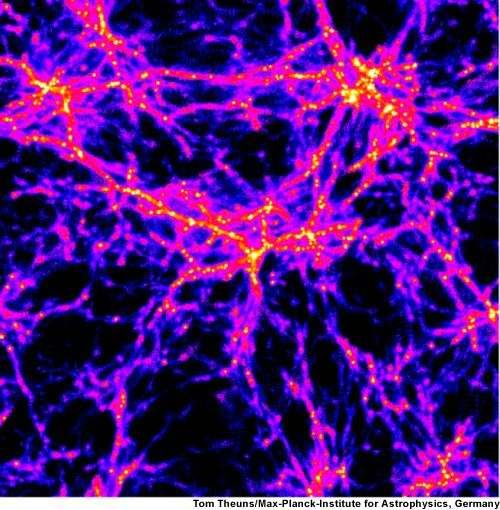
Computer model of early universe. Gravity arranges matter in thin filaments.
Source: Awakening 101.-------------------------------
http://www.heartspace.org/misc/IndraNet.html

The Indra's Net: What Is It?
FAR AWAY IN THE HEAVENLY ABODE OF THE GREAT GOD INDRA, THERE IS A WONDERFUL NET WHICH HAS BEEN HUNG BY SOME CUNNING ARTIFICER IN SUCH A MANNER THAT IT STRETCHES OUT INDEFINITELY IN ALL DIRECTIONS. IN ACCORDANCE WITH THE EXTRAVAGANT TASTES OF DEITIES, THE ARTIFICER HAS HUNG A SINGLE GLITTERING JEWEL AT THE NET'S EVERY NODE, AND SINCE THE NET ITSELF IS INFINITE IN DIMENSION, THE JEWELS ARE INFINITE IN NUMBER. THERE HANG THE JEWELS, GLITTERING LIKE STARS OF THE FIRST MAGNITUDE, A WONDERFUL SIGHT TO BEHOLD. IF WE NOW ARBITRARILY SELECT ONE OF THESE JEWELS FOR INSPECTION AND LOOK CLOSELY AT IT, WE WILL DISCOVER THAT IN ITS POLISHED SURFACE THERE ARE REFLECTED ALL THE OTHER JEWELS IN THE NET, INFINITE IN NUMBER. NOT ONLY THAT, BUT EACH OF THE JEWELS REFLECTED IN THIS ONE JEWEL IS ALSO REFLECTING ALL THE OTHER JEWELS, SO THAT THE PROCESS OF REFLECTION IS INFINITE
THE AVATAMSAKA SUTRA
FRANCIS H. COOK: HUA-YEN BUDDHISM : THE JEWEL NET OF INDRA 1977
When I was trying to come to a decision regarding the look and feel of my new web site, I wanted to employ a background image that had universal import and could point the way to an adequate description of the nature or reality. A tall order, if not impossible, but the choice was clear: Indra's Net.
There are several aspects of Indra's Net, as described in the above quote, that signify it as a crystal clear allegory of reality:
1. The Holographic Nature of the Universe
Long before the existence of the hologram, the jeweled net is an excellent description of the special characteristic of holograms: that every point of the hologram contains information regarding all other points. This reflective nature of the jewels is an obvious reference to this.
This kind of analogy has been suggested by science as a theory for an essential characteristic of the cosmos, as well as as the functioning of the human brain, as beautifully described in The Holograpic Universe by Michael Talbot.
2. The Interconnectedness of All Thingss
When any jewel in the net is touched, all other jewels in the node are affected. This speaks to the hidden interconnectedness and interdependency of everything and everyone in the universe, and has an indirect reference to the concept of "Dependent Origination" in Buddhism. Additionally, Indra's Net is a definitive ancient correlate of Bell's Theorum, or the theory of non-local causes.
3. Lack of a substantive self
Each node, representing an individual, simply reflects the qualities of all other nodes, inferring the notion of 'not-self' or a lack of a solid and real inherent self, as seen in the Advaita Vedanta school of Hinduism and Buddhism in general.
4. Non-locality
Indra's Net shoots holes in the assumption or imputation of a solid and fixed universe 'out there'. The capacity of one jewel to reflect the light of another jewel from the other edge of infinity is something that is difficult for the linear mind, rational mind to comprehend. The fact that all nodes are simply reflections indicates that there is no particular single source point from where it all arises.
5. Innate Wisdom
The ability to reflect the entirety of all light in the universe attests to the inherent transcendant wisdom that is at the core of all nodes, representing all sentient beings, and to the inherent Buddha Nature.
6. Illusion or Maya
The fact that all nodes are simply a reflection of all others implies the illusory nature of all appearances. Appearances are thus not reality but a reflection of reality.
7. Universal Creativity
A familiar concept in various high dharmas is one of an impersonal creative intelligence that springs forth into reality through the instruments of all living beings.
8. The Mirror-like Nature of Mind
The capacity to reflect all things attests to the mind being a mirror of reality, not its basis. This is a common thesis among various schools and religions.
And Indra's Net has been used as a defining metaphor for the Internet. One major web hosting site is www.indra.com.
The following are some quotes and interesting web sites regarding Indra's Net:
Indra's Net is a core metaphor of HuaYen.
Stephen Mitchell, in his book The Enlightened Mind, wrote:
"The Net of Indra is a profound and subtle metaphor for the structure of reality. Imagine a vast net; at each crossing point there is a jewel; each jewel is perfectly clear and reflects all the other jewels in the net, the way two mirrors placed opposite each other will reflect an image ad infinitum. The jewel in this metaphor stands for an individual being, or an individual consciousness, or a cell or an atom. Every jewel is intimately connected with all other jewels in the universe, and a change in one jewel means a change, however slight, in every other jewel."
(It's also interesting to note that contemporary physicists are in general agreement that this ancient metaphor is indeed a good description for the universe.)
-
btw, are you the owner of www.rense.com?