No Sinners & How to save oneself?
-
In Buddhism, actions are merely termed as unskillful or unwholesome, not as sinful.
Buddhists do not regard man as sinful by nature of 'in rebellion against god'. Every human being is a person of great worth who has within himself a vast store of good as well as evil habits. The good in a person is always waiting for a suitable opportunity to flower and to ripen. Remember the saying, 'There is so much that is good in the worst of us and so much that is bad in the best of us.' Buddhism teaches that everyone is responsible for his own good and bad deeds, and that each individual can mould his own destiny. Says the Buddha, 'These evil deeds were only done by you, not by your parents, friends, or relatives; and you yourself will reap the painful results.' (Dhammapada 165)
Man's sorrow is his own making and is not handed down by a family curse or an original sin of a mythical primeval ancestor. Buddhists do not accept the belief that this world is merely a place of trial and testing. This world can be made a place where we can attain the highest perfection. And perfection is synonymous with happiness. To the Buddha, man is not an experiment in life created by somebody which can be done away with when unwanted. If a sin could be forgiven, people might take advantage and commit more and more sins. The Buddhist has no reason to believe that the sinner can escape the consequences by the grace of an external power. If a man thrusts his hand into a furnace, his hand will be burnt, and all the prayer in the world will not remove the scars. The same is with the man who walks into the fires of evil action. The Buddha's approach to the problems of suffering is not imaginary, speculative or metaphysical, but essentially empirical. According to Buddhism, there is no such thing as sin as explained by other religions. To the Buddhists, sin is unskillful or unwholesome action - Akusala Kamma, which creates Papa - the downfall of man. The wicked man is an ignorant man. He needs instruction more than he needs punishment and condemnation. He is not regarded as violating god's will or as a person who must beg for divine mercy and forgiveness. He needs only guidance for his enlightenment. All that is necessary is for someone to help him use his reason to realize that he is responsible for his wrong action and that he must pay for the consequences. Therefore the belief in confession is foreign to Buddhism.
The purpose of the Buddha's appearance in this world is not to wash away the sins committed by human beings nor to punish or to destroy the wicked people, but to make the people understand how foolish it is to commit evil and to point out the reaction of such evil deeds. Consequently there are no commandments in Buddhism, since no one can command another for his spiritual upliftment. The Buddha has encouraged us to develop and use our understanding. He has shown us the path for our liberation from suffering. The precepts that we undertake to observe are not commandments: they are observed voluntarily. The Buddha's Teaching is thus: 'Please pay attention; take this advice and think it over. If you think it is suitable for you to practise my advice, then try to practise it. You can see the results through your own experience.' There is no religious value in blindly observing any commandment without proper conviction and understanding. However, we should not take advantage of the liberty given by the Buddha to do anything we like. It is our duty to behave as cultured, civilized and understanding human beings to lead a religious life. If we can understand this, commandments are not important. As an enlightened teacher, the Buddha advised us on how to lead a pure life without imposing commandments and using the fear of punishment.
Man is Responsible for Everything
When a man has learned how to live as a real human being without disturbing others, he can live peacefully without any fear in his heart.
According to the Buddha, man himself is the maker of his own destiny. He has none to blame for his lot since he alone is responsible for his own life. He makes his own life for better or for worse. The Buddha says: man creates everything. All our griefs, perils and misfortunes are of our own creation. We spring from no other source than our own imperfection of heart and mind. We are the results of our good and bad actions committed in the past under the influence of greed and delusion. And since we ourselves brought them into being, it is within our power to overcome bad effects and cultivate good natures. The human mind, like that of an animal, is something governed by animal instinct. But unlike the animal mind, the human mind can be trained for higher values. If man's mind is not properly cultured, that uncultured mind creates a great deal of trouble in this world. Sometimes man's behavior is more harmful and more dangerous than animal behavior. Animals have no religious problems, no language problems, no political problems, no social and ethical problems, no colour-bar problems. They fight only for their food, shelter and sex. But, there are thousand of problems created by mankind. Their behavior is such that they would not be able to solve any of these problems without creating further problems. Man is reluctant to admit his weaknesses. He is not willing to shoulder his responsibilities. His attitude is always to blame others for his failure. If we become more responsible in our actions, we can maintain peace and happiness.
[edit]Man is His Own Jailor
Is there any truth in man'sclaim that he should be given freedom to do things as he likes?
When we consider human freedom, it is very difficult to find out whether man is really free to do anything according to his own wishes. Man is bound by many conditions both external and internal; he is asked to obey the laws that are imposed on him by the government; he is bound to follow certain religious principles; he is required to co-operate with the moral and social conditions of the society in which he lives; he is compelled to follow certain national and family customs and traditions. In modern society, he in inclined to disagree with life; he is expected to conform by adapting himself to the modern way of life. he is bound to co-operate with natural laws and cosmic energy, because he is also part of the same energy. He is subjected to the weather and climatic conditions of the region. Not only does he have to pay attention to his life or to physical elements, but he has also to make up his mind to control his own emotions. In other words, he has no freedom to think freely because he is overwhelmed by new thoughts which may contradict or do away with his previous thoughts and convictions. At the same time, he may believe that he has to obey and work according to the will of god, and not follow his own free-will. Taking into consideration all the above changing conditions to which man is bound, we can ask 'Is there any truth in man's claim that he should be given freedom to do things as he likes?' Why does man have his hands tied so firmly? The reason is that there are various bad elements within man. These elements are dangerous and harmful to all living creatures. For the past few thousand years, all religions have been trying to tame this unreliable attitude of man and to teach him how to live a noble life. But it is most unfortunate that man is still not ready to be trustworthy, however good he may appear to be.
Man still continues to harbor all these evil elements within himself. These evil elements are not introduced or influenced by external sources but are created by man himself. If these evil forces are man-made, then man himself must work hard to get rid of them after realizing their danger. Unfortunately the majority of men are cruel, cunning, wicked, ungrateful, unreliable, unscrupulous. If man is allowed to live according to his own free-will without moderation and restraint, he would most definitely violate the peace and happiness of innocent people. His behavior would probably be much worse than that of dangerous living beings. Religion is required to train him to lead a respectable life and to gain peace and happiness here and hereafter. Another obstacle confronting religious life and spiritual progress is racial arrogance. The Buddha advised His followers not to bring forward any racial issue when they come to practise religion. Buddhists are taught to sink their own racial origin and caste or class distinction. People of all religions should not discriminate against any groups of people by bringing forward their personal traditional way of life. They should treat everyone equally, especially in the religious field. Unfortunately, followers of different religions create more discriminations and hostility towards other religious groups when performing their religious activities. While working others, they should not disturb their feelings because of their so-called traditions and customs. They can follow traditions and customs that are in keeping with the religious principles and moral codes of their religions. Racial arrogance is a great hindrance to religion and spiritual progress. The Buddha once used the simile of ocean water to illustrate the harmony which can be experienced by people who have learnt to cast aside their racial arrogance: Different rivers have different names. The water of the individual rivers all flow into the ocean and become ocean water. In a similar manner, all those who have come from different communities and different castes, must forget their differences and think of themselves only as human beings.
How to Save Yourself
Oneself, indeed, is one's savior, for what other savior would there be? With oneself well controlled the problem of looking for external savior is solved, -- (Dhammapada 166)
As the Buddha was about to pass away, His disciples came from everywhere to be near Him. While the other disciples were constantly at His side and in deep sorrow over the expected loss of their Master, a monk named Attadatta went into his cell and practised meditation. The other monks, thinking that he was unconcerned about the welfare of the Buddha, were upset and reported the matter to Him. The monk, however, addressed the Buddha thus, 'Lord as the Blessed One would be passing away soon, I thought the best way to honour the Blessed One would be by attaining Arahantship during the lifetime of the Blessed One itself.' The Buddha was pleased by his attitude and his conduct and said that one's spiritual welfare should not be abandoned for the sake of others.
In this story is illustrated one of the most important aspects of Buddhism. A person must constantly be on the alert to seek his own deliverance from Samsara, and his 'salvation' must be brought about by the individual himself. He cannot look to any external force or agency to help him to attain Nibbana. People who do not understand Buddhism criticize this concept and say that Buddhism is a selfish religion which only talks about the concern for one's own freedom from pain and sorrow. This is not true at all. The Buddha states clearly that one should work ceaselessly for the spiritual and material welfare of all beings, while at the same time diligently pursuing one's own goal of attaining Nibbana. Selfless service is highly commended by the Buddha. Again, people who do not understand Buddhism may ask, 'It may be all right for the fortunate human beings, in full command of their mental powers, to seek Nibbana by their own efforts. But what about those who are mentally and physically or even materially handicapped? How can they be self-reliant? Do they not need the help of some external force, some god or deva to assist them? The answer to this is that Buddhists do not believe that the final release must necessarily take place in one life time. The process can take a long time, over the period of many births. One has to apply oneself, to the best of one's ability, and slowly develop the powers of self reliance. Therefore, even those who are handicapped mentally, spiritually and materially must make an effort, however small, to begin the process of deliverance.
Once the wheels are set in motion, the individual slowly trains himself to improve his powers of self-reliance. The tiny acorn will one day grow into a mighty oak, but not overnight. Patience is an essential ingredient in this difficult process. For example, we know from experience how many parents do everything in their power to bring up their children according to the parents' hopes and aspirations. And yet when these children grow up, they develop in their own way, not necessarily the way the parents wanted them to be. In Buddhism, we believe that while others can exert an influence on someone's life, the individual will in the end create his own kamma and be responsible for his own actions. No human being or deva can, in the final analysis, direct or control an individual's attainment of 'the ultimate salvation'. This is the meaning of self-reliance. This does not mean that Buddhism teaches one to be selfish. In Buddhism, when someone seeks, by his own effort, to attain Nibbana, he is determined not to kill, steal, tell lies, lust after others, or lose the control of his senses through intoxication. When he controls himself thus he automatically contributes to the happiness of others. So is not this so-called 'selfishness' a good thing for the general welfare of others? On a more mundane level it has been asked how the lower forms of life can extricate themselves from a mere meaningless round of existence. Surely in that helpless state some benevolent external force is necessary to pull the unfortunate being from the quicksand. To answer this question we must refer to our knowledge of the evolution theory. It is clearly stated that life begin in very primitive forms?no more than a single cell floating in the water. Over millions of years these basic life forms evolved and became more complex, more intelligent. It is at this more intelligent level that life forms are capable of organization, independent thought, conceptualization and so on. When Buddhists talk about the ability to save oneself, they are referring to life forms at this higher level of mental development. In the earlier stages of evolution kammic and mental forces remain dormant, but over countless rebirths, a being raises itself to the level of independent thought and becomes capable of rational rather than instinctive behavior. It is at this state that the being becomes aware of the meaninglessness of undergoing endless rebirths with its natural concomitants of pain and sorrow. It is then that the being is capable of making its determination to end rebirth and seek happiness by gaining enlightenment and Nibbana. With this high level of intelligence, the individual is indeed capable of self-improvement and self-development.
We all know human beings are born with very varying levels of intelligence and powers of reasoning. Some are born as geniuses, while at the other end of the spectrum, others are born with very low intelligence. Yet every being has some ability to distinguish between choices or options, especially when they concern survival. If we extend this fact of survival even to the animal world we can distinguish between higher and lower animals, with this same ability (in varying degrees of course) to make choices for the sake of survival. Hence, even a lower form of life has the potential to create a good kamma, however limited its scope. With the diligent application of this and the gradual increase of good kamma a being can raise itself to higher levels of existence and understanding. To look at this problem from another angle, we can consider one of the earliest stories that have been told to show how the Buddha-to-be first made the initial decision to strive for Enlightenment. A great many rebirths before the Buddha was born as Siddharta, he was born as an ordinary man. One day while traveling in a boat with his mother, a great storm arose and the boat capsized, throwing the occupants into the angry sea. With no thought for his personal safety, the future Buddha carried his mother on his back and struggled to swim to dry land. But so great was the expanse of water ahead of him that he did not know the best route to safety. When he was in this dilemma, not knowing which way to turn, his bravery was noticed by one of the devas. This deva could not physically come to his aid, but he was able to make the future Buddha know the best route to take. The young man listened to the deva and both he and his mother were saved. There and then he made a firm determination not to rest until he had finally gained Enlightenment. This story illustrates the fact that Buddhists can and do seek the help of devas in their daily life. A deva is a being who by virtue of having acquired great merit (like the king of the devas) is born with the power to help other beings. But this power is limited to material and physical things. In our daily existence, we can seek help of the devas (when misfortune strikes, when we need to be comforted, when we are sick or afraid, and so on). The fact that we seek the aid of these devas means that we are still tied to the material world. We must accept the fact that by being born we are subject to physical desires and needs. And it is not wrong to satisfy these needs on a limited scale. When the Buddha advocated the Middle Path, He said that we should neither indulge ourselves in luxury nor completely deny ourselves the basic necessities of life.
However, we should not stop at that. While we accept the conditions of our birth, we must also make every effort, by following the Noble Eightfold Path, to reach a level of development where we realize that attachment to the material world creates only pain and sorrow. As we develop our understanding over countless births, we crave less and less for the pleasures of the senses. It is at the stage that we become truly self-reliant. At this stage, the devas cannot help us anymore, because we are not seeking to satisfy our material needs. A Buddhist who really understands the fleeting nature of the world practises detachment from material goods. He is not unduly attached to worldly goods. Therefore he shares these goods freely with those who are more unfortunate than he is -- he practises generosity. In this way again a Buddhist contributes to the welfare of others. When the Buddha gained Enlightenment as a result of His own efforts, He did not selfishly keep this knowledge to Himself. Rather, He spent no less than forty five years imparting His knowledge not only to men and women but even to the devas. This is Buddhism's supreme example of selflessness and concern for the well-being of all living things. It is often said that the Buddha helped devotees who were in trouble not through the performance of miracles such as restoring the dead to life and so on, but through His acts of wisdom and compassion.
In one instance, a woman named Kisa Gotami went to seek the help of the Buddha in restoring her dead child to life. Knowing that He could not reason with her as she was so distressed and overwhelmed with grief, the Buddha told her that she should first obtain a handful of mustard seeds from a person who had never lost a dear one through death. The distracted woman ran from house to house and while everyone was only too willing to give her the mustard seeds, no one could honestly say that he or she had not lost a dear one through death. Slowly, Kisa Gotami came to the realization that death is a natural occurrence to be experienced by any being that is born. Filled with this realization she returned to the Buddha and thanked Him for showing her the truth about death. Now, the point here is that the Buddha was more concerned with the woman's understanding about the nature of life than giving her temporary relief by restoring her child to life -- the child would have grown old and still have died. With her greater realization Kisa Gotami was able not only to come to terms with the phenomenon of death but also to learn about the cause of sorrow through attachment. She was able to realize that attachment causes sorrow, that when attachment is destroyed, then sorrow is also destroyed. Therefore in Buddhism, a person can seek the help of external agencies (like devas) in the pursuit of temporal happiness, but in the later stages of development when attachment to the worldly conditions ceases, there begins the path towards renunciation and enlightenment for which one must stand alone. When a man seeks to gain liberation, to break away from the endless cycle of birth and death, to gain realization and enlightenment, he can only do this by his own efforts, by his own concentrated will power. Buddhism gives great dignity to man. It is the only religion which states that a human being has the power to help and free himself. In the later stages of his development, he is not at the mercy of any external force or agency which he must constantly please by worshipping or offering sacrifices.
-
If people, regardless of the belief/faith/religion they claim to have, including Buddhists, can truly learn, understand and practise the true teachings of Buddha, and not just pay lip service (ie. act one way in certain situations, and the opposite way in other situations when deemed fit), the world will be a much better place. The above text is good. Unfortunately, not many people have such pure hearts and discipline to make good use of it.
Rainbow Jigsaw of Life
-
Originally posted by Rainbow Jigsaw:
If people, regardless of the belief/faith/religion they claim to have, including Buddhists, can truly learn, understand and practise the true teachings of Buddha, and not just pay lip service (ie. act one way in certain situations, and the opposite way in other situations when deemed fit), the world will be a much better place. The above text is good. Unfortunately, not many people have such pure hearts and discipline to make good use of it.
Rainbow Jigsaw of Life
You 've made a good point, however, if everybody have pure hearts and discipline, there will never be a need for religions or morality in the first place as everybody will be able to live in harmony!
We live in a society where is a conflict of needs and wants of self and others, causing constant difficulties and suffering.
It is precisely that we don't always have the goodness of hearts that these texts are made available to us.
"You can bring the cow to the water, but you can't make it drink, but water is always be there should the cow be thirsty! "
-
A good post there by Rooney.
I agree with points brought out by both Rainbow and Weychin. Indeed if everybody is pure of heart and has perfect self-discipline, there is no need for religious or moral teachings.
The only era where this utopia is said to materialise (according to scriptures) is sometime near the birth of Maitreya Buddha on earth. All humans speak one language and definitely more than 90% of the global human population are very good in their observance of the 5 precepts. Some may even be near perfection in that observance.
-
Originally posted by Spnw07:
A good post there by Rooney.
I agree with points brought out by both Rainbow and Weychin. Indeed if everybody is pure of heart and has perfect self-discipline, there is no need for religious or moral teachings.
The only era where this utopia is said to materialise (according to scriptures) is sometime near the birth of Maitreya Buddha on earth. All humans speak one language and definitely more than 90% of the global human population are very good in their observance of the 5 precepts. Some may even be near perfection in that observance.
And yet people near birth of Maitreya still needs to receive dharma teachings. Why?
Because only dharma teachings can lead people to liberation.
Perfect morality is not 'the point' in Buddhism -- awareness, enlightenment and liberation is. Of course, morality is important though. But if morality is all there is in Buddhism, there will be no point of Buddhism - there are enough teachings of morality in society and religion cannot claim to be any special in that, or have some sort of monopoly in teaching morality.
-
Originally posted by Weychin:
You 've made a good point, however, if everybody have pure hearts and discipline, there will never be a need for religions or morality in the first place as everybody will be able to live in harmony!
We live in a society where is a conflict of needs and wants of self and others, causing constant difficulties and suffering.
It is precisely that we don't always have the goodness of hearts that these texts are made available to us.
"You can bring the cow to the water, but you can't make it drink, but water is always be there should the cow be thirsty! "
People with pure hearts and discipline may go to higher realms, but not necessarily liberation.
-
Agree!
-
Originally posted by Spnw07:
A good post there by Rooney.
I agree with points brought out by both Rainbow and Weychin. Indeed if everybody is pure of heart and has perfect self-discipline, there is no need for religious or moral teachings.
The only era where this utopia is said to materialise (according to scriptures) is sometime near the birth of Maitreya Buddha on earth. All humans speak one language and definitely more than 90% of the global human population are very good in their observance of the 5 precepts. Some may even be near perfection in that observance.
The reason why our world is still so corrupted, confrontational and problematic despite the huge and growing numbers of religious people around the world (including people who claim to be religious or of any faiths), is the very fact that people think it's impossible to be really good or moral, so just trying to be good or moral is more than enough. That's why we see people behaving good in certain moments, and behave the opposite at other times (especially when others are not watching).
Observe people closer, more often and during their 'periods of unpreparedness', including those who claim to be very strong in faith, and you'll wonder if all the religious texts and teachings helped them much. Being able to memorise and recite religious texts forwards and backwards, or even in their dreams doesn't make someone a better person, if his/her heart has no true intention to be good. Words have no meaning as they're just output from the physical body.
Maitreya is an extremely wise and patient World Teacher, but I wonder how many people (including Buddhists) can be truly ready for his teachings. By the way, the reason why all humans can 'speak one language' when the time comes is because they will not be 'speaking' as we do now. I shall not elaborate more here, as it's inappropriate for this forum.
Rainbow Jigsaw of Life -
Originally posted by An Eternal Now:
And yet people near birth of Maitreya still needs to receive dharma teachings. Why?
Because only dharma teachings can lead people to liberation.
Perfect morality is not 'the point' in Buddhism -- awareness, enlightenment and liberation is. Of course, morality is important though. But if morality is all there is in Buddhism, there will be no point of Buddhism - there are enough teachings of morality in society and religion cannot claim to be any special in that, or have some sort of monopoly in teaching morality.
Agree. Buddhism is not just about perfect morality. Yet perfect morality is one of foundation pillars which support greater awareness of our Buddha nature and what it means by liberation, enlightenment and finally true liberation from the future cycles of rebirth is built on.
Indeed if I were to seek morality in Buddhist teaching alone, I wouldn't have decided to go through the 3 refuges ceremony and become a Buddhist. I might have gone to become a Christian considering that I get approached by Christians on the streets and during weekends at home more often than that of Buddhists.
-
Originally posted by Rainbow Jigsaw:
The reason why our world is still so corrupted, confrontational and problematic despite the huge and growing numbers of religious people around the world (including people who claim to be religious or of any faiths), is the very fact that people think it's impossible to be really good or moral, so just trying to be good or moral is more than enough. That's why we see people behaving good in certain moments, and behave the opposite at other times (especially when others are not watching).
Observe people closer, more often and during their 'periods of unpreparedness', including those who claim to be very strong in faith, and you'll wonder if all the religious texts and teachings helped them much. Being able to memorise and recite religious texts forwards and backwards, or even in their dreams doesn't make someone a better person, if his/her heart has no true intention to be good. Words have no meaning as they're just output from the physical body.
Maitreya is an extremely wise and patient World Teacher, but I wonder how many people (including Buddhists) can be truly ready for his teachings. By the way, the reason why all humans can 'speak one language' when the time comes is because they will not be 'speaking' as we do now. I shall not elaborate more here, as it's inappropriate for this forum.
Rainbow Jigsaw of Life
"Being able to memorise and recite religious texts forwards and backwards, or even in their dreams doesn't make someone a better person, if his/her heart has no true intention to be good. Words have no meaning as they're just output from the physical body."I agree wholeheartedly with the above. Yet memorisation and recitation is somehow emphasised in many of the Buddhist talks and events that I have attended so far.
Will memorisation and recitation contribute to a person realising his/her true intention to be good? Yes for some, no for others.
Well, a Buddha will always teach those who are ready to listen and practise his Teachings. As to how many, it is stated in the scriptures, the numbers are like billions when Maitreya Buddha starts the turning of the Dharma Wheel.
For those who are not yet ready, he will help them to cultivate good Dharma causes for liberation in their future lifetimes.
-
Originally posted by Spnw07:
"Being able to memorise and recite religious texts forwards and backwards, or even in their dreams doesn't make someone a better person, if his/her heart has no true intention to be good. Words have no meaning as they're just output from the physical body."I agree wholeheartedly with the above. Yet memorisation and recitation is somehow emphasised in many of the Buddhist talks and events that I have attended so far.
Will memorisation and recitation contribute to a person realising his/her true intention to be good? Yes for some, no for others.
Well, a Buddha will always teach those who are ready to listen and practise his Teachings. As to how many, it is stated in the scriptures, the numbers are like billions when Maitreya Buddha starts the turning of the Dharma Wheel.
For those who are not yet ready, he will help them to cultivate good Dharma causes for liberation in their future lifetimes.
I can sense you're quite a balanced and open individual, which is nice to see around in SGF. :)
There's nothing wrong with "memorisation and recitation of religious texts" as they play an important role in certain stages of one's spiritual path. What I was cautioning was doing it without true understanding and therefore not questioning when needed. If one doesn't really understand, one won't know how or what to question.
It's extremely easy for religious leaders (of any faith) to influence his followers to follow without questioning, based on the premise that the religious texts are holy truths, and therefore these leaders' interpretation are also holy and unquestionable. Studying religious texts obediently like school children (who have been drilled thoroughly to absorb and regurgitate, not question) produces religious scholars, not necessarily spiritually mature persons.
Regardless of what religious texts from whichever faiths, if one wishes to truly learn and grow spiritually, he needs to learn to question and seek real answers with help from those texts and beyond that can stand the test of time and situations, in order to address all his questions. As for what is true and real, he'll have to learn to tell and feel through experience, not just through exchange of words. It takes many lifetimes to do this, but if one is truly serious about learning to grow spiritually, then there's no better time to start than now.
Rainbow Jigsaw of Life
-
Originally posted by Rainbow Jigsaw:
The reason why our world is still so corrupted, confrontational and problematic despite the huge and growing numbers of religious people around the world (including people who claim to be religious or of any faiths), is the very fact that people think it's impossible to be really good or moral, so just trying to be good or moral is more than enough. That's why we see people behaving good in certain moments, and behave the opposite at other times (especially when others are not watching).
Observe people closer, more often and during their 'periods of unpreparedness', including those who claim to be very strong in faith, and you'll wonder if all the religious texts and teachings helped them much. Being able to memorise and recite religious texts forwards and backwards, or even in their dreams doesn't make someone a better person, if his/her heart has no true intention to be good. Words have no meaning as they're just output from the physical body.
Maitreya is an extremely wise and patient World Teacher, but I wonder how many people (including Buddhists) can be truly ready for his teachings. By the way, the reason why all humans can 'speak one language' when the time comes is because they will not be 'speaking' as we do now. I shall not elaborate more here, as it's inappropriate for this forum.
Rainbow Jigsaw of Life
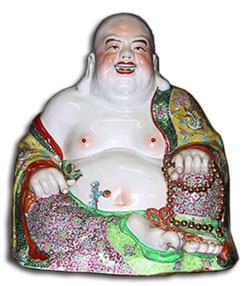
Chinese depiction: often referred to as the Laughing Buddha(Japanese, Miroku; Chinese, Mi-lo Fwo; Tibetan, Byams-pa; Vietnamese, Di-lac; Korean, Mi-rug)
 According to some Buddhist traditions, the period of the Buddhist Law is divided into three stages: a first period of 500 years, of the turning the Wheel of the Law; a second period of 1,000 years, of the deterioration of the Law, and a third period of 3,000 years (called Mappo in Japan) during which no one practises the Law. After this, Buddhism having disappeared, a new Buddha will appear who will again turn the Wheel of the Law. This future Buddha is still in the Tusita heaven, in the state of a Bodhisattva. Gautama Buddha himself will enthrone him as his successor. The name means 'benevolence' or 'friendship'. He is now living his last existence as a Bodhisattva. In anticipation of his imminent arrival, he is sometimes considered as a Buddha and given the title of Tathagata.
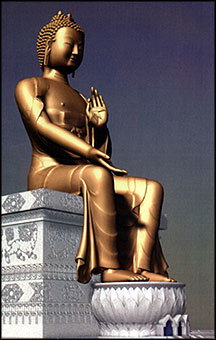
Maitreya is the only celestial Bodhisattva recognized by the sects of the Theravada school, who represented him from the outset. His images appear in Gandhara, perhaps even before those of the Buddha (with whom he was perhaps confused): he is represented standing or seated, as an ornamented Buddha, with long thin hair on the shoulders or tied in a chignon on his head, his hands in Dharmacakra mudra when seated, or in Vitarka and Varada mudras when standing.
In Tibet, when he is represented seated, his legs hang (in the European manner) and he is clothed as a Buddha. (The image on left is of the Maitreya Project Statue being built in Bodh Gaya, India). This is the form he assumes in Java in the eighth-century temple, the Chandi Mendut. His representations abound throughout Buddhist Asia. Yet he is usually shown as a Bodhisattva, standing and adorned with jewels, rather than seated. In certain images representing him in the sky Tusita, he appears seated with his legs in Padmasana. He is recognized by wearing a small stupa in his headdress. His attributes may vary, and he may hold a vase or a wheel (cakra) placed on lotus flowers. A scarf is always tied around his waist. Sometimes an antelope skin covers his left shoulder. He often forms a triad with Sakyamuni and Avalokitesvara; in fact, in Sri Lanka, sculptures thought to depict Avalokitesvara have been reinterpreted as showing Maitreya.
In Korea and Japan, where his cult enjoyed great favour from the sixth century, he is often confused (as in China) with Amitabha and Sakyamuni. In sculpture, he was sometimes confused with Nyoirin Kannon in Japan, a form of Avalokitesvara. He was also given the name of Jishi Bosatsu, 'He who is full of pity'. He was first likened to Kami Hachiman, a deification of the Japanese Emperor Ojin (third century), and was later considered an incarnation of Amitabha, serving as an intermediary between Gautama (the world of mortals) and Amitabha (the world of the beyond).
Acolytes of Maitreya: Asanga and Vasubandhu
Besides the triads, Maitreya is often represented with two acolytes: Asanga (Japanese Muchaku), founder of the Hosso sect, and Asanga's brother Vasubandhu (Japanese Seshin). Tradition relates that Maitreya descended from the Tusita heaven at the request of Asanga and his brother to teach them the content of the five sutras. These two Arahants then composed many other enlightening shastras for the followers of the doctrines of the Mahayana. In Japan, Asanga is some-times called Genjo and is then confused with the Chinese pilgrim Xuanzang. Asanga lived in India, in Pataliputra (present-day Patna in the state of Bihar), with his brother in the fourth century. They are represented in the form of monks, and are given the title of Bodhisattva. In Japan, the cult of Maitreya and of his acolytes is little maintained except by the Zen and Shingon sects.



Copyright © 2008 - BDEA / BuddhaNet. All rights reserved. 




-
"A" is apple, "B" is for boy, is the first things I've been taught to memorize.
These words are etched to my mind, it does not always arise, but as long as I do not lose my memory, it is always there.Even I may not be intelligent, but whenever there arises a need, I can always retrieve it. Put a book in a pocket, you may lose it, the more I memorize it, the more the teachings entrenched itself.
Understanding and wisdom for most people is an acquired thing, in Buddhism we begin by being mindful. We slowly opened our mind to awareness, we progress and we regress.
Buddhism in essence can be simple as it is profound, once we start ungrasping we start see an opening a slight easing of the heart. We start acquiring insight, however, we are not Buddha yet, for there more things we've yet learn to ungrasp. We stilled ourselves, and we see even more clearly, the more we can let go.
But more often than not,we usually get caught up in our lives and forget the inner peace the stillness of heart gives us. The more we grasp the more ungrounded and unhappy we are, that's where we find inspiration from teachers, books and if we are able to keep it inside of us, ourselves.
Why should I be cynical, knowing it that the human nature to err, people will regress just like I do, but once pointed to the right direction, I can always orientate to right direction again!
We are human borne with desire to struggle in worldly activities, unlike the leisurely Devas above us, drunken with euphoria of pleasures to bother, or the Hell and Hungry Ghost, too preoccupied in pain and discomfort to contemplate!
It is between this pain and pleasure leisureliness that we human are better equipped to discriminate.
-
Originally posted by An Eternal Now:
And yet people near birth of Maitreya still needs to receive dharma teachings. Why?
Because only dharma teachings can lead people to liberation.
Perfect morality is not 'the point' in Buddhism -- awareness, enlightenment and liberation is. Of course, morality is important though. But if morality is all there is in Buddhism, there will be no point of Buddhism - there are enough teachings of morality in society and religion cannot claim to be any special in that, or have some sort of monopoly in teaching morality.
ermm enlightenment.... It generally means we understand something and give up attachment to it right?If I am not enlightened.... can I try to follow Buddha's Noble Eightfold path, is it sufficient to end suffering?
-
Originally posted by 2009novice:
ermm enlightenment.... It generally means we understand something and give up attachment to it right?If I am not enlightened.... can I try to follow Buddha's Noble Eightfold path, is it sufficient to end suffering?
The Noble Eightfold Path is precisely practiced to gain enlightenment.
There cannot be ending suffering without enlightenment. What is enlightenment? Realising the true nature of reality. Therefore one must practice Noble Eightfold Path.
Noble Eightfold Path is the practice of morality, samadhi, and wisdom.
-
A very good article by someone who knows what he's talking about.

The Eight-Fold Path is the fourth of the Four Noble Truths - the first of the Buddha's teachings. All the teachings flow from this foundation.
The Four Noble Truths are
1. The Noble Truth of the reality of Dukkha as part of conditioned existence. Dukkha is a multi-faceted word. Its literal meaning is "that which is difficult to bear". It can mean suffering, stress, pain, anguish, affliction or unsatisfactoriness. Each of the English words is either too strong or too weak in their meaning to be a universally successful translation. Dukkha can be gross or very subtle. From extreme physical and mental pain and torment to subtle inner conflicts and existential malaise.
2. The Noble Truth that Dukkha has a causal arising. This cause is defined as grasping and clinging or aversion. On one hand it is trying to control anything and everything by grabbing onto or trying to pin them down, On the other hand it is control by pushing away or pushing down and running away or flinching away from things. It is the process of identification through which we try to make internal and external things and experiences into "me and mine" or wholly '"other" than Me. This flies in the face of the three signs of existence - Anicca, Dukkha. Anatta - Impermanence. Stress or Suffering and No-Self. Because all conditioned existence is impermanent it gives rise to Dukkha, and this means that in conditioned existence there is no unchanging and permanent Self. There is nothing to grasp onto and also in reality, nothing or no 'one' to do the grasping! We grab onto or try to push away ever changing dynamic processes. These attempts to control, limit us to little definitions of who we are.
3. The Noble Truth of the end of Dukkha, which is Nirvana or Nibbana. Beyond grasping and control and conditional existence is Nirvana. "The mind like fire unbound." The realisation of Nirvana is supreme Bodhi or Awakening. It is waking up to the true nature of reality. It is waking up to our true nature. Buddha Nature. The Pali Canon of Theravada, the foundational Buddhist teachings, says little about Nirvana, using terms like the Unconditioned the Deathless, and the Unborn. Mahayana teachings speak more about the qualities of Nirvana and use terms like, True Nature, Original Mind, Infinite light and Infinite life. Beyond space and time. Nirvana defies definition.
Nirvana literally means "unbound' as in "Mind like fire unbound". This beautiful image is of a flame burning by itself. Just the flame, not something burning and giving off a flame. Picture a flame burning on a wick or stick, it seems to hover around or just above the thing burning. The flame seems to be independent of the thing burning but it clings to the stick and is bound to it. This sense of the flame being unbound has often been misunderstood to mean the flame is extinguished or blown out. This is completely opposite to the meaning of the symbol. The flame "burns" and gives light but is no longer bound to any combustible material. The flame is not blown out - the clinging and the clung to is extinguished. The flame of our true nature, which is awakening, burns independently. Ultimately Nirvana is beyond conception and intellectual understanding. Full understanding only comes through direct experience of this "state' which is beyond the limitations and definitions of space and time.
4. The Noble Truth of the Path that leads to Awakening. The path is a paradox. It is a conditioned thing that is said to help you to the unconditioned. Awakening is not "made" by anything: it is not a product of anything including the Buddha's teachings. Awakening, your true nature is already always present. We are just not awake to this reality. Clinging to limitation, and attempts to control the ceaseless flow of phenomena and process obscures our true nature.
The path is a process to help you remove or move beyond the conditioned responses that obscure your true nature. In this sense the Path is ultimately about unlearning rather than learning - another paradox. We learn so we can unlearn and uncover. The Buddha called his teaching a Raft. To cross a turbulent river we may need to build a raft. When built, we single-mindedly and with great energy make our way across. Once across we don't need to cart the raft around with us. In other words don't cling to anything including the teachings. However, make sure you use them before you let them go. It's no use knowing everything about the raft and not getting on. The teachings are tools not dogma. The teachings are Upaya, which means skillful means or expedient method. It is fingers pointing at the moon - don't confuse the finger for the moon.
The Path
1. * Samma-Ditthi — Complete or Perfect Vision, also translated as right view or understanding. Vision of the nature of reality and the path of transformation.
2. Samma-Sankappa — Perfected Emotion or Aspiration, also translated as right thought or attitude. Liberating emotional intelligence in your life and acting from love and compassion. An informed heart and feeling mind that are free to practice letting go.
3. Samma-Vaca — Perfected or whole Speech. Also called right speech. Clear, truthful, uplifting and non-harmful communication.
4. Samma-Kammanta — Integral Action. Also called right action. An ethical foundation for life based on the principle of non-exploitation of oneself and others. The five precepts.
5. Samma-Ajiva — Proper Livelihood. Also called right livelihood. This is a livelihood based on correct action the ethical principal of non-exploitation. The basis of an Ideal society.
6. Samma-Vayama — Complete or Full Effort, Energy or Vitality. Also called right effort or diligence. Consciously directing our life energy to the transformative path of creative and healing action that fosters wholeness. Conscious evolution.
7. Samma-Sati — Complete or Thorough Awareness. Also called "right mindfulness". Developing awareness, "if you hold yourself dear watch yourself well". Levels of Awareness and mindfulness - of things, oneself, feelings, thought, people and Reality.
8. Samma-Samadhi — Full, Integral or Holistic Samadhi. This is often translated as concentration, meditation, absorption or one-pointedness of mind. None of these translations is adequate. Samadhi literally means to be fixed, absorbed in or established at one point, thus the first level of meaning is concentration when the mind is fixed on a single object. The second level of meaning goes further and represents the establishment, not just of the mind, but also of the whole being in various levels or modes of consciousness and awareness. This is Samadhi in the sense of enlightenment or Buddhahood.
* The word Samma means 'proper', 'whole', 'thorough', 'integral', 'complete', and 'perfect' - related to English 'summit' - It does not necessarily mean 'right', as opposed to 'wrong'. However it is often translated as "right" which can send a less than accurate message. For instance the opposite of 'Right Awareness' is not necessarily 'Wrong Awareness'. It may simply be incomplete. Use of the word 'right' may make for a neat or consistent list of qualities in translations. The down side is that it can give the impression that the Path is a narrow and moralistic approach to the spiritual life. I use variant interpretations so you consider the depth of meanings. What do these things mean in your life right now?
- John Allan
-
Originally posted by Rainbow Jigsaw:
I can sense you're quite a balanced and open individual, which is nice to see around in SGF. :)
There's nothing wrong with "memorisation and recitation of religious texts" as they play an important role in certain stages of one's spiritual path. What I was cautioning was doing it without true understanding and therefore not questioning when needed. If one doesn't really understand, one won't know how or what to question.
It's extremely easy for religious leaders (of any faith) to influence his followers to follow without questioning, based on the premise that the religious texts are holy truths, and therefore these leaders' interpretation are also holy and unquestionable. Studying religious texts obediently like school children (who have been drilled thoroughly to absorb and regurgitate, not question) produces religious scholars, not necessarily spiritually mature persons.
Regardless of what religious texts from whichever faiths, if one wishes to truly learn and grow spiritually, he needs to learn to question and seek real answers with help from those texts and beyond that can stand the test of time and situations, in order to address all his questions. As for what is true and real, he'll have to learn to tell and feel through experience, not just through exchange of words. It takes many lifetimes to do this, but if one is truly serious about learning to grow spiritually, then there's no better time to start than now.
Rainbow Jigsaw of Life
One of my doubts and concerns is that some seem to believe that memorisation and recitation will help one to achieve true understanding eventually. There is also another kind of existing difficulty for some practising Buddhists - which is the wisdom to judge or discern when questioning is needed. Some think what they have is 'wisdom' but could be merely theoretical or worldly knowledge per se.I wholeheartedly agree that without true understanding, one wouldn't know how or what to ask. In my experience, this applies for both religious or non-religious matters, secular or non-secular.
"As for what is true and real, he'll have to learn to tell and feel through experience, not just through exchange of words. It takes many lifetimes to do this, but if one is truly serious about learning to grow spiritually, then there's no better time to start than now."
Very true indeed.
-
Originally posted by An Eternal Now:
People with pure hearts and discipline may go to higher realms, but not necessarily liberation.
What is liberation? -
Originally posted by Dondontan:
What is liberation?When all mental sufferings and attachments and afflictions have ceased forever.
-
The best of truths is the Four Noble Truths. The best of paths is the Noble Eightfold Path.
-
Originally posted by An Eternal Now:
When all mental sufferings and attachments and afflictions have ceased forever.
Is this possible at all?So when this happen, does it mean the person will not need go for rebirth over and over again?
-
Originally posted by Dondontan:
Is this possible at all?So when this happen, does it mean the person will not need go for rebirth over and over again?
Yes it is true and I have met such people. Yes it also means freedom from uncontrolled cycles of rebirth.
It is possible only through realisation of the nature of reality. This removes the separate self sense, the sense that 'I control', 'I perceive', etc. If the sense of a separate perceiver, controller, self, agent, is removed via insights, there cannot be anymore attempts to resist, attach, seek, tune out, of reality. All these dualistic attraction and grasping or aversion (which implies a dualistic self and an object - a 'me' trying to control/seek/resist an 'outside object') can only stand when the illusion of a 'me' persists. And suffering results from the resistance, seeking etc.
Otherwise there is simply transient phenomena vividly arising and subsiding on its own as a display of awareness yet without leaving traces, like drawing pictures on the pond, lines appear but cannot form into an image - they just appear and spontaneously self-liberate.
-
Originally posted by An Eternal Now:
Yes it is true and I have met such people. Yes it also means freedom from uncontrolled cycles of rebirth.
It is possible only through realisation of the nature of reality. This removes the separate self sense, the sense that 'I control', 'I perceive', etc. If the sense of a separate perceiver, controller, self, agent, is removed via insights, there cannot be anymore attempts to resist, attach, seek, tune out, of reality. All these dualistic attraction and grasping or aversion (which implies a dualistic self and an object) can only stand when the illusion of a 'me' persists. And suffering results from the resistance, seeking etc.
Otherwise there is simply transient phenomena vividly arising and subsiding on its own as a display of awareness yet without leaving traces, like drawing pictures on the pond, lines appear but cannot form into an image - they just appear and spontaneously self-liberate.
Interesting!In buddhism, is this a long and difficult process to attain liberation?
-
Originally posted by Dondontan:
Interesting!In buddhism, is this a long and difficult process to attain liberation?
The initial glimpse of your true nature can come in a few years if you're diligent. Full liberation usually takes over 10 years (from the few I've seen), though if you are a very diligent monk, I don't know, maybe shorter. I would also note however that it is definitely possible for a lay man to become enlightened - My enlightened teachers and friends who are living are all lay man currently, even though my Master was a monk (he passed away).
The Buddha actually promises that by practicing the four foundations of mindfulness, one could become enlightened as an anagami or arhat within as little as 7 days and no more than 7 years. I think it is possible but one would have to be very engaged in that practice in a retreat setting.
-
Originally posted by An Eternal Now:
The initial glimpse of your true nature can come in a few years if you're diligent. Full liberation usually takes over 10 years (from the few I've seen), though if you are a very diligent monk, I don't know, maybe shorter. I would also note however that it is definitely possible for a lay man to become enlightened - My enlightened teachers and friends who are living are all lay man currently, even though my Master was a monk (he passed away).
The Buddha actually promises that by practicing the four foundations of mindfulness, one could become enlightened as an anagami or arhat within as little as 7 days and no more than 7 years. I think it is possible but one would have to be very engaged in that practice in a retreat setting.
7 days.....? this is..... very fast! I thought it supposed to take us a lifetime to understand..... interesting....
U are not lying right hahah (joking)