Practice in Daily Life
-
Originally posted by Sableko:
My master taught me to chant "OM MANI PEK MEI HOM".
This mantra alot of my buddhist friends dunno how to pronouce.They rather chant nwamtf.NWAMTF is easier to chant compared to Om Mani Padme Hum.
-
Originally posted by Positron:
This mantra alot of my buddhist friends dunno how to pronouce.They rather chant nwamtf.NWAMTF is easier to chant compared to Om Mani Padme Hum.
What is nwamtf? -
Originally posted by likeyou:
What is nwamtf?
nan wu ah mi tuo fo, the chinese word. -
Originally posted by Positron:
nan wu ah mi tuo fo, the chinese word.
Thanks Pos. -
Originally posted by likeyou:
Thanks Pos.
Welcomed.Anyone knows the correct pronouciation of om mani padme hum?Many of my buddhsit friends dunno.
-
Originally posted by sinweiy:
also since our hearing is sharp in our world, listening to Dharma talks daily when there's time helps our view to be Right and keep our action away from unwholesomeness.
i listened to MCK's talk when got free time. http://new.amtb-aus.org/
just download and listen in ur phone/mp3 player. u don't have to understand the meaning when listening, not so important to try very hard understanding. MCK would say Dharma had no meaning. we are the one that give it meaning. :)
so u just listen. ...anyway MCK would repeat the same thing over and over again. depend on your level of realisation, listening formulate discipline of the mind and later u'll gain concentration and then wisdom eventually.
u can also contemplated on å› æ— æ‰€ä½� 而生其心 in Diamond Sutra, the stanza that cause Hui Neng to be enlightened.. let go in the moment, free the mind from everything, like responsibility, career, material, love ones, family, people that own u money, people that dislike u, self etc all are but impermanent, false and empty.. let the mind free.
/\
How to comtemplate on the short phrase?
-
What's the difference between insight meditation and chanting?
Why do buddhists recite sutra?
-
Originally posted by Positron:
What's the difference between insight meditation and chanting?
Why do buddhists recite sutra?
Insight meditation and chanting are different. Reciting sutra is to remember what the Buddha taught.
Thusness: Ok. I think when we view consciousness, we have to understand that there are a few things. We cannot keep on thinking about the objective world first. We must see how consciousness reacts. That is if we react very intensely, strongly towards symbols, then whatever reactions will go back deep into your consciousness. This is one thing. My perspective is that when you chant, you are not dealing with our luminous clarity. We're dealing with propensities deep in your consciousness. Insight meditation itself deals directly with this clarity. That is the luminous clarity. But if we were to continue to chant, you are actually focusing more on the deeper layers of consciousness that deals with propensities and the power of concentration. Do you see what I mean? It's not so much of the luminosity. However, the chanting itself, when it takes strength, it creates a kind of momentum. A momentum that synchronises not only with your sub-conscious or the deeper layers of your consciousness, but also your conscious level. This means it can sync the two layers into one. This syncing the two into one clears your mind, clears your thoughts. And then at this time, you ask who you are, that is, not letting the momentum take place, but just feel and sense... then you ask what is it. At that moment, you might see your reality. But your mind must be able to settle down first. But you must know there is a difference between working at the concentration level, dealing with the karmic propensities and creating new momentums, and practicing insight meditation that touch directly the clarity and the luminous nature, are two different things. You see what I mean or not?
Participant 1: Yeah I think so. This means that I still need to do insight meditation?
Thusness: Yes you have to do insight meditation. Even if you attain calmness you still have to do insight meditation. You must feel the awareness... You must sense it everywhere... That is very important for liberation. Now when we talk about awareness, we don't call it Self or we don't call it Mind. Why people call it Awareness is because they do not want to call it Self, because there is no Self. The reason they said Awareness, is because Awareness is not an entity. It is not a thing. It is just a point of luminous clarity. It is just clarity. But because we are so accustomed to thinking things in terms of object and subject, we always take Awareness as something. It must be somewhere inside, residing somewhere. Even if it is not residing inside the body it must be somewhere, someplace. This is the problem, you see. So when you say that let’s be aware. We always think of “how?” How to be aware? When we say “where is awareness”, they always look for a place, they always look for a something. This is how the mind react, this is what I call a momentum. They always behave this way. They do not know how to say “Just do nothing. Everything is expressing itself by clarity.” They always want to react, you see what I mean? -
Originally posted by Isis:
Hello.. i got a question to ask..
What if when you chant Namo Amituofo silently and one may feel restless after a while and then slowly progress to aversion... Since aversion has arised, shall we just continue to focus on the name of the Buddha?
Yes, continue to recite. Once you notice restlessness / aversion arise, let go of them and go back to reciting the name.
-
Originally posted by Positron:
nan wu ah mi tuo fo, the chinese word.The 'wu' is pronounced as 'mo', however'. Namo amituofuo.
-
Originally posted by An Eternal Now:
The 'wu' is pronounced as 'mo', however'. Namo amituofuo.
Thanks for telling me.No one teach me how to comtemplate on the diamond sutra stanza posted by sinweiy.
-
Excerpt from by Zen teacher David Loy:
http://ccbs.ntu.edu.tw/FULLTEXT/JR-JOCP/jc26559.htm
Nietzsche relates the denial of a thinker to a denial of the process of thinking. Why; after all, do we believe that there is an act of thinking? Because that act is what the thinker does: stringing thoughts together by creating new thoughts on the basis of the old thoughts. If there is no such thinker, then there need be no such act. That leaves only thoughts, but one at a time, although the succession may be rapid.
The significance of Nietzsche's remarks for us is that we find the same claim in the Asian nondual philosophies, particularly in Ch'an Buddhism. In The Platform Sutra of the Sixth Patriarch, Hui Neng explains what prajña is:
To know our mind is to obtain liberation. To attain liberation is to experience the Samadhi of Prajna, which is ''thoughtlessness". What is "thoughtlessness"? Thoughtlessness is to see and know all Dharmas (things) with a mind free from attachment. When in use it pervades everywhere, and yet it sticks nowhere....When our mind works freely without any hindrance and is at liberty to "come" or to "go", we attain Samadhi of Prajna, or liberation. Such a state is called the function of "thoughtlessness". But to refrain from thinking of anything, so that all thoughts are suppressed, is to be Dharma-ridden, and this is an erroneous view. [20]
The term "thoughtlessness" would seem to recommend a mind free from any thoughts, but Hui Neng denies this: rather, "thoughtlessness" is the function of a mind free from any attachment. The implication is that for someone who is liberated thoughts still arise, but there is no clinging to them when they do. Why the term "thoughtlessness" can be used to characterize such a state of mind will become clear in a moment. But the question that arises first is in what way one can ever be attached to thoughts if, as the Śiks�samuccaya says, a thought has no staying power, that like lightning it breaks up in a moment and disappears. Hui Neng answers this later in the Platform Sutra when he says more about "how to think":
In the exercise of our thinking faculty, let the past be dead. If we allow our thoughts, past, present and future, to link up in a series, we put ourselves under restraint. On the other hand, if we never let our mind attach to anything, we shall gain liberation.
(my emphasis [21])One clings to a thought by allowing the thoughts to link up in a series, which means having one's next thought "caused", as it were, by the previous thoughts, rather than letting each thought arise spontaneously and nondually.
According to the autobiographical first part of the Platform Sutra, Hui Neng became deeply enlightened and realized that all things in the universe are his self-nature, upon hearing a line from the Diamond Sutra: "Let your thought arise without fixing it anywhere". [22] The passage just prior to this one-which Hui Neng must also have heard-puts this in context. Edward Conze translates it as follows:
Therefore then, Subhuti, the Bodhisattva should produce an unsupported thought, a thought which is nowhere supported, which is not supported (apratisthiti) by forms, sounds, smells, tastes, touchables, or objects of mind. [23]
A thought is "Unsupported" because it does not arise in dependence upon anything else, not "caused" by another thought ("mind-objects") and of course not "produced" by a thinker, which the Bodhisattva realizes does, not exist. Such an "unsupported thought", then, is prajña, arising by itself nondually.
The ego in its purity is experienced in the interval between two states or between two thoughts. The ego is like the worm which leaves one hold only after it catches another. Its true nature is known when it is out of contact with objects or thoughts. You should realize this interval as the abiding, unchangeable Reality, your true Being... [26]
The image of the ego as a worm which leaves one hold only after catching another might well have been used by Hui Neng and Ma-tsu to describe the way in which thoughts are apparently linked up in a series. The difference is that Mahayana Buddhism encourages the arising of "an unsupported thought", whereas Ramana Maharshi understands unchangeable Reality as that which is realized only when it is out of contact with all objects and thoughts. This is consistent with the general relation between Mahayana and Advaita: Nirguṇa Brahman is so emptied of any attribute ("neti, neti,...") that it becomes impossible to differentiate from Śūnyat�. "It is difficult indeed to distinguish between pure being and pure non-being as a category". (S. Dasgupta). [27] But there is still a difference in emphasis.
Mah�y�na emphasizes realizing the emptiness of all phenomena, whereas Advaita distinguishes between empty Reality and phenomena, with the effect of devaluing the latter into mere m�y�.
The image of a worm hesitant to leave its hold was used in a personal conversation I had in 1981 with a Theravada monk from Thailand, a meditation master named Phra Khemananda. This was before I discovered the passage from Ramana Maharshi; what Khemananda said was not prompted by any remark of mine, but was taught to him by his own teacher in Thailand. He began by drawing the following diagram:
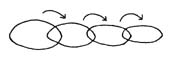
Each oval represents a thought, he said; normally, we leave one thought only when we have another one to go to (as the arrows indicate), but to think in this way constitutes ignorance. Instead, we should realize that thinking is actually like this:
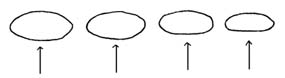
Then we will understand the true nature of thoughts: that thoughts do not arise from each other but by themselves.
This understanding of thoughts-not-linking-up-in-a-series but springing up nondually is consistent with D. T. Suzuki's conception of prajña:
It is important to note here that prajna wants to see its diction "quickly" apprehended, giving us no intervening moment for reflection or analysis or interpretation. Prajna for this reason is frequently likened to a flash of lightning or to a spark from two
striking pieces of flint. "Quickness" does not refer to progress of time; it means immediacy, absence of deliberation, no allowance for an intervening proposition, no passing from premises to conclusion. [28]
This gives insight into the many Ch'an dialogues in which students are criticized for their hesitation or praised for their apparently nonsensical but immediate replies. That the reply is immediate is not itself sufficient; what is important is that each response be experienced as a nondual "presentation of the whole". Hesitation reveals lack of prajña because it indicates either some logical train of thought or the self-conscious paralysis of all thought. That many approved replies are non-sequitur reveals one aspect of the enlightened mind, that its thoughts are free from reasoning and any methodology.
Even more important, this also explains how meditation functions, since the "letting-go" of thoughts breaks up the otherwise habitual linking together in a series. Huang Po: "... Why do they [Ch'an students] not copy me by letting each thought go as though it were nothing, or as though it were a piece of rotten wood, a stone, or the cold ashes of a dead fire"? [29]
-
Originally posted by Positron:
How to comtemplate on the short phrase?
sorry for the late reply,AEN posted some useful information from Ch'an School.
å› æ— æ‰€ä½� 而生其心 mean to let go of attachment/greed, dualism and wandering thoughts. to return to the pure true mind, there's no right and wrong view, no dual view. let go of wrong view and right view is True Right View.
even the thinking of Buddha have to be let go.then when u have no view, even the view of no view have to be let go. not easy. to have totally 'No' æ— view is very very difficult.
so for us, does reciting Amituofo also clinging to a view? Actually, it's fine, as u are clinging to a view WITHIN the power of Amitabha. When u reach Pureland, Amitabha will help u get rid of it and u will attain Buddhahood. It's a Brilliant method.
they say Buddha/Bodhisattva vow to liberate all sentient being, if not they won't attain Buddhahood. but u say i'm not liberated, why they already attained Buddhahood?
"When one realised one's True self/mind/buddhanature, then all sentient beings are Buddhas. But if one looses one's True self/mind/buddhanature, then all Buddhas are sentient beings." - last words when Master Hui neng parinirvana
/\.
-
Reciting sutra will increase wisdom?
-
This a good example on the term train of thoughts, with a thought leading to another, this how the average persons mind's transits from on thought to another. Such that it appears as a train of thoughts appearing as one single stream.
Each oval represents a thought, he said; normally, we leave one thought only when we have another one to go to (as the arrows indicate), but to think in this way constitutes ignorance. Instead, we should realize that thinking is actually like this:
Then we will understand the true nature of thoughts: that thoughts do not arise from each other but by themselves.
This understanding of thoughts-not-linking-up-in-a-series but springing up nondually is consistent with D. T. Suzuki's conception of prajña:
-
The below article provided enlightening exegesis and similarly to Om Mani Padme Hum recitation to rebirth to pureland as well. Hope that it is useful. If very enlightening, plse circulate to all who are interested :)
å¤�莲居居士念佛论——黄念祖è€�居士
底下是å¤�è€�师的è¯�,这一段很é‡�è¦�啊。“念到æˆ�片,一心ä¸�乱,ç�†ä¸€å¿ƒï¼Œäº‹ä¸€å¿ƒï¼Œéƒ½æ˜¯è¯�。一般说æ�¥ï¼Œä¸�忘就是è¯�。苦ä¹�忙闲è€�有这一å�¥ï¼Œå°±æ˜¯è¯�。这是è¯�明,就是å‡æ�®ï¼Œä¸�è¯�这个ä¸�能è¯�æ£è§‰”。念佛念到æˆ�片,就是能有一片很清净。å†�进一æ¥ï¼Œå°±æ˜¯ä¸€å¿ƒä¸�乱,ç�†ä¸€å¿ƒï¼Œäº‹ä¸€å¿ƒï¼Œè¿™ä¸�大容易达到。http://www.fjnet.com/wywz/wywznr/201008/t20100811_166028.htmThis is about true nature of thoughts and is very helpful on daily practice to achieve higher grade of Pureland in daily practice. It is also a great insight to understand Amitabha 48 vows and Pureland Sutra :)
黄檗山æ–é™…ç¦…å¸ˆä¼ å¿ƒæ³•è¦� http://www.baus-ebs.org/sutra/jan-read/003/04-006.htm
-
Originally posted by Positron:
Reciting sutra will increase wisdom?
yes, the principle is the same with reciting mantra or Buddha's Name, which is to DISPLINE the MIND. which mean when your mind is focus in reciting, then the mind become still, and when it's still, wisdom will arise.our mind is like a hanging lamp lights swinging in the center of a dark room. we won't be able to see clearly the inside of the room, when the lamp is moving around non stop. so Buddha's principle is to stop the mind. when the lamp stay still, what it shine will be clearer to see. similarly when the mind is still the wisdom we originally had in our Buddhanature will surface up per se.
those meditator who count breath also follow the same principle. One disciple of Buddha use sweeping the floor while reciting a stanza also follow the same principle.
hence that said, there are 84000 methods of disiplining the mind, and if Buddha know you very well, u can be concentrating on walking, or even eating mindfully, hearing, bowing to Buddha, doing some routine action...all this can also be use to Disciple the mind. however for me, is recommend Reciting Buddha's Name "Amituofo", as it got added Power from Amituofo.
/\