::Homework Crapbox::
-
Indian doctors have been accused of conducting sex change operations on young girls whose parents want sons to improve the family's income prospects.
Madhya Pradesh state government is investigating claims that up to 300 girls were surgically turned into boys in one city after their parents paid about 2000 pounds (US$3000) each for the operations.
Read full article :
http://www.smh.com.au/world/indians-pay-surgeons-to-turn-girls-into-boys-20110629-1gpnf.html#ixzz1Qco6DRGS -
Young Singaporeans angry at Dr Tony Tan for depriving them opportunities at home
Though presidential hopeful Dr Tony Tan has won the ringing endorsement of senior PAP leaders in the last few days with PAP’s Secretary-General Lee Hsien Loong calling him a ‘unifying’ figure for all Singaporeans, it appears that he will not have the support of many young Singaporeans who are still angry at him for depriving them educational opportunities at home.
As a former PAP education minister in the 1990s, Dr Tony Tan was responsible for the PAP’s open-door policy to foreign students which had brought thousands of them from China, India and elsewhere to study in Singapore universities on government scholarships which paid for their tuition fees and monthly living allowances among other things.
“Singapore will not have enough graduates to service the economy in the year 2000, and steps will have to be taken to boost the intake at the universities here, while attracting more graduates from abroad as well,” Dr Tony Tan said way back in 1997.
When asked if measures would be put in to protect Singapore students from competition, Dr Tony Tan replied callously:
’There is no way in which you are going to be able to protect either Singaporeans or Singapore because we are a small country.’
(Source: Straits Times, 1998)
Due to Dr Tony Tan’s pro-foreigner education policies, many Singaporeans missed out on places in local universities and had to further their tertiary education overseas, a fact not lost on a NTU graduate who said:
“Tony Tan is responsible for one of the greatest policy errors that will cause great, untold harm to Singapore. His foreign students policies have caused an entire generation of Singaporeans to lose loyalty for Singapore.
Which citizens would not lose their feelings for the country if they are discriminated in the very country whom they have sacrificed 2.5 years of their lives under a humiliating military conscription service. Some of the so-called foreign scholars were really mediocre. Even I got better results(2nd-upper honours) than many of them. Go and get NTU to open up their records. Ask NTU School of EEE to reveal how many so-called foreign scholars got 2nd-lower honours and below. It is a simple matter to verify.”
æ¢�ç�¬å©· is disgusted at Dr Tony Tan’s refusal to do more to help Singaporeans:
“If pap cannot even manage and protect the citizens in a small country, what use are they then? Why still vote for them for so many decades? And why should we vote for TT to be the President since he is not even trying to protect the citizens? 爱国爱民视之如å�乃z,但在他们身上å�´çœ‹ä¸�到!”
Chia CC wondered if Dr Tony Tan will be a president for Singaporeans or foreigners:
“Wow, looks like Tony was the traitor who formulated the PAP policy of “NS for Singaporeans, but free varsity places and jobs for foreigners”. If he gets to be President, perhaps he will end up looking after foreigners better than the citizens who voted him into office!!”
Katherine Ho asked why she should vote for somebody who cared for foreigners more than Singaporeans:
“This Tony Tan will never fight for us like what late Mr Ong did. so why do we need a president that feeds on us but betrays us. like a common saying goes: “ïf one keeps a dog, it will at least show gratefulness”. But for him, it will be like keeping a dog so that it can bark at you or even bite you anytime!”
With public opposition against the PAP regime at an all-time high, the PAP may not risk a contest which Dr Tony Tan may well lose based on its growing unpopularity. The two other contenders are likely to be disqualified as Dr Tan Cheng Bock is the non-executive chairman of a company while Mr Tan Kin Lian is the CEO of a cooperative, not a company and hence they do not meet the requirements posited by the Council of Presidential advisers technically.
Dr Tony Tan is likely to become Singapore’s next ‘elected’ president without fighting a contest like his predecessor S R Nathan who has earn millions of dollars from Singaporeans by keeping ‘quiet’ and doing ‘little’.
-----------------------------------------------------------------------
53272.1 Former DPM Tony Tan’s foreign-talent-first Singaporeans-second university admission policy
For over two decades, Dr Tony Tan oversaw university education as its Minister-in-charge. In the late 1990s, the Singapore government convened a panel, under the direction of DPM Dr Tony Tan to re-examine university admission criteria. One of the pressing problems seen by the government at the time was that Singapore’s low birth rate, in part caused by misguided eugenics population policies, had resulted in fewer and fewer graduates entering universities. As reported in the Straits Times on 1st August 1997:
* MORE GRADUATES NEEDED: Singapore will not have enough graduates to service the economy in the year 2000, and steps will have to be taken to boost the intake at the universities here, while attracting more graduates from abroad as well, said Deputy Prime Minister Tony Tan, who oversees university education.
The panel was set up in 1998 and held its first meeting on 17th April 1998. Although Dr Tony Tan was not on the panel, he was the minister overall in charge of it. Apart from the projected shortage of skilled graduates, one of the other reasons for reviewing university admission criteria was to address the perception that it was almost entirely academic based with no consideration for extra-curricular achievements. The other, seemingly innocuous goal, was to transform the local universities of NUS and NTU into world-class universities.
Right from the start in 1998, Dr Tony Tan ruled that a policy which limits foreigners or protects Singaporean students and graduates was not on the table:
One student had asked if the Government would implement policies that would protect Singaporeans facing competition from foreigners, for jobs as well as university places.
Dr Tan answered: “There is no way in which you are going to be able to protect either Singaporeans or Singapore because we are a small country.
“We don’t set prices. We are a price-taker, not a price-setter,” he said on Thursday.
In a similar vein with Minister George Yeo, who rebutted MP Tan Cheng Bock later in 1999 on grounds that Singapore should not adopt Singaporeans first policy when it came to jobs, DPM Tony Tan was adamant that Singaporeans should not get preferential treatment whether competing for jobs or places in local universities.
Fast-forward a year later, when it was becoming apparent that Singapore still needed more graduates to service its economy lest economic growth slows, a report appeared in the Straits Times questioning if the government should increase the intake of university students at local universities NTU and NUS due to an increasing number of Singaporean students who were unable to qualify for local university, and had to resort to expensive educational opportunities overseas, the vast majority of them being polytechnic graduates who had been shut out of local universities without being told a good reason why (given the non-transparent nature of university admission critierion):
Overseas education counsellors say most Singaporeans go abroad because they cannot get into the local universities and the bulk of them – about 60 per cent – are polytechnic diploma holders. Some 65 per cent of those who went to British universities last year were polytechnic graduates. The comparative figures for Australia and the US were 80 per cent and 15 per cent respectively. Another 20 to 30 per cent are A-level holders who do not meet NUS and NTU admission criteria. The rest head overseas on scholarships.To make matters worse, it was becoming apparent that Singapore was losing talent because of this overseas brain drain. Taking the case of Tan Teck Chuan:
After completing his national service, he joined Ngee Ann Polytechnic where he began his winning streak, sweeping more than 10 book prizes, a scholarship and the first Tay Eng Soon gold medal for outstanding work as a diploma student in building services.
Then came decision time. He could wait for another eight months and try for a place at the National University of Singapore or the Nanyang Technological University.
If he clinched a place, it would mean studying for another four years as he would not be allowed to skip the first year because his polytechnic course was not considered relevant.
His other option: Go to Cardiff University and aim for an honours degree in two years.
NUS and NTU do not reveal how they calculate the entry points for polytechnic graduates, but Mr Tan knew that besides his polytechnic grades, his O-level results and work experience would be taken into account. On that basis, he did not rate his chances highly.
On the other hand, he had a firm offer from Cardiff, one of the top five universities in mechanical engineering in Britain.
The choice was clear, but the two-year stint in Wales did not come cheap though – $60,000 to be exact.
At the end of it all, Teck Chuan said that he wished he had a chance at local universities:
Although he appreciated the value of the overseas exposure, Mr Tan told Insight he wished that Singapore had given him and others like him the opportunity to pursue tertiary education here – at less cost to himself and his family.
“People ask me why was I not satisfied with a poly diploma. But let’s face it, in Singapore, what counts is a degree.
“And by the end of my poly course, I knew I had the ability to do a degree in two or three years, so I don’t see why I don’t deserve that shot at a university degree – right here at home.”
To be clear, Teck Chuan was not just one out of a few Singaporeans who missed out opportunities at local universities. The articles goes on to say that UK universities usually found that Singaporeans were model students:
Officials of Leeds, Glasgow, Leicester and Loughborough Universities note that Singaporeans are model students who pass with first class or second-upper honours.
The University of Glasgow alone had 20 first class and 40 second-upper class honours among the graduating batch of Singaporeans last year.
Tony Tan’s role
Here is where DPM Tony Tan’s role came into play. DPM Tan said that while more graduates are needed to keep the economy going (a shortfall of graduates was expected even if NTU and NUS increased their intake), but that increasing the intake was ruled out for fear that it might “lower their standards” and cause them to become “unmanageable”. His solution? Part of it was to instead increase the intake of foreign students from overseas (similar to overseas recruitment, no?) so as to retain education standards, done probably in part to ensure NUS and NTU were seen as world class education institutions which foreigners would flock to:
Deputy Prime Minister Dr Tony Tan revealed in Parliament that projections by the Ministry of Trade and Industry indicated that Singapore needed 17,000 graduates a year to service its economy.
With an intake of about 10,000 or 11,000 to NUS and NTU, there would still be a shortfall.
He ruled out expanding the intake at NUS and NTU, saying that it could lower their standards and cause them to become unmanageable “mega-universities”.
The better options were to increase the number of tertiary-level institutions and recruit students from overseas.
In other words, if one is looking to blame any minister for the huge influx of foreign students in local Singapore universities and the huge brain drain of polytechnic graduates who leave for overseas university education (who are unfairly penalised due to consideration of ‘O’ Level grades), DPM Tony Tan appears to be the minister responsible.
In his quest to ensure the Singapore economy had enough graduates to keep it going and while also trying to boost local university standards and international appeal, DPM Tony Tan set in motion the policy which discriminated against local students in favour of foreign students who, in some apparent cases are not able to qualify for their own country’s competitive university entrance exams.
Is this not a clear case of putting foreign students ahead of locals? All in the name of boosting the image of NUS/NTU over that of the locals. To make matters worse, CPF money cannot be used for education overseas. Polytechnic students who had to go overseas or resort to expensive college education through distance learning have DPM Tony Tan to thank for putting foreign students overseas ahead of locals.
It would not be the least bit suprising if it eventually emerged that DPM Tony Tan was the brains behind the policy which explicitly invites foreign students fully sponsored by the Singapore government (and its taxpayers) to study in NUS/NTU and offers them a PR (without the obligation of National Service) upon graduation. Such an ill thought policy marginalises local talents and swells the ranks of non-committed PRs who are in Singapore only as a stepping stone to overseas universities. Here’s an account by a forumer of how such a reverse-discriminatory policy worked.
Now DPM Tony Tan says he might run for President. Well when the voting comes, Singaporeans should keep in mind the above.
.
Defennder
-
53270.1 Tony Tan and the university education review
This is a follow up to the previous post on DPM Tony Tan’s role in university education reform. There are a number of objections and replies to what was posted here and elsewhere. I think it’s fair only if I addressed some of these. Apart from that there are new points to be made here as well.
A commenter said that local universities reserve some 80% of places for Singapore residents. There are some considerations to take into account here. Firstly the number refers to the total number for each university, regardless of course of study. It is apparent to many that an arts degree is very different from a science degree, and when ex-DPM Tony Tan said that they needed more graduates to service the economy, I believe he did not mean to imply any degree is fine so long as it is a bachelors’ degree. Apparently some courses will be in demand due to its degree being sought after by prospective employers, whereas others are treated as generic paper degrees. I am not aware of any faculty-specific quotas, hence it’s entirely possible for the ratio to hold since the rest of them are admitted to courses completely unrelated to their prior field of study (polytechnic graduates for eg.). Additionally residents refer to both citizens and PRs, and not just citizens alone. Should faculty-specific quotas be established to help more polytechnic students secure a place? Perhaps this is worth considering.
But to be clear the point raised previously is not so much the ratio of international-resident students, but why couldn’t they raise the intake? Back then DPM Tony Tan said that doing so would cause the universities to become unmanageable “mega-universities.” But exactly what numbers did DPM Tan mean when he said it would be unmanageable? According to this 1997 report from the ST:
Expanding intake at NUS and NTU to, say, 15,000 a year was not desirable, he said.
Doing so could lower their standards and cause them to become unmanageable “mega-universities” with student populations of 30,000 or 40,000, said Dr Tan.
But is it really reasonable to have said something like that? Somehow or another unless he wants to retain it at 15,000, it will eventually exceed that number. From this report, appeared that the combined intake was 38,951 in 2003, which is more than double the 15k figure DPM Tan warned about back in 1997. Was this a case of poor planning or more likely a dismissive flippant remark? I cannot say for sure. Maybe someone else can shed some light on that.
Secondly, it’s true that Tan Teck Chuan did not apply to local universities so no one would know for sure if he would be accepted. But then again the previous post did not say that he was rejected by local universities, only that he stood a low chance because of existing policies which discriminated against polytechnic graduates. The same policies which resulted from the university education panel recommendations, accepted by the Government under DPM Tony Tan who was the minister-in-charge or university education, also started to woo foreign students by doing overseas recruitment in foreign countries. But I concede that Tan Teck Chuan’s case is not directly relevant since he was not rejected by the universities here (since he never even tried applying because it entailed an 8 month wait when he already had an offer from Cardiff). If so, kindly disregard this and I apologise for citing this misleadingly. But I should point out that the Teck Chuan’s story was found in that report musing on whether university admission was disadvantaging local polytechnic graduates, so if anything the ST article which I quoted is itself already erroneous in that respect, even without having myself cite it to make the case.
Now even retracting this story does not exonerate DPM Tony Tan. This minister is still responsible for having started all those foreign recruitment exercises where MOE staff travel to foreign cities and advertising for students to apply to NTU and NUS instead of their own colleges in a bid to attract foreign students.
Let’s take a closer look at what happened back then in 1997. Along with this came the recommendation to reduce the gap between what foreign students paid an what locals paid for undergrad tuition fees in 1997; a policy which was partially reversed some ten years later (after DPM Tony Tan stepped down) due to rising complaints from the public that taxpayers’ monies were being used to subsidies tuition fees for foreign students instead of locals:
Dr Tan, who is the minister overseeing university education, said that the changes were necessary to build up the universities into world-class institutions.
…
Foreign students will pay less too. Asean students now pay 50 per cent more than Singaporeans and those from elsewhere pay 100 per cent more. But from this July, all foreigners will pay 25 per cent more than Singaporeans and, from next year, they will pay just 10 per cent more.
This change is aimed at drawing foreigners who might otherwise be daunted by the cost of living here and the strong Singapore dollar.
But Dr Tan said that the foreign students who come “must be better than Singapore students”.
The universities will cast their net wide for foreign talent, from neighbouring countries, as well as from China, India and perhaps even Europe and the United States.
The universities will market themselves abroad, at educational fairs, by advertising and, when invited, by talking to students who might consider coming here.
Again there you have it, evidence that all these overseas recruitment effort for foreign students overseas (even to the point of visiting foreign villages and advertising for NUS/NTU) started way back in 1997 after DPM Tony Tan started to review and overhaul university education. In the same year (1997) the quota for foreign students was raised from 20% from 10% previously. From the ST article Varsity fee hike : RAdm Teo gives assurances(31st Mar 1997):
All foreign students will pay eventually just 10 per cent more than local students as compared to the additional 50 to 100 per cent they are paying now. Their quota will be doubled to 20 per cent of the student population.
Now some might ask: Is 20% really a lot given that the remainder are local students? To answer this question it might be helpful to compare the proportion of foreign students with that of other countries’. Taking the United States for example, in 2006 foreign born students comprised some 12.7% of the university student population. Take note that here it’s “foreign born” meaning to say 12.7% is inclusive of migrants who have since become American citizens. By contrast, in Singapore the 80% figure refers to resident population which includes PRs who were not born in Singapore. What does this tell you? Doesn’t this mean that if you consider foreign-born students (regardless of whether they hold citizenship or PR), would the actual ratio be much higher than the advertised 20%?
All these was done for the purpose of making the universities world-class institutions, at the cost of denying local polytechnic graduates a place in favour of foreign talent. It reminds me much like how Singaporean workers are treated as economic digits just so that the ministers obtain their desired Key Performance Indicators (KPI).
Now addressing the argument that all those changes were worth the effort since NUS/NTU degrees would be considered more prestigious when it reached world class standards. How does this help Singaporean graduates? To put it bluntly, unless the Singaporean graduate wanted to find work abroad and not locally, it would not help them much. Given that NTU/NUS were the main local universities, it was inevitable that employers in Singapore would hire mostly NTU/NUS graduates anyway. So it’s not as though Singaporean graduates are helped that much.
If we spend more time thinking about this, which group of people does this help? Isn’t it the non-locals who benefit? The PRs and foreign graduates. They are the group of people who are least rooted to Singapore and are more likely to leave or go abroad for their career or future graduate studies. Having a degree from a world-class university only helps ensure that they become more mobile and less rooted to Singapore. Is this a desired policy goal in itself? And yet again I stress this is very subjective POV, and the question is if NUS/NTU had taken in more locals does it mean it would have been less world-class? Even if it is, which is a more desirable objective? For NUS/NTU to become world class or to help Singaporean students obtain their degrees? Priorities matter here.
Teaching standards
Lastly before I end this, allow me to elaborate how some of the university overhaul affected faculty staff as well. So far I have given only the point of view of university applicants and students but not that of local staff. The university overhaul overseen by DPM Tony Tan had the consequence of preferring foreign teaching staff over locals, even if they were not as good in teaching (or even communicating effectively in English, the linga franca of Singapore) as previous teaching staff had been from the ST Varsity changes controversy : Does Yankee do that dandy? (8th June 2002):
BUT it was in 1997 that the pace of change accelerated. That was when Deputy Prime Minister Tony Tan was asked to carry out Prime Minister Goh Chok Tong’s vision of turning Singapore into the Boston of the East.
An international academic advisory panel comprising academics and corporate leaders was set up to advise the Government on how the universities could become a strategic resource for Singapore as it moved into becoming a knowledge-based economy.
…
Speaking on the issue during the Education Ministry’s Budget debate, Dr Wang said that with the ‘Americanisation’ of NUS, ‘established norms of employment have been turned upside down’.
He said that staff aged about 50 were upset that after committing their life to NUS, they were handed short-term contracts of two to three years.
…
There is a perception that foreigners, especially those with degrees from top North American universities, are preferred over locals, they tell Insight. All decline to be named.
Some charge that professors who do research, especially research that can be commercialised, are valued over those who are good teachers.
Says a mathematics professor from NUS: ‘There are colleagues who can’t string a sentence together in English, but they are held in high regard and given promotions because of their research.
‘On the other hand, some who are good, solid teachers who can truly inspire students, are overlooked.’
Several lecturers from the arts and social sciences faculty, which has witnessed the highest turnover rate, feel that they are being overlooked for pay rises and promotions because their research cannot be commercialised.
Whatever happened to the value of being a good teacher? Has it all been thrown out for the sake of Singapore’s leaders wanting to rush NUS/NTU to the top of the international university ranking lists? Many students in local universities have complained at one point or another that they are taught by lecturers who can’t communicate effectively or tutored by teaching assistants without a reasonable grasp of English for effective teaching. Did DPM Tony Tan and the university education review panel who recommended the changes decide that having world-class universities were more important than providing local students with affordable and accessible college education?
Summary
In short, having addressed all or most of the objections and replies I received both online and offline from anonymous commenters and friends, none of them have managed to disprove that these few main important points:
- DPM Tony Tan as Minister-in-charge of university education was the government figure who initiated and overhauled the university education by introducing wide-reaching reforms which were recommended by a university education review panel.
- These reforms included subsidising foreign students such that they paid merely 10% more than locals, in a bid to attract them to apply to local universities (this policy was overturned partially only in 2006 after many Singaporeans complained).
- Apart from this, overseas marketing of NUS and NTU to foreign students in their own backyard (through educational fairs) was also done to attract them to come to NUS/NTU, partly done by offering them fully paid scholarships.
- Teaching staff were increasingly graded more on their research contributions and possible commercialization of research ideas rather than their ability to teach and inspire students, resulting in increasing numbers of teaching staff who were competent in research but less so in teaching or even communicating in English to their students.
Tony Tan now says he has not ruled out a run for President. I would say, let ex-DPM Tony Tan’s record speak for himself.
.
Defennder
-
Local academics being discriminated by foreign heads in universities
I am a Singaporean who is working overseas as an academic. I did my PhD in the US and was a university “gold” medalist in Singapore. Based on my personal experience, it appears to me that foreigners are often preferred over Singaporeans in the hiring process.When I was on the job market, a bunch of NUS search committee, five of them in total, gave me “Kangaroo” interview with no intention hiring me. As I recall, the search committee was made up of foreigners, coming from China, India and elsewhere. The head of the search committee was a Chinese, who at that time was himself a recent hire.
Needless to say, the committee ended up hiring a bunch of foreign newbies.
The interesting thing was, the head of the search committee had no intention of building up the department at NUS. I later found out that shortly after our meeting, he quit NUS and left the country.
Just to be clear, I want to return to Singapore, to look after my aging parents and to be where I grew up in. However, with foreigners heading departments and even universities, I am afraid that is not going to happen.
Besides, NUS and NTU are incredibly unstable places for an academic career, especially for a Singaporean. Just pick a faculty and look at the staffing-list over the past 10 years of so, around the time of the Tony Tan “regime-shift”. One thing you will likely find is an incredibly high attrition rate of academics, our local academics are especially the ones with a target on their backs.
So, while university alums from various cohorts often share common experiences about their old professors, our local graduates merely several years apart were probably taught by different sets of professors. It is like having a new NUS or NTU every few years. There is hardly any common thread. Is this really what we want?
Finally, why would our foreign academic professors be keen to establish good relationships with students, and at the very least, do their best in teaching when they know they are not going to box themselves up in a tiny red dot for long?
We have foreign academics, now making up the majority of full-time tenure-track academics in Singapore, who can’t teach, who have no incentive to teach, and worse, have no desire to teach even if incentivized. Unfortunately, these are the kind of people our government would grovel to have them over.
I am glad TR is bringing this topic into the light.
.
Foreign Academic
-
Hi Guys, I just saw a friend today who told me that his GLC company employed only one Singaporean – himself, in a department of 20 programmers. He told me that foreign IT personnel are cheaper to hire, and that the department head himself is an Indian national. My friend was fortunate to be hired as they needed a Singaporean to do some sensitive government-related work. After meeting him, I felt really down. What can Singaporeans do to alter such flawed policies? Do we depend just on the election – held every five years to determine our destiny? Is there nothing that we can do collectively as Singaporeans to press for changes? Sigh… Thanks & warmest regards, . Gilbert Goh * Gilbert was a candidate of the NSP team contesting in Tampines GRC in the recent election. He also runs Transitioning.org, a non-profit registered society specially set up to cater to the emotional needs of the unemployed Singaporeans.
-
I am back here! after hitaus for 2 years due to NS...out and free as a bird again! Thanks Ultimaonline for keeping this forum on going while i am not as active. I have always read everything in homework forum with enthusiasm. =)
-
Originally posted by hiphop2009:
I am back here! after hitaus for 2 years due to NS...out and free as a bird again! Thanks Ultimaonline for keeping this forum on going while i am not as active. I have always read everything in homework forum with enthusiasm. =)
Welcome back, and Happy ORD to you, HipHop! :D -
Dream wedding loan boomerangs into financial nightmare for accountant
By News Desk in Johor Baru/The Star | ANN – Fri, Jul 1, 2011
Johor Baru, Malaysia (The Star/ANN) - She first borrowed 3,000 ringgit from an Ah Long (loan shark) to finance her dream wedding.
But it soon turned into a nightmare as she ended up borrowing from 22 other Ah Long as well while trying to cover her loans and the loan amount snowballed to 40,000 ringgit.
The Malaysian accountant, who only wanted to be known as Azura, 29, initially borrowed 3,000 ringgit from one Ah Long in November.
When she did not have the money to pay, she resorted to borrowing from another Ah Long and then another, until the situation got out of control.
"The 23 Ah Long have been harassing me since December, and threatened to splash paint over my house," she said, adding that she had lodged a police report over the matter.She said she borrowed a maximum of 1,000 ringgit from each Ah Long and had paid a total of 15,000 ringgit in interest, but this was still not enough to settle her debts.
Azura decided to come clean with her husband over her sticky financial situation and also sought help from Johor Baru Malaysian Chinese Association (MCA) Public Complaints Bureau deputy chairman Michael Tay.
Her husband agreed to use the 20,000 ringgit he will be receiving at the end of the month to help settle the loans, while his brother will also chip in by selling off his lorry for 10,000 ringgit.
"The case once again shows the consequences of borrowing money from Ah Long and I urge the public to learn a lesson from this episode," Tay said.
Nusajaya police department chief Supt Abdul Aziz Ahmad confirmed that police reports had been lodged and said police had conducted investigations but it was a civil matter.
------------------------------------
zeddy commented :
Wow.. This reminds me of my former neighborhood buddy who in the past had a habit of spending things that he could not afford... The bugger borrowed from 1 Ah Long then borrowed again from another 5 Ah longs when he could not keep up his payment to the first Ah Long.. Its like a cycle.. Borrowing from 1 Ah Long leads him to another one and in the end he ended up owing money to 6 Ah Longs.. In desperation he borrowed money from many people in the neighborhood.. Many of his friends shunned him and even his parents stopped helping him with his debts.. Every week these Ah longs would create different masterpieces of their art on his front door and gate.. They really drove him crazy and in the end he was admitted to the IMH (Institute of Mental Health, a psychiatric prison) ever since.
-
To all the discussion about Singapore Politics, that is why I am getting the hell out of here after my A levels. I am very thankful that my parents support me (pre-requisite is that I have to score well enough to get into a good university overseas...one that is "better" than local ones *dies* ) and are able to afford it and I intend to pay them back in every way I can. The system here is way too screwed up and after this year's elections... Looks like I've lost what little hope I had for this country. Do I feel a sense of belonging here? Yes. Sort of. But only because of my friends and family here. I'm proud of Singlish, for one thing. Haha. As long as you retain the ability to speak in English, what's wrong with a little slang now and then?
The grass is always greener on the other side, and this time, it seems to be true. But I'll be fair and check out how out-of-singapore is like before judging on whether I will return. After all, income tax here is way lower than most countries overseas... and I did grow up here.
I do, however, know many students around my age (or have just finished undergrad) who want to, plan to and most likely will (or already have had) "get (gotten) the hell out of Singapore", to quote myself and them. Sorry, all that brainwashing they tried in school with National Education and the notorious compulsory Social Studies at O levels (more like Propaganda Studies...Sociology is nothing like that.) has not worked. :D
I hope that not all students share my opinion, for the sake of Singapore. But, honestly? This is GenMe. We are selfish. We also happen to need to fill our rice bowls and live our lives.
And to stay on topic (we're supposed to complain about school here, no?) I hate that my school's prelims are a month earlier than other schools. Which means that you can probably guess which JC I'm in. Which also means you're probably thinking about that popular stereotype of my school. >.< ...annnnnnd back to studying. '-'
-
Kaki - A short film on colorectal cancer by Royston Tan, commissioned by the Singapore Health Promotion Board.
http://www.youtube.com/watch?v=5CWa1f0TbDg -
Why I don’t feel I belong over here?
It is not only academics who are discriminated. NTU students are also discriminated in favor of foreign students.
I will never donate a single cent to NTU. I overpaid for my education there. Here are my reasons:
.NTU keeps raising school fees even as teaching quality declines
NTU lecturers are not keen to teach. Small wonder if they are being discriminated for devoting more time to teaching instead of research.
Some lecturers like Michael Heng (teaches HR in School of EEE) have complained that they could not get tenure because teaching is not important. Other colleagues agreed with him on conditions of anonymity. Read article below:
http://www.asiaone.com/News/Education/Story/A1Story20090220-123438.htmlNTU, before you raise your school fees next time, look into the mirror first and think whether you deserve it or not. We students pay to be educated, not for the university to gain prestige through research. Please give us better value for our money.
.NTU recruits foreign lecturers who need to take English lessons from their students first
NTU, your school fees cost me an arm and a leg. When I attend lectures, I want to understand the lecturers. Tell me, how can I understand if the lecturers cannot speak a proper English sentence without slaughtering the language? I pay to learn, not to be entertained by comical lecturers with funny accent and laughable grammar.
I don’t blame the lecturers. If I were them, I would gladly take up a 10-digit salary job even if I know I cannot do the job properly. I blame NTU for recruiting these lecturers. I can be forgiving if these lecturers are highly eloquent and manage to bluff their way through. But these lecturers’ poor English is impossible to miss during any job interview. The senior management who recruited these lecturers ought to be sacked.
Meanwhile, I am issuing a warning letter to you. If you do not show improvement soon, we are going to video-tape these comical lectures and post them on youtube. Let the world be the judge. I will personally make the extra effort to send these videos to every university ranking board for them to make the right assessment in their ranking of NTU. By the way, if you dare raise school fees without showing improvement, you can be sure you will receive a well-informed ranking from every university ranking boards in the world.
I cannot understand why I have to repeat an extra year of schooling if I fail English and yet, NTU lecturers who fail English get paid 10-digit salaries to teach me.
.Singaporeans pay to study while foreigners get paid to study
This is so ridiculous that no foreigners will believe me if I tell them this is happening in the Singapore universities. Where in the world do you have local students being discriminated in favor of foreign students? Foreign students are offered free education and paid allowance. Some of them cannot even secure a 2nd-upper honors. I know of some who even got a pass with Merit and 3rd-class honors only. Scholars with 3rd-class honors and below? Don’t believe me? Ask NTU school of EEE to open up their records from 1998 onwards. This can easily be verified. This is so unfair to local students who graduate with 2nd-upper honors and above but are burdened with heavy student loans while foreigners with poorer results graduate with no financial burden at all. Why did I do National Service for? To be suckers to foreign students?
Giving freebies to foreigners is really a stupid way to attract talent. Instead of attracting talent, you actually turn talent into parasites. Giving money away freely breeds parasites. It makes people lazy. It is amazing this can come from a government who adopts a stingy nanny approach to its citizens (“We don’t want Singaporeans to develop a crutch mentality”). Yet, when it comes to foreigners, it gives money so freely until smart foreign students become lazy. Don’t believe me? Ask the local NTU students. A lot of unbelievable things are happening in NTU.
NTU, I know you are hard up for donation money. You probably fail miserably on this aspect in the university ranking. Let me do you a favor. Go and beg from the foreign scholars, if they have not flown home. Because they are the ones who should be grateful, not local students like me who overpaid for our education in NTU. You don’t offer value for money.
.NTU is super over-crowded
No amount of words can describe how crowded NTU is. NTU students, you know what I mean.
The over-crowdedness is at least more tolerable if NTU is filled with fellow Singaporeans or highly deserving foreign scholars (not smart but lazy foreign “scholars” or mediocre foreign “scholars” who cannot even get a 2nd-upper). I feel this is so unfair to fellow Singaporeans who are denied university places and have to take on heavy financial burden to study overseas. The irony is that some of these rejected Singaporean students did very well overseas and never returned. I don’t blame them for losing their loyalty. Maybe even their parents have lost feelings for the country. Which parent would not? They sacrificed a comfortable retirement due to their children’s expensive overseas education and what did they get in return? Their children didn’t want to return home anymore.
.What is NTU doing in China?
If an alien lands in NTU, he will think that NTU is located in China. NTU has totally lost its sense of local identity. Just go to the canteen and look at the selection of canteen food. It just shows how extreme the proportion of PRCs in the university becomes until a Singapore university has lost its own identity. I feel sad as a Singaporean. I feel even sadder for my non-Chinese Singaporean comrades. I wonder how they are feeling as a Singaporean studying in NTU.
.Do you think NTU deserves getting more than one cent of donation from me? I have absolutely no loyalty to NTU. Thanks to the discriminatory government education policies, I belong to a “lost” generation in Singapore.
Mr Goh Chok Tong, you used to be one of my favorite politician when I was a kid but now, no more. In response to Lim ZiRui’s feedback that many young people no longer felt a sense of ownership to Singapore, you asked “Why should I be working for people who don’t feel they belong over here?”
This article is my answer to your question, Mr Goh.
.
AngryEngrStudent
-
Author: sadperson
Comment:
I studied at NUS a few years ago. Despite garnering 4 As and 2 'S' paper distinctions, I was not offered the NUS scholarship I applied for. In fact, they did not even offer me an interview. The competition for scholarships among the local students is very, very stiff. Meanwhile, the foreigners who studied in the same class as me in JC all successfully acquired scholarships from NUS and NTU, despite obtaining worse grades than me at the 'A' levels. Needless to say, this scenario has left me very bitter towards NUS, and I definitely won't be donating any money to them. I urge all local NUS students to do the same. Ask yourselves, why are you so grateful to an institution that treats you like a second-class person, and rolls out the red carpet for our kings and queens from China, India, etc? -
An open letter to the Education Minister from a Secondary 4 student
Dear Education Minister,I am a Secondary Four student at Nan Chiau High School, and am due to take my O Levels this year. Being shown first-hand what the education system is like, especially from a fairly unflattering point of view, has made me realise much about the education system that I do not like. Of course, I am fully aware that no education system is perfect, yet in the spirit of transformation the PAP has hopefully adopted since the 2011 General Elections, I write this letter to you in the hope that some of these problems with our system will indeed be changed, or if not, at least reviewed.
I speak just for myself, and not for all other graduating students in Singapore when I say this, but I do feel strongly about many methods being employed in secondary schools, especially for graduating classes. For one, I have come to realise the serious emphasis the education system has placed on factual memorisation. Perhaps it is just used in my school, or maybe even a method most autonomous or government schools apply, but based on personal observation, I have come to the conclusion that students are often not taught to ask ‘Why?’
Children are curious and inquisitive, asking their parents questions many parents themselves are not able to answer. As a parent yourself, I believe you can testify to this. Too often, I have heard toddler cousins asking their parents why the grass on my front lawn is green, and how their baby sister was created, or why fruit punch is reddish-pink. I therefore strongly believe that the education system is indeed stifling to a child’s inquisitive and curious mind.
Albert Einstein once said: “The important thing is not to stop questioning. Curiosity has its own reason for existing. One cannot help but be in awe when he contemplates the mysteries of eternity, of life, of the marvelous structure of reality. It is enough if one tries merely to comprehend a little of this mystery every day. Never lose a holy curiosity.” Yet, what is it we are doing to our students today? We are training them not to question, Mr Heng.
I once had to do a Chemistry paper in which I was asked ‘Why?’ for many things, such as ‘Why is carbon a non-metal?’
Perhaps it is just my school’s teaching methods, but for the life of me, I was never once taught why carbon was a non-metal. Since I started with Chemistry in Secondary Three, I learnt that the staircase line divided the Periodic Table into metals and non-metals, and that metals and metals took part in metallic bonding.
That, I believe, is one of the key flaws in the education system. This is a flaw that is not only serious, but also has wide-reaching effects. The most common definition of education is the one provided by the Cambridge dictionary, which states that education is ‘the process of teaching or learning in a school or college, or the knowledge that you get from this’, but I prefer the one found in the students’ favourite dictionary. Education itself, as defined by Dictionary.com, is ‘the act or process of imparting or acquiring general knowledge, developing the powers of reasoning and judgment, and generally of preparing oneself or others intellectually for mature life.”
The beauty of education is to ask ‘Why?’ and have those questions answered. To be aware of knowledge one never knew about. To constantly discover new insights and new things every day, to answer questions lurking in our minds. But far too often, we are taught not to ask why, to just memorise. To get an A1, all we have to do is memorise our textbooks inside out and upside down, and be able to regurgitate them on the very day, tweaking them minimally to answer the questions asked. In the pursuit for grades, I believe we have lost the beauty of education: The ability to ask ‘Why?’
Maybe I’m still a teenager. Still sixteen, still not quite mature in my thinking processes and ways of speech. Maybe I don’t know exactly what type of education system I want, but I know one thing: I want a system where I’m not a product on a factory line, but a real human with an inquisitive mind, always taught to ask and wonder. Memorizing is indeed the fastest way out. Fastest way to good grades, the fastest way out of poverty, the fastest way to a good job and a good salary and a good life. The fastest way to a First World Country. But is it really the best way to educate?
Minister, the purpose of education is to ‘prepare oneself or others intellectually for mature life’. Singapore is a First World Country with developing quartenary industries and a high Human Development Index. It has a stable economy, a thriving political landscape and top-notch healthcare systems. No longer can we adopt the same methods it took us to get here. Instead, what the country needs is more thinkers, more creators. People who dare to ask ‘Why?’ and ‘Why not?’. People who are not slaves to change, but create the change. How do we train the leaders of the nation, if many of our brightest young minds are not bright because they can think, but are bright simply because they know how to maneuver their way around school exams and the education system? It is no surprise then, that many of our local policies are all recycled from those of other countries. They lack imagination and creativity, because it is my deep-set belief that other than curiosity, those are the other things the local education system kills.
My friends are constantly telling me that Singapore has no talent. They are constantly swooning over foreign celebrities, actors and actresses, but in comparison, the support and fanbase for our own local talents are negligible, save for a few. I do not believe that Singaporeans lack talent. In fact, I truly believe Singaporeans are a talented bunch. Art, music, dance, you name it, I can name someone who’s good at it. So what is the problem here, you may ask. The problem is that Singaporean youths are often not taught as individuals with separate talents, but as a collective who are all the same. Often, we suppress our own natural talents for what the education system wants. I have had so many Chemistry and Biology answers marked completely wrong just because I used my own words to express the same idea. ‘Cambridge wants this, so we will give them this’ appears to be the mindset of most of the teachers, who throw us model answers to be memorised. We cannot change the markers at the University of Cambridge, but I am sure you would agree with me that this is not the way to educate youths. Many times, in English, I have been told to follow a certain structure and certain format for even free writing tests. Youths are brimming with creativity and fresh ideas, but we lack that same outlet to express them. Why do you think social networking is such a crazy trend? Social networking gives students a voice that the education system never gave them.
How do we cultivate talent in this manner, by not giving youths a voice? By memorizing tons and tons of model answers and essays to be submitted? In this way, the education system is sending a message to Singaporean youths that it is not wrong to have a voice, but it is wrong to use this voice in the system of education. What it does not realise is that it is the education system that is supposed to give Singaporean students their voice! By educating students, we are giving them the ability and knowledge to speak their minds, yet take this privilege from them away all at the same time.
Is this really what education is? Stifling voices in favour of appeasing examiners, memorizing facts to get that A1, yet all of these are forgotten by the time we start work?
Call me naive, because I am still young, but I believe an education is not about imparting facts and figures and making students digest it all. It’s about shaping a mindset. Creating a person. Nurturing what God gave each one of us. I fear that in the pursuit for the Singaporean Dream, we have lost the initial purpose of education: to create a person, who is opinionated and articulate and creative and imaginative. Who is not afraid to think out of the box and come up with new ideas and policies.
We may be a First World Country, but if our education system still holds the belief that we are in a Second or Third World Country, and need to furiously cram facts in our head to get out of the cycle of poverty fast, then we will never truly raise First World leaders. Leaders who can think about the solution to an exact problem, and not recite whatever they learnt in their political science or economics courses in university.
—
Another gaping flaw in the education system is the premise of character development. From the way it is taught in schools, it often feels like schools are introducing character development just purely for the sake of it, and not for inculcating values important to working life.
Mr Heng, we are taught Civics and Moral Education from a FILE, and from TEXTBOOKS. We are given CME EXAMS. Surely you would agree this is not the way to go about teaching values? Values cannot be taught, so the education system tries to force it down our throats by teaching us morally-correct behaviour.
Since Social Studies in primary school, we have been fed the system’s easy way out. Instead of actually having values instilled into us, we are taught to give morally-correct answers. We are taught to help old ladies cross roads when they look like they need assistance. Though the last sentence may be a bit of an exaggeration, one cannot deny that it is true. Character is not the knowledge that we should help the old lady cross the road, but the actual act of helping her do it.
The sad but true reality is that most teenagers know that the old lady needs assistance, but would rather continue checking Facebook statuses and giving Twitter updates on their smartphones rather than going over and helping the poor soul.
Granted, who am I to make a generalisation and say that all teenagers are this way? I know that there are teenagers and youths out there who are truly compassionate, who would truly go out of their way to help, but I have no arguments in my bag of tricks to argue for the stand that this behaviour is taught by Civics and Moral Education lessons in schools. Rather, more often than not, it is good parenting that leads a child to do so, not CME lessons.
Teachers often ‘eat up’ our CME lessons to have their own lessons, for one. Though this may not be a commonplace occurence, it happens extremely often for graduating classes when teachers are rushing to finish up the syllabus. Again, the system sends out another message: As long as you can get all A1s for your O levels, your character does not matter.
I am sure this is not the intended message, but it is certainly what most of us are hearing. The common mentality is ‘So what if you have a good character? You’re failing most of your subjects.”
I find this rather peculiar, because I for one have always found that with a strong character, good grades come naturally afterwards. With self-discipline and self-motivation, a student can certainly get good grades. Thus, character development should in fact be more important than academic education, because after all, an education is not about pure academics. Instilling values in a child is certainly an important part of preparing them for maturity, for maturity does not come with grades, but with wisdom and growth no amount of midnight-oil-burning can develop.
—
As a Secondary Four student, I experience first-hand the ugliness of the flaws the education system has. In fact, I spent one hour and forty-five minutes writing you this letter. Though I am not sure if you will ever get to read it ever in this lifetime, but this is something that I believe in. I believe in being the change I want to see in the world, or at least in my environment, as cliched as that sounds. Every one else will tell me that this is a waste of time, because I have Preliminary examinations next week and I could have been studying instead of typing this long Facebook note out.
This is the type of education system the Ministry of Education’s policies have cultivated. A system where fighting for things one believes in are seen as a ‘waste of time’, where reading anything non-school-related is seen as yet another waste of time. Is this the type of education a First World Country should have, one where students’ thoughts and abilities to express themselves are confined within the front and back cover of their textbooks, where it is better to be passive and just study hard under the system than fight to change it and waste one’s time, where having your own thoughts is a liability.
Have we lost the true meaning of education somewhere in the paper chase, buried under all the degrees and diplomas and paychecks? Or were we lost all along as to what education truly means?
I have not given up hope that there is still space for change. I have not submitted myself to accepting that ‘this is the Singapore system and I cannot do anything about it’. I am fighting for the changes I want to see in the best way that I can, because I believe that someday, my children will be educated in such a way that they are taught to never stop asking, and to always care about the people around them. I believe that you have the power to make these changes happen, and if not, at least a thorough review of the policies made by your predecessors.
Thank you very much for your time.
.
Janelle Lee
-
53896.1 56 percent of NTU faculty are foreigners from 56 countries worldwide
According to the NTU report 2010 released recently, 56 percent of NTU faculty are foreigners from 56 countries worldwide including Singapore PRs:
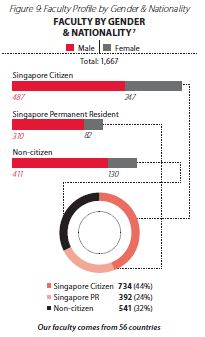
[Source: NTU report 2010]
Singapore citizens including new citizens form only 44 percent of the faculty.
The result is not surprising as there are an increasing number of foreigners being scouted from overseas as lecturers in both NUS and NTU in recent years.
The Temasek Review had earlier published stories about how Singapore PhD holders are being discriminated and disadvantaged by the local universities’ pro-foreigner hiring policies though the foreigners employed may not be necessarily better than them.
The emphasis on research and producing papers which are important criteria in the universities’ yearly rankings may have prompted them to cast their net overseas for established researchers who may not necessarily be good teachers.
In 2009, Associate Professor Michael Heng, from NTU’s School of Electrical and Electronic Engineering, wrote to the Straits Times alleging ’serious lapses’ in the process of awarding tenures to lecturers.
He said that in internal school meetings, faculty members were told by their Chairs that only research counted in the tenure review. They were told teaching and service to the university were not important, he said.
‘This is taxpayers’ money we are talking about, so this is of public interest,’ he added. (read more here)
Not too long ago, a NTU student wrote to us complaining about the heavy accent of some foreign lecturers:
“When I attend lectures, I want to understand the lecturers. Tell me, how can I understand if the lecturers cannot speak a proper English sentence without slaughtering the language? I pay to learn, not to be entertained by comical lecturers with funny accent and laughable grammar….I cannot understand why I have to repeat an extra year of schooling if I fail English and yet, NTU lecturers who fail English get paid 10-digit salaries to teach me.”
-
Letter from Li Yuren
http://imcmsimages.mediacorp.sg/CMSFileserver/documents/006/PDF/20110713/1307VOP025.pdfI TOTALLY agree with Mr Adrian
Ho’s letter “Review pay for
nurses” (July 12). I pay tribute
here to all nurses, local and foreign,
most of whom serve their
patients from their hearts and
keep mum when abused by the
patients and their relatives.
Months ago, a friend asked
me for help to scan his friend’s
documents for a job application.
I later happened to meet the
owner of the documents and
asked about her profession. She
was a nurse at a nursing home
who commanded a monthly
salary of S$430 and was given
only one day off every month.
I found this hard to believe,
so she showed me her employment
letter. I was shocked to
learn that the employer made it
mandatory for her to surrender
S$50 into a savings accounts.
Although her employer provided
foreign employees with
accommodation in the home’s
dormitory and allowed them
meals from the kitchen which
serves the patients, it made me
wonder about how one can, with
that sum left to her, manage to
tide over a month in a highcost
country like Singapore. In
order to support her family back
home, she persevered for nearly
three years.
On another occasion, I
went with a group of friends
to a nursing home to do voluntary
work. Some of the things I
observed gave me some insight
into the life of a nurse.
One nurse who could speak
basic Cantonese was trying to
coax a dementia patient into
taking her medication. After
45 minutes, the patient finally
opened her mouth for her
cough syrup — which she spat
in the nurse’s face and then
had a good laugh.
Amazingly, the nurse
reached for some tissue paper
and walked to the wash basin
to clean herself. Her eyes were
moist but she maintained her
composure.
She went back to the patient
and continued persuading
her to take her pills.
I gathered from the nurses
that such incidents and worse
are common: Foul-tempered
patients tipping bowls of hot
soup over nurses’ hands, or
hurling vulgarities at them.
Recently, that nurse whom
I assisted with her documents
called to thank me for helping.
She had received her endorsement
by the Singapore Nursing
Board and was granted a practising
licence, which led her to
a job with one of the medical
centres here that specialises in
gynaecology.
She was granted an S-Pass
and was overjoyed to be paid
S$1,300, a 202-per-cent pay increment.
What baffles me is the
actual remuneration she receives
and the stipulated minimum
fixed monthly salary of S$2,000
for S-Pass holders. Where does
the difference of S$700 go to?
I urge the relevant authorities
to look into a salary review
for nurses and the possible violation
of employment laws by
medical service providers. And
let us give nurses their due respect
the next time we visit
someone in the hospital.
-
NUS rejected my son – have to sell house to send him overseas
July 13th, 2011 | Author: ContributionsMy son had GCE ‘A’ 4 straight As with ‘S’ papers in his ‘A’-level but was rejected by NUS medicine. He applied and was accepted by many medical schools in the UK, USA, Australia and Ireland. He finally accepted one of the top medical schools in the UK.
I sold my house to support him and have the never regretted doing that. He is now in his clinical year and is happy with his life in the UK. He has also settled down well and has decided not to come back as he does not owe the govt anything. We have the government to thank for losing my only son to a foreign country.
Fairness
-
[Humour] - "Horny" a parody of Justin Beiber's "Baby"
-
http://sg.news.yahoo.com/blogs/singaporescene/tony-tan-favour-singaporeans-first-education-policy-060406055.html#mwpphu-container During my son's 3-year study in Temasek Poly, there were 5 FT students in his call. My son's results were mostly A or A-, except for 1 D. Whereas for these 5 FT students (3 PRCs, 1 Vietnamese & 1 Pinoy), they received on average B- or C+. For the result D, my son did not like the module as he has difficulty understanding his FT Indian lecturer - strange accent & weird pronounciation. After they graduated, all six of them applied for NTU for undergraduate study. And, do you know what??? All these 5 FT students got in into NTU, my son's application was rejected. I wrote in to find out, only to be given this reason: NTU will accept student with any D result even though his GPA score was much higher as compared to these 5 FT students. Anyway, NTU encouraged my son to keep on applying until application becomes successful. And, mind you that each application is not FOC, an admin fee has to be paid with each application. And, my son kept on applying & applying for the next 3 years, never successful & a waste of time!!! After much deliberation, I advised my son to apply to overseas universities. Yes, he did!!! Not only did his application was accepted by all these universities ( Australia National Uni, Uni of New South Wales, Uni of Queensland, Northwestern Uni, Cornell Uni, Massachusetts Institute of Technolo---- & St Andrew's Uni), he was given a scholarship by 2 universities. He chose ultimately The University of Queensland as the course there has more hands-on components & very much field relevant to his specialisation. He did very well throughout his study there & received a GPA score of 6.78 out of 7. Imagine a Singaporean boy who once got a D for his diploma & rejected 4 times by NTU, able to achieve this GPA score. He was placed under Dean's List & highly recommended to do his Honours. After his traumatic experience with NTU, he became very disillusioned with Singapore education system & decided not to come back to Singapore anymore. As mentioned by him rather seriously, he will not be coming back unless there is a change in the government. As for his 5 FT friends who had studied in NTU & heavily subsidized by Singapore taxpayers' $$$, they are no longer in Singapore as they succeed in finding better jobs elsewhere beyond Singapore's borders. Tony Tan, I put these questions for you to reflect with sincerity & impartiality: (1) In what ways have these 5 FT students contributed to Singapore's economy? (2) Why do your PAP colleagues (including yourself) make use the taxpayers' money to pay for these 5 FT students in NTU? (3) In your right mind as a politician, is this the way your PAP colleagues (including yourself) reject local talents without giving them even a chance to prove their economic worth to Singapore? (4) Do you think these driven-out local talents will ever come here again with you around as Elected President (if you are elected)? I rest my case!
-
A Teary Mother Bear Killed Her Baby and Committed Suicide ¨C A Heart Breaking True Story By Ingenira

Traps were laid in the wild illegally. When the bear was trapped, she lost not only her paws and four limbs for a good fortune of money, but she was locked up in the cage and had to endure daily torture of bile collection up to 25 or 30 years. This bile collection process requires a hole to be cut in the bear stomach and an iron pipe inserted into the bear gall bladder. Bile was then taken several times a day. The entire procedure was done without anaesthetic in order to save cost. The pain was excruciating. The bear could not bear it and attempted to kill herself by punching her stomach. However, human prevented this suicide act by forcing the bear to wear an iron vest. With this iron vest, her movement was restricted; committing suicide was an impossible task. A mother bear knew it too well. When the bear worker wanted to open up her cub¡¯s stomach, the mother bear broke open the cage and went after the cub. After failing to release the chained cub, she hugged the cub. The mother bear then killed the cub to save it from a life of hell.
Jason: extract length reduced on request from copyright owner
-
-
NTU Convocation 2011 Ceremony 14 Closing Speech
-
Dr Tony Tan's speech (in Mandarin)
-
Excerpts :
http://blogs.nature.com/news/2011/08/commission_condemns_guatamalan_1.html
Researchers knowingly violated ethical boundaries when they intentionally infected Guatamalan prisoners, mental health patients, and prostitutes with sexually transmitted diseases in a 1940s research project, a presidential commission concluded yesterday.
When the harrowing experiments came to light (see 'A shocking discovery'), President Barack Obama charged the President’s Commission for the Study of Bioethical Issues with investigating the matter. After picking through 125,000 pages of historical documents, the committee determined that the experiments were unethical even by the prevailing norms of the era, and that those who conducted the research actively sought to keep experiments out of the public eye.
It was also no accident that the research was performed in Guatemala, argued Amy Gutmann, chairwoman of the commission and president of the University of Pennsylvania. “Some of the people who were involved in this experiment explicitly said, ‘We could not do this in our own country’,” she said. “It was a foreign population that was seen as ethnically, racially, nationally different.”
“The only way you could continue doing this is to think of what you were working on as material as opposed to human subjects,” Gutmann added.
The work was also in clear opposition to ethical standards of the time, argued Nelson Michael, director of the US Military HIV Research Program. “I’m not aware of any standards that would have said, ‘it’s ok to go offshore to do this kind of research’,” he said. “They did it because they found a doorway that they found darkened and they went through it.”
Sexually transmitted diseases, including gonorrhea and syphilis, were among the biggest threats to public health at the time. It was estimated that 20% of the people living in psychiatric institutions were there because of the neurological effects of advanced syphilis. The researchers in the Guatemalan study, which included John Cutler, an architect of the Tuskegee syphilis experiments, were looking for a way to prevent the spread of such diseases. But despite that sense of urgency, the studies carried out in Guatemala were poorly designed, poorly executed, and entirely unethical, the commission concluded.
All told, the commission found that more than 5,000 people were enrolled in either or both of the programme’s two research arms: one in which prisoners, the mentally ill, and prostitutes were intentionally infected via injections with syphilis and gonorrhea, and another in which blood and spinal fluid was tested for background levels of the infectious agents. The latter studies were also conducted in young Guatemalan orphans. All of the experiments were performed without consent of the subjects.
The commission found evidence of at least 83 deaths, but could not determine to what extent the deaths were likely to be related to the experiments.
The committee is still writing up its conclusions, and plans to submit a report on the historical study to Obama in September. It will also prepare a second report – following a probe into the adequacy of current policies to protect human research subjects – by the end of the year.
John Arras, a philosopher at the University of Virginia, said that he initially struggled with the decision over whether the researchers deserved blame for the ethical transgression. But the details of the experiments wiped away any doubt, he added.
Arras then detailed the stomach-churning case of Berta, a patient in a psychiatric ward who was deliberately injected with syphilis and not given treatment until three months after her infection. Soon after, Cutler wrote that Berta seemed about to die from the syphilis they infected her with. That same day, he inserted gonorrheal pus from another patient into both of her eyes, her urethra, and her rectum. He also re-injected her with more syphilis. Several days later, her eyes were filled with pus from the gonorrhea and she was bleeding from her urethra.
“I would submit that this kind of case cannot be waved away by even the most acute awareness of fluctuation in medical ethics standards of the time,” Arras said.
------------------------------------http://www.nytimes.com/2011/08/31/world/americas/31syphilis.html
Gruesome details of American-run venereal disease experiments on Guatemalan prisoners, soldiers and mental patients in the years after World War II were revealed this week during hearings before a White House bioethics panel investigating the study’s sordid history.
About 5,500 Guatemalans were enrolled, about 1,300 of whom were deliberately infected with syphilis, gonorrhea or chancroid. The stated aim of the study was to see if penicillin could prevent infection after exposure. But the study’s leaders changed explanations several times.
“This was a very dark chapter in the history of medical research sponsored by the U.S. government,” Amy Gutmann, the chairwoman of the bioethics panel and the president of the University of Pennsylvania, said in an interview.
President Obama apologized to President Álvaro Colom of Guatemala for the experiments last year, after they were discovered.
Since then, the panel, the Presidential Commission for the Study of Bioethical Issues, has studied 125,000 pages of documents and has sent investigators to Guatemala. While the panel will not make its final report until next month, details emerged in hearings on Monday and Tuesday.
The most offensive case, said John Arras, a bioethicist at the University of Virginia and a panelist, was that of a mental patient named Berta.
She was first deliberately infected with syphilis and, months later, given penicillin. After that, Dr. John C. Cutler of the Public Health Service, who led the experiments, described her as so unwell that she “appeared she was going to die.” He then inserted pus from a male gonorrhea victim into her eyes, urethra and rectum. Four days later, infected in both eyes and bleeding from the urethra, she died.
“I really do believe that a very rigorous judgment of moral blame can be lodged against some of these people,” Dr. Arras said.
Also, several epileptic women at a Guatemalan home for the insane, were injected with syphilis below the base of their skull. One woman became completely paralyzed for two months by syphilitic meningitis.
Dr. Cutler said he was testing a theory that the injections could cure epilepsy.
Poor, handicapped or imprisoned Guatemalans were chosen because they were “available and powerless,” said Anita L. Allen, a bioethicist at the University of Pennsylvania’s law school and a panelist.
Dr. Cutler’s team took pains to keep its activities hidden from what one of the researchers described as “goody organizations that might raise a lot of smoke.”
Members of the bioethics commission recalled Nazi experiments on Jews and said that Dr. Cutler, who died in 2003, must have known from the Nuremberg doctors’ trials under way by 1946 that his work was unethical.
Also, according to Dr. Gutmann, Dr. Cutler had read a brief article in The New York Times on April 27, 1947, about other syphilis researchers — one of them from his own agency — doing tests like his on rabbits. The article stated that it was “ethically impossible” for scientists to “shoot living syphilis germs into human bodies.” His response, Dr. Gutmann said, was to order stricter secrecy about his work.
-
NameWee has recently produced and directed his movie, Nasi Lemak 2.0. A journalist writes in the newspaper, "I heard the movie is entertaining, but I refuse to watch it because NameWee has in the past insulted Malays and Malaysia."
This pissed NameWee off, and he retorts the journalist in this YouTube video. Note : The dialogue is in Malay, with Chinese subtitiles.
http://www.youtube.com/watch?feature=player_embedded&v=t5d0eqBqra8 -
Horrifying and sad. The van was a hit-and-run. And as she lay dying, dozens of passer-bys ignored her. Watch the video.
http://www.youtube.com/watch?v=1K2z-5_X2Js&feature=player_embedded
May the girl receive all the medical and emotional healing she needs. It is still unknown if she will survive the ordeal.

 Author: