Vectors question.
-
I need some help regarding on vectors. I really appriciate help from all.

Q1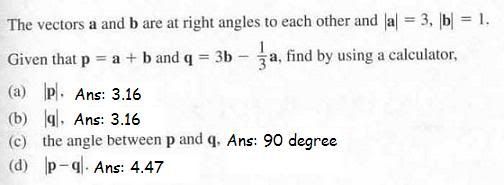
Q2
Q3
Q4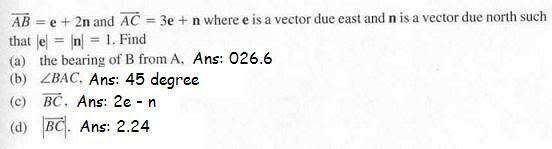
-
Q1 hint: think of a and b as x-axis i and y-axis vectors j.
-
Q1)
a) use pygathoras theorem. U can estimate p by sketching, and you will find that a and b are 90 degrees. Hence a right angled triangle.
Ans = sqrt (3^2 + 1^2) = 3.16
b) same method as a)
c) use p.q = mod p mod q cos teta
(a + b).(3b - 1/3a)
= 3 b.b - 1/3 a.a (a.b=0)
= 3 - 3 (b.b = 1, a.a = 9)
= 0
hence 90 degrees
d)
p-q = 4/3 a - 2b
Hence use same method as a and b
Ans = sqrt(16/9 + 4) = 2.40 (I'm pretty sure ans is wrong) -
Q2)
a)
start from O
[1/2 a] means 1 square horizontal towards right
2b means diagonal upwards for 2 squares towards right
-2c means move 4 squares downwards
Hence, if you follow the motions starting from O, you reach the bottom right point (the bottommost)
b)
understand a and try again =D
This is simple vectors
c)
i) EF = a + 3c
ii) EF = 2b + 2c
hence, a+3c = 2b + 2c
a = 2b - c
which should already be obvious from the OA, OB and OC
But they asked "Hence", thus we need to derive from EF -
1a) q = a + b
using pytogoras therom,
|q| square = |a| square + |b|square
|q| = squ root of (9+1)
= 3.16
b) Use the same tatics as Q(1a)
c) Use q.p = |q||p|cosQ ... where Q is the angle of q, p
d) Use the same tatics as Q(1a) -
lol... nm... eagle solve fast sia...
go jogging liao... -
Q3)
a) p + q (you should know how)
b) -q + r
c) AOE is right angled triangle
since OABC and OCDE are rhombuses, |r| = |q| = |p| = 2
Hence, |AE| = sqrt (2^2 + 2^2) = 2.83 -
Tamago~ I don't get the hint

Eagle.. I understand Q1 (a) & (b) already..
But I don't understand leh for part Q1 (c) and (d).. The above are O level questions. I haven't learnt -
Oh I see.. I understand le!Originally posted by eagle:Q3)
a) p + q (you should know how)
b) -q + r
c) AOE is right angled triangle
since OABC and OCDE are rhombuses, |r| = |q| = |p| = 2
Hence, |AE| = sqrt (2^2 + 2^2) = 2.83
-
Q4)
a)
Draw a triangle. 1 unit right and 2 units up (A to B)
then u get a right angled triangle
calculate angle of bottom left angle
tan inverse 2 = 63.4 degrees
But we need to find bearings (angle from vertical line),
so take 90 degrees - 63.4
Ans: 90 - 63.4 = 26.6
b)
on your same diagram, starting from A, go 3 units right and 1 unit up (A to C)
You find that angle BAC = the angle of 63.4 degrees in (a) minus the angle of the bottom left angle of the right angled triangle formed by C and A
So we need to find the bottom left angle of the new triangle first, which is
tan inverse 1/3 = 18.4 degrees
Hence, angle BAC = 63.4 - 18.4 = 45 degrees
c)
BC = BA + AC = AC - AB = 2e - n
d)
Sketch out BC separately. 2 units right and 1 unit down
You will find that it is again another right angled triangle
Then |BC| = sqrt (2^2 + 1^2) = 2.24 -
Thx eagle!Originally posted by eagle:Q2)
a)
start from O
[1/2 a] means 1 square horizontal towards right
2b means diagonal upwards for 2 squares towards right
-2c means move 4 squares downwards
Hence, if you follow the motions starting from O, you reach the bottom right point (the bottommost)
b)
understand a and try again =D
This is simple vectors
c)
i) EF = a + 3c
ii) EF = 2b + 2c
hence, a+3c = 2b + 2c
a = 2b - c
which should already be obvious from the OA, OB and OC
But they asked "Hence", thus we need to derive from EF -
p.q is call the dot product of p and qOriginally posted by Darkness_hacker99:Tamago~ I don't get the hint
Eagle.. I understand Q1 (a) & (b) already..
But I don't understand leh for part Q1 (c) and (d).. The above are O level questions. I haven't learnt
In short,
p.q = |p||q| cos teta, where teta is the angle between the vectors p and q
In the case where teta = 90 degrees, cos teta = 0
Hence when 2 vectors are perpendicular, p.q = 0
When 2 vectors are parallel (teta = 0 degrees), p.q = |p||q|
This is the basics of vectors
-
since both vectors are at right-angle it may seem better to visualise it as x and y-axis. but just visualise lah.Originally posted by Darkness_hacker99:Tamago~ I don't get the hint 
-
Originally posted by ispyyy:lol... nm... eagle solve fast sia...
go jogging liao...
I did till F maths and maths S vectors last time with no problems... But I think I have forgotten a lot...
Ah... thinking of my JC times... now I so stupid liao
-
Originally posted by eagle:p.q is call the dot product of p and q
In short,
p.q = |p||q| cos teta, where teta is the angle between the vectors p and q
In the case where teta = 90 degrees, cos teta = 0
Hence when 2 vectors are perpendicular, p.q = 0
When 2 vectors are parallel (teta = 0 degrees), p.q = |p||q|
This is the basics of vectors This is new to me.. O level don't have..
When learning the basics of vectors, there are actually alot to learn within the basic. -
Yeah, and eagle is still faster than me in solving the questions above.Originally posted by eagle:
I did till F maths and maths S vectors last time with no problems... But I think I have forgotten a lot...
Ah... thinking of my JC times... now I so stupid liao -
ewww o lvls stuff...
-
Yup! Then use pythagoras thoem to solve..Originally posted by ^tamago^:since both vectors are at right-angle it may seem better to visualise it as x and y-axis. but just visualise lah. -
Yes!Originally posted by Darkness_hacker99:Yup! Then use pythagoras thoem to solve.. -
Originally posted by eagle:Q4)
a)
Draw a triangle. 1 unit right and 2 units up (A to B)
then u get a right angled triangle
calculate angle of bottom left angle
tan inverse 2 = 63.4 degrees
But we need to find bearings (angle from vertical line),
so take 90 degrees - 63.4
Ans: 90 - 63.4 = 26.6
b)
on your same diagram, starting from A, go 3 units right and 1 unit up (A to C)
You find that angle BAC = the angle of 63.4 degrees in (a) minus the angle of the bottom left angle of the right angled triangle formed by C and A
So we need to find the bottom left angle of the new triangle first, which is
tan inverse 1/3 = 18.4 degrees
Hence, angle BAC = 63.4 - 18.4 = 45 degrees
c)
BC = BA + AC = AC - AB = 2e - n
d)
Sketch out BC separately. 2 units right and 1 unit down
You will find that it is again another right angled triangle
Then |BC| = sqrt (2^2 + 1^2) = 2.24
Thanks!!!
The question look complicated, but after breaking into smaller pieces it look very simple! -
yepOriginally posted by Darkness_hacker99: This is new to me.. O level don't have..
When learning the basics of vectors, there are actually alot to learn within the basic.
My way of solving all the questions is just to use the basics to derive the formulas (for F maths), and then solve it when I do all my tutorials
Only for exams do I memorize the formulas to increase my speed... which was still rather unnecessary -
I find eagle very knowledgabe..Originally posted by eagle:
I did till F maths and maths S vectors last time with no problems... But I think I have forgotten a lot...
Ah... thinking of my JC times... now I so stupid liao 
-
u r wrong. This is only simple stuff.... And I once tutored a few O level students before... so all these stuff are well in my headOriginally posted by Darkness_hacker99:I find eagle very knowledgabe.. -
Originally posted by eagle:u r wrong. This is only simple stuff.... And I once tutored a few O level students before... so all these stuff are well in my head Not bad.. Keep up the good job.
-
.........Originally posted by Darkness_hacker99: Not bad.. Keep up the good job.
I just help whenever I can that's all.... It's not a job...
I'm sure many others like to help too =D