Chemistry
-
Mg + H2SO4 -> MgSO4 + 2H
Why is the above not H2 but 2H ?
Need to clear my doubts. Thanks. -
cos it's a very slow reaction?

-
dilute acid + metal -----> salt + hydrogen (H2)
if im not wrong (although i think confirm wrong), hydrogen exists as a diatomic molecule -
but it looks like a confirmed case of H2(g)
-
Why H2? Thanks.
-
turns into gas lor.
-
Yeah I know ... but doesn't those in aqueous solution turns to ion ??
-
because H- ma. If H2, should be H20 cos the O contribute positive ion lor.
-
Sorry but I don't understand.. care to explain it in simpler terms ?Originally posted by LyonK:because H- ma. If H2, should be H20 cos the O contribute positive ion lor. -
no. the 2 H+ ions will be reduced by the electron-donating Magnesium atoms.Originally posted by dbowie:Yeah I know ... but doesn't those in aqueous solution turns to ion ?? -
Originally posted by LyonK:because H- ma. If H2, should be H20 cos the O contribute positive ion lor.

-
Really tammy jie ... I dun understand .....Originally posted by ^tamago^:no. the 2 H+ ions will be reduced by the electron-donating Magnesium atoms. -
erm. i dun understand LyonK too.Originally posted by dbowie:Really tammy jie ... I dun understand ..... 
-
I think I get what he means but I am not sure if he's correct ..Originally posted by ^tamago^:erm. i dun understand LyonK too. -
It is a balancing equation

-
it is 2H+. aqueous Hydrogen.Originally posted by dbowie:Mg + H2SO4 -> MgSO4 + 2H
Why is the above not H2 but 2H ?
Need to clear my doubts. Thanks.
actually it is H3O+ but i assume u are in sec sch, and haven learn the hydronium ion yet -
But then why in practical lesson
2K + 2H2O -> 2KOH + H2
Why is it H2 ?
Need clarifications, thanks .. -
Looks like we need to recruit more chemistry pros.

-
Originally posted by dbowie:But then why in practical lesson
2K + 2H2O -> 2KOH + H2
Why is it H2 ?
Need clarifications, thanks ..
yea i think this is the answer...cus when u balance the equation u put the 2 infront...u cant put it behind the HOriginally posted by LyonK:It is a balancing equation -
Acid + Metal = Salt + HydrogenOriginally posted by dbowie:But then why in practical lesson
2K + 2H2O -> 2KOH + H2
Why is it H2 ?
Need clarifications, thanks ..
Hydrogen is H2 loh... -
This is fundamentalLy wrong.Originally posted by dbowie:Mg + H2SO4 -> MgSO4 + 2H
Firstly, according to the law of conservation of charge, there's no way that u can have 2H+ surviving on the right hand side while the left hand side has no total charge of +2.
Secondly, the only possible way for 2H to exist is when the whole reaction is done in gaseous state at high temperatures (ie the hydrogen is atomised), else it is almost impossible for hydrogen to exist as monoatoms. They preferentially exist as H2 at room temperature and pressure.
Thirdly, if this is an ionic equation in aqueous medium, the equation is wrong. It should be Mg(s) + 2H+ (aq) -> Mg2+ (aq) + H2 (g) as (SO4)2- is a spectator ion since magnesium sulphate is soluble and remains in solution with no chance in state.
Hence my only logical conclusion is that the above equation is wrong. For O/A levels, the correct equation should be Mg + H2SO4 -> MgSO4 + H2 and NEVER write H2 gas as 2H. Perhaps it was copied wrongly or a printing error.
As such, may I ask where is the source of this equation so that I could perhaps reach a better conclusion?
*EDIT*
To add on, for a metal + acid reaction, hydrogen gas is ALWAYS released and it DOES NOT remain in the solution as H+ ions.
Of course some may argue that H2 gas may exist in an equilibrium with H+ ions in the presence of water but that is STRICTLY OUT OF TOPIC AND DON'T BOTHER ABOUT IT FOR O/A LEVELS.
*ENDS EDIT*
Thanks and cheers for your mugging!
-
Deleted.
-
It could be TS mixed up this two already.
The one above the is chemical equation.
While is one below is one of the equation deriving Ionic equation. Because at O level, you'll need to 'split' up the aqueous compound and find out the reacting chemicals.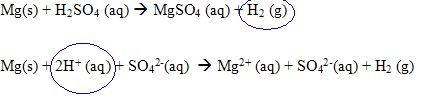
-
Yup very possible.
Time to unlearn and relearn. -
yeah, i was also wondering how it could remain as 2H when it accept the electrons from Mg.