Help required:
-
Question 1
Methane is sometimes used as a fuel for cooking. The complete combustion of one mole of methane produces 882 KJ of heat.
Part 1: Construct an equation for this combustion. (This one I know)
Part 2: What is the mass of methane required to produce 1323 KJ of heat?
Part 3: What is the amount of heat produced if 12 dm(cubed) of carbon dioxide is evolved at r.t.p. in the combustion of methane?
Question 2
Propane is a versatile energy source that has several residential, commercial and industrial uses. The combustion of propane produces a substantial amount of heat energy.
C3H8 + 5O2 --> 3CO2 + 4H2O
Calculate the enthalpy change of the reaction given that an overall of 1109.5 KJ of heat is produced and that 66g of CO2 is evolved in the combustion of propane.
Question 3
The equation for the combustion of methanol is as follows:
CH3OH + 3/2O2 --> CO2 + 2H2O
What is the volume of oxygen required at r.t.p. for the combustion of methanol to produce 1452 KJ of heat? (Overall energy change = -726 KJ)
~ Please help... keep getting stuck without any solutions. ~
~ -
Q1i)

Q1ii)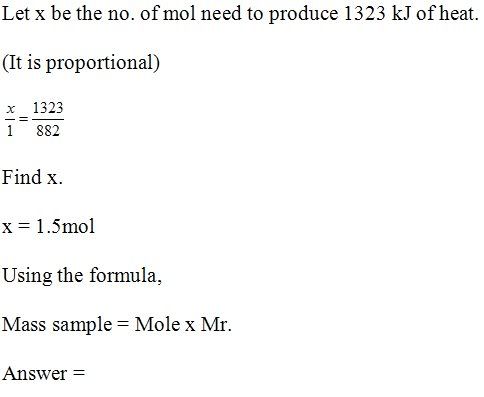
Q1iii)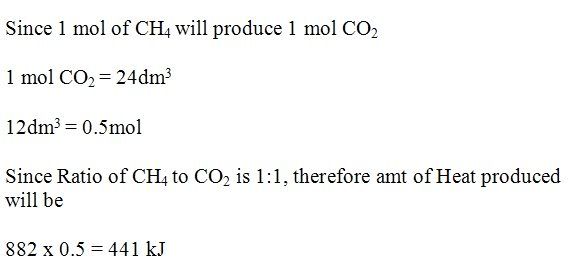
-
Thanks!

Can someone explain to me how are the bonds broken in question 2?
-
Wait ar.. I just woke up from my nap.. Very blur.. Engine haven't start yet..Originally posted by Oceane:Thanks!
Can someone explain to me how are the bonds broken in question 2? 
Let me confirm the Q1 with my counterparts first. -
Q2 Reserved.
-
Q3. Similar to Q1.
1.5mol of Oxygen produces 726 kJ of heat.
twice it.
3mol of Oxygen will produce 1452 kJ of heat.
Volume of 3 mol of Oxygen = No. of mol x Constant of gas
3 x 24dm^3 = 72dm^3 -
Thanks man.Originally posted by Darkness_hacker99:Q3. Similar to Q1.
1.5mol of Oxygen produces 726 kJ of heat.
twice it.
3mol of Oxygen will produce 1452 kJ of heat.
Volume of 3 mol of Oxygen = No. of mol x Constant of gas
3 x 24dm^3 = 72dm^3
Another question: What are the bonds broken in the reaction of Methane with Chlorine, and what are the bonds formed in the same reaction?
Equation is: CH4 + 4Cl2 --> CCl4 + 4HCl
Thanks.
-
I dunno if I use this illustration will you understand anot..Originally posted by Oceane:Thanks man.
Another question: What are the bonds broken in the reaction of Methane with Chlorine, and what are the bonds formed in the same reaction?
Equation is: CH4 + 4Cl2 --> CCl4 + 4HCl
Thanks.
On the left, bonds are broken.. Then join back on the right as new products.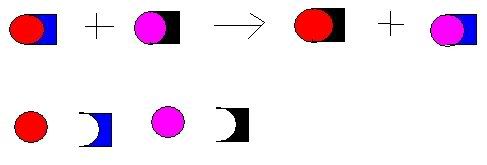
-
Edited.
-
Thanks.Originally posted by Darkness_hacker99:I dunno if I use this illustration will you understand anot..
On the left, bonds are broken.. Then join back on the right as new products. -
Any idea yet?Originally posted by Darkness_hacker99:Q2 Reserved. -
OK to sum it up... these are the 2 questions left that I require help:
A: Propane is a versatile energy source that has several residential, commercial and industrial uses. The combustion of propane produces a substantial amount of heat energy.
C3H8 + 5O2 --> 3CO2 + 4H2O
Calculate the enthalpy change of the reaction given that an overall of 1109.5 KJ of heat is produced and that 66g of CO2 is evolved in the combustion of propane.
B: 51.5 kJ of heat was absorbed in the dissociation of HBr to give hydrogen and bromine with the evolution of 80g of gaseous bromine.
2HBr --> H2 + Br2
Calculate the bond energy of the H-Br bond. -
No full solutions but I shall give you guide to solving the question:Originally posted by Oceane:OK to sum it up... these are the 2 questions left that I require help:
A: Propane is a versatile energy source that has several residential, commercial and industrial uses. The combustion of propane produces a substantial amount of heat energy.
C3H8 + 5O2 --> 3CO2 + 4H2O
Calculate the enthalpy change of the reaction given that an overall of 1109.5 KJ of heat is produced and that 66g of CO2 is evolved in the combustion of propane.
B: 51.5 kJ of heat was absorbed in the dissociation of HBr to give hydrogen and bromine with the evolution of 80g of gaseous bromine.
2HBr --> H2 + Br2
Calculate the bond energy of the H-Br bond.
A -> enthalpy change of the reaction = enthalpy change per 'mole' of reaction
Therefore, 66g of CO2 = how many moles of CO2? Let this answer be A1
From A1, you calculate the no. of 'moles' of the reaction (A2). A2 moles of reaction gives off 1109.5 KJ of heat, so 1 mole of reaction gives of? (1/A2 x 1109.5 KJ)
Ans: -2219 KJ per mole (3sf)
B-> As per question A. 80g of Br2 = how many moles of Br2? (B1).
From B1, you can thus calculate the no. of 'moles' of reaction (B2).
Ok next, the net enthalpy change of the reaction = bonds formed - bonds broken. In this case, you form B2 amounts of H-H and B-B bonds when you break 2 x B2 amounts of H-Br bonds.
For your info, B.E. of H-H = 436 kj per mole, B.E. of Br-Br = 193 kj per mole.
Therefore, enthalpy change = BE[H-H] + BE[Br-Br] - 2xBE[H-Br]
Rearranging, 2xBE[H-Br] = BE[H-H] + BE[Br-Br] - enthalpy change
So in this case, 2 x B2 x BE[H-Br] = B2 x BE[H-H] + B2 x BE[Br-Br] - (+51.5 kj per mole)
Sub in the values of B2 and manipulate to get your answer.
Answer: +263 kj per mole (differs from the data booklet value of +366 kj per mole though)